
A Dallas IT manager usually sees the problem before anyone else does. The new VoIP rollout is finished, the WAN edge has been refreshed, the switches in the MDF have been replaced, and now the retired handsets, routers, optics, and line cards are sitting in a locked room with no owner and no plan.
That pile is more than clutter. It can hold resale value, regulated data, and avoidable environmental risk at the same time. Businesses searching for telecom equipment buyers Dallas often start by looking for the highest bid. In practice, the better question is simpler: who can help you move the equipment out securely, document everything properly, and recover value without creating a compliance problem later.
Your Dallas Business and the Telecom Upgrade Cycle
Dallas businesses retire telecom hardware faster than many teams expect. Voice platforms move from legacy systems to VoIP. Branches consolidate hardware. Data center and carrier-adjacent environments replace older network gear on a rolling schedule. The result is constant churn.
That churn isn't happening in a small market. The global telecom equipment market was projected to reach USD 695.72 billion in 2026, driven by 5G deployments, according to Mordor Intelligence's telecom equipment market analysis. For Dallas companies, that scale shows up locally as more upgrade activity, more decommissions, and more surplus equipment moving into the secondary market.

Dallas also has a practical advantage. The city sits in a strong telecom and enterprise ecosystem, so there are multiple paths for retired gear. Some companies want cash recovery. Others need secure IT asset disposition (ITAD), responsible electronics recycling, or a structured plan for a broader office cleanout.
What usually goes wrong
Most loss happens before a buyer ever sees the lot. Teams mix scrap with resale units. They don't capture serial numbers. They assume a factory reset is enough. They wait until facilities needs the room cleared by Friday.
When that happens, buyers price defensively. Your internal team scrambles. Documentation gets thin.
Practical rule: If the gear has already been unplugged, stacked, and forgotten for six months, assume you need to rebuild the asset record before you ask for quotes.
A better process starts earlier, ideally while the upgrade project is still active. If you're planning infrastructure changes, this local guide to telecom infrastructure services in Dallas is a useful companion because it connects upgrade planning with the retirement problem many teams leave until the end.
Why telecom transitions need a different mindset
Telecom equipment doesn't behave like ordinary office surplus. A desk phone may store directories and call history. A switch can hold configuration files. A router or firewall may contain credentials, logs, and network architecture details. Some assets still have resale demand. Others are only suitable for commodity recycling or parts harvesting.
Businesses making broader voice changes can also benefit from implementation perspectives outside the U.S. market. This guide to an Australian hosted PBX phone system setup is worth a look because it highlights the operational side of moving away from traditional landlines, which often triggers the disposal decision in the first place.
The disciplined approach is straightforward. Inventory first. Value second. Security controls before pickup. Partner selection after that. Logistics and paperwork at the end.
Create a Comprehensive Asset Inventory
The fastest way to lose money on retired telecom hardware is to describe it vaguely. “Several pallets of phones and switches” tells a buyer almost nothing useful. It signals uncertainty, and uncertainty lowers offers.
An inventory fixes that. It gives your team control over the transaction and sets the baseline for valuation, chain of custody, and internal approval.
Start with device-level detail
A workable inventory doesn't need fancy software. A spreadsheet is enough if it's complete and maintained carefully. What matters is consistency.
For each asset, capture:
- Manufacturer and exact model. “Cisco switch” isn't enough. The full model determines market interest and support status.
- Serial number. This is the anchor for chain of custody and buyer verification.
- Asset tag or internal ID. Useful when your accounting or facilities team tracks items differently from IT.
- Physical condition. Note cracked housings, broken ports, missing faceplates, corrosion, bent rack ears, or heavy cosmetic wear.
- Functional status. Mark untested, powers on, passes basic boot, or known fault.
- Included components. Handsets, power adapters, rack rails, transceivers, power supplies, antennas, and licenses all affect disposition.
- Location. MDF, IDF, branch office, storage cage, warehouse shelf, or user area.
- Data risk notes. Flag items that may store settings, logs, directories, or credentials.
Build the manifest before requesting quotes
This part is essential. If you ask for bids before the manifest is clean, you invite low estimates, change orders, or rejected pickups later. Strong buyers compare your list against what they can realistically test, remarket, or recycle. If your list is incomplete, they price the lot for worst-case handling.
A useful reference on process discipline is this article on why IT inventory audits matter before recycling. The same logic applies to telecom gear. Count first. Verify second. Move third.
Measure twice, move once. Asset disposition works the same way as infrastructure work. The teams that slow down for the manifest usually finish the project faster.
Separate by practical categories
Don't keep one giant undifferentiated list if the lot is mixed. Break it into working groups your finance, IT, and facilities teams can understand quickly.
A simple example:
| Category | Typical items | Why it matters |
|---|---|---|
| Network core and edge | Routers, switches, firewalls, optics | Often highest scrutiny for config data and value |
| Voice equipment | VoIP phones, gateways, PBX components | Commonly large in volume, mixed in value |
| Wireless and access | Access points, controllers, antennas | Often bundled with mounts and injectors |
| Power and support gear | UPS units, power supplies, shelves | May shift toward recycling depending on age |
| Scrap and damaged | Broken units, incomplete devices | Prevents overstating lot value |
Document what a buyer will ask anyway
Experienced telecom equipment buyers Dallas teams will ask the same questions every time. Save the back-and-forth and answer them in your manifest from the start.
Include notes like:
- Are the units palletized or still installed?
- Have any items been tested after decommissioning?
- Are accessories matched to the parent unit or mixed loosely in boxes?
- Are there export restrictions, internal approval steps, or site access limitations?
- Does the lot include data-bearing devices requiring secure handling?
The better your file, the more credible your quote request becomes.
Use inventory as a cross-functional control
Inventory isn't only for the buyer. It keeps your internal teams aligned. Finance wants disposition records. Security wants documented custody. Sustainability leaders want proof that assets didn't go into general waste streams. Facilities wants the room cleared on schedule.
For teams trying to mature internal controls, the framework in this piece on IT asset management for Philippine businesses is useful because the core discipline translates well across regions. Assets lose value and traceability when nobody owns the record.
A clean inventory turns a messy retirement project into a manageable one. It also exposes the next decision clearly: what is this equipment worth?
How to Accurately Evaluate Equipment Value
Not every retired telecom asset deserves the same path. Some units belong in the resale channel. Some are better suited for donation or component harvesting. Others are end-of-life material that should move straight into responsible recycling.
The mistake is treating everything as if it has the same value profile. It doesn't.

Use a three-stage valuation method
A disciplined valuation process is more accurate than a quick visual estimate. Research cited by Beyond Surplus on network equipment buyers in the USA describes a structured three-stage method: device-to-model matching with serial number documentation, remarketable versus scrap separation, and disposition-path assignment before external transactions. That same source notes reactive handling correlates with 20-30% higher total cost of ownership and that organizations using device-level tracking and structured valuation achieve 15-25% higher net recovery than those submitting unvetted bulk lots.
That matters because telecom lots often contain hidden drag. Missing power supplies. Unsupported modules. Damaged ports. Mixed accessories. All of that reduces recoverable value if it isn't identified before the buyer does.
What usually drives value
A buyer's valuation is rarely about one factor. It's a stack of practical considerations.
- Market demand. Equipment tied to active replacement cycles or supported environments tends to draw more interest.
- Completeness. A phone with the correct stand and power supply is easier to remarket than a bare handset in a mixed bin.
- Testability. Units that can be verified move more easily than untested lots.
- Condition. Cosmetic damage doesn't always kill value, but broken ports and missing components do.
- Lot quality. Uniform lots are easier to process than mixed pallets of unrelated models.
- Logistics cost. Remote pickups, poor packing, and site restrictions all affect net offers.
Secondary listings are directional, not definitive. A single item advertised online is not the same thing as a bulk lot a professional buyer has to sort, test, pack, and warranty.
Sort assets into three value buckets
Many internal teams find their momentum here. You don't need a perfect price for every unit on day one. You need the right lane for each type of equipment.
| Bucket | Typical characteristics | Common disposition path |
|---|---|---|
| Resale candidates | Complete, identifiable, functional, marketable | Buyback or resale |
| Reuse or parts | Functional but lower-demand, mixed condition, incomplete | Donation, harvesting, selective resale |
| End-of-life | Damaged, obsolete, nonfunctional, poor documentation | Certified recycling |
The point isn't to force every item into resale. The point is to avoid throwing recoverable assets into scrap, or wasting labor trying to sell units that have no practical secondary demand.
What doesn't work
Using online asking prices as your benchmark doesn't work well for business lots. Those listings ignore labor, testing failure rates, packing costs, and post-sale support. They also ignore one hard truth: the buyer is taking operational risk that your internal team no longer wants.
A better negotiation position comes from lot quality, not optimism. If your manifest is clean and your categories are accurate, buyers can make firmer offers with less discounting built in.
The most successful projects I see follow a simple rule. They value the lot before they market the lot. That one sequencing choice usually changes the outcome more than shopping the same vague list to ten different buyers.
For organizations exploring cash recovery options alongside recycling, reviewing money for old electronics programs can help frame where resale, buyback, and recycling diverge in practical applications.
Ensure Ironclad Data Security and Regulatory Compliance
A telecom device can look harmless and still create a serious security problem. VoIP phones may hold directories and call history. Switches and routers can retain startup configs, credentials, management IP details, and network topology clues. Session border controllers, gateways, and related appliances can contain even more sensitive information.
That is why data handling has to sit at the center of any telecom disposition plan. Not beside it.
Verification matters more than promises
A buyer saying “we wipe data” isn't enough. Businesses need evidence. A 2025 Gartner report found 68% of mid-sized firms in major U.S. markets like Dallas cite data wiping verification as a top ITAD concern, yet few regional buyers advertise audited chain-of-custody reports. The same cited source notes improper e-waste disposition led to $2.5M in fines across 15 Texas cases in 2024-2025, as summarized in Andover Consulting Group's Dallas liquidators page.
Those numbers should change how you evaluate telecom equipment buyers Dallas providers. A vague process is a risk signal. A missing custody record is a risk signal. No certificate of destruction is a risk signal.
Know the difference between reset, sanitization, and destruction
Many teams still confuse a factory reset with verified sanitization. They are not the same thing.
- Factory reset removes user-facing settings but may not meet your internal or regulatory standard.
- Sanitization aligned with standards such as NIST 800-88 is a controlled process intended to clear or purge data appropriately.
- Physical destruction is often the right choice when the device is damaged, storage media can't be reliably sanitized, or policy requires irreversible destruction.
The right method depends on the equipment and your risk posture. The wrong method is guessing.
If a device ever touched your production network, treat it as sensitive until documented sanitization or destruction says otherwise.
Require an auditable chain of custody
A secure process should answer basic questions without hesitation:
- Who took possession of the equipment?
- When did it leave the site?
- How was it transported?
- Where was it processed?
- Which serial-numbered assets were wiped, destroyed, resold, or recycled?
- What certificates or final reports were issued?
Without that record, a “secure disposal” claim is only a statement. It isn't proof.
Many businesses widen their criteria beyond simple buyers. They need a partner with documented controls, not just a truck and a quote. If secure handling is part of your scope, review what's involved in secure data destruction services before you commit to any pickup.
Compliance and sustainability are linked
Some teams separate compliance from sustainability. In practice, they overlap. Responsible electronics recycling isn't responsible if data-bearing devices leave your control without documented treatment. A sustainability report is weaker if you can't prove lawful, traceable disposition.
Strong programs build both outcomes into one operating model:
| Requirement | What good looks like |
|---|---|
| Data handling | Verified sanitization or destruction |
| Documentation | Asset-level reports and certificates |
| Custody | Recorded transfer from site to processor |
| Environmental handling | No landfill shortcuts, proper downstream processing |
| Internal governance | Records suitable for audit and policy review |
The safest telecom disposition plans assume scrutiny. If legal, IT, security, or procurement asks for the record a year later, you should be able to produce it quickly.
Vetting and Choosing Your Dallas ITAD Partner
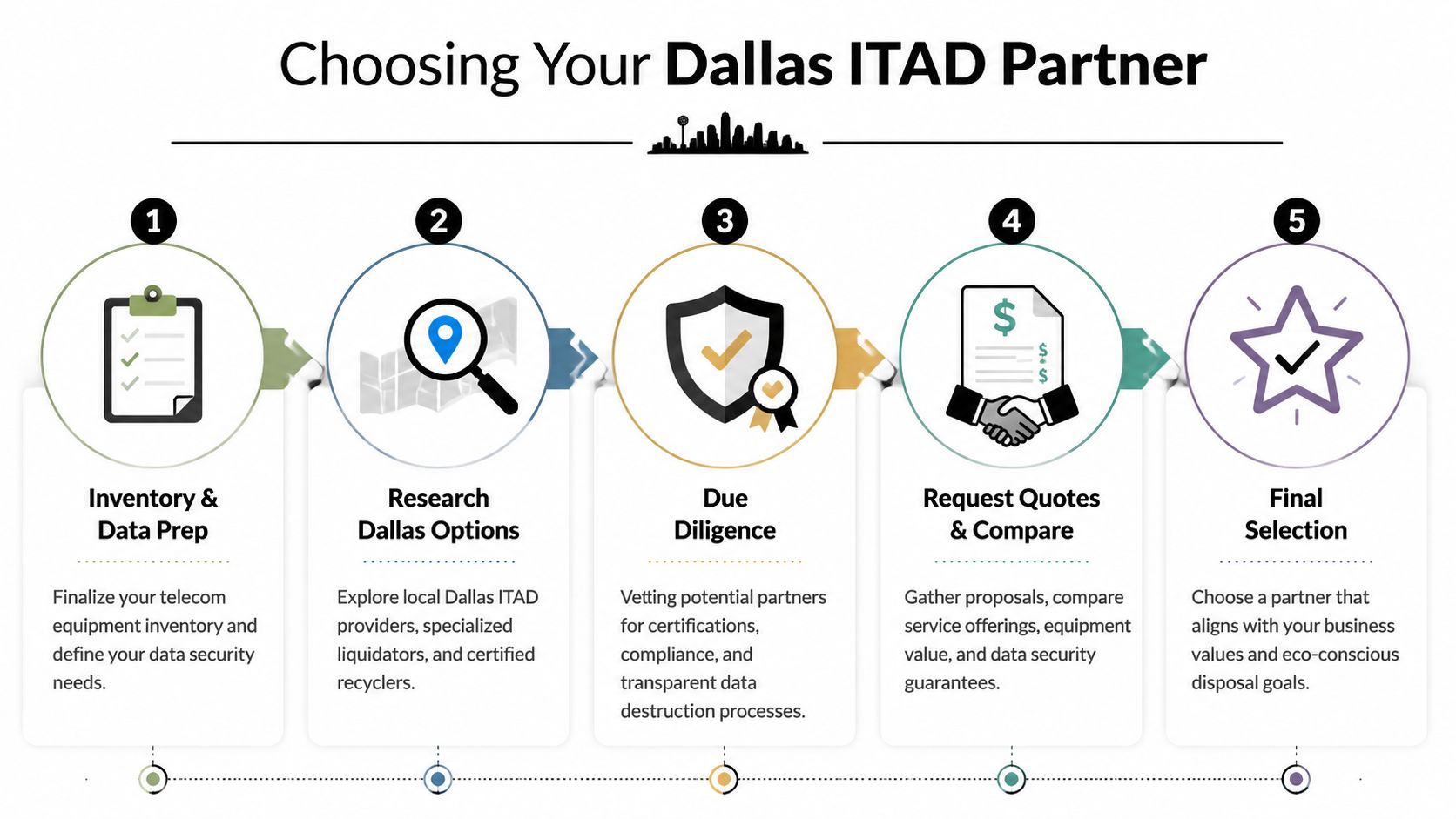
Dallas has a real secondary market for retired telecom and network gear. Some firms focus on voice systems. Others specialize in broader IT equipment. That variety is useful, but it also means you need to match the partner to your actual goal.
The wrong fit creates friction fast. A liquidator may offer cash but provide weak reporting. A recycler may handle end-of-life material well but have limited ability to monetize reusable equipment. A full-service ITAD partner may manage the entire lifecycle but won't always look like the highest raw bid on paper.
Compare the main buyer types
The Dallas market includes specialized buyers such as Clarus Communications for telephone systems and GreenTek Solutions for IT gear, which shows a diverse ecosystem where the right choice depends on whether you prioritize cash, compliance, or community impact, as noted by GM Insights' telecom equipment market coverage.
Here's the practical comparison:
| Partner type | Best fit | Strength | Limitation |
|---|---|---|---|
| Specialized liquidator | High-demand telecom models | Fast pricing on specific gear | Narrower service scope |
| Recycler | End-of-life material | Efficient compliant recycling | Limited value recovery |
| Full-service ITAD partner | Mixed lots with risk controls | One process for inventory, data, pickup, and reporting | May require more diligence upfront |
Ask questions that expose process quality
A polished website doesn't tell you much. Good vetting comes from specific questions.
Ask every provider:
- What documentation do you issue at the end. You want serialized reporting, not a generic receipt.
- How do you handle data-bearing telecom equipment. Listen for process details, not broad assurances.
- Can you support onsite pickup and packing. This matters when internal labor is limited.
- How do you distinguish resale, donation, and recycling paths. A mature answer will sound operational, not marketing-heavy.
- What happens if the lot differs from the manifest. Good partners have a variance process.
- What environmental standards guide downstream handling. You want transparency, not evasion.
A buyer worth using can explain what happens to your equipment after it leaves the dock. If they can't, keep looking.
Look beyond top-line price
An offer is only as good as the services attached to it. A slightly lower bid can be the better deal if it includes insured pickup, serialized tracking, secure data destruction, and final reporting your auditors will accept.
This matters even more for mixed telecom lots. One provider may pay more for a narrow subset of Cisco voice or network gear but leave you to manage broken handsets, cabling, and low-value accessories elsewhere. Another may take the entire project under one documented workflow.
When social impact belongs in the buying decision
For many businesses, especially schools, healthcare groups, public agencies, and ESG-focused companies, the disposition path is not only financial. Community impact matters too. Donation-based recycling and social enterprise recycling can support digital inclusion while still maintaining strict data and environmental controls.
That's a legitimate decision criterion. So is pickup reliability. So is reporting quality. So is whether your internal team can close the project with one vendor instead of three.
The strongest Dallas disposition outcomes usually come from partners that can do four things well: evaluate value realistically, secure data properly, recycle responsibly, and document every step in language procurement and compliance teams can use.
Finalizing the Deal Logistics and Negotiation
By the time quotes arrive, most of the outcome has already been set by your inventory quality, value triage, and security requirements. Negotiation still matters, but this isn't just about squeezing the last dollar out of a lot.
It is about total deal value.
Read the quote structure carefully
Telecom buyers don't all price the same way. One may offer a flat lot price. Another may provide line-item pricing on resale candidates and no-value pricing on scrap. A third may propose consignment for certain models.
Each structure shifts risk differently.
- Lot pricing is simple and fast, but it can hide where value is being discounted.
- Line-item pricing gives visibility, though only if your manifest is accurate.
- Consignment can improve returns on select assets, but it usually means slower closeout and more moving parts.
If your internal deadline is tight, the fastest clean exit may be worth more than a prolonged attempt to optimize every unit.
Negotiate on scope, not just price
Strong telecom disposition deals are built around service inclusions. Ask what is covered and what is not.
Items worth negotiating directly:
- Pickup timing and staging support
- Packing and palletization responsibility
- Serialized reporting
- Certificates of recycling and data destruction
- Treatment of residual scrap
- Variance handling if actual counts differ from the manifest
- Payment timing after audit and acceptance
Many businesses improve outcomes without forcing unrealistic price demands by choosing the right partner. If the buyer can remove labor from your team, reduce compliance burden, and close the paperwork loop cleanly, the offer may be better than a higher nominal bid with thin service.
Tie disposition to sustainability reporting
Buyback is changing. According to a 2025 Deloitte study, 72% of sustainability managers seek buyback programs that tie resale value to ESG reporting, and simple resale can yield 40-60% higher returns than recycling alone, but only if the ITAD partner can access modern secondary markets, as discussed in Telecom McAuliffe's article on refurbished and used telecom equipment.
That doesn't mean every item should be resold. It means your negotiation should include reporting outputs that help sustainability leaders show what was reused, what was recycled, and how the program supported broader environmental goals.
Close the file with complete records
A deal isn't finished when the truck leaves. It is finished when your organization has the full package of disposition records.
Your closeout file should include, at minimum:
- Approved quote or purchase agreement
- Asset list or acceptance report
- Bill of sale or transfer record
- Pickup documentation
- Certificates for data destruction where applicable
- Certificates or statements for responsible recycling
- Final reconciliation for payment and variances
Good logistics feel uneventful. That's the sign the process was planned correctly.
When teams skip this final discipline, they create audit work for themselves months later. When they do it properly, they free space, protect the company, and turn a cluttered telecom retirement project into a clean operational closeout.
Partner with Reworx for Responsible Telecom Recycling in Dallas
Retiring telecom hardware doesn't have to turn into a slow-moving storage problem or a compliance headache. When you inventory assets properly, separate value from scrap, control data risk, and document the chain of custody, the process becomes much easier to manage.
For Dallas businesses that want a single partner for secure IT equipment disposal, electronics recycling, secure data destruction, and sustainable handling, Reworx Recycling offers a practical path through the entire retirement cycle. That includes support for mixed telecom lots, broader office cleanouts, donation-based recycling, and responsible downstream processing with community impact in mind.
Operations also matter. Scheduling pickups across multiple locations, coordinating removals, and keeping projects on time requires disciplined field planning. The logistics principles in this guide to streamlining outside sales field operations are a good reminder that route efficiency and pickup coordination affect customer experience in disposition work too.
If your team is looking for a structured local program, review Reworx's secure IT asset disposition services for businesses in Dallas and build the retirement plan before the next upgrade leaves another room full of hardware behind.
If your business has retired phones, switches, routers, optics, or mixed telecom hardware ready to move, Reworx Recycling can help you donate old equipment, schedule a pickup, and manage secure, sustainable disposition with a community-minded approach.