
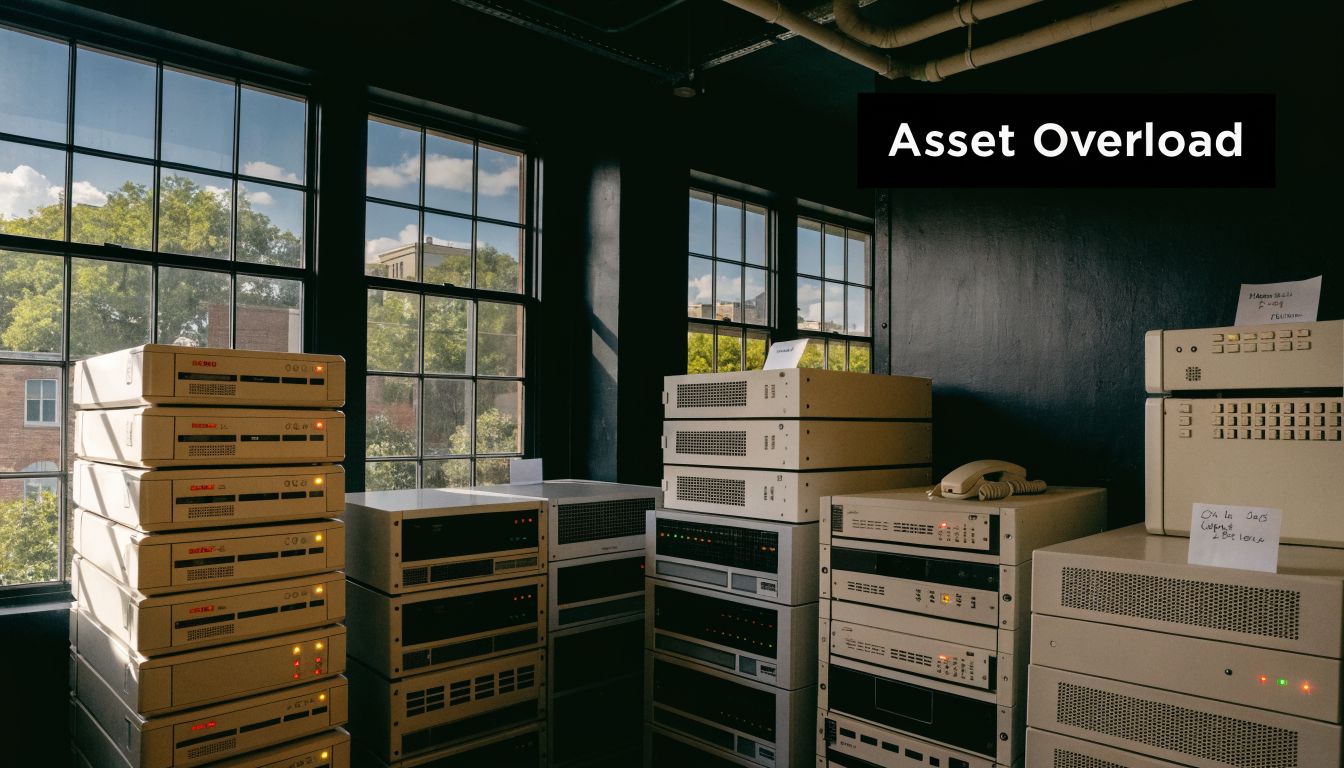
A lot of Los Angeles businesses end up in the same spot. A network refresh is done, the new gear is live, and the old telecom hardware is still sitting in a comms room, storage closet, or offsite cage. Routers, switches, PBX systems, access points, optics, power shelves, and mixed rack parts start taking up space while nobody wants to touch the disposal decision.
Delay usually costs money and increases risk. The issue involves more than just finding telecom equipment buyers Los Angeles businesses can call. The primary job is figuring out what still has resale value, what holds sensitive data, what belongs in a regulated disposition workflow, and who can reliably manage pickup and reporting in a city where logistics can become the hardest part of the project.
The Challenge of Retiring Telecom Assets in Los Angeles
Los Angeles is not a simple resale market. It is a deep telecom market with local manufacturers and channel activity that shape how buyers think about value, support, and downstream demand. According to ZoomInfo's Los Angeles telecommunications manufacturing list, RTW was reported at $59.9 million in revenue, Silvus Technologies at $48.9 million, and Doodle Labs at $41.8 million, all in Los Angeles and all in the telecommunication equipment manufacturing category. That kind of local concentration is one reason telecom equipment buyers Los Angeles companies deal with tend to look past a simple model number and ask tougher questions about condition, modules, licenses, and supportability.
What businesses usually get wrong
Many organizations begin with the wrong inquiry. They often ask, "Who buys old telecom gear near me?" This is a logical starting point, but it typically directs them toward generic buyer pages that offer little information beyond the basic claim "we buy telecom equipment."
The better questions are operational:
- What exactly is in the lot
- Which items are complete and testable
- Which assets contain data or configuration risk
- Who handles pickup, chain of custody, and no-value recycling
- What proof will your team receive after the equipment leaves
Those details decide whether the project runs cleanly or turns into a series of change orders, revised offers, and internal escalations.
Practical rule: Old telecom gear should be treated as a risk-managed asset disposition project, not as a junk removal job.
Why typical buyer pages fall short
The biggest gap in this market is practical guidance. Many pages aimed at sellers focus on contact forms and broad purchasing claims, but they rarely explain eligibility, documentation, data destruction proof, or support for regulated environments. That gap matters in Los Angeles because a single lot may include enterprise switches, voice systems, wireless backhaul gear, UPS components, rack PDUs, and storage-bearing devices from multiple sites.
A facilities lead may want the room cleared fast. An IT manager wants serial-level accuracy. Legal or compliance wants auditable records. Finance wants value recovery. Sustainability wants responsible recycling and reuse. One buyer rarely satisfies all of that unless the workflow is built correctly from the start.
If you're planning electronics recycling or broader IT equipment disposal in Southern California, it's useful to review a local perspective on responsible e-waste recycling in Los Angeles because telecom hardware often sits inside a larger office cleanout, data center decommissioning, or corporate refresh project.
Preparing Your Telecom Inventory for Maximum Value
The fastest way to reduce your payout is to send a buyer a vague note that says "mixed Cisco and telecom equipment, several pallets, pickup in LA." Buyers read that as uncertainty. Uncertainty becomes discounting.
Treat the lot like a reverse-logistics project. That means building a manifest that lets a buyer understand resale probability, test effort, missing parts, and downstream recycling cost before a truck is scheduled.
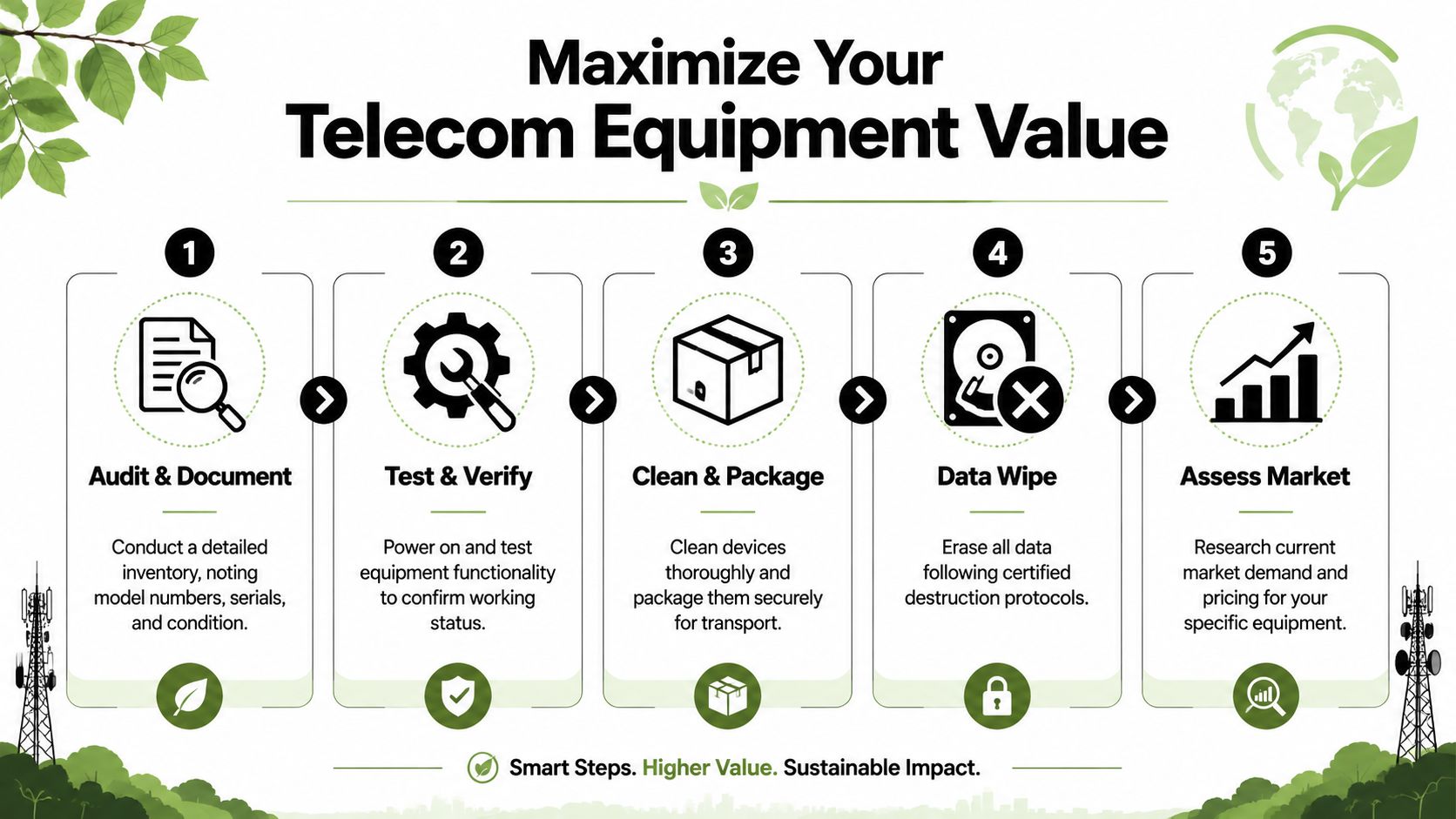
Build a manifest buyers can actually price
At minimum, your inventory should capture:
- Manufacturer and model. Use exact model numbers, not general descriptions like "switch" or "phone system."
- Serial number. This matters for traceability, service history, and auditability.
- Configuration details. Include installed modules, optics, supervisor cards, power supplies, trays, rack ears, and cables if they are part of a complete working unit.
- License status. If software or feature licenses transfer, say so. If unknown, mark them unknown.
- Physical condition. Note dents, broken ports, missing faceplates, or damaged rails.
- Testing status. Identify whether the unit powers on, passes basic tests, or is untested.
- Data-bearing status. Flag any device with storage, removable media, call logs, or saved configurations.
That level of detail sounds tedious, but it changes pricing behavior. Industry guidance from Beyond Surplus on telecom equipment buyers notes that fully tested equipment can reach up to 85% of list price on the secondary market, while untested units may fail 25% to 35% of post-purchase quality control, and surplus gear can lose 50% of value within 6 to 12 months after end-of-life. The same guidance also makes a point experienced sellers learn quickly: incomplete lists force buyers into defensive pricing.
Separate complete units from problem lots
Don't put your best assets into the same pile as scrap and mystery hardware. That buries value.
Use three lanes:
| Inventory lane | What belongs there | Why it matters |
|---|---|---|
| Complete and testable | Units with matching components, known condition, and usable accessories | Buyers can price these with confidence |
| Mixed but recoverable | Partial systems, loose cards, optics, handsets, and compatible spares | Often still saleable, but at lower confidence |
| No-value or recycling-only | Damaged, obsolete, incomplete, or failed items | Keeps scrap from dragging down the rest of the quote |
Internal discipline matters more than seller enthusiasm. A clean spreadsheet beats a long sales pitch every time.
Buyers don't pay a premium for optimism. They pay for documentation, completeness, and lower risk.
Test what you can, but document honestly
If your team can safely power on and verify gear, do it. If not, say it's untested. Inflating condition doesn't help. It only leads to repricing after pickup.
For companies that need a stronger process before electronics recycling, laptop disposal, product destruction, or telecom resale, a structured audit is often the best first move. A good reference point is why IT inventory audits matter before recycling, because telecom closets usually contain mixed assets that finance and compliance both care about.
If you manage sites beyond the U.S., the operational checklist in this Comms room strategy for UK businesses is also useful. The geography is different, but the decommissioning logic holds up: document first, isolate dependencies, and don't treat the room clear-out as an afterthought.
How to Vet Telecom Equipment Buyers in Los Angeles
Not every buyer plays the same role. Some are pure resellers. Some are IT asset disposition firms. Some can handle secure data destruction and recycling. Others are best only for straightforward resale lots.
That distinction matters because the telecom market doesn't move in a straight line. Dell'Oro Group reported in its 2019 telecom equipment market review that the overall telecom equipment market advanced 2% in 2019 after three years of decline from 2014 to 2017, and that Mobile RAN and Optical Transport accounted for about 55% of the market that year. For sellers in Los Angeles, the practical takeaway is simple: buyers tend to be more interested in gear tied to network modernization, optical transport, radio access, and current buildout cycles than in random mixed inventory with no testing history.

Three buyer types and what each does well
| Buyer type | Best fit | Main limitation |
|---|---|---|
| Reseller | Working, current, easy-to-identify gear with clear resale demand | May not want low-value items, reporting, or compliance-heavy projects |
| ITAD provider | Mixed loads, secure disposition, audit trails, corporate workflows | Offer may be lower on high-demand gear if service scope is broad |
| Donation-based social enterprise | Organizations that care about reuse, community impact, and sustainable recycling | Needs to be evaluated on process depth, pickup capability, and documentation just like any other partner |
A lot of businesses make the same mistake they make in other liquidation contexts. They compare only the headline payout. That's not enough. The same logic used when comparing costs of estate liquidation firms applies here: one offer may look higher until you account for labor, hauling, cleanup, missing documentation, or downstream disposal charges.
Questions worth asking before you release equipment
Use a short but strict screening list:
- Can you provide serialized asset reporting after pickup?
- What happens to no-value equipment that can't be resold?
- Do you offer secure data destruction for storage-bearing or configuration-bearing devices?
- Who handles onsite labor such as unracking, palletizing, and labeling?
- How are exceptions handled if the received condition differs from the manifest?
- Can you work with offices, schools, healthcare, or government sites that need tighter controls?
The strongest telecom equipment buyers Los Angeles companies work with are usually the ones that answer those questions directly, without sliding back into marketing language.
What a realistic evaluation looks like
A buyer should be able to tell you, in plain terms, whether your lot belongs in a resale workflow, an ITAD workflow, a donation-based recycling program, or a hybrid approach. Mixed inventories often need all four elements. Some telecom shelves and radios may have resale demand. Older handsets and broken power gear may belong in electronics recycling. Data-bearing assets may need secure destruction. Some working office technology may be better suited to reuse or donation.
If your project crosses those lines, it helps to review what IT asset disposition companies are expected to manage, especially when your telecom hardware is only one part of a larger office cleanout, facility cleanout, or data center decommissioning effort.
Ensuring Secure Data Destruction and California Compliance
Price gets attention. Data risk should get the final word.
Telecom hardware often stores more than people expect. Voicemail systems, call accounting platforms, unified communications servers, session border devices, security appliances, routers, wireless controllers, and some switches may retain credentials, configuration files, call logs, IP schemes, and user information. If those assets leave your site without the right controls, the issue isn't resale value anymore. It's exposure.

Segment by data-bearing risk first
Mordor Intelligence estimates in its telecom equipment market analysis that telcos represented 71.25% of telecom equipment market share in 2025, while private 5G demand from enterprise and industrial buyers is projected to grow at a 14.62% CAGR from 2026 to 2031, reaching more than USD 51.3 billion by 2031. For sellers, the useful point isn't just demand. It's that carrier-grade and enterprise equipment often move through different resale paths, and enterprise lots tend to raise stronger questions about stored data, user records, and internal configurations.
Start by splitting your inventory into two groups:
- Data-bearing or configuration-sensitive assets such as voice systems, servers, appliances, controllers, and devices with removable media
- Non-data-bearing infrastructure such as certain passive components, cabling, mounts, empty chassis, and some accessory hardware
That one sort makes the rest of the project easier. Your internal security team can sign off on one lane while operations keeps the non-sensitive lane moving.
Non-negotiable: If an asset can store customer data, user data, credentials, or network configuration, it needs a documented destruction or sanitization path before resale or recycling.
Know the destruction options
The right method depends on the device and your internal policy.
Software wiping
Best for reusable drives and systems when you want to preserve resale value. This only works when the media is accessible, healthy enough to process, and your vendor can document the result.
Degaussing
Useful in more limited situations where magnetic media is involved. It can render media unusable, which usually ends the reuse path for that component.
Physical shredding or destruction
Best when policy, sensitivity, or device condition rules out reuse. This is often the cleanest choice for failed drives, unknown media, or heavily regulated environments.
For California businesses, the practical compliance issue is auditability. Your team needs proof. That usually means chain-of-custody documentation and a Certificate of Data Destruction that maps back to the assets removed from your site. Without that, your team may have done the work but still struggle to prove it during an internal review, customer inquiry, or policy audit.
Businesses that want a tighter process around secure data destruction, computer recycling, and IT asset disposition in Southern California should look closely at secure data destruction services in Los Angeles, especially when telecom infrastructure is bundled with laptops, storage, mobile devices, or office servers.
Negotiating Fair Value and Managing LA Logistics
Once you have a clean inventory and a shortlist of qualified buyers, the negotiation should shift from "What's your price?" to "What's included in the transaction?" That's where deals become either efficient or painful.
This is the part generic buyer pages usually ignore. They don't tell you who pays for labor, what happens to dead gear, whether pickup includes stairs or elevator coordination, or how they handle a downtown loading dock versus a suburban warehouse. In Los Angeles, those details aren't small. They often decide whether the project closes on time.
Compare full-service value, not just the offer amount
The strongest comparison uses five variables:
| Deal variable | What to ask |
|---|---|
| Purchase price | What is the payout for the assets with resale value |
| Logistics cost | Is pickup included, billed separately, or conditional |
| Data destruction scope | Are wiping, shredding, and reporting included |
| No-value recycling | Will scrap, failed gear, and mixed accessories be handled responsibly |
| Payment timing | When do you get paid, and what can trigger repricing |
A lower headline offer can still be the better deal if it includes onsite labor, serialized reporting, secure data destruction, and responsible recycling for everything that won't sell. That's especially true for office cleanout, facility cleanout, medical equipment disposal, laboratory equipment disposal, or data center decommissioning projects where the telecom gear is only part of the load.
Los Angeles pickup problems you should solve before truck day
The local gap in online guidance is real. Generic telecom buyer pages rarely explain minimum lot sizes, local pickup windows, onsite removal constraints, or the effect of regional resale channels on value. That practical shortfall is noted in Los Angeles electronics recycling guidance from Greentek Solutions, and anyone who's managed a pickup in this city knows why.
Use a pre-pickup checklist:
- Building access. Confirm loading dock rules, elevator reservations, badges, and freight hours.
- Staging plan. Decide whether gear will be removed live from racks or staged in advance.
- Packaging. Ask whether the buyer expects pallets, gaylords, antistatic protection, or loose floor-loaded material.
- Traffic timing. Schedule around your site's access realities, not just the vendor's preferred route.
- Point of contact. Put one person in charge onsite. Projects slow down fast when facilities, IT, and security all assume someone else is leading.
In Los Angeles, pickup planning is part of value recovery. A disorganized removal can erase the benefit of a decent offer.
Keep regional supply chain logic in mind
A lot of telecom hardware pricing is affected by where replacement gear, parts, and secondary demand are flowing. If your team wants a better feel for how regional transport pressure can shape equipment movement into Southern California, this overview of air freight from Shenzhen to Los Angeles is a useful logistics read. It isn't about used telecom specifically, but it helps explain why timing, congestion, and freight realities influence local handling decisions.
For companies that need one partner to handle business pickups, secure processing, sustainable recycling, product destruction, and broader IT asset disposition, it's worth reviewing IT asset disposal solutions for businesses in Los Angeles before you lock in a vendor. The smoother the logistics model, the less likely your internal team gets pulled into avoidable cleanup work after the truck leaves.
Conclusion: A Strategic Partner for Your Retired Assets
Retiring telecom gear isn't a side task for someone to handle when they have time. It affects security, compliance, facilities coordination, sustainability reporting, and value recovery all at once.
The best telecom equipment buyers Los Angeles businesses work with don't just make offers. They help create order from a mixed pile of hardware, separate resale from scrap, document what matters, and remove assets without creating new risk. That's why the smartest organizations measure success across several outcomes: fair recovery, secure data handling, responsible electronics recycling, and a disposition process their internal teams can defend.
Responsible choices also carry social and environmental value. Reuse keeps working equipment in circulation longer. Proper recycling keeps hazardous material out of landfills. Donation-based recycling and corporate donation programs can also support digital inclusion and community benefit when assets are still usable.
If your business is planning telecom retirement, computer recycling, laptop disposal, secure data destruction, or a broader office or facility cleanout, choose a partner that can manage the whole workflow instead of just taking the easy items.
Frequently Asked Questions
Do telecom equipment buyers in Los Angeles accept small lots
Some don't. Many buyers prefer larger, cleaner lots because mixed small loads take more labor to sort and test. If your inventory is modest, combine telecom hardware with other retiring IT assets such as laptops, desktops, peripherals, and networking gear so the pickup is more efficient.
Can one partner handle a larger decommissioning project
Yes, but ask for the exact scope. Some providers can manage data center decommissioning, rack removal, secure data destruction, computer recycling, and product destruction in one workflow. Others only buy selected resale items and leave your team to deal with the rest.
What happens to equipment with no resale value
That depends on the vendor. A responsible provider should separate reusable equipment from true end-of-life material, direct usable items toward reuse or donation when appropriate, and process the remainder through sustainable recycling rather than landfill disposal. Ask this question early, especially if your company tracks ESG, waste diversion, or social enterprise recycling outcomes.
If your Los Angeles business needs a practical partner for electronics recycling, donation-based recycling, secure data destruction, or telecom and IT equipment disposal, Reworx Recycling is worth a close look. The team helps organizations retire equipment responsibly, schedule pickups, protect sensitive data, and support community impact through reuse and donation. Reach out to discuss your inventory, plan a pickup, or explore a corporate donation program that turns retired technology into measurable value.