
If you're searching for telecom asset recovery services near me, you're probably already sitting on the problem. It may be a locked storage room full of retired PBX hardware, pallets of switches from a network refresh, old handsets in branch offices, or decommissioned routers that nobody wants to touch because they might still hold configuration data.
That backlog creates two business problems at the same time. First, it ties up space, attention, and budget. Second, it turns what should be a controlled retirement process into an unmanaged risk event. For a business manager, IT lead, facilities director, or sustainability owner, the challenge isn't just finding someone local to haul equipment away. It's finding a partner that can document custody, protect data, satisfy compliance expectations, and recover whatever value is still left in the gear.
A lot of vendors sound similar on the surface. They all talk about pickups, recycling, and security. The key difference shows up in the details. How they inventory assets. How they sanitize storage media. How they document serial numbers. How they report final disposition. How they separate resale, parts harvest, and recycling. Those details decide whether your project ends with clean audit documentation or a box of unanswered questions.
The Hidden Costs of Storing Surplus Telecom Gear
Most organizations keep surplus telecom equipment longer than they should. The reason is understandable. Nobody wants to make a rushed disposition decision, and telecom gear often gets pushed behind more urgent projects. The trouble is that delay isn't neutral. It has a cost, and it keeps increasing while the equipment sits.
The biggest mistake I see is treating retired network hardware like inactive inventory. It isn't. It's an asset class that's already moving down in value while still consuming warehouse space, rack room space, and staff time. According to industry analysis on telecom infrastructure economics, the telecom industry faces staggering carrying costs from obsolete equipment storage, with energy comprising over 92% of network operating costs, which makes delayed asset recovery a major financial drain.

What storage really costs
The visible cost is floor space. The less visible cost is everything that comes with holding retired equipment in place.
- Facility burden means cages, shelves, storage rooms, or leased warehouse space stay occupied by equipment that no longer supports the business.
- Operational drag shows up when staff has to move, label, recount, or secure old gear every time a facilities change happens.
- Power and environmental overhead can continue even when devices are disconnected, because the surrounding storage environment still has to be maintained.
- Management delay keeps finance, IT, and compliance teams from closing out the project cleanly.
A disciplined asset recovery program prevents that backlog from turning into permanent clutter. It also reduces the environmental and legal exposure associated with unmanaged electronic waste, which is why it helps to understand the broader environmental and legal impacts of improper commercial e-waste disposal.
Practical rule: If your team has moved the same retired telecom gear more than once, you're already paying too much to keep it.
Delay lowers value and increases risk
Telecom hardware doesn't age gracefully in storage. Market demand changes, supported firmware cycles change, and buyers discount equipment that arrives late, incomplete, or undocumented. A switch, router, or handset set that might have qualified for remarketing earlier can slide into lower-value channels if it's left untouched.
The issue isn't just depreciation. It's uncertainty. Once assets sit long enough, labels go missing, branch offices lose track of what was removed, and project teams forget whether a lot contains reusable hardware, damaged hardware, or data-bearing devices that need certified destruction. That's when recovery value starts slipping away because the condition and chain of custody are no longer clear.
Why acting now usually beats waiting
A nearby provider should help you convert a pile of “old telecom stuff” into a defined project. That means identifying the inventory, separating recoverable equipment from scrap, documenting data handling, and closing the loop with auditable records. Businesses that wait usually end up paying twice. Once for storage, and again for a rushed cleanup later.
For business managers, that's the main shift in mindset. Telecom asset recovery isn't disposal planning. It's cost control and risk control. When you frame it that way, the project usually gets approved faster, and the vendor conversation becomes much more disciplined.
Decoding Telecom Asset Recovery Services
Many buyers start with the wrong question. They ask whether a vendor “does telecom recycling.” That's too broad to be useful. What matters is whether the provider can manage the full recovery chain from asset identification to final disposition, with the right controls in between.
According to this guide to monetizing retired IT assets, a structured telecom asset recovery process begins with asset identification, followed by NIST 800-88 compliant data sanitization, functional testing and grading, secure transport with chain-of-custody tracking, and a final disposition report for auditing purposes. The same source notes that skipping certified steps can cause 40-60% loss in potential value.

Asset identification and inventory control
Serious projects are won or lost at this stage. A provider should catalog gear by make, model, serial number, and asset tag where available. For telecom environments, that often includes routers, switches, optics, line cards, PBX components, handsets, wireless infrastructure, and support peripherals.
If a vendor can't explain how they reconcile what was picked up against what was received and processed, stop there. You need that record for internal controls, insurance questions, and audit support.
A helpful background read on the broader process is this overview of what IT asset disposition means in practice.
Data sanitization isn't just a wipe
Telecom managers sometimes assume only laptops and servers carry meaningful data. That's not a safe assumption. Network devices can retain configurations, credentials, call records, routing information, and customer or operational metadata depending on the environment.
A qualified recovery partner should be able to explain:
- Which devices are sanitized by software-based erasure
- Which media require physical destruction
- How NIST 800-88 procedures are applied
- What proof you receive after processing
That proof matters as much as the sanitization itself. If there's no documentation, your organization may struggle to demonstrate that data-bearing assets were handled correctly.
The right answer isn't “trust us.” The right answer is a documented method tied to specific equipment records.
Testing, grading, and remarketing
A complete telecom asset recovery service does more than collect scrap. It evaluates whether equipment should be resold intact, harvested for parts, or recycled. That evaluation typically depends on model demand, physical condition, age, completeness, and whether the item passes functional testing.
For business owners, this matters because value recovery starts with sorting discipline. A vendor that throws everything into one stream usually leaves money on the table. A vendor that tests and grades intelligently can identify what still has a secondary market.
Logistics and final reporting
Pickup logistics sound simple until the job involves multiple offices, limited loading access, after-hours removal, secure staging, or equipment that must be de-installed before transport. A local partner should be able to describe chain-of-custody procedures from pickup through processing without hesitation.
Here's the simplest way to think about the service stack:
| Service element | What it should accomplish |
|---|---|
| Inventory intake | Establish exactly what assets are in scope |
| Data sanitization | Protect the business from data exposure |
| Testing and grading | Determine resale, parts harvest, or recycle path |
| Secure logistics | Preserve custody and reduce handling mistakes |
| Reporting | Give finance, IT, and compliance a usable record |
When people search for telecom asset recovery services near me, this is what they're really trying to find. Not a truck. A controlled process.
A Step-by-Step Process for Vetting Local Providers
A local telecom asset recovery partner should be easy to reach, but that's not enough. Convenience matters. So do pickup windows, regional coverage, and site access. Still, if you stop your vetting process at proximity, you can end up with weak documentation, unclear data handling, and disappointing value recovery.
The market is large enough that surface-level claims don't tell you much. According to this overview of Detroit asset recovery and the wider ITAD market, the ITAD market hit $20.6 billion in 2022 and is shaped by compliance standards such as R2v3 and NAID AAA. The same source notes that e-waste totals 62 million metric tons annually and only 22.3% is formally recycled, which is a reminder that documented downstream handling matters, not just pickup.
Start with a narrow local search
Begin with a short list, not a giant spreadsheet. Search for providers within practical hauling distance of your sites and look for evidence that they handle business-grade electronics, not just residential drop-offs. A company that specializes in office pickups, decommissioning, secure data destruction, and reporting will usually signal that clearly.
Your initial shortlist should answer a few basic questions fast:
- Do they handle telecom equipment specifically
- Do they offer business pickups or on-site services
- Do they mention certifications and audit documentation
- Do they describe secure data destruction, not just recycling
- Do they appear set up for multi-site or commercial projects
At this stage, don't get distracted by polished marketing language. You're only trying to identify which vendors deserve a deeper review.
Verify certifications before discussing price
Many businesses reverse the right order. They ask for a quote first and validate controls later. That creates pressure to accept a low-cost option that may not meet your documentation or security requirements.
Look for providers that can clearly explain their certifications and how those certifications relate to your equipment stream. The important point isn't the acronym by itself. It's what the process demands in practice.
| Vetting point | What you want to hear |
|---|---|
| R2v3 | A certified recycling and reuse framework with documented process discipline |
| NAID AAA | Controlled data destruction practices and auditable handling |
| NIST 800-88 alignment | A specific method for sanitizing data-bearing devices |
| Disposition reporting | Asset-level or lot-level documentation tied to what was processed |
If a provider uses vague language like “industry standard wiping” without explaining documentation, ask follow-up questions immediately.
A solid framework for this decision is to review guidance on selecting a reliable e-waste recycling partner, then apply those criteria to your telecom retirement project.
Ask for sample paperwork before pickup day. Good vendors expect this request and can provide examples without hesitation.
Test how they think about data-bearing telecom assets
Some vendors are strong in commodity electronics recycling but weaker on telecom-specific risks. That gap usually shows up when you ask about routers, firewalls, handsets, optical gear, or PBX components. A qualified provider should be comfortable discussing devices that may contain stored configurations or other sensitive information.
Ask them to walk through a real workflow:
Pickup and receiving
How is the lot identified when it leaves your site, and how is it matched when it arrives?Sorting and inspection
How do they determine whether a device is reusable, parts-worthy, or recyclable?Sanitization or destruction
Which devices get wiped, and which get physically destroyed?Exception handling
What happens when a device is damaged, unlabeled, or missing expected components?Reporting
What documents do you receive at the end, and how are they organized?
The quality of the answers matters more than the sales language. You're looking for operational clarity.
Evaluate logistics like an operator, not a shopper
A nearby vendor still has to execute the job. That means you should discuss site realities before you approve anything. Telecom retirements often involve branch offices, MDF or IDF closets, after-hours access, elevator reservations, loading docks, and mixed asset conditions.
A provider that asks detailed logistics questions early usually runs cleaner projects. A provider that says “we'll figure it out on pickup day” often creates avoidable confusion.
You can borrow a useful mental model from adjacent device markets. This expert guide to refurbished phones is consumer-focused, but the underlying principle is relevant for business buyers too: condition, testing standards, and transparency directly affect value and trust. The same logic applies when telecom assets move into resale or refurbishment channels.
Ask how they determine value
Not every telecom retirement project generates a strong buyback. Some loads are mixed. Some are mostly low-demand gear. Some have more compliance sensitivity than resale opportunity. A reliable provider should be candid about that.
What you want is a valuation process that's understandable. Ask whether they assess equipment by model, condition, completeness, and current secondary-market demand. Ask whether they distinguish between intact resale, component harvesting, and commodity recycling. If they can't explain the decision path, you won't be able to compare proposals on equal terms.
The best local providers don't just remove equipment. They help you decide what's worth remarketing, what should be destroyed, and what belongs in a certified recycling stream.
Your Vetting Checklist and Critical Questions to Ask
Most telecom retirement mistakes happen before pickup. They happen when the buyer assumes a provider's website claims are enough. They aren't. You need written answers, sample documents, and a clear description of how the vendor handles your specific asset mix.
That matters even more for smaller businesses and distributed organizations. A 2025 Gartner report summarized here noted that 68% of SMBs in major U.S. markets face compliance risks during telecom upgrades, while 42% are unaware of sector-specific audit requirements for PBX systems or routers, leading to an average fine of $15,000 per incident.
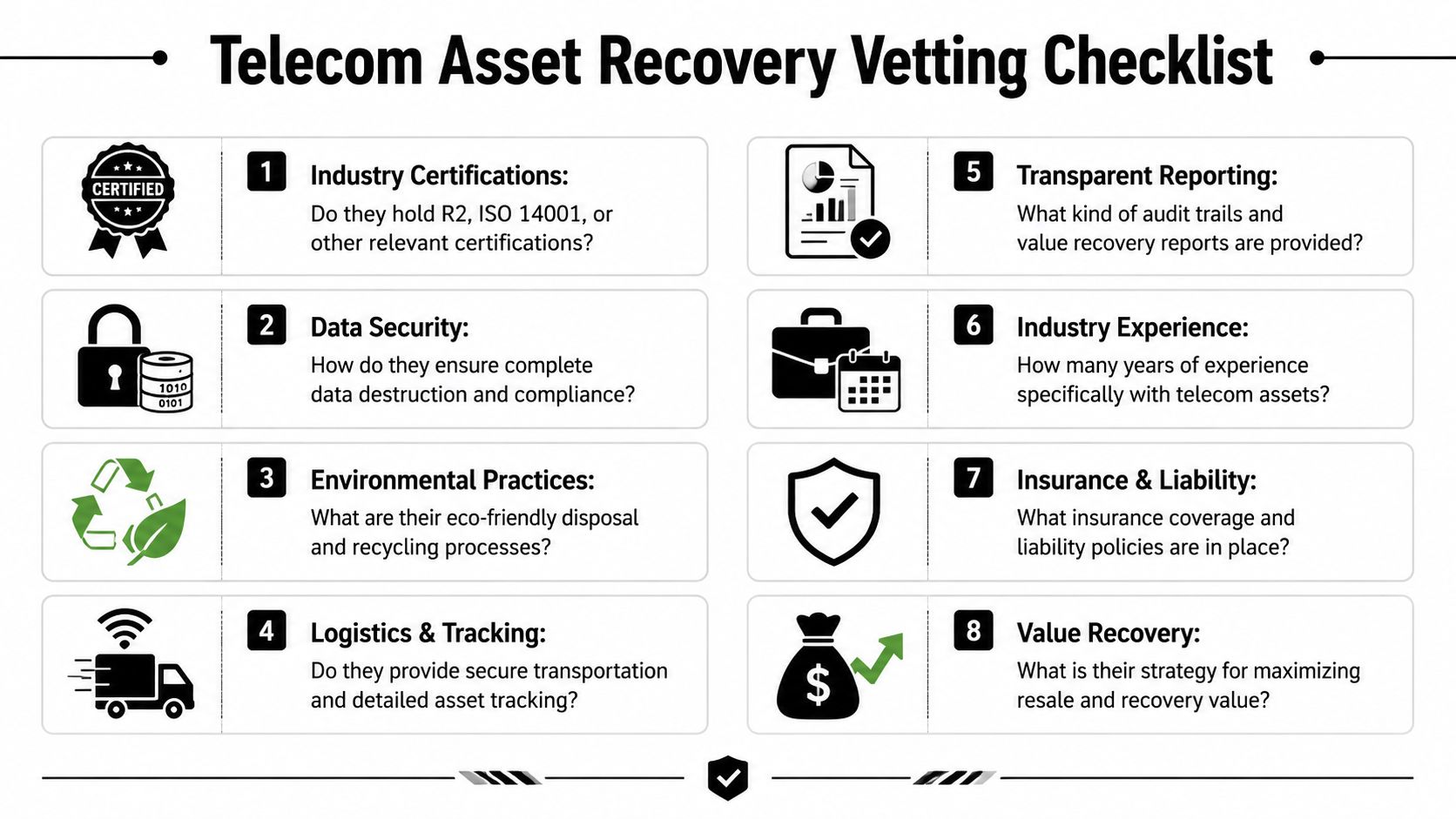
Compliance and documentation
If you only ask one category of questions, ask these.
Certification scope
Which certifications do you currently hold, and how do they apply to telecom equipment processing?Proof of process
Can you share sample certificates of destruction, disposition reports, and chain-of-custody documents?Audit support
If our compliance team has questions after the job closes, who answers them and what records are retained?
For data destruction standards, it's useful to understand what NAID AAA certification represents in operational terms, especially when you're comparing vendors that all claim to be secure.
Security and chain of custody
Vague answers become dangerous. If a vendor can't describe custody transitions clearly, that's a problem.
Ask these directly:
At pickup
Who signs for the equipment when it leaves our site?In transit
How is the load tracked, and how do you document any transfer points?At processing
When do serial numbers get captured, and how are exceptions handled?
Get the answer in writing if the project includes routers, firewalls, PBX systems, handsets, or any gear that may contain stored settings or operational data.
Operations and site execution
Plenty of vendors can process equipment. Fewer can run a smooth pickup from an active business environment.
Use a practical checklist:
Building access
Have you handled high-rise pickups, campus environments, or restricted loading docks?De-installation
Do you remove equipment from racks or closets, or do you require assets to be staged in advance?Multi-site coordination
Can you support a phased project across offices or remote facilities?Packaging and handling
Who provides pallets, containers, labels, or staging guidance?
Value recovery and commercial terms
Buyback conversations tend to become unclear fast unless you pin them down.
Ask for plain answers to these:
| Question | Why it matters |
|---|---|
| How do you determine fair market value | Lets you compare proposals on method, not just headline payout |
| What lowers the resale category | Helps your team prepare and avoid preventable deductions |
| What is resold versus recycled | Shows whether the vendor is sorting for value or defaulting to scrap |
| When is settlement issued | Avoids confusion after equipment leaves your site |
A short meeting script that works
If you want a simple way to pressure-test a provider, use this sequence in a call or meeting:
- Walk me through chain of custody from pickup to final reporting.
- Show me a sample certificate of destruction and disposition report.
- Explain how you handle data-bearing telecom equipment.
- Tell me how you grade resale candidates versus recycle-only material.
- List the exact responsibilities my team must complete before pickup day.
The stronger vendors answer these quickly, specifically, and without drifting into generic marketing language.
Common Pitfalls in Telecom Asset Recovery to Avoid
The most expensive mistakes in telecom asset recovery usually sound reasonable at the time. Pick the cheapest quote. Let the equipment sit until the team has time. Assume a wipe happened because the vendor said it did. None of those choices holds up well once audit, finance, or security teams start asking questions.
One of the clearest warnings comes from this analysis of telecom equipment asset recovery pitfalls. It states that inadequate data-wiping documentation accounts for 60% of value loss. It also notes that enterprises forfeit 40-60% of potential recovery value by storing gear for more than one year, and that assets such as optics can depreciate 25-40% annually.

Choosing on price alone
A low quote can hide weak controls. If one vendor is dramatically cheaper, ask why. They may be excluding de-installation, skipping detailed inventory work, offering minimal reporting, or pushing mixed loads into low-value recycling streams without meaningful remarketing effort.
A cheaper pickup can become an expensive internal problem if your team later has to reconstruct what happened to the equipment.
Accepting weak destruction proof
“Data destroyed” is not enough. You need documentation tied to the actual assets or lots processed. Without that, your compliance team has little to work with if a question comes up later.
Read through common mistakes businesses make with e-waste disposal and you'll notice a common theme. The issue usually isn't intent. It's missing process evidence.
If the paperwork is thin, assume the controls are thin too.
Waiting too long to start
Teams delay asset recovery because they want one perfect, consolidated project. In practice, that often means nothing moves until the value has already declined and records are harder to reconcile. A phased pickup with clean documentation is usually better than a delayed “big bang” event.
Poor internal preparation
Vendors matter, but internal discipline matters too. If your team sends out unlabeled pallets, mixed device types, or no site contact information, even a good provider has to spend time sorting preventable confusion.
Before pickup, do three things well:
- Tag ownership by site, room, or business unit where possible.
- Separate sensitive assets that need destruction from standard telecom surplus.
- Assign one internal owner who can answer questions and approve exceptions quickly.
Those simple controls reduce disputes, speed reporting, and improve your ability to compare final results against what you expected.
Conclusion Turning Surplus Assets into Strategic Value
Telecom retirement projects look operational on the surface, but the decisions behind them are strategic. The provider you choose affects data security, audit readiness, space utilization, environmental outcomes, and the amount of value you recover from equipment that no longer serves production.
That's why the search for telecom asset recovery services near me shouldn't end with whoever can schedule a truck first. A strong local partner should be able to explain their certifications, custody controls, sanitization methods, reporting package, and valuation logic in plain language. If they can't, the risk hasn't gone away. It's just been handed to someone else.
The practical standard is simple. Choose a provider that can identify the assets accurately, control them from pickup through processing, document data destruction properly, and separate resale opportunities from true end-of-life material. That combination protects the business and gives finance, IT, facilities, and sustainability teams a result they can confidently defend.
Handled well, telecom asset recovery isn't a cleanup task. It's a disciplined business process that closes out old technology responsibly and turns surplus equipment into documented value.
If your organization is planning a telecom refresh, office cleanout, data center decommissioning, secure data destruction project, or broader IT asset disposition effort, Reworx Recycling can help you move retired equipment out of storage and into a documented, sustainable recovery process. As a donation-based recycling and social enterprise recycling partner based in Smyrna, Georgia, Reworx supports businesses with electronics recycling, computer recycling, laptop disposal, product destruction, facility cleanout services, and responsible IT equipment disposal while advancing community impact through technology donations and digital inclusion. If you're ready to schedule a pickup, explore corporate donation programs, or find a practical path for sustainable recycling, connect with Reworx Recycling and start the conversation.