

Your phones aren't ringing reliably, Teams calls are clipping, a branch office keeps dropping connectivity, and someone has scheduled a carrier cutover for the same week your operations team is preparing for severe weather. That's usually when “telecom” stops feeling like a utility and starts feeling like the backbone of the business.
In Houston, that pressure is familiar. Companies here run busy offices, warehouses, clinics, field operations, and multi-site networks that can't afford fragile voice and data systems. When a circuit fails, a handset cluster dies, or an edge device starts behaving erratically, remote support alone often isn't enough. Someone has to show up, trace the issue, test the handoff, replace the hardware, and restore service.
That's what onsite telecom services Houston really means in practice. It isn't just dispatching a technician to hang a phone. It's the field work behind continuity: installation, cabling, failover planning, troubleshooting, maintenance, and eventually the controlled retirement of replaced gear.
Keeping Your Houston Business Connected and Resilient
A common Houston scenario looks like this. A company is heading into a high-demand week, maybe a logistics push, a seasonal sales period, or storm preparation. Then voice quality drops, internet failover doesn't trigger cleanly, and the network closet turns into a guessing game because nobody onsite has the tools or authority to isolate the fault.

At that point, the business isn't buying “support” in the abstract. It needs physical action. Technicians may have to inspect the demarc, verify patching in the MDF and IDF, check power and optics, swap a failing gateway, or coordinate directly with a carrier while testing live services from the site. That's the difference between a help desk ticket and onsite telecom service.
What local support changes
Houston businesses usually don't struggle because they lack technology options. They struggle because real environments are messy. Buildings have old cabling mixed with new runs. Expansions happen faster than documentation gets updated. Equipment gets added in a hurry, then left in place for years.
Local onsite teams matter because they can deal with what's physically there:
- They inspect the actual plant instead of relying on outdated diagrams.
- They troubleshoot handoffs in person when a problem could sit with the carrier, firewall, switch stack, or internal wiring.
- They restore service faster when the issue requires parts, testing tools, and access to secured spaces.
- They see lifecycle problems early such as abandoned hardware, overloaded racks, and unmanaged retired gear.
Practical rule: If business continuity depends on the circuit, the closet, or the rack, your support model needs people who can reach the site.
The larger telecom industry gives useful context for why this work remains central. The U.S. telecom services market was valued at USD 468.08 billion in 2023 and is projected to reach USD 725.68 billion by 2030, with a projected 6.6% compound annual growth rate from 2024 to 2030. That growth reflects ongoing investment in connectivity, voice, broadband, and enterprise communications, all of which still require field installation and maintenance.
Resilience includes the end of the lifecycle
One of the mistakes I see in telecom upgrades is treating installation as the finish line. It isn't. A clean deployment often creates a second project immediately: what to do with the switches, phones, routers, storage, and other devices that just came out.
If your team is already planning cutovers and removals, it makes sense to include secure IT asset disposition services in Houston for businesses in the same planning cycle. That keeps the site cleaner, reduces security loose ends, and prevents old telecom gear from sitting untracked in closets or cages.
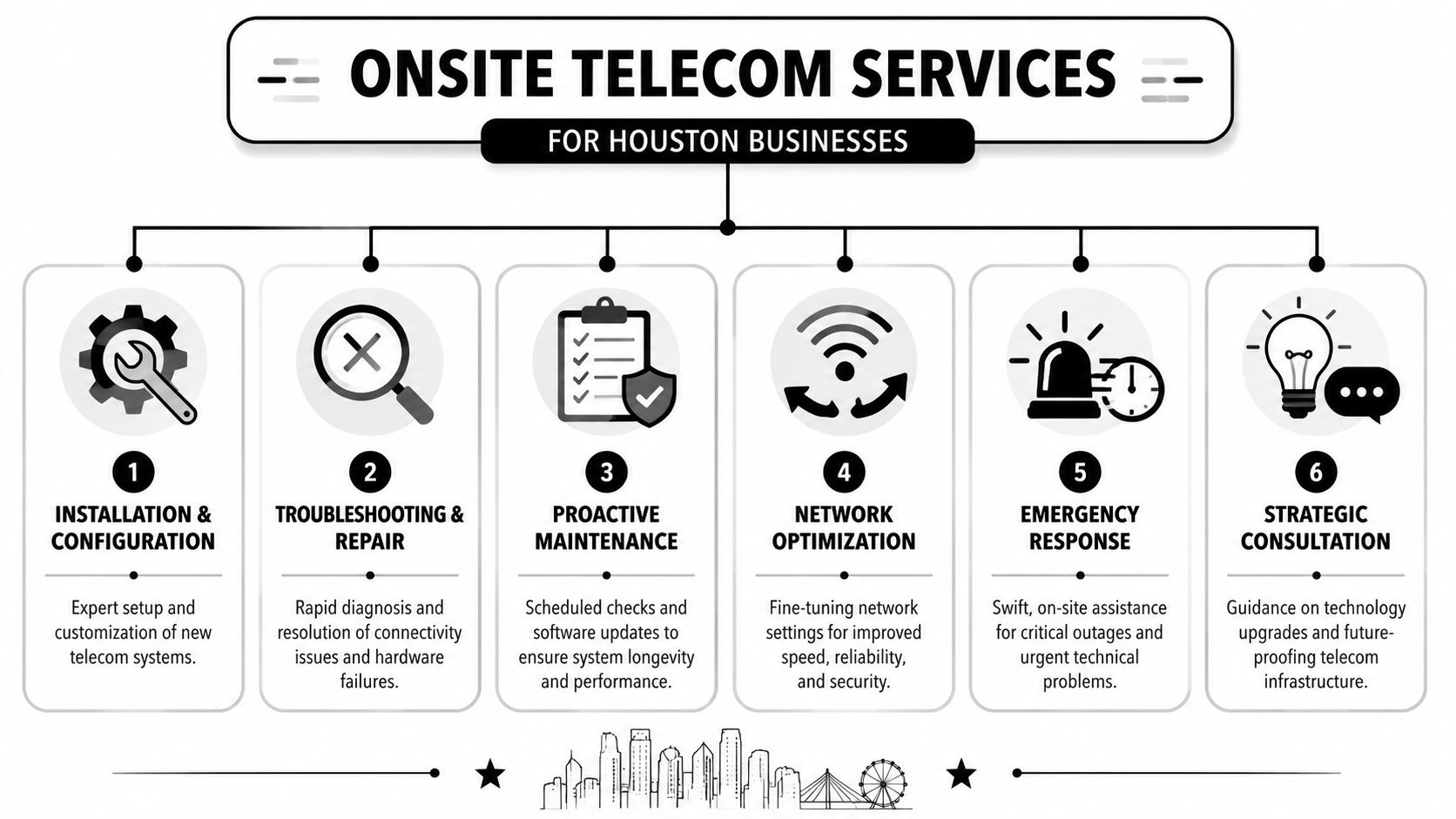
What Onsite Telecom Services Actually Include
The phrase covers a lot of ground, and buyers often hear it used too loosely. Good onsite telecom work is a chain of tasks that starts before installation and continues well after the initial turn-up.
Installation and structured cabling
Think of structured cabling as the building's nervous system. If the pathways are poorly planned, labels are missing, or patching is inconsistent, every later issue gets harder to diagnose. Onsite teams install and organize the physical layer that everything else depends on, including copper runs, fiber handoffs, patch panels, racks, phone endpoints, access points, and power support.
This work is rarely glamorous, but it's where a lot of long-term reliability is won or lost. A neat rack, tested terminations, and consistent labeling save time every time someone has to add, move, repair, or replace equipment.
Configuration and turn-up
Once gear is in place, somebody still has to make it function as a system. That includes carrier handoff testing, VoIP or UCaaS endpoint registration, VLAN alignment, failover checks, and validation that voice, data, and wireless services behave the way the business expects.
A bad turn-up leaves behind hidden problems. Calls may work but have poor quality. The backup link may exist but not fail over correctly. A branch may appear online while critical applications still route poorly.
Onsite telecom service is strongest when field installation and rapid local maintenance work together, including redundant last-mile connectivity and failover paths that keep critical tracking, data, and security systems live during an outage, as described in Houston enterprise telecom service guidance.
Troubleshooting and repair
This is the part most buyers think of first, but it only works well when the provider understands the rest of the environment. A solid onsite telecom technician doesn't just replace a part and leave. They isolate whether the fault lives in the carrier circuit, edge hardware, internal switching, cabling, power, or endpoint behavior.
When your issue feels broader than telecom alone, this outside perspective on when your office IT is down is useful because it highlights the operational reality many businesses face. Outages rarely stay in one lane. Voice, connectivity, printing, authentication, and line-of-business systems often fail together.
Here's what competent onsite troubleshooting usually looks like:
Physical verification first
Technicians check link lights, optics, power, terminations, and patching before making broad assumptions.Service path testing
They test the path from carrier handoff to internal equipment to user-facing service, not just one segment.Controlled replacement
If hardware is swapped, they confirm config integrity and service restoration before closing the work.Escalation with evidence
If the issue belongs to the carrier or another vendor, they escalate with test results instead of vague complaints.
Proactive maintenance and optimization
Preventive telecom work isn't just “checking in.” It means reviewing hardware health, cleaning up cabling, confirming redundancy, updating documentation, validating firmware plans, and spotting risks before they become emergency dispatches.
That's especially useful in sites that have grown in layers. A Houston office may have inherited old PBX gear, newer VoIP handsets, a mixed switching environment, and wireless overlays from several projects. Periodic onsite review can expose fragile dependencies that remote monitoring won't catch.
A quick comparison makes the distinction clearer:
| Service type | What it addresses | What often goes wrong without it |
|---|---|---|
| Installation | New circuits, handsets, racks, patching, edge devices | Incomplete setup and undocumented changes |
| Repair | Failures, outages, damaged hardware, bad links | Recurring incidents with no root cause |
| Maintenance | Health checks, cleanup, validation, planning | Small issues become emergency calls |
| Optimization | Performance, resilience, layout, redundancy | Systems work, but not reliably under stress |
If your refresh also means old handsets, switches, or network appliances are coming out, IT equipment recycling for telecom in Houston belongs in the project scope early, not after the loading dock fills up.
Key Benefits for Houston's Competitive Businesses
The main value of onsite telecom services Houston isn't technical elegance. It's operational control. Businesses buy time back, reduce avoidable disruption, and keep revenue-generating activity from stalling because a rack, circuit, or phone system issue needs hands on it.
Less downtime and less confusion
Remote teams can diagnose a lot, but they can't reseat a module, inspect water exposure in a closet, trace unlabeled patching, or physically test every segment of a troubled link. Onsite support shortens the period where everyone is debating the cause while the business stays partially down.
That matters in Houston environments where logistics, customer service, dispatching, and cross-site communication often depend on stable voice and data connectivity. The direct benefit isn't abstract uptime. It's fewer interrupted shipments, fewer dropped customer interactions, and less staff time wasted on workarounds.
A provider who can reach the site, work the problem locally, and coordinate with carriers in real time usually protects the business better than a provider who only opens tickets well.
Access to specialized skills without building a large internal team
Most small and mid-sized businesses don't need a full bench of telecom specialists on payroll. They need access to people who understand circuits, cabling, wireless backhaul, edge routing, VoIP, and failover when those issues appear.
That's a more efficient model for many organizations:
- IT teams stay focused on broader systems, security, user support, and application delivery.
- Facilities teams avoid telecom guesswork in closets, risers, and equipment rooms.
- Leadership gets a clearer escalation path when outages affect customer-facing operations.
There's also a security angle. Physical telecom work often involves secured rooms, network interfaces, and devices that may store credentials or configuration data. A disciplined onsite process helps reduce the chance that ad hoc fixes create bigger exposure later.
Better fit for Houston operating conditions
Houston businesses often need telecom support that reflects actual site conditions, not generic national playbooks. A clinic, warehouse, industrial office, recycling operation, and professional services firm all use telecom differently. The right onsite provider adjusts to the environment, the access rules, and the business impact of each outage.
That flexibility shows up in practical ways:
- Multi-site growth gets easier when someone can standardize installs across locations.
- Storm preparedness improves when failover and edge readiness are reviewed before a disruption.
- Moves and expansions create fewer surprises when onsite teams assess what the building can support.
If you're comparing local options, a telecommunications company near me search is only a starting point. The essential question is whether the provider can support live business operations onsite, not just sell connectivity.
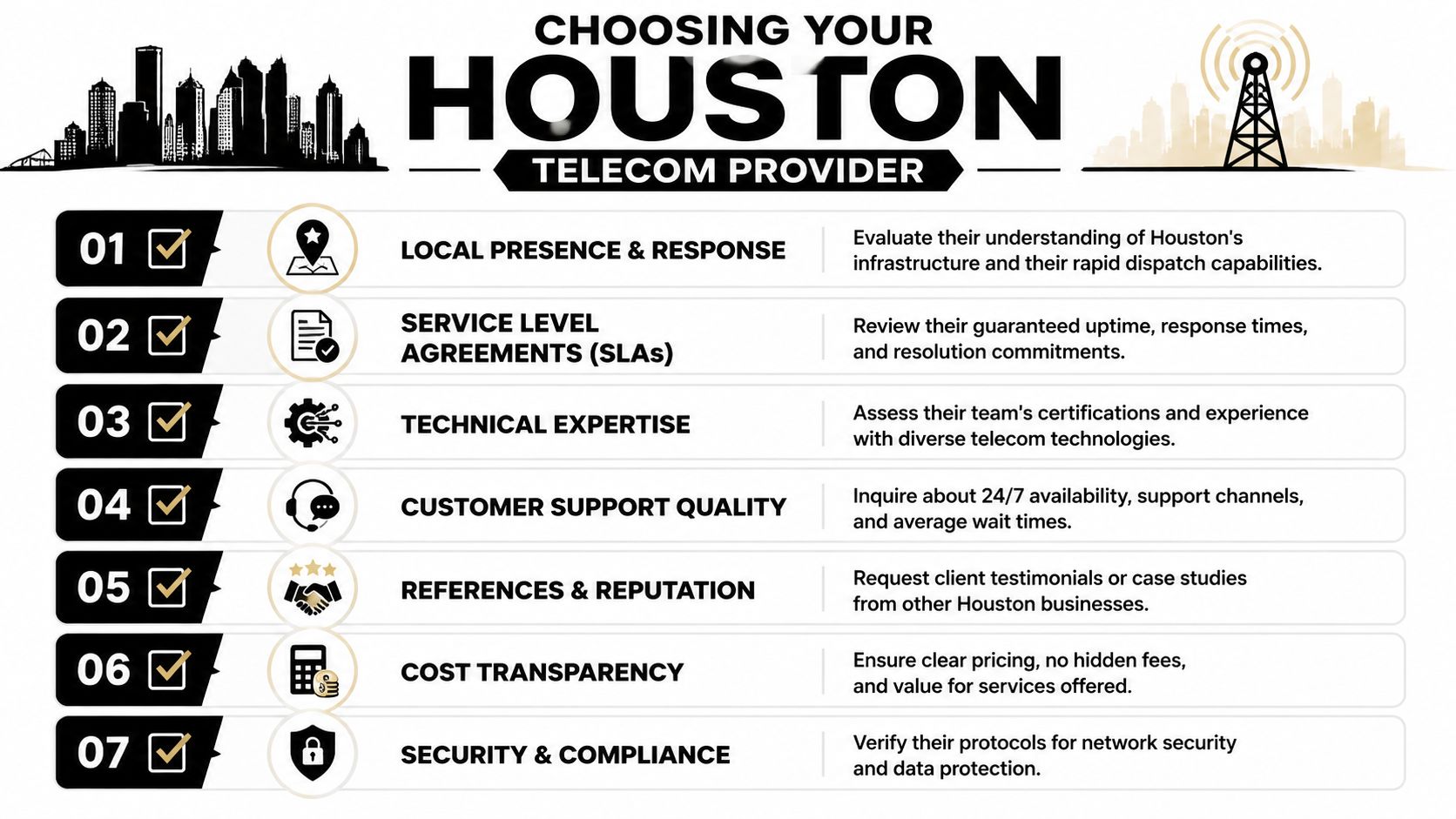
How to Vet and Choose a Houston Telecom Provider
A polished proposal doesn't tell you much by itself. Telecom providers sound similar until you ask how they dispatch, what their technicians do onsite, and how they handle the ugly parts of live infrastructure work.
Start with local presence, not just coverage maps
Many firms can sell in Houston. Fewer can field a real local response. That distinction matters because the work often requires building access, rapid dispatch, and technicians who can adapt to site-specific conditions without starting from zero.
Houston is supported by a substantial telecom ecosystem, and the U.S. Bureau of Labor Statistics reported 60,910 telecommunications line installers and repairers employed in the telecommunications industry in May 2023, with an annual mean wage of $76,740 and an hourly mean wage of $36.90. In plain terms, businesses in this market have reason to expect providers with actual field capacity, not just remote support backed by subcontractor guesswork.
Ask direct questions such as:
Who is local
Are the technicians employees, recurring subcontractors, or whoever is available that day?What can they do onsite
Can they cable, test, replace hardware, coordinate carrier handoffs, and document changes?How do they respond after hours
If your outage starts late or during a critical event, what happens next?
Read the SLA like an operator, not a buyer
Service level agreements are often written to sound reassuring. Read them from the standpoint of someone losing connectivity at a live site.
A useful SLA should clarify:
| Question | What you want to see |
|---|---|
| Response | A clear definition of when response starts |
| Dispatch | Whether onsite dispatch is included or extra |
| Coverage window | Business hours only or broader support |
| Escalation | Named process for urgent failures |
| Exclusions | Carrier delays, customer-owned gear, after-hours access issues |
If the language is fuzzy, expect friction later. “Best effort” may be fine for noncritical systems. It isn't enough for sites where phones, connectivity, or tracked operations can't stay down.
Test technical depth with specific scenarios
Don't ask whether they “do telecom.” Ask what they'd do if your primary circuit stayed up but voice quality collapsed. Ask how they handle a mixed environment with legacy PBX remnants and newer UCaaS phones. Ask what they need from your team before replacing a firewall-adjacent edge device.
Strong providers answer with process. Weak providers answer with adjectives.
Ask for the sequence, not the promise. Good telecom partners can describe how they inspect, test, isolate, replace, document, and close.
Look for lifecycle discipline too
A provider that installs cleanly but leaves retired equipment piled in a room is creating a future problem. Even if another vendor handles asset disposition later, the telecom provider should know how removed devices are segregated, documented, and handed off.
For businesses sorting through local options, telecom installation services near me is a useful search path, but your shortlist should come from operational answers, not homepage language.
Navigating Houston's Local and Regulatory Landscape
Houston telecom work gets expensive when teams ignore physical standards and local operating realities. The site may look simple on a floor plan, but large campuses, older buildings, and mixed-use facilities can turn basic installs into rework if the original design cuts corners.
Cabling standards aren't optional
Onsite teams need to know the difference between a run that merely links up and a run that will stay stable under production use. Houston's own technical standards are a good example of how precise this gets. The City of Houston network standards specify a 295-foot permanent-link limit for horizontal copper, require 10-foot service loops at the IDF side and 3-foot loops at the workstation side, and call for 2-strand singlemode fiber with media converters when runs exceed that limit, along with Cat6A patch cords, STP in high-EMI areas, and OSP-rated cabling outdoors.
That level of detail matters because poor design choices don't fail gracefully. They become intermittent faults, unstable links, and repeat truck rolls.
Houston-specific resilience planning
Storm exposure changes telecom planning. So does the city's mix of high-rise offices, industrial properties, healthcare sites, and distributed operational footprints. Businesses should expect onsite teams to think about continuity in physical terms, not just subscription terms.
Useful local questions include:
Where is critical gear mounted
If water intrusion, heat, or access restrictions hit the site, can your team still reach and protect key devices?How is failover tested
Not whether it exists on paper, but whether someone has verified the path under realistic conditions.What happens during a building issue
If power, riser access, or site entry becomes constrained, who has the authority and plan to respond?
Permits, pathways, and building coordination
In larger Houston properties, successful telecom work depends as much on coordination as on equipment. You may need landlord approvals, riser scheduling, escort procedures, after-hours work windows, or coordination with facilities and security.
That's why experienced onsite crews ask early about:
- Access controls for MDFs, IDFs, roofs, and loading areas
- Cable pathways that affect routing choices and future expansion
- Shared building constraints where multiple tenants and vendors intersect
A provider that treats these as side issues usually causes delays. A provider that handles them upfront tends to keep the project moving and reduce rework.
The Final Step Your Telecom Upgrade is Missing
Most telecom projects end too early. The new system goes live, everyone confirms service, and the team moves on. Meanwhile, the old routers, switches, PBX units, handsets, drives, batteries, and patch hardware are still sitting in a closet, staging area, or dock cage with no clear disposition plan.

That's not cleanup. It's an unmanaged risk.
Why old telecom gear creates a second project
Telecom refreshes don't just remove scrap metal. They often retire devices that held configurations, call data, credentials, logs, storage, or regulated components. The operational question isn't only who installs the replacement. It's who takes custody of the removed equipment, how data-bearing components are handled, and how the material leaves the site responsibly.
That gap shows up often in provider pages that describe service coverage but say little about end-of-life handling. As noted in this Houston telecom discussion on the overlooked end-of-life question, telecom refreshes commonly involve retiring routers, PBX hardware, and storage that can contain sensitive data, and an integrated plan should include asset recovery, wipe verification, and responsible recycling.
What a complete retirement plan should include
For practical purposes, telecom decommissioning should cover four controls:
Asset recovery and segregation
Removed gear should be grouped intentionally, not left mixed with office junk, spare parts, or active equipment.Data handling
Devices that may retain information need sanitization or destruction procedures appropriate to the device type and business policy.Chain of custody
Someone should be able to say what left the room, who handled it, and where it went next.Responsible downstream processing
Gear that can't be reused should move through proper electronics recycling channels rather than improvised disposal.
IT asset disposition becomes part of telecom planning, not a separate afterthought. A lot of businesses still separate the two and end up with confusion between IT, facilities, procurement, and sustainability teams.
Where a recycling and ITAD partner fits
One option in this phase is certified hard drive destruction services in Houston, particularly when retired telecom or adjacent network equipment includes storage or data-bearing components that shouldn't leave your control without documented handling. Reworx Recycling also works in the broader electronics recycling and IT equipment disposal space, which makes it relevant when telecom upgrades generate mixed loads of phones, networking gear, computers, and related hardware.
Old telecom equipment shouldn't linger in storage because nobody owns the last step. Assign ownership before cutover day, not after.
This is also where sustainability leaders should pay attention. Telecom retirement can support electronics recycling, IT equipment disposal, secure data destruction, IT asset disposition, donation-based recycling, and broader sustainable recycling goals if the process is built properly from the start. If the process isn't built, the same project can create security loose ends, storage headaches, and waste liabilities.
Frequently Asked Questions About Onsite Telecom
What's the difference between onsite telecom support and a managed service provider
They can overlap, but they aren't the same thing. A managed service provider may monitor systems, coordinate vendors, and provide remote support across IT functions. Onsite telecom service is narrower and more physical. It deals directly with circuits, cabling, network closets, handsets, edge devices, and field troubleshooting.
Some MSPs include telecom capability. Some don't. The key question is simple: when the problem requires hands at the site, who shows up and what can they do once they're there?
How should a business budget for maintenance versus emergency calls
If telecom matters to daily operations, relying only on break-fix support usually costs more in disruption than it saves in fees. A practical approach is to treat routine maintenance as a planned operating expense and reserve emergency support for unpredictable failures.
That means you review the environment on purpose, keep documentation current, and test critical paths before they fail under pressure. Emergency dispatch still has a place, but it shouldn't be the only model.
A useful internal budgeting split looks like this:
- Planned maintenance covers inspections, cleanup, testing, and minor corrections.
- Project work covers expansions, relocations, refreshes, and carrier changes.
- Emergency response covers outages, damaged hardware, and service failures.
Does onsite telecom only matter for large enterprises
No. Smaller organizations often feel outages more sharply because they have less redundancy in staff and process. A midsize office, clinic, warehouse, or nonprofit may not have deep internal telecom expertise, which makes local field support even more valuable when issues disrupt phones, internet access, or workflow systems.
The main difference is scope, not importance. Smaller firms may need simpler environments supported well. Larger firms may need more formal processes across many sites.
Our upgrade is done. What should we do with old phones, switches, and related gear
Don't leave them sitting in storage without a disposition plan. Start by separating obviously active equipment from retired equipment, then identify anything that may hold data or configuration information. After that, route the retired assets through a documented ITAD and electronics recycling process.
That step often gets ignored because the “project” feels complete once the new system is live. In reality, retirement is the last technical and compliance step of the project, especially if the load includes networking gear, PBX components, office electronics, or hardware tied to a larger office cleanout or facility cleanout.
If your Houston organization is replacing telecom hardware, clearing out network closets, planning a data center decommissioning, or building a more responsible electronics recycling workflow, Reworx Recycling offers planning resources and services related to secure data destruction, IT equipment disposal, donation-based recycling, corporate donation programs, and sustainable end-of-life handling. It's a practical next step if you need to donate old equipment, schedule a pickup, or align telecom retirement with a more controlled and community-minded recycling process.