You're probably starting this search because something already hurts. Calls break up during busy hours. Internet tickets bounce between your ISP and your firewall vendor. A renewal date is approaching, and nobody on your team wants to untangle old carrier contracts, aging circuits, and a pile of phones or network gear that should've been retired months ago.
That's why “managed telecom services near me” isn't a casual search anymore. For most SMBs, it's a risk-management decision. You're not just looking for someone to sell bandwidth or VoIP seats. You're looking for a partner who can stabilize communications, simplify support, and keep technology decisions from creating a bigger cleanup problem later.
Why Your Search for Telecom Services Matters More Than Ever

A lot of companies still treat telecom as a utility. Pay the bill, call support when something breaks, and hope the stack keeps working. That approach falls apart once your business depends on cloud apps, hybrid work, site-to-site connectivity, security controls, and reliable collaboration tools.
The broader market is moving in the opposite direction. The global telecom managed services market was valued at USD 20.67 billion in 2022 and is projected to reach USD 55.29 billion by 2030, growing at a CAGR of 13.4%, driven by SMBs that want cost-effective and scalable solutions without carrying large in-house IT teams, according to Grand View Research's telecom managed services market report.
What changed for SMBs
The old model assumed your internal team could manage carriers, handsets, circuits, tickets, and upgrades as a side task. In practice, that work competes with everything else your IT staff already owns. Security patching, endpoint management, Microsoft 365, user support, compliance reviews, and vendor coordination all land on the same people.
Managed telecom services can remove that drag if the provider takes ownership. That means real escalation paths, documentation discipline, and enough engineering depth to troubleshoot the whole chain instead of blaming a single device.
A local search matters because proximity still helps. Regional providers usually know the local carrier environment, common service limitations, and where last-mile issues show up. If you're trying to compare options, reviewing telecommunications company options near you can help frame the local vendor field.
Practical rule: If a provider only talks about monthly cost and call quality, you're still hearing a sales pitch, not an operating model.
The part most buyers miss
Here's the trade-off I've seen repeatedly. Teams get highly focused on uptime, response times, and pricing. Those matter. But the selection process often ignores the final stage of the lifecycle: what happens when the migration leaves behind phones, routers, switches, modems, access points, and legacy telecom hardware.
That omission creates operational clutter at best and a compliance problem at worst. A good telecom partner should think beyond install day. They should have a clean plan for decommissioning, secure handoff, asset tracking, and retirement of replaced equipment.
That's the fundamental difference between a vendor and a partner. One installs the new system. The other helps you manage the full technology lifecycle without leaving risk in the storage room.
Smart Strategies for Finding Local Telecom Partners

Typing “managed telecom services near me” into Google is a starting point. It's not a vetting process. Search results will surface companies with decent local SEO, not necessarily the ones that run disciplined projects or think about risk after cutover.
The market has a blind spot. Most managed telecom providers focus on voice and data solutions but offer zero guidance on secure device retirement or IT asset disposition. That leaves businesses with a compliance and environmental blind spot during upgrades, especially when telecom equipment can comprise up to 12% of the 57 million tons of e-waste generated annually, as outlined in Warner Telecom's discussion of telecom provider gaps.
Search for lifecycle capability, not just telecom support
Change your search terms. Don't stop at “managed telecom services near me.” Add modifiers that expose whether a provider understands the full operational picture.
Try searches built around:
- Migration intent: “managed telecom provider office relocation” or “telecom migration support business”
- Infrastructure depth: “SD-WAN VoIP carrier management local MSP”
- Retirement planning: “telecom decommissioning secure disposal ITAD”
- Regulated environments: “HIPAA telecom support” or “PCI telecom managed services”
That last category matters because a provider that has operated in regulated environments usually documents better, escalates faster, and respects change control.
If you want to benchmark how modern providers position cloud communications, review examples like Modern phone solutions by F1Group. Not because you should copy the stack, but because it shows how some firms package voice, support, and business communications in a more integrated way.
Ask where old hardware goes
This question filters weak providers quickly. Ask, “When you replace our phones, routers, switches, and wireless gear, who handles secure retirement?” If the answer is vague, you've learned something useful.
A stronger provider will already have a process for:
- Asset logging: What was removed, from which site, and by whom
- Chain of custody: How retired devices are tracked after removal
- Secure data handling: What happens to storage-bearing equipment
- Disposition planning: Whether the equipment is refurbished, recycled, or destroyed according to policy
For a broader view of the kinds of providers and service categories businesses often compare, it helps to review telecom solutions in your area.
The search gets better the moment you stop asking, “Who can install this?” and start asking, “Who can own the consequences of this decision for the next few years?”
Go beyond Google
Some of the best telecom referrals come from non-competing peers. Ask a local manufacturer, healthcare practice, law firm, logistics company, or multi-site office who they trust for carrier management and escalations. Those teams will tell you what the website won't.
I also look for evidence of local operating maturity. Do they participate in regional business groups? Can they explain how they handle dispatch, project management, and after-hours support for nearby sites? Local presence only matters if it translates into better accountability.
Your Vetting Checklist for Managed Telecom Providers
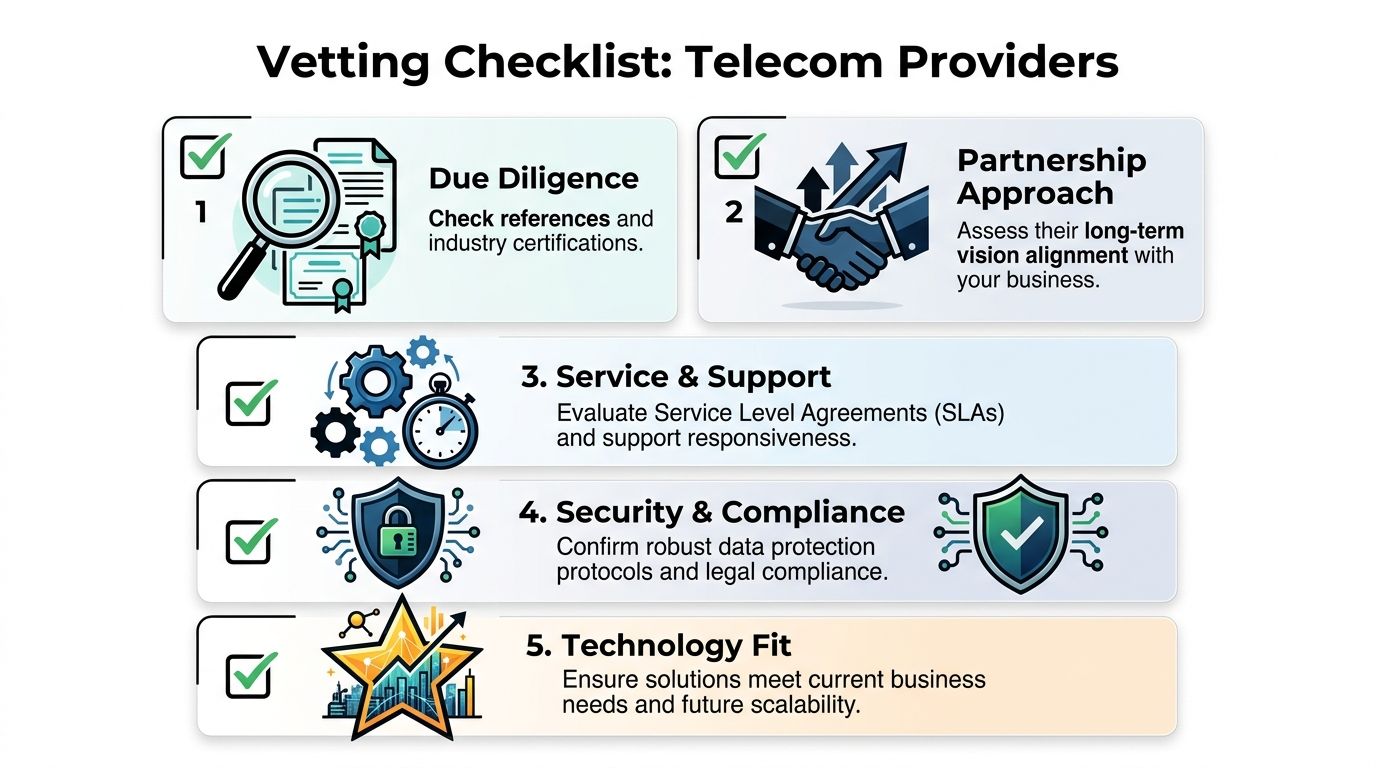
Once you have a shortlist, stop thinking like a shopper and start thinking like an operator. The right provider isn't the one with the nicest demo. It's the one you can manage, hold accountable, and scale with.
One issue almost always gets overlooked. Many providers talk about savings, but few offer a transparent sustainability ROI. They often fail to provide data on the environmental impact of upgrading, the embodied carbon in new equipment, or the circular economy benefits of refurbishment. That makes it harder for businesses to align cost efficiency with ESG goals, as noted in Cloudtango's discussion of this market gap.
The five areas that matter
Here's the checklist I use.
| Area | What to verify | What weak answers sound like |
|---|---|---|
| Service levels | Clear uptime commitments, escalation rules, support hours, and ownership boundaries | “We're very responsive” |
| Security and compliance | Documented handling of vulnerabilities, admin access, logging, and policy alignment | “Security is built in” |
| Commercial model | Billing clarity, contract terms, renewal structure, and change-order rules | “We'll work that out later” |
| Scalability | How they support new sites, hybrid work, and platform changes | “We can probably add that” |
| Lifecycle planning | Decommissioning, asset retirement, and sustainability reporting approach | “You can handle disposal internally” |
What strong due diligence looks like
I don't need a provider to be perfect. I need them to be precise. Their team should know who owns incident communication, how they document inventory, and when they escalate to a carrier versus solving the issue themselves.
Look for these signs:
- Operational discipline: They maintain current inventories, circuit records, and site diagrams.
- Support maturity: They can explain ticket routing, severity definitions, and communication during outages.
- Project control: They use a defined rollout plan rather than “best effort” coordination.
- Honest limitations: They'll tell you where they rely on third parties and where they don't.
If you're comparing local vendors and want a practical frame for the market, this view of local telecom companies and related services can help narrow the field.
Field note: The best provider conversations are usually less polished. Good operators answer with process, not slogans.
Don't treat sustainability as a side issue
A telecom refresh creates a physical footprint. Old desk phones don't vanish. Firewalls, access points, patch gear, UPS units, and network appliances all have to go somewhere. If the provider has no answer, your team inherits the mess.
That matters for more than sustainability reporting. It affects storage, audit readiness, security handling, and the speed of future moves. I'd rather work with a provider that admits they need an outside recycling or ITAD partner than one that ignores the issue entirely.
The pricing trap
Cheap monthly pricing can hide expensive behavior. I've seen low-cost providers win the contract and then lose trust through slow escalations, weak project management, or sloppy inventory control. By the time the business notices, the savings are gone.
A better comparison is total operating friction:
- How many vendors must your team coordinate
- How often issues get bounced
- How cleanly the provider handles adds, moves, and changes
- How much legacy equipment gets left behind after a rollout
That's the difference between buying telecom service and buying telecom management.
Critical Questions to Ask Potential Telecom Partners
The sales deck usually sounds fine. What matters is how the provider behaves when a cutover slips, a carrier misses an install date, or a new security issue hits hardware already in production.
I like to structure interviews around real scenarios. If a provider struggles with practical questions, that's useful. It means your team will be doing more of the work than the contract suggests.
Questions about architecture and technical depth
Start with how they design and operate.
Ask:
- How do you handle multi-site environments with different carriers and legacy equipment?
- What's your process for documenting existing telecom assets before any migration starts?
- How do you decide when to standardize hardware versus support a mixed environment?
- Which tools do you use for inventory discovery, configuration management, and monitoring?
This is also where I test for vendor lock-in thinking. Top-tier MSPs can reduce deployment time by 50% through zero-touch provisioning when they migrate clients to open standards like TIP OpenWiFi. By contrast, vendor-specific lock-in can delay migrations by 6 to 12 months and cause new feature rollouts to lag by 18 months, according to Broadband Breakfast's analysis of MSP challenges.
That's why I ask directly:
- What's your stance on open standards and multi-vendor environments?
- When do you recommend an open approach versus a single-vendor stack?
- What would make our environment hard to migrate later?
For companies comparing providers in the Southeast, a review of telecom services in Atlanta can help frame the types of service capabilities worth asking about.
Ask questions that force a provider to describe decisions, not features.
Questions about support under pressure
Support quality is rarely obvious during a sales cycle. You have to pull it out of them.
Use scenario prompts:
- Describe how you handle a widespread voice issue during business hours. Who communicates with us, and how often?
- Walk me through your process for responding to a zero-day vulnerability affecting network hardware in production.
- If a carrier and our LAN team disagree about the source of a failure, who owns the bridge call and evidence gathering?
- How do you classify severity, and what changes after hours?
You're listening for ownership. Strong providers name roles, decision points, and escalation timing. Weak ones fall back on “we open a ticket with the carrier.”
Questions about lifecycle and retirement planning
At this point, a lot of interviews get more revealing.
Ask:
- What happens to replaced phones, routers, APs, and network gear after cutover?
- Do you provide asset lists for removed equipment?
- How do you coordinate secure handling for storage-bearing devices?
- Can you support decommissioning during office closures, consolidations, or data center changes?
If they look surprised, that's the point. You've identified a provider that thinks only about deployment, not about the end of life for the equipment they replace.
Managing the Transition to a New Provider

Choosing a provider is only the midpoint. The transition tells you whether you picked well. Good telecom firms create order fast. Weak ones create meetings, spreadsheets, and confusion.
I prefer a phased onboarding plan instead of a full cutover on day one. Start with a limited scope. One site, one circuit type, or one user group is enough to test ticket handling, inventory accuracy, communication quality, and implementation discipline.
What the first phase should produce
A serious provider should deliver a clearer baseline almost immediately. That means an inventory of what exists today, where the contract exposure sits, and which services no longer fit the business.
A proven managed services provider can deliver 10 to 20% average cost reductions through a structured expense optimization method that includes a forensic audit, identifying billing errors that account for 30% of overspend, reducing management overhead through consolidation by 25 to 40%, and using bulk purchasing power for better rates, according to AgilityPortal's telecom managed services analysis.
That doesn't mean you should expect instant savings on every account. It does mean the onboarding work should be evidence-based.
Here's what I expect in the opening phase:
- Telecom audit: Review invoices, contracts, service records, and active usage
- Inventory consolidation: Build a usable record of circuits, devices, sites, and vendors
- Support mapping: Define who calls whom when incidents happen
- Migration sequencing: Identify what can move first and what should wait
Contract terms worth slowing down for
Don't rush signature review just because the project team wants to start. Pay attention to the clauses that decide how painful a bad relationship becomes later.
Focus on:
- Data ownership: Your inventories, records, and service documentation should remain accessible.
- Exit language: Offboarding support should be clear before onboarding starts.
- Change controls: Adds, moves, and changes need a defined approval path.
- Liability and exclusions: Know what the provider won't own.
If the transition is tied to a physical move, expansion, or consolidation, it helps to think in parallel about telecom and facilities planning. Teams handling office relocation and equipment transitions usually benefit from treating telecom, decommissioning, and asset retirement as one project rather than three separate ones.
Operator advice: A smooth transition isn't the absence of issues. It's the presence of fast ownership when issues appear.
Where transitions usually fail
In my experience, transitions go sideways for simple reasons. Nobody agrees on the source inventory. Legacy circuits don't match invoices. The business assumes old hardware “will get handled later.” Support paths are unclear until the first outage.
That's why the first weeks matter so much. You want a provider that surfaces hidden complexity early, even if the news is inconvenient. The firms that promise a frictionless rollout often haven't looked hard enough.
Building a Lasting and Strategic Telecom Partnership

The best result from a search for managed telecom services near me isn't a lower monthly invoice. It's a more stable operating environment. Your team spends less time chasing carriers, less time untangling escalations, and less time dealing with leftovers from old technology decisions.
That only happens when the provider understands the full lifecycle. They need to support today's voice, connectivity, wireless, and network needs. They also need to help you retire yesterday's equipment in a controlled way. Most firms are happy to talk about deployment. Fewer are prepared to talk about decommissioning, secure data destruction, or responsible asset retirement with the same level of detail.
That's the gap worth paying attention to. A provider that ignores end-of-life planning usually leaves cleanup work on your side. A provider that plans for it reduces risk, keeps projects cleaner, and gives facilities, IT, and compliance teams a shared operating picture.
If you're making this decision now, be selective. Ask harder questions. Push for precise answers. Favor partners who document well, communicate clearly, and can explain what happens before, during, and after a migration.
Good telecom management doesn't stop at installation. It proves itself during renewal cycles, office moves, hardware refreshes, and the moment old equipment needs to leave the building responsibly.
If your business is replacing phones, networking gear, servers, laptops, or other legacy equipment during a telecom upgrade, Reworx Recycling can help you handle the final step responsibly. Their team supports electronics recycling, donation-based recycling, IT equipment disposal, secure data destruction, office cleanout, data center decommissioning, and broader IT asset disposition needs while advancing social enterprise recycling and community impact. If you're planning a refresh, schedule a pickup, donate old equipment, or explore a partnership that keeps retired technology out of landfills and puts usable devices back to work where they can help communities most.