Your phones sound fine until they don't. Then a sales team can't reach clients, a front desk can't transfer calls, a warehouse can't confirm pickups, and a remote employee starts missing meetings because voice quality collapses at random times.
That's usually when business owners start searching for telecom support services Los Angeles. Not because they want another vendor, but because communications problems stop feeling like “IT issues” and start feeling like operational risk. In Los Angeles, where companies juggle hybrid work, multiple sites, old cabling, cloud calling, and nonstop customer expectations, telecom support has to cover more than a phone system. It has to protect uptime, reduce disruption, and make future upgrades less painful.
There's another layer many companies miss. Telecom infrastructure has a full lifecycle. You install it, maintain it, secure it, upgrade it, and eventually retire it. If that last step is handled poorly, old handsets, switches, routers, and voice appliances can create both data security and disposal problems. That's why smart telecom planning now overlaps with IT asset disposition (ITAD), secure data destruction, and sustainable recycling.
Why Reliable Telecom Support Is Your LA Business Lifeline
A common Los Angeles scenario looks like this. A post-production studio opens on a deadline day, but incoming calls aren't routing correctly, internal extensions fail intermittently, and a conference bridge for a client review keeps dropping. The internet is technically up, yet the business is still half offline because its voice environment is unstable.
That's the mistake many companies make. They treat telecom as a utility that should “just work,” until one broken element exposes how many workflows depend on it.

Downtime hits more than the phone system
When telecom support is weak, the problem spreads fast:
- Sales teams lose momentum: Missed inbound calls and poor call quality affect new business and account management.
- Customer-facing staff stall out: Reception, service dispatch, reservations, and support desks rely on call routing and voicemail.
- Leadership loses visibility: If conferencing and collaboration tools don't connect cleanly, decisions slow down.
- IT gets dragged into firefighting: Internal teams stop working on planned projects and start chasing recurring call issues.
For many LA businesses, telecom also touches door systems, paging, contact centers, alarm lines, conference rooms, and branch connectivity. That's why a support gap in one area often creates confusion in three others.
Practical rule: If your business can't tolerate several hours of calling disruption during a busy day, telecom support is a business continuity function, not a side service.
Some owners also overlook the local context. Los Angeles is a huge, dense market with mixed building stock, distributed teams, and wide differences in connectivity quality from one neighborhood or facility type to another. Support has to account for that reality. It's not enough to promise remote help if your issue needs someone onsite and your office is across town in traffic.
Telecom support also reflects a broader community need
Reliable connectivity isn't only a private business concern. Los Angeles County announced a public-private broadband partnership in May 2024 that targets over 275,000 households and small businesses in areas including East LA and South LA, which shows how large the local need is for affordable, dependable connectivity and support, according to the Los Angeles County broadband partnership announcement.
That matters for employers. Your telecom choices affect staff productivity, customer access, and in some cases your ability to support distributed or lower-connectivity users. A good provider helps you stabilize service now and plan for changing work patterns later.
When you're reviewing options, it also helps to think beyond installation and repairs. A local resource like telecom consulting support in Los Angeles can help frame telecom as part of a broader infrastructure strategy, not just a phone bill. And if your team is also trying to reduce device waste from upgrades, practical guidance like Trade.com.au's recycling tips can help you build better habits around retired mobile equipment.
Decoding Telecom Support The Core Services Explained
Many companies buy telecom support without a clear understanding of the included services. That leads to two expensive mistakes. They either pay for a bare-bones arrangement that won't protect uptime, or they sign up for a bundle that sounds impressive but doesn't match how the business operates.
A better way to think about telecom support is to compare it to a commercial building. You need the walls and wiring, the switches and controls, the safety systems, and the people who know how to troubleshoot when one layer affects another.
The physical layer and the service layer
Some support starts with hardware. That includes structured cabling, handset deployment, switches, routers, session-aware voice devices, patching, and rack organization. If those pieces are installed poorly, no amount of software tuning will fully fix the instability.
Other support sits above the hardware. That includes call routing, voicemail, auto attendants, conferencing, carrier coordination, platform administration, and troubleshooting between your internet connection and voice service. In this context, many businesses discover that “the phones” are really a mix of vendor platforms, network paths, and policies.
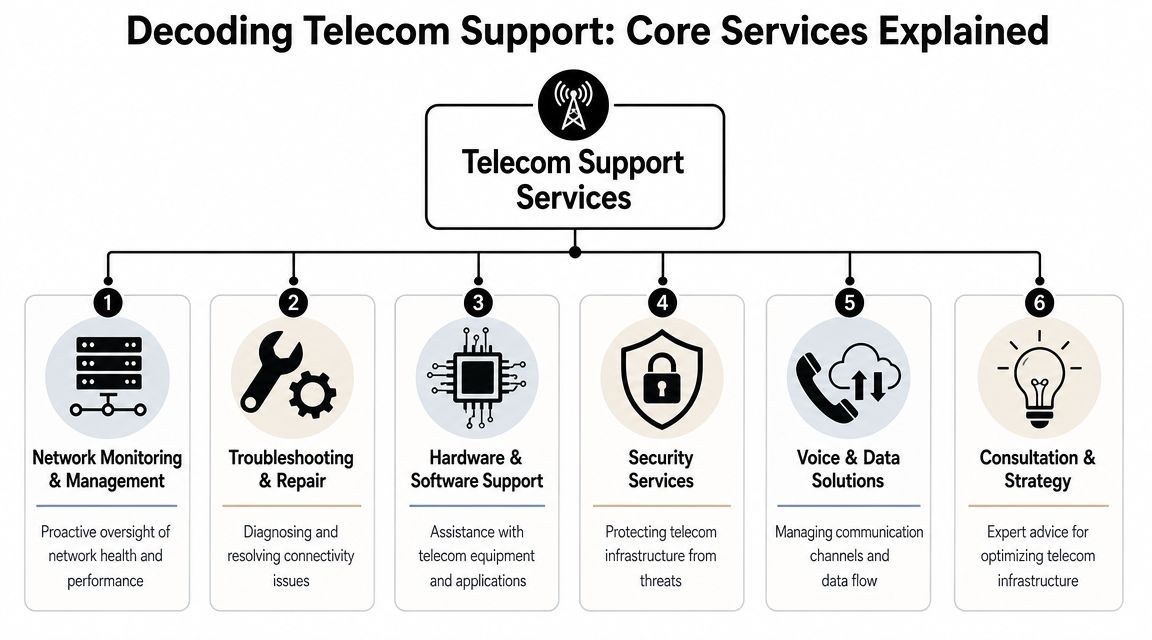
Here's a practical breakdown:
- Onsite infrastructure support: Cabling, hardware replacement, equipment setup, move-add-change work, and physical troubleshooting.
- Remote monitoring and maintenance: Watching call performance, service availability, and alerts before users flood the help desk.
- Carrier and vendor coordination: Opening tickets, escalating outages, and translating technical findings into plain business impact.
- Voice platform administration: Managing users, extensions, routing rules, hunt groups, and call flow changes.
- Security and access control: Protecting signaling, administrative access, and related communications systems.
- Planning and migration support: Moving from legacy PBX or hybrid voice systems to cloud calling without creating chaos.
Why protocol knowledge matters
A lot of telecom trouble doesn't look dramatic. Calls may connect but sound clipped. Transfers may fail only between certain locations. A Teams user may call out successfully but not receive inbound calls through a specific route. Those aren't “simple phone problems.” They're interoperability problems.
Support professionals in this space need working knowledge of SIP and RTP for call setup and media flow, TLS for security, plus hands-on experience with platforms such as Cisco Unified Communications Manager and Microsoft Teams Direct Routing, as shown in a California telecom support job posting on Indeed.
Good telecom support doesn't just reset devices. It traces how calls are signaled, where media travels, and why one system interprets another system incorrectly.
That's why businesses should ask what stack a provider supports. If your environment includes Cisco, Avaya, Teams calling, or a mix of legacy and cloud tools, you need a team that's comfortable in mixed environments.
What service mix fits most growing companies
Not every company needs a fully managed voice environment. But most small and mid-sized firms in Los Angeles do need a blend of reactive and proactive help.
A useful middle ground often includes:
- A stable baseline: Monitoring, alerting, and recurring health checks.
- Fast access to expertise: Someone who can diagnose routing, endpoint, and provider-side issues.
- Change support: Adds, moves, and policy adjustments when departments grow or relocate.
- Upgrade guidance: Help evaluating whether to keep a legacy setup, extend it, or replace it.
If your infrastructure plan also includes voice gear refreshes, branch consolidation, or retirement of old communications hardware, it helps to review a broader Los Angeles telecom services overview so support decisions line up with network, device, and lifecycle planning.
Choosing Your Telecom Partner Key Criteria for LA Businesses
A provider can sound polished in a proposal and still be the wrong fit. In Los Angeles, that mismatch shows up quickly. One business needs onsite help across multiple offices. Another needs careful after-hours cutovers. A third needs telecom support that works with accessibility requirements and older building infrastructure.
The right partner isn't just technically capable. They're operationally disciplined.
Start with response expectations, not marketing language
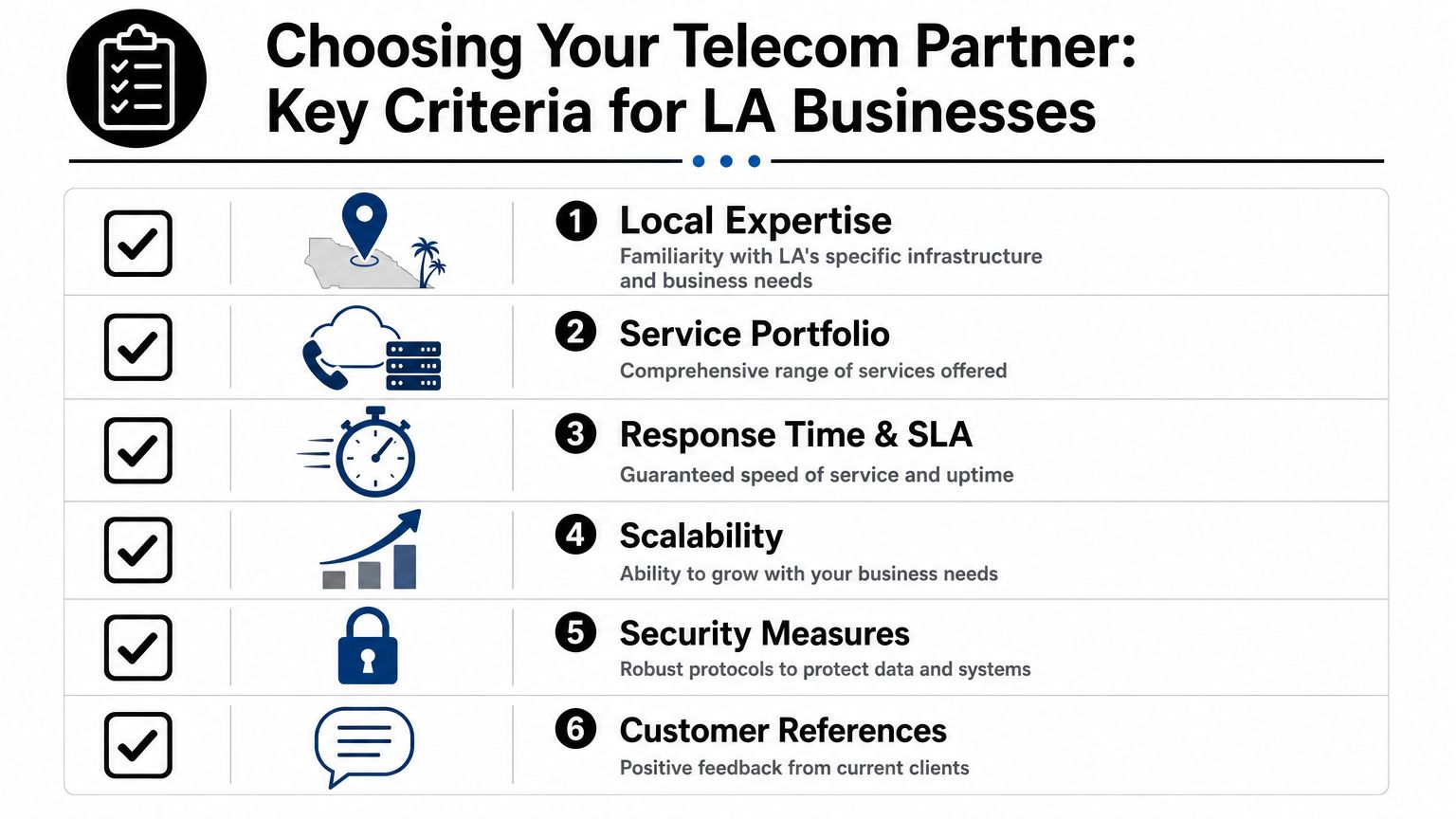
Many proposals promise “fast support.” That phrase means almost nothing unless you know what triggers a response, what counts as resolution, and whether onsite dispatch is included.
When you compare providers, look for clarity on these points:
- Severity definitions: What counts as a critical outage versus a minor issue?
- Escalation path: Who takes over when first-line support can't solve the issue?
- Onsite availability: Can they send someone when remote diagnostics aren't enough?
- After-hours coverage: Are nights and weekends covered by the same team or a separate queue?
- Change windows: Can they support planned cutovers outside business hours?
If you manage several locations, ask how they handle a branch issue differently from a headquarters outage. Those situations shouldn't follow the same playbook.
Check for fit with your environment
A law office, medical group, school, warehouse, and hotel may all need phones and connectivity, but their support expectations are different. The provider should understand your business rhythms and critical communications points.
Industry-specific questioning is crucial. For example, a healthcare group may prioritize continuity and user provisioning across clinics. A property manager may care more about front-desk routing, building entry systems, and tenant communications. A manufacturer may need paging, plant-floor reliability, and less tolerance for onsite disruption during shifts.
One useful way to pressure-test a service promise is to compare it against broader service packaging examples. Resources like what to expect from our services can help you think more critically about what should be explicitly included versus vaguely implied in a contract.
Don't skip accessibility capability
A surprisingly overlooked issue in telecom support is accessibility. California offers programs that provide specialized telecommunications equipment for residents with certified disabilities affecting hearing, speech, or vision, and a capable support partner should be able to guide a business on procuring and integrating assistive tools, as described by 211 LA's specialized telecommunications equipment program.
For employers, schools, healthcare organizations, and public-facing businesses, that matters in everyday operations. A provider who can't speak clearly about accessibility equipment, user accommodations, and support workflows may leave your team to figure it out alone.
Accessibility isn't separate from telecom operations. It's part of how users actually access calls, alerts, and communication tools.
Look for evidence of local operating discipline
Before signing, ask for specifics about how they work in Los Angeles. Not broad claims. Specifics.
A strong evaluation usually includes:
- Coverage footprint: Which parts of LA they routinely serve and how they handle dispatch.
- Documentation quality: Whether they inventory circuits, voice paths, devices, and dependencies.
- Change control habits: How they schedule, test, and roll back risky changes.
- Vendor coordination: How they manage carriers, cloud voice providers, and hardware manufacturers.
If you want a localized benchmark for these conversations, a directory-style resource such as a telecommunications company near you in Los Angeles can help frame the kinds of providers and services that commonly show up in this market.
Understanding Telecom Support Costs in Los Angeles
Telecom support pricing gets confusing because many businesses compare unlike-for-like proposals. One quote may cover only reactive labor. Another may include monitoring, user administration, and limited changes. A third may look expensive until you realize it includes after-hours support and a broader service scope.
In Los Angeles, the two most common pricing models are break-fix and managed services. Each works. The better choice depends on how much risk your business can absorb and how often your environment changes.
Break-fix versus managed services
With break-fix support, you pay when something goes wrong or when you request project work. This model can make sense for a smaller office with a simple setup, low change volume, and internal staff who can handle routine administration.
Managed services shift the relationship toward recurring support. Instead of waiting for a failure, you're paying for ongoing oversight, maintenance, and access to support capacity. That tends to fit organizations with more users, multiple sites, hybrid work, compliance concerns, or limited internal telecom expertise.
Local market guidance for Los Angeles puts break-fix support at about $125 to $225 per hour and managed services at about $125 to $220 per user per month, according to this Los Angeles IT support cost guide.
| Model | Best For | Typical LA Cost Structure |
|---|---|---|
| Break-fix | Smaller environments, lower complexity, infrequent support needs | $125 to $225 per hour |
| Managed services | Multi-user environments, recurring support needs, businesses prioritizing uptime | $125 to $220 per user per month |
What those numbers mean in practice
Break-fix can feel cheaper until the business starts stacking tickets. One routing problem, one carrier escalation, one handset batch replacement, and one after-hours issue can change the math quickly. It also creates budgeting uncertainty.
Managed services cost more predictably, but the key question is what's included. Some plans cover monitoring and basic administration but bill separately for project work, onsite visits, or vendor coordination. That's why a monthly fee by itself doesn't tell you much.
Use these filters when comparing proposals:
- Scope of support: Does the contract include voice platform changes, carrier liaison work, and endpoint support?
- Onsite versus remote: Which services are included, and which trigger extra billing?
- Business hours limits: Are after-hours needs billed differently?
- Change volume: If your team frequently adds users, reconfigures call flows, or relocates desks, recurring support may be easier to budget.
If your telecom budget also overlaps with equipment refreshes, old circuit cleanup, or hardware removal, it helps to view support costs next to your broader telecom infrastructure planning in Los Angeles, not as a standalone line item.
Questions to Ask Before Signing a Telecom Support Contract
A proposal tells you how a provider wants to be seen. Your questions reveal how they operate.
Many businesses, at this point, either protect themselves or walk into a messy support relationship. The best questions aren't aggressive. They're specific enough that vague answers become obvious.
Ask about technical depth
Start with the team, not the brand name. Skilled labor is tight in telecom, and staffing quality matters. The U.S. Bureau of Labor Statistics projects about 23,200 annual openings for telecommunications technicians from 2024 to 2034, which underscores the continuing demand for trained people in this field, as cited in Global IT's discussion of managed telecom services and labor demand.
Ask questions like these:
- Who works tickets? Are issues handled by general help desk staff or telecom-focused engineers?
- How do you train technicians? You're looking for a real process, not “they have experience.”
- What platforms do you support day to day? Make them name the systems they work in regularly.
- What happens when a problem crosses providers? Their answer should include escalation, ownership, and communication.
Ask how support works under pressure
The worst time to discover a provider's process is during an outage.
Use scenario questions:
- If our phones are up in one office but failing in another, how do you isolate the issue?
- If a carrier blames our equipment and our platform vendor blames the carrier, who owns coordination?
- What's your after-hours process for a voice outage affecting customer service?
- When do you decide to dispatch onsite instead of continuing remote troubleshooting?
Ask for one real example of an escalation path. If they can't describe the sequence clearly, they probably don't run one consistently.
Ask about contract edges and billing surprises
A lot of frustration comes from assumptions buried in the fine print. Don't ask only for price. Ask what creates extra cost.
A practical contract checklist includes:
- Included work: Which routine tasks are covered each month?
- Excluded work: What always gets billed separately?
- Minimums and dispatch fees: Is there a minimum billable visit?
- Project work: How are migrations, relocations, and larger changes priced?
- Exit terms: What happens if you change providers?
Ask about resilience and staffing
A provider may sound capable, but capacity matters just as much as expertise.
Focus on questions such as:
- How many people are available for telecom support coverage?
- Do you provide 24/7 support, and is that internal or outsourced?
- What happens if our primary contact is unavailable?
- How do you maintain documentation so another technician can step in quickly?
These questions help you distinguish between a company with a repeatable service operation and one that depends on a few overextended individuals.
The Final Step Secure Telecom Equipment Decommissioning
Most telecom discussions stop at procurement and support. That's incomplete. Every business eventually replaces handsets, retires switches, removes routers, decommissions legacy voice gear, or clears out a server room during an office move.
When that happens, old telecom equipment becomes a security, compliance, and sustainability issue all at once.
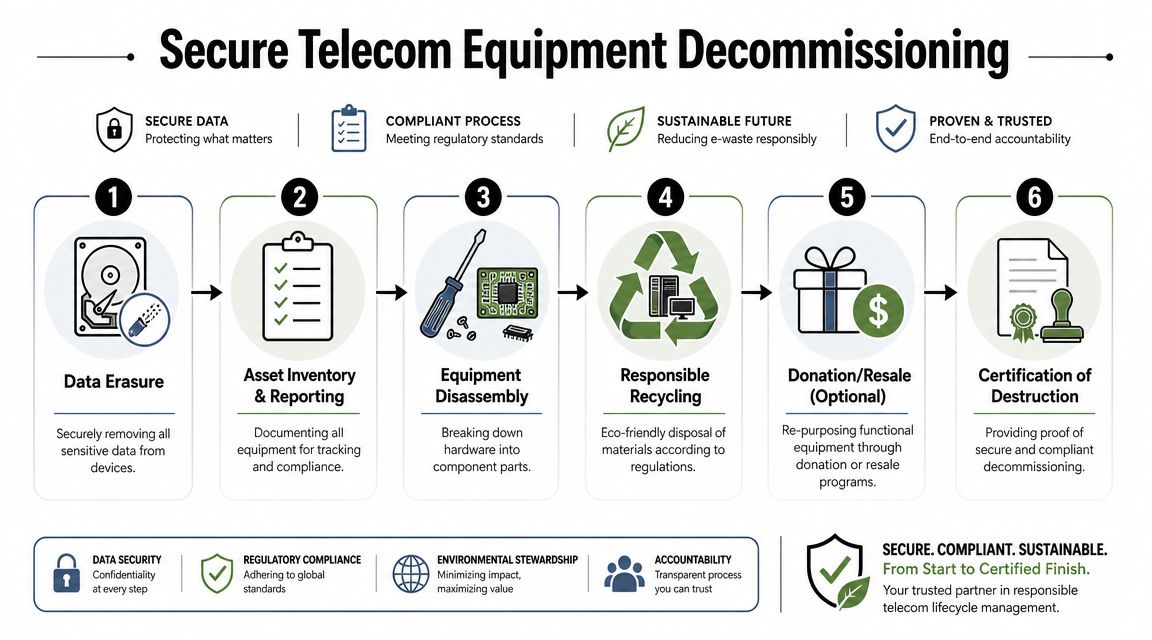
Decommissioning is not the same as unplugging
Retired telecom gear may still contain call logs, configuration data, credentials, storage media, user information, or network details. Even when a device seems outdated or noncritical, it can still expose useful information if it leaves your control without a process.
That's why decommissioning should include more than disposal. It should include:
- Asset inventory: Know exactly what's being removed.
- Data handling: Identify which devices may hold sensitive information.
- Chain of custody: Track equipment from removal through final disposition.
- Environmental handling: Keep electronics out of improper waste streams.
- Documentation: Maintain records for internal review and compliance needs.
Where ITAD fits into telecom lifecycle management
IT asset disposition becomes relevant. A disciplined ITAD process helps a company retire telecom hardware without creating hidden exposure. It also helps facilities, IT, and procurement teams coordinate instead of working in separate lanes.
A practical telecom end-of-life workflow often looks like this:
- Plan the cutover carefully so the old system isn't removed before the new one is stable.
- Document assets by type and location so nothing gets stranded in closets, IDFs, or branch offices.
- Separate reusable from obsolete equipment based on business need and condition.
- Process devices through secure data destruction or verified disposition rather than informal disposal.
- Close the loop with reporting so finance, IT, and compliance teams know what happened.
Old telecom hardware is still part of your risk surface until it's documented, sanitized, and removed through a controlled process.
Why sustainable disposition matters to Los Angeles businesses
For many organizations, telecom refreshes happen alongside office cleanouts, branch closures, relocations, or broader infrastructure upgrades. That means the decommissioning phase may include electronics recycling, computer recycling, laptop disposal, product destruction, facility cleanout, or even data center decommissioning if voice and network systems are part of a larger project.
This is the point where a specialized partner can help. Reworx Recycling provides secure equipment decommissioning support tied to data destruction, equipment handling, and responsible end-of-life processing. For companies managing telecom refreshes, that can align the final stage of the project with secure data destruction, sustainable recycling, and internal reporting needs.
There's also a broader business value here. Donation-based and socially oriented recycling programs can turn retired assets into community benefit when equipment is still suitable for reuse. That supports internal sustainability goals while reducing landfill disposal and simplifying hardware retirement workflows.
The bigger lesson is simple. Telecom support services Los Angeles shouldn't end with installation, troubleshooting, or monthly maintenance. The strongest approach covers the full lifecycle, from design and uptime to decommissioning and responsible retirement.
If your business is replacing phones, clearing out network closets, retiring telecom hardware, or planning a broader IT refresh, Reworx Recycling can help you handle the final step with a structured, responsible process. Donate old equipment, schedule a pickup, or explore a partnership that supports secure disposition, sustainable electronics recycling, and community impact through technology reuse.