
If you're planning a telecom refresh in Dallas, the hard part usually isn't ordering the new gear. It's dealing with what comes out. Legacy PBX shelves, VoIP handsets, switches, routers, UPS units, rack rails, patch panels, copper bundles, and mystery hardware from prior moves all end up in one pile. Then IT, facilities, compliance, and sustainability all want different things from the same project.
That's where most generic electronics recycling advice breaks down. Sustainable telecom recycling Dallas projects succeed when you treat decommissioning as an infrastructure operation, not a junk haul. The assets need to be identified, secured, removed in the right sequence, triaged for reuse or recycling, and documented from pickup through final disposition.
Dallas is a practical market for this work. The city has a long recycling history, and major carriers operating in the market have shown that large-scale reuse and recovery can be executed with discipline. What matters for your team is converting that broad capability into a repeatable playbook for telecom hardware retirement across offices, call centers, branches, and network rooms.
Building Your Decommissioning Blueprint: The Telecom Asset Audit
Unstructured telecom retirements create preventable problems. The project starts as a network upgrade, but by the time the cutover happens, nobody has a clean list of what's leaving service. Facilities sees racks and cabling. IT sees switches and firewalls. Compliance sees data-bearing devices. Finance wants to know whether any equipment still has resale value.
Most Dallas-area telecom recycling content fails to answer the operational question IT teams have: how to retire telecom racks, PBX/VoIP systems, and cabling at scale without creating compliance or chain-of-custody gaps, even though telecom gear has distinct end-of-life handling needs compared with general IT assets, as noted by Dallas telecom recycling guidance.
Start with the audit. Not a loose spreadsheet. An auditable inventory tied to rooms, racks, and business ownership.
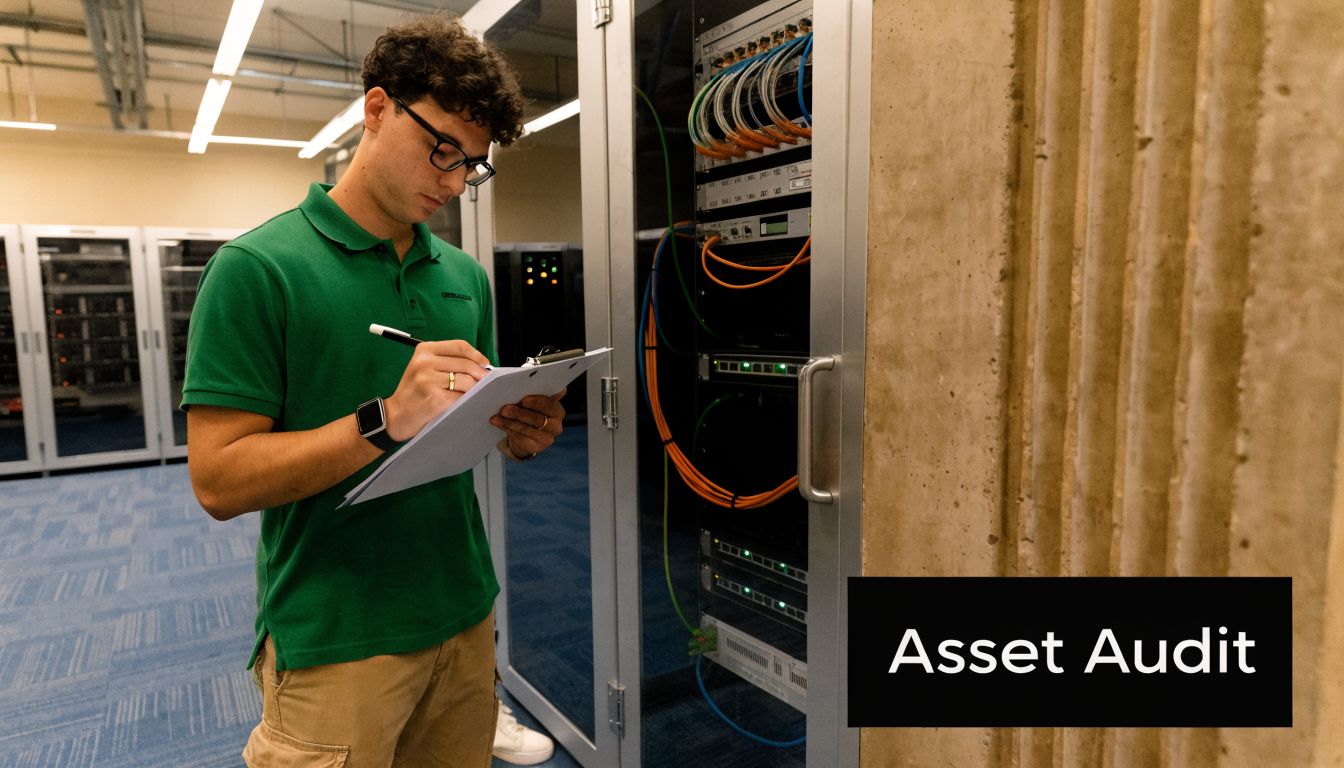
Build the asset list by physical location
The fastest way to miss telecom equipment is to inventory by invoice history alone. Old phone systems, expansion modules, wall-mounted network gear, and branch closet hardware often aren't reflected cleanly in procurement records. Walk the site.
Use a location-first audit sequence:
- Main distribution areas. Capture core switches, routers, firewalls, rack PDUs, UPS units, console devices, and any mounted storage.
- Intermediate closets. Record edge switches, patch fields, injectors, wireless controllers, legacy gateways, and orphaned equipment.
- Work areas and shared spaces. Include desk phones, conference phones, room controllers, and branch appliances.
- Storage rooms. Old VoIP handsets, spare blades, discontinued PBX cards, and unreturned field equipment usually surface in these locations.
The output should map each asset to a room, rack, and status. In service, disconnected but present, staged for removal, or unknown.
Separate telecom gear by disposition path
A useful audit doesn't stop at counting boxes. It sorts equipment into what can happen next.
A practical triage table looks like this:
| Asset type | Key audit question | Likely path |
|---|---|---|
| Enterprise switches and routers | Is it current enough to reuse or remarket? | Reuse, refurbishment, or recycling |
| PBX and voice hardware | Is it still supported and complete? | Niche resale, parts harvest, or recycling |
| VoIP handsets | Are models uniform and in working condition? | Reuse, donation, or recycling |
| UPS units and batteries | Does it require special handling? | Controlled battery recycling |
| Racks, rails, and metal infrastructure | Any embedded electronics or tags? | Reuse, scrap recovery, or redeployment |
| Cabling and patch materials | Is removal in scope and sorted by type? | Commodity recycling where appropriate |
Practical rule: If the audit lists “network equipment” as one line item, the audit isn't ready for pickup.
Flag every data-bearing component
Telecom teams still underestimate how many network assets retain sensitive information. Firewalls, routers, switches, session border controllers, voice appliances, call recording hardware, and multifunction telecom systems can all store credentials, configs, logs, certificates, or locally cached data.
During the audit, mark assets in one of three security categories:
- Known data-bearing such as firewalls, routers, call servers, and appliances
- Potentially data-bearing such as managed switches, IP phones with local storage, and monitoring devices
- Non-data-bearing such as racks, passive cabling, empty patch panels, and metal brackets
That distinction controls downstream handling, labor, and paperwork.
Tie the audit to chain of custody
The audit should become the first document in your custody trail. Serial numbers matter when available, but don't stall the project trying to force perfect serialization on every passive part. Serialize what carries risk or value. Count and classify the rest in grouped line items.
For organizations that need a tighter intake process before recycling, this guide to IT inventory audits before recycling is aligned with the same principle. Know exactly what you're handing off before anything leaves the building.
A disciplined audit does three jobs at once. It defines scope, protects custody, and gives your recycler a realistic basis for logistics and disposition planning. Without it, every later step gets slower and less defensible.
Dallas & Texas E-Waste Compliance for Telecom Gear
Telecom decommissioning gets risky when teams treat compliance as an afterthought. In Dallas, the operational reality is straightforward. You're retiring equipment that may contain data, batteries, circuit boards, and materials that can't be handled like ordinary office trash. The legal rules matter, but so does the evidence that your team followed a controlled process.
Dallas has the advantage of operating in a mature recycling environment. The city set out to more than quadruple recycling tonnage from 10,000 tons in 2003 to 43,600 tons in 2011, and it was projecting 53,000 tons of recycling collections for 2011, or about 10% of the municipal solid waste generated by Dallas, according to Waste360's reporting on Dallas recycling growth. For business users, that history matters because it helped create a market where specialized IT asset disposition and electronics recycling services can operate at commercial scale.
What compliance means in practice
Most teams don't need a legal memo. They need operating rules.
For telecom gear, those rules usually come down to four controls:
- Controlled removal. De-install equipment without mixing regulated or sensitive items into general debris.
- Segregated staging. Keep batteries, data-bearing hardware, reusable equipment, and scrap materials separate.
- Documented transfer. Record what left the site, who released it, and who accepted it.
- Qualified downstream processing. Send the material through a recycler or ITAD provider that can document final handling.
That approach helps with state and federal expectations, internal audit standards, and customer diligence reviews.
Why generic cleanout vendors create problems
A building cleanout company may be perfectly competent at hauling furniture and office fixtures. That doesn't mean it's equipped to manage telecom end-of-life work. PBX cabinets, call processors, network appliances, and battery-backed systems require different handling. If those assets are swept into a broad facility cleanout scope, you lose granularity fast.
That loss shows up in three places:
| Risk area | What goes wrong | What to require |
|---|---|---|
| Asset visibility | Telecom gear gets merged into “miscellaneous electronics” | Itemized inventory and pickup records |
| Environmental handling | Batteries and mixed electronics are packed together | Clear segregation procedures |
| Audit support | No paper trail after removal | Certificates and serialized reporting where applicable |
The strongest compliance posture isn't built at the recycler's dock. It starts in your building with how the assets are identified and handed off.
Dallas market maturity helps, but it doesn't replace process
Dallas can support sustainable telecom recycling Dallas programs because the infrastructure exists. That doesn't mean every vendor uses it well. Your team still needs to ask hard questions about transport, data-bearing devices, battery handling, and downstream accountability.
For organizations comparing providers, secure IT asset disposition services for businesses in Dallas offers a useful benchmark for the type of service scope you should expect in a compliant telecom retirement project. The point isn't branding. It's completeness.
Compliance is less about reciting rules than proving operational discipline. If your records show what was removed, how it was secured, and where it went, you're in a much stronger position than a company that only has a hauling invoice and a handshake.
Ensuring Ironclad Security: Data Destruction and Chain of Custody
The most expensive mistake in telecom recycling usually isn't environmental. It's security-related. Teams remember to wipe laptops. They forget that network and voice infrastructure can store credentials, call logs, config files, VPN details, IP assignments, certificates, local user data, and management history.
That's why data destruction has to sit at the center of the project. Not beside it.
AT&T's circularity reporting shows what scale looks like when secure recovery is built into the model. The company said its consumer-device take-back and recovery programs handled 14.0 million devices in 2025, and 94% of materials from take-back programs were reused or sold in 2025, according to AT&T's circularity reporting. For Dallas businesses, the takeaway isn't to copy a carrier program. It's to recognize that high-volume, secure processing is achievable when intake, tracking, and disposition are controlled.
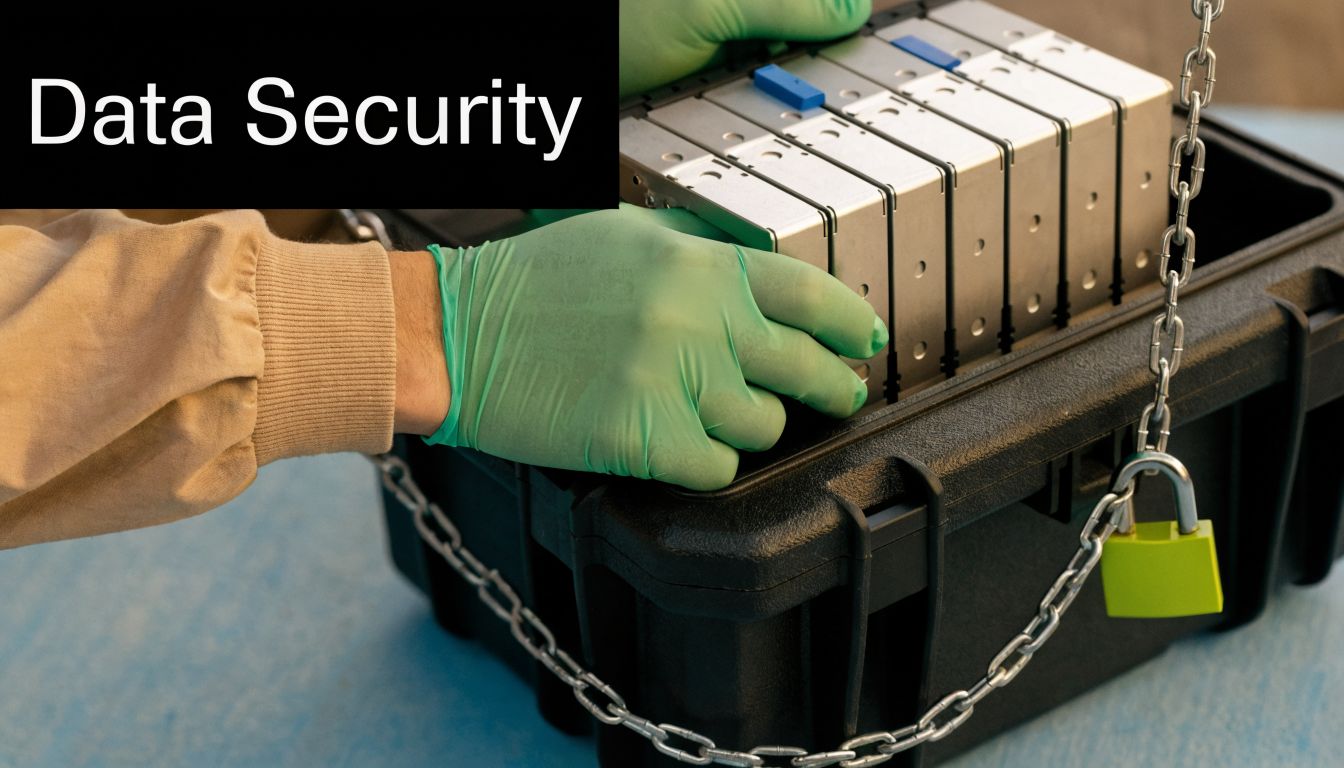
Treat network hardware as sensitive by default
A common failure pattern goes like this. The team creates a secure workflow for servers and laptops, then handles switches, routers, and PBX hardware as “just telecom.” That assumption breaks custody.
Handle these categories as potentially sensitive unless your audit proves otherwise:
- Routers and firewalls because they often retain credentials and network maps
- Managed switches because they may store running and startup configurations
- VoIP and PBX appliances because they can contain user assignments, call routing, and voicemail integrations
- Wireless controllers and access management hardware because they may retain authentication and policy settings
- Call recording and edge appliances because they may hold regulated or contractual data
If the device ever touched production traffic, assume it needs deliberate sanitization.
Match the destruction method to the asset
Not every asset should be physically destroyed first. Not every asset should be software-wiped either. The right method depends on the device, the storage type, the residual value, and your risk tolerance.
A simple decision framework:
| Asset condition | Preferred method | Why |
|---|---|---|
| Reusable equipment with removable storage or wipeable memory | Logical sanitization where appropriate | Preserves remarketing or reuse value |
| Unsupported or damaged data-bearing devices | Physical destruction of storage components | Removes recovery risk |
| Equipment with uncertain storage architecture | Conservative handling and verification | Prevents false assumptions |
| Regulated or high-sensitivity environments | Destruction plus documentation | Supports audit defense |
An experienced ITAD provider earns its fee by addressing these critical details. Someone must determine whether the risk resides within a hard drive, flash module, controller board, or embedded memory.
Security test: If your team can't explain where the data sits on a retired telecom device, that device should not leave the facility under a casual pickup process.
Chain of custody is the control that holds the whole project together
Data destruction without chain of custody is incomplete. You may have confidence in the final processing step, but you still need proof that the same assets left your building, stayed under control in transit, and arrived at the right facility.
At minimum, the custody trail should show:
- Release point inside your office, branch, or data room
- Item identification by serial number or grouped lot description
- Responsible parties for handoff and transport
- Processing outcome such as reuse, resale, recycling, or destruction
- Final documentation tied back to the original inventory
That's the difference between “we believe it was handled” and “we can prove how it was handled.”
For teams that need physical media destruction support as part of a broader telecom retirement, hard drive shredding services in Dallas for companies reflects the kind of discrete security control worth evaluating.
What fails in the real world
Most chain-of-custody gaps don't come from dramatic misconduct. They come from routine sloppiness.
Examples include unlabeled gaylords, mixed pallets from multiple locations, devices added after the inventory freeze, branch offices shipping directly without central approval, and field technicians dropping gear into general recycling cages. Each one weakens your ability to certify disposition later.
The strongest telecom retirement programs use the same security mindset at every site. Same release rules. Same labeling logic. Same exceptions process. Same documentation.
Security isn't a separate workstream from sustainability. It's what makes sustainable telecom recycling Dallas defensible at enterprise scale.
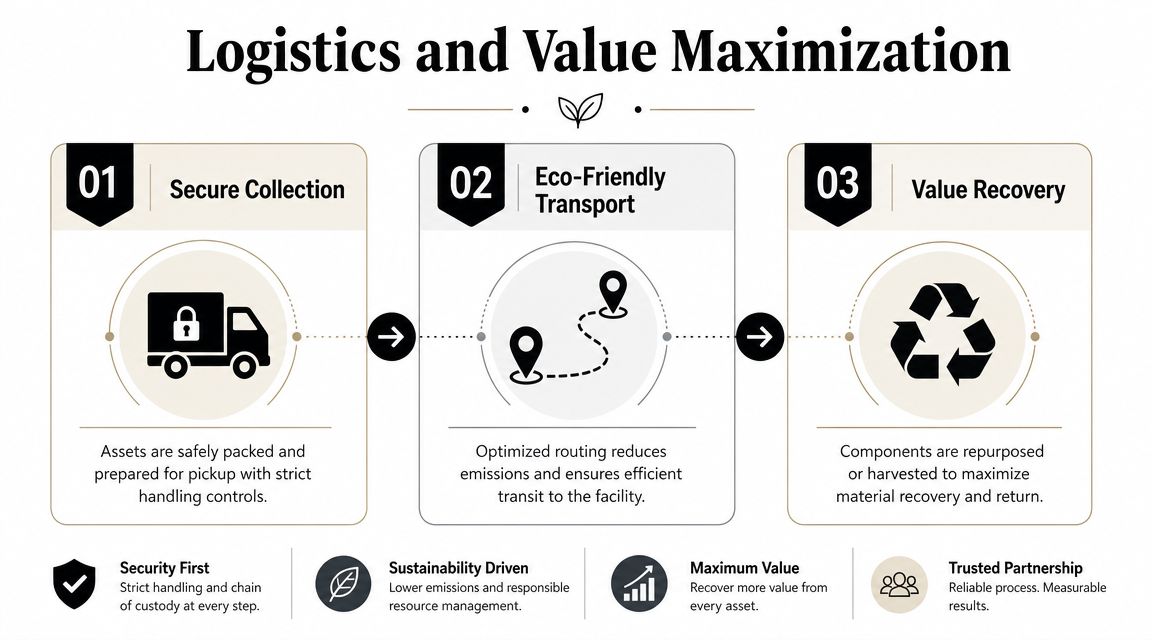
From Your Office to Recovery: Logistics and Value Maximization
Once the assets are audited and secured, the project turns physical. At this stage, many telecom retirements lose money. Gear sits too long in a staging room, pickups get scheduled before packing is complete, reusable devices are mixed with scrap, and branch locations improvise their own outbound methods.
The work needs a logistics plan, not just a truck.
T-Mobile's Dallas operation is the clearest benchmark for what disciplined reverse logistics can look like. The company said its Dallas facility processed roughly 1 million returned devices in a single month in October 2024, with most devices ready for reuse within 7 to 12 days, according to T-Mobile's sustainability and recovery overview. The lesson for corporate telecom decommissioning is practical: cycle time and triage quality matter as much as volume.
Stage the pickup around the building, not around convenience
A telecom pickup that ignores the site layout creates delays and custody issues. High-rise offices, shared loading docks, medical campuses, warehouses, and multi-suite business parks all require different removal tactics.
Before the truck is booked, lock down these items:
- Building access windows so crews don't compete with freight schedules or tenant restrictions
- Staging points that keep retired equipment secure and out of employee traffic
- Packaging rules for loose handsets, rack gear, blades, optics, and accessories
- Lot separation for data-bearing assets, resale candidates, and material destined for recycling
- Signoff responsibility so one person owns release at each location
If you're decommissioning multiple Dallas offices, standardize the staging template. Don't let each site invent its own process.
Triage drives value recovery
Not all retired telecom hardware is waste. Some equipment still has useful life, especially if it's current enterprise switching, uniform batches of VoIP phones, or clean network accessories removed from a planned refresh. Value recovery depends on sorting discipline at intake.
A practical triage model looks like this:
| Triage bucket | What belongs there | Operational goal |
|---|---|---|
| Reuse-ready | Working, current, clean, complete assets | Fast testing and redeployment or resale |
| Repair/refurbishment | Equipment with defects or missing components | Controlled labor decision |
| Parts harvest | Incomplete or unsupported gear with useful components | Maximize material and parts yield |
| Commodity recycling | End-of-life equipment and mixed electronic scrap | Responsible material recovery |
Donation-based recycling and social enterprise recycling can fit into this process, but only after the security and functional checks are complete. A device should never be donated because nobody wants to inventory it properly.
Faster triage protects more than resale value. It reduces the time sensitive assets spend sitting in a gray zone between retirement and final disposition.
Don't let cabling and passive gear distort the project
One of the biggest planning mistakes in sustainable telecom recycling Dallas work is letting low-value bulk material dominate the removal plan. Copper cabling, patch cords, metal brackets, and empty hardware can consume labor and floor space quickly. They matter, but they should not be packed and tracked the same way as data-bearing gear.
Use separate handling lanes:
- Sensitive electronics lane for tracked network and voice equipment
- Reusable infrastructure lane for racks, cabinets, rails, and accessories with redeployment value
- Bulk materials lane for sorted cable, metal, and passive debris
That separation keeps the project moving and protects the higher-value assets from damage.
Pick partners that can execute the middle mile
A lot of providers can collect material. Fewer can manage the messy middle between pickup and final processing. That middle includes reconciliation, testing, sort discipline, and value assessment. For buyers evaluating resale pathways for telecom assets, telecom equipment buyers in Dallas is one example of the kind of market-specific capability worth checking.
This is also the one place in the article where it's worth naming Reworx Recycling directly. If your project combines telecom gear with broader electronics recycling, IT equipment disposal, office cleanout, secure data destruction, or donation-based recycling objectives, a provider with both ITAD workflow and community donation channels can simplify the disposition mix. The key question is still operational. Can the provider separate what should be reused, destroyed, donated, or recycled without breaking custody?
What works and what doesn't
What works:
- Pre-labeled pallets and containers
- Site-specific release forms
- Fast reconciliation after pickup
- Clear decision rules for resale versus destruction
- Short dwell time at every stage
What doesn't:
- Mixed pallets from multiple branches
- Last-minute additions after the asset list is closed
- Treating all telecom gear as scrap
- Letting removed equipment sit in office storage for weeks
- Assuming value recovery will happen without clean triage
Good logistics turns disposal into controlled recovery. Bad logistics turns working hardware into low-grade scrap and leaves your team chasing paperwork later.
Selecting a Dallas ITAD Partner: A Vendor Selection Checklist
Most telecom recycling failures can be traced back to one decision. The company picked a vendor that could remove equipment, but couldn't govern the full lifecycle. Price usually drives that mistake. Scope confusion finishes it.
A qualified Dallas ITAD partner should function like an extension of your operations team. That means the vendor has to understand telecom hardware, custody controls, environmental handling, and reporting standards well enough to close the project without leaving loose ends.

Use this checklist before you compare pricing
A strong vendor review isn't complicated, but it does need discipline.
Start with operational fit
- Telecom-specific familiarity. Ask whether the provider regularly handles PBX systems, VoIP handsets, switches, routers, racks, batteries, and multi-site removals.
- De-install coordination. Confirm whether they only receive packaged assets or can support on-site decommissioning workflow with your facilities team.
- Mixed project support. Many Dallas refreshes include computer recycling, laptop disposal, product destruction, and office cleanout needs alongside telecom assets.
Then move to risk controls
- Documented chain of custody. If the provider can't describe custody from site release through final disposition, keep looking.
- Data destruction options. They should explain when they use sanitization, when they destroy media, and how they verify the outcome.
- Insurance and liability clarity. Ask what coverage applies if a transport or data event creates exposure.
Evaluate reporting before you evaluate marketing
A polished sales deck won't protect you in an audit. Reporting will.
Ask to see sample outputs for:
| Reporting item | Why it matters |
|---|---|
| Asset inventory reconciliation | Confirms what was actually received |
| Data destruction certificate | Supports internal and external audit needs |
| Recycling certificate | Documents environmental disposition |
| Exception reporting | Shows missing, damaged, or unmatched assets |
| Final disposition summary | Separates reuse, resale, destruction, and recycling |
If the sample reports are vague, your final records will be vague too.
Procurement teams often focus on pickup speed. Experienced IT managers focus on what the vendor can prove thirty days later.
Ask about downstream discipline
A provider may collect and sort assets well, then hand them off to downstream partners you've never heard of. That's not automatically a problem. Hidden downstream practices are.
Ask direct questions:
- Who handles refurbishment?
- Who handles material recycling?
- How are downstream vendors vetted?
- How are exceptions documented?
- Can the provider trace final disposition by asset class?
These questions matter more in telecom than many buyers expect because decommissioned gear often includes a mix of metal infrastructure, batteries, circuit boards, plastics, and reusable network devices.
Include mission alignment, but keep it practical
Corporate sustainability leaders increasingly want more than landfill diversion. They want reuse, donation, and community benefit where appropriate. That's a valid selection factor, especially if your company has ESG goals or corporate donation programs.
Still, mission alignment should come after process competence, not before it. Social enterprise recycling only adds value when the basics are already strong: secure handling, accurate triage, and reliable reporting. For teams formalizing their evaluation criteria, factors to consider when choosing an e-waste recycling partner is a practical screening reference.
The right vendor isn't the one with the broadest claims. It's the one that can take a messy telecom retirement, impose order on it, and produce records your legal, IT, and sustainability teams can all live with.
Closing the Loop: Certificates, Reporting, and Measuring Your Impact
A telecom recycling project isn't finished when the loading dock clears. It's finished when the paperwork matches the physical reality. Without that closeout package, your team is left with assumptions instead of evidence.
The minimum documentation should include two things. First, proof of what happened to data-bearing assets. Second, proof of what happened to the rest of the equipment. For most organizations, that means a Certificate of Data Destruction, a Certificate of Recycling, and a final asset report that ties back to the original inventory or release list.
What good closeout documents should show
Strong documentation is specific. It shouldn't read like a generic service receipt.
Look for these elements:
- Asset traceability that matches serialized items or lot-based pickup records
- Disposition clarity showing whether equipment was reused, sold, destroyed, or recycled
- Date consistency across pickup, receipt, processing, and certification
- Exception visibility for missing labels, damaged units, or inventory mismatches
- Authorized signoff from the processing party
If your provider can't reconcile these points cleanly, your chain of custody has a weak ending.
Why reporting matters beyond compliance
The records also help your internal stakeholders. IT wants confirmation that sensitive gear was handled properly. Facilities wants the project closed. Sustainability wants evidence for environmental reporting. Finance may want visibility into recovered value or donated assets.
Sustainable telecom recycling Dallas becomes more than disposal through this process. A well-documented project gives your organization something usable: defensible records, cleaner audit support, and a clearer story about how retired infrastructure was handled.
Closeout documents aren't administrative leftovers. They are the proof that your decommissioning plan actually happened.
For companies with broader ESG, social enterprise recycling, or corporate donation goals, impact reporting can add another layer. The exact format varies by provider, but the principle is the same. Your leadership should be able to see what was diverted into reuse, what required destruction, and how the project supported responsible end-of-life handling.
Archive those records centrally. Don't leave them in an email thread tied to a one-time project manager. Telecom refresh cycles repeat, and the next one gets easier when the last one ended with clean documentation.
If your business is planning a Dallas telecom refresh, office cleanout, data center decommissioning, computer recycling effort, or secure IT asset disposition project, Reworx Recycling is one option to evaluate for donation-based electronics recycling, pickup coordination, and responsible end-of-life handling. Businesses can use its resources to plan equipment donation, schedule a pickup, and build a more controlled recycling process that supports both environmental responsibility and community impact.