A Chicago office finishes a phone system migration, swaps out aging switches, and finally gets the new network stable. Then the leftover hardware starts taking over a storage room. Old VoIP handsets, managed switches, routers, patch panels, UPS units, and bins of cabling sit there longer than anyone planned.
For small and mid-sized businesses, that pile creates a very specific problem. It's too much for a household drop-off mindset, but often not enough to fit the operating model of a large enterprise ITAD vendor. That's where telecom equipment recycling Chicago becomes less about “getting rid of stuff” and more about running a controlled end-of-life process.
The right process protects data, satisfies compliance needs, keeps electronics out of the wrong waste stream, and can still support reuse, donation, and material recovery. It also gives facilities teams, IT managers, and sustainability leads a clean paper trail instead of a lingering liability.
Your Chicago Office Upgrade Is Done, Now What?
A telecom refresh usually ends with a working system and a messy back room. The business celebrates the improved call quality or stronger network coverage, but someone still has to deal with the retired hardware. In practice, that person is often an office manager, an IT lead, or a facilities coordinator who inherited the cleanup after the project budget was already spent.

What's sitting in that room is not ordinary trash
Retired telecom gear often includes devices that still hold configuration data, user information, call logs, credentials, or network maps. Even when the equipment looks obsolete, the risk isn't obsolete. A managed switch or firewall pulled from production can still tell a lot about how your environment was built.
That's why a cleanup after an office move, tenant improvement, or network overhaul often overlaps with broader relocation work. Teams handling space transitions often coordinate with facilities decommissioning services because furniture removal, fixture teardown, cabling pullback, and electronics retirement tend to happen on the same timeline. When the move is tied to a reconfiguration, it also helps to align the hardware retirement with an office relocation recycling workflow.
The real decision is about control
Chicago businesses usually face three bad default options. Leave the equipment in storage. Let staff piece together disposal on their own. Or move it quickly without enough documentation.
None of those options age well.
Old telecom hardware becomes harder to identify, harder to track, and harder to dispose of correctly the longer it sits untouched.
A better approach starts with a simple assumption. Every retired device needs a documented path. That path may end in reuse, donation, buyback, component harvesting, or certified recycling, but it should never be “we'll deal with it later.”
What works and what doesn't
The businesses that handle telecom equipment recycling Chicago well usually do a few things early:
- They isolate retired gear fast. Production equipment and retired equipment shouldn't mix in the same closet once a cutover is complete.
- They assign ownership. One person needs to own the inventory, pickup coordination, and final records.
- They treat data-bearing telecom gear like data-bearing IT gear. Phones, gateways, firewalls, routers, and switches deserve the same seriousness as laptops and servers.
What doesn't work is assuming all e-waste vendors handle telecom hardware the same way. They don't. Some are set up for household electronics. Some are built for very large fleets. The middle market in Chicago often has to work harder to find a practical fit.
Navigating Chicago and Illinois E-Waste Compliance
Your office cutover is finished. The old phones are in boxes, the switches are stacked in the server room, and someone suggests taking a few loads to a city drop-off site. For a Chicago business, that is usually the wrong path.
Commercial telecom equipment follows a different set of rules than a resident cleaning out a home office. The City of Chicago's Household Chemicals and Computer Recycling Facility is designed for household use, and the city states that commercial electronics are not accepted through that channel, according to the City of Chicago electronics and chemical recycling program. That leaves a real service gap for Chicago companies that are too large for municipal options and too small to meet the minimums of national enterprise ITAD contracts.
That middle group gets squeezed all the time. A 40-person office with retired desk phones, access points, firewalls, and a few racks of network gear has enough volume to create compliance risk, but not enough volume to attract every large recycler.
Municipal recycling and business disposal are different systems
Public programs are built around residents. Business telecom retirement requires documented handling, chain of custody, and a downstream process that fits commercial equipment.
Illinois also treats many covered electronics as items that should be managed through approved recycling channels rather than trash disposal. For a business, the practical takeaway is simple. If your company generated the equipment, your company is responsible for where it goes, how it is processed, and what records you keep.
That matters most for small and mid-sized businesses because they often sit between two models that do not fit well. City programs are not for them. Large enterprise vendors may want pallet counts, recurring national volume, or narrower intake criteria. A flexible commercial partner, including a provider offering Illinois electronics recycling service, makes more sense for mixed telecom loads that need pickup, sorting, and documentation without enterprise-only thresholds.
The legal risk is not just disposal. It is loss of control.
Telecom gear often gets misclassified as low-risk scrap because it looks old or low-value. In practice, retired business equipment can still hold configuration files, call logs, credentials, network maps, internal labels, batteries, and circuit boards that require proper handling.
I tell Chicago operations teams to ask one question first. Can you prove what happened to each category of equipment after it left your site?
If the answer is no, the process is weak.
A vendor should be able to explain, in plain language, how equipment is received, sorted, tested for reuse, stripped for parts, or sent to certified downstream recycling. If they cannot explain that chain clearly, they probably cannot document it well either.
What to review before you approve a vendor
A practical compliance review does not need to be complicated, but it does need to be specific:
- Commercial acceptance: Confirm the vendor is set up for business-generated electronics, not just public drop-off material.
- Item tracking: Ask how serial numbers, asset tags, and load contents are recorded at pickup and intake.
- Data-bearing device handling: Require a defined process for phones, firewalls, routers, switches, and any device with storage or retained configurations.
- Downstream disclosure: Ask where non-reusable equipment goes and whether downstream processors are certified.
- Final documentation: Get reporting that matches your internal inventory and supports audit, insurance, and policy requirements.
Smaller Chicago businesses need to be careful in these situations. Plenty of vendors can remove equipment. Fewer can support a mixed telecom load with the paperwork and process discipline a business needs.
Internal policy still matters
Even with a good recycler, the handoff can break down inside your office. Gear gets mixed together. Staff remove labels inconsistently. No one separates reusable units from scrap. Then the inventory no longer matches what left the building.
The fix is straightforward. Set sorting rules before pickup, assign one owner, and document exceptions. Operations teams often borrow ideas from adjacent surplus workflows for this reason. The asset types are different, but the discipline is similar to closeout and liquidation projects, which is why some teams reference DIY estate sale strategies when building internal staging and documentation rules for mixed surplus.
What a compliant telecom recycling path looks like
| Issue | Weak approach | Strong approach |
|---|---|---|
| Intake method | Staff drop-offs or an unknown hauler | Scheduled commercial pickup with documented receipt |
| Equipment classification | Everything treated as scrap | Reuse, donation, parts harvest, and recycling separated by condition |
| Data protection | Assumptions based on device age | Device-specific sanitization and destruction controls |
| Downstream handling | No visibility after pickup | Named downstream process and documented end disposition |
| Reporting | Generic weight ticket only | Itemized reporting and certificates where needed |
For many Chicago SMBs, the best fit is not a resident program and not a rigid enterprise contract. It is a local partner that can pick up mixed telecom equipment, process reusable items for donation when appropriate, recycle the rest through approved channels, and provide records strong enough to stand up to internal review. That model closes the gap most businesses have.
Building Your Telecom Asset Disposition Plan
A smooth pickup starts weeks before a truck arrives. The strongest telecom retirement projects begin with an internal asset plan, not a vendor quote request. If your inventory is vague, your downstream options will be vague too.
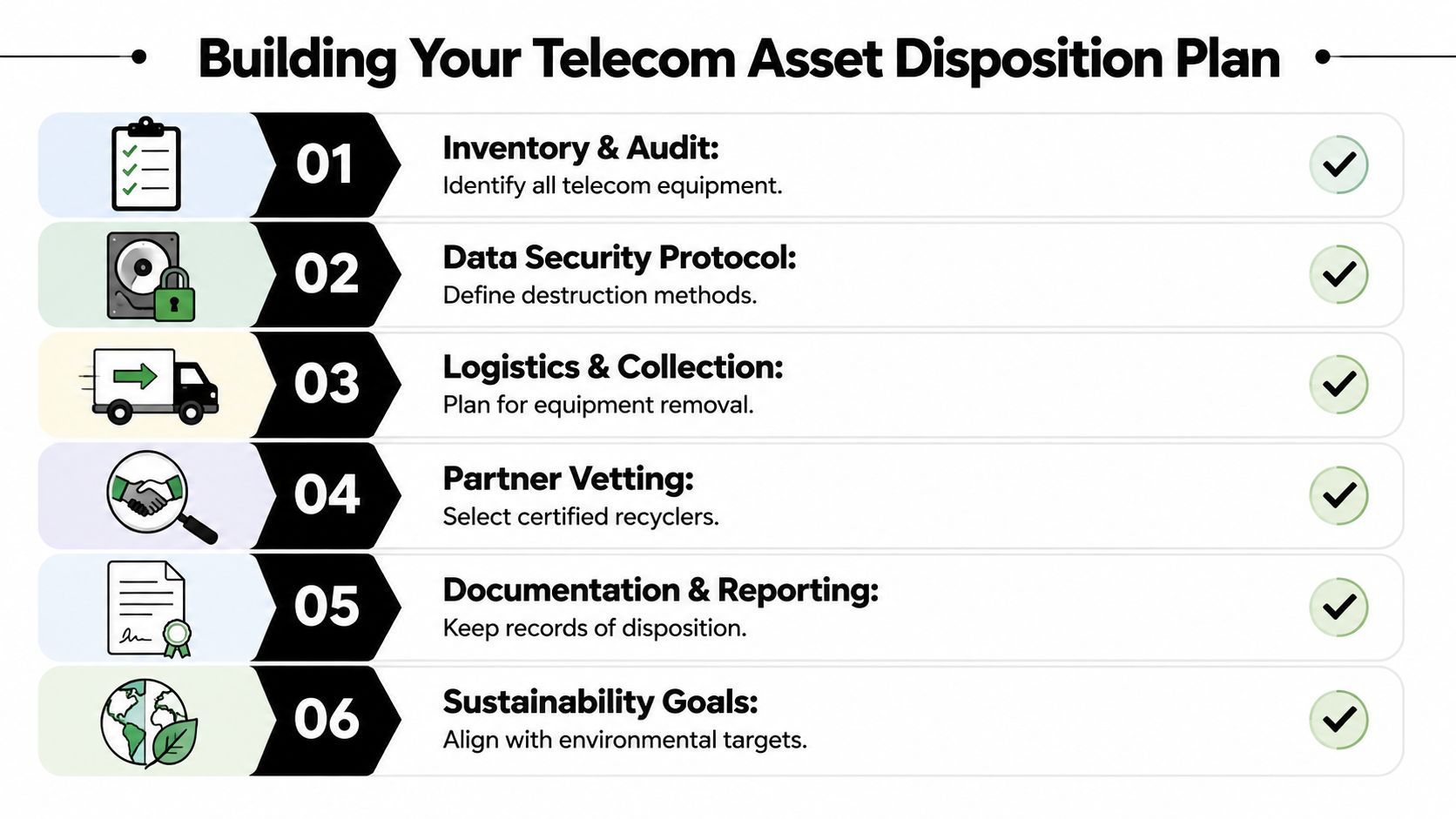
Start with an audit that operations can actually use
Most companies already know the broad categories. Phones. Routers. Switches. Firewalls. Maybe some rack hardware, access points, and backup units. What they don't always have is a usable device-level record.
At minimum, your inventory should capture:
Asset identity
Record manufacturer, model, serial number, and any internal asset tag.Physical status
Note whether the unit is working, damaged, incomplete, or untested.Data relevance
Flag anything that stores configurations, credentials, logs, user data, or internal settings.Disposition potential
Separate equipment that may be reusable, suitable for donation, eligible for buyback, or recyclable only.
A one-sheet spreadsheet is fine if it's accurate. Fancy asset software won't help if no one updates it during decommissioning.
Use EDE to set a serious benchmark
The Electronics Disposal Efficiency Rate, or EDE, measures the weight of equipment responsibly disposed of divided by the total weight of equipment disposed. The methodology includes equipment placed in secondary service, recovered components extracted during dismantling, and equipment sent directly to recycling. Organizations are advised to benchmark against standards such as R2 and e-Stewards and set baseline EDE targets, typically 75 to 85 percent, according to the Electronics Disposal Efficiency Rate methodology and benchmark standards.
That matters because “we recycled it” is too blunt to be useful. A better question is how much of the total material stream was handled through responsible channels that preserved reuse value, recovered components, or documented certified recycling.
Practical rule: If your team can't state its target disposition outcome before pickup, you'll have a hard time evaluating the result afterward.
Sort assets by pathway, not by room
A common mistake is sorting by office area. Closet A. Floor 2. Warehouse shelf. That's useful for pickup logistics but weak for disposition. Sort by likely outcome instead.
| Asset type | Likely first question | Typical path |
|---|---|---|
| Newer phones and network gear | Is it functional and complete? | Reuse, donation, or buyback review |
| Legacy managed devices | Does it contain sensitive configs or logs? | Sanitization first, then reuse or recycling |
| Damaged boards and cabling | Is material recovery the realistic goal? | Dismantling and certified recycling |
| Batteries and power accessories | Does special handling apply? | Controlled recycling stream |
That sorting logic also improves quoting. Vendors can price and plan more accurately when they know what's potentially reusable versus what is scrap.
The planning step most teams skip
Decide in advance what proof you expect back. Many businesses ask about pickup timing and cost before they ask about reporting. That's backwards.
Require a clear record of what left the building, how it was categorized, what was sanitized, what was recycled, and what was directed to reuse or donation channels. If your team needs a primer on how this fits into a broader retirement program, a practical reference point is what IT asset disposition means for business equipment planning.
Guaranteeing Secure Destruction of Telecom Data
Most businesses understand that old laptops need secure wiping or shredding. Fewer apply that same discipline to telecom hardware. That's a problem, because routers, switches, firewalls, VoIP gateways, and unified communications appliances often store the exact kind of information an attacker would want.

Telecom data doesn't always look like “files”
A switch may not hold documents in the way a laptop does, but it can retain VLAN structures, IP scheme references, admin credentials, SNMP settings, access control rules, and network topology clues. A VoIP system may hold call records, user assignments, voicemail associations, and configuration backups. Firewalls and security appliances can be even more sensitive.
That's why generic data destruction language can create false comfort. “We wipe hard drives” doesn't tell you how a vendor handles nontraditional storage in telecom devices.
The transparency gap in the Chicago market
Many Chicago recyclers mention standards such as NAID AAA or R2, but few publicly clarify whether they meet telecom-specific requirements such as NIST SP 800-88 for network equipment. That leaves businesses unable to tell from public materials whether a vendor can securely decommission a managed switch or VoIP gateway, as discussed in the West Chicago recycler profile that highlights compliance visibility limits.
That gap matters most for smaller organizations without a dedicated ITAD team. A facilities manager at a midsize firm might know enough to ask for data destruction, but not enough to challenge vague answers about telecom sanitization.
A vendor who can explain laptop wiping but not switch decommissioning is only solving part of the problem.
What secure handling should include
A telecom data destruction workflow should be specific about both method and proof. Ask for the actual process, not just the result.
Look for these controls:
- Asset-level identification: Data-bearing telecom devices should be tagged and tracked before they leave the site.
- Method matching: Some devices can be sanitized for reuse. Others should be physically destroyed because the hardware is damaged, obsolete, or too risky to redeploy.
- Chain of custody: Every handoff should be documented from pickup through processing.
- Final documentation: You need records that show what was destroyed, what was sanitized, and what entered recycling.
Practical questions to ask before release
Use plain language when screening a recycler or ITAD provider. Ask questions a non-specialist can still verify later.
- Can you identify which telecom devices in this lot are data-bearing?
- How do you sanitize managed switches, firewalls, and VoIP hardware?
- Do you issue certificates tied to the actual devices collected?
- Can you explain where sanitization ends and physical destruction begins?
If the answers stay general, assume the process is general too.
When physical destruction is the better call
Not every telecom asset should be wiped and reused. Some older devices have low resale value, weak supportability, or uncertain storage architecture. In those cases, physical destruction may be cleaner from a risk perspective, especially for devices that sat in sensitive environments.
Chicago organizations that need local secure media handling can use hard drive destruction services in Chicago as one part of a broader telecom retirement process, but the key is to apply the same rigor to non-drive telecom hardware instead of treating it as harmless scrap.
How to Choose the Right E-Recycling Partner in Chicago
Your office refresh is finished. The old phones, switches, battery backups, and network gear are stacked in a back room. The problem is not deciding whether to recycle them. The problem is finding a Chicago partner that will take a business-size telecom lot without treating it like either household drop-off material or a Fortune 500 project.

That service gap is where many small and mid-sized businesses get stuck.
A company with one office or a few Chicago locations may have too much equipment for public programs and too little volume for large ITAD providers that prefer bigger pickups. Yet the project still needs proper intake, business pickup, documentation, and a disposition path that fits telecom hardware. A retired firewall from a 20-person office deserves the same disciplined handling as one from a regional headquarters.
Judge vendors by operational fit
Start with fit before marketing language. Certifications, insurance, and reporting matter, but they do not solve the pickup problem if the vendor will not handle a smaller mixed load or cannot explain what they do with telecom equipment specifically.
Use this checklist during vendor review:
| Selection factor | What to verify | Why it matters |
|---|---|---|
| Pickup flexibility | Will they accept smaller business loads with mixed telecom equipment? | Many Chicago SMBs fall between residential options and enterprise minimums |
| Telecom-specific process | Can they identify phones, switches, firewalls, UPS units, and related accessories by disposition type? | Telecom lots often contain batteries, stored settings, and gear with uneven resale value |
| Reporting quality | Will they issue itemized records, not just a generic weight ticket? | Your audit trail depends on device-level or lot-level clarity |
| Reuse, donation, and recycling paths | Do they sort for second-life use before material recovery where appropriate? | That can improve recovery and reduce unnecessary destruction |
| Downstream transparency | Can they explain where reusable and end-of-life material goes? | You need fewer blind spots after pickup |
A good vendor answers these questions plainly. A weak vendor stays vague, talks only about pounds collected, or treats all telecom hardware as scrap.
Ask questions a facilities manager and an IT lead can both verify
The best screening calls are practical. They should tell you how the vendor runs the job, not how polished their sales language is.
Ask questions like these:
- What is your minimum for a Chicago business pickup with mixed telecom gear?
- How do you separate reusable devices from equipment that goes straight to recycling?
- What documentation do we receive at pickup and after processing is complete?
- Can you work with small-to-mid-sized businesses that need occasional pickups, not enterprise contracts?
- How do you handle donation-eligible equipment versus material-only equipment?
That last question matters more than many businesses expect. Telecom closets usually contain a mix of low-value scrap, usable accessories, and hardware that still fits a community or nonprofit use case. A provider that can only shred or only resell gives you a narrower outcome than the asset mix deserves.
A useful comparison comes from the secondary device market. Buyers tend to trust sellers who explain grading and testing clearly, which is part of why transparency stands out in resources like Used Mobiles 4 U. The same rule applies here. If a recycler cannot explain condition standards, reuse criteria, and final disposition in plain English, expect gaps later.
Why the middle market needs a different kind of partner
For many Chicago businesses, the right fit is a provider built for inconsistent volumes and mixed outcomes. That is different from a municipal model, and it is different from a large enterprise ITAD intake built around truckload economics.
Reworx Recycling is one example of that middle-market approach. The company works with business electronics, supports donation-based asset handling, and offers guidance on how to evaluate a reliable e-waste recycling partner. For a business that is too large for public drop-off but too small for enterprise minimums, that flexibility can solve a real operational problem.
The social impact matters too. If part of your telecom lot can be reused or directed into donation channels after proper processing, the project does more than clear storage space. It keeps viable equipment in circulation longer, reduces unnecessary material recovery, and gives smaller Chicago businesses a practical path to responsible disposition without waiting until they have a full truckload.
The Pickup Process, Value Recovery, and Final Reporting
Once the internal sorting is done and the vendor is selected, the pickup itself should feel controlled, not improvised. If it feels rushed, unclear, or undocumented, the project was not prepared well enough.
What happens on pickup day
A business pickup should start with asset verification. The collected equipment should match the inventory you prepared or, at minimum, be reconciled against a final onsite count before loading. Teams should know which devices need special handling, which pallets or containers hold data-bearing hardware, and what leaves the premises first.
The key handoff document is the chain of custody. It doesn't need to be dramatic. It just needs to be complete. Once the truck departs, you should know what was collected and under whose control it now sits.
If a single pallet of telecom gear leaves your building without documentation, treat that as a process failure, not a minor clerical issue.
Where value recovery actually comes from
Value recovery in telecom retirement usually comes from one of three places. Reuse. Refurbishment. Material recovery. Newer or still-functional devices may support buyback or resale review. Equipment that no longer fits your environment may still fit another use case after testing and sanitization. Commodity recovery applies when the hardware has reached the end of useful life but still contains recoverable materials.
The reuse-first model is not theoretical. A federal case study at the U.S. Railroad Retirement Board headquarters reported that the agency recycled more than 3,200 pounds of electronic waste in one year, a nearly 10 percent increase over the previous year, donated all surplus desktop equipment in good condition through a reuse program, and sent most other electronic equipment, including servers and networking equipment, to a certified electronics recycler, according to the EPA case study on electronics recycling at the U.S. Railroad Retirement Board headquarters.
That framework translates well to telecom hardware. Reusable assets should be evaluated for second life first. Non-reusable assets should move into certified downstream recycling with documentation.
The documents that close the loop
The project isn't finished when the gear is gone. It's finished when the final records are in your file.
Expect these outputs where applicable:
- Collection records: What was picked up and when.
- Disposition summary: What was reused, refurbished, harvested for parts, or recycled.
- Data destruction confirmation: Certificates or destruction records for covered devices.
- Recycling documentation: Proof that non-reusable electronics entered an appropriate recycling stream.
These records matter for more than compliance. They also help facilities teams, finance teams, and sustainability leaders report the outcome of the project accurately.
Donation value is part of the business value
A donation-based model also changes the internal story. The retirement project becomes more than a cleanup task. If usable devices can be refurbished and placed back into service through community channels, the business gets environmental benefit and social value from the same event.
That matters for organizations trying to connect office upgrades, cleanouts, and ESG efforts into one coherent operating practice.
Building a Sustainable ITAD Program with a Social Enterprise
One successful pickup solves a project. A repeatable program solves a pattern. For Chicago businesses that refresh equipment every year, relocate departments, or cycle through phones and network gear across multiple sites, a standing ITAD program is easier to manage than a series of emergency cleanouts.
Why this belongs in your operating rhythm
The e-waste volume problem is large well beyond one office. Globally, 53.6 million metric tons of e-waste were generated in 2019, and only 17.4 percent was formally recycled. The same source notes a projection of 74 million metric tons by 2030. Locally, DuPage County has recycled more than 15 million pounds of electronics since 2012, according to Chicago-area and broader e-waste system data.
For a Chicago business, those figures put local telecom retirement in context. Your storage closet is a small piece of a much larger waste stream. That's exactly why a repeatable process matters.
What a durable program looks like
A practical in-house program usually includes a few fixed habits instead of one giant annual purge.
- Create a staging point: Designate one secure area for retired electronics so gear doesn't scatter across offices and closets.
- Set release rules: Nobody should move telecom devices into disposal without inventory and approval.
- Standardize documentation: Use the same intake sheet, chain-of-custody expectations, and final record format every time.
- Schedule recurring pickups: Regular removal prevents backlog and reduces the temptation to use informal disposal routes.
Why a social enterprise model changes the outcome
A social enterprise approach adds a second layer of value. The company still gets secure handling, controlled recycling, and documented disposition. But usable equipment can also support digital inclusion, community access, and workforce development rather than moving straight to destruction.
That's especially relevant for organizations that want their sustainability program to do more than count pounds diverted. A good ITAD relationship can support electronics recycling, donation-based recycling, office cleanout planning, secure data destruction, and broader corporate donation programs without forcing every project into a one-size-fits-all disposal path.
Keep the middle market in mind
Large enterprises often have dedicated disposition contracts. Households have city programs and retail drop-offs. The middle market still needs practical infrastructure.
That's why SMB-friendly telecom equipment recycling Chicago should be built around flexibility, transparent reporting, and realistic pickup models. The vendor should be able to manage a small lot with the same seriousness as a large one.
If your business is retiring phones, switches, routers, cabling, or mixed office electronics, Reworx Recycling offers a practical path for donation-based recycling, secure data handling, and business pickup coordination. Contact the team to donate old equipment, schedule a pickup, or build a long-term IT asset disposition partnership that supports both compliance and community impact.