The request usually starts the same way. A Houston IT manager walks past a rack room, sees a stack of retired switches, routers, VoIP phones, firewalls, and a few unlabeled servers, and realizes the hardware refresh is done but the hard part isn't. The equipment is out of production, but it still carries risk. Some of it may still hold configurations or storage media. Some may have resale value. Some belongs in a compliant recycling stream, not a dumpster or a generic junk haul.
That's why IT equipment recycling telecom Houston work should be treated as a business process, not a cleanup errand. The right disposition plan protects data, preserves asset value, documents custody, and supports sustainability goals. It can also support a stronger CSR story when reuse and donation are part of the model instead of sending every retired unit straight to scrap.
The Houston IT Challenge Staring You Down
A typical Houston telecom cleanout rarely happens in one neat room. Old network gear tends to collect in layers. There's the retired core switch still sitting in the MDF, handsets boxed in a branch closet, access points left over from the last office reconfiguration, and a few storage devices nobody wants to touch until legal or security approves the process.
That's where companies get stuck. The problem looks physical, but the primary issue is operational. A junk hauler can remove weight. An ITAD process has to handle data risk, inventory control, reuse decisions, and downstream accountability.
Houston businesses feel this pressure more than most because the city has a dense mix of energy, healthcare, logistics, education, and multi-site operations. Those environments generate a lot of retired electronics and very little tolerance for sloppy disposal. If you're staring at a pile of network appliances and wondering whether it's recycling, resale, product destruction, or secure data destruction, the answer is usually some combination of all four.
A better starting point is to treat the project as disposition, not disposal. That single mindset shift changes the questions you ask.
Practical rule: If a device ever connected to your network, logged activity, stored credentials, or contained removable media, handle it as a controlled asset until your team proves otherwise.
That's also why many Houston organizations start by reviewing specialized telecom recycling workflows in Houston before they schedule pickup. The challenge isn't getting the gear out. The challenge is getting it out without losing control of value, data, or documentation.
The Pre-Disposal Blueprint Planning Your Telecom ITAD Project
Before anyone unplugs a rack or stages a pallet, decide what kind of project you're running. A branch office cleanout, a data center decommissioning, and a routine computer recycling sweep may all involve similar equipment, but they don't require the same approvals, timing, or records.

Start with scope, owners, and deadlines
Most projects fail early because no one defines ownership. IT assumes facilities will coordinate removal. Facilities assumes security will define data handling. Finance wants value recovery reporting after the fact. Procurement may already be talking to vendors before the internal rules are clear.
Use a short planning sheet that answers these points:
Project type
Office cleanout, telecom refresh, laptop disposal batch, medical equipment disposal, product destruction, or full IT asset disposition.Primary owner
Name one internal decision-maker who can approve inventory rules, access windows, and final disposition paths.Required stakeholders
IT, information security, compliance, facilities, procurement, finance, and any department that owns specialized hardware.Timing constraints
Lease exit, refresh deadline, cutover date, after-hours access, elevator restrictions, or loading dock rules.
This is also the stage where Houston teams should treat recycling compliance as a formal workflow, not a side task. Texas has had statewide policy support for computer recycling since the Texas Computer TakeBack Law took effect in 2008, requiring manufacturers to provide free and convenient recycling. This created a mature compliance framework for Houston businesses, meaning ITAD should be treated as a formal process, not an ad hoc task, as outlined in the City of Houston electronics recycling summary.
Gather the documents before the move starts
The best planning sessions are document-driven. Don't rely on memory.
Pull together:
- Existing asset records from CMDBs, spreadsheets, lease schedules, or procurement files.
- Site access details such as dock hours, badging rules, freight elevator limits, and escort requirements.
- Data handling policies that define whether media can be wiped for reuse or must be physically destroyed.
- Disposition goals such as resale, donation-based recycling, sustainable recycling, internal redeployment, or certified destruction.
- Reporting requirements for finance, ESG, audit, or internal security review.
A short RFP or project brief built from those materials will get better vendor responses than a vague request to “pick up old telecom gear.”
Define success before pickup day
Some companies optimize for speed. Others care most about secure data destruction or community impact through corporate donation programs. Both are reasonable, but they require different operating choices.
A practical benchmark is this: if your team can't explain what equipment is in scope, what happens to data-bearing devices, and what paperwork you expect at closeout, the project isn't ready. Houston teams looking for a starting framework often use an ITAD telecom services checklist near them to line up logistics, sanitization, and reporting before assets move.
Inventory and Triage Unlocking Value from Retired Telecom Gear
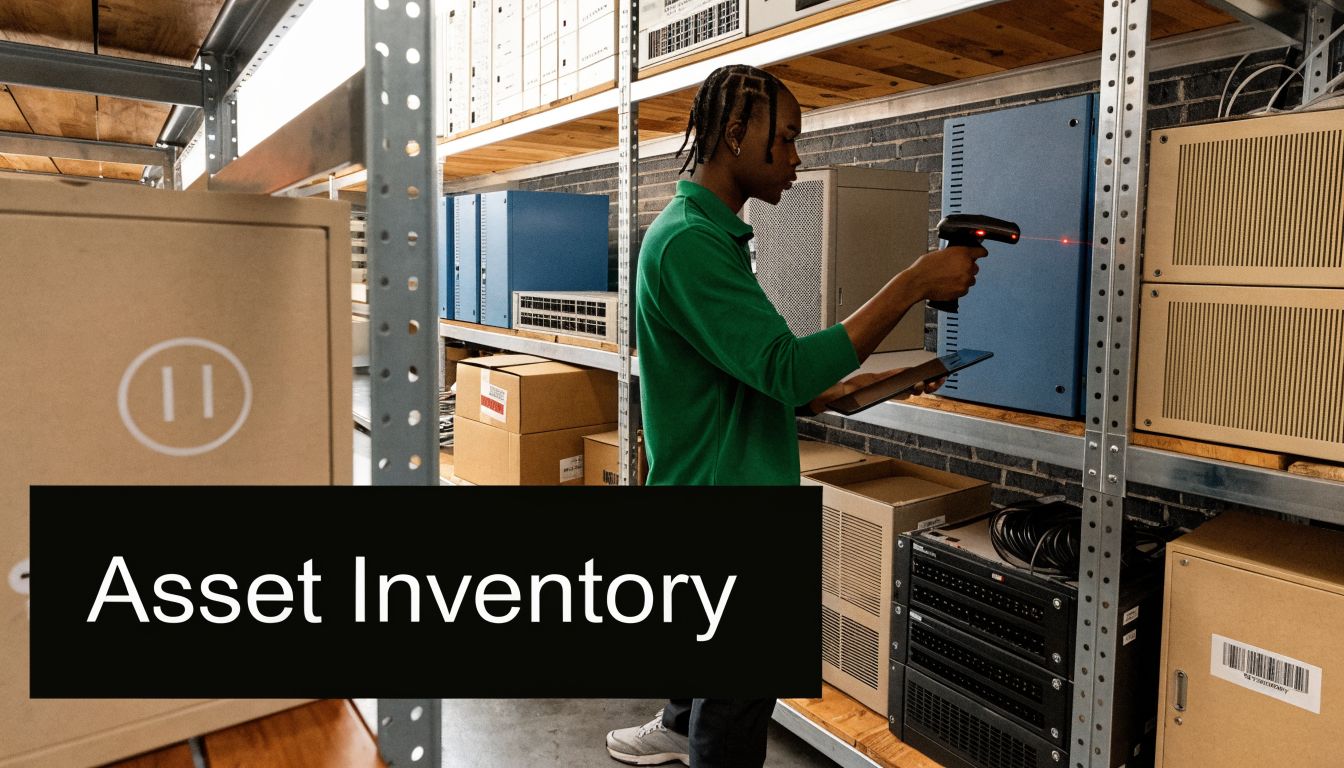
This stage represents where most value is won or lost. Companies often look at old routers, switches, servers, and transceivers and assume they're all scrap. They aren't. Some units belong in a reuse channel, some should be harvested for parts, and some need immediate recycling because they're obsolete, damaged, or too risky to remarket.
What a useful inventory actually includes
A vague count isn't enough. “Twelve switches and some phones” won't support valuation, custody, or destruction records.
Your inventory should capture:
| Field | Why it matters |
|---|---|
| Manufacturer and model | Determines marketability and support status |
| Serial number | Supports chain of custody and audit trails |
| Asset tag | Helps reconcile internal records |
| Condition | Distinguishes resale candidates from recycle-only units |
| Location | Prevents missed equipment across closets or branch sites |
| Data-bearing status | Flags units needing wiping or shredding |
| Accessories included | Power supplies, optics, rails, and licensing can affect reuse potential |
Without that detail, everything gets priced and handled like low-value mixed scrap.
Use a triage model, not a scrap pile
A practical telecom triage process separates equipment into four lanes:
Reuse or remarketing lane
Newer switches, routers, servers, and accessory gear in usable condition.Redeployment lane
Equipment your organization can still use in a lower-priority site, lab, or backup function.Donation-based recycling lane
Hardware that may still help schools, community programs, or digital inclusion efforts after proper testing and sanitization.Recycle-only lane
Damaged, incomplete, unsupported, or unsafe equipment that should go directly to certified material recovery.
That distinction matters because industry guidance notes that organizations often lose 40–60% of potential value from retired IT hardware when decommissioning is delayed or asset recovery isn't tightly managed, primarily because equipment is treated as scrap too early in the process, according to this guide to monetizing retired IT assets.
Separate “can't use” from “shouldn't resell.” Those are not the same category.
What works and what doesn't
What works is fast triage with documented condition grading. Test power-on status. Confirm model and serial. Flag any device with storage media. Pull accessories together. Make a reuse decision before the resale window closes.
What doesn't work is staging everything for weeks while teams wait for a perfect list. Delay pushes viable gear out of the secondary market and turns recoverable equipment into commodity material.
Another common mistake is treating telecom gear as if only servers matter. In practice, value often hides in components people overlook: transceivers, newer phones, power modules, wireless controllers, and clean accessory kits. Those items won't always justify stand-alone pickup, but they can improve recovery when they're inventoried correctly.
For larger server and network retirements, a detailed server decommissioning checklist helps teams line up serial capture, media identification, and final triage before anything leaves the building.
Securing the Data Compliant Destruction for Houston Businesses
In Houston, data destruction mistakes don't stay small. A retired firewall can hold credentials. A storage array can hold client records. A phone system can retain call history and configuration details. For energy, healthcare, legal, and finance environments, that means old telecom hardware is a security project first and a recycling project second.

Know the difference between wiping and destruction
Too many teams use the word “wiped” loosely. A factory reset is not the same as auditable sanitization.
The stronger process is to match the method to the asset:
Clear or Purge for reusable media
If a drive or storage component is eligible for remarketing or redeployment, sanitization should align with NIST 800-88 Clear or Purge standards.Physical shredding for failed or highly sensitive drives
When media can't be sanitized reliably, or internal policy requires destruction, shredding is the safer path.Documented handling for network devices
Switches, firewalls, and routers may not look like storage assets, but many retain configs, logs, or credentials and need documented sanitization steps.
The practical divide is simple. If your policy permits reuse, wipe correctly and record it. If reuse isn't allowed, destroy physically and reconcile the destroyed item back to the inventory.
Demand proof, not reassurance
A verbal promise doesn't help during an audit. You need records that show what was received, what method was used, and what was destroyed or sanitized.
Look for:
- Serialized intake records
- Method-specific data destruction logs
- Certificates of data destruction tied back to listed assets
- Exception handling for drives that fail testing or can't be wiped
- Final reconciliation between pickup manifest and destruction records
Operational advice: If the certificate can't help you identify what was destroyed, it's a souvenir, not a control.
There's also a practical hardware angle many IT teams miss. Physical damage and drive instability often show up before formal retirement. If your staff needs a non-promotional primer on why storage devices fail in the first place, this write-up on fixing laptop hard drive failures gives useful context for deciding when recovery, wiping, or destruction is the right move.
Keep destruction aligned with value recovery
The wrong sequence can erase residual value. If a device is a legitimate reuse candidate, waiting too long to assess and sanitize it can push it into the shred pile. On the other hand, trying to preserve every device for resale creates unnecessary risk if policy or asset condition clearly calls for destruction.
That's why strong ITAD programs decide early which assets are recoverable and which must be physically destroyed. A controlled process balances both outcomes.
For organizations retiring laptops, drives, or storage-heavy telecom gear, certified hard drive destruction services in Houston are often part of that control set, especially when internal policy requires a defensible chain from pickup through destruction.
Logistics and Chain of Custody From Your Door to Final Disposition
Once inventory and data handling are defined, the next risk is movement. Gear gets missed, mislabeled, swapped, or left unsecured during handoffs far more often than most internal teams expect. That's why chain of custody matters from the moment equipment leaves the rack, not just when it reaches a processor.
The handoff points that matter
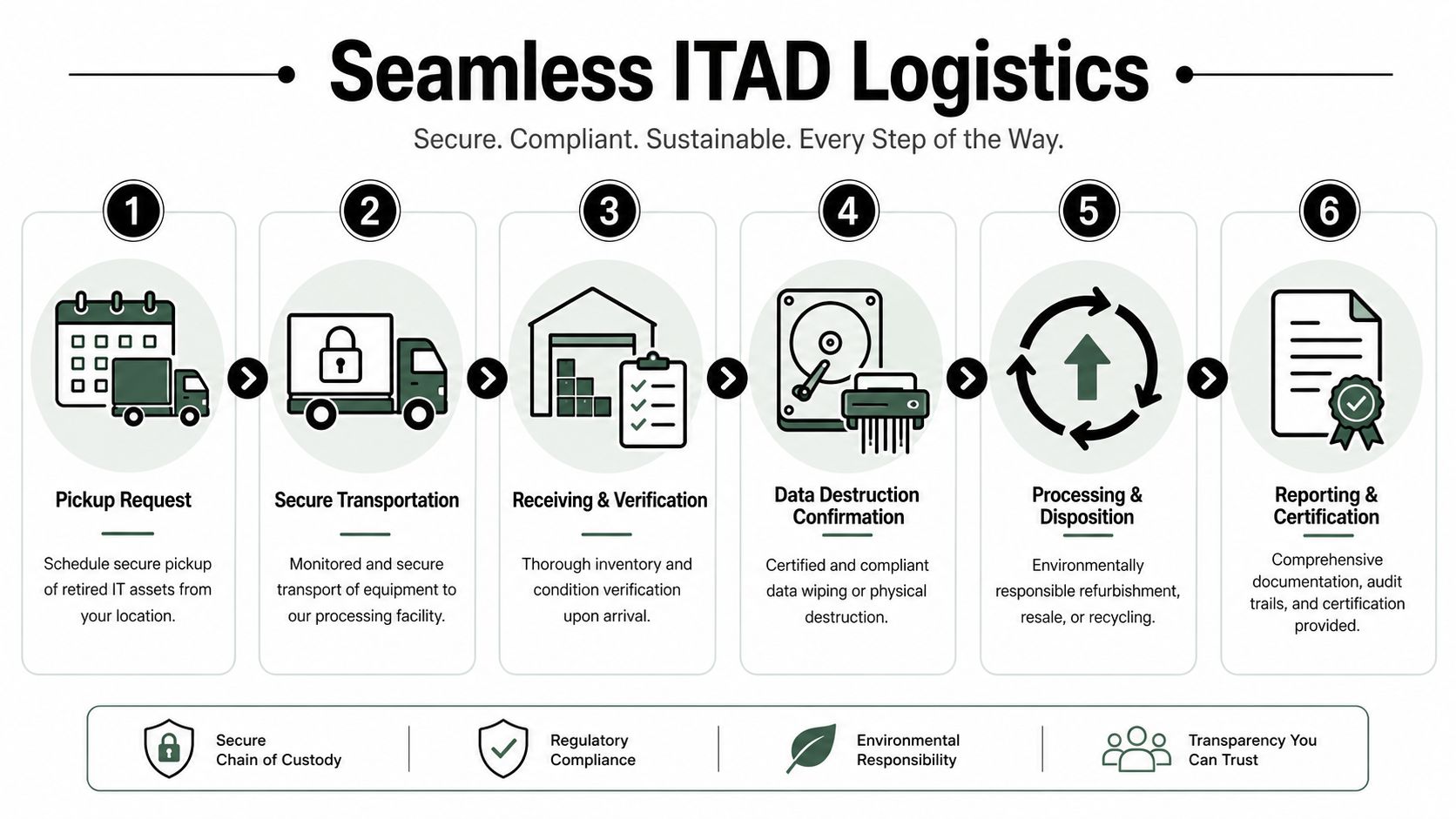
A secure logistics workflow usually has six control points:
- Pickup scheduling with defined scope and site contacts.
- Onsite release where listed assets are staged and checked out.
- Transport custody with secure handling during loading and transit.
- Receiving verification at the processing facility.
- Disposition routing into reuse, donation, or recycling streams.
- Final reporting with manifests and certificates.
If one of those breaks, the paperwork won't reconcile later.
What chain of custody should look like in practice
Good chain-of-custody documentation answers three questions clearly: what left your site, who accepted it, and what happened next.
A solid record set includes:
- Release documentation signed at pickup
- Itemized or serialized manifests when available
- Receiving confirmation after transport
- Disposition records tied back to intake
- Exception notes for overages, shortages, or damaged units
This matters in Houston because the local processing ecosystem is already capable of enterprise-scale work. Houston's regional recycling infrastructure is well-established, with the Houston-Galveston Area Council contracting with certified, high-capacity processors like CompuCycle. This means businesses have access to a mature ecosystem capable of handling enterprise-scale logistics and material recovery securely, as described by the Houston-Galveston Area Council electronics recycling program.
Don't treat transport as a trucking problem
The weak model is simple pickup with vague paperwork. The stronger model is transfer of liability with documented custody. That means site-level manifests for multi-location jobs, controlled staging, and a receiving process that confirms what arrived.
For telecom work, this gets more important when assets are spread across branch offices, IDFs, storage closets, and temporary project rooms. A clean chain of custody lets IT, facilities, and compliance all review the same story later. Without it, disputes turn into guesswork.
Choosing Your Partner Vetting Certified Recyclers in Houston
By the time you're evaluating vendors, you should already know your inventory standards, data rules, and reporting expectations. That changes the conversation. Instead of asking, “Can you recycle this?” ask, “How do you document custody, separate reuse from scrap, and prove downstream handling?”
Ask operational questions, not marketing questions
A recycler may advertise electronics recycling, office cleanout help, facility cleanout support, and buyback. Those services matter, but they don't tell you how the work is controlled.
Use questions like these:
Where does non-reusable equipment go after first processing?
You want a clear downstream answer, not broad language about responsible recycling.How do you handle data-bearing devices that fail wiping?
The vendor should explain the fallback path without improvising.What reporting do you provide after pickup?
Ask to see sample manifests and closeout documents.How do you separate resale candidates from recycle-only material?
This reveals whether the vendor understands asset recovery or treats everything as scrap.Can you support donation-based recycling when equipment qualifies?
For many organizations, that supports CSR and digital inclusion goals alongside compliance.
Why certification and downstream discipline matter
Volume alone doesn't make a recycler trustworthy. Process does. Texas programs handled a large stream of electronics in 2025, which is exactly why downstream discipline matters. The Texas Recycles Computers program processed nearly 3.9 million pounds of computer equipment in 2025, with a 99.9% rate of reuse or recycling. The high volume underscores the need to choose certified partners who can manage materials responsibly and avoid compliance risks associated with unvetted downstream processors, according to the Texas electronics recycling program report.
That doesn't mean every local provider operates at the same standard. It means the state already shows what high-throughput, compliance-heavy electronics recovery looks like. Your vendor should fit that reality.
A good recycler answers with paperwork, process, and named controls. A weak one answers with reassurance.
Add community impact to the selection criteria
This is the part most technical ITAD guides miss. Once you've confirmed security, custody, and compliant downstream handling, there's still a business choice left. Do you want the project to end as a pure transaction, or do you want some portion of qualified equipment to support community reuse?
That's where a social enterprise model can matter. A donation-based program can help businesses connect sustainable recycling, corporate donation programs, and digital inclusion without sacrificing process. If your retired laptops, desktops, monitors, or accessory gear can be redeployed responsibly, that creates a stronger CSR outcome than zero-value recycling across the board.
One provider operating in this category is Reworx Recycling, which offers donation-based recycling, secure data destruction, business pickups, and IT equipment disposal services for organizations managing end-of-life electronics. For Houston companies, that model is worth considering when the goal is broader than scrap removal.
The practical takeaway is simple. Choose the partner that can prove three things at once: your equipment was controlled, your data was handled correctly, and your disposition strategy matched both business value and community value.
Turn Your Old Tech into a Community Asset with Reworx
Retiring telecom and IT hardware in Houston doesn't have to end with a warehouse pallet and a write-off. When the process is planned correctly, you protect your organization, document every handoff, and make smarter decisions about resale, recycling, and secure destruction. You also get a chance to turn surplus equipment into something more useful than scrap.
That's the missing opportunity in many ITAD projects. Some assets belong in certified recycling streams. Some require product destruction. Some still have a practical second life through refurbishment or community-focused reuse. If your organization wants that outcome, programs that support laptop donation and reuse planning can fit naturally into a broader office cleanout or telecom decommissioning strategy.
If your business is planning IT equipment recycling telecom Houston projects, office cleanouts, secure data destruction, or donation-based recycling, explore the resources from Reworx Recycling. You can use them to plan a pickup, evaluate compliant IT asset disposition options, and turn retired equipment into environmental and community value.