A storage room full of retired laptops can turn into three separate problems in New York City at the same time. Facilities sees a space issue. IT sees a data risk. Sustainability sees a recycling obligation that is not simple to roll equipment to the curb.
Recycling in NYC for businesses often presents challenges. The city talks a lot about recycling, composting, and diversion. Most public guidance, though, is written for households. A facilities manager dealing with desktops, monitors, network gear, mobile devices, printers, and surplus accessories needs a different playbook.
The right approach is operational, not cosmetic. You need a disposal path that protects data, satisfies commercial waste rules, keeps loading docks clear, and produces documentation your legal, compliance, and ESG teams can use. If the project also supports reuse and community benefit, better. But the first job is getting the basics right.
The Challenge of E-Waste for New York City Businesses
A common NYC scenario starts after a refresh cycle. Finance has approved new laptops. The rollout is complete. The old fleet is stacked in a locked room, mixed with broken monitors, docking stations, a few servers from a closet cleanout, and random devices no one wants to claim.

At that point, the question is seldom “can this be recycled?” The difficult questions are tougher.
- Who owns the chain of custody: IT, facilities, procurement, or security?
- What still contains data: laptops, desktops, servers, copiers, mobile devices, and removable media all need review.
- Where can it wait safely: many NYC offices do not have a true surplus staging area.
- What leaves first: reusable assets, broken units, batteries, and peripherals need separate handling.
Why NYC makes this harder
New York offices move fast. Upgrades happen on tight schedules. Office footprints are smaller than teams want. Building rules can limit freight elevator access, loading dock windows, and after-hours work. If you are in finance, media, healthcare, education, legal services, or government contracting, the sensitivity of the data raises the stakes more.
Residential recycling habits do not help much here. Household guidance may tell people where to bring certain items, but commercial electronics disposal has a different risk profile. A laptop is not scrap metal and plastic. It is a device that may still hold customer records, employee information, credentials, or regulated data.
The business problem is bigger than disposal
For companies, old electronics affect more than housekeeping.
| Business concern | What it looks like on the ground |
|---|---|
| Compliance | Equipment sits too long, mixes with general office waste, or leaves without proper records |
| Security | Drives are overlooked, wiped inconsistently, or stored in accessible spaces |
| Operations | Storage rooms become overflow zones and cleanouts disrupt normal work |
| Sustainability | Reuse opportunities get missed and recycling results are hard to report |
Treat retired electronics as controlled assets until you have documented transfer, data handling, and final disposition.
That is why IT asset disposition belongs in the same conversation as office moves, technology rollouts, and facility cleanouts. It is not a side task. It is part of business continuity.
Navigating NYC's Commercial Recycling Regulations
The first rule is simple. Businesses in NYC do not use the free DSNY residential curbside system. Companies must arrange service through licensed private carters. The city’s own guidance makes that distinction clear, and it is one of the biggest reasons business recycling programs drift into noncompliance when teams rely on household-oriented instructions. NYC also applies fines for improper e-waste disposal, starting at $50 for a first offense and rising to $200 according to the city’s recycling guidance for residents and businesses at NYC recycling rules for businesses and residents.
Start with the commercial standard, not the residential one
Facilities teams often inherit recycling procedures from office managers or building staff. That works for paper and cardboard until a tech refresh hits. Then the gaps show up.
Commercial e-waste planning should begin with these assumptions:
- Your business needs a private carter relationship. Do not assume the building’s general waste setup covers electronics correctly.
- Your electronics stream needs separate control. Data-bearing devices should never move through the same informal process as mixed office junk.
- Your records matter. If a regulator, auditor, client, or internal security team asks where equipment went, “we had it picked up” is not enough.
For teams that want a city-specific overview before building an internal process, this guide to recycling in New York City is a useful starting point.
What trips businesses up most often
The biggest failures are not malicious. They are operational.
- Overflow during upgrades: old laptops and monitors get parked near trash rooms or loading areas.
- Mixed cleanouts: facilities combines furniture debris, boxed cables, and electronics into one vendor job.
- Assumed coverage: a moving company, hauler, or office cleanout crew takes hardware without any effective ITAD controls.
- No license check: the company never confirms whether the waste partner is the right fit for electronics handling.
- Weak service language: the agreement says “remove equipment” but says nothing useful about data destruction, reporting, or downstream processing.
How to review your vendor setup
A practical review takes less time than cleaning up a mistake later.
Check the basics
Ask these questions before the pickup date, not after:
- Is the vendor the right type of provider for commercial material?
- Who is responsible for loading, packing, and transport from your floor to the truck?
- Does the scope include electronics specifically, or only general recycling and refuse?
- What documentation will you receive after service?
Review the service agreement
Look for language that answers operational questions:
| Contract issue | What you want clarified |
|---|---|
| Material scope | Which devices and accessories are accepted |
| Pickup conditions | Building access, timing, labor, and packaging requirements |
| Data handling | Whether devices are wiped, shredded, or transferred elsewhere |
| Reporting | Inventory detail, certificates, and final disposition records |
| Exceptions | Batteries, damaged equipment, loose drives, and specialty items |
If the contract only describes hauling, you are buying removal, not a secure electronics disposition process.
Containerization and separation still matter
NYC’s waste rules are moving toward tighter separation and cleaner set-outs for businesses. That broader environment matters because electronics become a casualty of rushed back-of-house operations. When bins, loading areas, and disposal routines are under stricter scrutiny, the easiest mistake is to push unusual items into the wrong stream to get them out of the way.
The better practice is to create a separate internal workflow for electronics. That means distinct collection points, a named owner, and a pickup cadence that matches your refresh cycle rather than waiting until storage becomes a problem.
Preparing Your IT Assets for Secure Disposition
Most failures in electronics recycling happen before the truck arrives. Someone forgets a closet of old devices. A manager assumes laptops were wiped. Loose drives end up in a banker’s box with keyboards and power strips. Good disposition starts inside your building.

NYC public guidance tells residents where certain items can go, but that does not solve the business problem of secure data destruction. The city’s own item guidance leaves a practical gap around complex electronics and data-bearing devices, which is why commercial teams need a tighter process than “drop it off somewhere” for laptops and related equipment, as noted in NYC’s rules for metal items and electronics handling.
Build the inventory before anything moves
Do not start with pallets. Start with a list.
Your inventory does not need to be elegant. It needs to be reliable. For each device, capture enough detail to match the asset later in a settlement report or destruction record.
Include:
- Asset tag or internal ID
- Manufacturer and model
- Serial number
- Device type
- Condition
- User or department, if relevant
- Presence of storage media
- Power adapters or accessories if they affect reuse
This is also the moment to separate assets into categories. A reusable laptop should not follow the same path as a physically damaged unit with a swollen battery. A decommissioned server with drives installed needs different handling than an empty chassis.
Decide the data method before pickup day
Deleting files is not a disposition plan. Neither is a factory reset.
A proper internal review should answer two questions:
- Can this device be sanitized to your policy standard?
- If not, does the media require physical destruction?
That decision usually depends on the asset class, your internal security policy, the sensitivity of the data, and whether you intend to maximize reuse value. Modern fleets often include solid-state storage, encrypted endpoints, removable media, and specialized gear from labs, conference rooms, or production teams. Those devices do not all behave the same way.
A practical prep sequence
- Quarantine retired devices in a defined holding area.
- Confirm ownership and release with IT or department leads.
- Record the asset before wiping, repurposing, or boxing.
- Tag exceptions such as broken screens, missing drives, or damaged batteries.
- Choose sanitization or destruction based on policy.
- Seal and stage equipment so pickup can happen without re-sorting on the dock.
Chain of custody is easier to defend when inventory, data handling, and pickup prep all happen in one controlled workflow.
Secure the waiting period
The most overlooked risk is the period between decommissioning and pickup. That can last days or weeks in a busy office.
Use basic physical controls:
- Restricted access: only named staff should enter the staging area.
- Device segregation: keep wiped devices separate from media awaiting destruction.
- Tamper awareness: use labeled containers or sealed gaylords when practical.
- Pickup scheduling discipline: do not let retired gear linger because the project lost momentum.
If your company is pairing electronics removal with a move or floor closure, it helps to coordinate that work with a broader decommissioning plan. This overview of professional office decommissioning is a good reference for aligning furniture, fixtures, and technology removal so one stream does not interfere with another.
For a more detailed internal checklist, use this guide on how to prepare your company’s electronics for recycling. It maps well to the handoff between facilities, IT, and security.
Choosing Your E-Waste Disposal Path in NYC
Once assets are staged and documented, you still have to choose the path out. In NYC, that choice depends on volume, data sensitivity, building logistics, and how much documentation your organization needs after the job is done.
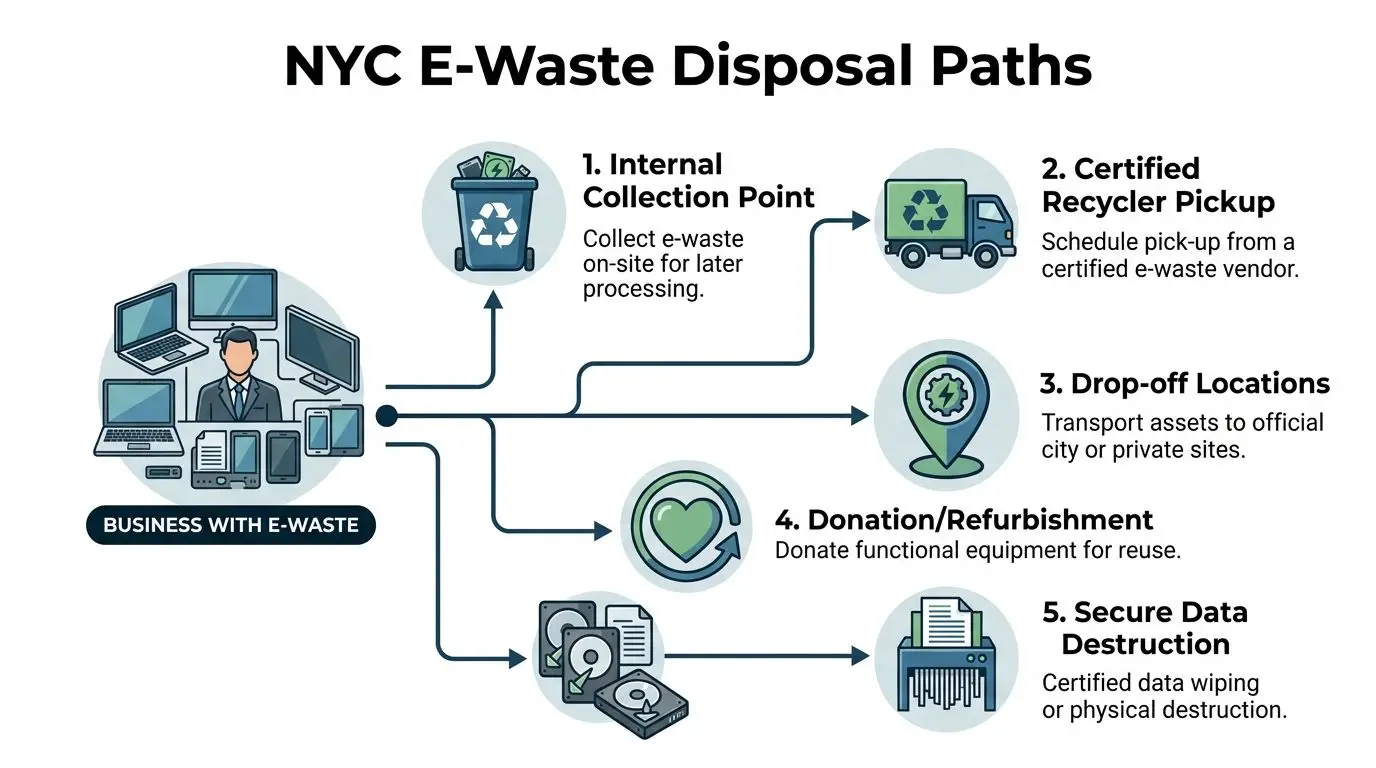
The wrong decision usually comes from treating all electronics as equal. They are not. A few non-data-bearing accessories may fit one disposal route. A law office clearing old laptops and copiers needs another. A data center decommissioning project needs something else entirely.
Option comparison for NYC businesses
The city’s waste characterization work shows why generic recycling channels are a poor fit for electronics. In the 2023 study summarized by Great Forest, e-scrap made up 0.5% of the residential waste stream while contamination in recycling bins reached 27.5%, which points to weak capture and improper sorting in general programs. That makes a business case for more specialized handling rather than relying on mixed disposal habits, as discussed in the NYC waste audit analysis.
Here is the practical comparison.
| Disposal path | Works for | Limits for businesses | Best use case |
|---|---|---|---|
| City drop-off style options | Very small quantities, simple items | Inconvenient for office volumes, weak fit for chain of custody, staff time required | A handful of items, not a program |
| Manufacturer take-back | Specific brands or product categories | Narrow acceptance rules, inconsistent logistics, limited reporting | One product family |
| General junk removal | Fast space clearing | Poor fit for data-bearing assets, weak documentation, uncertain downstream controls | Non-electronic debris only |
| Dedicated ITAD provider | Bulk electronics, mixed asset loads, secure handling | Requires planning and vendor review | Office cleanouts, refresh cycles, recurring programs |
When city or retail drop-off can work
For a very small office with one or two devices and no sensitive data concern, a drop-off route can be workable in theory. In practice, most commercial teams find it inefficient.
The reasons are operational:
- Staff has to transport the equipment.
- Chain of custody can break the moment an employee uses a personal vehicle or unlogged trip.
- There is little room for customized reporting.
- It does not scale when one refresh turns into multiple closets of equipment.
That is why facilities managers reserve these options for edge cases, not core policy.
Why manufacturer programs only solve part of the problem
Take-back programs can be useful when your fleet is highly standardized and you are returning a narrow set of devices. They become less useful the minute the load includes mixed brands, accessories, old AV gear, networking hardware, printers, test equipment, or random legacy assets collected over years.
The hidden problem is labor. Someone in-house still has to sort everything, interpret acceptance rules, and manage separate return streams. For a busy NYC office, that admin work costs more than expected.
What a full-service ITAD path changes
A dedicated electronics recycling and ITAD process is built around business requirements rather than household convenience.
Look for these outputs:
Security controls
You want a provider that can support secure data destruction and handle data-bearing devices as controlled assets, not anonymous scrap.
Pickup and logistics
For NYC, this matters more than many teams expect. Freight windows, dock coordination, elevators, packing, and after-hours access can make or break a project.
Documentation
You need records that close the loop. That may include inventory reconciliation, data destruction records, certificates tied to the job, and disposition reporting.
Reuse and donation potential
Not every retired device belongs in a shred stream. Functional assets may have reuse value or donation potential if handled correctly.
One option businesses evaluate for this type of work is an electronic waste recycling company that provides pickup, secure handling, and ITAD-oriented processing for mixed business equipment.
If your project includes laptops, desktops, servers, network gear, or anything that ever stored company data, choose a path designed for traceability, not convenience.
Match the disposal path to the project type
Use the project itself to decide.
- Single department refresh: ITAD workflow with inventory and pickup.
- Office cleanout before a move: combine decommissioning, electronics segregation, and scheduled removal.
- Recurring sustainability program: establish collection points and quarterly pickups.
- Data center shutdown: use a specialized process with asset-level control and media handling.
The key is not overcomplicating small jobs or under-controlling big ones. NYC businesses get into trouble when they do the latter.
How to Run a Successful Corporate E-Waste Program
A one-time cleanup solves a room problem. A recurring program solves a management problem. If your organization upgrades devices regularly, opens and closes spaces, or supports hybrid staff with distributed equipment, you need a standing process.
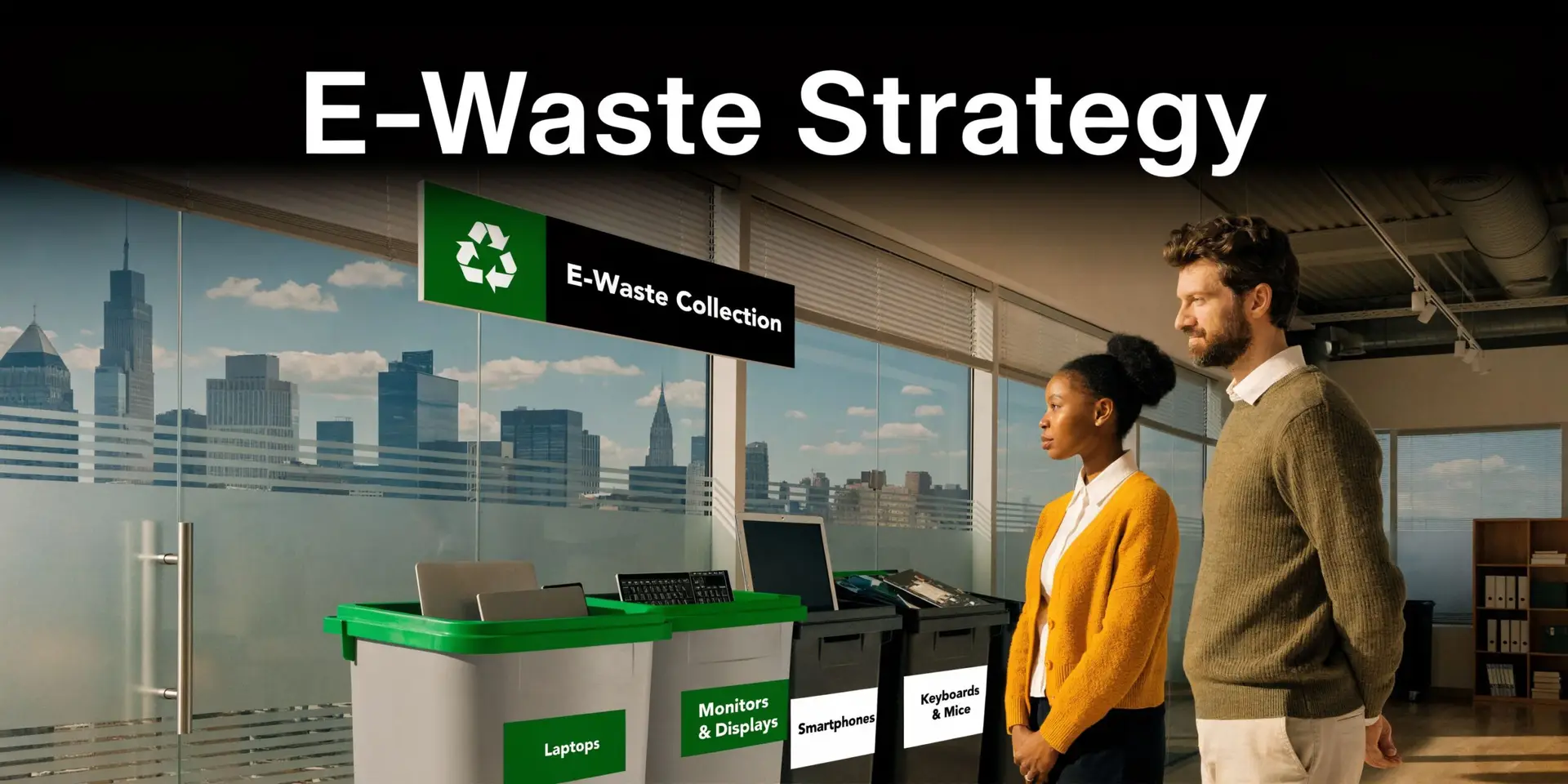
New York City’s broader waste push is a useful signal for businesses. In Fiscal Year 2025, DSNY reported a 48.7% capture rate for metal, glass, and plastic, while the city’s overall diversion rate remained under 20%, according to the NYC Zero Waste Report 2025. That gap is why company-led programs matter. Public systems alone will not solve business electronics recovery.
Build the internal case first
Executive approval comes from three arguments, not one.
Risk reduction
A formal e-waste program lowers the odds of ad hoc disposal, lost devices, and undocumented data-bearing equipment.
Operational control
A scheduled process keeps storage rooms clear and prevents office refreshes from becoming emergency cleanouts.
Sustainability credibility
A program produces records. Records let sustainability teams report what happened without guessing.
Design a program that people will use
Many internal recycling efforts fail because they are too vague. “Bring old electronics to facilities” is not a system.
A usable program includes:
- Named ownership: one person in facilities and one in IT should share accountability.
- Defined intake rules: employees need to know what belongs in the stream and what does not.
- Secure staging: devices wait in a controlled area, not under desks or in open copy rooms.
- Pickup cadence: monthly, quarterly, or event-based, depending on equipment turnover.
- Final reporting: all documentation is stored where audit, procurement, and ESG teams can access it.
A simple operating model
Routine collections
For normal refresh cycles, use a standing process. Departments submit retired assets. IT confirms release. Facilities stages them. Pickup happens on a planned schedule.
Event-based drives
For larger projects, such as office consolidations or annual surplus reduction, run a specific collection event. Give departments deadlines, location instructions, and acceptable item lists.
Special streams
Keep separate handling for batteries, damaged devices, and anything from secure areas or regulated environments.
The cleaner your intake rules are, the less sorting you will pay for later.
Communicate like an operator, not a marketer
Internal launch emails should answer practical questions:
| Employee question | What your program should say |
|---|---|
| What can I turn in | List accepted device types and accessories |
| What should I not bring | Exclude personal trash, non-approved items, and unsafe damaged material unless planned |
| Will data be protected | Explain company-approved sanitization and destruction procedures |
| Where does it go | Describe the chain from collection point to final disposition |
| Why are we doing this | Connect compliance, security, reuse, and sustainability |
Keep the message short. Repetition is more valuable than enthusiasm.
Close the loop with documentation
The job is not done when the pallets leave. It is done when your records are complete.
At minimum, keep:
- Pickup records
- Asset lists or summarized counts, depending on scope
- Data destruction documentation where applicable
- Recycling or disposition certificates
- Internal approvals for surplus release
If you are building or refining a recurring process, this resource on optimizing your company’s e-waste recycling strategy key considerations and best practices can help structure the policy side, especially when multiple departments touch the same assets.
The Reworx Advantage Partnering for Social and Environmental Impact
In a city waste environment this large, vendor choice is not a side decision. DSNY’s FY25 materials describe a system supported by a $2 billion budget and nearly 8,000 workers, alongside commercial containerization requirements covering more than 200,000 businesses, which shows how complex the operating environment is for any company trying to manage waste and recycling responsibly in NYC through DSNY’s FY2025 collections and diversion reporting.
For electronics, the strongest partner is usually the one that can combine secure handling with a credible reuse strategy. That matters because shredding everything may be simple, but it is not always the most responsible outcome for functional equipment.
Why the social enterprise model stands out
A donation-based, reuse-oriented model gives sustainability leaders a better internal story to tell.
Instead of treating every retired device as waste, the organization can pursue a hierarchy:
- Reuse when equipment remains viable
- Harvest value responsibly when reuse is not possible
- Recycle materials correctly when devices reach end of life
That approach aligns better with corporate donation programs, digital inclusion goals, and practical ESG reporting than a scrap-only mindset.
The business benefit is still operational
This is not about values. It also helps facilities and IT teams.
- Cleaner internal approvals: stakeholders are more likely to support a structured disposition program when community impact is part of the result.
- Better alignment with procurement and ESG teams: reuse and donation support broader sustainability narratives.
- Stronger employee engagement: staff responds well when retired equipment may support schools, nonprofits, and underserved communities instead of going straight to destruction.
For companies already adapting to broader supply chain and packaging expectations, it also helps to understand how external stakeholders are tightening sustainability requirements. Electronics disposition is part of that larger operational picture.
One organization businesses can evaluate in this category is Reworx Recycling, which positions electronics recycling and ITAD within a social enterprise model that emphasizes donation, reuse, community benefit, and secure handling alongside standard disposition services. More on that approach is available at partnering for impact with Reworx.
A responsible electronics program should do more than remove risk. It should also make better use of equipment that has life left in it.
Take Control of Your NYC Business E-Waste Today
For NYC businesses, electronics disposal is a facilities issue, an IT issue, and a compliance issue all at once. The companies that handle it well do three things consistently. They separate commercial rules from residential assumptions, they control data before devices leave the building, and they choose a disposal path that fits the scale of the job.
That turns recycling in NYC from a recurring headache into a managed process. Your storage rooms stay usable. Your documentation holds up, and your business avoids the chaos that comes from treating retired electronics like ordinary office junk.
If your office is planning a refresh, move, cleanout, or recurring collection program, act before surplus equipment starts piling up. A short planning conversation now is easier than sorting mixed hardware under deadline pressure later.
If your organization needs a practical next step, contact Reworx Recycling to discuss secure pickup, IT equipment disposal, office cleanout support, and a recycling approach that can also support donation, reuse, and community impact.