Your team just refreshed a floor of laptops, retired a rack of servers, or wrapped a data center decommissioning project. The pallets are labeled. The pickup is scheduled. The truck leaves.
That's usually the moment when uncertainty starts.
If you're the IT manager, facilities lead, or sustainability director signing off on that load, you're not only asking whether the equipment is gone. You're asking what happened next. Was the data indeed destroyed? Did every serialized asset reach the right processor? Were reusable devices remarketed or donated responsibly? Did anything get exported, mishandled, or dropped into a downstream channel you never approved?
That's where the transparency supply chain question stops being abstract. In IT asset disposition, transparency is how you reduce risk, support compliance, and prove that your organization handled retired technology responsibly from pickup through final outcome. It also shapes your electronics recycling, secure data destruction, and broader sustainable recycling program in a way auditors and leadership teams can understand.
For businesses handling laptop disposal, office cleanout projects, medical equipment disposal, laboratory equipment disposal, or product destruction, this matters because end-of-life technology rarely moves through one pair of hands. It passes through drivers, warehouses, data destruction stations, testing benches, refurbishment channels, commodity processors, and downstream vendors. If you can't see those handoffs, you can't fully defend the result.
Your Retired IT Assets Have a Story Where Does It End
A common scenario goes like this. Finance wants retired assets off the books. Security wants proof of data destruction. Sustainability wants landfill diversion records for ESG reporting. Procurement wants to know whether the ITAD vendor used approved downstream processors.
Then an internal audit asks for documentation on a batch of devices that left six months ago.
The pickup receipt exists, but the story ends there. No serialized reporting. No clear chain of custody. No visibility into who handled the load after the first stop. That's the kind of gap that turns routine IT equipment disposal into a compliance problem.
According to MIT Sloan's discussion of the GEODIS Supply Chain Worldwide Survey, only 6% of companies report full end-to-end visibility across their supply chains, which shows how rare complete transparency still is at scale in complex networks like ITAD (MIT Sloan on supply chain transparency).
Why this hits IT teams harder
In consumer goods, poor visibility can create sourcing or product risk. In IT asset disposition, poor visibility can create data exposure, environmental liability, and broken audit trails.
A retired laptop isn't just scrap. It may still contain customer records, employee files, credentials, or regulated data. A server leaving your site may carry storage media that require documented handling and final destruction. A facility cleanout may include networking gear, printers, mobile devices, drives, and accessories that all need different disposition paths.
Practical rule: If you can't document where each category of retired asset went, you don't yet have a transparent disposition process.
What busy managers usually need
Teams often don't need a grand theory. They need answers to practical questions:
- Where did the assets go after pickup, sorting, and processing?
- Who touched the equipment at each handoff?
- How was data destroyed and what proof exists?
- Which downstream vendors handled materials after initial processing?
- What was the final outcome for reuse, donation-based recycling, parts harvesting, or commodity recovery?
This is also where community impact enters the picture. Responsible electronics recycling isn't only about avoiding harm. When reusable equipment is handled well, it can support corporate donation programs, digital inclusion, and workforce development instead of becoming unmanaged waste.
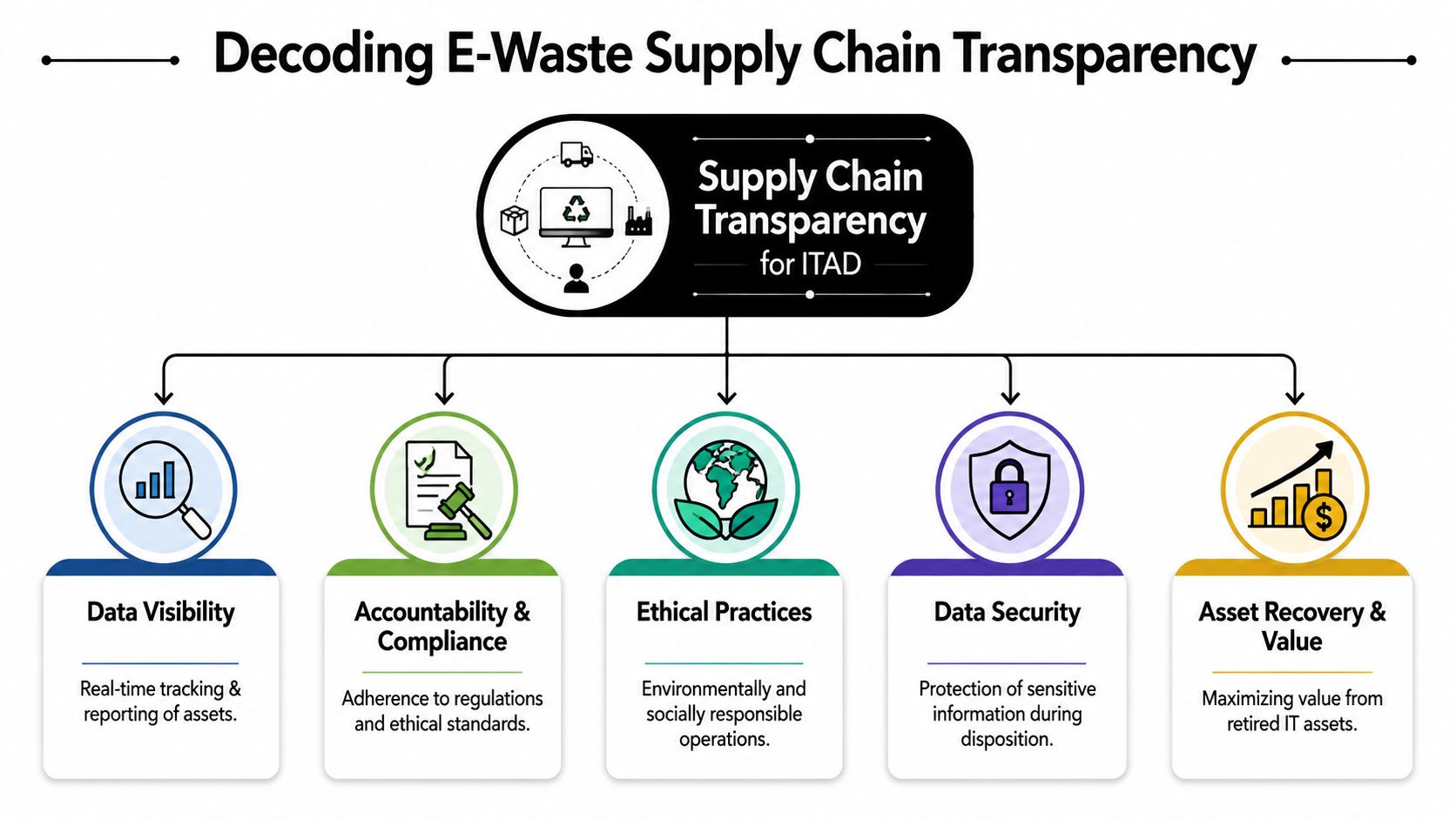
Decoding Supply Chain Transparency for E-Waste
Supply chain transparency in e-waste means you can see, verify, and explain the movement and handling of retired technology from your location to final disposition.
MIT Sloan breaks transparency into visibility and disclosure. Visibility means identifying and collecting data from all links in the chain. Disclosure means sharing that information with the right internal and external stakeholders. In ITAD, both matter. Internal visibility helps IT, security, legal, and sustainability teams work from the same facts. External disclosure helps with audits, customer requests, and compliance reviews.
Think of it like certified mail
A useful analogy is certified mail for a high-value package. You don't just want proof that the box left your office. You want timestamps, signatures, destination confirmation, and a record of custody.
ITAD works the same way, except the package may split into several outcomes. One laptop may be wiped and reused. Another may be dismantled for parts. A damaged drive may be physically shredded. Transparency means each path is visible enough to defend.
Three pillars that matter most
Traceability
Traceability is the ability to follow an asset, or a batch of assets, through each step of the reverse supply chain. That starts with inventory at pickup and continues through transport, receiving, testing, data destruction, resale, donation, recycling, or destruction.
If a recycler can't tie a serial number or asset tag back to a documented outcome, you're relying on trust instead of evidence.
Auditing
Auditing is how you verify that the process described on paper is the process used in practice. A vendor may say it follows strict procedures. Auditing asks for records, process controls, certifications, and downstream documentation that support that claim.
This becomes more important beyond the first vendor. EcoVadis cites McKinsey data showing that 60% of supply chain leaders report Tier 1 transparency, but only 30% report transparency beyond Tier 1, which is why downstream partner visibility matters so much in ITAD (EcoVadis on supply chain transparency).
Data security
This is the pillar most IT leaders care about first, and for good reason. Data security in the transparency supply chain means there's an unbroken record showing where devices and media were, who handled them, and how data destruction was completed.
If you need a practical reference point, this overview of chain of custody in electronics recycling is useful because it connects documentation directly to asset handling.
A pickup receipt proves removal from your building. It does not prove secure disposition.
What transparency is not
It isn't just a sustainability statement on a website. It isn't a generic recycling certificate with no asset detail. And it isn't “we handle everything in-house” unless that statement can be backed up with process records and downstream disclosure.
For e-waste, real transparency means the story of an asset doesn't disappear after the truck door closes.
The Technology Powering a Transparent ITAD Process
A transparent ITAD process doesn't run on goodwill. It runs on systems.
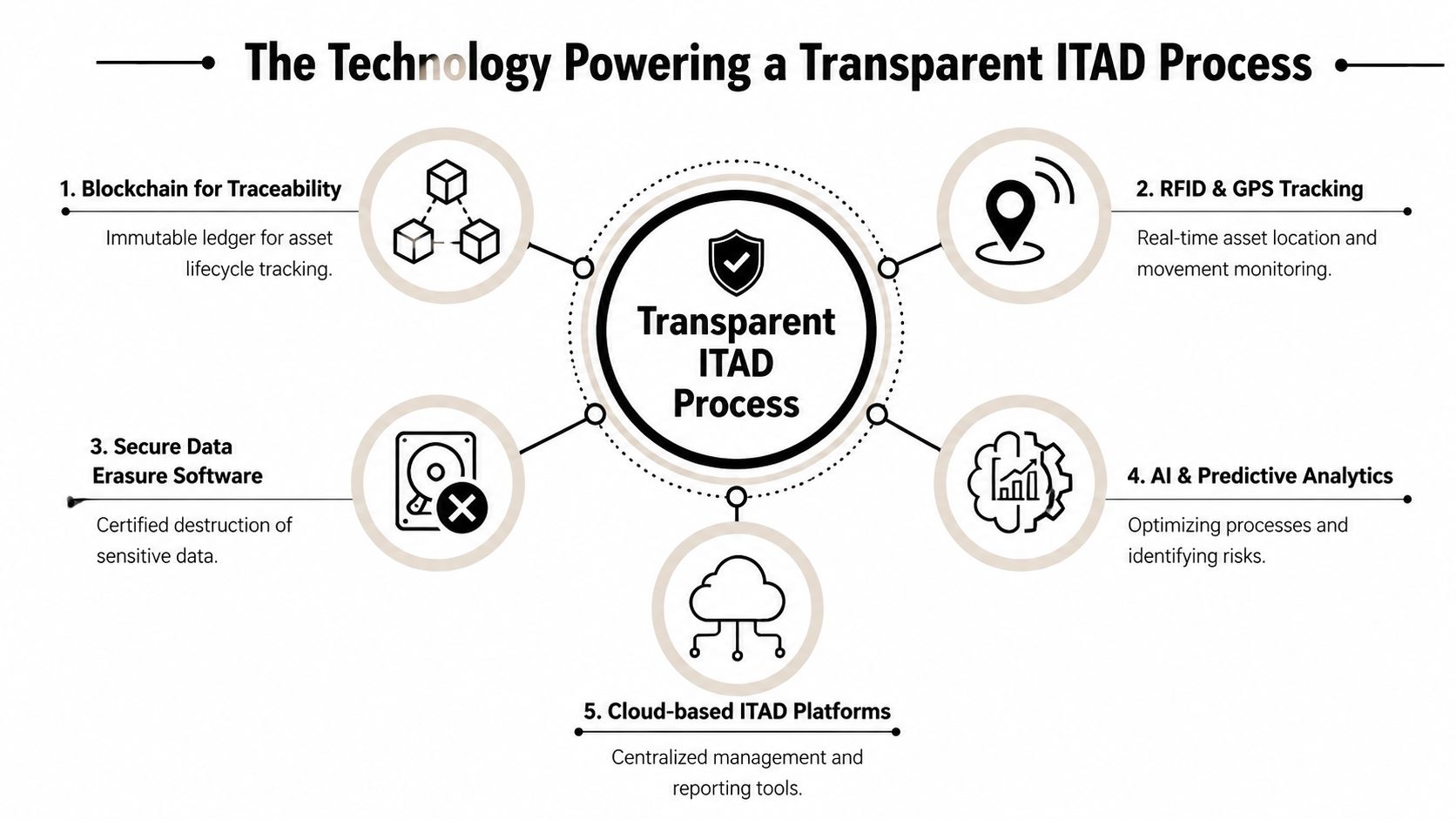
The strongest programs combine physical controls with digital records so that pickup, transport, processing, and reporting all feed the same evidence trail. TDWI notes that timely, accurate supply-chain data helps companies react faster and more effectively when problems occur, and that logic applies directly to disposition workflows where one missing record can delay an audit response or incident review.
The tools that create usable visibility
Here's what shows up most often in practical ITAD operations:
| Technology | What it does in practice | What to watch for |
|---|---|---|
| Serialized asset tagging | Ties each device to an inventory record and final outcome | Weak if tags aren't reconciled at receiving |
| GPS-enabled logistics tracking | Documents where shipments moved and when | Useful for transport, but not enough by itself |
| Secure data erasure software | Produces records for logical wiping workflows | Needs linkage to specific devices or drives |
| Client reporting portals | Gives IT and compliance teams access to status and records | Portals are only as good as the underlying data |
| Integrated compliance systems | Connects disposition data with audit and policy workflows | Implementation can be messy without standard fields |
A word on advanced tools
Blockchain, IoT, and analytics get a lot of attention in supply chain discussions. Oracle and IBM are often referenced in this context because complex supply chains create large data volumes and multiple handoffs. In ITAD, the question isn't whether a tool sounds modern. It's whether it improves proof.
Blockchain can help when multiple parties need a tamper-resistant history of asset movement. The downside is that it won't fix bad input data. If the first scan is wrong, the ledger preserves the wrong record very well.
AI and predictive analytics can also help flag anomalies, such as a shipment that skipped a normal processing step or a serial number that never reached final disposition. But again, they work only when your base data is clean.
Decision test: Choose technology that reduces manual reconciliation. If a tool creates more dashboards but not better records, it's not improving transparency.
The hidden work is document flow
Many transparency failures come from paperwork bottlenecks, not equipment handling. Bills of lading, destruction logs, receiving records, and downstream certificates often sit in separate systems. That's why operations teams are paying more attention to automating supply chain document processes, especially when they need searchable records rather than email attachments buried across departments.
For organizations evaluating platforms, this look at IT asset tracking systems gives a useful framework for what to ask about visibility, reporting, and audit readiness.
One practical example is a business electronics recycling partner using serialized intake, scanning at every custody transfer, secure wipe reporting, and client-accessible disposition records. Reworx Recycling offers this type of documented tracking within its broader ITAD and reverse logistics services, which is the sort of operational setup busy teams should look for whether they're planning a small office cleanout or a larger data center decommissioning project.
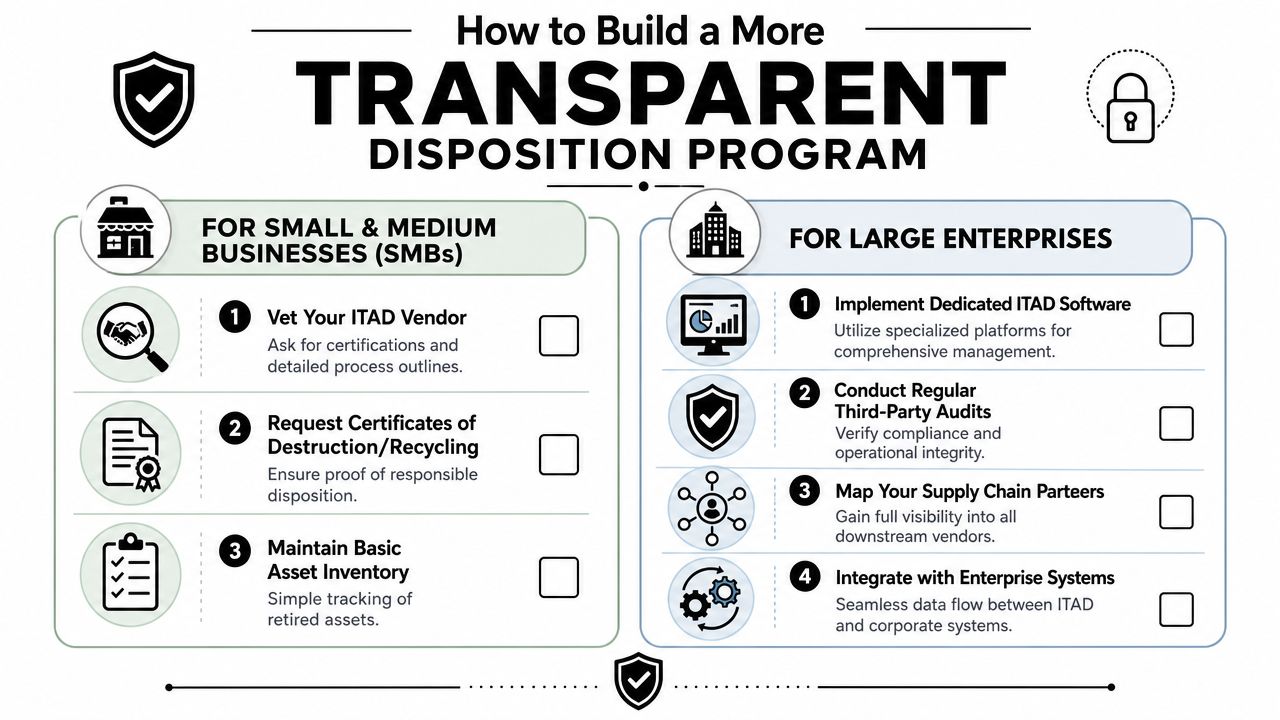
How to Build a More Transparent Disposition Program
Most companies can improve transparency faster than they think. You don't need a giant digital transformation project to fix the biggest blind spots. You need the right controls in the right order.
TDWI's point is useful here. Timely and accurate supply-chain data helps companies react faster when problems occur, which is exactly what you want when a drive goes missing on a manifest, a device class needs recall support, or a regulator asks for proof of handling (TDWI on supply chain visibility and transparency).
For small and mid-sized businesses
If you're running a lean team, start with controls that create evidence without adding heavy overhead.
- Ask for serialized reporting: Don't settle for a generic “items received” summary. Ask whether the vendor can report by serial number, asset tag, or another unique identifier.
- Require destruction and recycling documentation: You want records for data-bearing devices and a clear description of material outcomes.
- Map the first handoff: Know who picks up equipment, where it is received, and whether the vendor uses downstream processors.
- Keep a simple retirement log: A spreadsheet with asset type, serial number, pickup date, and final documentation is far better than relying on email threads.
- Review vendor criteria before you sign: This checklist on how to assess ITAD vendor selection criteria helps teams turn vague promises into measurable questions.
A smaller company retiring laptops during an office cleanout doesn't need enterprise software on day one. It does need a repeatable process that IT, finance, and operations all recognize.
For larger enterprises
Larger organizations face a different problem. They usually have more systems, more stakeholders, and more asset volume. The issue isn't whether data exists. It's whether the data connects.
A stronger enterprise program often includes:
- A written ITAD policy that defines approved vendors, chain-of-custody requirements, data destruction methods, and escalation rules.
- Vendor audits that test real workflows, not just marketing claims.
- Downstream mapping so procurement and compliance teams know where materials go after initial processing.
- System integration between asset inventory, disposition records, and ESG or compliance reporting.
- Role clarity across IT, security, facilities, legal, and sustainability.
The most useful KPIs at this stage
You don't need dozens of metrics. Start with a handful that expose weak spots.
| KPI | Why it matters |
|---|---|
| Assets matched to final disposition records | Shows whether inventory and outcomes reconcile |
| Data-bearing devices with destruction evidence | Helps security and audit teams verify closure |
| Loads with documented downstream path | Measures visibility after the first processor |
| Exception resolution time | Indicates how quickly your team can address missing or unclear records |
Better transparency isn't about collecting every possible field. It's about collecting the fields you'll need when something goes wrong.
Navigating Common Challenges and Red Flags
Many teams get frustrated. They were told transparency would be straightforward. Then they discover that every extra handoff creates more records to manage, more vendors to review, and more chances for confusion.
The hard truth is that more data doesn't always mean more clarity.
When transparency becomes burden
Forto makes a helpful point: transparency depends on high-quality data, and the Fair Labor Association's machine-readable site-list requirement shows how expectations are shifting from broad statements to structured, auditable disclosure (Forto on supply chain transparency).
That matters in ITAD because teams can drown in documents that don't answer the core question. A folder full of PDFs may look thorough, but if none of them tie a serial number to a final outcome, the reporting burden went up while insight stayed flat.
Three common traps show up often:
- Document overload: Too many certificates, not enough linkage between them.
- Weak downstream visibility: The first vendor is known. The next processor isn't.
- Mixed data standards: Different teams track assets differently, so records can't be reconciled quickly.
Red flags in a recycling partner
Some warning signs are easy to miss because they sound normal at first.
- Vague answers about downstream handling: If the vendor won't explain where materials go after initial processing, visibility probably ends too early.
- No serialized reporting: Batch summaries may be acceptable for low-risk items, but they're weak for laptops, servers, or storage media.
- Pricing that seems unusually low: That can signal shortcuts in data handling, labor practices, or environmental controls.
- Generic certificates only: A certificate without asset-level detail may satisfy filing habits but not audit scrutiny.
- No clear explanation of downstream processors: This is one area where asking direct questions about downstream processing practices can reveal whether a vendor is structured for real transparency.
If a provider can describe pickup in detail but gets blurry about what happens after sorting, that's not a small gap. That's the gap.
What a practical standard looks like
A useful standard is simple: the vendor should provide the minimum information needed to make decisions, investigate exceptions, and support audits. Not less. Not endless noise.
For a laptop disposal project, that may mean serialized intake, custody records, destruction reporting for drives, and final disposition by device. For a bulk commodity load from a facility cleanout, it may mean batch-level tracking plus documented downstream processors. The right level depends on asset risk.
The point isn't to create perfect omniscience. It's to create a defensible record.
Measuring Success and Partnering for Impact
A strong transparency supply chain does two jobs at once. It protects the business, and it gives the business a better story to tell.
Protection comes from documented chain of custody, faster exception handling, and cleaner audit support. The better story comes from showing that retired technology was handled responsibly through reuse, donation-based recycling, secure data destruction, and sustainable recycling practices that support people as well as compliance.
KPIs that actually help
Good KPIs should tell you whether your process is becoming easier to trust. Useful examples include:
- Percentage of assets with certified data destruction
- Percentage of pickups reconciled to inventory records
- Percentage of loads with documented downstream handling
- Exception resolution time for missing or unclear records
- Verified landfill diversion rate
- Percentage of reusable devices routed to approved reuse or donation channels
If you want a broader operations primer, this explainer on what supply chain visibility entails is a helpful companion because it frames visibility as a management discipline, not just a software feature.
Why this matters beyond compliance
Transparent ITAD affects the community too. When retired equipment is managed with clear disposition logic, organizations can support digital inclusion and local impact instead of treating every device as waste. That's one reason social-enterprise recycling models are getting more attention from corporate sustainability leaders.
For teams that want to connect secure disposition with broader outcomes, this overview of partnering for impact through technology reuse and recycling shows how end-of-life programs can support community benefit alongside risk reduction.
This is the shift. Your retired assets don't have to disappear into a black box. With better traceability, tighter documentation, and more disciplined vendor oversight, they can move through a process you can defend to auditors, leadership, customers, and your own employees.
If your organization is planning electronics recycling, IT equipment disposal, computer recycling, secure data destruction, laptop disposal, facility cleanout support, or a larger ITAD refresh, Reworx Recycling can help you turn retired equipment into a documented, responsible outcome. Businesses can donate old equipment, schedule a pickup, or explore a partnership that supports both operational compliance and community impact.