Choosing the right electronic waste recycling company is a critical business decision that extends far beyond simple disposal. This choice directly impacts your company’s data security, environmental compliance, and public reputation. For business owners, IT managers, and corporate sustainability leaders, selecting a partner who aligns with your operational standards and corporate values is essential for responsible IT asset disposition (ITAD).
From Disposal Problem to Strategic Partnership
This isn't a low-stakes decision. We're not just talking about hauling away obsolete equipment; we're talking about protecting sensitive company and customer data, staying on the right side of complex environmental laws, and upholding your brand's integrity. One wrong move could lead to a devastating data breach, steep fines, or the kind of negative press that takes years to recover from.
To do this well, you need a shift in thinking. Don't see e-waste as a disposal problem. Instead, frame it as a strategic IT Asset Disposition (ITAD) program. This mindset forces you to consider the entire lifecycle of your technology, with a sharp focus on recovering value, destroying data securely, and recycling responsibly.
From Disposal Mindset to Strategic ITAD
Adopting an ITAD strategy means you’re moving from a reactive chore to a proactive, value-driven plan. It’s a bigger-picture view that covers several key areas:
- Data Security First: Every single device—from hard drives and servers to company smartphones—is a container for data. A true ITAD partner ensures that data is completely and irreversibly destroyed before any device is recycled or resold. They should always provide official certificates of destruction to back it up.
- Compliance and Risk Management: Environmental regulations, like the EPA’s rules around hazardous waste, are no joke. A certified partner has the expertise to navigate this maze for you, making sure every item is handled in full compliance with federal, state, and local laws. When you bring on an e-waste recycler, you should treat it with the same seriousness as any other vendor relationship, applying sound contractor management principles to protect your organization.
- Value Recovery: Not all of your old tech is junk. A smart ITAD program is designed to spot the assets that still have life in them. Equipment that can be refurbished and resold can actually turn a disposal cost into a revenue stream through buyback programs.
- Sustainability and ESG Goals: Who you choose as your recycling partner is a direct reflection of your company's commitment to Environmental, Social, and Governance (ESG) principles. Working with a certified, responsible recycler gives you tangible, verifiable data you can use in your sustainability reports.
The importance of e-waste recycling in businesses cannot be overstated. A well-managed program protects your organization from liability while demonstrating a firm commitment to environmental stewardship.
The Social Enterprise Advantage
Now, imagine taking your ITAD program a step further. When you partner with a social enterprise like Reworx Recycling, a routine operational task becomes a powerful story of community impact and environmental leadership.
Under this model, donated electronics that are still functional get a second life. They are professionally refurbished and then provided to non-profits, local schools, and families in underserved communities, helping to bridge the digital divide right where you live and work.
This isn’t just about recycling anymore; it's about generating a measurable social return. By choosing a donation-based model, your company’s retired assets can empower a student, support a workforce development program, or equip a community center with needed technology. Suddenly, your e-waste program transforms into a cornerstone of your corporate social responsibility (CSR) work—a positive, authentic story that resonates with employees, customers, and stakeholders.
Vetting Your Potential Recycling Partners
Choosing the right electronic waste recycling company is a big deal. It’s about more than just hauling away old gear. The partner you pick becomes a steward of your data, a guardian of your environmental compliance, and ultimately, a reflection of your company's values. It takes a methodical process to separate the true professionals from the risky operators out there.
Think about it this way: there are two paths you can take with your old IT assets. One is a simple disposal mindset, which often leads to unforeseen headaches. The other is a strategic approach to IT Asset Disposition (ITAD) that prioritizes security and unlocks hidden value.
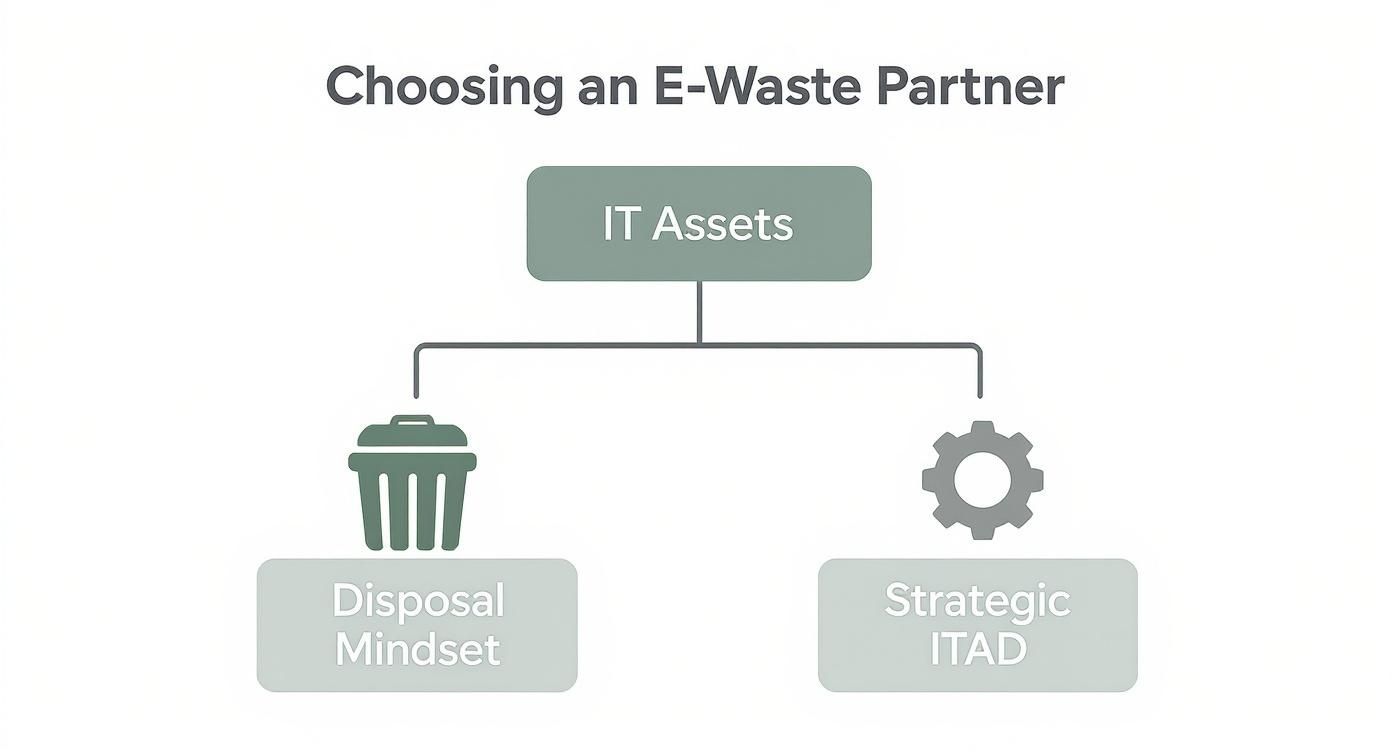
As you can see, a thoughtful ITAD strategy leads to much better outcomes. To get there, you need to vet your potential partners thoroughly. It’s worth taking the time to ask a set of crucial questions to ask potential partners, a smart practice whether you're hiring movers or an e-waste expert.
Certifications and Compliance
Industry certifications are your first and best line of defense. They’re independent proof that a vendor holds themselves to high standards for environmental safety, worker health, and data security. Without them, you're just taking their word for it, which is a gamble you don't want to make.
Here are the big ones to look for:
- R2 (Responsible Recycling): This is a major global standard. An R2-certified partner like Reworx Recycling has been audited on everything from their environmental practices and data security to how they track materials downstream. It’s your guarantee that your equipment won’t be illegally exported or tossed in a landfill.
- e-Stewards: Often considered the gold standard, e-Stewards certification has a strict, zero-tolerance policy against exporting hazardous e-waste to developing countries. It provides an extra layer of confidence that your assets are being handled with the highest integrity.
- NAID AAA Certification: This one is all about data destruction. A vendor with NAID AAA certification is subject to surprise audits to make sure their processes for shredding, wiping, and degaussing drives meet the toughest security protocols.
A vendor’s certifications aren't just logos for their website. They are verifiable proof of their commitment to doing things the right way. Always ask to see current copies of their certificates to confirm they’re in good standing.
Before you go any further, use this checklist to quickly size up any potential vendor. It will help you compare apples to apples and spot any immediate red flags.
Vendor Vetting Checklist
A quick-reference checklist to evaluate and compare potential electronic waste recycling companies across key criteria.
| Evaluation Criteria | What to Look For | Why It Matters |
|---|---|---|
| Certifications | R2v3, e-Stewards, NAID AAA. Ask for current copies of certificates. | Provides independent proof of compliance with environmental, safety, and data security standards. |
| Data Destruction | Offers both physical shredding and software wiping. Provides a Certificate of Data Destruction for every device. | Guarantees sensitive information is permanently destroyed, protecting you from data breaches and liability. |
| Chain of Custody | Detailed, serialized reporting from pickup to final disposition. GPS tracking on trucks. | Creates an unbroken, auditable trail for every asset, which is crucial for compliance and security. |
| Insurance Coverage | General Liability, Pollution Liability, and Errors & Omissions (E&O). | Protects your organization from financial loss in case of an accident, data breach, or environmental incident. |
| Transparency | Willing to allow facility tours (virtual or in-person). Answers all questions directly. | A transparent partner has nothing to hide and is confident in their processes and security measures. |
If a vendor checks all these boxes, you’re on the right track. A solid partner will have no problem providing this documentation and being completely open about their operations.
Secure Data Destruction Methods
Every single device you retire—from a server in the data center to a simple office printer—is a potential data breach waiting to happen. The cost of a single breach, both in fines and lost reputation, can be staggering. That's why understanding and verifying a partner’s secure data destruction methods is absolutely non-negotiable.
There are really two gold-standard methods for ensuring data is gone for good:
- Physical Destruction: This is the most foolproof method. It involves putting hard drives, solid-state drives (SSDs), and other storage media through a shredder that reduces them to tiny, useless fragments. Once a drive is shredded, there's no way to ever recover the data.
- Cryptographic Erasure/Data Wiping: This is a software-based approach that overwrites the existing data with random ones and zeros, making the original information completely unreadable. It’s a great option for newer devices that might be refurbished and resold.
Any partner you consider must be able to clearly explain their process and provide an auditable report for every single asset they handle. You need a Certificate of Data Destruction, which is the official document that legally transfers liability for that data from you to them.
Want to dive deeper into this? Check out our detailed guide on securing sensitive data during the e-waste recycling process.
Chain of Custody and Reporting
From the exact moment your equipment is loaded onto their truck, you need a crystal-clear, unbroken record of where it is and who has handled it. We call this the chain of custody, and it's your proof of due diligence.
A professional ITAD partner will provide transparent documentation every step of the way. Insist on seeing detailed reporting that includes:
- A full, serialized inventory of every asset collected.
- GPS tracking information for the truck carrying your equipment.
- Logs showing when your assets were checked into their secure facility.
- Final disposition reports that detail whether each item was recycled, resold, or destroyed.
This paper trail is your best friend during an internal audit or a compliance check. A vendor who is cagey about their reporting process is a massive red flag.
Insurance and Liability Coverage
Last but certainly not least, you have to verify that your potential partner carries the right kind of insurance. This is what protects your business if something goes wrong—an accident on the road, an environmental issue, or a data breach that happens while your assets are in their possession.
Ask for their certificates of insurance and look for three key types of coverage:
- General Liability: This covers basic property damage or injury.
- Pollution Liability: This is specific coverage for costs related to any environmental contamination.
- Errors and Omissions (E&O): This is crucial. It covers you from risks related to a data breach or other failures in their professional service.
A properly insured partner is a stable partner. It shows they take risk management seriously and have the financial backing to make things right if the worst happens. It’s the final piece of the puzzle in building a trustworthy, long-term partnership.
Understanding Costs and Unlocking Hidden Value
When you're dealing with outdated IT assets, it's easy to see it as just another disposal cost. But that’s a limited view. A smart approach turns this line-item expense into a genuine opportunity to recover value and make a real impact. Getting a handle on the financial side of working with an electronic waste recycling company is the key.
The pricing for ITAD services isn't one-size-fits-all. It really depends on the scope and complexity of the job. A straightforward office cleanout will be priced very differently from a full-blown data center decommissioning, which demands specialized logistics and serious project management.
Common Pricing Models in E-Waste Recycling
As you start talking to recycling partners, you'll probably run into a few common fee structures. Knowing what they are ahead of time helps you budget properly and compare quotes apples-to-apples.
- Per-Pound or Per-Item Fees: This one is as simple as it sounds. The company charges based on the total weight of the equipment or by the number of individual items collected. It's a popular model for smaller pickups or one-off recycling drives.
- Project-Based Fees: For bigger, more involved jobs—like a facility cleanout or handling IT equipment disposal across multiple sites—vendors often quote a flat project fee. This usually covers everything: logistics, labor, secure transport, data destruction, and the final reports.
- Service-Specific Charges: Some specialized services might have their own price tags. Things like on-site hard drive shredding or certified data wiping often carry separate fees. Always ask for a detailed breakdown so there are no surprises.
Understanding these models is just the first step. The real conversation starts when you shift your focus to the other side of the ledger: value recovery.
From Cost Center to Revenue Stream
Your retired assets might have more life left in them than you think. A true ITAD partner won't just haul things away; they'll do a thorough assessment to see what can be refurbished and resold. This is where buyback programs change the game.
An effective asset buyback program can dramatically offset—or even completely eliminate—your recycling costs. Instead of paying for disposal, you get a check for assets that still have value on the secondary market.
This process kicks off with a detailed inventory and a fair market valuation of your equipment. For anything with no resale value, the focus turns to responsible recycling. It’s hard to overstate the potential locked inside old electronics. In 2022, global e-waste contained metals worth an astronomical sum, but only a tiny fraction of that value was ever recovered through formal recycling. That's a huge economic and environmental opportunity just waiting to be tapped.
The Unique ROI of a Social Enterprise Partnership
When you choose a social enterprise recycling partner like Reworx Recycling, you add a powerful new dimension to your ROI: social capital. While traditional vendors are focused solely on the financial return, a donation-based model transforms your old equipment into a community investment.
This isn't just another transaction; it's a chance to make your ITAD program a pillar of your Corporate Social Responsibility (CSR) strategy. The benefits are both tangible and far-reaching:
- Tax Advantages: Donating functional equipment to a registered non-profit can bring significant tax benefits to your business.
- Community Impact: Your old laptops and monitors can empower students, equip other non-profits, and support workforce development programs, tackling the digital divide head-on.
- Enhanced Brand Reputation: This creates an authentic, positive story that resonates with employees, customers, and stakeholders who care about corporate citizenship.
By partnering with Reworx, you're not just managing e-waste. You're actively creating opportunities and showing a deep commitment to sustainable, ethical business. To see how it all works, check out our guide on unlocking value after electronics recycling. This approach turns an operational task into a strategic advantage that pays dividends well beyond the balance sheet.
Managing Project Logistics and Pickup
Once you’ve vetted and selected the right electronic waste recycling company, the real work begins. The focus shifts from planning to execution, and a successful partnership really boils down to smooth logistics, whether you're tackling a full office cleanout or a simple equipment refresh. Good preparation is the difference between a seamless project and a chaotic one that disrupts your entire workday.
The process starts long before the recycling truck pulls up to your door. Your IT, facilities, and management teams all need to be on the same page about the project's scope, timeline, and who's responsible for what. I've seen projects get messy fast simply because of poor internal communication, leading to delays, misplaced assets, and a whole lot of unnecessary stress.
Think of it as a coordinated handoff. Your team preps the assets, and your recycling partner handles the removal. When both sides know exactly what to expect, the whole process is secure, professional, and surprisingly simple.
Preparing Your Assets for Pickup
Taking the time to properly stage your equipment before the crew arrives will make the whole process go exponentially faster. This isn't just about being tidy; it's a critical first step in maintaining a clear chain of custody right from the start.
First, designate a secure, central staging area. Find a spot that’s easy for the pickup team to access but won't get in the way of your daily business. Having all the assets in one place prevents confusion and makes sure nothing gets missed.
Next, it’s always a good idea to do a quick preliminary inventory. While your ITAD partner will conduct their own detailed audit, having your own list helps you cross-reference their final report. This doesn't need to be fancy—a simple spreadsheet with asset types, quantities, and serial numbers (if you have them) is perfect. It adds a simple but effective layer of accountability.
Finally, do a walkthrough and make sure there’s a clear path for the removal team. Measure doorways, hallways, and elevators to confirm that bigger items, like server racks or large printers, can be moved out without any trouble. Clearing these pathways beforehand prevents delays and keeps your property from getting scuffed up on pickup day.
What to Expect on Pickup Day
A professional ITAD partner operates with precision and security. On the day of the pickup, you should expect a uniformed and badged crew to show up with all the right gear—secure, lockable bins for loose hard drives, pallets, and shrink wrap for larger equipment.
The crew leader will usually start by walking through the scope of work with your on-site contact. Then, they’ll start their own inventory, often using barcode scanners to log each asset by serial number. This officially kicks off the chain-of-custody documentation, which tracks your gear from your facility all the way to theirs.
Key Takeaway: The entire pickup should feel transparent and well-documented. The crew should be professional, efficient, and happy to answer your questions. If anything feels off, don't be afraid to speak up.
Once everything is inventoried and loaded securely onto a locked, GPS-tracked truck, you should be handed a Bill of Lading or a similar receipt. This document confirms the transfer of materials and is the first official piece of your project paperwork. It’s a simple piece of paper, but it’s a vital one.
Organizing a Corporate E-Waste Drive
Looking beyond your own IT assets? Partnering with a social enterprise recycling provider like Reworx Recycling is a fantastic way to engage your community with a corporate e-waste drive. This lets your employees bring in their own unwanted electronics for responsible recycling, really amplifying your company’s commitment to sustainability.
Pulling off a successful drive just takes a few key steps:
- Set a Date and Time: Pick a day or a week that makes sense for your team and coordinate the logistics with your recycler.
- Promote the Event: Get the word out using internal newsletters, emails, and posters. Be clear about what items are accepted (laptops, phones, cables) and what’s not allowed.
- Designate a Drop-Off Location: Set up a collection point that's easy to find and access, like the company lobby or cafeteria.
- Arrange for Pickup: Your recycling partner will provide collection bins and schedule a pickup when the event is over.
These drives are powerful tools for employee engagement and a very tangible way to show your company’s values in action. They turn a simple recycling project into a shared effort for a great cause. Coordinating a pickup for your business is straightforward; you can even schedule a pickup with Reworx Recycling to see how a professional team can manage the logistics for your office or a special event.
Building a Partnership for Sustainable Impact
The journey doesn’t end when the truck pulls away with your old equipment. When you choose an electronic waste recycling company, you’re not just making a one-off transaction—you’re starting a strategic partnership. The real, long-term value comes when you stop seeing IT asset disposition (ITAD) as simple disposal and start viewing it as a powerful engine for positive change.
A true partner does more than just logistics. They give you the data and the stories you need to amplify your company's commitment to sustainability. This relationship can turn a routine operational task into a cornerstone of your Environmental, Social, and Governance (ESG) strategy. It’s a chance to transform a compliance headache into a genuine narrative of corporate leadership and community investment.

From Recycling Reports to ESG Leadership
Your annual ESG report is a critical tool for communicating your values to investors, customers, and employees. But generic statements about sustainability just don’t cut it anymore. Stakeholders demand tangible data and measurable results, and this is where a high-quality recycling partner becomes indispensable.
A professional ITAD vendor will provide detailed impact statements and environmental reports after every project. These documents are goldmines of information, offering hard numbers you can plug directly into your reporting.
- Pounds Diverted: Get the exact weight of electronic waste you kept out of local landfills.
- Materials Recovered: See a breakdown of the specific commodities—like copper, aluminum, and precious metals—that were reclaimed for manufacturing.
- Carbon Footprint Reduction: Quantify the estimated CO2 emissions you avoided by choosing to recycle.
This data allows you to shift from vague claims like "we recycle responsibly" to powerful, evidence-backed statements. Imagine reporting, "This year, we diverted 15,000 pounds of e-waste from landfills, preventing the release of an estimated 25 metric tons of CO2 equivalents." That’s a story with real weight.
This level of detailed tracking is crucial, especially as the world generated a record 62 million tonnes of e-waste in 2022. That staggering figure underscores the urgent need for responsible corporate action.
The Power of a Social Enterprise Story
Partnering with a social enterprise like Reworx Recycling adds another, more human layer to your impact story. While traditional recyclers focus on commodities, a donation-based model channels your retired assets directly into community empowerment. This transforms your ITAD program from a purely environmental initiative into a powerful social one.
Think about the narrative you can build. Your company’s retired laptops are no longer just assets to be disposed of; they become vital tools that help bridge the digital divide.
Your old equipment can empower a student to finish their homework, give a job seeker the tools to re-enter the workforce, or provide a local non-profit with the technology it needs to serve the community. This is the true definition of a circular economy—one that benefits people and the planet.
This is a story that resonates deeply. It showcases your company's investment in the local community in a tangible, relatable way. You can feature these stories in your internal communications to boost employee morale and in your external marketing to connect with customers on a level that goes far beyond just products and services.
This approach is about building a legacy. Our guide on building a sustainable future with e-waste management services dives deeper into how this kind of strategic partnership helps you achieve long-term goals.
Taking the Next Step Toward Impact
Your ITAD program holds immense, untapped potential. It can be a source of revenue, a shield against compliance risks, and a powerful demonstration of your corporate values. The key is to choose a partner who shares your vision and has the expertise to help you unlock that potential.
Don't settle for a vendor who just takes your old equipment off your hands. Seek out a partner who will work with you to build a program that delivers measurable environmental and social returns. When you do, you turn an operational necessity into a strategic advantage that strengthens your brand, engages your team, and makes a real difference.
Ready to transform your ITAD program from an obligation into an opportunity? Contact Reworx Recycling today to discuss a donation partnership or schedule your first pickup. Let's build a more sustainable and equitable future together.
Common Questions We Hear
When you're navigating the world of electronics recycling, a lot of questions pop up. Whether you're an IT manager, a business leader, or a sustainability professional, you need straight answers to make the right call. Here are some of the most common things people ask when they're looking to partner with an electronic waste recycling company.
What's The Real Difference Between Recycling and ITAD?
This is a great question, and the distinction is a big deal. Standard electronics recycling usually focuses on one thing: breaking down old devices into raw materials in an environmentally safe way. It's a key part of the puzzle, but it’s just one piece.
IT Asset Disposition (ITAD), on the other hand, is the whole strategy. It's a security-first approach that covers the entire end-of-life journey for your tech. Think of it as the complete package:
- Ironclad data destruction: Making sure every scrap of sensitive information is verifiably destroyed, period.
- Value recovery: Finding equipment that can be refurbished and resold, which helps offset your costs.
- Compliance and reporting: Giving you the detailed chain-of-custody paperwork you need to meet legal and corporate standards.
- Donation and reuse: Finding a second life for functional gear through programs like those we run at Reworx Recycling.
Put simply, recycling is a single task. ITAD is a comprehensive game plan. A partner who offers full ITAD services protects you from serious risks and can even find value in equipment you thought was worthless.
How Can We Be Certain Our Sensitive Data Is Gone For Good?
This is easily the most critical concern for any organization, and for good reason. Just hitting "delete" or reformatting a drive doesn't permanently erase data. To be absolutely sure your information is unrecoverable, you need proof of destruction from a professional recycler.
That proof is called a Certificate of Data Destruction. This isn't just a simple receipt; it's a legally binding document. It details the exact methods used (like physical shredding or cryptographic erasure) and lists the serial numbers of every single device that was sanitized.
This certificate is what officially transfers liability for the data from your company to your recycling partner. Without it, you're still legally on the hook for any information left on retired assets—even long after they've left your building. Always, always demand a serialized Certificate of Destruction for every device that held data.
What Kinds Of Equipment Can We Actually Recycle Or Donate?
You'd be surprised. The range of equipment that can be managed responsibly is much broader than most businesses realize. A versatile partner like Reworx Recycling can handle a huge spectrum of assets, from computer recycling to complex laboratory equipment disposal, making sure nothing ends up in a landfill if it doesn't have to.
This includes things you'd expect, and some you might not:
- Standard Office Tech: Laptops, desktops, monitors, printers, servers, networking gear, and mobile phones.
- Specialized Business Equipment: We often handle medical equipment disposal from clinics, laboratory equipment disposal from research facilities, and old point-of-sale (POS) systems from retailers.
- Data Center Hardware: This covers everything from servers and storage arrays to networking switches during a full data center decommissioning project.
Through our donation-based social enterprise model, any equipment that still has life in it—from office laptops to specialized lab instruments—can be refurbished and given a new purpose. This directly supports community organizations and turns a disposal task into something genuinely impactful. A good electronic waste recycling company will help you figure out what's best for donation versus what should be broken down for materials.
Ready to turn your old technology into a force for good? At Reworx Recycling, we make it simple for your business to recycle responsibly, protect your data, and make a real impact in the community. Take a look at our services and learn more on our blog.