An IT manager in a Tucson office opens a storage room and finds the same problem many organizations face: retired laptops stacked beside decommissioned servers, tangled cables, aging monitors, and a few CRTs removed from front desks years ago. The equipment may be obsolete, but the data, asset records, environmental obligations, and community value haven't disappeared.
For Tucson businesses, schools, healthcare organizations, laboratories, and public agencies, IT equipment recycling in Tucson AZ isn't a matter of finding a place to drop off electronics. It requires a decision about reuse, secure data destruction, transportation, documentation, and the final destination of every device. A household-oriented collection event may work for a small personal load, but it doesn't replace a commercial IT asset disposition (ITAD) process.
This guide takes a practical position: organizations handling data-bearing equipment should use a documented disposition workflow, reserve municipal household programs for appropriate household-scale loads, and favor donation or refurbishment whenever security and condition allow.
Why Tucson Businesses Are Rethinking Their Old IT Equipment
The storage room usually becomes the unofficial retirement queue. A school district holds laptops after a refresh, a medical office keeps workstations because someone might need spare parts, and a contractor parks servers in a back room while deciding whether a cloud migration is complete. Months later, nobody can confidently say which assets still contain data, which belong to a lease return, or which have any recoverable value.
That uncertainty creates operational exposure. Tucson organizations may need to satisfy HIPAA, FERPA, PCI, customer privacy, procurement, lease-return, and internal governance requirements, depending on the information their equipment handled. A device that no longer boots can still contain an SSD, HDD, NVMe module, removable media, or configuration data. Throwing it into an informal disposal stream doesn't erase that risk.
Practical rule: Treat every retired computer, server, phone, tablet, and storage device as a tracked asset until a documented disposition decision is complete.
Tucson's municipal system also has a defined role, but it isn't a commercial ITAD department. The city directs electronics away from the curbside blue bin because they can cause fires, damage recycling equipment, and contaminate recyclable material. Electronics instead move through the Los Reales Household Hazardous Waste program or approved collection events, as described in the City of Tucson electronics recycling guidance.
Organizations that rely on reactive disposal can pay twice. They lose potential reuse or resale value first, then spend time reconstructing asset records or responding to a data incident later. A structured process gives the IT manager a serialized inventory, controlled pickup, secure data handling, and evidence of final disposition.
Tucson's collection history shows that demand is established. Local partners once collected more than 40,000 pounds at a single January e-waste event and almost 24,000 pounds at a second event the following month, while Arizona community efforts have recycled more than 2.7 million pounds since 2009, according to the Arizona Department of Environmental Quality e-waste program. The lesson for businesses is straightforward: electronics diversion is established locally, but commercial users still need a process built around volume, data, and accountability.
What IT Equipment Recycling and ITAD Actually Cover
A Tucson office may send laptops and desktops for recycling, then discover that the retirement queue also contains servers, lab instruments, CRT monitors, storage media, and network equipment. Electronics recycling handles the material-recovery stage. Processors dismantle equipment, separate plastics, aluminum, steel, copper, circuit boards, wiring, batteries, and other components, then route recoverable materials to appropriate downstream partners.
IT asset disposition, or ITAD, governs the full decision process. It starts with inventory and ends with documented final disposition. A complete workflow can include asset tagging, controlled transportation, data sanitization, physical destruction, testing, refurbishment, resale, donation, parts harvesting, and recycling. The IT asset disposition process gives organizations a framework for managing those steps as one accountable program.
The equipment list is wider than many office managers expect when they inventory only laptops and desktops
A Tucson business retirement queue may include:
- End-user devices: Laptops, desktops, tablets, mobile devices, point-of-sale terminals, scanners, and printers.
- Infrastructure: Rack servers, storage arrays, switches, routers, firewalls, networking appliances, UPS units, and telecommunications equipment.
- Display equipment: LCD monitors, legacy CRT monitors, and televisions.
- Specialized assets: Medical equipment, laboratory instruments, diagnostic systems, and embedded computers.
- Supporting material: Cables, power supplies, batteries, racks, and removable media.
Data security extends beyond the visible computer. SSDs, HDDs, NVMe modules, removable drives, and certain device modules can retain sensitive information. The vendor should identify those components, record serial numbers when possible, and apply an approved sanitization or destruction method.
Municipal collection is not designed to provide those controls. The City of Tucson electronics recycling resources separate public collection options from the inventory, custody records, and disposition evidence businesses require.
Facilities teams should begin with a waste audit covering equipment categories, ownership, condition, data status, pickup constraints, and downstream documentation. A practical guide to waste audits and contracts helps connect IT retirement decisions with broader waste procurement and vendor controls.
Recycling is the endpoint for material without a responsible reuse route. ITAD determines whether each asset should be reused, donated, resold, destroyed, or recycled, and records the decision.
Tucson and Arizona Rules You Need to Know
Arizona's electronics policy needs careful reading. HB2614 created a statewide framework with staged requirements. Beginning January 1, 2011, it restricted sales of covered electronic devices unless manufacturer and retailer program conditions were met. Beginning January 1, 2013, it prohibited disposal of covered electronic devices in landfills statewide, with civil penalties of up to $10,000 per day for violations, according to the Arizona Legislature's HB2614 text.
The program was originally designed to run through July 1, 2020, making it an important historical foundation for Arizona's electronics management system. However, current compliance decisions shouldn't rely on a simplistic assumption that Arizona provides a universal, active landfill-ban framework for every business load. A current legal overview describes Arizona as lacking a mandatory statewide e-waste recycling rule or landfill ban, which is why Tucson's local collection infrastructure remains important (Arizona e-waste compliance overview).
Tucson's Los Reales Sustainability Campus and HHW infrastructure provide organized public access. The HHW program accepts electronics on Thursday, Friday, and Saturday from 7 a.m. to 2 p.m., and community events have included computers, televisions, printers, and other electronics (Tucson HHW community collection information). Those services are useful, but they don't automatically provide serialized chain-of-custody records, commercial pickup coordination, or fleet-level data destruction.
| Rule or Program | Scope | What It Means for Businesses |
|---|---|---|
| Arizona HB2614 | State electronics framework and producer-related requirements | Maintain a responsible routing process and don't assume ordinary disposal is an acceptable business control. |
| Los Reales HHW | Public electronics collection through Tucson's household hazardous waste infrastructure | Confirm acceptance rules and volume limits before using it for organizational equipment. |
| Community collection events | Scheduled public and community electronics diversion | Useful for suitable small loads, not a substitute for commercial ITAD documentation. |
| Federal data obligations | HIPAA, FERPA, PCI, FACTA, FTC safeguards, and CMMC may apply by organization and data type | Use auditable sanitization and destruction records for data-bearing assets. |
For Arizona-specific planning, review the Arizona electronics recycling services available to commercial organizations, then compare the documentation against your security and procurement requirements.
Choosing the Right Path for Your Organization
The right disposal route depends on volume, data sensitivity, equipment condition, and documentation requirements. Tucson's public programs are valuable, but they aren't interchangeable with a certified commercial workflow.
A few non-sensitive, nonworking laptops may fit a public drop-off or collection event. A retired office fleet, server room, school refresh, or laboratory closure needs stronger controls. Devices containing regulated or confidential information should never enter a route that can't document who received them and what happened next.
| Disposal Path | Best For | Cost Range | Documentation | Data Security |
|---|---|---|---|---|
| Household-style drop-off | Small, suitable loads with no sensitive business data | Confirm current program terms | Basic public-program records may apply | Customer must verify sanitization independently |
| Community collection event | Occasional household or community-scale electronics | Confirm event terms and accepted items | Event or receipt records may be available | Not designed as a commercial chain of custody |
| Certified ITAD pickup | Business fleets, serialized assets, and recurring refreshes | Quoted per project and equipment mix | Asset inventory, custody records, and processing reports | Documented sanitization or destruction |
| Full decommissioning | Server rooms, data centers, laboratories, mixed infrastructure, and CRT-heavy loads | Quoted after site and equipment review | Detailed project documentation | Removal, transport, media processing, and final disposition controls |
| Buyback or trade-in | Marketable equipment with residual value | May offset project costs | Asset valuation and transaction records | Sanitization remains essential before resale |
Match the route to the risk
A local office replacing user laptops should separate equipment into working, repairable, nonworking, and data-bearing categories. A school district should add ownership records, grant conditions, student-data controls, and donation eligibility. A healthcare provider should require media-level evidence that supports its privacy program.
Legacy CRTs, televisions, mixed loads, and specialized lab equipment deserve early screening. Tucson sources show that acceptance rules and fees vary across local options, especially for heavier legacy equipment, so waiting until the loading dock is full is a poor planning decision (local reporting on Tucson electronics recycling programs).
IT retirement also belongs in broader technology planning. Teams reviewing cloud migration, hardware refreshes, and infrastructure support may benefit from this overview of technology decision-making through TBaaS, especially when disposal timing depends on a larger modernization project.
My recommendation is firm: use public collection for appropriate small loads, use buyback when value is clear, and use certified ITAD for any commercial fleet with sensitive data or audit obligations.
R2 and e-Stewards Certifications Explained Simply
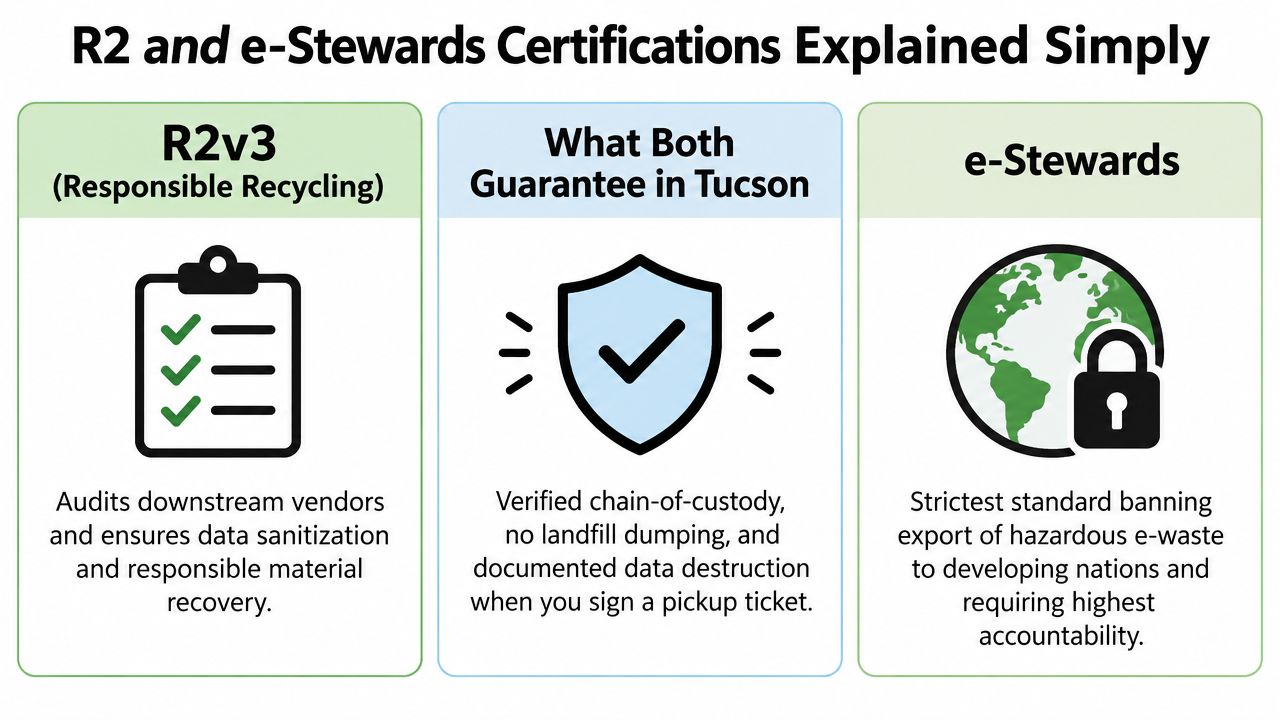
Certifications matter only when they translate into controls you can verify. For Tucson buyers, R2v3 and e-Stewards are signals that a recycler has undergone an audited process, but the certificate alone isn't a substitute for reviewing the contract, scope, downstream partners, and reports.
R2v3 requires certified facilities to maintain a documented data-sanitization plan, control physical access, preserve chain-of-custody records, remove passwords, locks, and asset tags, and verify sanitized media through secondary testing of at least 5% of items for quality assurance, according to the R2 Standard v3.1 reference. That combination links intake tracking to data-risk reduction and gives enterprise or public-sector customers a stronger audit trail.
What to request before pickup
Ask the vendor to provide:
- Current certification evidence: The certificate name, certification scope, certificate ID, and expiration information.
- Data process documentation: The sanitization methods used for HDDs, SSDs, NVMe media, and devices that can't be successfully wiped.
- Custody records: Serialized receiving, transport controls, facility access procedures, and processing status.
- Final reports: Certificates of destruction or sanitization, asset-level outcomes, weight records, and downstream information.
- Audit rights: A clear process for reviewing records or requesting evidence when your auditor, customer, or regulator asks.
R2v3 generally accommodates controlled reuse and recovery markets, while e-Stewards places stronger restrictions around exports and hazardous-material management. The practical question isn't which acronym sounds better. It's whether the vendor can connect each serial number to a defensible outcome.
Review a recycler's environmental certifications and operating standards before approving a commercial pickup. Certification should reduce ambiguity, not end your due diligence.
Why Donation-Based ITAD With Reworx Recycling Makes Sense
A working laptop shouldn't automatically become shredded material. If it can be securely sanitized, tested, repaired, and placed with a responsible recipient, donation-based recycling preserves more of the device's useful life while supporting digital inclusion and community programs.
That makes donation-based ITAD a strong default for Tucson organizations that want environmental responsibility and operational discipline in the same project. Security comes first, then reuse, then material recovery for equipment that can't be responsibly redeployed.
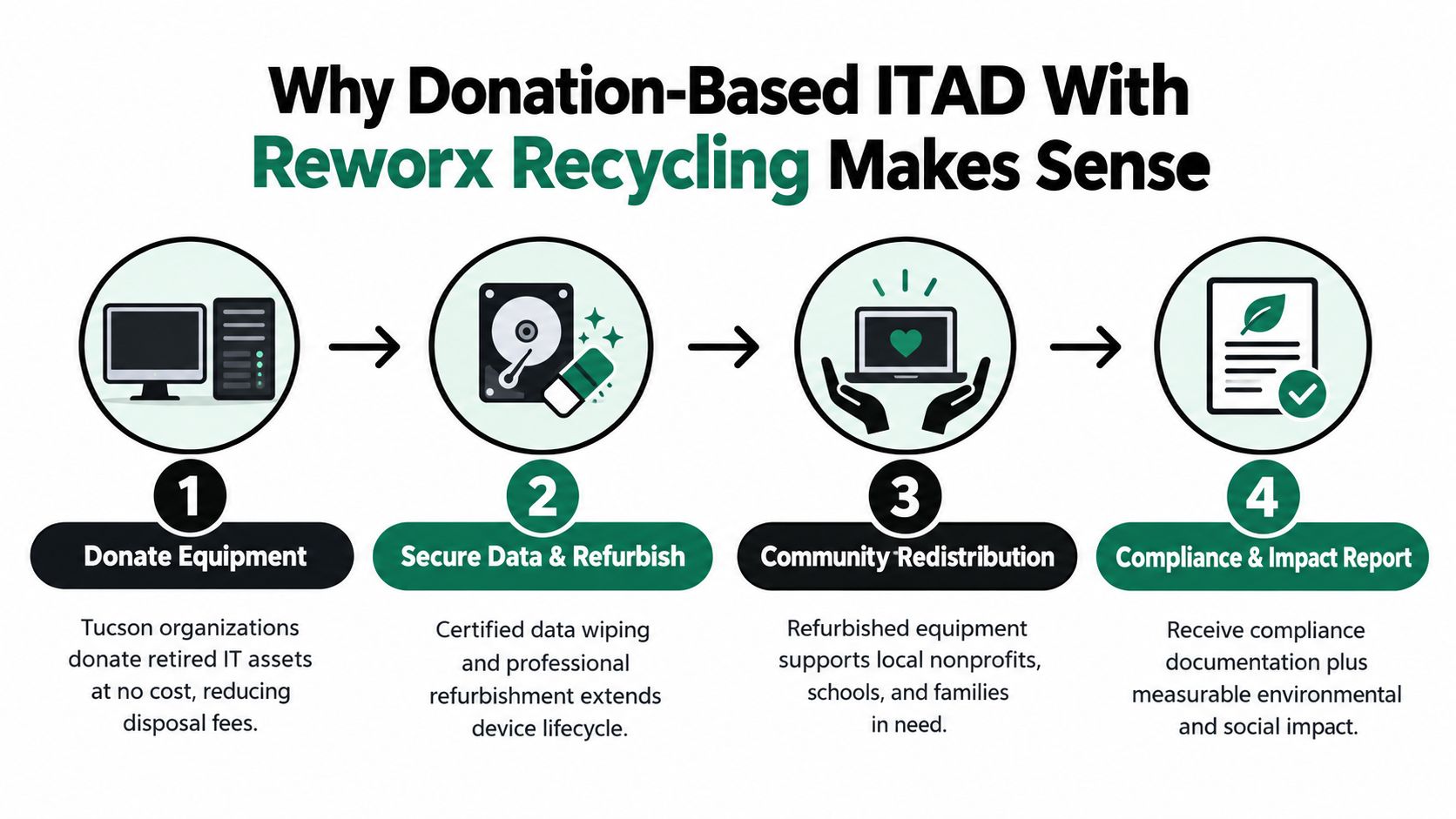
A workable donation workflow
- Inventory the equipment. Record serial numbers, device type, condition, ownership, and whether the asset contains data.
- Secure the media. Apply an approved sanitization or destruction process before reuse, resale, or donation.
- Evaluate for refurbishment. Working or repairable laptops, desktops, servers, and peripherals may support schools, nonprofits, families, or workforce initiatives.
- Recycle the residual material. Devices that can't be reused should enter a documented electronics recycling stream.
- Collect the records. Request asset-level processing results, destruction or sanitization evidence, and donation or impact documentation.
Reworx Recycling operates as a donation-based electronics recycling and ITAD social enterprise, with services that include business pickups, equipment decommissioning, secure hard-drive shredding, data destruction, equipment buyback, and donation pathways. Its stated mission connects responsible electronics management with technology donations, digital inclusion, and workforce development.
For organizations with ESG reporting or corporate donation programs, that social return can complement the standard compliance file. A donated device still needs a clear data outcome, ownership transfer, and condition record. Donation isn't a shortcut around IT controls.
Businesses can review the laptop donation process to determine whether usable equipment belongs in a refurbishment and community redistribution pathway rather than direct recycling.
Vendor Selection Checklist for Tucson IT Disposal
Choose an ITAD vendor by demanding evidence before equipment leaves your facility. A polished website, a verbal promise of secure data destruction, or a generic recycling receipt isn't enough for a business handling customer, patient, student, employee, or government information.
Start with certification and data controls. Ask whether the vendor holds current R2v3 or e-Stewards certification, request the certificate ID and expiration information, and ask how the certification applies to the facility and downstream partners. Then require a written description of NIST 800-88-aligned sanitization or physical destruction methods for each media type.
Questions Tucson buyers should ask
- Can you identify every asset? Require serialized intake, condition status, ownership records, and a final disposition outcome.
- Who controls transportation? Confirm locked vehicles, trained personnel, pickup records, and custody transfer points.
- Where does processing occur? Ask for facility details, access controls, downstream vendors, and export policies.
- What will we receive? Request sample asset reports, certificates of destruction, sanitization results, weight tickets, and any resale statement.
- How do you handle difficult loads? Clarify palletizing and removal for servers, UPS units, laboratory equipment, printers, CRTs, and mixed office cleanouts.
- What happens to non-resale items? The answer should distinguish refurbishment, parts recovery, material recycling, and prohibited disposal.
- How are commercial terms structured? Review pickup minimums, project fees, buyback terms, revenue sharing, and charges for legacy equipment.
| Criteria | What to Verify | Acceptable Proof |
|---|---|---|
| Certification | Current R2v3 or e-Stewards status and applicable facility scope | Certificate and scope documentation |
| Data destruction | Method by media type, serial-level tracking, and exception handling | Sample sanitization or destruction report |
| Chain of custody | Intake, transport, receiving, processing, and final outcome | Custody record and serialized asset list |
| Downstream control | Named partners, material routing, and export restrictions | Downstream list and audit evidence |
| Tucson logistics | Pickup scheduling, site access, loading, pallets, and mixed equipment handling | Written project plan and service terms |
| Value recovery | Buyback criteria and treatment of reusable hardware | Valuation schedule and settlement report |
| Environmental outcome | Recycling route and non-landfill policy | Processing report, weight record, or mass-balance record |
Red flags include verbal-only certifications, vague asset reporting, offshore-only processing, missing downstream information, and refusal to explain what happens to failed wipes. Use this ITAD vendor selection criteria as a screening reference, then have procurement and security review the final agreement.
Next Steps and How to Partner With Reworx
Start with the retirement queue, not the vendor list. Export the device inventory from your asset-management system, then add the items sitting in storage, server rooms, classrooms, laboratories, clinics, and facilities closets. Include laptops, desktops, servers, switches, printers, lab instruments, LCDs, CRTs, cables, batteries, and any equipment awaiting lease return.
Tag each asset with its serial number, condition, ownership, location, and data status. Separate likely donation or resale candidates from equipment that needs physical destruction or material recycling. This gives the pickup team a usable manifest and gives your security team a clear exception list.
Next, request a pickup or drop-off window through Reworx Recycling's Tucson operation. Confirm whether the load qualifies for donation, buyback, or billable decommissioning, especially if it includes servers, laboratory equipment, medical equipment, CRTs, or mixed materials. Reworx's service model includes business pickups, secure data destruction, equipment decommissioning, refurbishment, recycling, and equipment buyback.
Before collection, agree on the documentation package. At minimum, align on:
- A master asset list shared before pickup.
- Serialized chain-of-custody records.
- Data sanitization or destruction results tied to the relevant assets.
- Final disposition reporting for reuse, donation, resale, parts recovery, and recycling.
- An impact summary suitable for sustainability or corporate donation programs.
The best program is recurring. Quarterly fleet reviews help Tucson organizations identify equipment approaching end of support, lease return deadlines, warranty cliffs, or grant-funded refreshes before old hardware accumulates. Reworx Recycling's community-focused model can help connect secure ITAD with technology donations, digital inclusion, and workforce development, while keeping the business record organized.
Reworx Recycling helps Tucson businesses manage electronics recycling, secure data destruction, equipment pickups, ITAD, refurbishment, and responsible donation through a community-focused social enterprise model. Review the Reworx Recycling services and recycling resources, then schedule a pickup or discuss your next office cleanout, facility cleanout, server retirement, or laptop donation project.