For any business in Arizona, managing obsolete electronics is far more than a simple disposal task. It is a critical component of risk management, corporate responsibility, and brand protection. Because our state’s regulatory framework is voluntary, the onus is on corporate leaders to create a proactive strategy that guarantees both compliance and security. This guide is designed for IT managers, business owners, and sustainability leaders who need a clear path for responsible IT equipment disposal.
Understanding Arizona's Electronics Recycling Landscape
Unlike many other states, Arizona does not have a statewide landfill ban or mandatory product stewardship laws for e-waste. This places the responsibility for proper disposal squarely on the shoulders of businesses. The lack of strict mandates means your company's reputation and data security depend entirely on the partner you choose for IT asset disposition (ITAD).
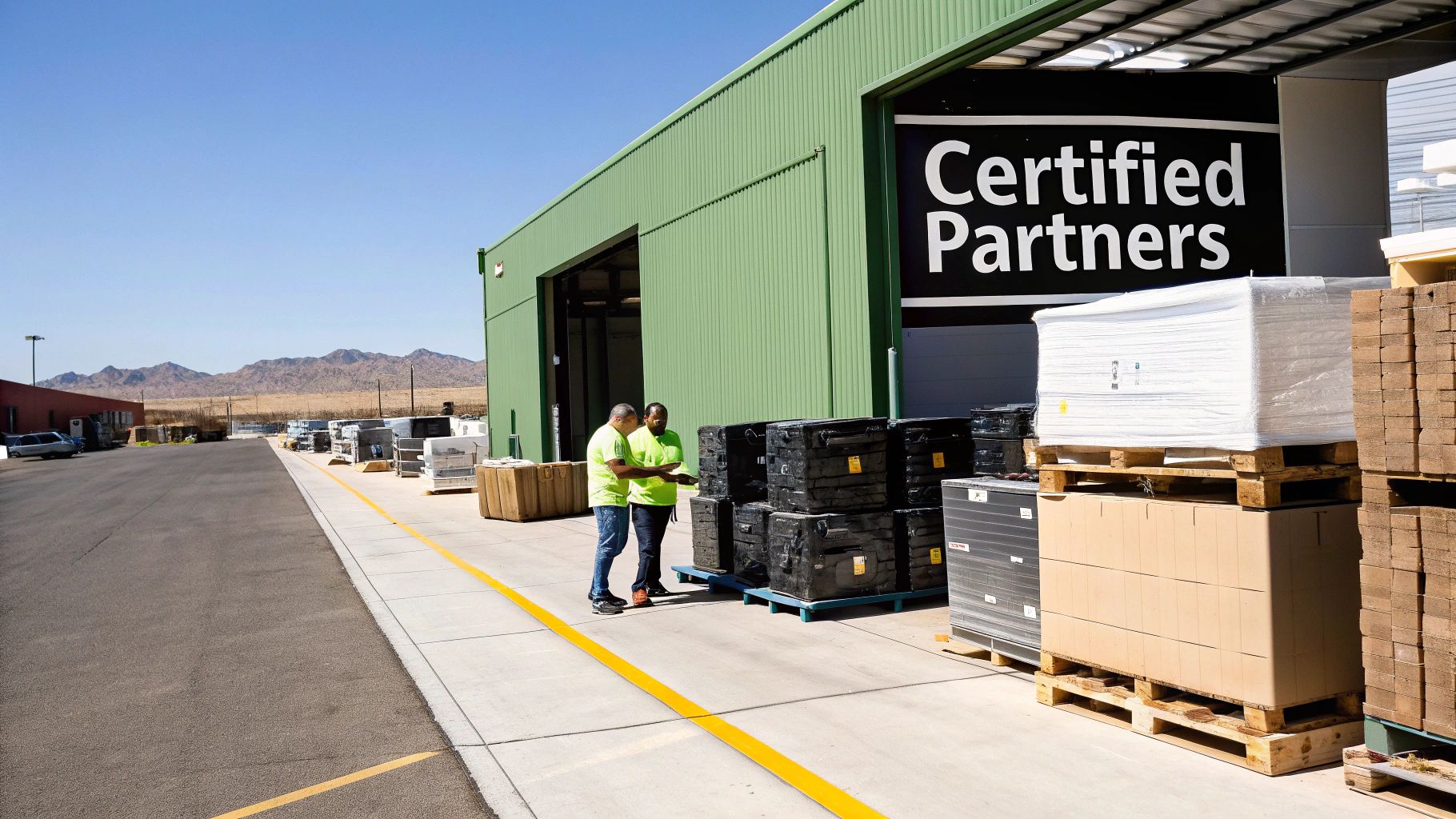
This voluntary approach has still produced impressive results. Despite the absence of a statewide landfill ban—a measure over 25 other states have adopted as of 2025—Arizona has seen significant voluntary recycling efforts. Initiatives led by the Arizona Department of Environmental Quality (ADEQ) since 2009 have successfully diverted over 2.7 million pounds of e-waste from our landfills.
For a business, this landscape creates both challenges and opportunities. Without clear regulations, the risk of partnering with an uncertified or unethical vendor is high. Such a mistake can easily lead to data breaches or improper disposal that violates federal environmental laws, such as the Resource Conservation and Recovery Act (RCRA).
The Business Case for Proactive E-Waste Management
Choosing a certified recycler is not just an environmental decision—it's a strategic business move. A transparent and secure process for your IT asset disposition (ITAD) protects your organization from serious liabilities.
Consider the potential fallout from a single discarded hard drive containing sensitive customer or employee data. The financial and reputational damage from such a breach can be catastrophic. This is precisely why a documented chain of custody and certified data destruction are non-negotiable components of any responsible office cleanout or equipment upgrade.
The critical question for Arizona businesses isn't just, "Where do our old computers go?" It's, "How can we prove our data was destroyed and our assets were handled in compliance with federal laws like FACTA and HIPAA?" Adopting this perspective is key to effective risk management.
When you partner with a social enterprise like Reworx Recycling, you add another layer of value. Our donation-based model ensures your retired assets are managed responsibly and create a positive community impact through digital inclusion programs. This approach aligns perfectly with modern corporate social responsibility (CSR) goals, turning a former cost center into a powerful story of community engagement. You can explore our specific programs, including details on our Phoenix, AZ free computer and laptop recycling services, to see how we support local businesses.
Key Compliance Factors for Arizona Businesses
To clarify what your business should focus on within Arizona’s voluntary system, we've outlined the most important compliance factors. This table breaks down the essentials for keeping your business protected.
Key E-Waste Compliance Factors For Arizona Businesses
| Compliance Area | What You Need To Know | Recommended Action |
|---|---|---|
| Data Security | Arizona law doesn't specify destruction methods, but federal laws (HIPAA, FACTA, GLBA) absolutely still apply. You are liable for any breach. | Only choose a partner offering certified, documented data destruction, including physical shredding. Always demand a Certificate of Destruction. |
| Environmental Impact | While there’s no state landfill ban, improper disposal can violate EPA rules, especially concerning hazardous materials like lead and mercury. | Work exclusively with recyclers holding R2v3 or e-Stewards certifications. These guarantee a zero-landfill policy and prohibit illegal exports. |
| Chain of Custody | You must be able to track your assets from the moment they leave your facility until their final disposition. This documentation is your proof of compliance. | Insist on a recycler that provides detailed asset tracking, serialized reporting, and a final Certificate of Recycling for your permanent records. |
| Vendor Vetting | The responsibility for your vendor's actions ultimately falls on you. An uncertified recycler exposes you to serious downstream liability. | Conduct thorough due diligence. This should include site audits (virtual or in-person) and verifying all environmental and security certifications yourself. |
Ultimately, proactive management is not about following non-existent state rules—it's about smart, defensive business practices that protect your data, brand, and bottom line.
How To Select A Certified Recycling Partner
Choosing an electronics recycler for your Arizona business is a decision with significant consequences. The right partner acts as a shield, protecting your company from the liabilities of a data breach, steep environmental fines, and reputational damage.
Conversely, the wrong choice can unravel years of hard work by exposing you to massive, unnecessary risks. Your entire IT asset disposition (ITAD) strategy is only as strong as the vendor you trust to execute it. An informed decision begins with understanding the industry's key certifications. These are not merely logos on a website; they are proof of rigorous, third-party audits that guarantee a recycler meets the highest standards for security and environmental responsibility.
Decoding The Gold Standards of E-Recycling
Two certifications stand out as the definitive benchmarks for responsible electronics recycling: R2v3 and e-Stewards. Each provides a framework to ensure your assets are managed safely from collection to final processing, though they have slightly different points of emphasis.
-
R2v3 (Responsible Recycling, Version 3): This is the most widely adopted standard globally. It is built on a hierarchy of "reuse, recover, dispose," meaning certified recyclers must prioritize refurbishment and parts harvesting before breaking items down for raw materials. It also includes strict mandates for data security protocols and health and safety standards.
-
e-Stewards: Developed by the Basel Action Network, this standard is renowned for its uncompromising stance on environmental protection. e-Stewards certified recyclers adhere to a strict zero-landfill policy and are forbidden from exporting hazardous e-waste to developing nations—a common shortcut taken by uncertified operators.
When you see these certifications, you know the vendor has been thoroughly vetted. They have proven their processes can handle sensitive data, protect employees, and keep toxic materials out of the global environment. At Reworx Recycling, our certified processes are built on these principles, giving Arizona businesses complete peace of mind.
Vetting Your Vendor Beyond The Certificate
While certifications are the essential starting point, your due diligence should not end there. A truly reliable partner will be transparent and ready to provide clear documentation for every step of the process. This is where the concept of chain of custody becomes critical.
A secure chain of custody is the documented, unbroken trail of your assets from your facility to their final disposition. It is your tangible proof that nothing was lost, stolen, or improperly handled. Without it, you are left with a massive blind spot in your risk management strategy.
An uncertified recycler might offer a lower price, but that "savings" is almost always subsidized by cutting corners on data security, worker safety, or environmental compliance. The potential cost of a single data breach or an EPA fine will always dwarf any upfront discount.
Before signing a contract, be prepared to ask potential vendors pointed questions about their process:
- How do you track our assets? Inquire if they use serialized tracking from pickup through final destruction.
- Can I review your documentation? Request sample Certificates of Destruction and Recycling. They should be detailed, professional, and unambiguous.
- Do you permit facility audits? A transparent partner will welcome you or a third-party auditor to inspect their operations.
By asking these questions, you move beyond marketing claims and verify actual capabilities. For more practical advice, consult our complete guide on selecting a reliable e-waste recycling partner. This level of scrutiny ensures you are not just hiring a hauler, but partnering with a true ITAD expert.
Ensuring Ironclad Data Destruction Before Recycling
For any IT leader in Arizona, the moment a device is flagged for recycling is also the moment it becomes a significant data security risk. Hitting "delete" or reformatting a hard drive is insufficient; it is the digital equivalent of tossing unshredded financial documents into a public dumpster.
Recovering supposedly "deleted" data is surprisingly easy for individuals with the right software. This makes a robust data destruction policy an absolute necessity in your IT equipment disposal plan. Protecting your company’s intellectual property, customer data, and employee files demands a final, irreversible method of data sanitization. This is essential for meeting compliance standards like HIPAA, PCI DSS, and FACTA.
Choosing The Right Data Destruction Method
The appropriate data destruction method depends on the device type, data sensitivity, and your compliance obligations. The industry relies on three primary methods, each with distinct advantages.
-
Software-Based Erasure (Wiping): This method uses specialized software to overwrite every sector of a drive with random characters, often multiple times, making the original data nearly impossible to recover. It is an excellent option for newer equipment intended for refurbishment and resale, as it preserves the drive's functionality.
-
Degaussing: This process uses a machine that generates a powerful magnetic field to completely scramble the data on magnetic media like traditional hard disk drives (HDDs) and backup tapes. Degaussing is quick and highly effective, but it also renders the drive useless. A financial firm decommissioning old servers would find this ideal for neutralizing large volumes of sensitive client data.
-
Physical Shredding: This is the ultimate, most secure method. The hard drive or solid-state drive (SSD) is fed into an industrial shredder that grinds it into small metal fragments. For a healthcare provider retiring servers with protected health information (PHI), physical shredding is the gold standard, providing absolute, verifiable proof of destruction.
For organizations facing the strictest compliance regulations, physical destruction is the only method that provides a 100% guarantee. When an undeniable audit trail is required, nothing surpasses a Certificate of Destruction backed by physical evidence.
Documenting The Process For Compliance
From a compliance standpoint, undocumented actions are considered incomplete. To satisfy auditors and protect your business, you must maintain detailed records of all data destruction activities. This documentation is a key part of the asset’s chain of custody.
This flowchart illustrates why choosing a partner who provides certified verification is so important.
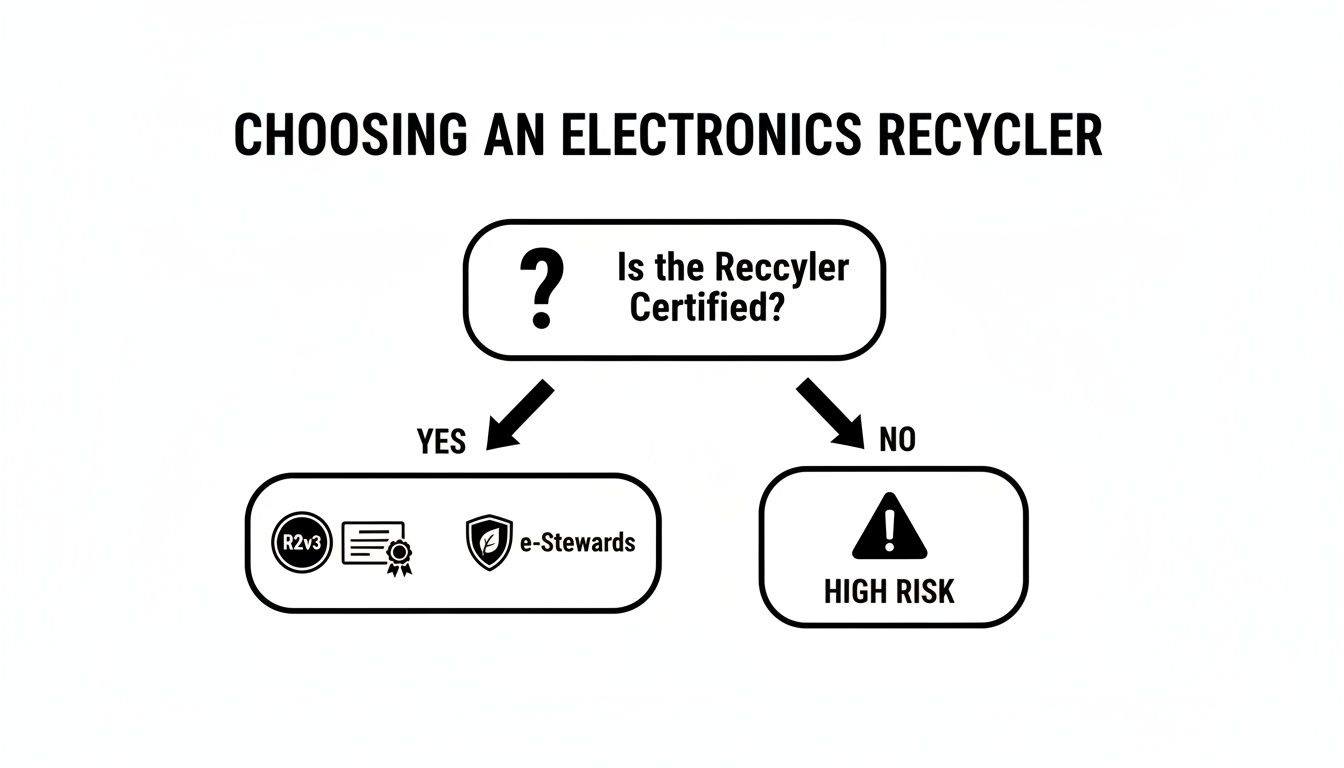
As shown, checking for certifications is the first critical step. It is a direct indicator of a recycler's ability to handle data destruction and documentation properly.
Your records should always include:
- A serialized inventory of all assets and their data-bearing components.
- The exact data destruction method used for each device.
- The date and location where the destruction occurred.
- A signed Certificate of Destruction from your recycling partner.
At Reworx Recycling, we provide both on-site and off-site shredding services that deliver this verifiable proof. Our process ensures your data is handled securely from collection to final destruction, providing the detailed paperwork Arizona businesses need to meet their compliance objectives. For a deeper technical overview, review our complete guide to secure data destruction.
Executing A Seamless Office Or Facility Cleanout
A large-scale IT asset cleanout—whether for an office relocation, data center decommissioning, or a company-wide tech refresh—can quickly become unmanageable. Without careful planning, it can evolve into a logistical challenge that diverts internal teams, overwhelms facility managers, and disrupts core operations.
However, with the right strategy, a complex project can become a smooth, efficient process. Success hinges on a robust approach to inventory, coordination, and scheduling. The first step is creating a detailed and accurate inventory of every asset. This requires more than a simple headcount; a successful office cleanout demands capturing specifics for each piece of equipment.
- Asset Type: Is it a laptop, server, monitor, or specialized equipment?
- Serial Number: Critical for tracking and establishing a clear chain-of-custody.
- Physical Location: Note the department, floor, and room number.
- Data-Bearing Status: Identify every device that contains a hard drive or stores sensitive information.
Completing this audit accurately from the start provides the foundation needed to coordinate with department heads and establish a realistic project timeline.
Managing A Diverse Mix Of Equipment
Modern offices contain more than just computers and monitors. A proper facility cleanout often involves various types of specialized electronics, each requiring a specific handling protocol.
A healthcare facility, for example, might retire diagnostic machines alongside administrative PCs. A manufacturing plant could decommission industrial control systems, and a research firm might need to arrange for laboratory equipment disposal. Each scenario presents unique challenges for safe, compliant disposal. This is why partnering with a full-service ITAD provider is essential. An experienced partner like Reworx Recycling understands how to manage this diverse mix of equipment, ensuring medical devices are processed according to health regulations and industrial machinery is handled safely.
The success of a large-scale cleanout is not measured by how quickly you can empty a building. It is measured by how seamlessly you transition assets out of your environment with zero data exposure and minimal disruption to your daily operations.
Take Phoenix, a major hub for Arizona's technology sector. The city is home to a growing number of data centers and tech companies, all of which require sophisticated ITAD solutions for their regular tech refresh cycles. As these businesses expand, so does the need for certified partners who can manage complex data center decommissioning projects and ensure compliance with both federal regulations and corporate sustainability goals. This local demand drives the need for high-capacity, certified recycling services.
Scheduling Pickups With Minimal Disruption
Once your inventory is finalized and the equipment is staged, the final step is removal. A poorly planned pickup can disrupt your entire business. The key is flexible scheduling and clear communication.
Work with your recycling partner to schedule pickups during off-hours, such as evenings or weekends, to avoid interrupting employees or daily workflow. For massive projects like a data center decommissioning, it may be strategic to plan the pickup in phases over several days.
A professional ITAD service should manage all logistics, including:
- Secure, locked trucks for safe transport.
- A professional, insured crew for all physical labor.
- Necessary pallets, bins, and packing materials.
- On-site asset scanning to verify against your inventory list before departure.
At Reworx Recycling, our managed logistics are designed for these exact scenarios. We oversee the entire process, from initial asset tagging to providing final certificates, freeing your team to focus on their primary responsibilities. For more tips, our guide on the steps to follow for decommissioning office equipment offers an excellent framework.
Building A Sustainable ITAD Program That Gives Back
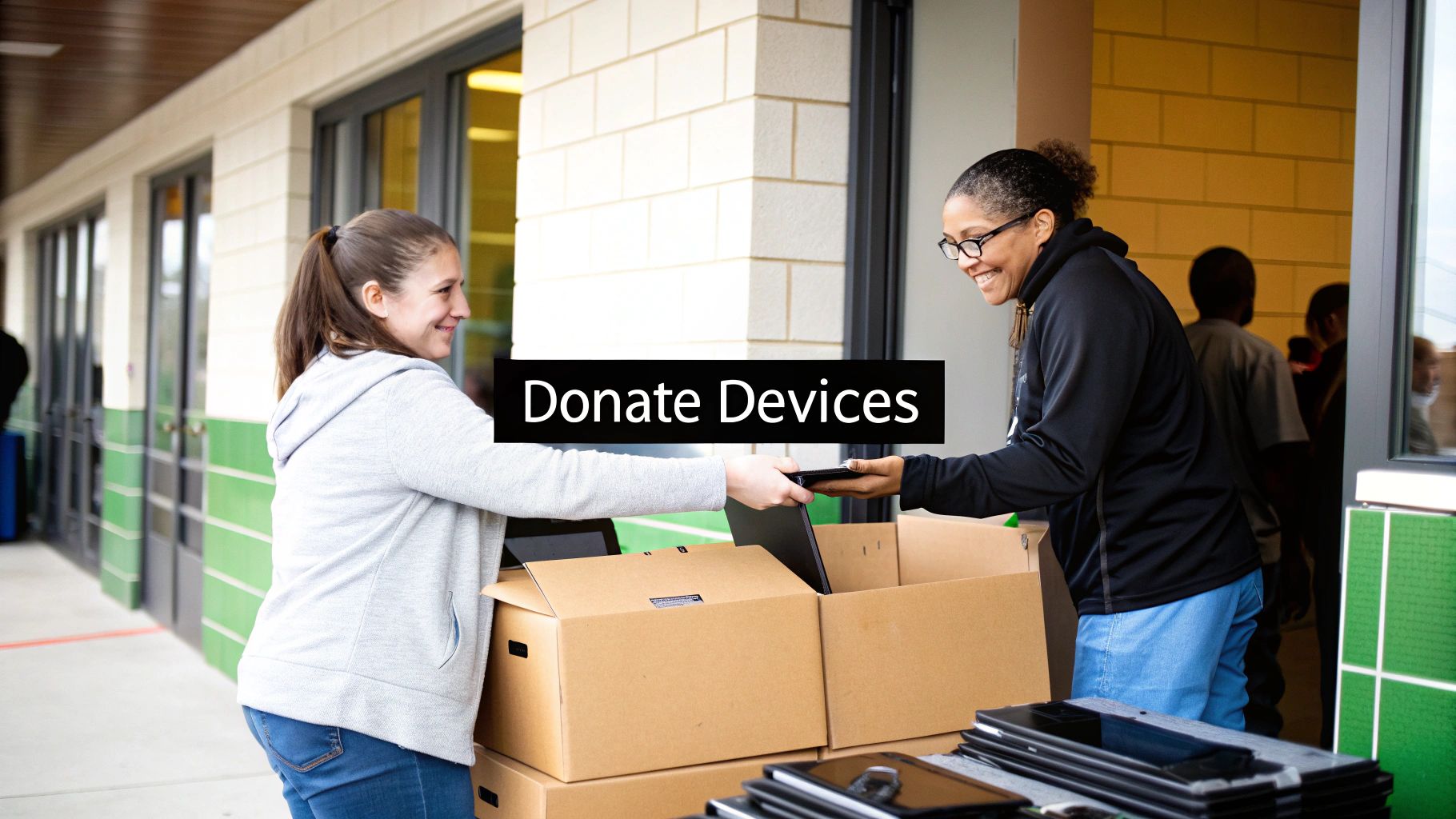
The modern approach to IT asset disposition (ITAD) has evolved beyond a simple disposal checklist. For Arizona businesses, it is now a strategic opportunity to enhance brand reputation, strengthen community connections, and create a positive social impact. A well-designed ITAD program can transform obsolete equipment from a liability into a valuable resource for others. This mindset aligns perfectly with the growing emphasis on corporate social responsibility (CSR) and environmental, social, and governance (ESG) criteria.
From Corporate Waste To Community Resource
The key to unlocking this potential is partnering with a social enterprise for your arizona electronics recycling. As a donation-based recycler, Reworx Recycling is structured to identify equipment that can be refurbished and redeployed within the community.
Our mission is to help bridge the digital divide. We take functional laptops, desktops, and other devices your business donates, securely sanitize all data, and then distribute them to non-profits, schools, and workforce development programs. Your old assets gain a new purpose, directly supporting digital access for those who need it most.
The Power Of Donation-Based Recycling
Opting for a donation-based recycling model provides distinct advantages over traditional recycling, creating a win-win for your business and the community.
- Amplified CSR & ESG Impact: Your equipment donation becomes a tangible, measurable contribution to local education and social initiatives.
- Enhanced Brand Image: You can share a powerful story about how your company empowers the community through technology.
- Employee Engagement: Involving your team in the donation process can boost morale and reinforce a positive company culture.
This model is a cornerstone of the circular economy, where resources remain in use for as long as possible. By prioritizing reuse, we not only reduce e-waste but also maximize the social value of every device. Learn more about this philosophy in our insights on the circular economy and Reworx Recycling’s role.
Your retired IT assets are more than scrap metal and plastic. For a student, a donated laptop is a gateway to learning. For a non-profit, a refurbished office computer is a tool to better serve the community. This shift in perspective defines a truly sustainable ITAD program.
To maximize your positive impact, integrate your ITAD program into established . This ensures your efforts are recognized and contribute meaningfully to your company's broader mission.
Recovering Value Through Equipment Buyback
Sustainability must also be economically viable. While many older devices are ideal for donation, newer or high-value equipment often retains significant financial value. A comprehensive ITAD program should include an equipment buyback option.
Reworx Recycling can assess your inventory of retired assets—such as recent-model servers, networking gear, or laptops—and offer fair market value. This allows your business to recover a portion of its initial investment, turning depreciated hardware into a new revenue stream. By combining a buyback program with donation-based recycling, you achieve a balanced ITAD strategy. You can responsibly manage all equipment, recover cash where it makes sense, and make a meaningful community contribution with the rest.
Frequently Asked Questions About Business E-Recycling
Even with a solid strategy, Arizona businesses often have specific questions about the day-to-day realities of managing electronic waste. Here are answers to some of the most common inquiries from IT managers, facilities directors, and sustainability leaders.
What Types Of Electronics Do You Accept?
A full-service, certified recycler should be capable of accepting nearly every piece of technology your business utilizes. At Reworx Recycling, our donation-based recycling program is designed to handle a comprehensive range of IT, office, and specialized equipment.
This includes everything from standard items to more unique hardware:
- Standard Office Hardware: Desktops, laptops, servers, monitors, keyboards, mice, and printers.
- Networking Gear: Routers, switches, hubs, and entire server racks.
- Specialized Equipment: We have extensive experience with laboratory equipment disposal and certain types of medical devices.
When in doubt, it is always best to inquire about a specific item. However, our goal is to be the single-source solution for your complete facility cleanout.
Is There A Cost For Business Recycling?
The cost structure for arizona electronics recycling depends on the project's scope. For small-volume drop-offs, many services are free. For larger corporate donation programs requiring logistics management and secure data destruction, a service fee may apply to cover labor, transportation, and certification.
However, many businesses can offset these costs entirely. At Reworx Recycling, we offer equipment buyback programs for your newer, high-value assets. This allows you to recover residual value from your hardware, often turning a disposal cost into a net positive for your IT budget. We always provide a custom quote that transparently details any fees and the potential buyback value.
How Can We Be Sure Our Data Is Secure?
This is the most critical question we receive, and the answer lies in a verifiable, documented process. Simply wiping a drive is insufficient for most compliance standards. A certified partner must provide concrete proof of destruction.
You should never have to take a recycler’s word for it. Secure data destruction requires a documented, auditable trail. Always demand a serialized Certificate of Destruction that details the method used and the specific devices it covers.
We offer multiple data destruction methods to meet your required security level, from DOD-compliant software wiping to on-site physical shredding. This guarantees your confidential information is permanently destroyed, protecting you from breaches and ensuring compliance with regulations like HIPAA or FACTA.
Can We Schedule A Pickup For A Large Cleanout?
Absolutely. Coordinated logistics are essential for any large project, whether an office move or a full data center decommissioning. A professional recycler should manage the entire pickup process to minimize disruption to your operations.
We schedule pickups at your convenience, often during off-hours or on weekends. Our insured team arrives with all necessary equipment—pallets, bins, and secure transport—to execute the job efficiently and safely. This managed service removes the burden from your internal staff, allowing them to remain focused on their core responsibilities.
Ready to implement a secure, sustainable, and socially responsible ITAD program for your Arizona business? Partner with Reworx Recycling to turn your outdated technology into an opportunity. Explore our services and schedule your pickup today.