A successful business electronics recycling program doesn't happen by accident. It starts with a structured, documented framework that takes the guesswork out of the equation for IT managers and corporate sustainability leaders.
This isn't just about getting rid of old gear; it's about building a predictable, secure, and compliant process for managing IT assets from the day they arrive to their last day of service. A solid policy is what prevents the last-minute chaos that often comes with an office cleanout or big hardware upgrades. It also turns a simple compliance task into a genuine showcase of your company's commitment to environmental responsibility and community impact, especially when partnering with a social enterprise like Reworx Recycling.
Building Your Corporate ITAD Framework
Before a single piece of hardware leaves your building, you need a plan. An IT Asset Disposition (ITAD) policy is your company's official playbook for retiring technology. This framework should be more than a generic template—it needs to be a practical system that IT and sustainability leaders can actually use to ensure every device is handled the right way, every time.
Flying without a formal policy opens your organization up to some serious risks. We're talking about data breaches from drives that weren't properly wiped, fines for not following environmental regulations, and just plain leaving money on the table by tossing out recoverable assets. A proactive approach to IT equipment disposal will always beat a reactive scramble.
Defining Ownership and Lifecycle Triggers
First things first: who owns this process? You have to assign clear ownership from the jump. Is it the IT Manager? The Facilities Director? Or maybe a cross-functional team that includes your sustainability lead? Nailing this down prevents confusion and keeps everyone accountable.
For example, in a hospital, the IT department might manage the process for computer recycling, but the compliance officer will absolutely need to sign off on any plan involving medical equipment disposal that holds patient data.
Next, you need to establish clear triggers for when different types of assets are retired. Maybe employee laptops are on a strict three-year refresh cycle, while your heavy-duty data center servers get a five-year lifespan. Specialized laboratory equipment disposal will have its own unique triggers based on performance metrics, manufacturer support, or new regulations.
These triggers should be documented and, whenever you can, automated. Your asset management system, for instance, could flag all laptops hitting their 36-month service anniversary, automatically kicking off the disposition workflow.
Creating a Standardized Inventory System
Let's be blunt: you can't manage what you don't track. A standardized inventory system is the absolute backbone of any effective ITAD program. This system has to follow every single device from the moment you buy it to its final disposal, making sure nothing ever falls through the cracks.
A reliable inventory system must include:
- Unique Asset Tag: A specific identifier for each and every device.
- Device Details: Model, serial number, and core specs.
- User Assignment: Who has the device right now.
- Purchase Date: Crucial for tracking the asset's age and warranty status.
- Disposition Status: A field to track its end-of-life journey (e.g., "pending wipe," "ready for recycling," "donated").
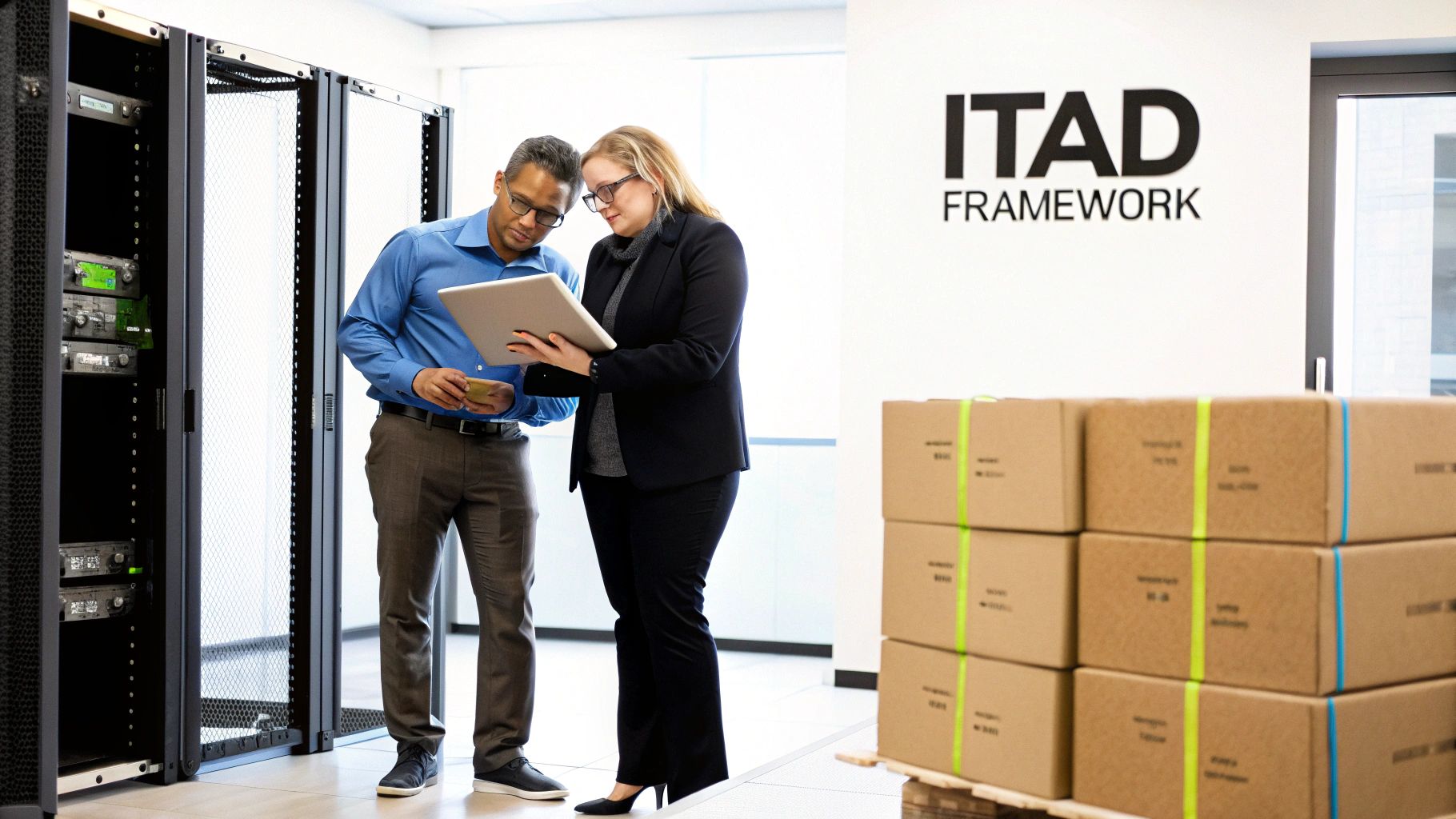
This flow chart breaks down the core components of a successful ITAD framework: setting your policy, getting your assets inventoried, and then picking a partner you can trust.
The visual makes it clear: a great program is built on a foundation of clear rules and meticulous tracking before you even bring an outside partner into the picture. By getting this internal structure right first, you set the stage for a secure, auditable, and efficient process. To see how this kind of structured approach can help your organization, you can explore the comprehensive details on our IT Asset Disposition services.
Key Takeaway: A detailed ITAD policy is your organization's best defense against data security risks and environmental non-compliance. It provides a clear, repeatable process that protects your company and simplifies hardware lifecycle management.
When you integrate this framework with your company’s data security protocols and bigger sustainability goals, you create a seamless system. This lays the groundwork for a reliable program with a partner like Reworx Recycling, ensuring your business electronics recycling efforts are both responsible and impactful.
Mastering Secure Data Destruction
An ITAD policy is your first line of defense, but the single most critical piece of that policy is how you handle data. Let's be blunt: dragging files to the trash bin or running a factory reset is a high-stakes gamble. For a determined thief, that "deleted" data is often easily recoverable.
This creates a massive liability for any organization handling sensitive information, whether it’s customer PII, internal financial records, or your own intellectual property. A single overlooked hard drive can snowball into a devastating data breach, costing millions in fines, legal fees, and shattered customer trust.
True data security for retired assets isn't about surface-level deletion. It requires a verifiable, irreversible process that guarantees your information is gone forever. This is why a methodical approach to secure data destruction isn't just an IT task—it's a core business security function.
Comparing Data Destruction Methods
When it comes to sanitizing old storage media, IT managers really have three main tools in their belt. Each offers a different level of security, and knowing the difference is crucial for making smart, risk-based decisions that protect your company.
Data Wiping (Software-Based): This is where specialized software overwrites your data with random characters, usually in multiple passes. It makes the original information unrecoverable with software tools and is a solid choice for assets you plan to refurbish or donate.
Degaussing (Magnetic Destruction): Think of this as a powerful magnetic scrambler. Degaussing exposes magnetic media like traditional hard disk drives (HDDs) and old backup tapes to an intense magnetic field, instantly erasing everything. It's highly effective, but here's the catch: degaussing does not work on solid-state drives (SSDs), which store data electronically.
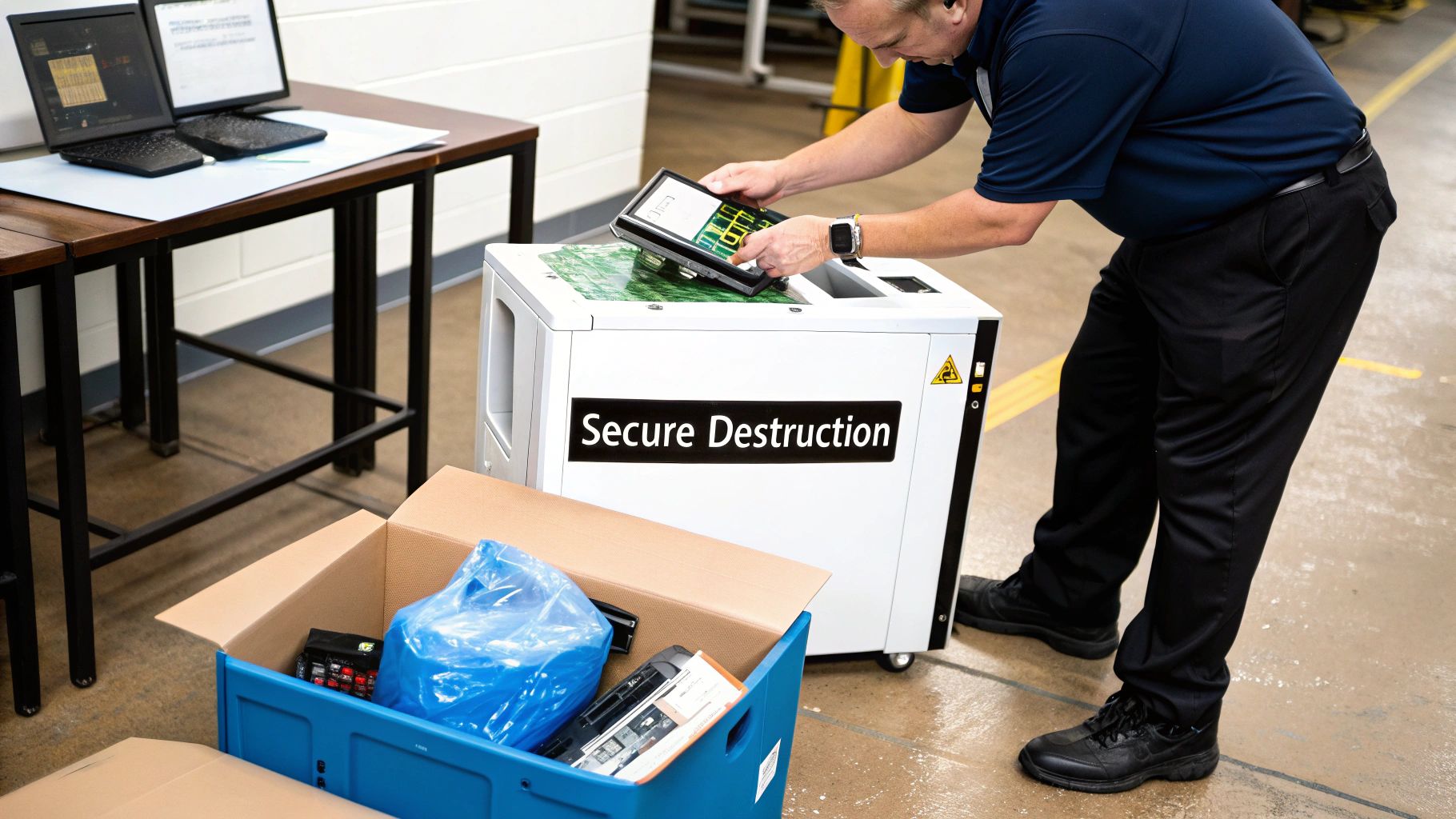
Physical Shredding (Physical Destruction): This is the ultimate security measure, often part of product destruction services. The storage device is fed into an industrial shredder that pulverizes it into tiny, unrecognizable pieces of metal and plastic. It's completely irreversible and provides absolute certainty that the data can never be accessed again. You can learn more about our certified hard drive shredding services to see how the process works.
For most businesses, especially those in regulated fields like healthcare (HIPAA) or finance, physical shredding is the gold standard. It removes all doubt and provides a clear, defensible end to the data lifecycle.
Ensuring Compliance and Maintaining an Audit Trail
Complying with data privacy regulations like GDPR, HIPAA, or CCPA isn't a suggestion—it's the law. A huge part of that compliance is being able to prove you took the right steps to destroy sensitive data. This is where your documentation becomes non-negotiable.
When you work with a certified recycler for data destruction, you should always receive a Certificate of Destruction for every single batch of media. This document is your official audit trail.
A Certificate of Destruction is a formal document that serves as your proof of compliance. It should include serialized tracking of the destroyed hard drives, the date and method of destruction, and a signature from a verified authority. This isn't just a receipt; it's your legal safeguard in the event of an audit or security inquiry.
This paperwork is what closes the loop on your ITAD process. It provides concrete, defensible evidence that your organization handles data responsibly from start to finish. Partnering with a provider like Reworx Recycling ensures you get this critical documentation every time, securing your compliance and giving you peace of mind.
Solving Your IT Equipment Disposal Logistics
You've logged the inventory and wiped the data. Now for the final hurdle: getting all that old equipment out of your facility and into the hands of a responsible recycler. This part of the process, the logistics, can be surprisingly tricky, especially when you're dealing with a large-scale business electronics recycling project. The best approach really hinges on your specific situation—things like how much gear you have, what kind of assets they are, and what resources your team can spare.
Picking the wrong method can lead to unexpected costs, security headaches, or disruptions to your day-to-day operations. A small business with a dozen old laptops has completely different needs than a hospital decommissioning an entire wing of specialized medical equipment. Knowing your options is the key to making sure the disposal process is smooth, efficient, and secure.
Drop-Off vs. Scheduled Pickup
For smaller batches of equipment—maybe a few retired desktops and printers from an office refresh—a self-service drop-off can be the most straightforward path. It gives you flexibility and works great when you only have a handful of items to manage. You can transport the assets on your own schedule without having to coordinate a formal pickup.
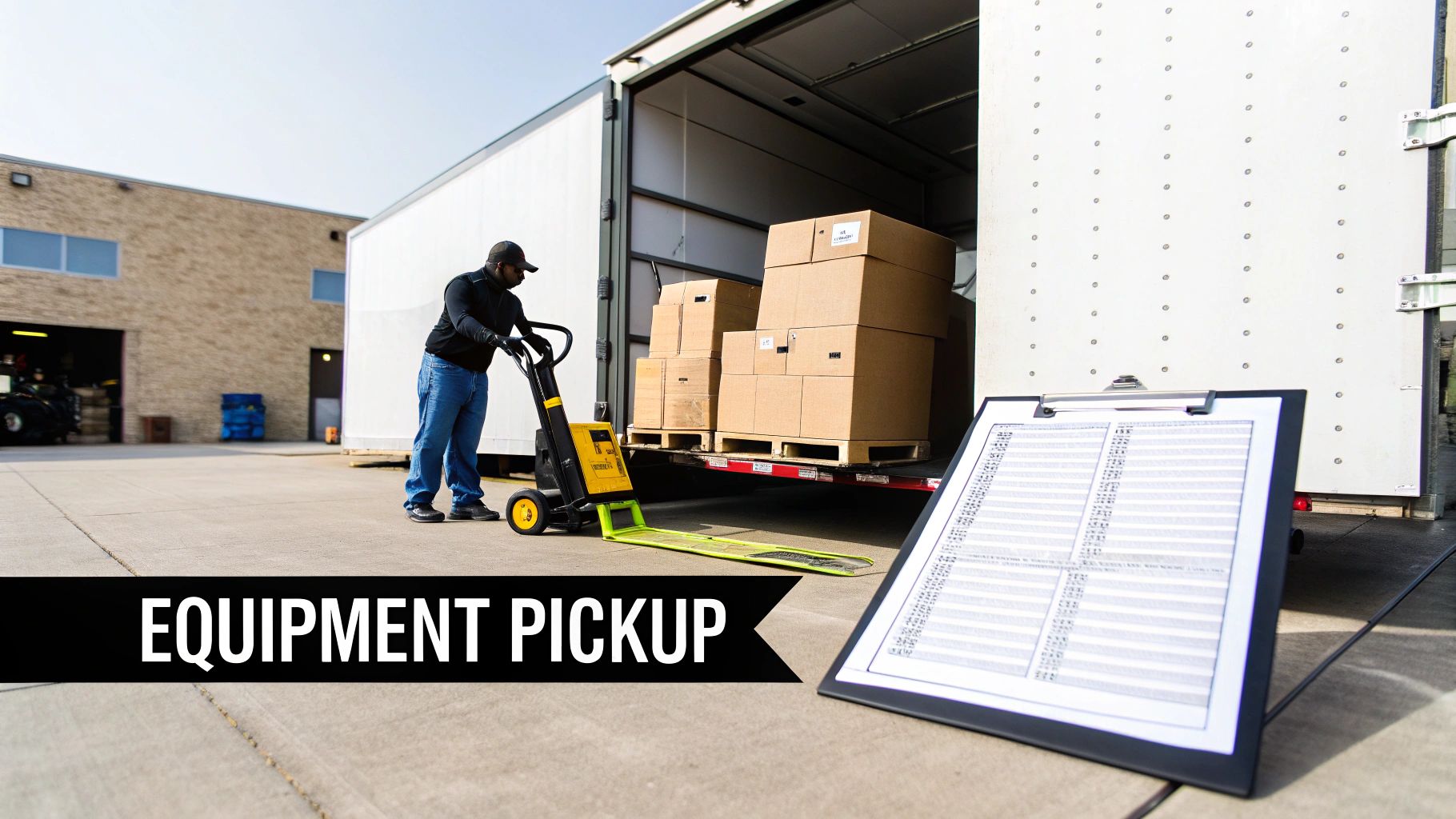
But for bigger jobs, like a full office cleanout or facility cleanout, a scheduled pickup service is almost always the smarter choice. Trying to manage the logistics of moving dozens, or even hundreds, of devices is a massive undertaking. A professional pickup service, like the one we offer at Reworx Recycling, takes that burden completely off your team. We ensure your assets are handled safely and efficiently, from your door right to our recycling facility.
Preparing for a Full-Service Pickup
When you team up with a recycler for a business pickup, a little preparation goes a long way. Some planning on your end makes the whole process faster, safer, and less disruptive for everyone. Think of it as a team effort between your staff and our crew.
Here’s a practical checklist to get your site ready for us:
- Consolidate Everything: Gather all the assets in one, easy-to-reach spot. A loading dock or a designated storage room is perfect. This keeps the pickup crew from having to weave through active office spaces.
- Palletize for Volume: If you have a lot of equipment, stack it securely on pallets and shrink-wrap it. Heavier items like servers and UPS units should go on the bottom, with lighter gear like laptops and keyboards on top.
- Loop in Your Facilities Team: Give your building or facility manager a heads-up about the scheduled pickup. They’ll need to know about truck arrivals, elevator use, and any special access arrangements to keep things moving.
- Label Clearly: Slap a clear label on pallets or containers that says "For Electronics Recycling." This prevents any mix-ups with other outgoing shipments or internal assets.
Taking these steps helps the pickup team get in and out quickly and safely, getting all that retired equipment out of your way with minimal friction.
Real-World Scenario: Picture an IT manager handling a data center decommissioning. They're tasked with removing dozens of heavy server racks, switches, and cooling units. Trying to do this in-house would mean renting specialized equipment and pulling staff off other projects, not to mention the risk of injury or damage. By scheduling a professional decommissioning service, they bring in a trained crew with the right tools to handle everything from disassembly to secure transport.
For any business, it’s also critical to know what can and can't be recycled ahead of time. To avoid any surprises on pickup day, it helps to review what your recycling partner accepts. You can find more details by exploring a list of accepted electronics for recycling to make sure everything is good to go. This one proactive step helps guarantee your ITAD project is a success from start to finish.
How to Choose and Vet Your Recycling Partner
Once your logistics are mapped out, it's time for the most critical decision in your entire electronics recycling program: selecting the right IT Asset Disposition (ITAD) partner. This isn't just another vendor to check off a list. The partner you choose directly impacts your company's data security, environmental compliance, and even your public reputation. A great partner is your shield against risk; a bad one can open you up to a world of liability.
The electronics recycling industry is growing fast, and for good reason. Businesses are under immense pressure to manage their old tech responsibly. The global market is expected to hit a staggering USD 147.9 billion by 2035, which tells you just how massive the e-waste challenge has become. With the U.S. generating nearly 7 million tonnes of e-waste every year and recycling only a tiny fraction, the stakes couldn't be higher. This makes vetting your partner a fundamental business function, not just a suggestion.
Looking for the Right Certifications
Industry certifications are your best first line of defense. They are independent, third-party verifications that prove a recycler meets strict standards for environmental safety, data security, and worker health. Honestly, if a potential vendor doesn't have them, you should probably walk away.
Two certifications are considered the gold standard in the United States:
R2 (Responsible Recycling): The R2 Standard covers the entire lifecycle of a device, from the moment it's picked up to its final disposition. It ensures certified recyclers have solid environmental protocols, forbid exporting hazardous e-waste to developing nations, and maintain rock-solid data destruction processes.
e-Stewards: Often seen as the most rigorous standard, e-Stewards is backed by the Basel Action Network. It comes with a strict no-landfill, no-export policy for toxic e-waste. When you see this certification, you know the recycler is committed to the highest level of environmental and social responsibility.
Seeing one or both of these logos means a recycler has survived intensive audits and is held to an ongoing standard of excellence. It's the closest thing you'll get to a guarantee in this industry.
When you're looking for the right partner, it's helpful to understand what these certifications really mean for your business.
Key Vendor Certification Comparison
| Certification | Focus Area | Key Guarantees for Your Business |
|---|---|---|
| R2v3 | Lifecycle Management & Data Security | Ensures a documented chain of custody, data sanitization protocols, and adherence to international trade laws. Protects against data breaches and improper disposal. |
| e-Stewards | Environmental Protection & Social Justice | Guarantees zero export of hazardous e-waste to developing countries and a strict no-landfill policy. Shields your brand from environmental controversy. |
| NAID AAA | Data Destruction Verification | Focuses exclusively on secure data destruction processes. Provides the ultimate assurance that your sensitive information has been irretrievably destroyed. |
| ISO 14001 | Environmental Management Systems | Demonstrates the vendor has a formal system in place to manage and continuously improve their environmental performance. Shows a commitment to sustainability. |
These certifications aren't just fancy badges; they are your proof that a potential partner takes their responsibilities—and your risks—seriously.
Key Questions to Ask Potential Partners
Once you've narrowed your list down to certified vendors, it's time to start asking the tough questions. Their answers will tell you everything you need to know about their transparency, processes, and reliability. Following good vendor management best practices here is crucial.
Here’s a checklist of questions I always recommend asking:
- Can you provide a complete map of your downstream recycling chain? A reputable partner should have no problem showing you exactly where every component of your assets goes after it leaves their facility. Transparency is non-negotiable.
- What are your specific data destruction methods, and how are they verified? Do they offer on-site shredding? What does their Certificate of Destruction look like? Don't be afraid to ask for a sample.
- What kind of reporting will we receive? A simple weight ticket isn't enough for a proper audit trail. You need serialized asset tracking reports, environmental impact summaries, and proof of data destruction for every single drive.
- How do you handle assets with potential resale value? If you're hoping to offset some costs, you need to understand their process for testing, refurbishing, and remarketing equipment.
These questions help you look past the price tag to evaluate the true value and security a partner can offer your organization.
Key Insight: A surprisingly low quote is one of the biggest red flags in the ITAD industry. It often means a vendor is cutting corners—maybe by illegally exporting toxic materials or skipping essential data security steps. True value comes from mitigating risk, not just from a low price.
The Social Enterprise Advantage
Finally, don't overlook the unique benefits of partnering with a social enterprise like Reworx Recycling. This model blends top-tier environmental and data security services with a direct, positive impact on the community. It’s a fantastic way to align your ITAD program with your company's corporate social responsibility (CSR) goals.
When you choose a social enterprise for your donation-based recycling, you ensure that usable equipment gets a second chance. These devices are often refurbished and donated to schools, non-profits, and families in need, helping to bridge the digital divide. This simple choice transforms your retired equipment from a liability into a community asset. It creates a powerful story that resonates with employees and customers alike. To see how this works in practice, check out our guide on Florida electronics recycling.
Measuring and Reporting Your Program's Impact
A well-planned business electronics recycling program is more than just a logistical win; it’s a powerful story about your company's values. Getting rid of old equipment isn’t really the end goal. The true value comes when you can measure, report, and share the positive impact of your efforts—turning a simple compliance task into a real asset for your brand.
For sustainability directors and other leaders, this reporting is what connects the dots between operational choices and your company's bigger Corporate Social Responsibility (CSR) goals. It gives you the hard data to show a real commitment to the environment and your community, which goes a long way with stakeholders, employees, and customers.
Key Metrics to Track and Showcase
To build a compelling impact report, you have to go beyond just how much stuff you recycled. While the total weight of recycled equipment is a great starting point, a truly effective report tells a much deeper story. I always advise clients to track a mix of environmental, financial, and social outcomes to paint the full picture.
Start building your reports around these core metrics:
- Total Weight Diverted from Landfills: This is the foundation. It’s a clear, simple number that shows the direct environmental benefit of your recycling program.
- Number of Assets Refurbished and Donated: When you partner with a social enterprise like Reworx, this metric is gold. It shows exactly how your old tech is helping bridge the digital divide in your own community.
- Value Recovered from Asset Resale: For any gear that still has market value, tracking the revenue from buyback programs shows how your ITAD strategy can pay for itself or even turn a profit.
- Certificates of Recycling and Destruction: These documents are your proof. Keep a meticulous record of every single certificate to prove you're compliant with both environmental and data security rules.
Pro Tip: Don't just list numbers; make them visual. Use simple infographics in your internal reports or public CSR summaries to show "X pounds of e-waste diverted" or "Y devices donated to local schools." It makes the data much easier for everyone to understand and appreciate.
Translating Data into ESG and CSR Narratives
The data you collect is the raw material for powerful corporate storytelling. Environmental, Social, and Governance (ESG) reporting isn't just for massive corporations anymore; investors and customers now expect businesses of all sizes to be transparent about their impact. Your electronics recycling program fits perfectly into these narratives.
The scale of the e-waste problem is enormous. Global e-waste generation hit a record 62 million tonnes in 2022, which is an 82% increase since 2010. With a shocking 78% of this e-waste going unrecycled, businesses have a critical role to play in closing that gap. If you want to dig deeper, the latest Global E-waste Monitor report gives the full context of what we're all up against.
By documenting your program, you can directly speak to the "E" in ESG. Use your Certificates of Recycling in annual sustainability reports to confirm you’re managing this waste stream responsibly. It’s a proactive way to show you're serious about minimizing your environmental footprint.
The Power of Social Enterprise Partnership
When you team up with a social enterprise, your reporting gains a priceless social dimension. The story shifts from just avoiding harm (like keeping toxins out of landfills) to actively creating good. This is where a partnership with Reworx Recycling can become a cornerstone of your CSR strategy.
You can start reporting on tangible community benefits, such as:
- Supporting Digital Equity: Detail how the laptops or tablets you donated are now being used by students or local non-profits.
- Enabling Workforce Development: Highlight how the refurbishment process creates local jobs and valuable skills training opportunities.
- Strengthening Community Ties: Showcase your company’s investment in the same community where your employees live and work.
This transforms your IT asset disposition program from a line item on the IT budget into a living example of your company's commitment to making a real difference. It’s a story that resonates, proving your business is dedicated to building a better future—not just a better bottom line. For organizations ready to get started, learning the specifics of electronics recycling in Georgia can be a great first step.
Got Questions About Business Electronics Recycling? We've Got Answers.
Even with the best-laid plans, questions always pop up when you're putting together a business electronics recycling program. We see it all the time—IT managers, facilities directors, and sustainability leads all wrestling with similar uncertainties. What exactly qualifies as e-waste? How secure is our data, really? What's the community impact?
Getting straight answers is the only way to move forward with confidence. So, let’s tackle some of the most common questions we hear from organizations just like yours.
What Kinds of Electronics Can My Business Actually Recycle?
This is usually one of the first things people ask, and the good news is, a good partner can handle just about everything you’ve got.
At Reworx Recycling, we accept a huge range of business electronics. Of course, this includes all the standard office gear you’d expect—laptops, desktops, monitors, printers, and servers. But our capabilities go much further, into the more specialized hardware that keeps your operations running.
We regularly process:
- Data Center Equipment: Think server racks, network switches, routers, and massive storage arrays.
- Medical and Laboratory Instruments: We’re equipped to manage the disposal of highly specialized diagnostic and research equipment.
- Telecommunications Systems: From old PBX systems to modern networking gear, we can handle it.
- Industrial Electronics: We also take on unique items like industrial control systems and manufacturing electronics.
Our goal is to be the only call you need to make, whether you're doing a simple office cleanout or a full-scale facility cleanout. If you have a really unique piece of equipment, just give us a call. A quick chat is usually all it takes to figure it out.
How Does Donating Our Old Equipment Help The Community?
When you work with a social enterprise like Reworx Recycling, you’re fundamentally changing what happens to your retired assets. It’s a shift from a simple disposal mindset to one focused on community building. Instead of being immediately shredded for raw materials, your viable equipment gets a second chance to make a difference.
This is at the very heart of our mission. Any devices that are still functional are professionally refurbished by our team and put back to work for people who need them most.
Through our corporate donation programs, your old computers and monitors find new homes at non-profits, local schools, and in underserved communities. This directly fuels digital inclusion efforts and puts essential technology into the hands of students and community leaders who might otherwise go without.
This approach doesn't just keep functional electronics out of the landfill. It creates a powerful, authentic corporate social responsibility story for your business—one that shows a real commitment to your community and resonates deeply with employees, customers, and stakeholders.
Is Our Company Data Truly Secure During This Process?
This is, without a doubt, the most critical question we get. The answer is an absolute, unequivocal yes. Data security is our highest priority from the second your equipment leaves your facility.
We maintain a strict, fully documented chain of custody for every single asset we touch. Our secure data destruction services are fully compliant with NIST 800-88 guidelines, which is the gold standard for media sanitization. We also offer multiple layers of security to match your organization's specific risk profile.
These methods include:
- Multi-pass data wiping for devices that will be refurbished and reused.
- Degaussing, which uses powerful magnets to destroy data on certain types of media.
- Physical hard drive shredding for the ultimate, irreversible data destruction.
For every single storage device that goes through this process, we issue a serialized Certificate of Destruction. This document is your official, auditable proof that your company's sensitive information has been permanently destroyed. It’s your guarantee of compliance with privacy regulations like HIPAA, FACTA, and GDPR, giving you complete peace of mind.
Ready to build a secure, compliant, and impactful electronics recycling program for your business? The team at Reworx Recycling is here to make it happen. From ironclad data destruction to community-focused donation programs, we provide a complete solution that turns your old equipment into an opportunity. Partner with us to recycle responsibly while supporting digital inclusion and workforce development in your community. Schedule a pickup or contact us to donate your old equipment today.