A New York tech refresh often starts as a routine project. New servers arrive. Employee laptops get replaced. A facility team clears storage rooms that have filled with retired monitors, scanners, networking gear, and accessories.
Then the true problem appears.
Those assets can't just go into the trash. They may still hold regulated data. They may still have resale value. And in New York, the wrong disposal decision can create environmental, legal, and audit trouble at the same time. For compliance officers, IT managers, and sustainability leaders, Enterprise Technology Disposal Services in New York isn't a narrow recycling issue. It's a full lifecycle decision about risk, documentation, logistics, and financial recovery.
Navigating the Challenge of Enterprise Tech Refresh in New York
A corporate IT manager in New York might be dealing with three different retirement projects at once. An Albany data room is coming offline. A Manhattan office is replacing hundreds of laptops. A Long Island site needs to remove specialized electronic equipment that has outlived its support contract.
Each stream looks different, but the core questions are the same. What equipment is covered by New York rules? How do you protect data during pickup and transport? Which items should be remarketed, donated, destroyed, or recycled? Who signs off on the chain of custody?
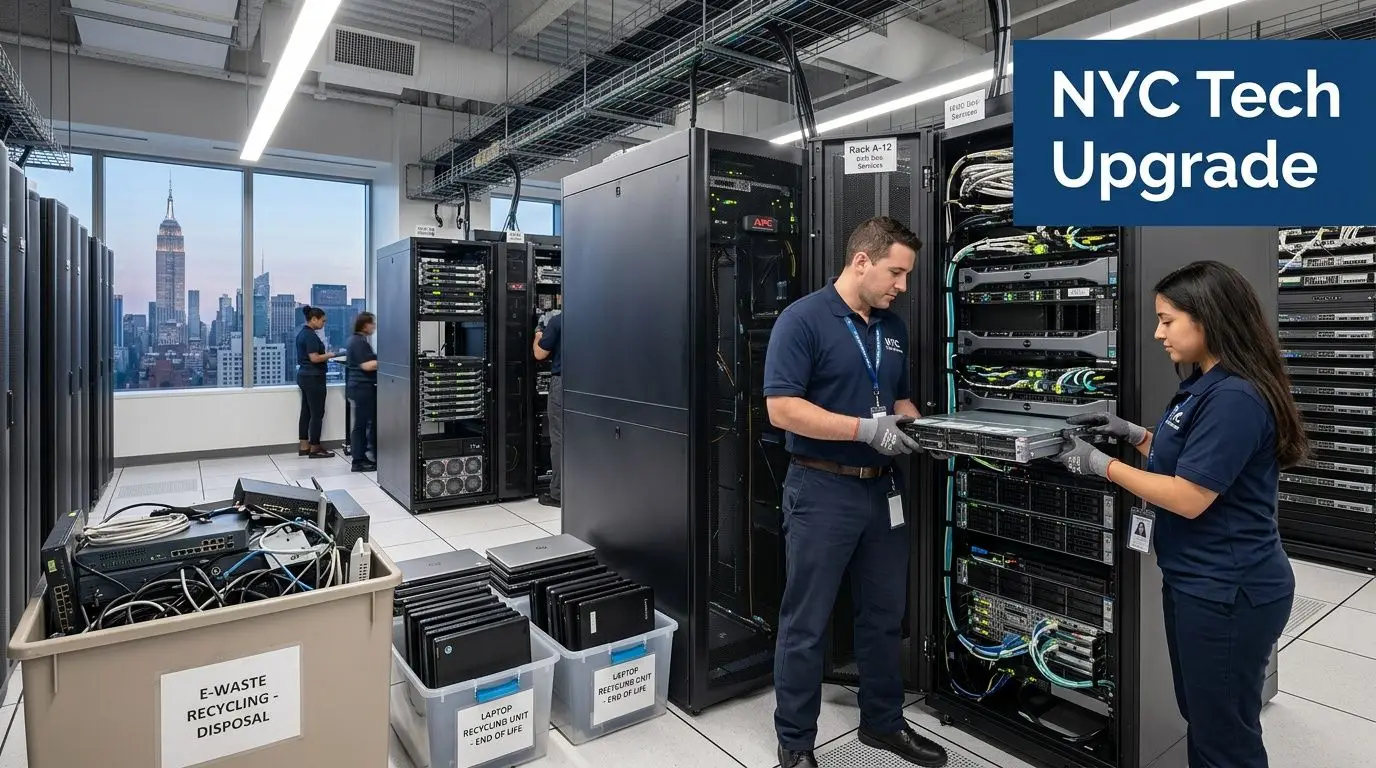
New York is one of the most demanding places to get this right because the scale is so large. The state generates over 400,000 tons of e-waste annually, and a projection tied to a 2025 New York State Senate bill warns that the AI boom could push that figure to 5 million tons annually by 2030 (Human-I-T's New York e-waste regulations overview). That volume changes how enterprises should think about end-of-life technology. Disposal is no longer an occasional cleanout. It's an operational discipline.
Why routine disposal thinking fails
Many organizations still treat retired hardware as a storage problem. They stack devices in a locked room and postpone decisions until quarter end, fiscal year end, or an office move. That delay creates three avoidable issues:
- Security exposure: Old assets may still contain customer records, employee information, credentials, or proprietary files.
- Compliance gaps: Business units often can't prove what happened to each asset after it left the floor.
- Lost value: Hardware that might have been redeployed, donated, or remarketed ages out while it sits idle.
A better approach is to treat retirement the same way you treat deployment. Inventory it. Assign ownership. Define approved handling methods. Require final documentation.
What a mature New York program looks like
A mature process connects legal compliance, data governance, logistics, and finance. That's what IT asset disposition, or ITAD, is supposed to do.
Practical rule: If your team can't identify where an asset is, who handled it, and how data was removed, the disposal process isn't finished.
For organizations planning large upgrades, IT asset disposition services for tech refresh planning can help structure that workflow before equipment starts piling up. That matters most when multiple departments, vendors, and locations are involved.
Understanding New York's E-Waste and Data Security Laws
In New York, proper disposal isn't a best practice. It's a legal requirement.
The central rule is the Electronic Equipment Recycling and Reuse Act, often shortened to EERRA. For businesses, the practical meaning is simple. Covered electronic equipment can't be placed in landfills or municipal waste streams. New York authorizes the Department of Environmental Conservation to impose fines of up to $25,000 per violation per day (Reworx Recycling's overview of electronics recycling for businesses in New York).
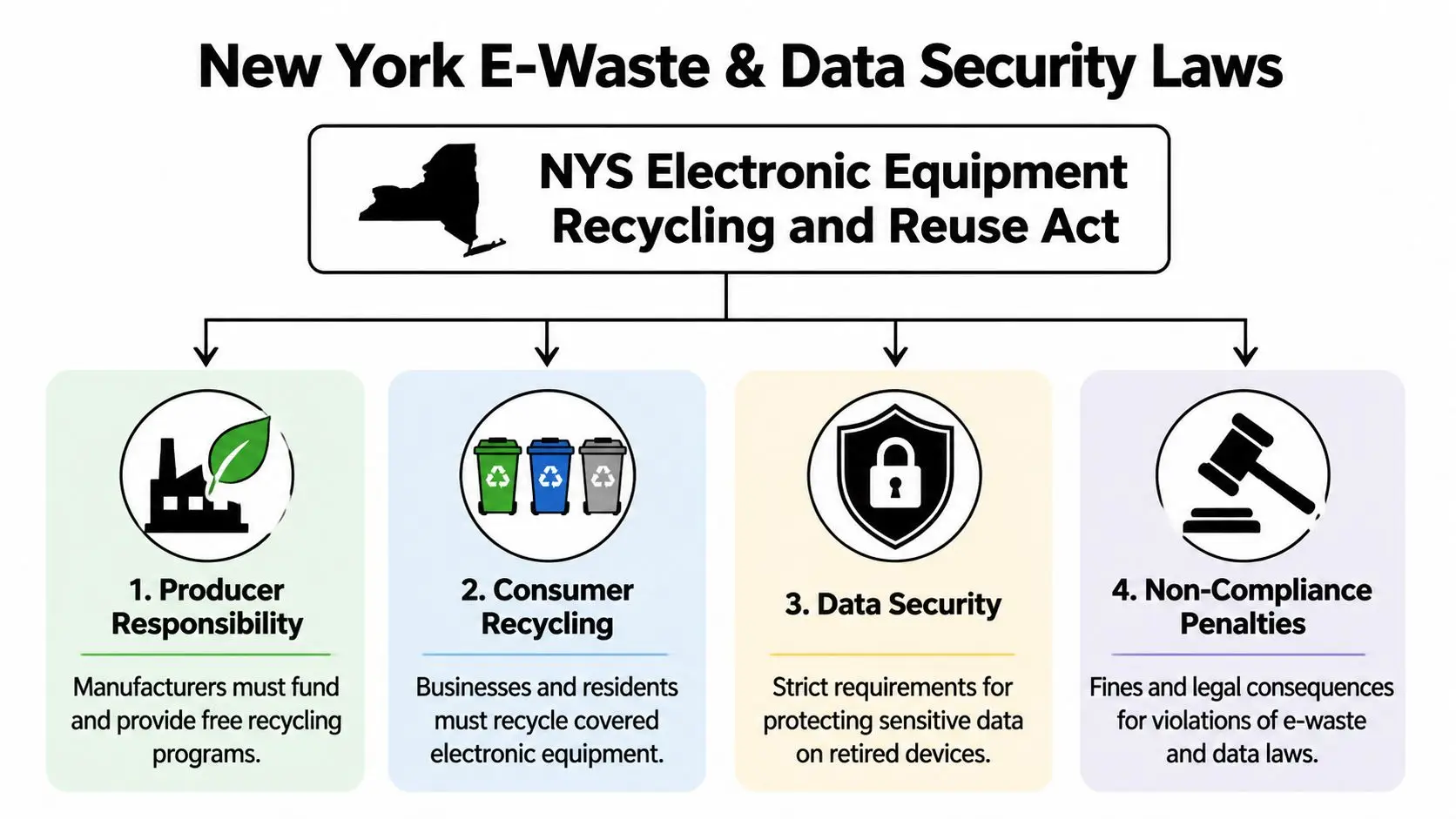
That penalty gets attention, but the law makes more sense when you look at the reason behind it. Retired electronics can contain substances such as lead, mercury, and cadmium. If equipment is dumped or mishandled, those materials can enter the environment through improper processing and leaching.
What equipment is usually in scope
For enterprise teams, confusion often starts with the phrase "covered electronic equipment." In practice, you should assume a broad range of common office and IT assets require controlled handling, including:
- Computing devices: Desktop computers, laptops, and monitors.
- Peripherals and accessories: External drives, keyboards, mice, and similar support devices.
- Office electronics: Certain scanners, facsimile machines, and related equipment.
- Infrastructure gear: Servers and other electronics retired during upgrades or decommissions.
The safest compliance posture is to review each asset class before disposal instead of guessing based on size or apparent value.
Where e-waste law and data law meet
A common compliance mistake is to separate environmental disposal from information governance. They aren't separate once a device stores sensitive data.
If a retired laptop contains financial records, regulated customer information, employee files, or business communications, disposal decisions may also affect obligations under laws and frameworks tied to financial reporting and privacy. The legal exposure then comes from two directions. One is improper waste handling. The other is failure to protect data during retirement, transport, destruction, or resale.
Disposal vendors don't just move scrap. They become part of your control environment.
That is why chain-of-custody records, serial-level inventories, destruction certificates, and documented processing methods matter so much in audits.
What New York organizations should do first
The fastest way to reduce exposure is to standardize a few decisions across the company:
- Define covered assets clearly: Give facilities, IT, and office managers a shared list.
- Ban informal disposal paths: No curbside disposal, no dumpster use, no ad hoc handoffs.
- Require approved processing methods: Data-bearing devices need documented sanitization or destruction.
- Use registered, documented channels: Procurement and compliance should know exactly which provider is authorized.
For organizations building that workflow, New York electronics recycling guidance from Reworx Recycling is one example of a location-specific resource that frames business disposal around compliance rather than convenience.
Core Services in Enterprise Technology Disposal
Most organizations use the phrase "disposal" to describe the whole process. In practice, enterprise disposal is a bundle of different services that solve different risks. If you don't separate them, it's hard to compare vendors or budgets accurately.
ITAD is the umbrella process
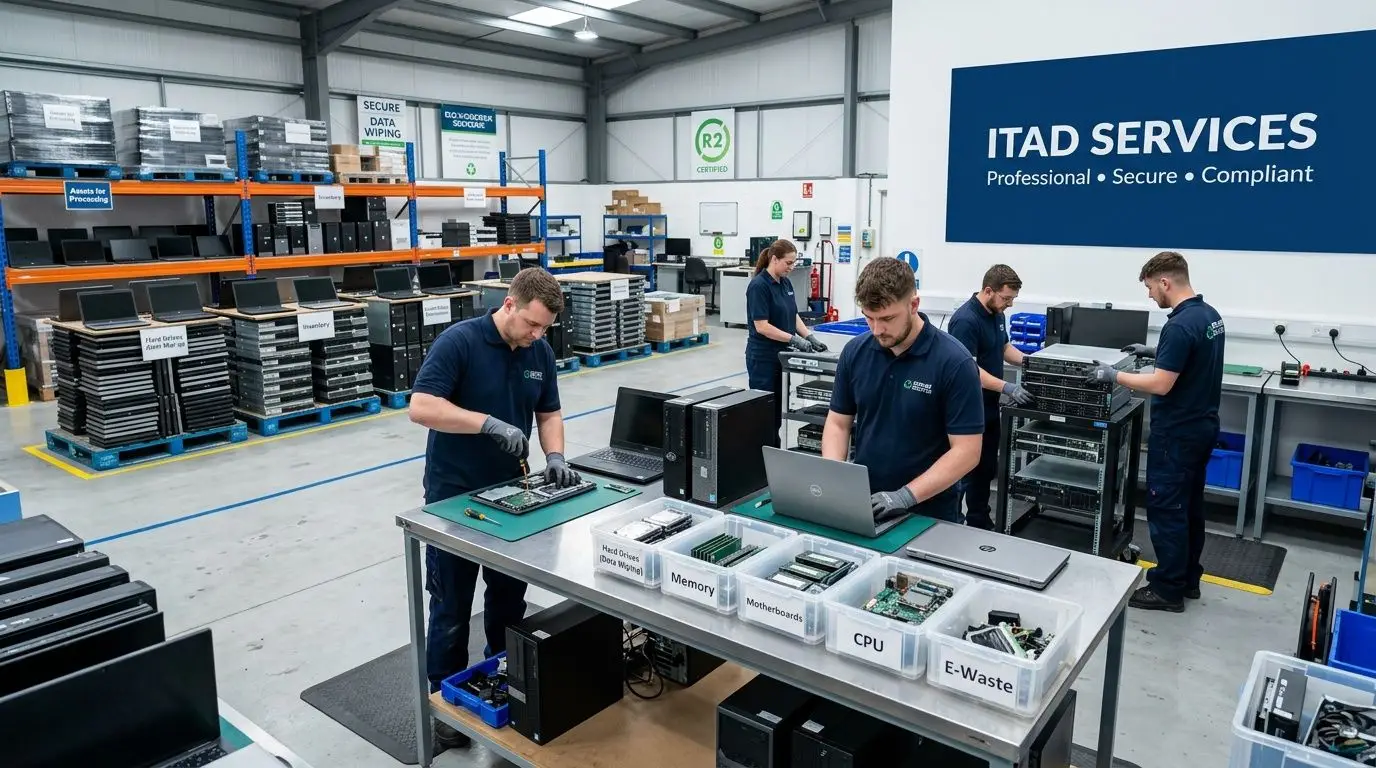
IT asset disposition, or ITAD, is the management layer over retired technology. It covers intake, inventory, triage, data handling, redeployment decisions, resale, donation pathways, recycling, and final reporting.
Think of ITAD as the retirement equivalent of asset management. It doesn't focus on one event. It governs the entire chain from "this device is no longer needed" to "this device was processed correctly and documented."
A solid ITAD program usually answers these questions:
- What assets are being retired?
- Which ones still have usable life?
- Which ones require physical destruction?
- Which ones should be recycled for material recovery?
- What proof will the company receive at the end?
Secure data destruction is its own workstream
Many buyers assume data destruction is just one step in recycling. It isn't. It has its own methods, controls, and audit requirements.
Some devices can be sanitized through software-based erasure when policy and asset condition allow. Others should be physically shredded because the media is damaged, obsolete, high risk, or governed by stricter internal rules. The right choice depends on the media type, the sensitivity of the data, and the organization's compliance posture.
Logistics matters more than most teams expect
A disposal project can fail long before anything reaches a processing facility. Trouble often starts during internal staging, packing, palletization, labeling, or loading.
A New York office tower may require freight coordination, elevator windows, building security approvals, and after-hours pickup. A suburban office park may be easier physically but still needs controls around who touches data-bearing equipment and when. A data center decommissioning project adds another layer because rack gear, cabling, and storage devices often move in separate streams.
Operational note: The pickup isn't the first step in secure disposal. The first step is how your staff identifies, segregates, and stages equipment before pickup.
Value recovery changes the economics
Not every retired asset is waste. Some still have secondary market value. Others may fit internal redeployment or donation-based recycling programs before they reach end-of-life recycling.
That distinction matters because a vendor who only talks about hauling and shredding may leave money on the table. A more complete provider should be able to explain why one batch is suitable for remarketing, why another needs destruction, and why another belongs in commodity recycling.
Here's a simple comparison:
| Service | Primary purpose | Main question it answers |
|---|---|---|
| ITAD | Program oversight | How should each asset be handled from start to finish? |
| Data destruction | Information protection | How do we ensure no recoverable data remains? |
| Reverse logistics | Controlled movement | How do we move equipment securely and document it? |
| Asset recovery | Financial return | What value can we reclaim before final recycling? |
Organizations comparing providers can use Reworx Recycling's IT asset disposition services as one reference point for what a full-service ITAD scope typically includes.
Securing Your Data with Certified Destruction Methods
The highest-risk mistake in enterprise retirement isn't usually environmental. It's assuming that a powered-off device is a harmless device.
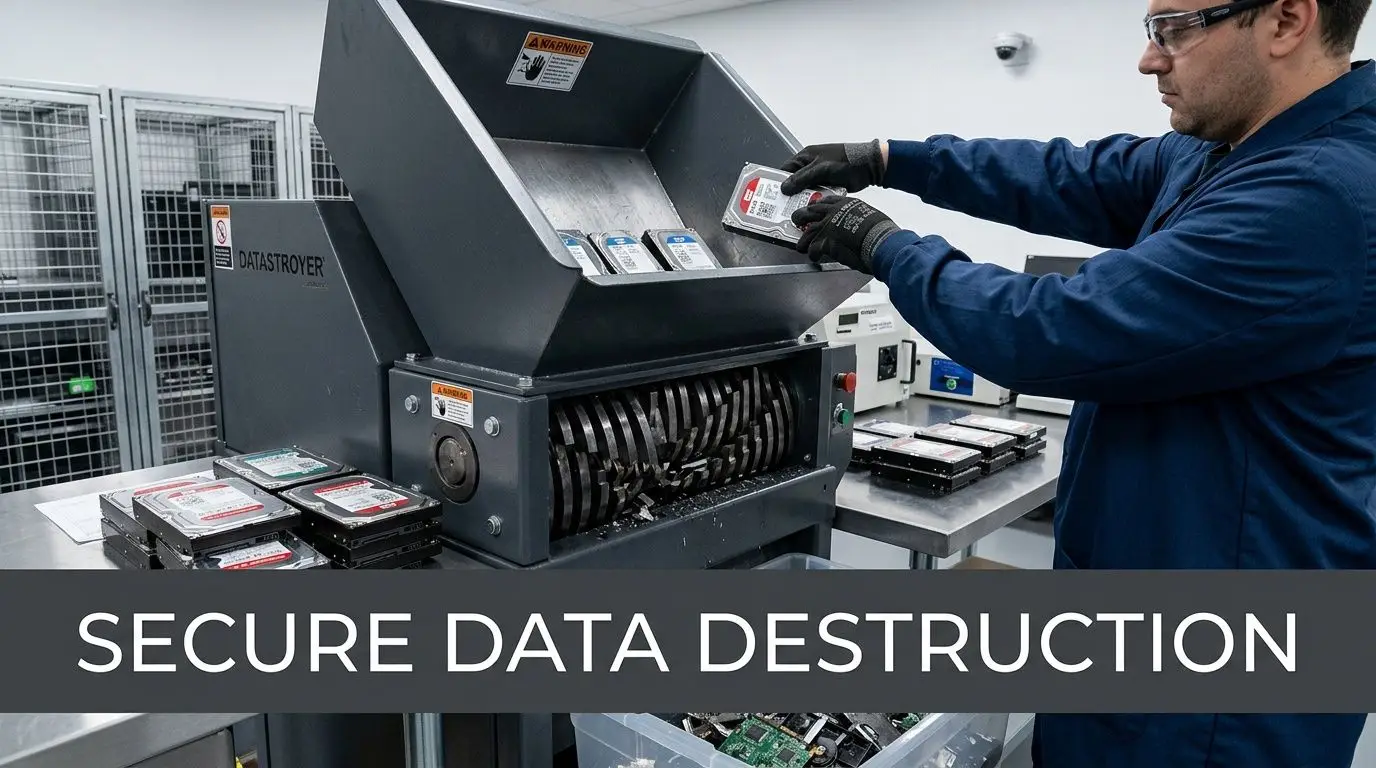
Retired hardware can still hold customer data, employee records, legal files, design documents, financial data, and saved credentials. In enterprise technology disposal, NAID AAA and R2v3 certifications matter because they define disciplined handling methods rather than vague promises. Certified on-site or off-site hard drive shredding that reduces media to less than 2mm particles, or documented multi-pass overwrites aligned with recognized standards, directly reduces breach risk and supports compliance with laws such as GLBA and SOX (EWASTE+ data destruction guidance).
What NAID AAA means in practice
When compliance teams hear "certified destruction," they should ask what the certification governs. With NAID AAA, the answer is process discipline.
That includes controls around employee screening, operational procedures, witnessed handling, secure transport, and auditable destruction practices. For a corporate compliance officer, value isn't the logo. It's the ability to test whether the vendor's process is repeatable, defensible, and documented.
Ask for specifics such as:
- Chain of custody: When does custody transfer, and how is that documented?
- Media handling: Are drives removed, serialized, locked down, and tracked?
- Destruction proof: What certificate is issued, and at what level of detail?
- Service options: Is on-site destruction available when policy requires it?
When shredding makes more sense than wiping
Software erasure has a valid role, especially when hardware still has reuse potential. But it isn't universal.
Physical destruction is often the better choice when media is damaged, when the asset's provenance is unclear, when drives won't power on, or when internal policy requires irreversible destruction. That's especially true during mergers, facility closures, legal holds resolution, or data center decommissioning where large numbers of storage devices move quickly.
A useful analogy is paper records management. Some documents can be archived. Some can be securely digitized. Others go straight to the shred bin because the risk of keeping them is higher than their future usefulness.
R2v3 covers the rest of the chain
R2v3 matters because destruction isn't the only risk point. Organizations also need confidence that downstream recycling, refurbishment, parts harvesting, and material processing follow documented environmental and security controls.
That broader view is what separates a true ITAD workflow from a basic scrap pickup. It connects data protection to environmental responsibility, which is exactly what a New York compliance framework requires.
Audit mindset: If a vendor can't explain what happens after pickup, you're not buying secure disposal. You're buying uncertainty.
For facilities teams running a larger cleanout, even non-IT items benefit from the same disciplined thinking. A practical example comes from Suburban Furniture's old furniture disposal insights, which show how disposal decisions become easier when teams sort items by condition, recovery potential, and handling requirements before removal day.
What documentation should leave the project file closed
A completed data destruction project should produce more than a truck departure. At minimum, the file should contain a serialized inventory when applicable, custody documentation, processing records, and a final certificate of destruction or sanitization that aligns with your internal policy.
For organizations that need a dedicated service path for media handling, certified hard drive destruction services from Reworx Recycling illustrate the type of specialized offering compliance teams usually look for when hard drives, SSDs, and other data-bearing media require separate controls.
Calculating the True Cost and ROI of ITAD in New York
"Free pickup" is one of the most misleading phrases in this market.
It may be true in narrow circumstances. It may apply only to specific volumes, geographies, or equipment mixes. But enterprise ITAD almost always includes a combination of labor, logistics, data handling, downstream processing, and value recovery. If you only compare the pickup charge, you can easily choose the more expensive option.

A verified market claim worth paying attention to is this: a 2025 Gartner report found that 40% of enterprises overpay for ITAD by 15% to 20% due to unclaimed asset value, and understanding the market for used servers, including examples in the $0.10 to $0.50 per pound range, is important for ROI forecasting. The same verified data notes that NYC pickups surged 35% after recent e-waste ban expansions (Hummingbird International's New York recycling page).
Where the hidden costs usually sit
The invoice line item isn't the whole cost. Internal labor often disappears into operations budgets, which makes disposal look cheaper than it is.
Look for costs in places such as:
- Staging labor: Employees sorting, disconnecting, labeling, and moving equipment.
- Storage drag: Equipment occupying secured rooms, racks, or floor space while waiting for a decision.
- Building logistics: Freight access, loading dock scheduling, and after-hours coordination.
- Destruction handling: Separate charges for shredding drives or processing non-remarketable material.
- Poor asset visibility: Missing serials and incomplete tagging reduce remarketing returns.
If your finance team only sees the vendor invoice, it may miss the labor and delay costs created upstream.
Where the return comes from
Value recovery isn't one thing. It can come from remarketing usable assets, harvesting components, offsetting processing fees, or redirecting suitable equipment into corporate donation programs instead of lower-value scrap channels.
The hard part is that value depends on the asset mix. Enterprise servers, recent laptops, and some networking hardware usually need a different evaluation path than damaged peripherals or obsolete displays. That is why disposal bids should include a clear explanation of grading, testing assumptions, and settlement timing.
Financial test: Ask each vendor to show how it distinguishes transport cost, processing cost, and asset recovery credit. If those numbers are blended, comparison gets muddy fast.
A simple budgeting framework
Instead of asking, "Is pickup free?", ask five better questions:
- What will we spend internally to inventory and stage the project?
- Which devices require certified destruction rather than resale preparation?
- What equipment still has remarketing or donation value?
- How are settlement credits calculated and documented?
- What liabilities are we avoiding by using a controlled process?
That framework produces a more honest business case for leadership. It also helps compliance and IT speak the same language. Compliance cares about defensibility. IT cares about execution. Finance cares about net cost. A real ITAD model has to satisfy all three.
For teams that want to emphasize the recovery side of the equation, asset recovery services from Reworx Recycling show how value reclamation can sit alongside responsible recycling rather than competing with it.
Your Step-by-Step Enterprise ITAD Project Plan
A successful retirement project rarely fails because people don't care. It fails because ownership is blurry. Someone assumes the facilities team is tracking serials. Facilities assumes IT is wiping data. IT assumes the vendor will sort everything out on arrival.
A better model is to run the project like a controlled operational change.
Step one defines the scope
Start with a complete inventory of what is leaving service. That includes model type, quantity, physical location, data-bearing status, and any special handling requirement. If the project spans multiple offices or departments, assign one owner to consolidate those lists into a single master record.
This first step is where many future disputes are prevented. If the organization doesn't know what it retired, it won't be able to prove how those assets were handled later.
Step two sets the decision rules
Before pickup is scheduled, define the disposition logic for each asset category. Some items may be approved for reuse or resale after sanitization. Some require immediate physical destruction. Some belong in recycling because they have no practical remarketing path.
A simple internal matrix often helps:
| Asset type | Preferred path | Control question |
|---|---|---|
| Employee laptops | Sanitization, then reuse or recovery if policy allows | Does the device contain regulated or high-risk data? |
| Failed drives | Physical destruction | Can the media be reliably sanitized? |
| Legacy peripherals | Recycling | Is there any realistic reuse value? |
| Server gear from decommissions | Triage by configuration and condition | Should parts be recovered, remarketed, or destroyed? |
Step three prepares the site
On-site preparation is not glamorous, but it determines whether the project runs smoothly. Equipment should be gathered into a secure staging area, separated by handling path, and labeled so custody can be confirmed at pickup.
That is also the moment to resolve practical obstacles such as freight elevator access, loading dock reservations, building security notification, and site contact responsibilities.
A disciplined pickup day starts the week before pickup day.
Step four controls movement and processing
Once the equipment leaves the site, chain of custody becomes the center of the project. Transportation records, receiving confirmation, and processing status updates should line up with the original inventory.
At the processing stage, assets are typically triaged into reuse, refurbishment, parts harvesting, destruction, or recycling streams. The point isn't to maximize one outcome at all costs. It's to apply the correct one to each asset.
Step five closes the loop
The project isn't finished when the truck leaves or when the equipment is shredded. It finishes when your organization receives and reviews final documentation.
That usually includes:
- Inventory reconciliation: What was received versus what was scheduled.
- Destruction records: Proof for media or assets that required it.
- Settlement information: Credits, offsets, or recovery reports where applicable.
- Compliance file closure: Documents retained for audit, legal, and internal controls.
If you build your enterprise technology disposal services in New York around that sequence, even large refreshes become manageable. The project stops feeling like a warehouse cleanout and starts operating like a governed business process.
How to Choose the Right ITAD Partner in New York
The fastest way to make a bad ITAD decision is to buy on convenience alone. A provider may offer quick pickup and still leave major gaps in registration, documentation, downstream handling, or data controls.
That's especially important in New York because verified market data indicates that only about 23% of NY e-waste is recycled properly, which raises audit and vendor selection risk. The same verified guidance stresses the need to verify NYSDEC registration and certifications such as R2v3 or NAID AAA beyond a vendor's marketing claims (ECER's New York service area guidance).
The questions that actually matter
A strong vendor conversation should sound less like a sales call and more like a controls review. Ask direct questions about process, evidence, and exceptions.
Focus on issues such as:
- Registration status: Can the provider document its New York eligibility and operating status?
- Certification scope: Which facilities and services are covered by NAID AAA or R2v3?
- Chain of custody: What happens from pickup to final processing?
- Insurance and liability: Is there coverage appropriate to data and environmental risk?
- Downstream transparency: Where do non-remarketable materials go next?
- Reporting quality: Will you receive usable audit records, not just generic summaries?
If a vendor answers every question with "don't worry, we handle that," keep asking. Good controls are explainable.
Vendor Selection Checklist for NY Enterprises
| Criterion | What to Look For | Why It Matters |
|---|---|---|
| NYSDEC registration | Verifiable registration details, not vague claims | Confirms the vendor is operating through legitimate channels |
| NAID AAA certification | Clear proof tied to destruction services and facility scope | Supports defensible data destruction controls |
| R2v3 certification | Evidence that downstream recycling and handling follow documented standards | Reduces environmental and chain-of-process risk |
| Chain of custody | Serialized tracking, transfer records, and documented handoffs | Protects against loss, mix-ups, and audit gaps |
| Pricing transparency | Separate explanation of logistics, destruction, recycling, and recovery credits | Helps you compare bids on total value, not slogans |
| Reporting package | Inventory reconciliation, destruction records, and final summaries | Makes audits and internal signoff far easier |
| Social impact option | Donation-based recycling or community technology reuse pathways where appropriate | Aligns IT retirement with CSR and digital inclusion goals |
Why the business model matters too
Two vendors can offer similar operational services and create very different organizational outcomes. That's where a social enterprise model deserves attention.
Reworx Recycling operates as a donation-based electronics recycling and IT equipment disposal partner that combines services such as pickups, secure data handling, recycling, and asset management with a broader community mission around technology access and workforce development. For some New York businesses, that model can help connect corporate donation programs, sustainable recycling goals, and end-of-life IT controls in one workflow.
That isn't a substitute for due diligence. It is an added lens for selection. If your company tracks ESG or community impact, the provider's mission can matter alongside its paperwork.
Conclusion The Reworx Advantage for New York Businesses
Enterprise technology disposal in New York sits at the intersection of compliance, security, operations, and finance. A strong program doesn't just remove old equipment. It controls risk, documents every handoff, protects sensitive data, and captures value that would otherwise be lost.
That matters more as refresh cycles accelerate and more organizations retire laptops, servers, networking gear, and specialized electronics across multiple sites. The companies that handle this well usually treat disposal as part of governance, not as an afterthought delegated at the end of a project.
There's also a broader opportunity inside the process. When retired equipment is evaluated carefully, some assets can support reuse, responsible recycling, or community-focused donation pathways instead of becoming unmanaged waste. That gives compliance teams and sustainability leaders a chance to align operational discipline with environmental responsibility.
For New York businesses that want a cleaner, more defensible approach, the right next step is to formalize your ITAD workflow and partner with a provider that can support secure handling, reporting, and responsible downstream outcomes.
If your organization is planning a tech refresh, office cleanout, data center decommissioning, or secure electronics recycling program, Reworx Recycling offers resources to help you evaluate next steps, schedule a pickup, and build a disposal process that supports compliance, sustainability, and community impact.