
A telecom search usually starts after the damage is already visible. Sales calls drop on VoIP, cloud apps stall in the afternoon, and remote staff start asking whether the VPN issue is on their end or yours. For an Atlanta business, those problems quickly turn into missed revenue, slower support, and less confidence in the network your team depends on every day.
Local context matters. A Midtown office, a clinic in Decatur, and a warehouse near Hartsfield-Jackson can face very different carrier options at the exact address. The question is not just which telecom providers near me offer service. It is which provider can support your current workloads, your uptime target, your security requirements, and the next phase of growth.
Many provider roundups stop at advertised speed and monthly price. That leaves out the decisions that usually matter more after install day: failover, support responsiveness, contract flexibility, static IP needs, equipment ownership, and how the cutover affects the hardware you are replacing.
That last point gets missed often. A provider switch usually leaves behind old firewalls, routers, switches, access points, handsets, and modems that still hold business data or configuration details. Choosing a carrier should be part of a wider lifecycle plan that includes IT asset disposition processes for retired network equipment, not a separate cleanup task someone remembers six months later.
This guide looks at Atlanta-area business telecom options with that full operational view in mind. The goal is simple: pick a provider that fits the site, protect uptime during the transition, and retire outdated hardware responsibly through Reworx Recycling as the final ITAD step.
1. AT&T Business
AT&T Business is usually one of the first providers Atlanta IT teams evaluate, and for good reason. If you want one vendor for internet, voice, wireless backup, and related network services, AT&T tends to make the shortlist fast. That matters when you're standardizing across more than one office and don't want four different support paths.
For a small or midsize company, the main attraction is flexibility. You can often start with business fiber where it's available, then move into more controlled options like dedicated internet as your uptime requirements tighten.
Where AT&T fits best
AT&T is a practical fit for businesses that care about consistency across locations more than chasing the lowest introductory rate. It also helps when leadership wants fewer vendors on the monthly operating stack.
A few scenarios where AT&T often works well:
- Multi-site offices: One account structure is easier to manage than piecing together separate local providers.
- Voice-heavy operations: If your phones, contact center traffic, and internet all need to work together, bundled business services can simplify support.
- Compliance-minded teams: Static IP options, managed hardware, and more formal enterprise sales processes are useful when security reviews are involved.
The trade-offs
The biggest issue isn't quality. It's availability at the exact address. One building may have a strong fiber option, while the office park across the road may still have fewer choices or a different build status.
Contracting can also get complicated once you move beyond standard business internet into dedicated services. That's not a reason to avoid AT&T. It just means procurement needs to read service terms carefully and map them to the business impact of downtime.
Practical rule: Ask AT&T to validate service at the suite level, not just the building address. In Atlanta, that detail can save weeks of back-and-forth.
AT&T also makes sense when you're treating a provider cutover as part of a broader hardware refresh. If you're replacing old edge devices, firewalls, or voice gear at the same time, don't leave decommissioning to chance. Reworx Recycling has a useful primer on what IT asset disposition means and why retired network equipment needs a documented path out of the business.
For provider details and local service information, start with AT&T Business in Atlanta.
2. Comcast Business
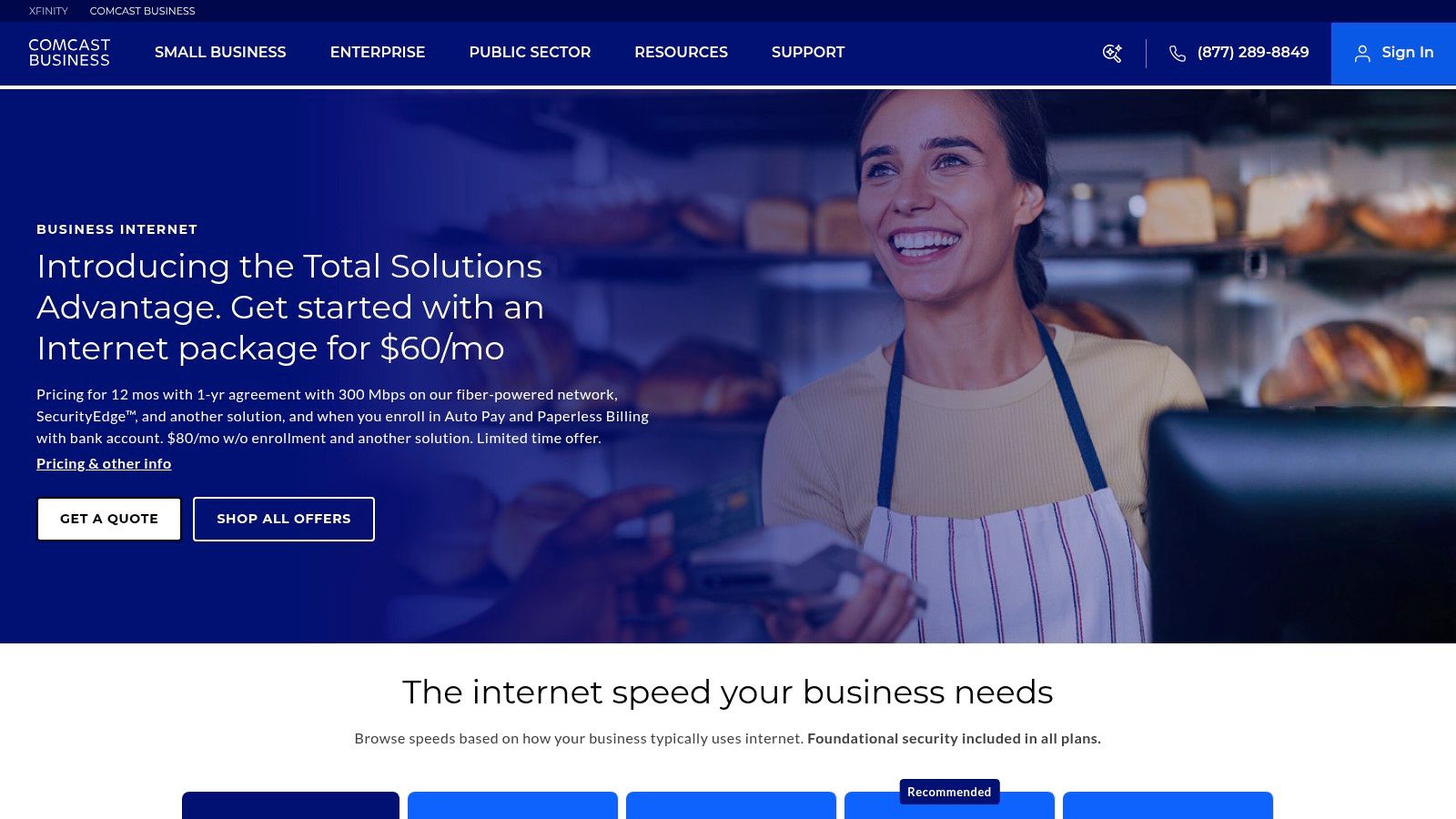
Comcast Business is often the practical answer when a company needs service installed quickly and doesn't want a long procurement cycle. In much of metro Atlanta, it's one of the easiest business internet options to get into the building. That alone makes it relevant for office moves, branch openings, and fast-growing teams.
Its strongest use case is straightforward business connectivity with room to add more later. Many companies begin on cable-based service, then add managed Wi-Fi, voice, static IPs, or fiber and Ethernet products as operations mature.
Why many Atlanta SMBs choose Comcast first
Comcast Business works especially well when the office needs a solid operational connection without an enterprise-grade sales process. The network footprint is broad, and installs are often less cumbersome than more specialized circuits.
What usually stands out:
- Fast deployment: Good for businesses opening on a deadline.
- Scalable path: You can begin with a simpler service mix and expand if the business adds users, sites, or hosted applications.
- Backup options: LTE failover can help smaller offices avoid total outages during local access problems.
The compromise is predictability. Promotional pricing, term lengths, and service bundles can vary quite a bit by address and by rep. That's manageable, but it means your evaluation has to include the second-year reality, not just the first invoice.
Comcast is a strong operational choice when "good enough now" matters more than a perfect long-term architecture on day one.
What to watch during migration
Comcast is also one of the providers where equipment turnover can pile up over time. Cable gateways, managed Wi-Fi hardware, voice equipment, and old branch networking gear tend to accumulate during changes, especially across multiple locations.
If your business is replacing Comcast-related equipment or moving away from it, build secure retirement into the project plan. Reworx Recycling offers secure data destruction services that are relevant when network appliances, storage-bearing devices, and office IT gear leave service.
Comcast itself is worth reviewing directly at Comcast Business.
3. Google Fiber

Google Fiber appeals to buyers who are tired of telecom complexity. If your main priority is simple fiber service with fewer legacy bundle decisions, GFiber is easy to like. The plans are generally straightforward, and the buying experience tends to feel cleaner than what many incumbent providers offer.
That simplicity is the whole story. Where GFiber is available in the Atlanta area, it's often attractive for small offices, creative teams, software companies, and businesses that want high-capacity fiber without a long list of optional add-ons.
What makes GFiber different
GFiber is less about a sprawling product catalog and more about clear service. For smaller businesses, that can be a real advantage because fewer moving parts usually means fewer billing disputes and fewer plan surprises.
A practical way to look at it:
- Simple plan structure: Easier for non-specialist buyers to evaluate.
- Symmetrical fiber experience: Better aligned with cloud backups, large file transfer, and hybrid work than older asymmetrical connections.
- Cleaner setup: Included Wi-Fi equipment and a generally direct installation model reduce project friction.
The downside is availability. With GFiber, enthusiasm doesn't matter if the address isn't serviceable. In Atlanta, that answer is still highly location-specific.
Best fit and limitation
I wouldn't position Google Fiber as the universal answer for every business searching telecom providers near me. I would position it as a high-interest option to check early, because when it's available, it can remove a lot of usual provider headaches.
It's less compelling for organizations that want deeply bundled voice, television, or broad legacy telecom packaging under one contract. That's not really the point of the platform.
If a business wants simple fiber and doesn't need a heavy telecom bundle, GFiber is often one of the cleanest options on the board.
Provider information for Atlanta is available at Google Fiber in Atlanta. And if the switch leaves you with surplus Wi-Fi gear, employee laptops, or retired office electronics, Reworx Recycling's business electronics recycling services fit naturally into that handoff.
4. Verizon 5G Business Internet

A branch lease gets signed, the team is scheduled to move in, and the wired circuit still has no firm install date. That is a common reason businesses start searching for telecom providers near me, and it is exactly the kind of situation where Verizon 5G Business Internet can solve a real operational problem.
Verizon's fixed wireless service is usually strongest as a timing and resiliency play. It gives companies a way to bring a site online quickly, keep staff connected during buildouts, or add a second internet path without waiting on construction. For IT managers, that can mean fewer lost workdays, fewer hotspot workarounds, and less pressure on the help desk during a move.
Where Verizon fits best
The service makes the most sense when speed of deployment matters as much as raw network consistency.
I typically see good fit in a few scenarios:
- New locations waiting on wired install: Keeps cloud apps, VoIP, and collaboration tools available while the primary circuit is still in process.
- Backup internet for uptime planning: Adds path diversity for offices that cannot afford a single point of failure.
- Temporary or changing sites: Useful for project offices, swing spaces, and locations that may not justify a long fiber build.
Those are practical use cases, but there is a trade-off. Fixed wireless performance can shift based on signal strength, building materials, window placement, and network congestion at that address. A pre-sales coverage check is not enough. Teams should test the service inside the actual suite, during business hours, with the same traffic mix they expect in production.
Where fiber still wins
Verizon 5G Business Internet is not the first choice for every workload. If the office depends on latency-sensitive applications, large recurring data transfers, or stricter service commitments, fiber usually remains the better primary connection. Wireless can still play an important role, just in a different slot in the network design.
That distinction matters in budgeting and in risk planning. A business that treats 5G as a tactical connection often gets more value from it than a business that expects it to behave like a dedicated wired circuit under every condition.
There is also an IT lifecycle angle that gets missed during provider changes. A Verizon rollout often replaces old branch routers, retired hotspots, failed access points, or surplus small-office hardware that has been sitting in storage. That is a good point to handle disposal properly, both for security and for asset control. Reworx Recycling supports that handoff through corporate computer recycling and helps companies understand the broader benefits of responsible e-waste recycling.
For current service details, review Verizon 5G Business Internet.
5. T-Mobile Business Internet
A common scenario looks like this. A branch office is opening in three weeks, the fiber install date is still uncertain, and staff need reliable access on day one. T-Mobile Business Internet is often a practical answer in that gap because it can be deployed quickly, kept as the primary connection for lighter workloads, or reassigned later as a backup link.
That flexibility is the main reason businesses evaluate it. For smaller offices, temporary locations, retail sites, and teams with basic cloud application needs, T-Mobile can reduce the wait and complexity that often come with wired circuits.
Why teams use it
The value here is operational. T-Mobile's fixed wireless service works well for businesses that care more about fast turn-up, predictable billing, and simple deployment than custom network design.
A few situations where it fits:
- New or relocated offices: Service can often be activated faster than a traditional wired circuit.
- Short-term or changing sites: Useful for project offices, pop-up locations, and mobile operations.
- Backup connectivity: A sensible secondary link when the primary circuit fails.
- Smaller IT environments: Good for teams that do not need a heavily engineered WAN at every site.
T-Mobile also benefits from broad 5G availability in many markets, which is why it regularly makes the shortlist during early provider reviews. The important qualifier is local performance. A strong market presence does not guarantee the same result inside a specific office, on a specific floor, or in a back room full of concrete and metal.
Where caution matters
Signal quality inside the building usually decides whether this service feels reliable or frustrating. Window placement, wall construction, interference, and gateway position all affect throughput and stability. Teams should test the service where the equipment will live, not in the lobby or conference room where reception is naturally better.
There is a second trade-off. T-Mobile Business Internet is easier to buy than many wired services, but it is not always the right fit for businesses that need advanced routing options, strict performance commitments, or more specialized IP requirements. IT managers should match the service to the workload, not just the price or install speed.
Provider changes also create an IT asset issue that gets ignored. A T-Mobile rollout can retire older hotspots, branch firewalls, employee-issued mobile devices, or small-office networking gear that no longer belongs in service. That is the right moment to handle disposal with the same discipline used during procurement. Reworx Recycling outlines the security and environmental benefits of responsible e-waste recycling for teams that want cleaner asset records, better downstream handling, and less risk from forgotten hardware.
For current service details, review T-Mobile Business Internet.
6. Lumen
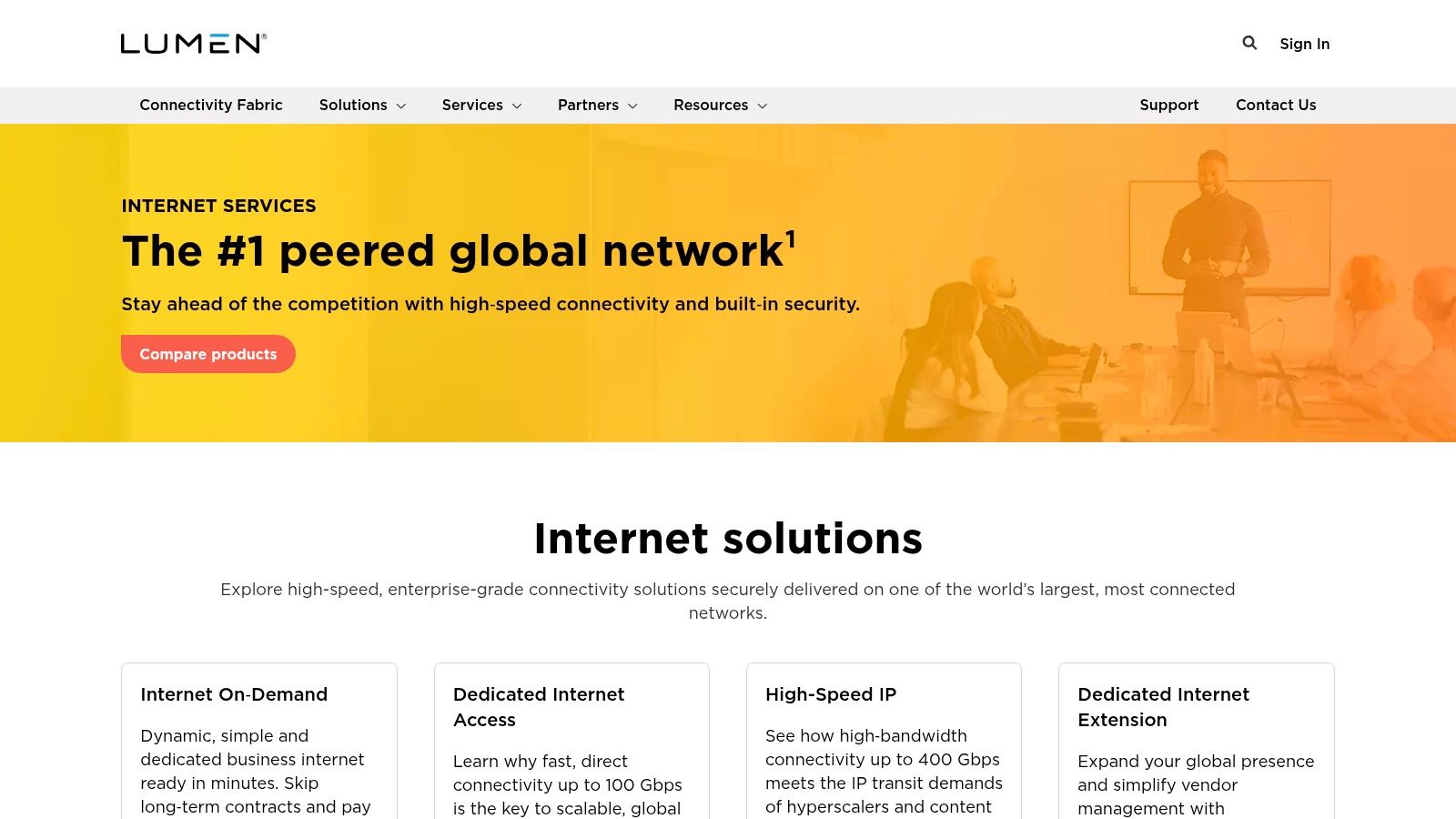
Lumen isn't usually the first provider a small office checks. It becomes relevant when IT leadership is less concerned with basic availability and more concerned with guaranteed bandwidth, service levels, WAN design, and integration with security architecture.
That's why Lumen tends to show up in conversations involving larger enterprises, regulated operations, and businesses with data-center, branch, or multi-region requirements. If Comcast and fixed wireless are operationally convenient, Lumen is more often an architectural decision.
What Lumen does well
The company's value is strongest when you need dedicated services, formal performance expectations, and room to integrate internet access with broader network design. Dedicated Internet Access, Ethernet, and related enterprise services matter in environments where an outage or performance swing has visible cost.
Lumen also fits when the business wants telecom to connect with other managed capabilities rather than sit alone. That can include SD-WAN strategies, security overlays, and structured inter-site networking.
A few signs Lumen belongs in the evaluation:
- Your business needs SLAs: Not just best effort connectivity.
- Traffic patterns are predictable and important: ERP, voice, secure access, and site connectivity need tighter control.
- The procurement process is formal: Security, legal, and architecture all have a say.
What slows deals down
Lumen is less convenient for buyers who need an answer by next week. Sales cycles can be longer, quotes are often customized, and building eligibility drives a lot of the conversation. For the right environment, that's acceptable. For a small office move, it may feel like overkill.
The contrast with mass-market broadband is useful here. In places like Cheyenne, Wyoming, provider availability varies sharply by technology, with cable, fiber, satellite, and fixed wireless each offering very different footprints and performance profiles, according to local broadband availability data. Atlanta is a bigger market, but the core lesson holds. Access method matters as much as brand name.
If you're comparing telecom providers near me for a mission-critical Atlanta site, Lumen belongs on the list when the business case is reliability and control, not just speed.
For current offerings, visit Lumen internet services.
7. Kinetic Business by Windstream
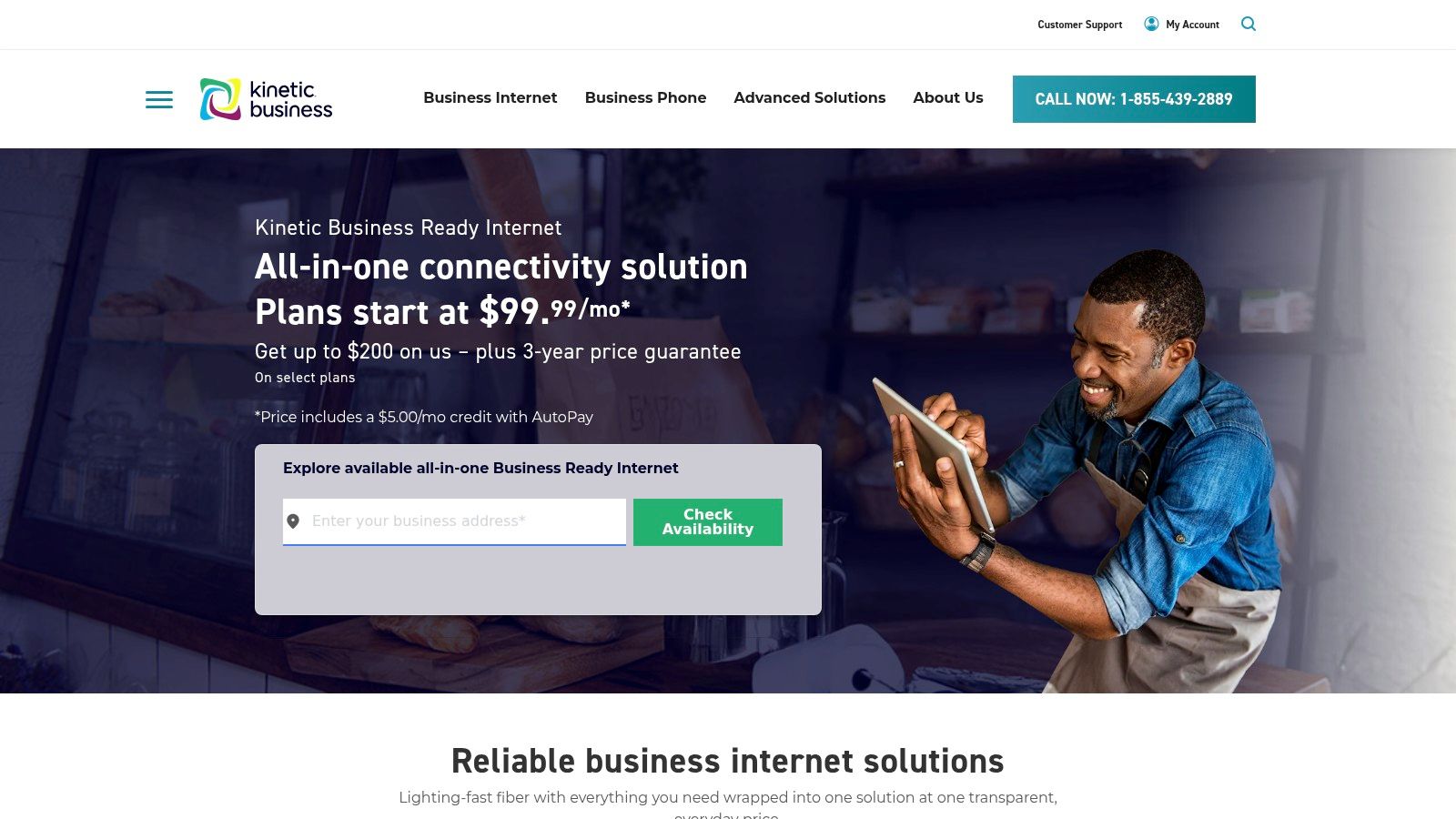
Kinetic Business by Windstream is the kind of provider that becomes valuable when you don't assume the biggest carrier is automatically the best fit. In parts of Georgia, Kinetic can be a competitive alternative, especially where it already serves a building or has stronger local positioning than buyers expect.
For Atlanta-area businesses, the key word is verification. This isn't the provider to evaluate from broad marketing coverage claims alone. Exact building and street-level availability decides whether Kinetic is a real contender or a dead end.
When Kinetic is worth the call
Kinetic can make sense for businesses that want business fiber or Ethernet options but also want an advantage in the quoting process. If incumbent providers are expensive, slow, or difficult to work with in a given location, an alternate carrier can reset the conversation.
It may be worth checking if you are dealing with:
- Underserved pockets: Buildings that fall awkwardly between larger incumbents' best footprints.
- Cost pressure: Sites where you need a competitive quote to challenge a renewal.
- Mixed-size operations: Companies that have both SMB-style offices and more demanding network locations.
The real limitation
Coverage isn't consistent across the Atlanta core, so Kinetic is more situational than universal. That doesn't make it weak. It makes it address-dependent, like many provider decisions in practice.
There's another angle business owners often miss during provider changes. Telecom comparison discussions usually focus on price and speeds, while overlooking the disposal burden created by retired modems, routers, set-top boxes, and 5G hardware. That gap is especially relevant for businesses managing multiple locations and frequent provider transitions, as highlighted in broadband market context for Austin.
That same issue shows up in Atlanta office moves, facility cleanouts, and IT refresh cycles. When old network hardware starts stacking up in a storage room, it becomes an IT asset disposition problem, not just a facilities annoyance.
For current offerings and address checks, see Kinetic Business by Windstream.
Top 7 Business Telecom Providers Comparison
| Provider | Implementation Complexity 🔄 | Resource Requirements ⚡ | Expected Outcomes 📊 | Ideal Use Cases 💡 | Key Advantages ⭐ |
|---|---|---|---|---|---|
| AT&T Business | Medium–High, fiber/DIA provisioning and contract negotiation | Medium–High, fiber build/managed router/SD‑WAN options | High reliability and scalable symmetric bandwidth (up to 100 Gbps) | Multi‑site SMB to enterprise needing unified internet, voice, security | Broad footprint and comprehensive product catalog |
| Comcast Business | Low–Medium, quick HFC installs; higher for Ethernet/DIA | Medium, coax or fiber, optional LTE failover and managed Wi‑Fi | Widely available, scalable speeds; promotional pricing variability | Offices needing fast installs and scalability across locations | Dense local network and flexible tier options |
| Google Fiber (GFiber) | Low, simple sign‑up, no contracts where available | Low, equipment included; service limited to available addresses | Predictable symmetric multi‑gig performance with no data caps | Small businesses/residential in lit areas seeking simple plans | Transparent pricing, fast installs, high user satisfaction |
| Verizon 5G Business Internet | Very Low, rapid turn‑up, self or pro install | Low, CPE and adequate 5G/LTE signal required | Fast deployment and portable connectivity; performance can vary | Temporary sites, pop‑ups, or as wireless failover for critical offices | Rapid deployment and easy relocation |
| T‑Mobile Business Internet | Very Low, quick provisioning and simple billing | Low, 5G/LTE coverage and customer premise device | Cost‑effective at lower speeds; throughput varies with signal | Small offices or redundancy where low lead time matters | Competitive pricing and minimal lead time |
| Lumen (CenturyLink / Level 3) | High, enterprise sales, quoting and provisioning cycles | High, DIA, dedicated fiber, SLAs and WAN/security integration | Deterministic performance with enterprise SLAs and reporting | Regulated environments and enterprises needing guaranteed bandwidth | Tier‑1 backbone, strong SLAs and managed integration |
| Kinetic Business (Windstream) | Medium, street/building specific availability checks | Medium, fiber where lit; availability varies by location | Competitive performance and pricing where available; consistency varies | SMBs in under‑served pockets or as alternative to incumbents | Cost‑competitive in served areas and mixed SMB/enterprise offerings |
Upgrade Your Connectivity and Your Sustainability
A provider cutover usually looks successful on paper the moment the new circuit goes live. Then the old modem, firewall, phones, and access points end up boxed in a server room or left in a closet at the old office. That is where avoidable risk starts.
Choosing a telecom provider affects uptime, cloud access, voice quality, remote work, and how quickly staff can recover from an outage. The transition affects something else that often gets missed. Retired hardware still carries business data, saved credentials, management settings, and asset value that should be tracked instead of forgotten.
The provider decision should match how the business operates. A small office that needs service fast may accept the trade-off of cable or fixed wireless. A larger site with critical SaaS traffic, VoIP dependence, or compliance requirements may need dedicated fiber, tighter SLAs, and a cleaner handoff between carriers and internal IT. Good telecom planning covers both the install date and the removal date.
That final step matters to different teams for different reasons. IT managers need documented chain of custody and secure data destruction. Operations teams need old gear out of the way during moves, remodels, and office closures. Business owners need to control total cost, reduce disposal headaches, and avoid storing obsolete equipment for years.
Reworx Recycling supports that end-of-life stage as a donation-based electronics recycling and IT asset disposition partner. The company helps businesses handle electronics recycling, computer recycling, secure data destruction, office cleanouts, and IT equipment disposal when a carrier change overlaps with a broader infrastructure refresh.
Telecom upgrades rarely stop at the circuit; they often trigger replacement of edge devices, Wi-Fi equipment, desk phones, mobile hardware, and backup connectivity gear. Each refresh creates another disposal decision.
A strong provider choice improves connection quality. A disciplined ITAD process closes the project properly, with equipment documented, data handled securely, and obsolete hardware kept out of storage rooms and landfills.
Ready to schedule a pickup for your old office electronics? Contact Reworx Recycling today to learn more about our corporate donation programs and secure your legacy data.
If your Atlanta business is upgrading carriers, opening a new office, planning an office cleanout, or retiring aging network hardware, Reworx Recycling can help you connect telecom changes with responsible electronics recycling, secure data destruction, and practical IT asset disposition planning.