Most Michigan businesses have one. A locked room, a back corner of the warehouse, a shelf in the server room, or a row of bins in facilities. Inside sits the slow buildup of old technology: retired laptops, dead monitors, phones from past upgrades, surplus printers, failed network switches, and servers nobody wants to touch until the audit, move, or refresh project forces the issue.
That storage closet feels harmless until it isn't. A hard drive with customer data is still a liability even when it's unplugged. A stack of cracked CRTs is still an environmental risk. Equipment that falls outside a manufacturer takeback program still needs a legal, secure path out of your building. In Michigan, that challenge has a distinct local flavor because recycling economics, coverage gaps, and uneven access across the state all shape what a responsible disposal plan looks like.
The practical question isn't whether to recycle. It's how to handle michigan electronics recycling in a way that protects data, satisfies internal compliance, and keeps usable equipment in circulation whenever possible. For IT managers, business owners, sustainability leads, and facilities teams, the right answer usually starts with process. Inventory first. Chain of custody second. Secure sanitization before anything leaves the site. Then choose the disposition path that fits the asset type, quantity, and risk.
Introduction The Hidden Challenge in Your IT Storage Closet
A Michigan IT manager usually doesn't inherit a clean asset retirement process. They inherit leftovers. Ten laptops from the last employee refresh. A rack of decommissioned servers waiting for approval. Old displays from an office remodel. A tote of phones and tablets nobody can confidently assign to a current program.
That backlog creates three problems at once. The first is security. If devices still hold data, every extra month in storage extends your exposure. The second is operations. Cluttered storage areas slow moves, upgrades, and inventory work. The third is sustainability. Equipment that could be reused, donated, or properly recycled often sits until it becomes harder to process.
Michigan adds another wrinkle. Some devices fit manufacturer takeback rules, and many don't. Urban businesses can often find more options than rural companies. A Detroit office, a Grand Rapids healthcare group, and a manufacturer in the Upper Peninsula may all face different logistics even when the devices look similar.
Practical rule: If your team can't answer where each retired device is, what data is on it, and where it's going next, you don't have disposition under control yet.
The strongest programs treat end-of-life electronics as part of asset management, not janitorial cleanup. That mindset shifts the conversation from "How do we get rid of this stuff?" to "How do we retire it responsibly, document it, and create value where we can?" That's the frame that makes michigan electronics recycling work for business, not against it.
Decoding Michigan's E-Waste Laws and Business Obligations
Michigan businesses need to understand one core point up front. Business-generated electronics are regulated differently than ordinary trash. Under Part 173 of the Natural Resources and Environmental Protection Act, Michigan classifies business-generated electronics as universal waste, and recyclers must register with EGLE and meet a 75% annual recycling rate to avoid speculative accumulation and compliance failures, as outlined in Michigan e-waste compliance guidance.

What universal waste means in practice
For a business, "universal waste" isn't just a label. It affects how you store, move, and hand off retired electronics. It means your devices shouldn't be treated like routine office debris headed to the dumpster. It also means vendor selection matters more than many companies assume.
If a recycler isn't operating in a compliant manner, your company may not have caused that failure, but you still created unnecessary risk by using a weak downstream partner. That's why procurement, IT, facilities, and compliance teams should all care about recycler vetting.
A sound process usually includes:
- Asset identification: Know what you're retiring before pickup day.
- Segregated storage: Keep end-of-life electronics separate from general waste and scrap.
- Documented transfer: Record when devices leave your custody and who receives them.
- Vendor due diligence: Confirm the recycler is registered and operates with disciplined processing controls.
Michigan businesses can start with a provider that specializes in Michigan electronics recycling services and then layer in their own internal controls for approvals, documentation, and pickup scheduling.
Why recycler standards matter to your business
The 75% annual recycling rate applies to recyclers, not to your internal IT department. But it still matters to you because it signals whether the vendor is processing material or merely accumulating it. That distinction is important with older, low-value, or labor-intensive devices such as CRT equipment, which can contain hazardous materials and require careful handling.
A recycler that can't move material through its system becomes a risk point, not a solution.
This is also where environmental compliance and privacy obligations meet. If a company throws away electronics with intact data, the issue isn't just improper disposal. It's also potential exposure under data protection requirements and internal governance policies. Healthcare providers, schools, public agencies, and any business handling personal or confidential information should treat disposal as a controlled event.
A practical due diligence screen
Before signing off on pickup or drop-off, ask these questions:
| Question | Why it matters |
|---|---|
| Is the recycler registered and operating under Michigan requirements? | Confirms baseline legal standing |
| How is chain of custody documented? | Protects your audit trail |
| What sanitization methods are available for different media types? | Aligns disposal with data risk |
| How are hazardous legacy devices handled? | Reduces environmental exposure |
| What reporting will you receive after disposition? | Supports compliance and internal records |
Michigan law doesn't reward casual disposal. The companies that stay out of trouble are the ones that treat retired electronics like regulated assets, not surplus junk.
On-the-Ground Realities of Electronics Recycling in Michigan
A facilities manager in Grand Rapids closes one office, an IT lead in Traverse City clears out a storage room, and a school district in the Upper Peninsula tries to retire aging classroom tech. All three have the same goal. Get obsolete electronics out of the building without creating a data, compliance, or disposal problem. In Michigan, the path to that goal looks very different depending on what the equipment is and where it sits.
Michigan has expanded recycling access over time, but electronics still come with friction that businesses feel immediately. One reason is cost. Disposal can be easier than responsible recycling. According to EGLE's five-year electronic waste program report, Michigan has no landfill ban on electronics and the lowest landfill tipping fees in the Great Lakes region. The same report states that the state's takeback program recycled over 125 million pounds of end-of-life electronics since 2011, peaked at just over 30 million pounds in 2014, then fell to over 20 million pounds in 2015. It also shows annualized per capita collection rates at 1.4 pounds in 2010 and 1.6 pounds in 2011, compared with Indiana at 2.5 pounds and Illinois at 2.4 pounds.
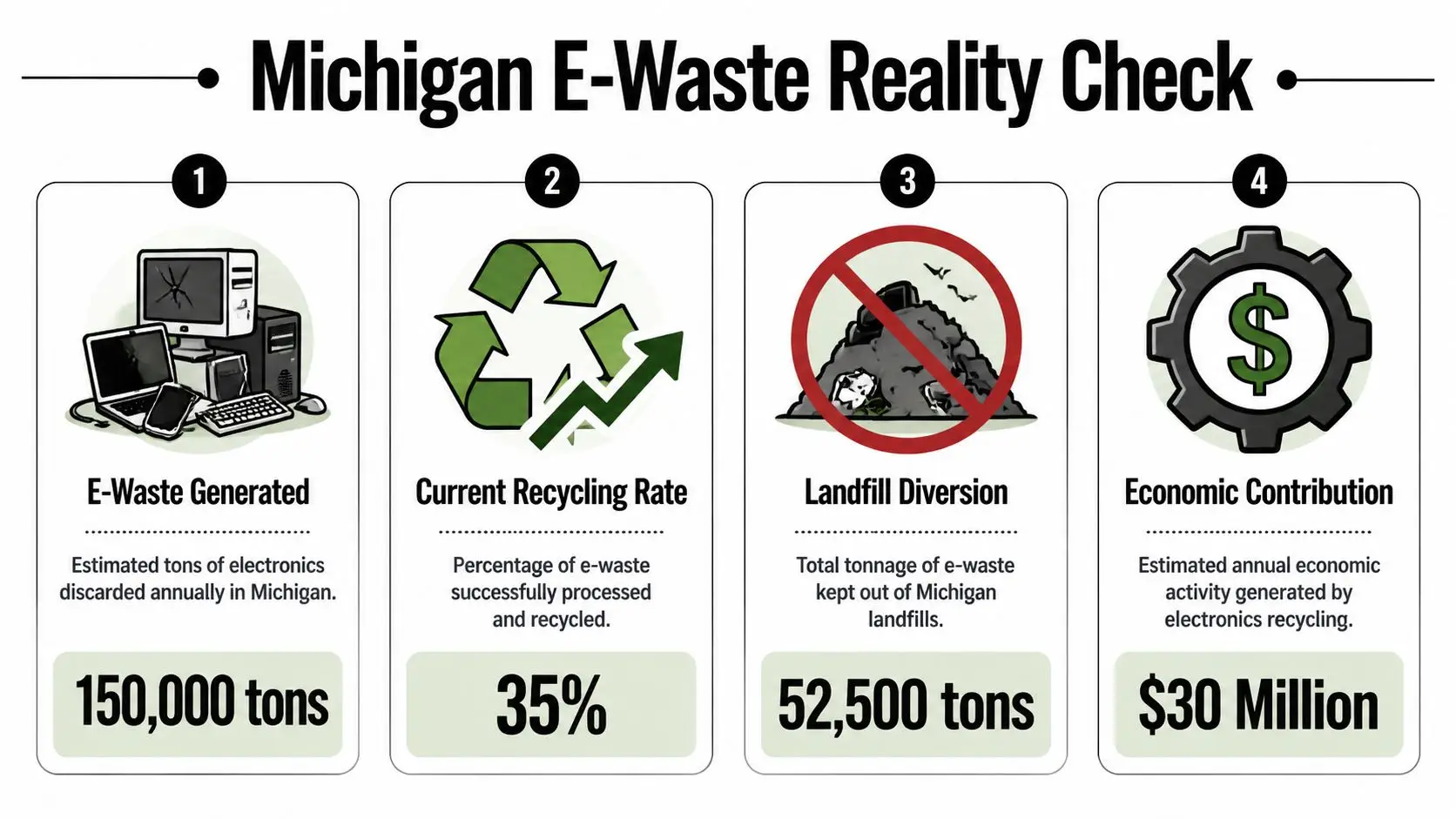
Those numbers match what many Michigan businesses see in practice. Old equipment stays in closets, warehouses, and back rooms longer than it should because the disposal option is cheap, while proper recycling takes planning, sorting, and sometimes budget approval.
That delay has a cost. Inventory gets less accurate. Chargers and docks separate from the devices they belong to. Pallets end up mixed with low-value peripherals, display equipment, and mystery boxes that nobody wants to open twice. A routine refresh turns into a project.
Coverage is another problem. Manufacturer takeback programs help with some common device categories, especially displays and certain core computing equipment. Business environments generate far more than that. Phones, tablets, switches, access points, printers, point-of-sale hardware, specialty electronics, and legacy peripherals often fall outside the easiest recovery channels or carry fees that were never in the original refresh budget.
This is the gap many generic recycling guides miss. The issue is not finding an outlet for a few standard laptops. The issue is finding one disposition plan for the entire mix, including the awkward assets that are not covered, not resale-worthy, or not worth shipping through multiple vendors.
Rural Michigan makes the gap wider. A company in metro Detroit may have local event access, denser vendor coverage, and shorter transportation routes. A manufacturer in Alpena, a hospital network serving northern counties, or a public agency in the Upper Peninsula deals with longer hauls, smaller loads, and fewer pickup options. That changes the economics fast. Equipment often sits until there is enough volume to justify a truck, which increases storage pressure and raises the odds of poor recordkeeping.
I see the same pattern across multi-site organizations. Urban offices can move retired assets out quickly. Rural sites become the holding locations for slow-moving, low-priority, or hard-to-classify equipment. Then corporate IT discovers that the oldest and least documented devices are concentrated in the places with the fewest practical recycling options.
That is why Michigan electronics recycling needs more than a drop-off list or a narrow manufacturer program. Businesses need a partner that can handle covered and non-covered devices, serve both dense metro routes and outstate locations, and process material in a way that supports environmental goals and community benefit. A social enterprise partner such as Reworx addresses that broader operational problem, especially for organizations that want one accountable outlet instead of a patchwork of exceptions.
Securely Preparing Your IT Assets for Disposition
The safest time to manage risk is before a device leaves your building. Once equipment is loaded onto a pallet or handed to a driver, you've already lost control of the physical asset. That's why preparation matters more than most organizations realize.
For business electronics, the baseline is straightforward. Use NIST-compliant sanitization methods before disposition. As summarized in Michigan e-waste guidance from Human-I-T, that can include 3-pass overwrite for hard drives or pulverization to less than 2mm particles for physical destruction, and the same source notes that the average data breach costs companies $4.45 million.

Start with inventory, not the truck
A rushed pickup is where mistakes happen. Devices go missing from records. Staff forget which laptop belonged to which employee. External drives get mixed into keyboard boxes. If you're planning an office cleanout or refresh, inventory should come first.
A workable prep sequence looks like this:
- Pull an asset list from your CMDB, endpoint platform, purchasing records, or fixed asset register.
- Physically verify what's on site.
- Tag exceptions such as damaged devices, missing drives, or unknown ownership.
- Separate by disposition path such as reuse, resale, recycling, or destruction.
- Lock the staging area until transfer.
This doesn't have to be elegant. It has to be accurate enough that no one wonders later whether a specific machine was retired, redeployed, or lost.
Match sanitization to the media
Deleting files isn't sanitization. Reimaging a machine isn't proof of data destruction. Formatting a drive isn't enough for regulated or sensitive environments. The method should fit the media type and the business risk.
Use a practical screen like this:
| Media type | Typical secure action |
|---|---|
| HDDs | NIST-aligned overwrite if the drive is healthy, or physical destruction if it isn't |
| SSDs | Validate that the method works for the device architecture, or destroy physically |
| Backup tapes | Controlled destruction rather than casual disposal |
| Mobile devices | Enterprise wipe, account removal, factory reset, then documented handoff |
| Failed storage media | Physical destruction because software wiping may not complete |
Businesses that need audited destruction records should use a provider offering secure data destruction services with documented chain of custody and clear downstream handling.
Field advice: If a drive can't be read reliably, don't assume it contains no recoverable data. Assume the opposite and destroy it accordingly.
The handoff checklist that prevents regret
Before release, confirm these items:
- Accounts removed: Sign out of device management, MDM, cloud sync, and activation locks.
- Media handled separately: Pull loose drives, backup media, and removable storage into their own controlled process.
- Labels reviewed: Remove or redact stickers that expose customer names, network details, or internal system references.
- Custody documented: Record date, quantity, device type, and receiving party.
- Certificates requested: Know what destruction or recycling documentation you'll receive and when.
Good disposition work is quiet. No surprises, no mystery pallets, no post-pickup scramble to figure out whether a machine with payroll data was properly sanitized.
Comparing Your Michigan Electronics Recycling Options
Michigan businesses usually choose among three disposal paths. Each can work. Each also has limits that become obvious once security, scale, and mixed equipment enter the conversation.
A broad improvement in recycling access is happening statewide. Michigan's recycling rate reached over 25 percent in fiscal year 2025, up from 14.25 percent before 2019, and EGLE projects the state could reach 30 percent by 2029. Support for that progress includes more than 333,000 new curbside carts in 34 communities, serving 1.2 million Michiganders, along with more than $11.8 million in grants, including over $4.6 million in Recycling Infrastructure Grants, as reported by American Recycler's coverage of Michigan's recycling progress. That's useful context, but business electronics still require a more selective decision.

Option one: Community drop-off sites and collection events
These are often the easiest entry point for very small quantities. If you have a handful of accessories, an isolated monitor, or a few low-risk peripherals, a local event can be convenient.
But the trade-offs are real:
- Security is limited: These programs usually aren't designed around enterprise chain of custody.
- Accepted items vary: One event may take printers and laptops, another may reject them.
- Bulk loads are awkward: Pallets of retired office equipment don't fit consumer-style drop-off well.
This path works best for small, low-risk, clearly accepted items. It works poorly for fleet retirements and regulated data environments.
Option two: Manufacturer takeback programs
These programs can reduce cost for covered categories. They make sense when your equipment mix aligns with what the manufacturer is obligated or willing to take back.
The challenge is scope. Programs often focus on select device classes, brands, or conditions. They may not help with mixed-brand lots, network hardware, accessories, damaged units, or everything that accumulates during a broader office cleanout.
Free isn't the same as complete. A no-cost path for some devices can still leave your team with the hardest half of the pile.
Option three: Certified recyclers and ITAD partners
This path is usually the most practical for businesses with real volume, sensitive data, or mixed asset types. A capable ITAD provider can combine pickup, documented data destruction, sorting, refurbishment, resale, and downstream recycling in one managed process.
The cost profile may be different from a public drop-off event, but so is the level of control. That's often worth it when your project includes servers, user devices, storage media, networking gear, or equipment spread across several sites. For West Michigan organizations evaluating local service options, electronics recycling in Grand Rapids, Michigan is one example of a business-oriented route.
A side-by-side decision view
| Option | Best for | Main weakness |
|---|---|---|
| Community drop-off | Small quantities, low-risk items | Limited security and inconsistent acceptance |
| Manufacturer takeback | Covered devices from eligible programs | Narrow scope and little flexibility |
| Certified ITAD provider | Bulk business assets and sensitive equipment | Requires more planning and may involve service cost |
The right answer depends on the inventory. Many businesses end up using more than one path. The mistake is expecting a consumer recycling option to perform like a business ITAD program.
The Reworx Advantage Sustainable ITAD as a Social Enterprise
Most recyclers can remove equipment. Fewer can help a business turn disposition into a credible part of its sustainability story. That's where the social enterprise model changes the conversation.
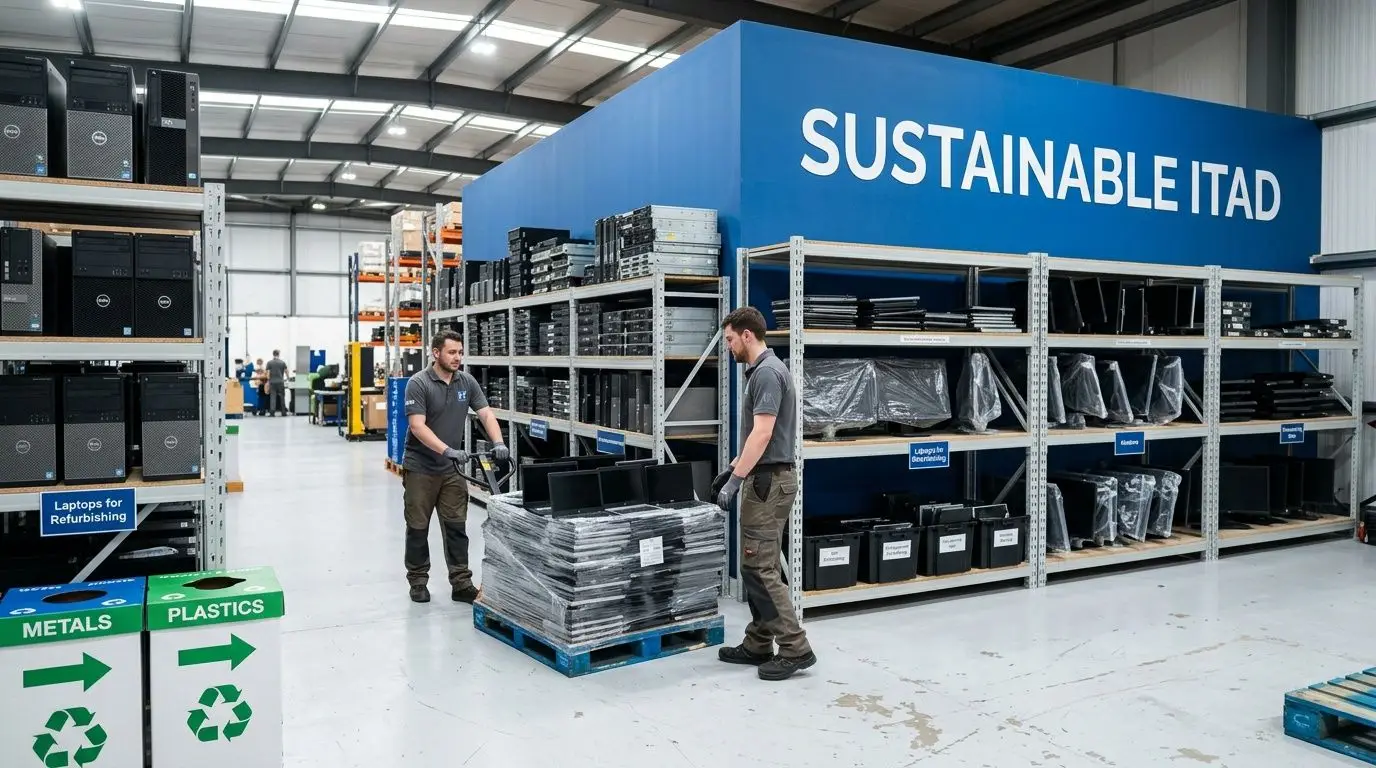
A standard recycling transaction ends when the pallet leaves and the paperwork closes. A donation-based, refurbishment-oriented model asks a better question. Which assets need destruction, and which ones can be repaired, redeployed, or donated after proper processing? For companies trying to tie IT asset disposition to ESG, CSR, or community impact goals, that distinction matters.
Why this model resonates with business leaders
A sustainability director wants landfill avoidance and reporting discipline. An IT manager wants secure sanitization and a clean chain of custody. A business owner often wants both, plus a practical answer to "What good comes from this besides compliance?"
That is the appeal of a social enterprise partner. Retired equipment doesn't have to be framed only as waste. Some of it can become useful technology for nonprofits, workforce programs, and people who lack reliable access to devices. The environmental benefit remains. The social outcome becomes visible.
The result is a stronger internal narrative:
- For IT: Assets left the environment securely and predictably.
- For sustainability: Reuse was prioritized where appropriate.
- For leadership: The project supports community benefit, not just disposal.
- For communications teams: There is a concrete story behind the recycling line item.
What that looks like in a real program
Donation-based recycling still requires rigor. Devices need intake review, data handling controls, triage, testing, and clear separation between reusable and non-reusable assets. The mission doesn't replace process. It gives process a broader purpose.
One option in this category is partnering for impact through Reworx, which presents a model built around electronics reuse, recycling, and community benefit. For businesses, the practical appeal is that socially beneficial outcomes can sit alongside standard ITAD needs such as pickup coordination, secure disposition, and responsible downstream handling.
A good ITAD partner reduces risk. A good social enterprise ITAD partner can also give your retired equipment a second life where that outcome is appropriate.
Where this approach works best
This model is especially useful for:
- Corporate refresh cycles where a portion of laptops or desktops still has reuse potential.
- Multi-site cleanouts where leadership wants a unified environmental and social impact narrative.
- Public sector and education clients that need disposition discipline and visible community alignment.
- CSR-driven companies looking to connect asset retirement with digital inclusion goals.
For many Michigan organizations, especially those modernizing device fleets or consolidating facilities, that combination is more compelling than a disposal-only relationship.
Beyond Laptops ITAD for Complex Business Needs
Business e-waste rarely stops at desktops and monitors. Once a company starts cleaning up legacy equipment, the list expands fast. Rack servers, switches, firewalls, storage arrays, VoIP hardware, copiers, scanners, lab instruments, and specialty medical devices all show up in the same project. That's why a mature ITAD plan has to scale beyond routine computer recycling.
Data center work requires discipline
Data center decommissioning is logistics-heavy and mistake-sensitive. Teams need a sequence for shutdown, asset identification, drive handling, rack removal, packing, transport, and final reporting. If one step gets skipped, you can lose equipment visibility or create a data risk.
The smartest approach is controlled staging, labeled assets, and documented handoff by cabinet, room, or project phase. For organizations planning this kind of work, a server decommissioning checklist helps structure the process before vendors arrive on site.
Facility cleanouts are usually mixed-stream projects
Office relocations and facility closures create a different challenge. IT equipment comes out alongside miscellaneous electronics, damaged peripherals, old AV gear, and hardware from departments that haven't inventoried anything in years. Facilities wants the space cleared. IT wants proof that nothing sensitive left unmanaged.
That tension is normal. The fix is to separate the project into streams: data-bearing devices, reusable assets, scrap-only electronics, and specialty equipment requiring custom handling. One vendor can manage it, but only if they understand both logistics and asset control.
Bulk removal is the easy part. The hard part is preserving accountability while the volume moves quickly.
Specialty equipment changes the rules
Medical and laboratory equipment often require extra review because they may contain sensitive data, embedded storage, proprietary components, or regulated materials. Product destruction introduces another layer. If you're disposing of prototypes, recalled devices, or branded hardware that shouldn't re-enter the market, your vendor needs a controlled destruction process, not just a recycling dock.
Single-vendor simplicity offers immense value in these situations. When one partner can coordinate secure data destruction, office cleanout support, equipment decommissioning, and downstream recycling, your team spends less time managing handoffs and exceptions.
Frequently Asked Questions about Business E-Waste
Is business electronics recycling in Michigan always free
Usually not.
Some public drop-off programs and manufacturer takeback options accept certain covered devices at no charge, but business recycling rarely fits that narrow model. Michigan companies often need pickup service, chain-of-custody documentation, data destruction, palletization, or handling for equipment that falls outside consumer-focused programs. Pricing typically comes down to volume, device mix, site access, and security requirements.
What if we have equipment that manufacturer programs won't accept
That problem shows up often, especially for Michigan organizations managing older inventories or operating outside major metro areas. As noted earlier, a large share of devices collected through recycling channels do not fit manufacturer-covered categories.
Phones, tablets, network gear, point-of-sale equipment, cables, small peripherals, and legacy electronics are common examples. If your team has those items, you need a recycling or ITAD partner that will take mixed loads instead of cherry-picking only the easy devices.
Can one vendor handle office cleanouts, drives, and specialty devices
Yes, if the provider is set up for more than basic pickup.
Ask direct questions. Can they destroy data-bearing assets and document the result? Can they sort reusable equipment from scrap on the same project? Can they manage specialty devices without handing part of the job to an unknown downstream processor? Those answers matter more than a general promise to "recycle electronics."
How should we get started
Start with a simple internal list. Count the asset types, note which items store data, identify any rural locations that may need consolidated pickup, and flag equipment that cannot go through a manufacturer return program.
Then choose a partner that can handle security, logistics, and downstream accountability in one process. If your company wants responsible recycling paired with reuse and workforce impact, Reworx Recycling is one practical place to review next steps.
If your business is ready to clear a storage room, retire aging hardware, or organize a larger disposition project, Reworx Recycling offers a practical next step. Their recycling resources can help your team assess donation-based recycling, schedule pickup, and build a disposition plan that supports secure handling, reuse, and community benefit.