
It usually starts with a ticket that looks small. A branch office complains about unstable calls, a finance lead asks why two locations are on different contract terms, and the cloud team reports that one aging circuit is now the bottleneck for Microsoft 365, VoIP, and VPN traffic. By the time leadership asks for quotes, the actual project is no longer just internet service. It is network design, carrier selection, migration timing, risk control, and cleanup of the hardware left behind.
Atlanta gives buyers real choice, which is good for procurement and difficult for evaluation. As noted earlier in the article, the city stands out for dense connectivity, major carrier presence, and strong access to regional and long-haul fiber. That means several providers can look qualified in an RFP, even though they differ in where they perform best, how they price risk, and how well they handle multi-site cutovers.
Start with the operating requirement, not the provider brand. A small branch may only need business broadband with a practical backup option. A headquarters, contact center, or production site may need dedicated internet, cleaner latency, route diversity, and an SLA that means something when an outage affects revenue. Those distinctions narrow the field faster than any marketing comparison chart.
Atlanta’s carrier density also changes how smart buyers structure projects. In this market, businesses can often mix providers by site, separate primary and failover access, or build around data center and cloud on-ramps instead of forcing every location into one contract model. That flexibility helps, but it also raises the stakes on migration planning. Ordering the circuit is the easy part. Coordinating installs, firewall changes, voice cutovers, testing windows, and rollback plans is where projects succeed or fail.
There is another procurement issue that deserves attention early. Telecom refreshes leave equipment behind, including routers, switches, handsets, UPS units, wireless gear, and older security appliances. Teams that plan for IT asset disposition services in Atlanta for corporate IT teams during the migration avoid a common mess at the end of the project, where retired hardware sits in storage with no clear chain of custody or disposal process.
This guide compares seven Atlanta telecom providers through that full lifecycle. The goal is not just to show who sells connectivity, but to help Atlanta IT leaders choose the right fit, stage the migration with fewer surprises, and close out the project responsibly once legacy equipment comes off the network.
1. AT&T Business
A common Atlanta scenario looks like this. Headquarters needs dedicated internet with an SLA, two branch offices need lower-cost fiber where available, and leadership wants wireless backup and mobility under the same provider relationship. AT&T usually makes the shortlist in that kind of rollout because it can cover more than a single circuit order.
AT&T fits best when the project is bigger than basic internet access. For a small office with a clean serviceable address, AT&T Business Fiber may be enough. For multi-site organizations, the value is the ability to line up dedicated internet, Ethernet, SD-WAN, managed security, and wireless backup under one carrier. That matters when the business wants fewer vendors to manage and a cleaner escalation path during outages or cutovers.
As noted earlier, Atlanta benefits from strong incumbent carrier infrastructure in many business corridors. That is one reason AT&T appears in both straightforward office procurements and more formal enterprise RFPs.
Where AT&T fits best
AT&T is a practical choice for companies trying to standardize service across locations with different site conditions. One branch may qualify for fiber quickly. Another may need a dedicated circuit. A third may need fixed wireless or cellular failover on day one. If your team wants one provider that can support those variations without rebuilding the sourcing process for each site, AT&T is worth close review.
A few situations where AT&T tends to make sense:
- Multi-site operations: Good fit for firms that want broad metro coverage and the option to add managed networking later.
- Mixed service requirements: Useful when one provider needs to support internet access, transport, security, and mobility.
- Branch standardization: Helpful for IT teams that need a repeatable design, even when sites have different building constraints.
The trade-off is complexity. AT&T gives buyers more design options than many competitors, but that also means quotes can be harder to compare if requirements are loose. Shared broadband, dedicated internet, Ethernet, and failover can all look reasonable on paper while carrying very different install intervals, SLAs, and operational risk.
My advice is simple. Force precision early. Ask AT&T to document the handoff type, term length, SLA, construction assumptions, managed CPE scope, and failover method in the quote package. That step prevents a lot of confusion once procurement, networking, and local site contacts all start reading the order differently.
For call centers, healthcare administration, financial operations, and other uptime-sensitive environments, push the discussion toward dedicated internet and tested failover design early. For a smaller office that needs stable symmetric service and can tolerate a lighter SLA, business fiber may be the better cost decision.
AT&T also works well in a full lifecycle migration plan. Circuit upgrades often trigger router, firewall, switch, or voice edge replacement. If you know gear is coming off the network, include chain-of-custody and business data destruction services in Atlanta in the project plan before cutover weekend. That keeps retired hardware from piling up in a closet after the telecom work is finished.
For product details and address qualification, start with AT&T Business in Atlanta.
2. Comcast Business

Comcast Business is often the fastest path to getting a site online in Atlanta, especially for small and midsize offices in buildings that are already on-net. If you need practical service, not a six-month design exercise, Comcast belongs on your shortlist.
I usually see Comcast work well for firms that need a quick install, straightforward business internet, and optional voice or managed WiFi without moving into a heavy enterprise procurement process. It’s also common as a secondary circuit, especially when the primary is on a different access type.
What Comcast does well
Comcast’s biggest advantage is deployment simplicity in the right building. For a law office, accounting firm, clinic, retail footprint, or satellite office, that can outweigh the theoretical benefits of a more customized carrier design.
Its portfolio also spans more than many buyers realize. You can start with cable-based business internet and move up to fiber-based dedicated internet or Ethernet if a location becomes more critical.
A few practical reasons buyers choose Comcast:
- Fast activation path: On-net buildings often move faster than fiber builds that require new construction.
- Good fit for SMB operations: Static IP options, voice, and managed WiFi cover the basics without overengineering the site.
- Useful redundancy option: Comcast can serve as a secondary path when the primary carrier is fiber-based.
Where buyers get tripped up
Shared broadband is still shared broadband. That doesn’t make it bad. It just means you need to match it to the site’s role. If the office depends on predictable low-latency performance or runs sensitive cloud workloads all day, cable tiers can become a limitation.
That’s where I see teams make the wrong call. They buy the most convenient service for a location that has gradually become mission-critical.
Comcast is strong when speed to install and building availability matter more than custom network architecture.
There’s also a lifecycle issue that shows up during Comcast migrations. Replacing gateways, phones, and old edge gear can leave storage closets full of devices that still hold configuration data. Before you hand equipment to facilities or general recycling, build a disposal plan that includes secure data destruction services in Atlanta.
For service options and enterprise discussions, use Comcast Business.
3. Verizon Business

A lease is signed, staff start dates are set, and the WAN order is still stuck behind building access and construction approvals. That is the kind of Atlanta rollout where Verizon Business gets serious attention. It solves a different problem than a traditional wireline carrier. The value is speed, mobility integration, and a second path that is physically separate from your primary circuit.
For buyers managing multiple branch types, Verizon is often less about replacing fiber and more about reducing business delay. I use it most often in three situations: getting a new site online before the fixed circuit is ready, adding wireless failover to protect cloud and voice uptime, or supporting temporary locations that do not justify a long construction cycle.
That makes Verizon a procurement and migration decision, not just a carrier comparison.
Where Verizon fits best in Atlanta
Verizon’s strongest use case is the site that needs connectivity now and can tolerate some performance variability. Retail locations, field offices, sales branches, clinics, and short-term project spaces often fit that profile. A wireless primary can be perfectly reasonable if the application mix is light to moderate and the cost of waiting is higher than the downside of using radio access.
It also works well as part of a layered design:
- Fast activation for time-sensitive sites: Useful when business operations cannot wait for fiber construction or landlord coordination.
- True path diversity for backup: Wireless failover avoids the shared conduit and last-mile risks that affect two wired providers in the same building.
- Clean fit with mobile-heavy organizations: One provider for smartphones, hotspots, and site connectivity can simplify support and billing.
The trade-off is straightforward. Performance depends on signal quality, cell loading, and how the building handles indoor coverage. I have seen one suite perform well and another floor in the same property need external antenna work or a different router placement to stabilize service.
What buyers should validate before signing
Do not treat 5G business internet as interchangeable with dedicated fiber for a core office, call-heavy site, or location with constant large file movement. Test the address. Review peak-hour behavior. Ask how the service will be installed inside the suite, what hardware is included, and how failover is handled if this circuit will back up an existing firewall.
Those details matter more than the headline speed.
Verizon can be the right answer when the business priority is launch speed, continuity, or branch flexibility. It becomes the wrong answer when teams skip site testing and assume wireless will behave like a fixed enterprise circuit under all conditions.
There is also a lifecycle issue that gets missed during these rollouts. A Verizon deployment often retires old routers, hotspots, handsets, and small-office PCs that still contain credentials, configs, or user data. Build that cleanup into the migration plan and decide what Atlanta businesses should do with old computers before the cutover creates another pile of unmanaged equipment.
Review current offerings at Verizon Business 5G internet.
4. GFiber (Google Fiber) for Small Business
A small Atlanta office signs a lease, needs internet live fast, and does not want a six-week carrier negotiation over add-ons it may never use. That is the kind of buying situation where GFiber usually enters the shortlist quickly.
GFiber is easy to recommend when the address qualifies and the goal is fast, symmetrical business internet without a layered enterprise contract. For small offices, startups, agencies, and professional services firms, that simplicity has real value. Procurement goes faster. Billing is easier to review. Internal IT spends less time sorting through bundled options that do not matter to the site.
I usually point buyers to GFiber when they want a clean access decision, not a broad telecom package. If your team already has its own firewall, collaboration stack, and security tools, a simpler connectivity product can be the better fit.
Why GFiber wins some deals
The main advantage is clarity. Buyers can evaluate the service without comparing a long list of managed features, hardware line items, and contract extras. That makes GFiber a practical option for businesses that want reliable fiber access and have no reason to turn a small office into a carrier engineering project.
It also fits lean IT teams well. Included equipment and a more straightforward deployment model can reduce day-one coordination, especially at sites where the priority is getting staff online with minimal friction.
A few points tend to matter during evaluation:
- Straightforward pricing: Easier for finance, operations, and office managers to approve.
- Symmetrical fiber service: A better match for video meetings, cloud backups, shared file work, and upload-heavy workflows.
- Less pressure to bundle services: Useful when you want internet service without wrapping voice, mobility, and managed security into the same agreement.
Where GFiber falls short
Address availability is still the first checkpoint. Some buildings qualify cleanly. Others do not. In multi-site planning, that means GFiber works best as a site-by-site option rather than the foundation of a standardized WAN strategy.
Feature depth is the second limit. Organizations that need managed SD-WAN, custom security design, complex escalation paths, or stronger support for larger branch networks will usually get more from the larger telecom providers covered earlier in this list. As noted earlier, Atlanta supports a wide range of business environments, from small offices to infrastructure-heavy enterprise sites. GFiber fits one part of that market very well, but it is not the right answer for every office type.
There is also a lifecycle step buyers often miss. A GFiber cutover often happens at the same time as a wider office refresh. Old laptops, desktops, access points, and small switches come out of service once the network is upgraded. Before that equipment piles up in a closet, build disposition into the project plan and review how Atlanta businesses can get money for old electronics. That is the difference between a clean migration and one more deferred cleanup task.
Check business availability through GFiber.
5. Lumen Technologies

A common Atlanta scenario looks like this. The business has outgrown basic internet at the branch, cloud traffic is rising, one or two sites now matter far more than the rest, and the network team needs cleaner connectivity into data centers and major platforms. That is where Lumen usually enters the shortlist.
Lumen fits buyers who are designing around enterprise traffic patterns, not just ordering a faster circuit. Dedicated internet, Ethernet, cloud connectivity, managed security, and SASE-related planning are all part of the conversation. For multi-site companies, public sector organizations, and firms with a few high-impact locations, that broader scope matters.
Atlanta makes that more relevant because the city supports a large concentration of data center and interconnection activity, as noted earlier in the article. If your WAN strategy includes office-to-colo traffic, regional aggregation, or cloud access that needs tighter control, Lumen is often a more practical fit than a provider built mainly for standard business broadband.
Where Lumen makes sense
I usually point clients toward Lumen when the site has strategic weight. Headquarters, core operations centers, data center-connected offices, and regional hubs are the clearest examples. In those environments, the buying decision is less about monthly rate and more about design quality, handoff options, support for future architecture, and how the carrier fits the rest of the network.
That trade-off is real. Smaller offices often do better with a simpler product and a faster install path. Lumen tends to make more sense when the connection supports something bigger, such as centralized security policy, cloud edge design, or a migration away from legacy MPLS into a more flexible WAN model.
What to watch before you sign
The challenge with Lumen is rarely raw capability. It is fit.
Sales cycles can run longer than many mid-market teams expect because quotes are often custom and technical choices affect both deployment and operations. Ask direct questions early: What is the demarcation? What handoff type is included? How will failover work? Which parts of the design sit with your team versus Lumen support? Those details decide whether the service will be easy to operate six months after install.
A practical screen helps:
- Use Lumen for strategically important sites: Core offices, cloud-heavy locations, and facilities tied to data center or regional traffic flows.
- Check the operating model, not just the circuit: Confirm who owns routing, security layers, escalation, and change control after turn-up.
- Match the contract to the migration plan: If the business expects office moves, network consolidation, or cloud re-architecture, lock that into the buying process before signatures.
One more point gets missed in telecom projects. Carrier migrations often happen alongside firewall refreshes, switch replacements, and server or endpoint retirement. If a Lumen deployment is part of a broader infrastructure change, review how Atlanta businesses can recover money for old electronics before retired equipment gets stacked in storage. That step connects procurement, migration, and end-of-life handling, which is how these projects should be managed.
For enterprise networking options, visit Lumen Technologies.
6. Zayo Group
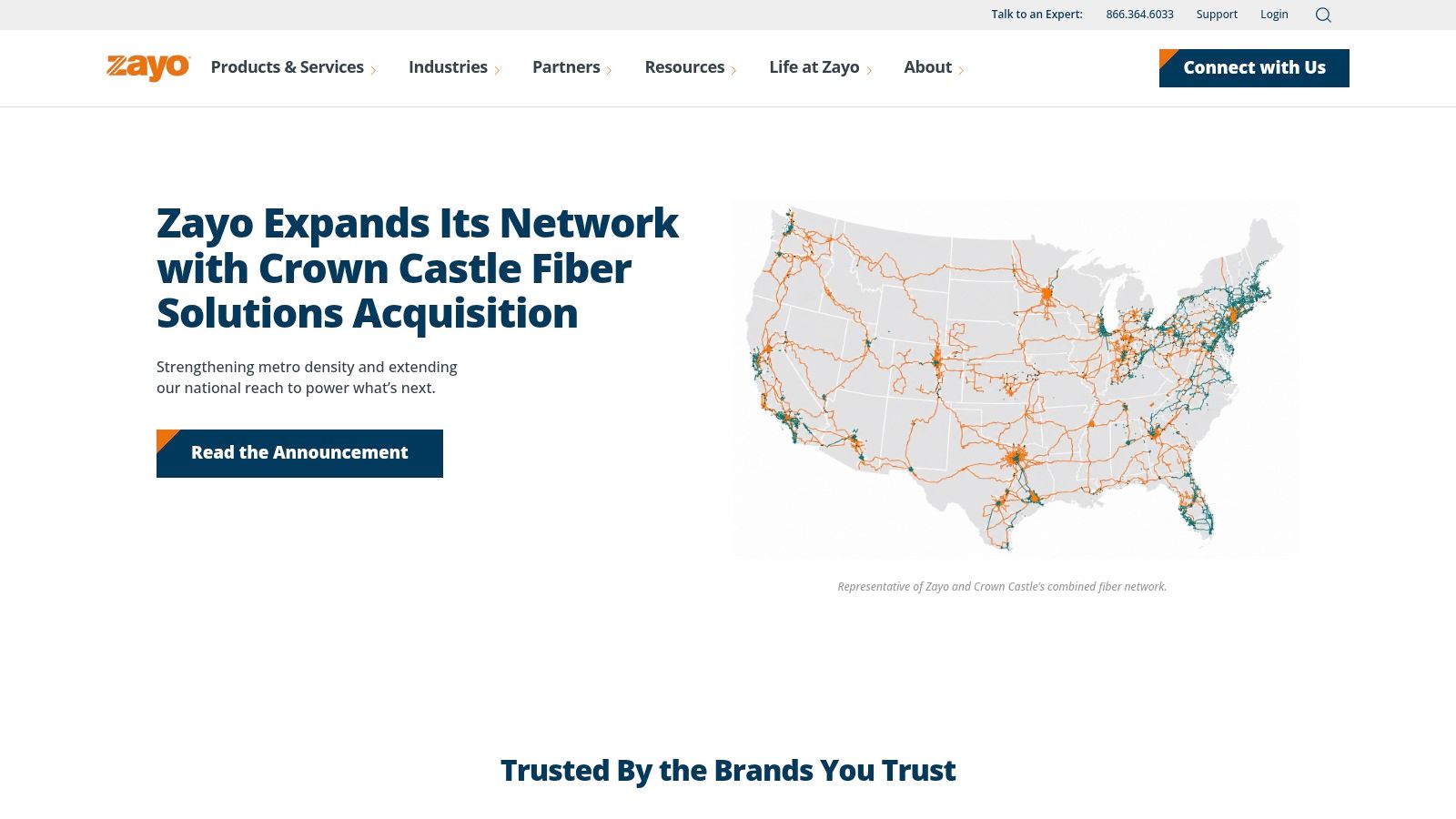
If your organization cares about fiber route control, dark fiber, custom laterals, or serious bandwidth planning, Zayo moves into a different category from mainstream business internet providers. This is the kind of carrier I think about for campuses, data center operators, media workflows, research environments, and enterprise teams that need route diversity they can engineer around.
Zayo isn’t built for every buyer. It’s built for buyers who know why pathing, interconnection, and custom fiber matter.
Why Zayo stands out in Atlanta
Atlanta’s role as a major bandwidth and interconnection hub makes a carrier like Zayo more relevant here than in smaller markets. The city serves as a major nexus for internet, voice, and data traffic across the Southeast, and all major telecom services are available in the central business district, according to the previously cited connectivity report.
That backdrop favors carriers that can support custom transport designs rather than only standard internet access. If your team needs dark fiber between facilities, wavelength services into a carrier hotel, or route-diverse transport to support low-latency applications, Zayo is worth the conversation.
Practical buying guidance
The mistake I see with Zayo is not technical. It’s organizational. Smaller companies sometimes reach for it because they want “the best fiber” without a clear use case. Then they end up in a more complex procurement than they needed.
Use Zayo when one of these is true:
- You need route diversity by design: Not just a backup link, but controlled path planning.
- You operate high-capacity sites: Data-heavy facilities, production environments, or interconnect-rich campuses.
- You need custom builds: Standard broadband products won’t solve the business problem.
If none of those apply, a more conventional provider will likely get the job done with less effort. But when they do apply, Zayo can be exactly the right fit.
One more operational point matters in Atlanta. Existing telecom coverage often lists providers and circuits but skips the downstream effect of network upgrades on hardware retirement. That gap has been called out in industry commentary on dedicated internet access in Atlanta, especially for schools, SMBs, and public facilities that replace legacy gear during fiber transitions. In real projects, that means your network design and your disposal plan should be scoped together.
For carrier and fiber solutions, see Zayo Group.
7. FiberLight
A common Atlanta scenario looks like this. The primary circuit is stable, the backup circuit is installed, and both connections still fail under the same street-level outage because the paths were never separate. FiberLight tends to enter the conversation when your team wants to avoid that mistake before signing a contract.
FiberLight fits buyers who need dedicated fiber internet, Ethernet, dark fiber, or point-to-point transport and care about how the service is built across the metro. That usually includes school systems, public agencies, healthcare groups, multi-site enterprises, and organizations with sites that cannot afford vague answers on route design.
Where FiberLight can be a smart choice
FiberLight is strongest when procurement and engineering need to stay tightly connected. If your RFP includes last-mile diversity, inter-site connectivity, or a custom metro design, local route knowledge matters. In Atlanta, building access, conduit availability, and overlapping carrier infrastructure often decide whether a secondary circuit is real protection or just a second bill.
This is also where FiberLight stands apart from simpler business internet products. The buying process may take more coordination, but the result can be better aligned to the actual risk at the site, especially for facilities with uptime requirements, shared campuses, or traffic moving between locations instead of only to the public internet.
As noted earlier in the article, Atlanta’s broader infrastructure buildout continues to increase demand for fiber capacity. For IT leaders, that has a practical consequence. Network upgrades often trigger refresh decisions for firewalls, optics, edge switches, legacy CPE, and retired backup gear.
The trade-off to understand
FiberLight is usually not the low-friction option for a small office that only needs basic internet access. Serviceability still depends on where the building sits relative to FiberLight’s network, and the evaluation process is more detailed than ordering a bundled plan from a large incumbent.
That extra effort can be worth it when path diversity, custom transport, or site-to-site performance matters more than getting the fastest quote turnaround.
One procurement mistake shows up often. Teams compare monthly recurring cost and ignore construction assumptions, handoff type, repair terms, and whether the backup path shares any physical dependency with the primary carrier. Ask for route maps where possible. Ask who owns the lateral. Ask what changes if the building manager restricts entry or riser access after contract signature.
The lifecycle piece matters too. Fiber projects rarely stop at circuit turn-up. Schools, nonprofits, and public entities often retire modems, routers, donated endpoints, and old edge equipment during migrations. Public discussion of broadband deployment often focuses on access gains, while the disposal work gets pushed to the end. That concern comes up in guidance on rural and community broadband deployments, and the same planning issue applies in Atlanta. If your migration will strand older hardware, include end-of-life handling in the project scope from day one, whether that means internal asset tracking or coordinating with a local social enterprise such as Reworx Recycling.
For network offerings and coverage discussions, visit FiberLight.
Atlanta Telecom: 7-Provider Comparison
| Provider | 🔄 Implementation complexity | ⚡ Resource requirements | ⭐ Expected outcomes | 💡 Ideal use cases | 📊 Key advantages |
|---|---|---|---|---|---|
| AT&T Business | Medium, address qualification and plan selection required | Multi‑gig fiber or shared tiers; managed services and wireless backup available | ⭐⭐⭐⭐, broad coverage and SLA options for mission‑critical apps | Wide SMB to large enterprise deployments needing integrated services | Broadest wireline footprint, multi‑gig tiers, SLAs, local field support |
| Comcast Business | Low–Medium, fast for on‑net installs; coax options simpler | Coax broadband (shared) to fiber/Dedicated Ethernet; managed Wi‑Fi options | ⭐⭐⭐, good throughput; shared tiers may affect latency/consistency | Rapid installs in on‑net buildings and general SMB use | Rapid deployment, large metro density, broad product portfolio |
| Verizon Business | Low, quick turn‑up for wireless; simple provisioning | 5G/LTE hardware; dependent on local signal strength; static IP on select tiers | ⭐⭐⭐, fast deployment; variable performance based on coverage | Temporary sites, wireless backup, primary when fiber unavailable | Fast turn‑up, good wireless redundancy and mobility |
| GFiber (Google Fiber) | Low, simple plans and straightforward installs | Symmetrical fiber (1–2 Gbps); included Wi‑Fi6E router; flat pricing | ⭐⭐⭐⭐, high symmetrical speeds with transparent billing | SMB offices that want simple, predictable fiber service | Flat‑rate pricing, included equipment, quick installs |
| Lumen Technologies | High, custom quotes and longer procurement cycles | Enterprise DIA/Ethernet/wavelengths; cloud on‑ramps and managed services | ⭐⭐⭐⭐, enterprise SLAs and cloud interconnects for critical workloads | Multi‑site enterprises, public sector, cloud‑centric customers | Deep long‑haul/metro fiber, strong cloud/colo interconnects |
| Zayo Group | High, custom dark fiber builds and route planning | Dark fiber, high‑capacity wavelengths (400G/800G), build fees may apply | ⭐⭐⭐⭐⭐, exceptional capacity, control and low latency where available | Data centers, media, research campuses, high‑bandwidth needs | Dense metro fiber, route diversity, high‑capacity wavelength options |
| FiberLight | Medium, availability tied to local laterals; planning needed | Dedicated fiber, Ethernet, dark fiber; local route maps for diversity | ⭐⭐⭐⭐, strong for custom metro builds and resilient routing | Enterprises, data centers, education and public sector projects | Atlanta‑centric routes, competitive custom builds, local right‑of‑way knowledge |
From Migration to Responsible IT Asset Disposition
It is 8:30 a.m. on cutover day. The new circuit is lit, the carrier says the handoff is clean, and your team is still waiting on building access to the MDF while someone hunts down the spreadsheet with the old PRI details. That is how telecom migrations drift off schedule. The provider choice matters, but execution is what determines whether the change improves operations or creates a week of avoidable disruption.
Treat the migration as a cross-functional project with a closeout plan from day one. Document the current environment before any disconnect request goes out. Confirm demarc locations, rack space, power, cross-connect requirements, and who controls site access. Set cutover windows that fit business operations, not just carrier availability. For voice, assign one owner for number porting and escalation. For network changes, test firewall rules, VPN dependencies, SD-WAN policies, and failover behavior before production traffic moves.
Atlanta adds another layer. As noted earlier, the region is growing fast as a connectivity and data center market, which means high demand for fiber, colo space, skilled field resources, and replacement hardware. In practice, that affects lead times, scheduling, and the amount of retired equipment a migration leaves behind.
That last piece gets missed in a lot of provider roundups.
A circuit upgrade often triggers broader changes across the environment. Teams replace routers that cannot support the new handoff, decommission voice gear tied to the old carrier, retire access switches, and pull laptops or endpoints from a site refresh happening at the same time. If those assets sit in a closet without inventory control or leave the building through an informal disposal process, the project ends with unnecessary security, compliance, and audit risk.
A better approach is to attach IT asset disposition to the migration work order. List every device leaving service. Record serial numbers, assigned users, storage media, and expected disposition path. Decide early which assets can be reused, which have resale value, and which need certified destruction. If the project includes servers, phones, firewalls, laptops, wireless gear, or storage devices, chain of custody needs a named owner.
Reworx Recycling fits into that final stage for Atlanta organizations that need electronics recycling, secure data destruction, IT equipment disposal, and pickup support during a telecom or infrastructure transition. As a metro-based social enterprise, Reworx can support office cleanouts, computer recycling, laptop disposal, product destruction, and broader ITAD requirements tied to network upgrades and facility changes.
There is also a business case beyond risk reduction. Responsible end-of-life handling supports sustainability reporting, donation programs, and local workforce impact. For IT leaders working with facilities, finance, compliance, and ESG stakeholders, disposal should be treated as part of the project scope, budget, and timeline.
If your migration includes old WAN equipment, branch hardware, decommissioned endpoints, or surplus devices from a site closure, handle the exit with the same discipline you apply to the install. Keep the carrier project on track, protect company data, and document where every retired asset went. For baseline guidance on compliant disposal practices, the EPA information on electronics donation and recycling is a useful reference.
If your organization is upgrading telecom services in Atlanta, do not stop at circuit activation. Use Reworx Recycling to plan electronics recycling, secure data destruction, IT equipment disposal, and pickup support for the routers, phones, laptops, and network gear your migration leaves behind.