You pulled the recalled laptops off the shelf last week. The pallets are labeled, sales is frozen, and someone wants a certificate so the file can close. A signed page that says the units were destroyed is not the same thing as a closeout an auditor will accept.
In the first quarter of 2024, U.S. companies recorded 909 recalls across five major industries, according to Sedgwick's U.S. Recall Index as reported by Foley & Lardner. That volume is why a certificate of destruction for recalls has to do more than look official. It has to reconcile every unit on the recall list to a destruction line, a date, a method, and a named person.
I would treat the certificate as one exhibit in the recall file, not the file itself. The test that makes it defensible is unit-level reconciliation.
What a Certificate of Destruction Must Contain
A Certificate of Destruction is a formal chain-of-custody record used to prove that recalled products were removed from commerce and destroyed through an approved method. The CPSC Recall Handbook tells retailers and distributors to keep recalled products separate, clearly label boxes and pallets, keep them out of salvage, and request a certification of destruction after off-site disposal. For on-site destruction, the CPSC recommends an affidavit or signed statement that names the recalled product, the quantity destroyed, and the destruction date. The employee who did the work and a witness should both sign.
That makes the certificate more than a receipt. It links a recalled model or lot to a quantity, a date, a method, responsible people, and a verification step. The CPSC may also witness destruction or ask for other proof before disposal proceeds. For electronics, fold in serial inventories, photographs, transport records, and the downstream recycler's records. Recalled goods shouldn't merely be moved. You have to show the identified units were controlled and permanently kept out of resale or reuse.
Fields an auditor will actually test
Each field answers a question an auditor asks out loud. Check the row before you accept a template, and match it against our certificate requirements so a draft fails on your desk, not in the audit room.
| Field | What It Proves | Evidence to Attach |
|---|---|---|
| Recall number and notice reference | Certificate belongs to a specific recall | Copy of CPSC or FDA recall notice |
| Product model, SKU or code | Destroyed items match the recalled population | Product labels, packing lists |
| Lot or serial range | Each unit is tied to the recall inventory | Serial reconciliation sheet |
| Quantity destroyed vs. quantity recalled | No units are unaccounted for | Inventory count before and after destruction |
| Destruction date and location | The event happened when and where stated | Dated photos, facility address |
| Method of destruction | The product could not be resold or reused | Vendor work order or on-site procedure |
| Performer and witness signatures | Named people are accountable | Signed affidavit or statement |
| Chain of custody | Products stayed controlled until destruction | Transport manifests, pickup receipts |
| Inventory adjustment | Records reflect the destruction | Updated inventory system entry |
Attach evidence, not adjectives. Dated photos of sealed pallets, a manifest, and the recycler's receipt beat a line that says “securely processed.”
Practical rule: If you can't trace every unit on the recall list to a destruction line, the certificate isn't ready to sign.
Why the certificate doesn't close the recall
A polished certificate generally doesn't prove a recall is legally closed. FDA guidance expects firms to propose the destruction method, notify the agency before destroying or reconditioning recalled goods, and keep adequate destruction records even when an investigator doesn't witness the work. The recall stays open until the product is brought into compliance or disposed of acceptably. CPSC coordination is tighter still. Destruction or disposal may need prior agency contact, and CPSC may require an in-person witness, an affidavit, or photographic verification. Off-site, that means written instructions to the vendor, segregation from other goods, and clear pallet and box markings before anyone issues a certificate.
Say a district destroys 412 laptops under a battery recall, but the certificate says “approximately 400” and lists no serial range. The auditor can't tell whether twelve units went to salvage, stayed in a closet, or were never received. A clean PDF is weak evidence when the destroyed count doesn't reconcile to the recalled population, or when nothing shows the goods stayed out of salvage.
Regulator rules aren't the same as what a customer, an insurer, or your internal audit team will demand. Confirm which set applies with your legal team before you lock the wording. I would keep the stricter set in the file. The insurer's question usually arrives after the agency has moved on.
Which Regulators Require Notice and Witnessing Before Destruction
A certificate written after the fact can't replace notice you were supposed to send first. Find your row, then contact that agency before you book a truck or a shredder.
| Situation | Notice Before Destruction | Witness or Verification |
|---|---|---|
| CPSC-recalled consumer products | Email CPSC staff before destroying, disposing or recycling | CPSC may witness, or require an affidavit with photographs |
| FDA-regulated products | Notify FDA and propose the destruction method | FDA may witness or review the process; written verification may be accepted |
| Electronics with storage media | Confirm written customer instructions and a recycler following NIST SP 800-88 or equivalent | Sanitization verification and a certificate for each media item |
| Off-site vendor destruction | Written instructions to the vendor and segregated, labeled pallets before pickup | Completion certificate, photos, and agency verification if requested |
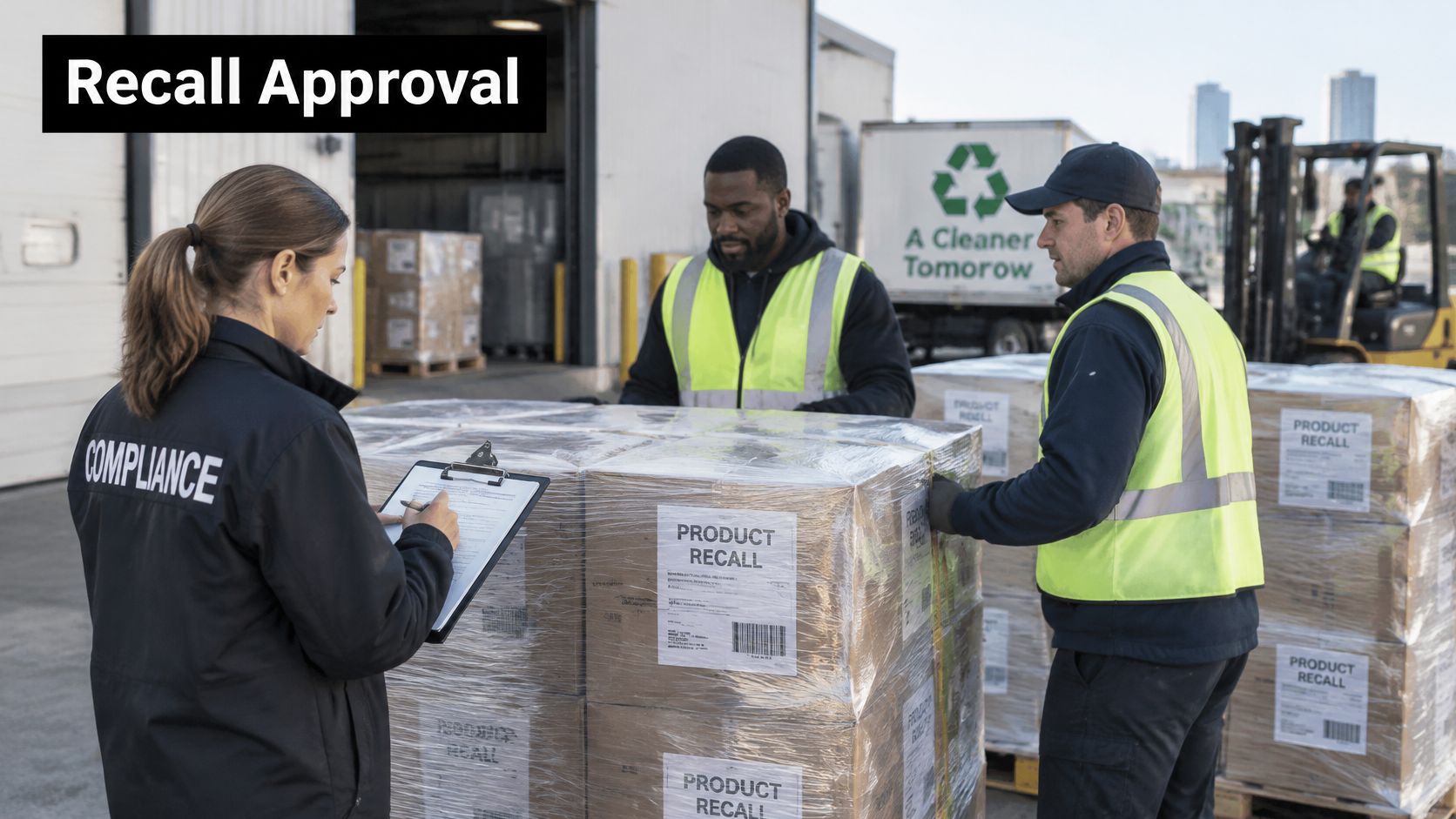
Consumer products under CPSC. The CPSC Regulated Products Handbook says recalled-product destruction or other corrective action must comply with state and local rules, and it must occur under a CPSC or U.S. Customs and Border Protection officer or employee when that supervision is required. Email CPSC staff before you destroy, dispose of, or recycle. The agency may witness the work or require an affidavit with photographs. The certificate sits on top of that coordination. It doesn't replace it.
FDA-regulated goods. Propose the method in writing and notify the agency before destruction. Keep the record even if nobody from the agency attends. When direct observation isn't possible, written verification from the company or from a government agency that witnessed disposition can stand in.
Media and off-site vendors. Settle written customer instructions and the sanitization standard before drives leave the dock. Off-site, the vendor works from written instructions, and pallets stay segregated and labeled. State and local disposal rules still sit on top of the federal email.
Run it in this order.
- Name the owner. Identify which agency issued or is monitoring the recall.
- Send notice in writing. Include the method you propose and the quantity you intend to destroy.
- Read the reply. Confirm whether they want to witness, want photos, or will accept a later affidavit.
- Then book destruction. Don't schedule the vendor until that reply is in the file.
Public agencies can line procurement language up with that sequence using our notes on public-sector compliance.
How to Run a Recall Destruction Workflow, Step by Step
Run the work in the order a recall team touches the goods. Skipping ahead is how units disappear between the notice and the certificate. The condensed flow below is the warehouse view. The numbered list under it is the file you will defend.
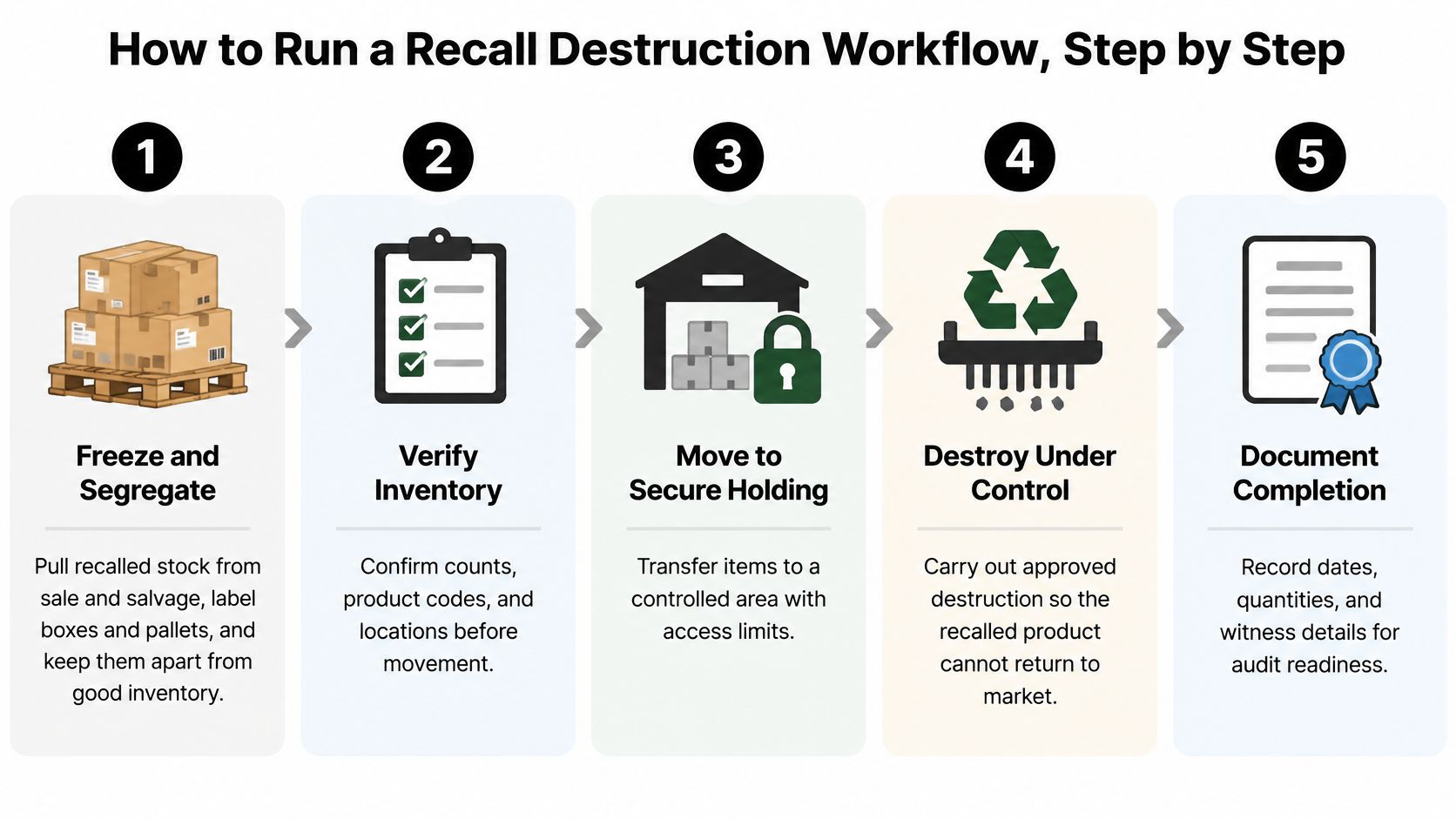
- Freeze and segregate. Pull recalled stock from sale and from salvage, label boxes and pallets, and keep them apart from good inventory. Mixing lots is the fastest way to lose a serial.
- Reconcile to the recall list. Match SKUs, lots, and serial ranges to the manufacturer's notice, and log any unit that isn't on the list. A unit you can't explain becomes a variance, not a rounding error.
- Assign a unique asset or batch ID. Give each lot an ID the certificate can point back to. Without it, later pages float free of the inventory.
- Choose the method. Use on-site destruction under a witness, or a vendor working from written instructions. Write the choice down before the truck arrives. Our recall chain-of-custody services are built around that handoff, not around a pile of unlabeled cartons.
- Sanitize or destroy data-bearing devices. Customers gather their unwanted electronics and note any devices that contain sensitive data. Record whether each device was logically sanitized or physically destroyed, and keep the tool name or the destruction specification.
A note that says only “shredded” or “recycled,” with no device scope, method, verification, or final disposition, is an audit gap. It doesn't show product containment, and it doesn't show data confidentiality.
- Verify and save the logs. NIST recommends verifying the sanitization or disposal process and completing a certificate for each sanitized piece of electronic media. Verification should sample pseudorandom locations across the media's addressable space, including user-addressable and reserved areas, so a tool didn't clear only part of the drive. Federal tax-information guidance asks for what was sanitized, when, quantity, method, verification status, and final disposition. One federal implementation checks every third piece of physical electronic media.
- Witness, photograph, and sign. Have the performer and a witness sign, keep dated photos of labeled pallets, and issue the certificate against the batch ID.
- Reconcile and close the file. Match the destroyed count to inventory, post the adjustment, and file the certificate with the serial sheet. After data destruction, Reworx Recycling recycles the electronics responsibly and in an environmentally friendly way, but the recycle step still has to land on that same reconciliation.
If a later sale of the business puts this file in front of a buyer, serial gaps stall diligence the same way they stall an agency. Brokers who earn commissions on paid data licensing still need a record that shows media never left controlled custody.
Sample Certificate of Destruction Layout Filled In
Use one page the records manager can copy. Every value below is a placeholder from the 412-laptop battery scenario, not a live recall.
- Header. Certificate ID COD-2026-0412 (placeholder). Recall number and CPSC or FDA notice reference (placeholder). Agency contact and date of notice (placeholder).
- Product. Manufacturer and model (placeholder), SKU (placeholder), lot (placeholder). Serials in one continuous block (placeholder), with any gaps listed on the reconciliation sheet rather than hidden in a range.
- Quantities. Recalled 412 (placeholder), destroyed 412 (placeholder), variance 0 (placeholder). Count date and count method, such as a serial scan versus a carton count (placeholder).
- Destruction. Date (placeholder), facility street address (placeholder), method stated as on-site shredding or certified recycling (placeholder), and vendor work order number (placeholder).
- Data scope. Storage media logically sanitized or physically destroyed (placeholder), plus the verification log reference (placeholder).
- Custody. Pallet label IDs (placeholder), transport manifest number (placeholder), and pickup receipt number (placeholder).
- Signatures. Performer name and title with a signed date (placeholder). Witness name and title with a signed date (placeholder). Leave the lines blank until the event happens.
- Attachments. Photo set (placeholder), affidavit (placeholder), and the inventory-system adjustment entry (placeholder).
Counsel has to review any template before you use it. Where the regulator wants a CPSC affidavit, that wording replaces generic certificate language. Don't blend the two and hope the reviewer translates.
Unsigned quantity lines and a serial range with silent gaps are the two blanks I would refuse to initial.
Vetting a Destruction Vendor and Its Certificates
Judge the provider's certificate before you judge the price. The same checklist applies to any destruction vendor, including us.
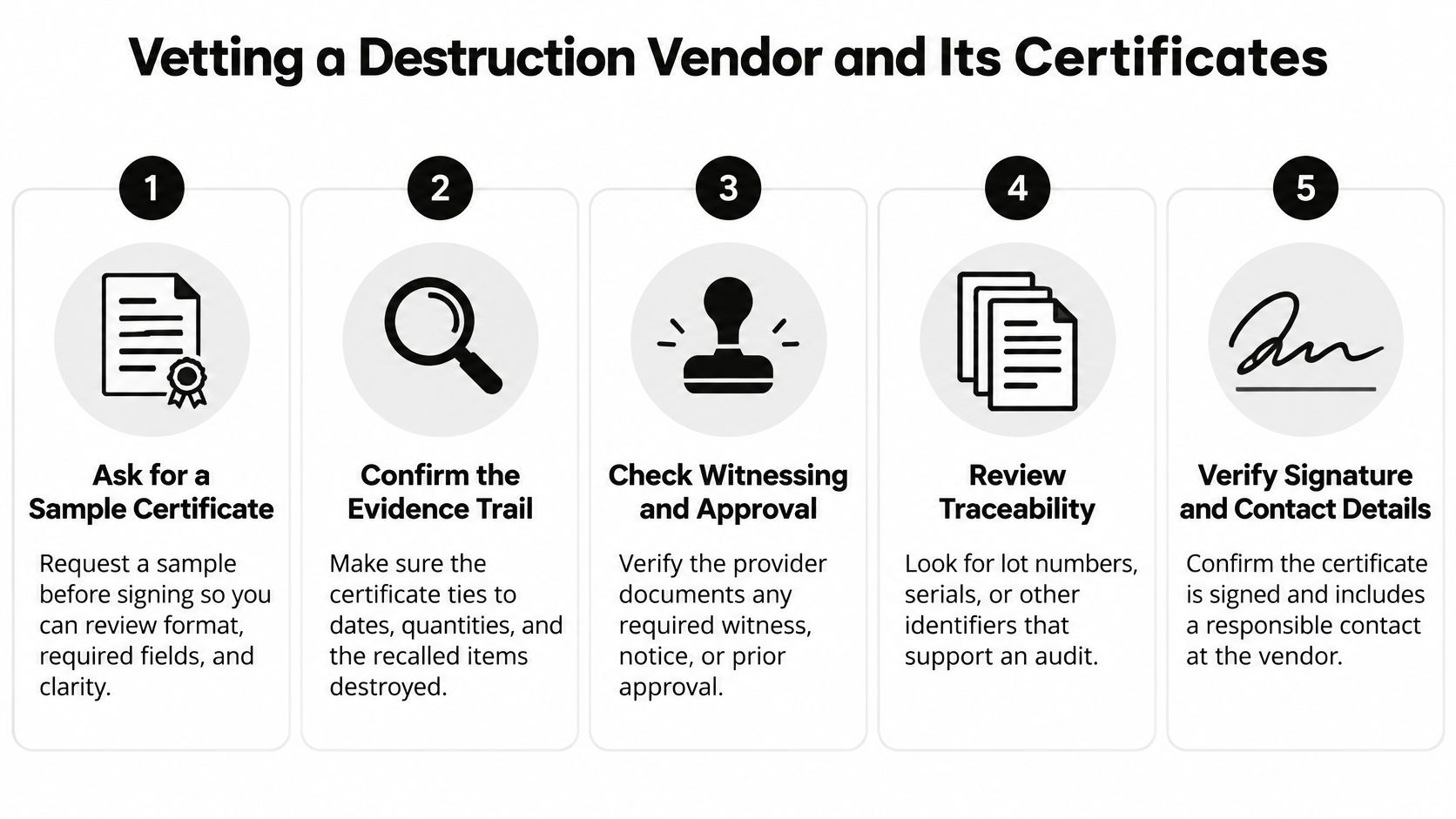
- Ask for a sample certificate before you sign. If the sample can't be reconciled to a fake serial list, the live one won't survive either.
- Confirm the sanitization standard. The vendor should follow NIST SP 800-88 or another current generally accepted standard.
- Read the procedure and the training record. Destruction steps should be written down, and the people who run them should be trained on a regular schedule.
- Ask who reviews the process. EPA R2 practices require an electronics recycler to sanitize, purge, or destroy data on hard drives and other storage devices unless the customer gives different written instructions. Those processes must be documented, and an independent party should periodically review and validate them.
- Lock segregation and a resale bar into the written instructions. “We usually keep recalls separate” is not an instruction.
- Check the certificate fields. Device scope, method, verification status, and final disposition all have to appear. Reworx Recycling specializes in secure data destruction, our recycling programs are certified, and we securely wipe or shred data-bearing devices so customer information stays protected. The certificate still has to say which of those two happened on each batch.
- Confirm witnessing and photos when your recall requires them. A vendor that won't allow a witness is the wrong vendor for a witnessed destruction.
Scan these red flags on the sample, not after the pickup.
- “Recycled” and nothing else. No method, no count, no media scope.
- No serial or quantity fields. You can't reconcile what you can't name.
- Refusal to name the destruction method. Vague wording usually hides a resale path.
- No written chain of custody. A pickup photo without a manifest doesn't show control.
Put three terms in the contract before you sign. Name the certificate turnaround, name a contact, and keep your right to audit the process. Warehouse controls, PPE, and local waste rules are easier to hold a vendor to when someone owns outsourced health and safety if you don't have that staff in house. Compare any bidder against our vendor selection criteria. The vendor certificate becomes one exhibit next to your reconciliation sheet. It doesn't replace the file.
Retention Schedules and Audit-Ready Recall Records
Don't invent a retention number. The period comes from the regulator that owns the recall, the vendor contract, and counsel. Name an owner and a review date instead of a made-up year.
| Record | Keep With | Retention Trigger |
|---|---|---|
| Destruction certificate | Recall file and inventory reconciliation | Recall closure confirmed by agency or counsel |
| Serial or lot reconciliation sheet | Certificate and original recall list | Recall closure, or any agency follow-up request |
| Photos and witness affidavit | Certificate and destruction log | Litigation hold or claim notice |
| Transport and chain-of-custody records | Vendor pickup manifest | Vendor contract end or audit |
| Sanitization verification logs | Device asset ID record | Device disposal or data incident |
A recall closure confirmed by the agency or by counsel is the trigger to review the certificate, not a cue to delete it the same day. An agency follow-up keeps the serial sheet alive even after you thought the recall was done. A litigation hold or a claim notice freezes photos and affidavits, and it can suspend disposal of any related record. A vendor-contract end or an audit is the moment to review transport records. Device disposal or a data incident is the trigger on sanitization logs, because those logs have to sit with the asset ID, not in a shared “shred” folder.
Store scanned originals with timestamps. Never split the certificate from its unit list, even when the PDF is easier to email alone. The same traceability problem shows up when teams try understanding provenance in embodied AI data. A record is only useful if you can walk it back to the object and the event.
Keep one recall index sheet that links the recall number, the certificate ID, the vendor, and the file location. An auditor should reach any unit's destruction record in minutes. Our record retention policies are the place to park that index owner and the review date.
Recall Destruction Certificate FAQs for Businesses and Agencies
Can a recycler's certificate replace ours?
No. File the vendor certificate inside your recall file with your reconciliation sheet and the notice correspondence. Their signature doesn't become your inventory.
What if a unit can't be found?
Document the search, log the unit as a variance, and talk to counsel before anyone signs a certificate that implies every unit is accounted for. A missing serial is a variance, not a reason to round the count.
Do public-sector organizations face different rules?
Federal notice and witnessing rules apply the same way. State and local disposal rules, procurement terms, and public records requests can change what the file must hold and how long it stays available. Email the agency that owns the recall before destruction, the same as a private firm.
Is a photograph enough?
No. Photos support the signed record and the agency correspondence. They don't replace either one.
Confirm Your Recall Closeout File Before You Book Destruction
Three checks decide whether you book destruction or you wait. None of them is a reprint of the certificate fields.
- The inventory adjustment is ready to post once destruction is confirmed, with the batch ID already in the system.
- The recall index sheet links the recall number, certificate ID, vendor, and file location.
- Counsel has reviewed the template for agency-specific wording, including an affidavit where the regulator requires one.
If any item fails, don't book the pickup. If all three pass, schedule a pickup or donate surplus and recalled electronics with Reworx Recycling. We provide donation-based electronics recycling, IT equipment disposal, and secure data destruction, and we offer free data destruction. The third step, Certification & Reporting, gives you detailed reports and a Certificate of Destruction tied to the work performed. Ask us about the certificate format before you book, especially for an office cleanout or a school laptop recall around Atlanta.
Responsible recycling here also supports technology donations, digital inclusion, and workforce development. Donate equipment, schedule a pickup, or partner with Reworx Recycling, then pull the recall list you already hold and check it against this list before the truck is on the calendar.
Reworx Recycling documents recalled-inventory destruction with reports and a Certificate of Destruction your audit file can reconcile. If you are closing a product recall, retiring laptops, or planning an IT asset disposition, visit Reworx Recycling to donate old equipment, schedule a pickup, or start a partnership. Bring your recall list. We'll talk through the certificate format before anything leaves your building.