The popular advice is to book trucks first and sort paperwork later. That's backwards. For product recall pickup services nationwide, coverage means nothing if you can't prove what happened to each serialized unit after it left the dock. I'd confirm the authorized remedy, assign one case ID, and lock your quarantine process before a single pallet moves.
Nationwide Recall Pickup Workflow at a Glance
Timing doesn't give you room to improvise. For products that may present a substantial risk, the CPSC recall handbook defines reporting immediately as within 24 hours of obtaining reportable information, and says the initial investigation should generally not exceed 10 working days. Your collection, quarantine, and escalation plan has to exist before transportation begins.
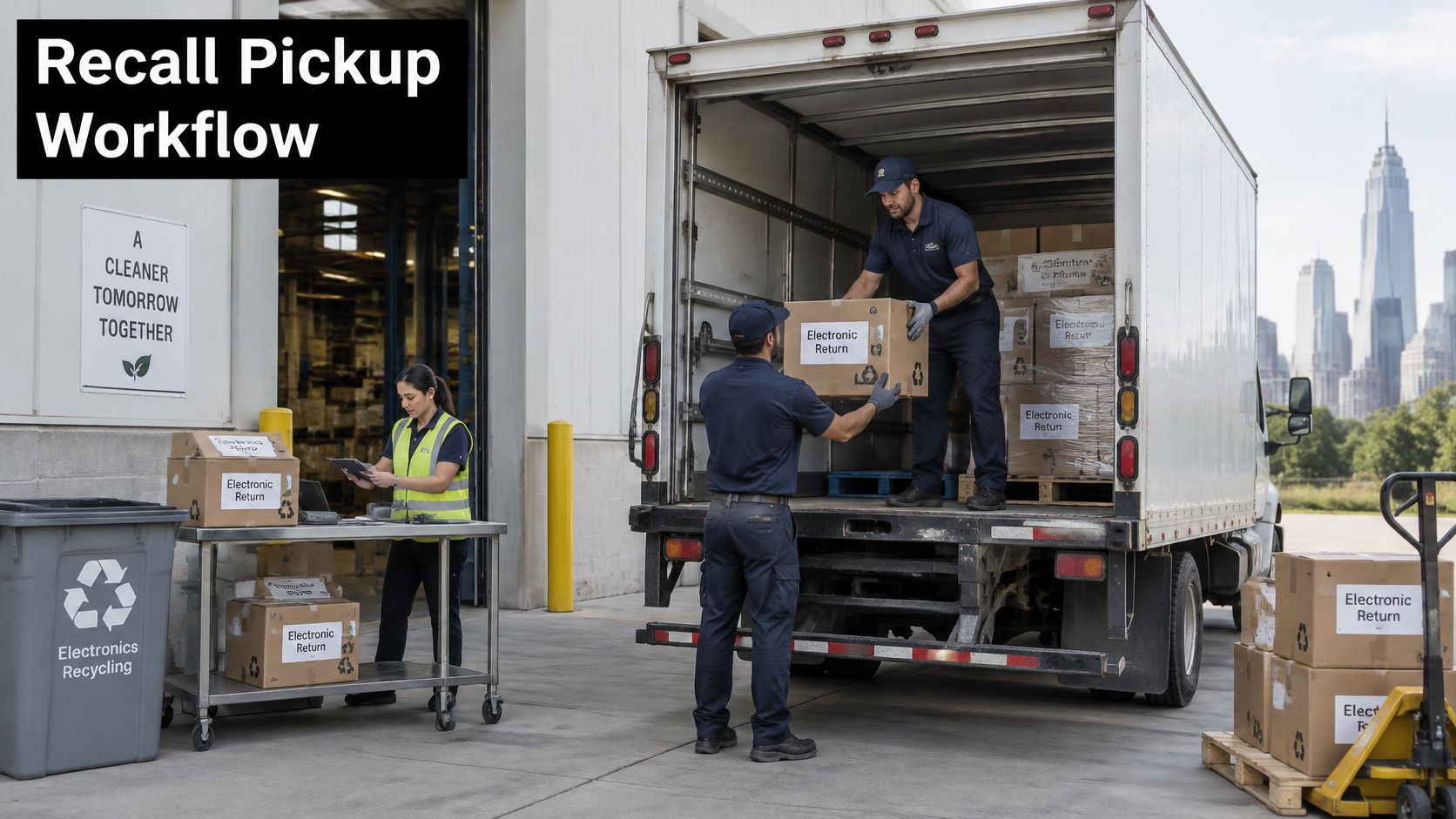
A nationwide program works when regional carriers feed one central record. A laptop in a branch office and a pallet in a warehouse must reconcile against the same notice, or you'll close sites on paper while units sit in storerooms.
Seven Phases of a Nationwide Recall Pickup Program
| Phase | Key action | Record produced | Done when |
|---|---|---|---|
| 1. Scope | Map affected models, serials and sites | Affected unit list | Every site has a counted inventory |
| 2. Remedy | Confirm refund, repair, replacement or disposal | Remedy memo | Remedy approved for each product line |
| 3. Notify | Send location-specific pickup instructions | Notice log | Every site has acknowledged |
| 4. Schedule | Book pickups by region and load size | Pickup case ID | Carrier and window confirmed |
| 5. Quarantine | Receive, count and seal units | Receipt manifest | Counts match the manifest |
| 6. Dispose | Recycle, destroy or return per the remedy | Disposition record | Certificate filed to the case |
| 7. Report | Track correction rate and exceptions | Closure report | Open exceptions escalated |
Where an Outside Partner Fits
Reworx Recycling offers nationwide services across the U.S., and its free pickup service is for schools, healthcare, government, commercial and business customers only, within the United States. That kind of partner belongs in phases four through six, not as a substitute for your scope and remedy work. You can review its nationwide recycling coverage against your site list before you commit dates.
Practical rule: If any phase lacks a named owner or a record template, don't launch. Fix that gap first.
Use the table as a go or no-go list at your kickoff meeting. Walk each row, name the owner out loud, and check the template exists. Programs that skip this step usually discover the missing record during reconciliation, when it's expensive to recreate.
Match the Recall Remedy to Each Unit
A pickup can reach every site on the list and still fail the recall. The failure happens when units leave quarantine before the authorized remedy is confirmed and each serial number is recorded. Match the handling path to the notice, not to what is easiest for the carrier.
Remedy Types and What the Pickup Must Do
Refunds and repairs account for most recall remedies; disposal is rare. The pickup instructions should reflect the authorized remedy for each product line.
| Remedy | What the pickup must do |
|---|---|
| Refund | Verify the purchase record, collect the unit, and retain it until the refund process is authorized. |
| Repair | Route the unit to an authorized repair site or arrange the repair specified in the recall notice. |
| Replacement | Record the old unit's serial number and match it to the replacement record. Keep the old unit in quarantine until its disposition is confirmed. |
| Disposal | Hold the unit until the manufacturer or regulator explicitly authorizes destruction, then retain the required disposition documentation. |
| Hold and escalate | Keep units quarantined when the notice is unclear. Request written clarification before assigning a return, repair, replacement, or disposal path. |
Screen Before You Book
For each product line, check who can authorize the remedy, whether units are tracked by serial number or lot, and whether they contain customer or employee data. Confirm any handling instructions for lithium-ion batteries before choosing packaging or transport.
Then assign each unit a path: hold it, return it to the manufacturer, use a manufacturer-provided label, or destroy it only when the notice permits destruction. Replacement programs also depend on matching parts to the right owners and shipments. Guidance on handling spare parts in crowdfunding campaigns offers a related perspective on keeping those records aligned.
Put refusal conditions in the pickup instructions. Drivers should not accept unlabeled units, units with missing serial numbers, or recalled and non-recalled stock mixed on one pallet. A rejected load delays collection; a mixed load can make unit-level reconciliation harder.
For a 200-laptop fleet across nine offices, separate leased machines from company-owned equipment in the records. Obtain the lessor's written approval before disposing of leased units, even if company-owned units at the same site are cleared for destruction. One location can have two different authorization paths.
Confirm the authorized remedy and serial-level evidence for each unit before it leaves quarantine. Verbal approval does not provide a reliable audit record.
Vendor Checklist and Cost Control
Compare providers against the same questions, and score the answers before price enters the conversation. Vague answers early become exceptions later.
Questions That Separate Strong Providers
- Coverage and eligibility: Does the provider serve every state on your site list and your customer type? We offer free pickup for schools, healthcare, government, commercial and business customers only, within the United States, so confirm you fit before planning around it.
- Booking discipline: Can you submit requests online with a signature and confirm pallet thresholds before booking? A provider that won't state minimums in writing will surprise you at scheduling.
- Destruction proof: Does it issue a certificate of destruction for every task? Ask for a sample certificate. No sample is a red flag.
- Media handling: Does it use degaussing or shredding for storage media, and can it tell you which method applies to your drives? Evasive answers on secure data destruction should end the conversation.
- Chain of custody: Can it show a documented handoff record and explain how received counts get reconciled against your manifest? If reconciliation is just a driver signature, you'll own every mismatch.
- Value recovery: Is there a buyback option for unaffected equipment pulled in the same office cleanout? We offer a nationwide equipment buyback program for businesses, which can offset part of a larger IT asset disposition (ITAD) project.
Run your shortlist through written vendor selection criteria so procurement, IT, and facilities score the same scope. That prevents a low freight quote from winning over a provider that closes cases.
What Drives Cost
Volume, pallet count, distance from the nearest depot, number of separate sites, and verification labor drive your bill. Serial-level checking on 500 laptops costs more in labor than the freight does, and that's normal.
Control cost by consolidating pickups by region, avoiding partial loads that trigger repeat trips, and preparing clean serial lists so crews aren't counting at the dock. Track cost per verified unit, not cost per pickup. A cheap pickup that leaves 30 units unreconciled isn't cheap once your team spends two weeks chasing them.
Pack, Schedule and Run Each Pickup
Nationwide coverage does not resolve a recall. Before a unit leaves quarantine, the plan must match it to an authorized remedy and preserve serial-level evidence. A pickup moves equipment; it does not prove that the right units received the right corrective action.
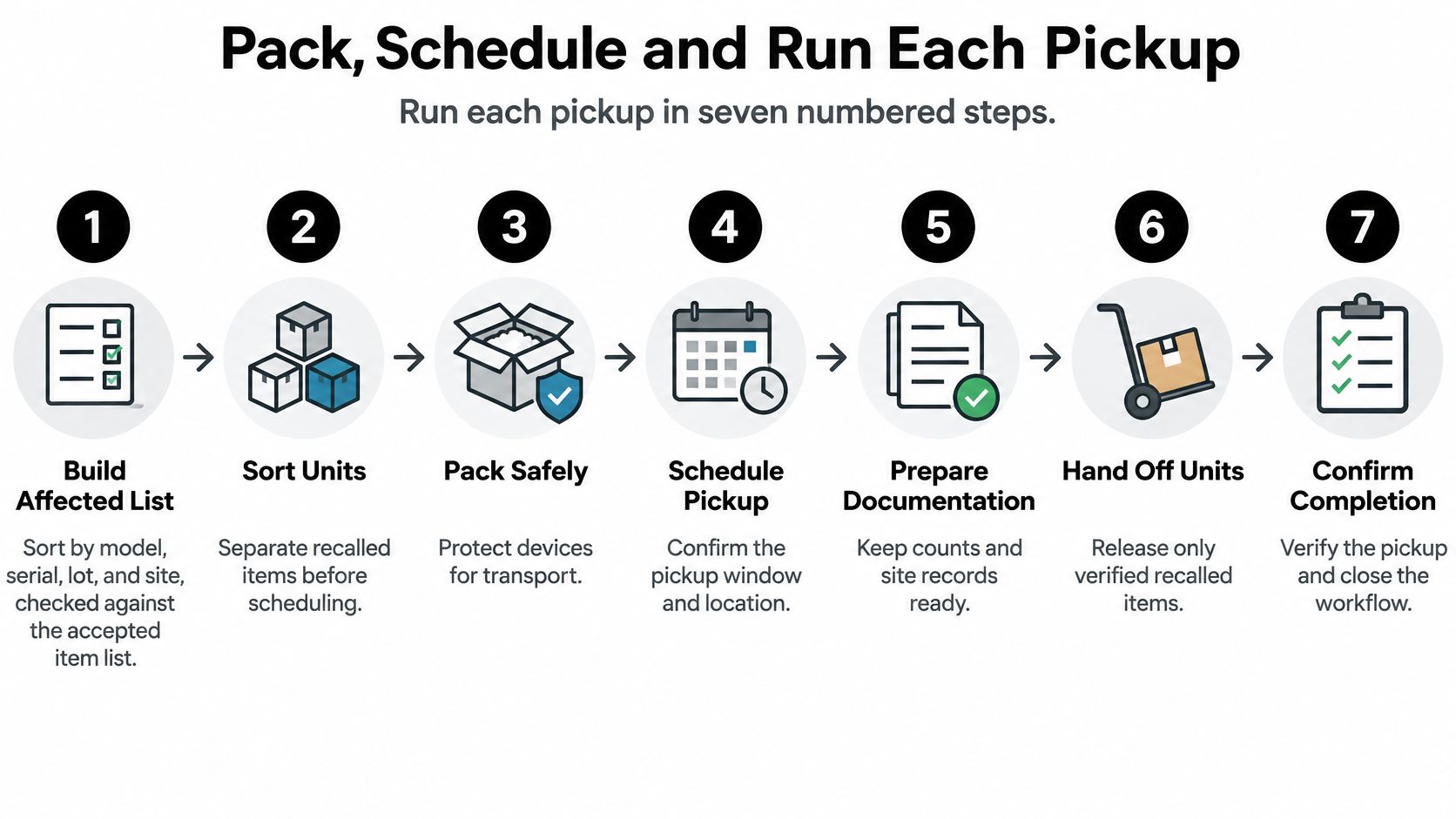
The Seven Steps
- Build the affected-unit list by model, serial or lot, and site. Businesses should first compile equipment available for pickup against the accepted item list. Do not rely on memory or a rough pallet count.
- Issue site-specific instructions with the case ID, pickup window, and name of the person responsible for the handoff. Put the case ID on every pallet so loads cannot be mistaken for one another.
- Choose the shipping path for the load size and record its confirmation number against the case. Reworx pickup requests must be submitted online, not by phone, and each request requires an online signature.
- Pack by site and authorized remedy. Keep units assigned to different outcomes separate, label each load with its case ID, and follow these instructions for packing electronics for shipping.
- Quarantine units on arrival in a separate area. Keep them out of ordinary stock while counts and remedy assignments remain open.
- Reconcile received units against the manifest using a physical count. Record discrepancies promptly, before repair, refund, or destruction begins.
- Close the disposition record only after the authorized remedy is complete. A completed transport is not proof that the recall has been resolved.
A product subject to a recall notice under the Consumer Product Safety Act cannot be sold, offered for sale, manufactured for sale, distributed in commerce, or imported. The CPSC may conduct unannounced inspections where such products are held.
Packing and Shipping Rules by Load Size
| Load size | Packing requirement | Shipping method | Condition to check |
|---|---|---|---|
| Under 100 lbs | Original cartons or sealed bins labeled with the case ID | Prepaid UPS Ground shipping label | Reworx provides the label and covers shipping |
| One pallet (40 x 48 x 48 in.) | Stretch-wrapped, serial list attached | Freight pickup | At least one pallet is required for free freight pickup |
| Multi-pallet or multi-site | Separate pallets by site and remedy | Scheduled freight pickup | Keep a separate manifest for each site |
| Lithium-ion or damaged batteries | Keep separate and follow provider packing instructions | Confirm handling before booking | Complete a hazard screen before scheduling |
| Mixed recalled and non-recalled stock | Separate the inventory | Arrange separate loads | Do not combine the stock on one load |
Reworx Recycling's Secure Pickup is a no-cost electronics pickup, with transportation logistics handled for the customer. Businesses must submit pickup requests online and provide the required online signature. Set a confirmed appointment window and make sure the site contact can release the correct, labeled load; missed handoffs can mean rebooking and extra handling, as in other door-to-door logistics such as car shipping for relocating families.
Schedule by region where possible, but do not consolidate units assigned to different remedies. Keep each site's manifest with its load, and leave any unmatched unit in quarantine until its identity and disposition are resolved. A pickup is ready to close when the manifest, physical count, and remedy record agree.
Chain of Custody and Data Security Records
Recalled electronics often hold customer, employee, or operational data, so they can't go into general electronics recycling. The FTC guide on protecting personal information advises disposal practices that are reasonable and appropriate to prevent unauthorized access to personally identifying information, recommends secure-erasure software capable of overwriting the entire drive, and warns that ordinary file deletion may leave data recoverable.
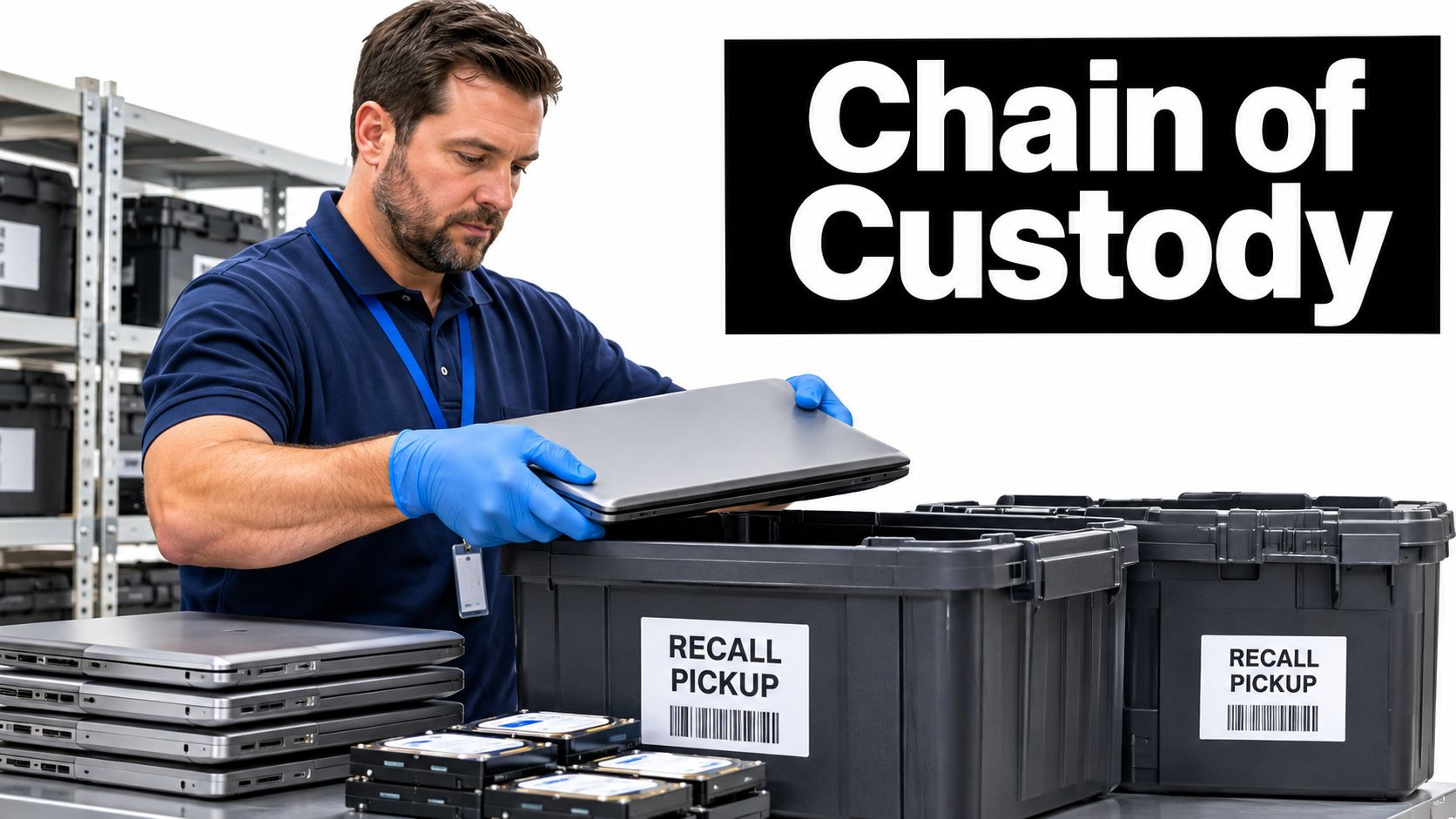
Set the Controls at Intake
Segregate storage media on arrival, before units join any general computer recycling stream. Identify each device and its media, then choose Clear, Purge, or Destroy based on confidentiality and whether the unit will be reused. A laptop headed for manufacturer repair needs a different decision than one cleared for laptop disposal.
For hard drives, we use hard drive shredding and degaussing for IT equipment decommissioning to eliminate any risk of data retrieval. Verify the result after processing, because a failed wipe that nobody checked is worse than no wipe. It creates false confidence.
Record Fields to Copy Into Your Template
- Case ID: Ties every record back to one recall notice.
- Serial or lot range: Identifies the exact units processed.
- Pickup date and carrier: Proves when custody changed and with whom.
- Receiving site: Names the facility that took possession.
- Method used: States Clear, Purge, or Destroy, plus the tool or process.
- Operator: Names the person who performed the work.
- Verification result: Records pass or fail, with failures routed to physical destruction.
- Final disposition: States repair, return, recycling, or destruction.
Keep your chain of custody documentation consistent across every site so records merge cleanly. We provide a certificate of destruction for every task fulfilled, serving as documentation for audits and legal matters.
Say a regional HR office returns laptops holding personnel files during a facility cleanout. Months later, legal asks how those files left the company. The certificate, matched to serials, is the only answer that holds up. A freight receipt proves a truck came. It proves nothing about the data.
Communication Templates for Notices and Exceptions
Write five templates once and use them at every site. Consistent wording means acknowledgements, counts, and exceptions come back in a format your team can reconcile.
The Five Templates
- Site notice: Include the case ID, affected models and serials, the remedy, the pickup window, and the name of the person who signs for the load. Send it to each site contact and require written acknowledgement.
- Acknowledgement request: Ask each site to confirm its unit count and report any unit it can't locate within a set number of days. Silence isn't a zero count.
- Exception outreach: Use repeated contact for owners you can't reach, including remote offices, former employees, leased sites, schools, and government buildings. Log each attempt by date, channel, and result.
- Posted and website notice: Carry a retention date on the template itself so nobody pulls it down early during a website refresh or store reset.
- Monthly participation report: List units returned, remedied, pending, and unresolved, so leadership sees recovery progress rather than pickup activity.
Retention rules are specific. The CPSC recall checklist states that retail notifications and posters must remain in place for 120 days or longer and recall information must remain on the company website indefinitely, and firms may need to report monthly on recall participation after a public announcement.
Keep language plain and name the remedy in the first lines. Don't promise a refund or repair date the remedy memo hasn't confirmed, because sites will quote your email back to you. Translate notices for sites that work in other languages rather than assuming the English version landed.
Working standard: Every template carries the case ID, so the notice log, acknowledgements, and closure report match without detective work.
Measure Recovery and Schedule Your Pickup
Pickup completion does not confirm recall resolution. Track whether each affected unit received its authorized remedy, and keep that measure separate from the number of units collected.
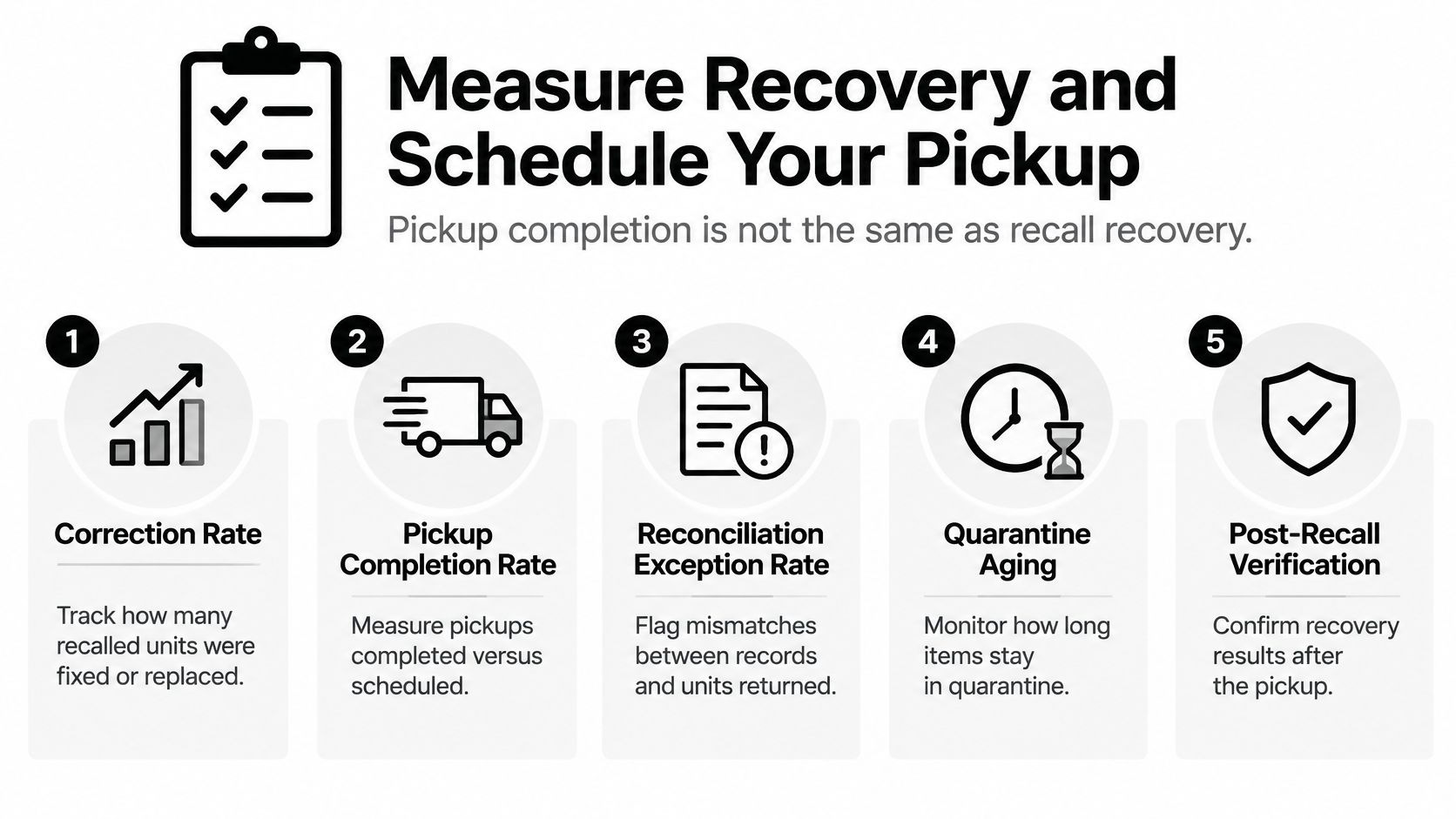
Five Measures Worth Reporting
- Correction rate: Units refunded, replaced, or repaired, divided by total recalled units.
- Pickup completion rate: Pickups completed against pickups scheduled.
- Reconciliation exception rate: Mismatches between manifests and physical counts.
- Quarantine aging: How long received units wait for their remedy.
- Post-recall incident count: New reports involving units that should already be recovered.
A recent NHTSA quarterly report for a child-seat recall covering 30,984 units listed 321 owners as unreachable, while only 1,656 units had been remedied by the 2026 first quarter. The figures describe one recall. They illustrate why a collection tally alone cannot establish recovery.
For each unresolved unit, retain the contact attempts, site, reason for the gap, and evidence of responsible handling. Escalate mismatched quantities and units without traceable identifiers. Keep unresolved units visible in the report rather than closing the case without evidence.
Once the remedy is confirmed and units are cleared for their next disposition, businesses can arrange a nationwide electronics recycling pickup. Reworx Recycling offers business pickups for accepted items, and cleared equipment may qualify for its nationwide equipment buyback program for businesses.
If you are planning product recall pickup services nationwide, Reworx Recycling offers business pickup, IT equipment disposal, and secure hard drive shredding. Schedule a business pickup or ask about equipment buyback through Reworx Recycling.