An IT manager clears a storage room after a device refresh. Laptops are queued for reuse, a server rack is ready to leave the building, and a box of phones and removable drives has no clear owner. Someone has deleted files from some devices, but nobody can yet show which media were checked, how they were handled, or what happened to each item afterward.
That gap matters. Data destruction services should do more than remove information: they should help an organization choose a suitable method, verify its outcome, and keep records that connect each retired asset to its final disposition. A well-designed process can protect sensitive information while preserving devices for reuse when that's appropriate.
Why Retired Devices Still Create Risk
A device can look empty and still contain information. Deleting files or restoring factory settings doesn't, by itself, demonstrate that the underlying storage has been sanitized or that an organization can account for the device after it leaves the office.
That concern isn't limited to large companies. Verizon's 2025 Data Breach Investigations Report analyzed 22,052 real-world security incidents and identified 12,195 confirmed data breaches. It found that stolen credentials were involved in 22% of breaches reviewed. Those findings offer a practical reminder for smaller organizations, too: retired laptops, servers, phones, and storage media deserve deliberate handling as part of broader security and compliance governance.
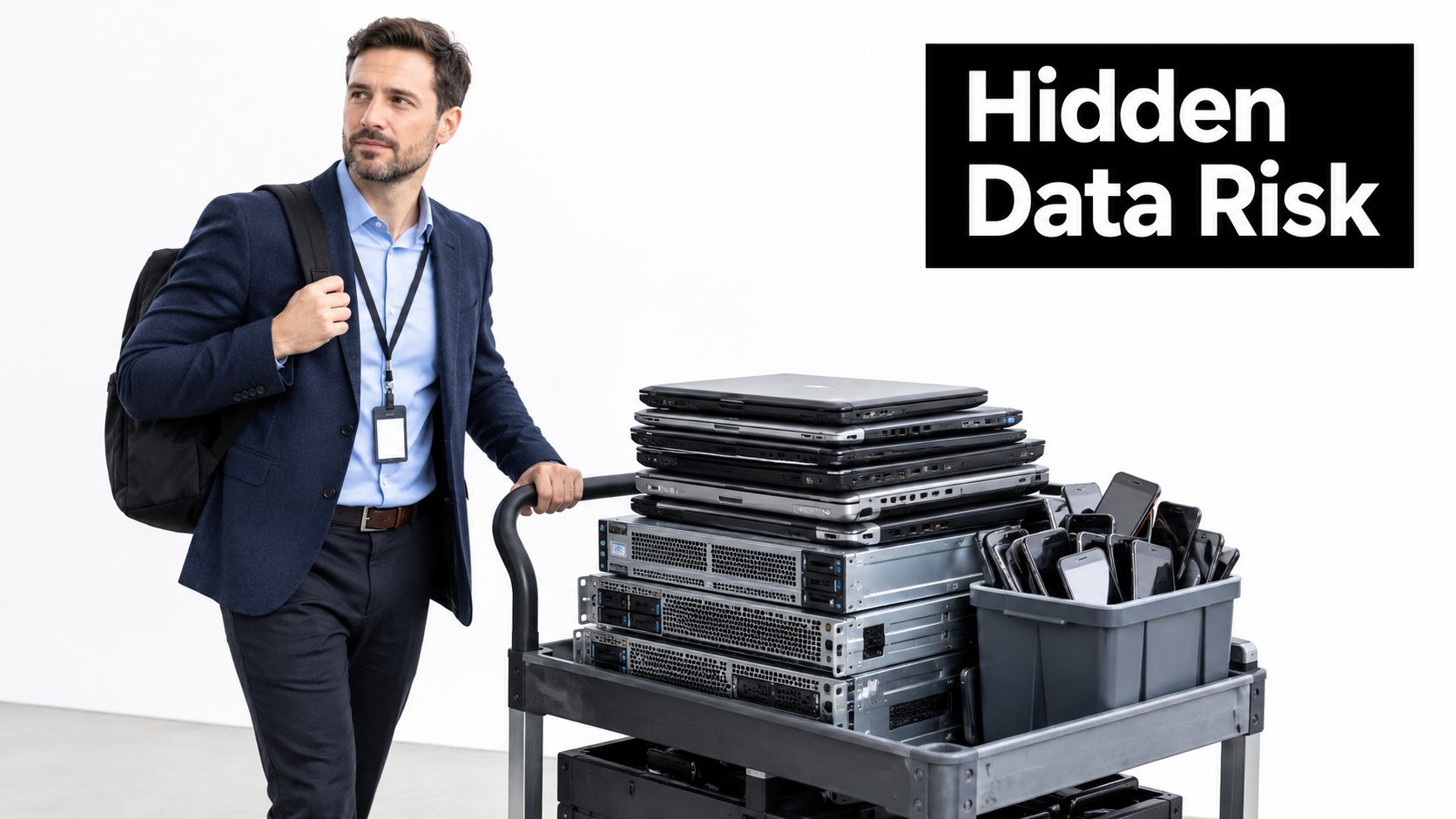
Consider a laptop set aside for donation after an employee leaves. The employee may have used it to access customer records, business files, or saved credentials. If the device is collected without an assigned owner, a suitable sanitization step, and a record of its outcome, the organization can't confidently say what information remained or who handled the laptop.
Practical rule: Treat an asset as a potential data exposure until its storage media have been properly sanitized or physically destroyed, and the organization can account for the result.
Uncontrolled handling can create security incidents, audit gaps, misplaced assets, and confusion about what a downstream recycler or reuse partner received. Organizations looking to strengthen their device-retirement controls can review Reworx Recycling's data breach prevention guidance.
A sound process gives IT, security, facilities, and sustainability teams a shared way to distinguish sanitization from destruction, prepare devices for collection, and retain useful evidence. It also helps leaders make a reasoned choice between preserving hardware for reuse and destroying media when that's the more defensible option.
Understanding Data Destruction Services
Data destruction services manage what happens to information stored on equipment that's leaving an organization's control. As part of IT asset disposition (ITAD), a service may identify the media, apply an appropriate sanitization or destruction method, check the outcome, record the handling, and route the remaining equipment for reuse, recycling, or another approved disposition.
Take a retired laptop. The laptop is the asset; its SSD or hard drive is the storage media. The organization first decides whether the information on that media needs to be removed and whether the laptop might be reused. The service then follows the organization's approved handling requirements and documents what happened. Donation or computer recycling comes later, after the data-handling decision has been completed.
That's different from file deletion, which removes a user's visible access to files but isn't proof that the information can't be recovered. It's also different from electronics recycling. Recycling addresses what happens to the hardware and materials; data destruction addresses what happens to the information the hardware holds. A device can be recyclable without its data having been properly sanitized, so the two responsibilities need to be connected but not confused.
Purge and destroy are different outcomes
NIST's terminology offers a useful distinction. Purge uses physical or logical techniques intended to make recovery infeasible with state-of-the-art laboratory methods while potentially preserving the media. Destroy makes recovery infeasible and prevents the media from being used for further data storage. The organization's reuse plans, media type, and confidentiality needs help determine which outcome is appropriate.
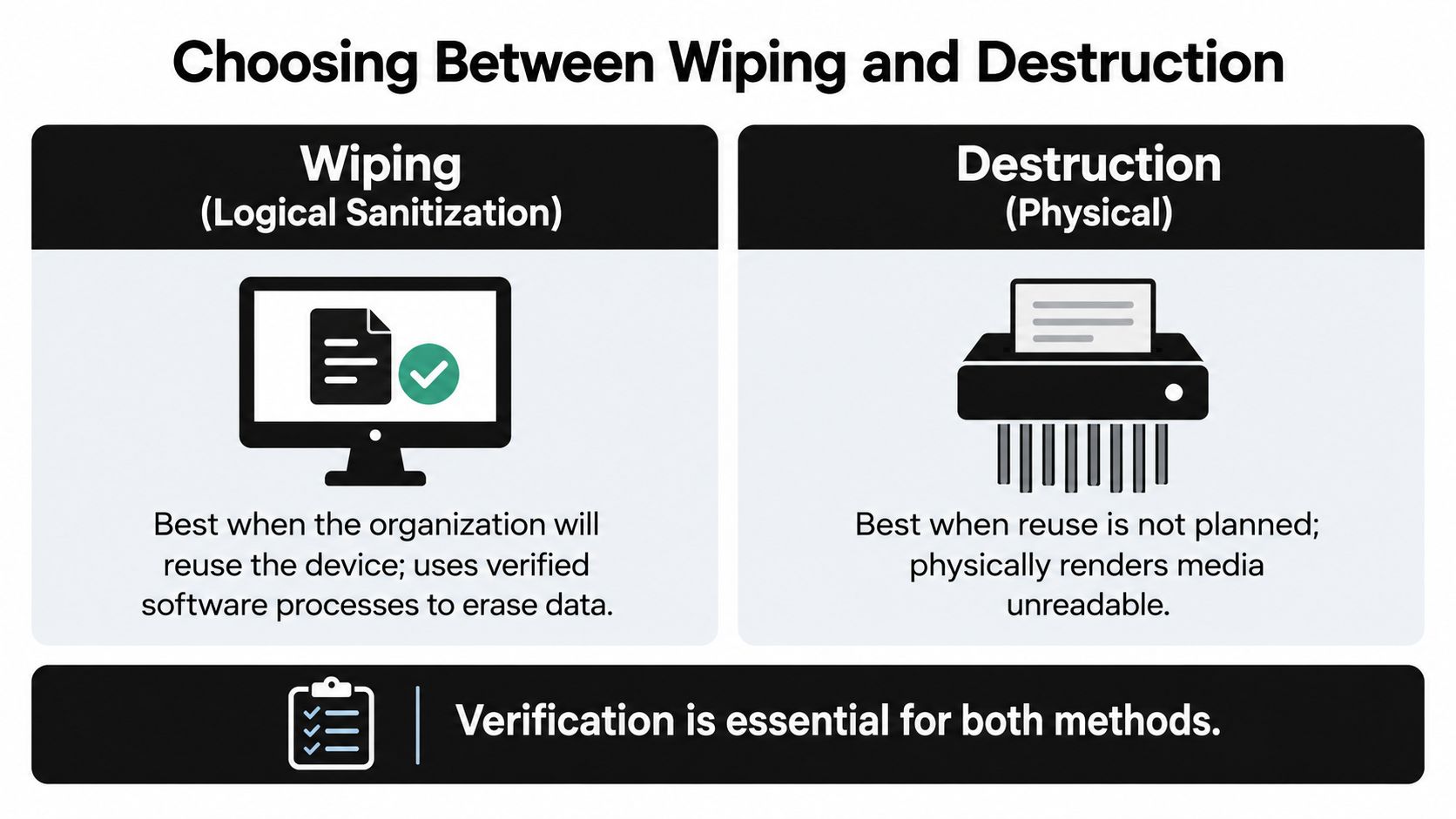
A software-based process or cryptographic sanitization may support reuse when the storage technology and verification process are suitable. Physical destruction is a different choice: it removes the media from future storage use. Neither label alone proves that a particular process worked. The provider should identify the method used and record whether the operation completed as intended.
The same governance idea applies beyond devices picked up in a truck. Organizations also need to consider logical sanitization for cloud systems and virtual infrastructure. A physical drive service can't, by itself, account for cloud copies, backups, snapshots, or virtual disks. Those data stores need identified owners and a separate, documented retirement process.
Choosing Between Wiping and Destruction
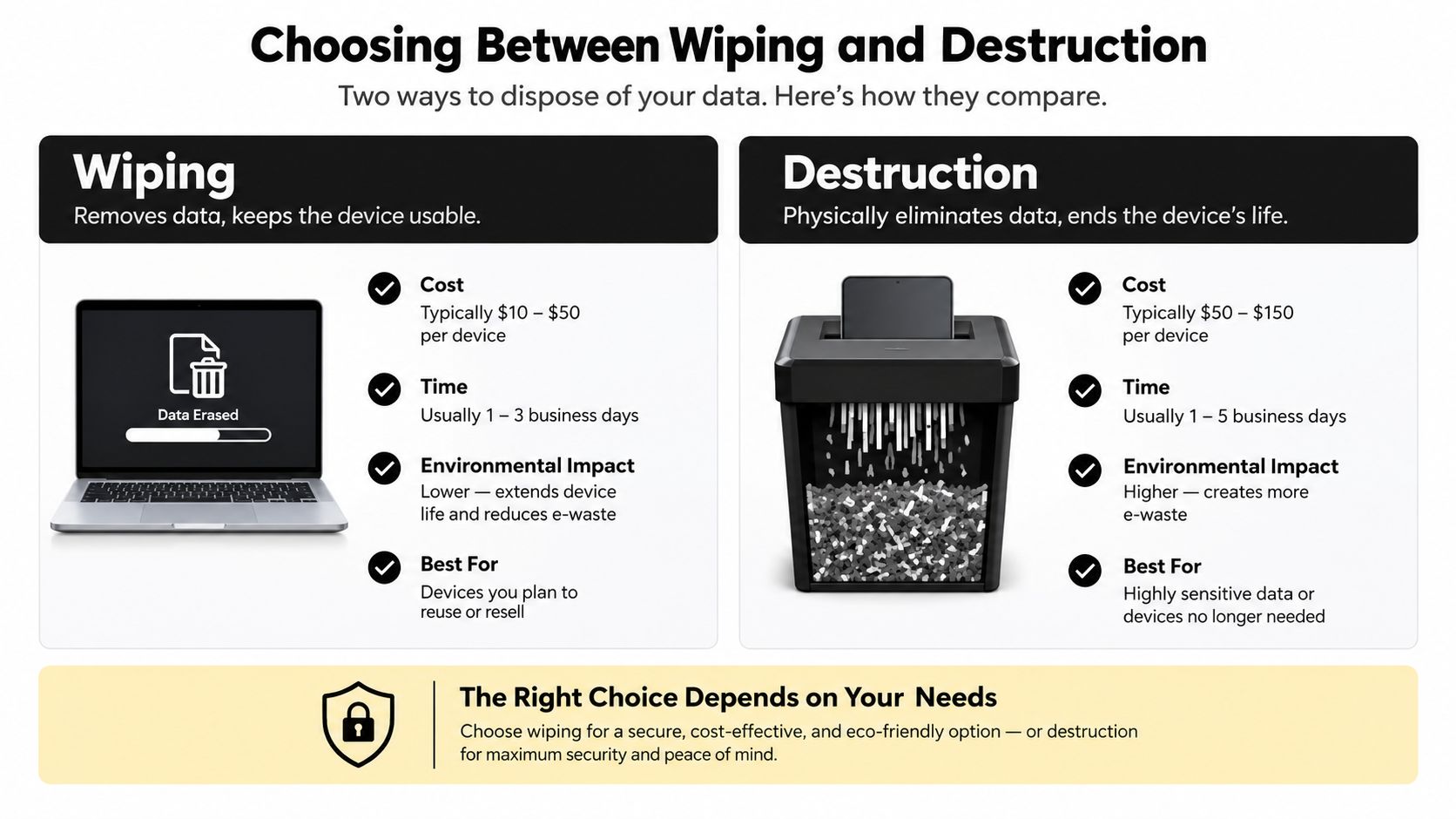
The right decision isn't automatically “shred everything.” A functional device that can be reused may be a candidate for logical sanitization, while a damaged or inaccessible drive may not support a reliable software process. The organization should match its method to the media type, data sensitivity, and reuse plan, then keep a record of that decision.
| Method | When it may fit | Main consideration |
|---|---|---|
| Logical sanitization | A device may be reused, and its storage technology supports a suitable, verifiable process | The organization needs evidence that the operation completed properly |
| Degaussing | Suitable magnetic media require a magnetic-field process | It isn't a universal option for every type of storage |
| Physical destruction | Media are damaged, can't be reliably sanitized, or carry a residual recovery risk the organization won't accept | The media can't be reused for storage afterward |
A wipe can be a sensible route for a reusable device when the storage technology, process, and verification are appropriate. That decision depends on the specific media and the evidence available, not on whether the machine boots. If the process can't reliably address the media, reuse shouldn't be assumed.
Degaussing uses a magnetic field, so it's relevant to suitable magnetic media, not a one-size-fits-all solution for every drive. An organization should confirm the storage technology before choosing it. For media that can't be reliably sanitized, or where the organization considers any residual recovery risk unacceptable, physical methods such as shredding, pulverizing, or disintegration may be more appropriate.
Balance assurance with reuse
Destroying every drive may seem like the simplest policy, but it can discard equipment that could have been sanitized and reused. International Telecommunication Union guidance reflecting IEEE 2883 practices recommends identifying the storage technology and data sensitivity, selecting a clear, purge, or destruct method, checking the result, and retaining evidence. It also recommends prioritizing purge over destruction for most data and notes that pulverizing or shredding can have negative environmental impacts. See the ITU guidance on sanitizing end-of-life storage media.
“Secure” doesn't always mean “maximum destruction.” A well-documented purge may fit a reusable asset; destruction may be the more defensible choice when the media are failed or the organization can't establish that sanitization was effective. For practical guidance on comparing approaches, review data sanitization methods.
Comparing On-Site and Off-Site Service
The place where destruction happens doesn't determine security on its own. On-site service can give staff an opportunity to witness work at the organization's location. Off-site service can simplify collection and processing, particularly for recurring or larger disposition projects. Either model depends on controlled handling and records that connect the asset to its result.
On-site destruction may suit an environment where staff want direct visibility or where transferring media before destruction would create an unacceptable concern. The trade-off is operational: the organization needs to coordinate access, scheduling, work areas, and any equipment or labor required. A witnessed event is useful, but it still needs an inventory and records showing which specific media were processed.
Off-site processing can work well when the provider offers a clear collection and receipt process. Before authorizing transport, ask how the provider secures the load, records the handoff, reconciles received assets against the pickup inventory, controls access at its facility, and reports the final outcomes. A missing or unexplained item is a custody problem, even if the remaining drives were destroyed correctly.
Security follows the asset through every handoff. A machine shredding a drive in a conference room doesn't replace secure transport, reconciliation, and documented results.
For a school or organization with limited loading space, a managed pickup and a clearly scheduled handoff may be more practical than bringing processing equipment on-site. Distributed offices may need a consistent inventory and transfer procedure at every location. A high-security facility may prefer witnessed work for selected media, while still requiring documented handling for any equipment processed elsewhere.
Consider environmental outcomes as part of the service model, too. Reusable equipment should be assessed before it's destroyed, and remaining hardware should go to an approved reuse or recycling route after data handling. Organizations evaluating on-site hard-drive destruction should ask how witnessing, asset tracking, and downstream disposition fit together.
Meeting Compliance With Verifiable Evidence
A compliance logo or a named framework doesn't tell an auditor what happened to a particular device. A defensible program connects the organization's obligations to a suitable method, a checked outcome, and records that identify the assets involved.
NIST media-sanitization guidance distinguishes verification from validation. Verification checks whether the sanitization operation completed without technical errors. Validation is the organization's formal decision that the available evidence is adequate for the confidentiality level of the data. A process can complete as designed while the organization still needs to decide whether that result meets its requirements.
Match the process to the information
For healthcare organizations, the U.S. Department of Health and Human Services says covered entities must maintain procedures for the final disposition of electronic protected health information and for removing it before hardware or media are reused. HHS identifies clearing, purging, and destruction as acceptable categories, with physical destruction examples including disintegration, pulverization, melting, incineration, and shredding. Its HIPAA guidance on reusing computers that store protected information makes clear that reuse doesn't eliminate the need to remove the information first.
An organization should classify equipment before collection because a magnetic hard drive, SSD, removable media, and failed or inaccessible drive may need different handling. If staff can't reliably verify a failed device through software, physical destruction may be more defensible. NIST recommends verification each time sanitization is applied when feasible. When full verification isn't practical, representative sampling should be documented, preferably by personnel independent of the original activity. HHS provides further disposal guidance for electronic protected health information.
GDPR accountability considerations and Department of Defense requirements may also apply, depending on the organization, data, contract, and operating context. Don't assume that invoking a framework name establishes compliance. The responsible team should identify the applicable obligations and document how its method and evidence address them.
Make the record reviewable
An auditor should be able to follow an asset through the process using records that identify:
- Asset identifier and media type, so a device can be matched to the inventory.
- Sanitization or destruction method, including the defined outcome.
- Operator and responsible parties, so roles and handling are clear.
- Date and result, including whether verification found technical errors.
- Chain-of-custody information, including collection and transfer records where relevant.
A certificate can be useful, but a date-only document doesn't show which media were handled or how. Organizations comparing certificates of destruction for hard drives should look for asset-level details and a result that can be reviewed against internal policy.
Planning a Documented Retirement Workflow
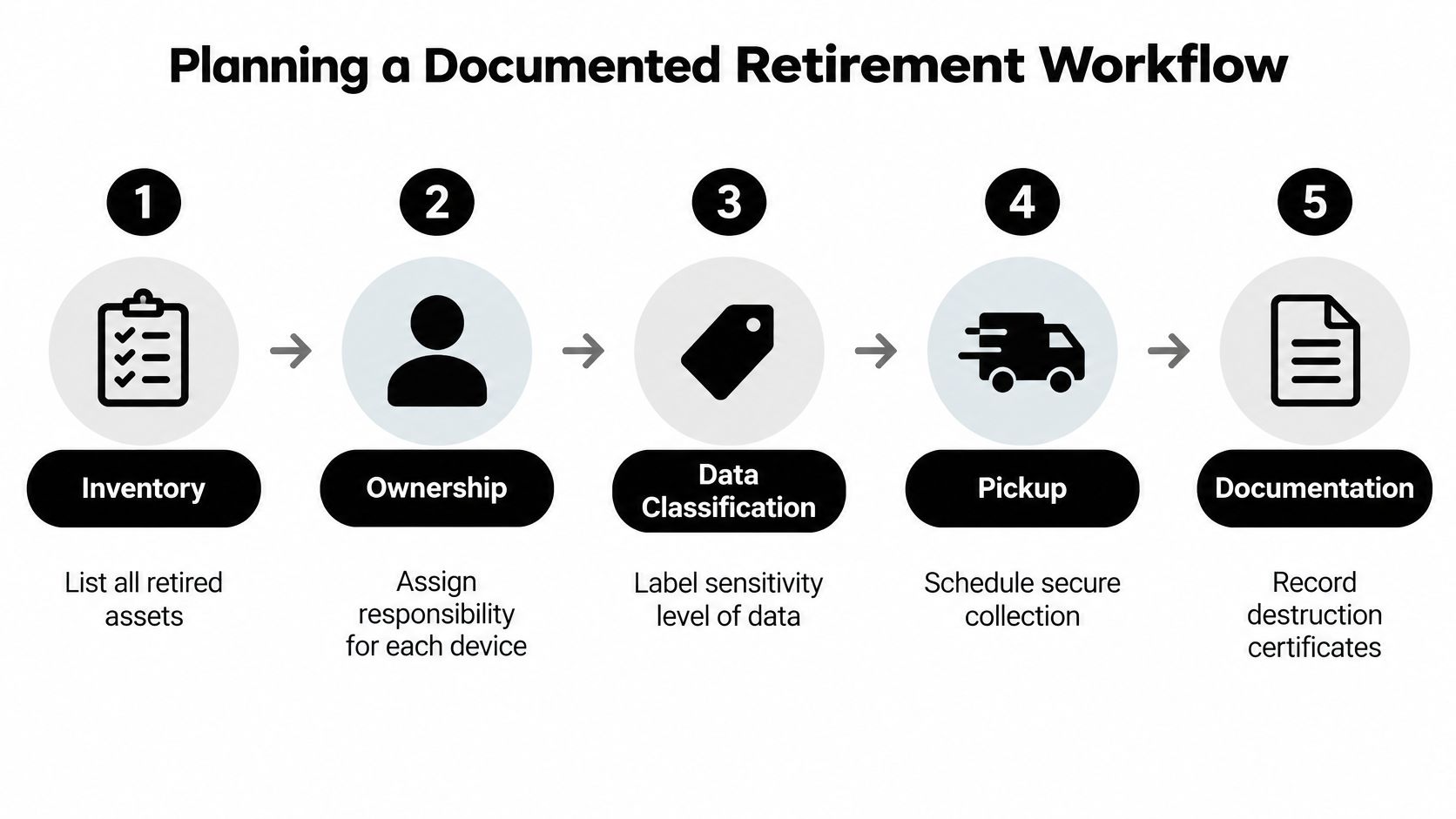
A reliable retirement process begins before a pickup is booked. When IT, security, facilities, and the data owner agree on responsibilities early, the organization can prepare equipment and records together instead of trying to reconstruct decisions after assets have left the site.
Establish ownership and sensitivity
Start with an inventory that identifies each device or media item and assigns an accountable owner. The owner should help classify the information and confirm whether the asset could be reused. A server may contain different data from a staff laptop, while a box of removable media may need its own inventory rather than being treated as miscellaneous equipment.
That classification informs the approved handling route. Record the media type and the reason for selecting a sanitization or destruction method. If the device has failed or can't be reliably accessed, flag that before the service provider processes it.
Control collection and handling
Prepare assets for collection using the agreed inventory and pickup instructions. At handoff, record what the provider receives and preserve the custody trail as equipment moves to a processing location. For larger projects, reconcile received items against the originating inventory rather than relying on a general count.
After processing, review the method, outcome, and verification information. Resolve discrepancies before closing the project. Then route equipment for reuse, donation, or responsible recycling according to the organization's requirements. The disposition record should connect that route to the asset's data-handling evidence.
A useful certificate or equivalent record should identify the relevant assets and media, the method applied, the operator or responsible party, the date, and the outcome. It should also support review of the chain of custody. A certificate that records only a service date doesn't let the organization verify which devices were processed or whether the method matched the plan.
Include logical data stores
Physical drives aren't the only places where organizational data may remain. Before retiring hardware or changing providers, assign owners to consider backups, snapshots, virtual disks, cloud copies, credentials, and cryptographic keys. A physical asset-disposition vendor may handle devices, but the organization still needs to assign responsibility for logical data stores and evidence of their retirement.
The NIST announcement of its media-sanitization guidance revision describes a more program-oriented emphasis, including enterprise governance, validation, vendor trust, and logical sanitization in modern environments. Organizations should account for both physical media and connected data systems in their own retirement process.
Begin planning while the refresh, office cleanout, school equipment change, facility cleanout, laboratory transition, or data center decommissioning project is still being scheduled. Early classification helps teams identify unusual media, assign owners, and arrange appropriate handling before the equipment is ready to leave.
Selecting a Data Destruction Vendor
A vendor's shredder tells you less than its documentation does. Two providers can run identical equipment and still differ widely in how they identify assets, record outcomes, and hand back evidence you can defend in an audit. So evaluate a provider on how it will handle your assets and demonstrate the outcome, not only on the machinery it owns. Ask for a clear explanation of its methods, the media each method suits, how it verifies the work, and what records you will receive. A vendor should also be able to explain how it controls assets from collection through final disposition.
Use a consistent evaluation checklist, such as the criteria covered in this guide to vendor selection criteria for data destruction services:
- Relevant experience: Ask whether the provider has handled your storage technologies and operating environment, such as corporate IT, schools, healthcare, or public agencies.
- Method and verification: Confirm what options are available, how the provider determines suitability, and how it records the outcome.
- Custody and transport: Review collection controls, transfer records, access restrictions, and how the provider reconciles assets.
- Reporting and continuity: Check whether records identify individual assets, and discuss insurance, operational continuity, and escalation procedures.
- Downstream handling: Find out whether devices are considered for reuse, donation, or recycling after data requirements are met, and how those routes are documented.
Pricing follows scope, not a flat rate. A proposal may depend on inventory volume and condition, storage technology, pickup logistics, on-site labor, travel, scheduling needs, secure transport, destruction level, verification, certification, recycling, and equipment recovery. Ask the vendor to explain which factors apply to your project so you can compare proposals on scope rather than a single headline figure.
The right fit also depends on who you are. A small or midsized business may prioritize a manageable pickup and clear asset-level records. Enterprise IT teams may need consistent processes across sites and coordination with internal owners of backups and virtual environments. Schools may be balancing device reuse and donation with student information protection. Government agencies should map each project to applicable internal and contractual requirements before authorizing a method.
For businesses seeking an ITAD partner, Reworx Recycling is a donation-based electronics recycling and IT equipment disposal social enterprise that offers pickups, equipment decommissioning, recycling consultations, technology donation options, and secure hard-drive shredding. Organizations can review its technology donation options, data destruction services, and pickup scheduling when assessing service fit. For downstream handling, the U.S. Environmental Protection Agency's electronics donation and recycling guidance is a starting point for understanding responsible electronics end-of-life choices.
Common Questions and Final Recommendations
Is deleting a file enough for a retired drive?
No. Deleting a file or restoring a device to factory settings doesn't, by itself, demonstrate that information on the underlying media is unrecoverable. Choose and document a suitable sanitization or destruction process for the specific media.
When is shredding more defensible than wiping?
Physical destruction may be appropriate when media are damaged or inaccessible, when the organization can't reliably verify sanitization, or when its assessment finds residual recovery risk unacceptable. A reusable device may instead be suitable for purge when the technology and verification process support that choice.
What should a certificate of destruction contain?
It should let reviewers identify the assets and media, see the method used, understand the recorded outcome, and determine who performed or accepted responsibility for the work. Date-only paperwork doesn't establish which specific devices were handled.
How should we retire cloud or virtual data?
Assign an owner to identify relevant cloud copies, backups, snapshots, virtual disks, credentials, and cryptographic keys. Document who is responsible for removing or sanitizing each data store and what evidence will demonstrate completion. A physical drive certificate can't account for data that wasn't on the drive being processed.
The practical decision sequence is straightforward: classify the data and media, determine whether reuse is realistic, select sanitization or destruction, verify the outcome, preserve asset-level evidence, and route reusable equipment to donation or responsible electronics recycling. A small business can start by assigning an asset owner and keeping a consistent inventory. Enterprise teams, schools, and government agencies should also coordinate the retirement of logical data stores and document how their internal obligations inform each method choice.
Reworx Recycling can help businesses plan equipment pickup, secure data destruction, IT equipment disposal, and donation-based electronics recycling. Visit Reworx Recycling to explore its services and discuss a responsible retirement program that supports community technology access while protecting organizational data.