A laptop refresh is underway, facilities is preparing for an office move, and a storage room is filling with retired monitors, servers, phones, and drives. The equipment may be ready to leave, but the spreadsheet is incomplete: some serial numbers are missing, nobody can confirm which devices held sensitive data, and the pickup plan says nothing about what happens after the carrier takes the load.
That's not just a recycling problem. It's an evidence problem. Before equipment leaves your building, you need to know who owns it, what information it may contain, who takes custody, how it will be sanitized, and what records will prove its final disposition. A defensible business electronics recycling program answers those questions before the first pallet is moved.
When a Hardware Refresh Becomes a Compliance Problem
An IT manager coordinating a 400-laptop refresh can end up making ad hoc decisions under pressure. A department drops equipment in a conference room, facilities labels some boxes, and a vendor arrives before the asset list is reconciled. One laptop is missing its tag. A failed drive gets mixed with devices slated for reuse. Someone says the data was wiped, but there's no record tying the method or result to that device.
The risk isn't limited to a missed recycling receipt. If a device disappears between the office and processor, the business may not be able to show who had custody. If a drive reaches a reuse channel without a suitable sanitization decision, the organization may face a data exposure. If equipment is processed through undocumented channels, the business may also lose evidence of responsible handling.
Before your next refresh, answer the questions that turn a pickup into a controlled process:
- Who owns each asset? Match the equipment to a department or responsible owner.
- What data could it contain? Record the storage media and relevant data classification.
- Who will handle it next? Document each transfer, including internal moves and carrier handoffs.
- What happens to the device? Distinguish reuse, resale, component recovery, material recycling, and residual disposal.
- What proof will you retain? Connect inventory, sanitization records, transport evidence, and final disposition.
The documented global picture shows why that discipline matters. The Global E-waste Monitor 2024 reports 62 billion kilograms of e-waste generated worldwide in 2022, but only 22.3% documented as formally collected and recycled. For your organization, the practical takeaway is direct: don't ask only where the equipment goes. Ask what evidence follows it. Reworx's discussion of the environmental and legal impacts of improper commercial e-waste disposal reinforces why the handoff deserves the same control as any other business process.
What Business Electronics Recycling and ITAD Actually Mean
Business electronics recycling is the planned end-of-life management of workplace technology. It can include collection, data sanitization, refurbishment, resale, component recovery, material recycling, and documented handling of residual waste. The word “recycling” alone is too vague to be a useful performance measure. A device diverted from a dumpster might still be processed through an undocumented route, while working equipment could be refurbished and reused rather than immediately broken down for materials.
IT asset disposition (ITAD) describes the broader operational program for retired technology. Think of it as reverse logistics for IT: equipment moves back through an organized process, with custody controls, data decisions, condition assessment, and reporting. That process commonly includes:
- Inventory and planning. Identify equipment, owners, locations, and storage media before removal.
- Decommissioning. Coordinate shutdown, backups, access removal, and physical disconnection.
- Sanitization. Select a media-appropriate method based on the data and intended use.
- Disposition. Route serviceable equipment toward reuse or resale, and other equipment toward component recovery, materials processing, or residual disposal.
- Reporting. Reconcile the original asset list against the transfers and final outcomes.
This distinction matters in procurement conversations. A recycler may accept equipment, but that doesn't automatically mean it provides a complete ITAD workflow or the records your auditor expects. Ask vendors to explain how they track custody and report each disposition route.
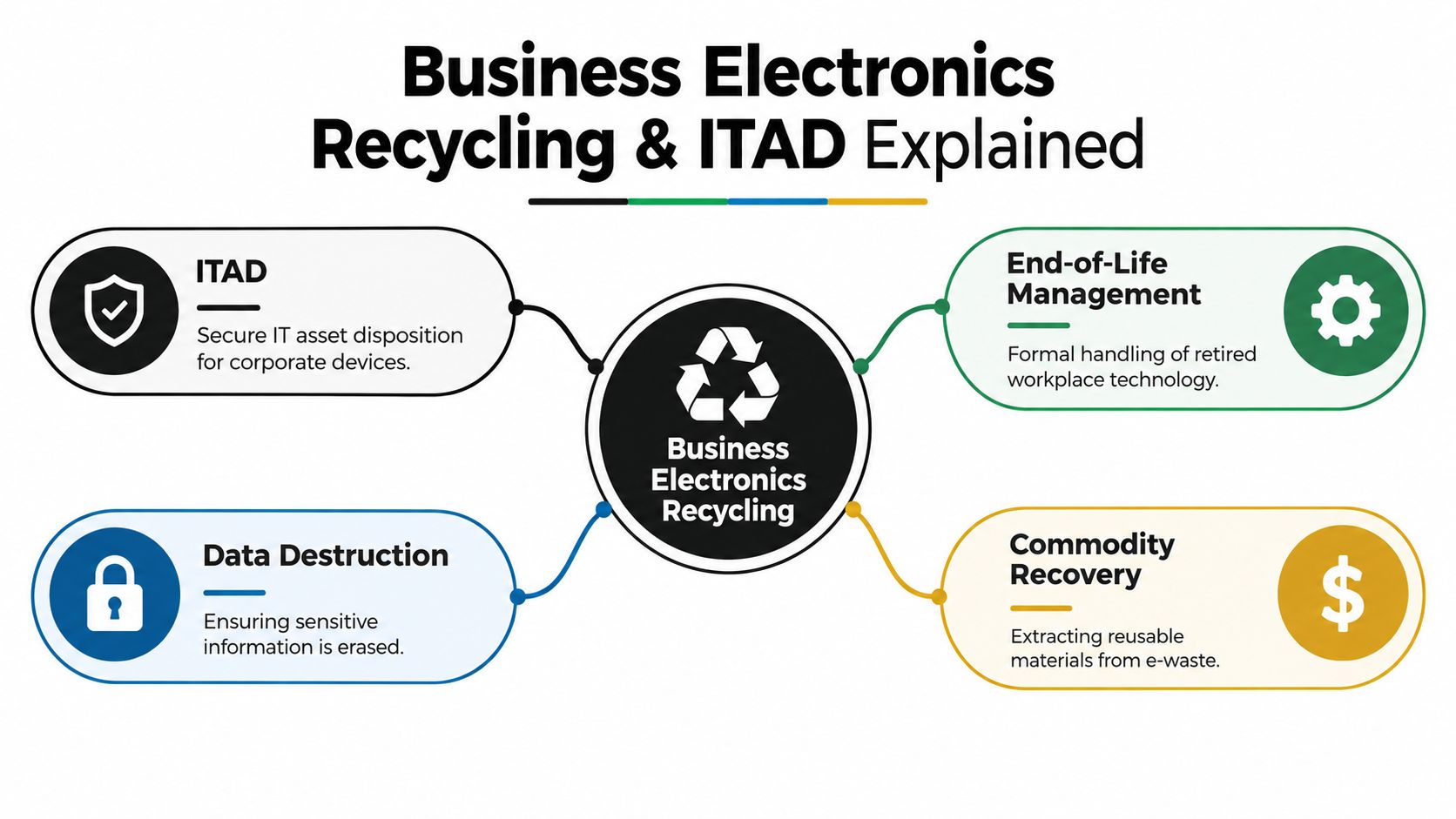
Use the same vocabulary internally. When IT, facilities, procurement, and sustainability teams all distinguish reuse from material recovery and both from disposal, they can set clearer requirements and evaluate results without relying on a single “recycled” label.
Regulatory and Data-Protection Requirements You Must Plan For
When retired equipment leaves your facility, a missing record can become a compliance problem. Your obligations depend on the equipment, the data it holds, where you operate, and the rules that apply to your organization. E-waste requirements vary by jurisdiction, while privacy and records duties depend on the data and sector. Review those requirements yourself; a vendor's standard certificate does not establish that your program complies.
Set a written sanitization standard before the next hardware refresh. NIST SP 800-88 Rev. 2 describes three outcomes: clear, purge, and destroy. Match the outcome to information sensitivity, storage media, and intended disposition. A software overwrite is not automatically suitable for every drive. Solid-state drives use wear leveling and overprovisioning, which can leave data beyond the reach of ordinary overwrites. For reusable media, consider an approved device sanitize command or cryptographic erase when encryption and key management support it. If reliable sanitization is not possible, choose physical destruction and document why.
NIST released SP 800-88r2 on September 26, 2025 (guidance), with greater emphasis on enterprise-wide sanitization programs and alignment with cybersecurity frameworks. Its treatment of cryptographic erase makes key management part of the decision. Specify what staff must do with damaged, encrypted, and reusable media, and require a record of the selected method and its verification.
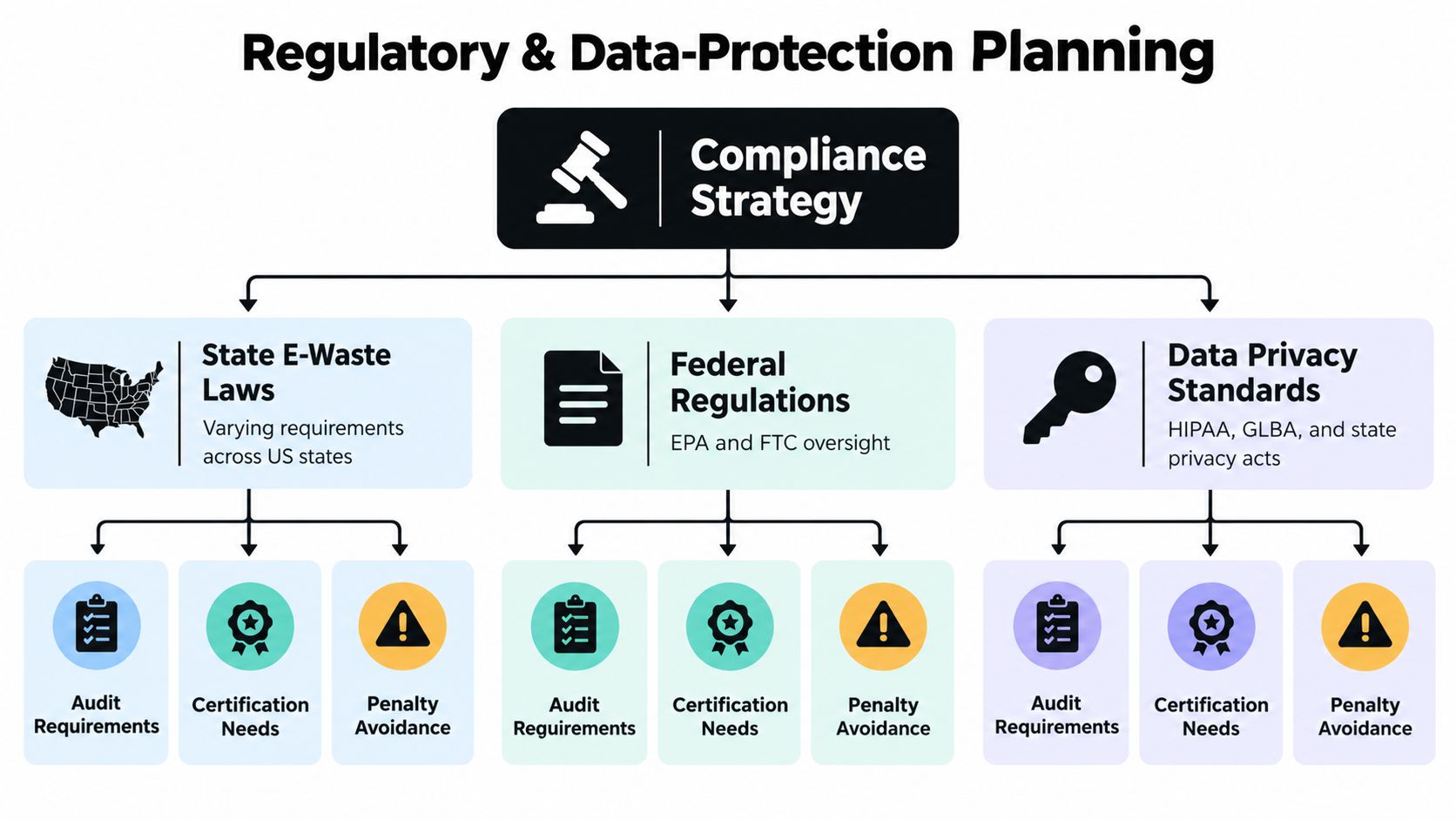
For equipment holding Federal Tax Information, the IRS says ordinary disposal is not acceptable sanitization. Its media-sanitization guidelines call for records of the media processed, processing date, quantity, method, verification, and final disposition. Apply the same evidence-first discipline to healthcare, education, and other regulated environments: map privacy and retention duties to the devices and data involved. Keep the governing policy, sanitization decision, verification results, and disposition record together in a controlled file. Use Reworx's data-security and compliance resources to inform vendor questions, then approve requirements internally before equipment moves. A certificate alone cannot answer what was processed, how, or why that method was chosen.
The ITAD Workflow from Inventory to Final Disposition
A defensible ITAD process is a sequence of accountable handoffs. Each transfer should have a sender, recipient, inventory reference, and record of what happened next. If the asset list stops at the loading dock, the remaining process is a black box.
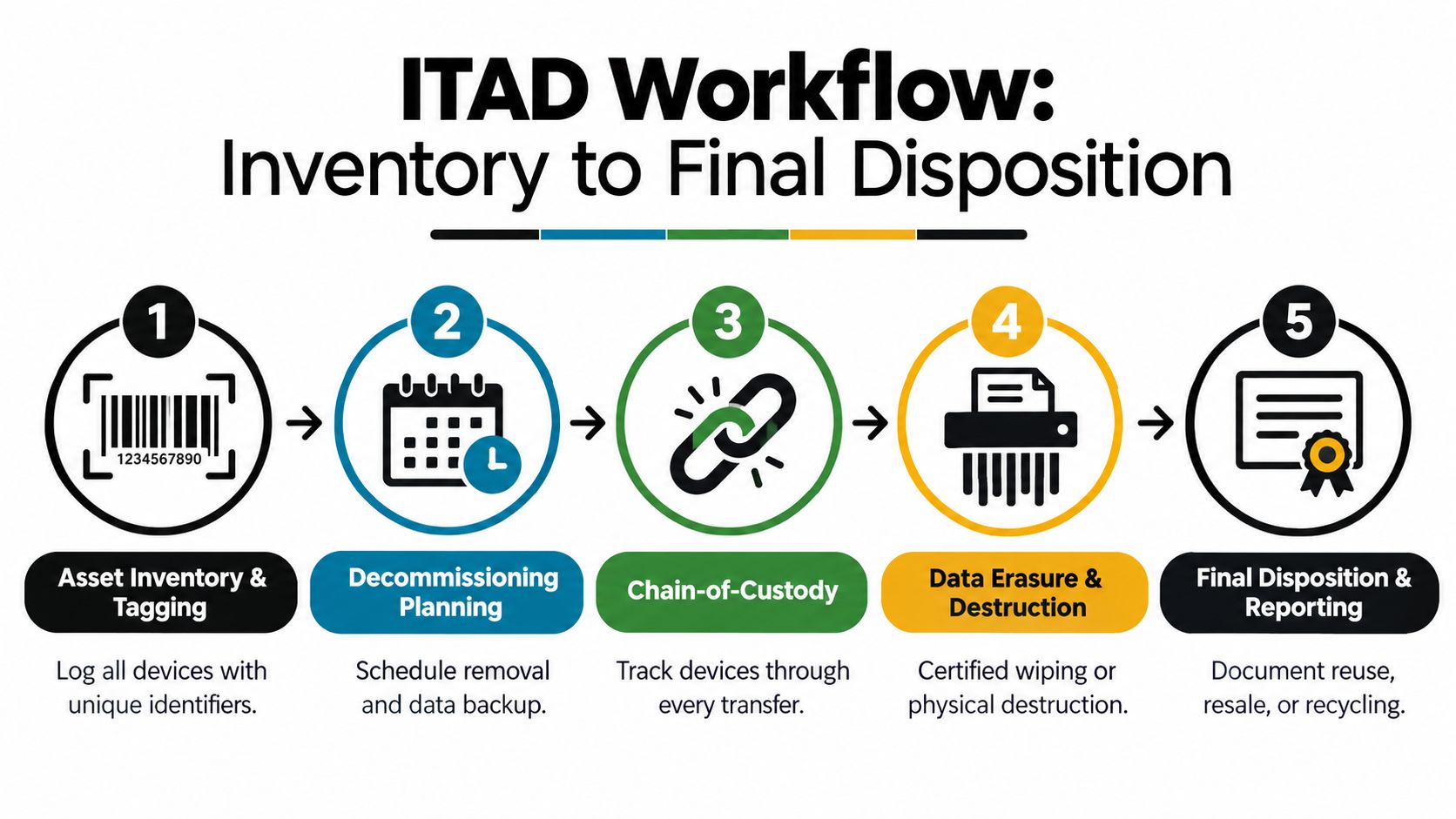
Start with a reconciled inventory. Record a unique asset identifier, serial number when available, equipment type, location, owner, and storage media. A laptop and its removable drive shouldn't become indistinguishable just because they're packed in the same box. If your inventory spans repair operations and retired stock, a system for electronics repair shop software may offer useful context for keeping equipment records and service workflows organized.
Next, plan the shutdown and removal. Confirm which systems need backup, account access removal, or a scheduled outage. Assign responsibilities for disconnecting, packing, and verifying equipment against the inventory. For data center decommissioning, include racks, network devices, storage arrays, and accessories rather than treating servers as the entire project.
At the transfer, create a custody record that identifies the shipment and the parties handling it. Then make a sanitization decision for each data-bearing asset. Record the media type, method, operator or process, date, and verification result. An SSD that may be reused requires a different technical assessment from a failed drive that can't complete sanitization. Don't let either disappear into a mixed batch without a documented exception and approved route.
Finally, record the disposition by category. Reuse, resale, component recovery, material recycling, and residual disposal are distinct outcomes. Reconcile the processor's report with the original inventory and investigate missing identifiers or quantities before closing the job. A certificate is useful, but it should point back to the devices and transfers it covers.
Building an Audit-Ready Chain of Custody
A certificate of destruction describes an outcome. By itself, it may not prove that the right asset was treated with an appropriate method or that the record belongs to the equipment your organization released. Build the evidence around the full journey instead.
| Event | Fields to Capture | Owner |
|---|---|---|
| Asset retirement | Asset identifier, owner, location, equipment type, storage medium, data classification | IT asset owner |
| Sanitization decision | Clear, purge, or destroy decision, rationale, approved method, exceptions | Security or data owner |
| Internal transfer | Sender, recipient, date, asset list, receiving confirmation | Facilities or IT |
| Carrier handoff | Shipment reference, device or container count, transfer date, carrier confirmation | Facilities or logistics |
| Processing | Method, operator or process, date, verification result, failed-media outcome | ITAD processor |
| Final disposition | Reuse, resale, recovery, recycling, or residual route; supporting report | Sustainability or ITAD lead |
If your team wipes devices before pickup, record the tool or approved process, asset identity, result, and any failures. Don't assume that an internal wipe removes the need for the downstream processor's controls. Layered sanitization can be sensible, but two records that disagree about a device's status can undermine confidence rather than improve it.
Practical rule: Every exception needs an owner, a documented decision, and a closed-loop outcome.
Set retention periods through your records policy and applicable obligations, then keep the evidence in a location that can be searched by asset identifier, shipment, and processing batch. Link inventory exports, transport documents, sanitization logs, and certificates instead of leaving them in separate inboxes. A chain-of-custody documentation framework can help you shape a consistent evidence set, but make sure your records reflect your own approved controls and workflow.
Build It In-House or Choose a Vendor
An internal program gives your team direct control over inventory, sanitization, and routing. It also requires the people, tools, training, secure storage, and downstream relationships to do those tasks reliably. If your organization retires equipment frequently and already has qualified staff, internal handling may fit. It still needs clear accountability for failed media, transfer records, and final disposition.
A vendor-led program can be more practical when refreshes are irregular, facilities staff are stretched, or the organization lacks specialist ITAD capability. The trade-off is that you're relying on the provider's process and any downstream partners. That makes due diligence essential, not optional.
| Decision area | In-house program | Vendor-led program |
|---|---|---|
| Control | Direct access to internal assets and procedures | Depends on contract terms, visibility, and reporting |
| Staffing | Requires trained people and sustained ownership | Shifts logistics and processing work to the provider |
| Risk management | Requires internal controls for every handoff | Requires validation of vendor and downstream practices |
| Reporting | Your team must reconcile evidence and disposition | Confirm reports tie to inventory and distinguish outcomes |
Ask prospective vendors how they handle encrypted drives, failed sanitization, missing or unreadable serial numbers, and equipment that can't be reused. Ask where downstream processing occurs, whether subcontractors are involved, and what records you receive. Require reporting that separates reuse and resale from commodity recovery and residual disposal. A vague answer such as “everything is recycled” isn't enough.
Disqualify vendors that can't explain their custody process, can't link processing evidence to your inventory, or treat one certificate as proof for every media type. Use the vendor selection criteria for electronics recycling and ITAD to prepare questions before procurement starts. Reworx Recycling is one option to evaluate for business electronics recycling, pickups, IT asset disposition, and data destruction; compare its documented services with your organization's approved requirements rather than relying on marketing language.
Tailoring the Program for SMEs, Enterprises, Schools, and Government
A small business does not need enterprise bureaucracy. It does need a reliable inventory and a record of each data-bearing device's final disposition. Assign one person to approve retirements, keep a consistent asset register, and choose a pickup or processing route that supplies usable evidence. Next action: check storage areas this week and list every device without a named owner or disposition status.
For enterprises, standardize decisions across sites. Similar devices should follow the same retirement and sanitization process unless their data classification or media condition justifies a different route. Connect approvals to existing security and governance processes, and require local teams and vendors to report in a shared format. Next action: map each facility's transfer process and identify the handoff with the weakest documentation.
Schools and universities must account for student information, shared devices, computer labs, and specialized equipment. Laboratory equipment may include components that need separate assessment. Send only suitable, properly sanitized devices into donation or reuse programs. Before a campus cleanout, coordinate IT, facilities, procurement, and the office responsible for student-data obligations. Next action: pilot a reconciled inventory and disposition record in one department or lab.
Government agencies should link disposal procedures to procurement rules, records policies, public accountability, and the sensitivity of information stored on media. Agencies handling Federal Tax Information have a specific requirement: as noted earlier, the IRS media-sanitization guidelines say ordinary disposal isn't acceptable and call for records of the media, processing date, quantity, sanitization method, verification, and final disposition. Build those records into the disposal file before processing begins, rather than requesting them afterward.
Across all four profiles, scale the workflow to fit the organization without dropping accountability. Capture the inventory, recorded weights, sanitization decisions, and disposition evidence needed to answer an audit question or investigate a breach. A modest process with named owners and reconciled records is stronger than a complicated policy nobody follows.
Measuring Circularity and Partnering for Community Impact
A recycling receipt doesn't tell you whether devices were reused, materials were recovered, or residuals were handled appropriately. Report outcomes separately so sustainability leaders and executives can see what the program delivered.
Track unit counts and weight by equipment category, then assign each asset or material batch a disposition route. Separate refurbished or reused devices from resale, component recovery, material recycling, and residual disposal. Ask the processor to identify downstream destinations and explain how batteries and other regulated components are handled. When a vendor provides a single recycling rate without defining its denominator or the route behind it, treat the metric as incomplete.
The global baseline is a reminder not to confuse collection with successful processing. The International Telecommunication Union reports that 22.3% of the world's 2022 e-waste was documented as formally collected and recycled in an environmentally sound manner. Its circular-economy information on e-waste underscores why businesses should report what happened after collection, not just what left the building. Make avoided-impact claims conservatively and only where you can explain the method and supporting evidence.

Circularity can also include community benefit. A donation-based recycling model may direct suitable equipment toward technology access and digital inclusion, while social enterprise recycling can connect electronics retirement with workforce development. Reworx Recycling's mission combines responsible equipment handling with community impact, so ask how donation eligibility, data sanitization, and downstream reporting fit together before you set a corporate donation program's targets.
Use the impact measurement guidance for electronics recycling to shape reporting around evidence rather than broad claims. Publish the categories you can verify, disclose material gaps, and keep the underlying inventory and processing records available for audit or board review.
Reworx Recycling helps organizations manage business electronics recycling, IT equipment disposal, pickups, and secure data destruction while supporting community-focused technology donation and workforce development. Review its services and educational resources through Reworx Recycling, then contact the team to discuss a pickup or donation partnership for your next equipment retirement.