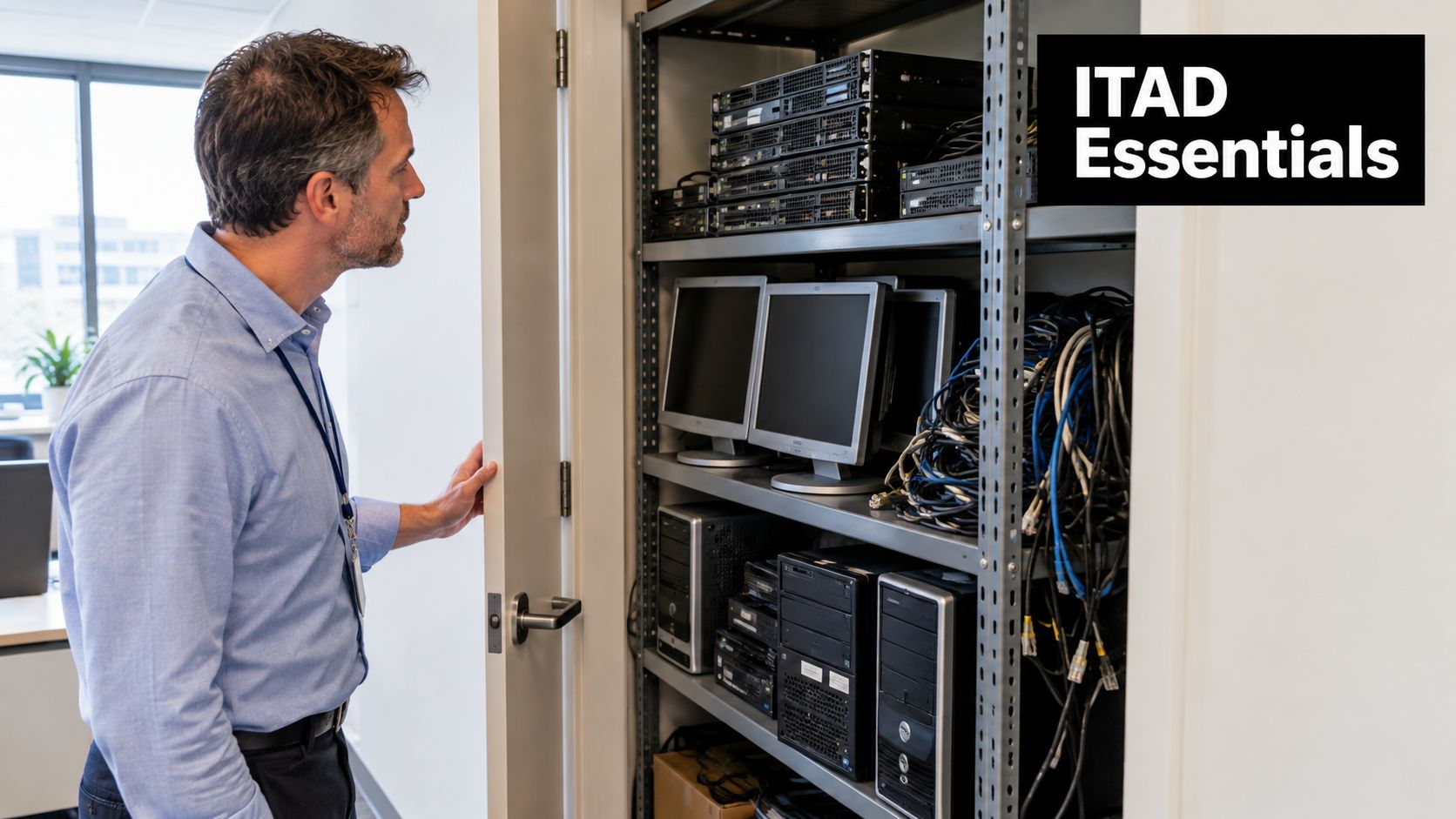
An IT manager opens a storage closet and finds retired laptops, decommissioned servers, old phones, printers, and a box of unclaimed hard drives. Nobody knows which assets still contain data, which belong to another department, or where the equipment should go next. That situation is common, but leaving the devices in place creates both a security problem and a growing disposal backlog.
ITAD services, or IT asset disposition services, provide a controlled path from retirement to final disposition. The process can include collection, inventory, secure data destruction, refurbishment, resale, donation, material recovery, and documented downstream handling. It applies to a one-time office cleanout as well as an ongoing enterprise refresh program.
The need is substantial. The Global E-waste Monitor reported that the world generated 62 million tonnes of electronic waste in 2022, while only 22.3% was documented as formally collected and recycled. The same report projects global e-waste generation will reach 82 million tonnes by 2030, with the documented recycling rate potentially declining to approximately 20% if infrastructure doesn't keep pace. (Global E-waste Monitor information)
ITAD isn't a recycling pickup. It is a governance process that answers five practical questions: What assets do we have, what data do they contain, who controls them during transport, what should happen to each device, and what evidence proves the outcome?
What ITAD Services Actually Cover
A useful ITAD program begins before the truck arrives. The organization identifies retired equipment, confirms ownership, determines whether data is present, and decides whether each item should be reused, remarketed, donated, recycled, or destroyed. That decision matters because a functioning laptop and a failed encrypted drive shouldn't follow the same path.
In practice, ITAD covers five connected responsibilities:
- Collection and logistics: Equipment moves from offices, schools, branch locations, data centers, or employee homes through a controlled chain of custody.
- Asset identification: Staff record serial numbers, device types, condition, ownership, and accessories so the received inventory can be reconciled against expectations.
- Data sanitization: Data-bearing media receives a method appropriate to its sensitivity, technology, condition, and intended destination.
- Disposition decisions: Reusable devices may be repaired, redeployed, sold, or donated. Non-reusable equipment moves into material recovery or regulated waste channels.
- Reporting: The organization receives records that connect each asset to its processing outcome, certificates, downstream destination, and any recovered value.
Why the work belongs to governance
A facilities team can remove equipment from a room, but removal doesn't prove that data was destroyed or that valuable assets were handled responsibly. An IT operations team needs an inventory trail, while security and compliance teams need evidence that sanitization matched the risk. Sustainability leaders need documented recycling and reuse outcomes rather than a general claim that equipment was “handled responsibly.”
This is why IT equipment disposal should be treated as a recurring operating process. It supports laptop disposal, computer recycling, data center decommissioning, medical equipment disposal, laboratory equipment disposal, product destruction, and office or facility cleanout without forcing every asset into the same outcome.
Practical rule: If nobody can identify an asset, its data status, and its final destination, the organization doesn't have a complete ITAD process.
Reworx Recycling is one example of a provider that combines business pickups, equipment decommissioning, secure hard-drive shredding, data destruction, equipment buyback, and electronics recycling. Its donation-based model also connects retired equipment with community impact, including technology donations, digital inclusion, and workforce development.
The Five Stages of an ITAD Workflow
A single laptop makes the workflow easier to understand. Suppose an employee returns a business laptop during a technology refresh. The device shouldn't go directly into a recycling bin or a resale box. It moves through a sequence that assigns responsibility and creates evidence at each point.
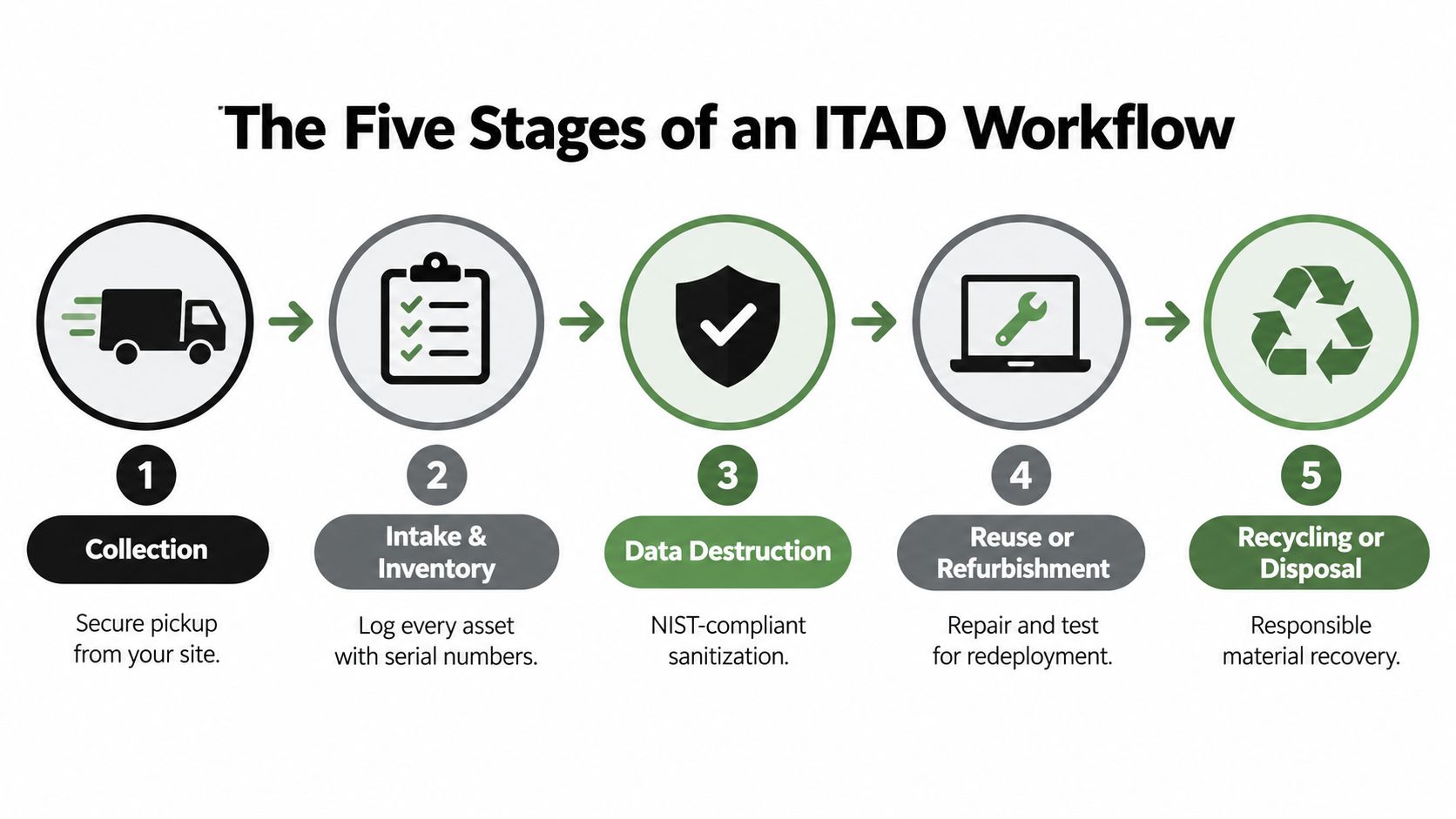
Collection and logistics
The provider schedules a pickup, confirms site access, prepares containers or pallets, and records the transfer. The organization should know which assets are leaving, who released them, and who accepted them. That record protects both sides if the received shipment doesn't match the expected load.
Intake and asset tagging
At intake, the laptop receives an asset record tied to its serial number or another unique identifier. Staff note its model, condition, storage media, accessories, and ownership information. The result isn't just a count of boxes. It's an inventory that can support reconciliation and later certificates.
Data sanitization and re-engineering
Technicians determine whether the laptop can be reused and select a sanitization method that fits the device and data classification. They may then test the battery, display, keyboard, ports, operating system, and other components. A reusable laptop can be refurbished for redeployment, resale, or donation instead of being treated as scrap.
Secure destruction or material recovery
A device with a failed drive, damaged storage, or no practical reuse value may require physical destruction or material processing. Other equipment can be dismantled so metals, plastics, batteries, and components enter appropriate recovery streams. The method should match the asset's condition and intended end state.
Downstream reporting
The final record should show what happened to the laptop, not that it arrived at a processing facility. Depending on the outcome, documentation may include a certificate of sanitization, destruction record, resale or donation record, recycling weight, recovered value, and downstream destination.
A clear workflow also assigns internal ownership. IT confirms the inventory, information security approves sanitization requirements, facilities supports access and loading, procurement manages the contract, and sustainability teams use the outcome data for reporting. Reworx describes the broader lifecycle of business equipment in its IT equipment recycling overview.
How Data Destruction Fits Inside ITAD
Data destruction isn't a simple choice between “wipe” and “shred.” NIST defines three sanitization outcomes: clear, purge, and destroy. The right selection depends on the information's sensitivity, the storage technology, the device's condition, and whether the organization wants to preserve the device for reuse. (NIST media sanitization FAQ)
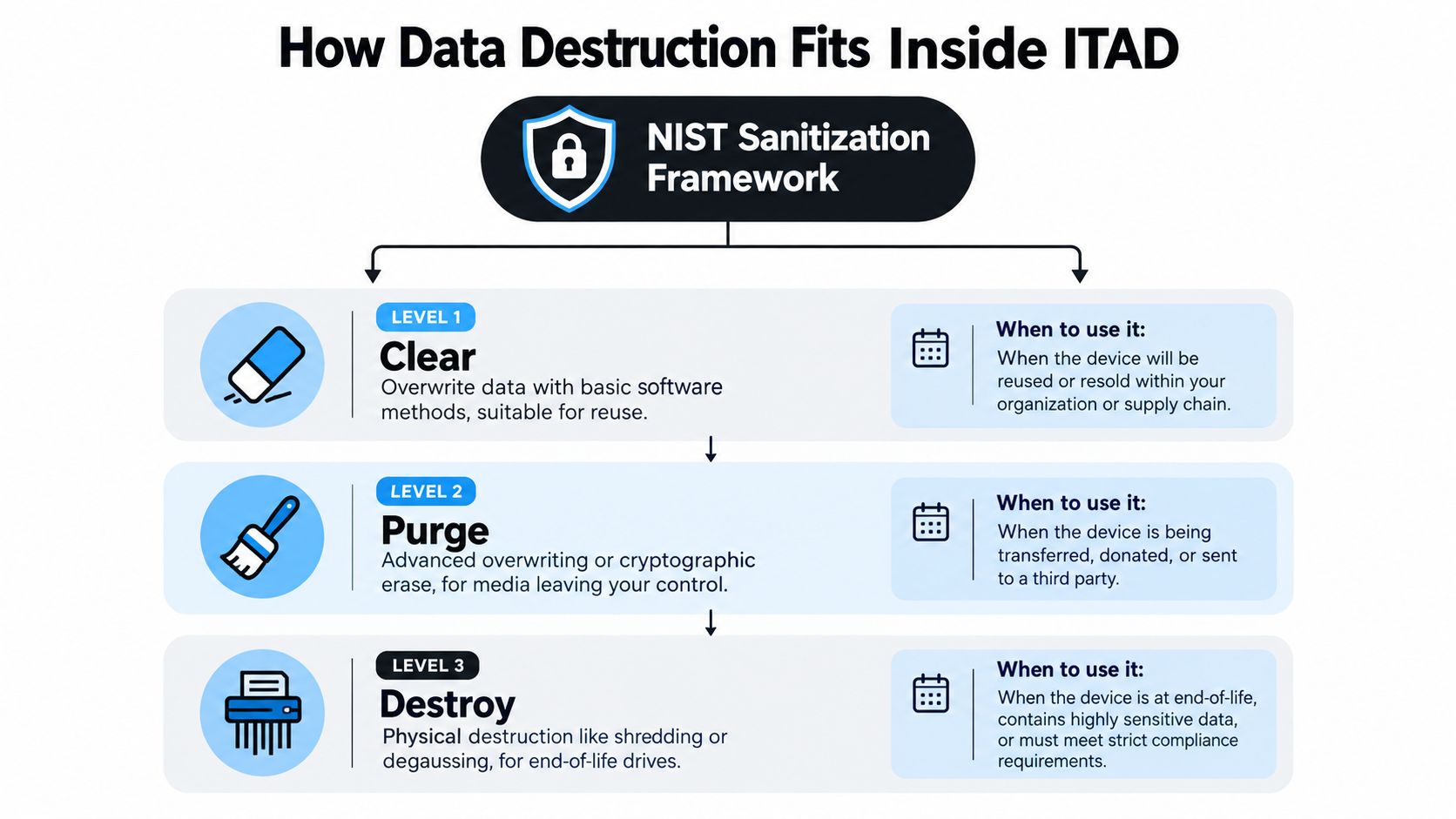
Clear for ordinary recovery risks
Clear uses logical techniques intended to protect against ordinary, non-invasive recovery attempts while preserving the storage device. A factory reset or an appropriate standard read-and-write command may fit a low-risk device that will remain under controlled organizational management, but a basic reset isn't automatically sufficient for every situation.
The team should document the tool, method, asset identifier, operator, completion status, and verification result. If the device contains more sensitive information or will leave the organization's control, clear may not be enough.
Purge when stronger protection is required
Purge uses logical or physical controls intended to make recovery infeasible with state-of-the-art laboratory techniques while potentially preserving the media. Depending on the technology, this can include cryptographic erase or a stronger sanitization method supported by the device.
A purge decision requires technical judgment. Solid-state drives, self-encrypting drives, removable media, and devices with unusual storage architectures may not respond to a generic wipe profile. The provider should explain why the selected method applies to that media type and how it verified completion.
Destroy when reuse isn't defensible
Destroy renders the storage medium permanently unusable. Physical destruction may be appropriate for failed drives, inaccessible media, highly sensitive information, damaged devices, or assets whose condition makes reliable sanitization impossible. Hard-drive shredding is useful in those cases, but destroying every drive by default can eliminate legitimate reuse and recovery value.
A certificate is evidence, not a substitute for inventory control. It proves what was processed only when the organization can show that the correct device entered the process and remained under control.
A defensible record ties the sanitization outcome to the asset's serial number, media type, method, date, operator, and verification. Organizations should also define exceptions in advance. A failed drive shouldn't be forced through a standard software workflow, and an unknown device found in a closet shouldn't be released for resale before its ownership and data status are resolved.
Reworx Recycling describes its secure data destruction services for organizations that need options such as hard-drive shredding and controlled equipment destruction.
Reuse, Refurbishment, Recycling, or Waste
“Send everything to a certified recycler” sounds simple, but it skips the decision that determines the outcome. A working laptop with a damaged charger, a server with resale value, a broken printer, and a swollen battery aren't equivalent materials. They require sorting before processing.
The first question is whether the device can provide useful service after secure sanitization and reasonable repair. A laptop may be redeployed internally, refurbished for donation, or remarketed. If repair costs exceed realistic value, material recovery may make more sense. Equipment containing hazardous components or damaged batteries may require a regulated waste route rather than ordinary recycling.
Start with the asset, not the container
Use condition, data status, ownership records, resale value, and destination to determine the path:
- Redeployment: Suitable for equipment that meets internal technical and security requirements after sanitization.
- Refurbishment or donation: Appropriate when testing and repair can give the device a useful second life for a school, nonprofit, or community program.
- Remarketing: Suitable when the asset has a credible secondary-market value and the organization can document the buyer and data outcome.
- Material recycling: Appropriate for equipment that can't be reused but can be dismantled and processed for recoverable materials.
- Regulated waste treatment: Necessary for items or components that require specialized handling, including certain batteries and hazardous materials.
Basel Convention e-waste amendments took effect on January 1, 2025, expanding prior-informed-consent controls to international shipments of both hazardous and non-hazardous electrical and electronic waste. The change makes cross-border disposition a compliance question, not merely a transportation decision. (Background on the Basel Convention changes)
Why domestic processing can be the better choice
Exporting equipment for recycling isn't automatically the most sustainable option. A shorter domestic route with auditable downstream processing may reduce chain-of-custody and regulatory risk, while documented reuse can preserve more embedded value than immediate material recovery.
The organization should ask whether a device is being transferred as a functioning product or shipped as waste, who becomes responsible when a broker or buyer takes possession, and which shipment and processing records will be retained. A donation or refurbishment pathway may still require data destruction and ownership documentation. The label doesn't remove the need for evidence.
The sustainable outcome isn't always the one that moves material the farthest. Reuse, secure local processing, and transparent downstream handling can be stronger than an opaque export route.
A mixed pallet should therefore be sorted before a final vendor decision. Reworx Recycling's circular economy business model reflects this distinction by separating useful equipment, recoverable materials, and items that require destruction or specialized handling.
Running ITAD as a Defensible Program
A defensible program starts with the inventory, not the certificate. Before pickup, create an expected asset list with serial numbers, locations, owners, media types, and known status. At intake, reconcile that list against what physically arrived and investigate missing, extra, or substituted equipment.
That control is especially important for unknown assets. A laptop found in a branch-office closet may have no current owner, while a drive in an employee's home may never have appeared in the central inventory. Treat unresolved equipment as a security exception until someone confirms its identity, ownership, and data status.
Controls providers should demonstrate
- Serial-level tracking: The provider can show how each asset is logged, scanned, labeled, and matched to its final outcome.
- Chain-of-custody records: Transfer points identify the releasing person, receiving party, date, location, and shipment or job reference.
- Exception handling: Failed drives, encrypted media, removable storage, mobile phones, printers, and cloud-connected equipment receive an appropriate review instead of a generic wipe.
- Component segregation: Batteries and hazardous components are separated from general equipment and routed through suitable channels.
- Downstream transparency: The provider identifies where reusable equipment, recyclable fractions, and regulated materials go.
- Outcome evidence: Certificates and reports connect sanitization or destruction methods to specific devices.
The chain-of-custody documentation process should be clear enough for an IT manager to follow an asset from the originating site through final disposition. A destruction certificate doesn't prove complete risk control if the inventory was incomplete, the wrong drive was processed, or the device changed hands before destruction.
Metrics that make the program accountable
Track reuse rate, recovered-value rate, recycling weight, and landfill-diversion rate. These measures connect operational decisions to financial recovery and sustainability reporting. They also reveal whether the program is preserving useful equipment or sending too much material directly into end-of-life processing.
A good quarterly review compares expected assets with completed outcomes, examines exceptions, reviews downstream records, and checks whether the selected sanitization methods still match current data classifications. That turns ITAD from an occasional cleanup into a repeatable control.
Common ITAD Pricing Models Compared
ITAD pricing becomes easier to evaluate when the buyer separates service cost from asset value. A provider may charge for collection, inventory, testing, data destruction, recycling, storage, reporting, or specialized handling. The equipment's resale value may then offset some costs or be shared under a separate arrangement.
| Pricing Model | How It Works | Best Fit | Watch Out For |
|---|---|---|---|
| Per-asset flat fees | The buyer pays a set amount for each device or asset category. | Mixed office equipment with identifiable volumes and repeatable processing needs. | Categories may hide differences between simple laptops, complex servers, and devices requiring special handling. |
| Per-pound processing fees | Charges are based primarily on the weight of material received. | Large office or facility cleanouts where equipment is mixed and resale value is limited. | Weight-based pricing can obscure data destruction requirements, asset tracking, and the treatment of higher-value devices. |
| Buyback or value-share arrangements | The provider purchases eligible equipment or shares proceeds after remarketing. | Recent laptops, servers, networking equipment, and other assets with credible secondary-market value. | The buyer should define grading, deductions, data responsibilities, title transfer, and the treatment of unsold assets. |
| Bundled managed services | Collection, inventory, sanitization, logistics, reporting, and disposition are combined under an ongoing agreement. | Enterprise refreshes, multi-site programs, and organizations that need predictable operational ownership. | A broad bundle can make it difficult to compare individual costs or identify exclusions for urgent, remote, or specialized work. |
For a one-time office cleanout, a flat project fee or per-pound structure may be straightforward, but ask whether it includes serial-level reporting and secure data destruction. For an ongoing technology refresh, a managed service can reduce administrative work, provided the contract defines service levels, exception handling, downstream evidence, and value recovery.
A buyback arrangement deserves careful review. Ask whether the provider pays before or after inspection, how damaged equipment is valued, and whether the organization receives records for assets that generate no resale proceeds. The cheapest quote can become expensive if it leaves the buyer to reconcile missing devices or arrange separate destruction for excluded media.
ROI and Sustainability Outcomes
ITAD creates value in several forms. Some outcomes appear as resale proceeds or avoided handling costs. Others appear in security evidence, reduced storage burden, recovered materials, landfill diversion, and community access to usable technology.
The material opportunity is large. Global e-waste generated in 2022 contained approximately US$91 billion in recoverable metals, including about US$19 billion of copper, US$15 billion of gold, and US$16 billion of iron, according to the International Telecommunication Union. (ITU e-waste facts)
Connect operational outcomes to leadership priorities
- Finance: Record equipment buyback proceeds, resale revenue, and recovered value by asset category.
- Security: Report completed sanitization or destruction outcomes tied to the asset inventory.
- Sustainability: Track recycling weight, reuse outcomes, landfill diversion, and downstream destinations.
- Community impact: Document donated or refurbished equipment that supports digital inclusion and workforce development.
- Operations: Measure how quickly storage areas, offices, and data centers return to usable condition after a project.
The EPA states that recycling one million laptops saves energy equivalent to the annual electricity use of more than 3,500 U.S. homes. It also reports that recycling one million mobile phones can recover approximately 35,000 pounds of copper, 772 pounds of silver, 75 pounds of gold, and 33 pounds of palladium. (EPA electronics recycling information)
Those figures don't predict the result of a particular office cleanout, but they show why responsible processing has measurable resource consequences. A CFO can evaluate recovered value and avoided costs, while a sustainability director can report material recovery and reuse. A donation-based recycler adds a community dimension by directing suitable devices toward people and organizations that can use them.
Reworx Recycling provides asset recovery services that can help organizations separate reusable equipment from end-of-life material and evaluate potential recovery outcomes.
Choosing a Provider and Next Steps with Reworx Recycling
A provider should answer operational questions in writing, not rely on a general statement about responsible recycling. Before signing, ask for:
- Credentials and capabilities: Which services cover data destruction, computer recycling, medical equipment disposal, laboratory equipment disposal, product destruction, and specialized materials?
- Inventory evidence: How are serial numbers captured, reconciled, and connected to final reports?
- Sanitization decisions: Which clear, purge, or destroy methods apply to each media type, and how are exceptions handled?
- Chain of custody: Who controls assets during pickup, transport, intake, processing, and downstream transfer?
- Downstream visibility: Which facilities receive reusable devices, recyclable materials, batteries, and regulated waste?
- Social impact reporting: Can the provider document donations, digital inclusion, workforce development, or other community outcomes?
- Program flexibility: Can it manage a single office cleanout, a facility cleanout, a data center decommissioning project, and recurring enterprise refreshes?
Reworx Recycling is a donation-based electronics recycling and IT equipment disposal social enterprise based in Smyrna, Georgia. Its services include business pickups, equipment decommissioning, IT asset management, secure hard-drive shredding, data destruction, equipment buyback, recycling consultations, and support for corporate donation programs.
The right next step is to prepare an asset list, separate known data-bearing devices from unknown equipment, identify any batteries or specialized components, and request a disposition plan that explains the proposed outcome for each category. That gives your team a practical basis for comparing providers and protects reuse value without weakening data security.
Businesses, schools, and public agencies can use Reworx Recycling for secure ITAD planning, equipment pickups, donation-based recycling, hard-drive shredding, and responsible material recovery. Visit Reworx Recycling to start a pickup, donate surplus equipment, or discuss an ongoing partnership for safe asset retirement.