You've just been told the lease ends in six weeks, a laptop refresh starts next month, and facilities found three closets of retired servers, monitors, and phones nobody owns. Someone asks IT to get rid of it all, fast. That's exactly when organizations delete a few files, call the cheapest hauler, and discover months later that they can't prove what left the building or where the data went.
Don't run commercial electronics recycling as an emergency cleanout. Run it as a documented disposition program, with a decision for every asset and paperwork that matches. You'll protect data, recover value where it's real, and give procurement and sustainability teams evidence they can defend.
Why Now Is the Moment to Fix Your E-Waste Process
A refresh, office move, or data center decommissioning forces hundreds of small decisions at once. If you haven't decided in advance who approves reuse, who logs serial numbers, and which drives get destroyed, your team will improvise at the loading dock. Improvisation is where data exposure, lost resale value, and missing certificates start.
The scale problem is no longer abstract. The world generated 62 million tonnes of discarded electrical and electronic equipment in 2022, or 7.8 kilograms per person, and only 22.3% was documented as formally collected and recycled, according to figures summarized in the European Commission summary of the Global E-waste Monitor 2024. The same source projects generation could reach 82 million tonnes by 2030 while the documented formal collection and recycling rate could fall to 20% under a business as usual scenario, as noted in that summary.
What breaks when you wait
Retired gear sits in unsecured rooms while staff wait for time to deal with it. Batteries degrade, asset tags disappear, and a drive pulled from a server ends up in a drawer with no record. When an auditor, customer, or insurer asks what happened, a verbal explanation won't hold up.
- No owner: IT, facilities, and procurement each assume someone else approved final disposition.
- No inventory: You can't match a certificate to a specific laptop, server, or phone.
- No sanitization rule: Reusable drives get shredded unnecessarily, while failed drives get a quick format.
Fix the process before the next refresh, not during it. Assign one owner, secure a staging area, and require a serialized record for data bearing assets. Review the environmental impact of electronic waste with your sustainability lead so diversion goals are set before pickup day, not invented afterward for a report.
Practical rule: If you can't produce a serial level record within one business day, you don't have a program. You have a pickup.
What Counts as Commercial Electronics Recycling
Commercial electronics recycling is the structured retirement of business owned IT, audiovisual, telecom, laboratory, and medical equipment through documented collection, data sanitization, reuse or recycling routing, and verified downstream processing. It isn't a consumer drop off event, and it isn't an informal scrap pickup with a handshake receipt. The deliverable is evidence, not just an empty closet.
That scope covers computer recycling, laptop disposal, servers and storage, networking gear, displays, printers and copiers with internal drives, phones, batteries, and peripherals. It also covers medical equipment disposal, laboratory equipment disposal, and product destruction where regulated or branded items can't reenter the market. Each category carries different data, battery, and material handling requirements, so don't price or approve them as one mixed load.
Three pressures you're already facing
First, data and hazardous material rules follow the equipment after it leaves your site. A pickup receipt doesn't prove environmentally sound treatment downstream. Second, sustainability teams need quantities collected, reuse outcomes, and recycling weights for Scope 3 and ESG reporting, not a device count. Third, finance expects you to recover value from assets that still work instead of paying to shred everything.
Formal recycling also matters for resource recovery. In 2022 the global stream contained about 31 billion kg of metals valued at about $91 billion, and formal recycling avoided an estimated 93 million tonnes of carbon dioxide equivalent emissions, according to the ITU page for the Global E-waste Monitor 2024. You won't capture that value if servers, circuit boards, cables, and batteries are thrown together as mixed waste.
Stop saying just recycle it. Specify the outcome per asset class, the sanitization level, and the downstream documentation you'll receive. That's the difference between IT asset disposition (ITAD) as a managed service and disposal as a gamble.
The End-to-End ITAD Process
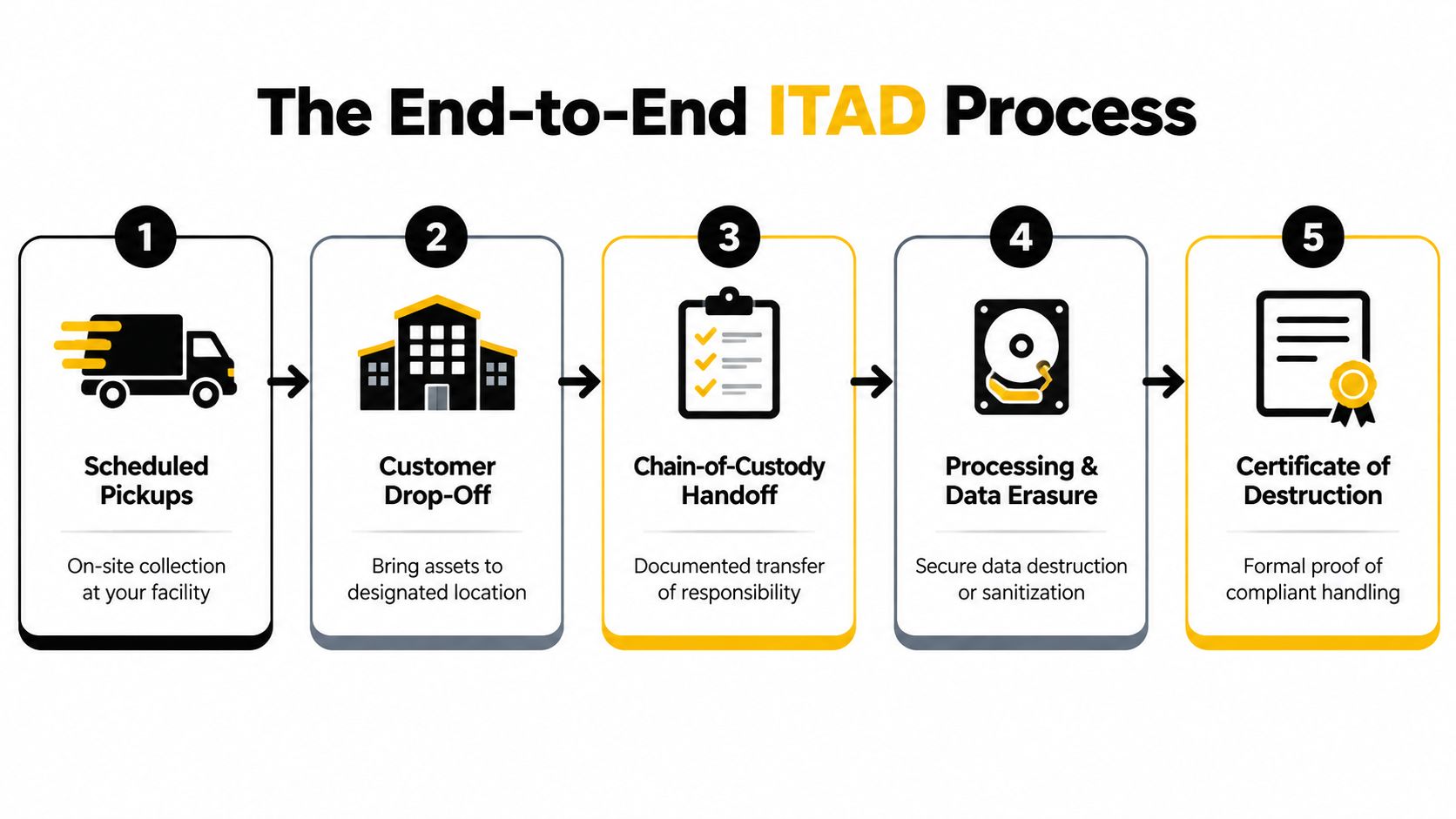
Start with intake, not with a truck. Decide whether you'll use scheduled pickups, customer drop off, or both, then document the chain-of-custody handoff at the moment responsibility transfers. Your staff member releasing the gear should sign against an inventory, not wave at a pallet.
Next comes asset tagging and a serialized manifest. Record asset tag, serial number, make and model, storage type, condition, and location for data bearing and high value items. You don't need serial level tracking for every keyboard cable, but you do need it for laptops, servers, drives, phones, and network appliances that store credentials or logs. An IT equipment audit at this stage prevents the most common certificate mismatch later.
Evidence each stage must produce
- Intake record: Date, site, categories, quantities, and who released and received the load.
- Sanitization log: Method, date, operator, verification result, and serial number for each medium.
- Triage decision: Disposition code showing reuse, resale, refurbishment, dismantling, or destruction.
- Downstream record: Weight tickets and processor documentation by material stream.
- Certificates: Certificates of recycling and destruction that match your manifest, not a generic batch total.
For sanitization, follow the levels in EPA guidance on clearing, purging, and destroying, which distinguishes clearing for ordinary access, purging to resist laboratory recovery, and destroying through methods such as shredding. That guidance also notes file deletion alone is generally insufficient because it removes directory references rather than reliably eliminating underlying data. Delete and reformat aren't a defensible secure data destruction plan.
Close the loop by reconciling certificates to inventory before you pay the final invoice. If counts, dates, or serial numbers don't match, escalate immediately while the vendor can still trace the load.
Reuse, Resell, Refurbish, Dismantle, or Destroy
Recycling isn't automatically the most sustainable or financially rational outcome. Extending a working laptop's life preserves its embedded materials and manufacturing energy, but reuse stops making sense when testing, parts, battery replacement, transport, sanitization, and warranty risk cost more than the device is worth. Make that call asset by asset, and write down why.
Use five inputs every time. Check expected resale value, repair and sanitization cost, battery and software support status, sensitivity of the data last stored, and whether you can trace the asset downstream. If any input is unknown, don't guess. Quarantine the device until IT can identify the storage and condition.
How the decision plays out by asset
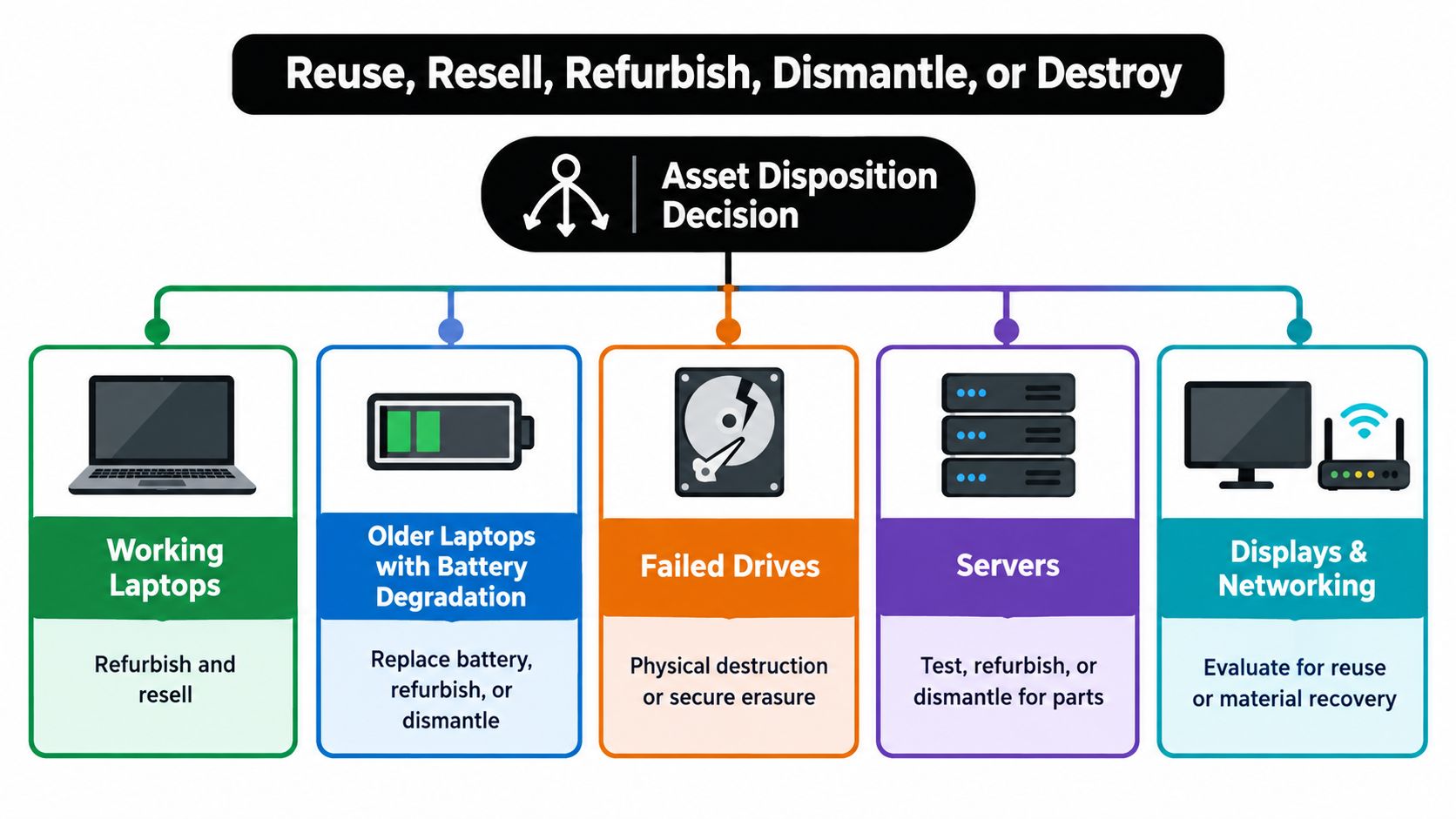
Working business laptops with current software support usually belong in refurbish and resell or donation, after verified sanitization that preserves the drive. Older laptops with degraded batteries need a harder look. Replace the battery only if the tested resale or redeployment value still covers parts and labor, otherwise dismantle for components and materials.
Failed or inaccessible drives can't be verified with a logical wipe, so physical destruction is the defensible choice. Servers are different. Test them, pull reusable processors, memory, and power supplies when full unit resale is weak, and dismantle the rest by commodity. Displays and networking gear rarely hold user files, but switches, firewalls, and copiers can hold credentials and logs, so sanitize or remove storage before reuse routing.
Lab and medical devices, printers, and product returns add regulatory and brand risk. If an item must not reappear in the market, specify witnessed product destruction and keep it out of the resale stream physically, not just on paper. For value recovery options that keep working gear in service, review asset recovery solutions against your own resale thresholds before you authorize a vendor to decide for you.
Don't let a vendor make the reuse versus destroy decision at the dock. Your policy should make it, and the disposition code should prove it.
Every branch needs matching evidence. Reuse needs a sanitization and verification record, resale needs a buyer or channel record, dismantling needs weight by material, and destruction needs method and date tied to serial numbers. Without that link, your sustainability claim is just a narrative.
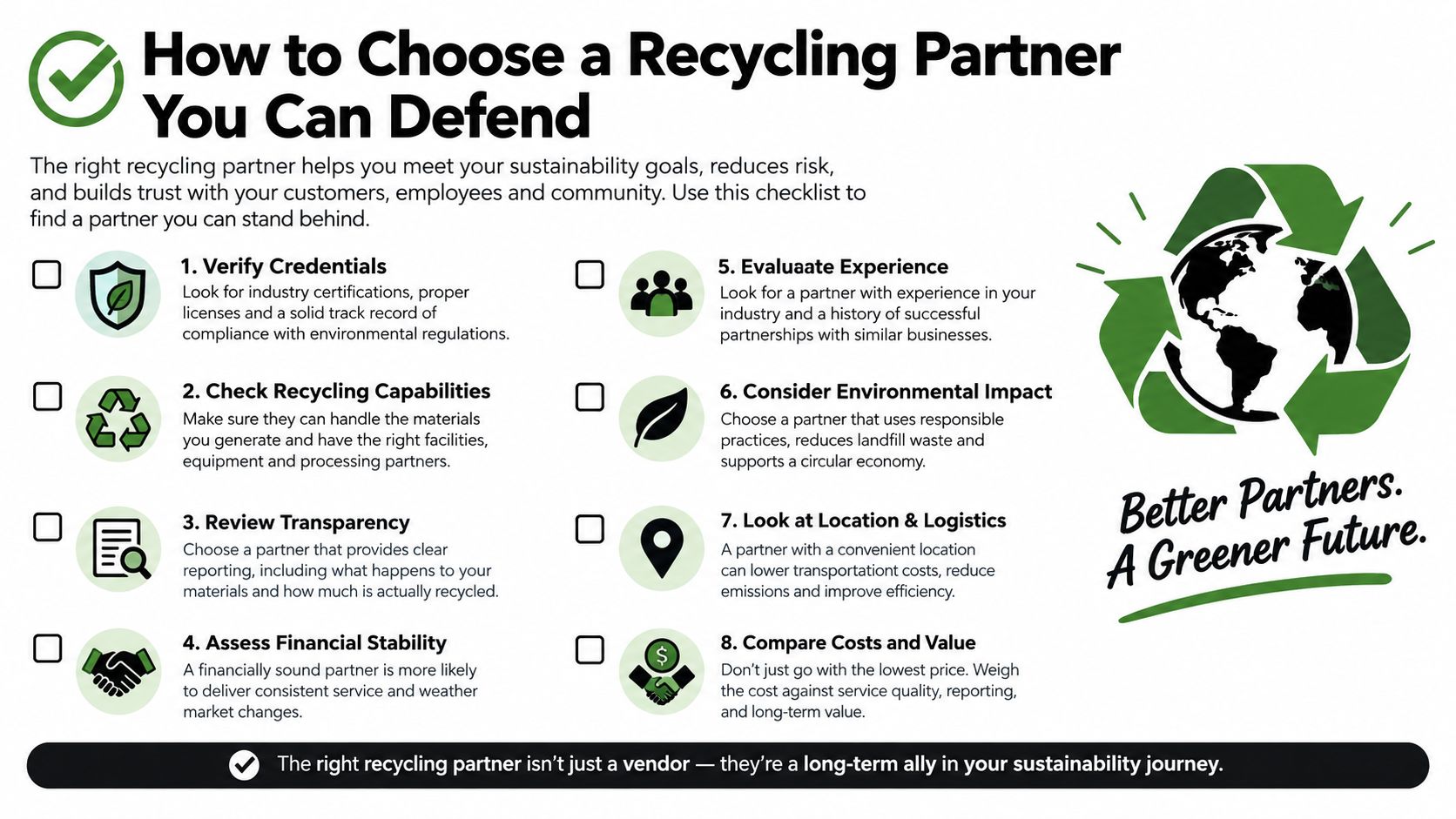
How to Choose a Recycling Partner You Can Defend
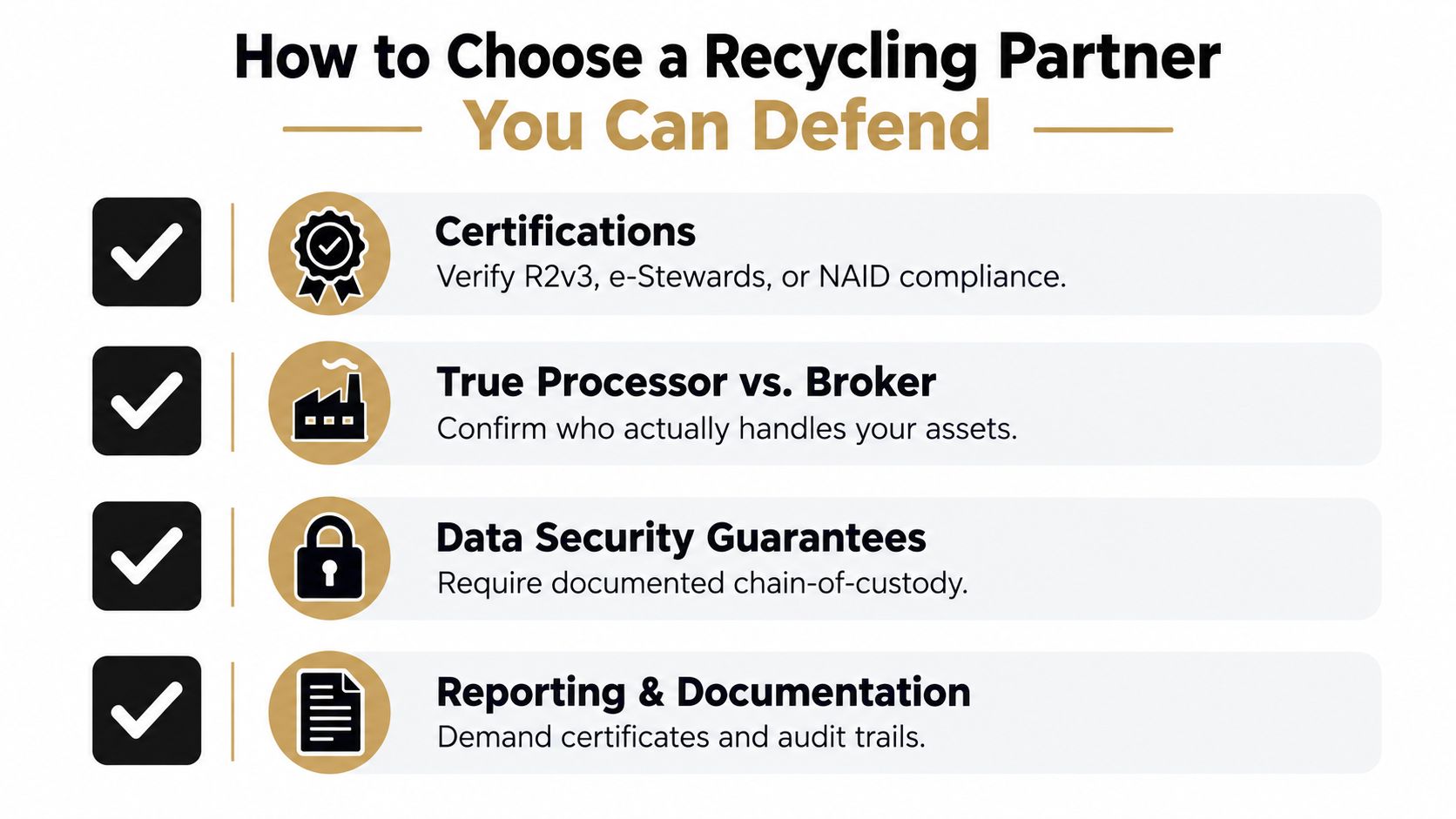
Certification is a starting filter, not a complete answer. Verify R2v3, e-Stewards, or NAID status where relevant, confirm the certificate covers the actual facility handling your gear, and check whether it has expired. Then ask who physically processes batteries, boards, displays, and shredded media after collection.
A broker who only aggregates loads can still be legitimate, but only if they disclose downstream processors and give you material level reporting. If a vendor can't name the final processor for a stream, don't approve that stream. That's especially important now that cross border movement faces tighter scrutiny, and a clean local pickup doesn't prove sound treatment in another country.
Questions to put in your RFP
- Sanitization options: Which clear, purge, and destroy methods do you offer by media type, and how do you verify each one?
- Custody controls: How are containers sealed, transported, staged, and tracked from our dock to processing?
- Reporting package: Will we receive serialized manifests, weight tickets, downstream destinations, and certificates that reconcile?
- Exceptions: How do you handle swollen batteries, failed drives, locked devices, and regulated equipment?
On method selection, align your data classification with approved sanitization choices as described in the NIST SP 800-88 revision 2 FAQ on classification and documentation, which calls for certificates, defined roles, training, and tool controls. Ask vendors to show a sample sanitization log and certificate before you sign, not after the first load.
Walk away from vague recycling certificates, refusal to allow a facility audit, and pressure to shred every drive when verified erasure would preserve reuse value. Compare proposals on evidence quality and downstream transparency, and use electronic recycling certification criteria as one reference point when you score them.
Programs That Work for Offices, Schools, and Agencies
An SMB office cleanout looks simple until you find the former HR laptop, a copier drive, and a box of backup tapes in the same closet. For offices, build the program around refresh and lease return dates, with a secure staging cage and a quarterly pickup cadence. Separate employee trade in devices from infrastructure gear, because phones and laptops need serial level sanitization while docks and cables don't.
A good office outcome is measurable. Facilities clears space on schedule, IT closes every data bearing asset in the inventory system, and finance receives buyback credit only for tested, sanitized units. If you can't close the asset record, the job isn't done, even if the room is empty.
Schools and universities
Schools run on classroom and lab refresh cycles, often across campuses with summer deadlines. That timing is an advantage if you inventory by room before break and stage by building. Student data obligations mean shared devices, staff laptops, and servers need a documented sanitization rule, not a teacher led factory reset.
Donation back and redeployment can extend device life for students, but only after verified erasure and functional testing. Link your refresh calendar to IT asset management for schools so incoming, redeployed, and retired fleets don't get mixed in the same carts. Keep batteries and damaged Chromebooks or tablets in a separate stream from the start.
Government and public agencies
Agencies need stronger procurement and records discipline, especially for multi site pickups and regulated assets. Require downstream disclosure, export classification where relevant, and escalation steps when a vendor can't identify a final processor. Build those terms into the contract, because you can't retrofit them after surplus property has left a warehouse.
Across all three settings, the pattern holds. Inventory first, sanitize by data class, route by condition, and reconcile documentation. Programs fail when each site invents its own shortcut.
The Cost, Value, and Reporting Payoff
Price the whole job, not the pickup. Your real cost includes internal labor to inventory and stage, logistics, sanitization or shredding, special handling for batteries and large equipment, downstream processing, and reporting. A free pickup that returns a one line certificate can cost you far more in audit time and lost resale value than a paid, documented service.
Value recovery starts with triage. The 2022 global e-waste stream contained approximately US$91 billion in metals, including about US$19 billion of copper and US$15 billion of gold, yet roughly US$62 billion in recoverable natural resource value was unaccounted for, according to the UNITAR announcement of the Global E-waste Monitor 2024. Your organization won't see global scale returns, but the principle applies. Working assets and high value boards lose value when they're mixed, damaged, or shredded without a test.
The trade off you must manage
Physical destruction gives strong assurance for failed or highly sensitive media, but it eliminates drive and device resale value and can make material separation harder. Verified erasure preserves reuse and donation-based recycling pathways, but it demands the right method for SSDs versus hard drives and a pass or fail record you can audit. Choose by data class, not by habit.
Reporting check: If your ESG dashboard only shows devices removed, you're reporting activity, not outcomes.
Feed serialized records, disposition codes, and weight receipts into Scope 3, CDP, and internal sustainability reporting. Track reuse rate, material recovery by weight, destruction exceptions, and buyback value per refresh. Review those numbers after every major pickup and tighten the routing rules where you're destroying value or recycling gear that should have been reused.
Getting Started and Partnering With Reworx Recycling
Assign a single program owner this week. Give that person authority across IT, facilities, procurement, and sustainability to set staging rules and stop an undocumented pickup. Without an owner, every department will keep its own closet, spreadsheet, and vendor.
Build a rolling 12 month refresh calendar that includes lease returns, warranty expirations, classroom and lab cycles, and planned facility cleanout dates. Standardize serialized asset tags, decide sanitization levels by data class in writing, and require certificates plus downstream reports for every load. Put those requirements in the purchase order, not in an email thread.
A practical first 30 days
Week one, inventory what's already retired and move it to a locked staging area. Identify data bearing media, swollen or loose batteries, regulated medical or lab items, and anything under legal hold. Don't wipe or destroy anything subject to retention until the responsible team confirms release.
Week two, set your disposition thresholds. Define when a laptop is refurbished, when a server is harvested for parts, and when a failed drive goes straight to destruction. Week three, qualify vendors against the RFP questions above and inspect sample reporting. Week four, run a pilot pickup from one site and reconcile every serial number before you scale to other locations.
Mistakes that keep recurring
- Waiting until lease end: You lose testing time and end up shredding reusable assets to meet a deadline.
- Accepting vague certificates: A batch total with no serials, method, or downstream destination won't satisfy an auditor.
- Ignoring hidden storage: Copiers, network appliances, voicemail systems, and backup devices get missed in rushed office cleanout work.
- Mixing streams: Reuse, destruction, and regulated waste in the same gaylord guarantees errors.
As one option for a managed program, Reworx Recycling provides business pickups, customer drop off, ITAD, secure hard drive shredding, equipment buyback, and corporate donation programs that route suitable technology toward community use. Evaluate it the same way you'd evaluate any partner, on sanitization methods, custody records, downstream disclosure, and reporting quality, and pilot the service before committing multiple sites.
Start with the inventory you already have. Secure it, classify it, decide each asset's path, and require proof at handoff and at final disposition. Do that consistently, and sustainable recycling stops being a slogan in your ESG report and becomes an operational record your IT, legal, and sustainability teams can stand behind. Whether you need a one time IT equipment disposal project or recurring social enterprise recycling support, schedule the pickup only after the documentation standard is agreed.
Donate or retire your surplus laptops, servers, and office electronics through a documented program that combines secure data destruction, responsible material recovery, and community technology access. Schedule a business pickup, arrange a drop off, or start a recurring ITAD and donation program by visiting Reworx Recycling and requesting a consultation for your next refresh or cleanout.