The fiscal close is approaching, and a Phoenix IT manager has a pallet of retired laptops beside a staging area full of monitors, network gear, and equipment from a lab or clinic. The pickup date is penciled in, but the asset list is incomplete, staff still need to confirm which devices hold business data, and nobody knows whether the municipal drop-off route will issue the records procurement requires.
That's the business problem behind electronics recycling in Phoenix. A sound IT asset disposition (ITAD) plan needs to protect data, handle batteries safely, document each transfer, and make clear what will be reused, resold, recycled, or destroyed. The recommendations below are for Phoenix-area businesses, schools, healthcare organizations, and public agencies preparing for a refresh or office cleanout.
Why Phoenix Businesses Are Rethinking Their E-Waste Plans
For an operations manager, a retired laptop isn't just scrap. It may contain customer records, employee information, or credentials. A server or medical device may carry data and contract obligations, while a working computer could still have value for refurbishment or donation. Sending everything out in one undocumented load may clear the room, but it leaves unanswered questions about security, custody, and final disposition.
Phoenix's semiconductor, healthcare, education, and government organizations can retire different kinds of equipment, from office computers to specialized systems. A household collection event isn't designed to resolve every business requirement for a batch of assets. The organization still needs to establish who owns the equipment, whether it contains data, what a vendor will accept, and what proof the vendor will return.
The state-law gap puts more weight on your process
Arizona has no statewide mandatory electronics take-back program or business-specific e-waste recycling requirement. That leaves organizations to build a process around applicable federal hazardous-waste rules, customer contracts, procurement requirements, and internal cybersecurity standards. The absence of a statewide take-back mandate doesn't remove the need to control sensitive data or document what happens to company property.
A practical program starts before the equipment leaves the building. Separate devices with storage media, identify units that contain lithium-ion batteries, confirm who can approve donation or resale, and decide what records finance, security, and sustainability teams need. Don't assume a general recycling receipt will substitute for an asset-level record or a data-destruction certificate.
The operational test: If a device contains business data, a battery, or equipment covered by a contract, treat its retirement as a documented commercial process.
Resolve the questions before the refresh begins
Before the next retirement push, decide whether the load is residential or commercial, one-time or recurring, and whether equipment needs on-site handling or secure transport. Ask how the vendor will identify each asset, document custody, handle damaged batteries, and report reuse or recycling outcomes. If devices might be donated, determine whether they're functional and whether data will be sanitized before they leave your control.
The guide focuses on those practical decisions: which local and federal rules matter, what evidence to keep, how to assess an ITAD partner, and how to plan a collection or year-end push. It also addresses the financial side, including when refurbishment, resale, or donation may make more sense than treating every device as scrap.
Phoenix and Federal Rules That Shape Your E-Waste Program
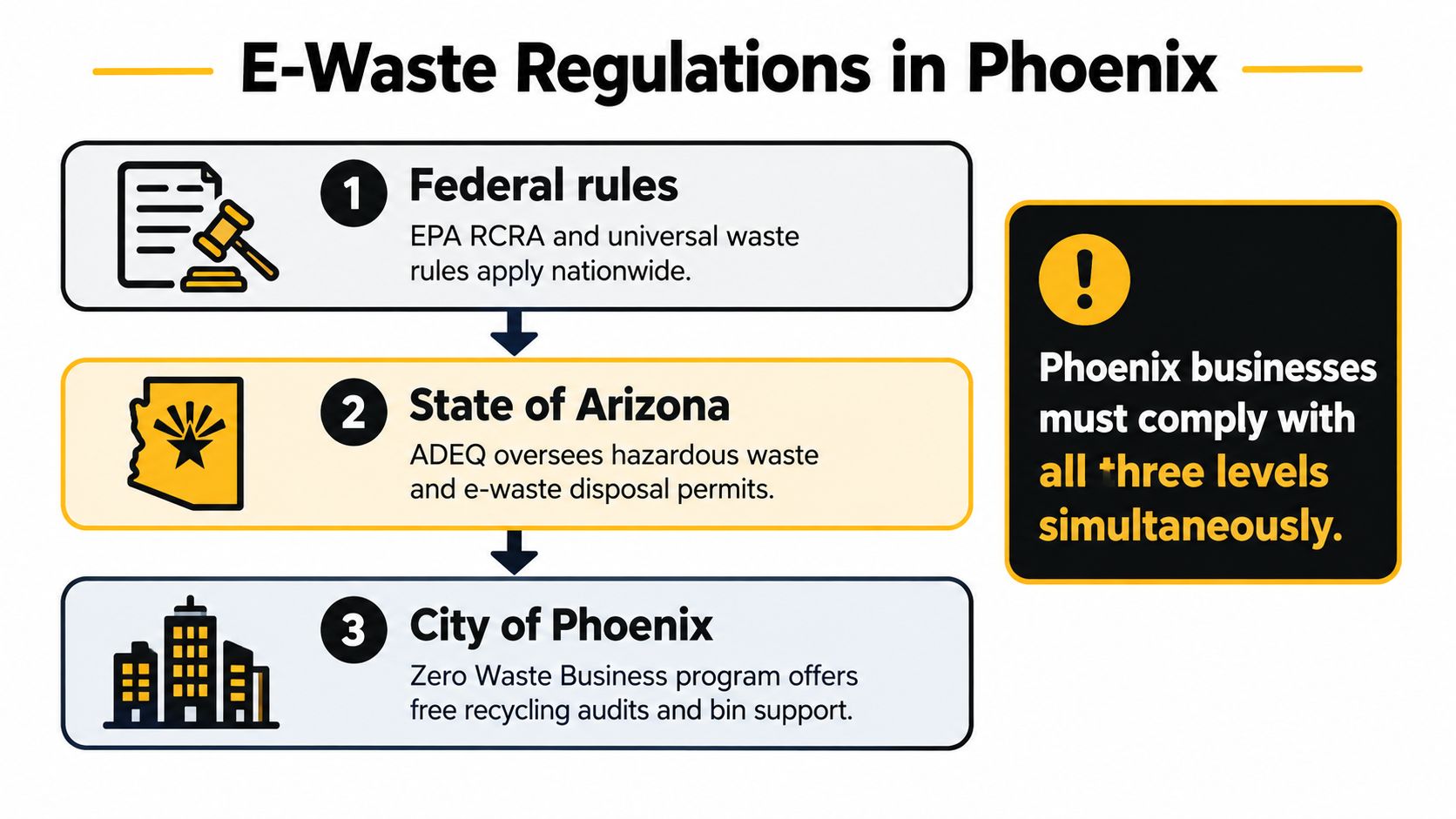
Phoenix organizations operate across several layers of responsibility. The city's Zero Waste Business program provides a local sustainability framework; Arizona has no statewide mandatory electronics take-back program; and federal hazardous-waste rules can apply to batteries and other regulated material. These layers aren't interchangeable, and participating in a municipal initiative doesn't replace your organization's security or recordkeeping requirements.
The City of Phoenix identifies Westech Recyclers as a participant in its Zero Waste Business program, which is designed to collect measurable information on reuse, recycling, and composting that would otherwise be landfilled. The city says Westech has operated in Arizona for more than 25 years, serves more than 3,000 commercial and government customers nationwide, and processes over 5 million pounds of electronics annually. That throughput is the recycler's total, not a Phoenix-only figure. It illustrates why institutional capacity and documented diversion data matter, but it shouldn't be presented as the volume generated locally. Phoenix's Zero Waste Business program and recycler information
Don't mistake a household option for a business program
Phoenix household hazardous-waste guidance is built for residents. The city lists electronics such as computers, hard drives, printers, tablets, monitors, and televisions under specific conditions, but that doesn't establish that commercial loads qualify for the same service or provide the paperwork a business needs. Before sending equipment to a resident-focused program, confirm eligibility, load limits, scheduling, accepted items, and what documentation is available. Phoenix household hazardous-waste collection guidance
For commercial equipment, document the decision even when the eventual route is simple. Record the asset inventory, transfer approval, transportation arrangements, and the receiving party's disposition reporting. The city's separate recycling guidance also recognizes repair and reuse as alternatives to immediate material recovery, including repair of phones, computers, laptops, components, and accessories. Phoenix residential recycling and reuse guidance
Apply EPA battery guidance to the actual intake process
The EPA says discarded lithium-ion batteries should go to certified electronics recyclers, participating take-back retailers, or household hazardous-waste programs. Most end-of-life lithium-ion batteries are likely hazardous waste and may be managed under universal-waste rules until they reach an appropriate destination facility. Don't put loose lithium-ion batteries or battery-containing electronics in municipal recycling or trash. EPA guidance on used lithium-ion batteries
For Phoenix businesses, translate that guidance into an intake procedure: identify laptops, phones, tablets, power tools, e-bikes, and backup batteries; keep terminals from contacting metal; isolate swollen or damaged units; and follow the receiving recycler's packaging instructions. For a business, the working rule is clear: if an item carries business data, a battery, or a contract obligation, document the commercial disposition rather than assuming a resident's free route is suitable. Phoenix-specific recycling and service details are available through Reworx Recycling's Arizona electronics recycling information.
Secure Data Destruction and Chain-of-Custody Controls
Start with an asset list, not a destruction method. Identify which devices contain storage, capture the asset tag and serial number where available, and classify each item as eligible for reuse, sanitization, or physical destruction. Then choose a method that matches the media, the organization's contract terms, and the evidence security or legal teams require.
Match the method to the media
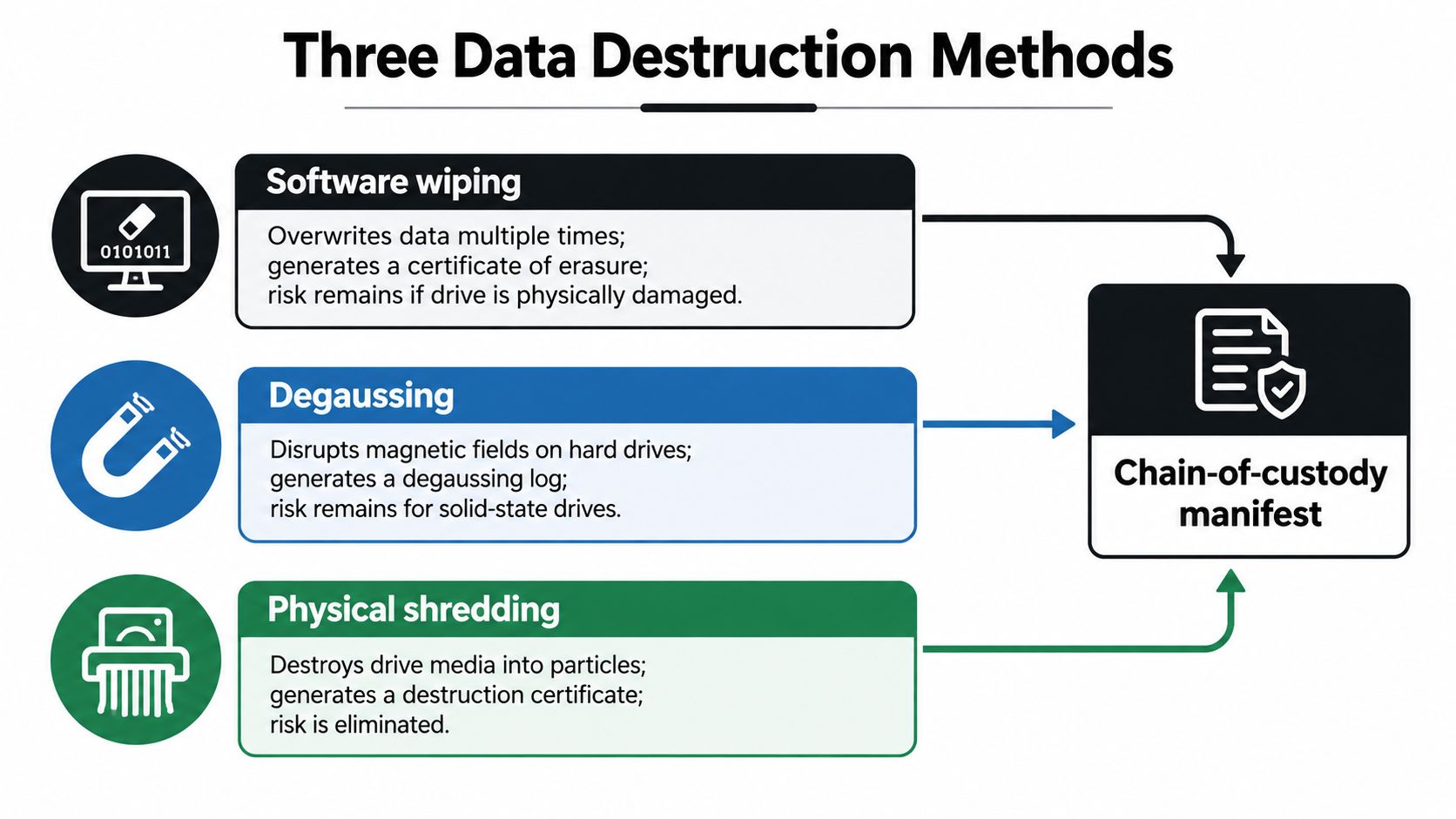
Software wiping uses a tool to overwrite or sanitize supported storage. It can preserve equipment for reuse, but a failed or damaged drive may not complete the process. Keep the sanitization result tied to the specific device and record any exceptions.
Degaussing disrupts magnetic fields on magnetic media. It isn't a universal option for solid-state drives, so don't treat it as a blanket method for a mixed fleet. Capture the media type, degaussing result, and any items routed elsewhere.
Physical shredding destroys the drive media and makes it unavailable for reuse. It may suit equipment that can't be sanitized to the required standard or where the organization requires destruction, but it sacrifices any remaining value in the drive. Keep the destruction record linked to the asset inventory.
Build the evidence trail before pickup
For an auditable process, align sanitization with the organization's approved standard, such as NIST 800-88 Rev.1 where applicable. The record should show which device was processed, which method was used, when it happened, and whether the process completed or an exception occurred. A certificate that only states a batch was destroyed, without tying the work to identified assets, may not answer an auditor's or incident-response team's questions.
Maintain custody from the point equipment is staged through pickup, transport, processing, and final disposition. Ask the vendor for serialized Certificates of Destruction when destruction is selected, plus a manifest that accounts for assets transferred. Make the manifest and destruction records part of the closeout package, not an optional follow-up.
Batteries need a separate stream. The EPA's handling guidance, covered above, means battery-containing devices should be identified and packaged according to the receiving program's directions, not mixed with loose scrap. A recycler must be prepared to receive the relevant battery stream; damaged or swollen units should be isolated and disclosed before transport.
Choose the cheapest method only if it also satisfies the media, contract, and audit requirements. A low processing price doesn't compensate for missing proof or an unsuitable sanitization method.
Ask vendors for written procedures covering software wiping, degaussing, shredding, exceptions, and custody. Reworx Recycling offers secure hard-drive shredding and ITAD services; compare those capabilities with your organization's specific documentation needs rather than assuming every provider's process is the same. For a practical recordkeeping framework, review chain-of-custody documentation for ITAD.
Choosing a Phoenix-Area ITAD Partner That Fits Your Risk Profile
Choose a vendor against your requirements, not a price quote alone. Phoenix businesses should establish what service area the provider covers, whether pickup is available at the facility, how the vendor secures equipment in transit, and how it accounts for every serialized asset. Ask for current certificates and audit scope rather than relying on a logo or a sales summary.
Certifications can help narrow the field, but they don't eliminate due diligence. R2v3 and e-Stewards are responsible electronics-recycling standards with different program requirements. ISO 14001 addresses environmental management systems. NAID AAA relates to secure information destruction. Ask what scope applies to the service you're buying, which facility performs the work, and whether subcontractors or downstream processors are involved.
Compare vendors on evidence and logistics
A Phoenix-area pickup can involve a business site, a school campus, a healthcare facility, or a government building. Confirm the pickup radius in writing, including any remote site or restricted-access location. If your policy requires on-site shredding, ask whether the vendor can provide it, what media it supports, and how the destruction event will be recorded.
Use this table as a shortlisting tool. A “minimum” means a procurement requirement to verify, not a claim that all vendors offer the same service.
| Criterion | Why It Matters | Minimum to Ask For |
|---|---|---|
| Certification and scope | Shows which standards and activities apply to the provider or facility. | Current certificates, scope, covered locations, and any subcontracting details. |
| Maricopa County pickup | Determines whether the provider can collect from each site on the required schedule. | Written service-area confirmation, access requirements, and pickup coordination process. |
| Asset-level reporting | Lets IT and finance reconcile equipment transferred and processed. | A manifest that ties received assets to serials or asset tags where available. |
| Data destruction | Protects information and creates evidence for security review. | Available methods, media limitations, exception handling, and certificate timing. |
| Battery handling | Prevents unsafe mixing and helps route regulated batteries appropriately. | Intake rules for intact, damaged, and swollen battery-containing devices. |
| Insurance and custody | Clarifies responsibility during storage, pickup, and transport. | Current coverage documentation and a written chain-of-custody process. |
| Buyback and donation | Identifies potential value and reuse opportunities before recycling. | Written valuation or disposition terms and records showing which items were reused. |
Municipal and household hazardous-waste programs can be useful for eligible residents, but they may not provide the asset-level serialization, data-destruction evidence, or chain-of-custody records a company requires. That's why “free” can be a poor comparison point: a lower upfront cost may leave your team without the evidence its policies demand.
Keep the shortlist focused. Require written answers, sample reports, applicable certificates, and clear terms for pickup, processing, donation, resale, and exceptions. Compare Reworx Recycling with other providers using the same questions; its services include business pickup, IT asset disposition, and secure hard-drive shredding. A procurement-ready ITAD vendor selection checklist can help keep the evaluation consistent.
Planning a Phoenix Recycling Event or Year-End ITAD Push
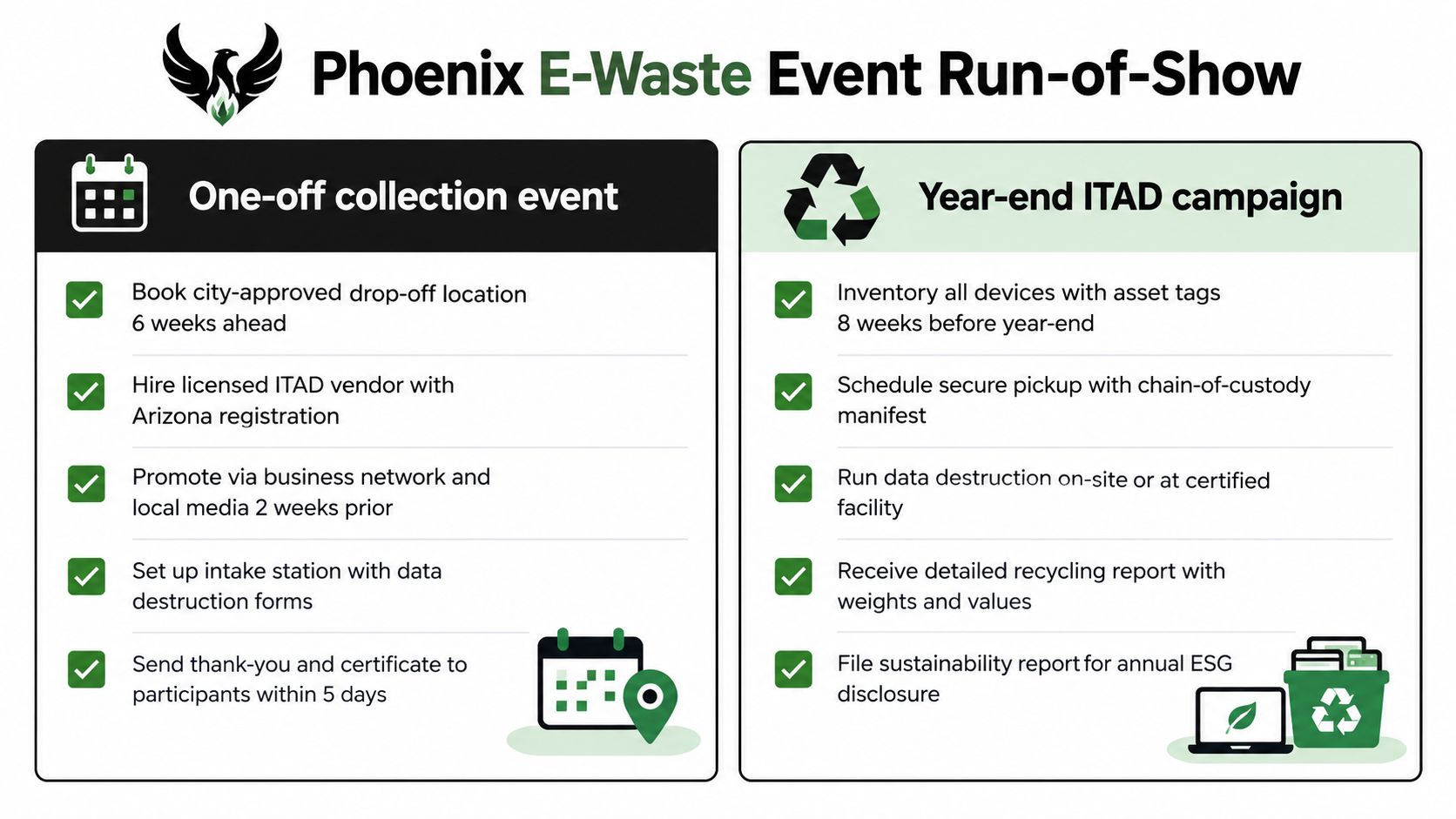
Treat an equipment retirement as an operations project, not a loading-day scramble. The schedule below uses relative milestones so your team can apply it to a one-off collection or a year-end campaign. Assign a named owner for inventory, data decisions, site logistics, and closeout records.
Work backward from the pickup date
Six weeks before: Select the vendor and begin an asset inventory. Include laptops, desktops, monitors, networking gear, servers, laboratory equipment, medical devices, phones, UPS units, and loose or built-in batteries. Note which items contain storage and which may be damaged.
Four weeks before: Notify IT, facilities, security, finance, legal, and sustainability. Confirm the data-sanitization method, whether any devices are candidates for donation or resale, and what approvals are needed before equipment leaves company control.
Two weeks before: Finalize pickup logistics, staging, access, and packaging. Tell employees or event participants what can be accepted and where to bring it. Keep batteries and suspect damaged units identified and segregated rather than adding them to general equipment piles.
During the event or campaign: Reconcile the physical load against the inventory. Have the receiving party acknowledge the transfer, retain the custody manifest, and record exceptions such as missing tags or unlisted equipment.
After pickup: Collect processing, destruction, reuse, and recycling records. Route donation candidates based on condition and sanitization status, then provide finance, legal, security, and sustainability teams the evidence they need.
Adjust for Phoenix conditions and routes
Don't leave equipment in an uncontrolled staging area while teams wait for a convenient pickup. Phoenix's summer heat makes secure, suitable storage and battery segregation operational priorities. Long transport routes can also affect scheduling, so confirm pickup windows and the vendor's handling arrangements early. The EPA's lithium-ion battery packaging and destination guidance applies to the event as well as routine asset retirement.
For event design, separate household participation from commercial asset retirement unless the receiving program confirms both are eligible. Business equipment may require data handling, asset reconciliation, and formal transfer records that a general public drop-off doesn't provide. Keep intake forms and instructions ready at the collection point, and direct staff to flag devices with damaged batteries rather than placing them in a common container.
Teams planning other end-of-life material programs may also find it useful to compare how disposal rules vary by asset type. For example, this guide to NZTA vehicle disposal rules offers context on a different disposal stream, but vehicle procedures don't replace electronics-specific controls.
The event isn't complete when the truck leaves. Reconcile what was collected with what the vendor received, investigate gaps, and file final disposition records where your organization keeps procurement, security, and sustainability evidence. Use a Phoenix e-waste drive planning guide to build a repeatable run-of-show rather than recreating the process for each campaign.
Costs, Buyback Value, and Sustainability Reporting
The lowest quote isn't necessarily the lowest-cost outcome. A business should compare pickup, sorting, data destruction, processing, and reporting costs against the risks and internal labor created by a weak process. Mishandled batteries, incomplete custody records, or a data incident can create expenses that a basic recycling quote doesn't include.
Functional equipment may have a second life. Depending on condition, demand, and the vendor's terms, eligible devices could be refurbished, resold, or donated instead of sent directly for material recovery. Ask for itemized valuation and a disposition record. Don't treat estimated resale value as guaranteed until the provider has assessed the actual assets and put terms in writing.

Make the reporting match the outcome
A sustainability report is stronger when it distinguishes what happened to each category of equipment. Reuse, remarketing, recycling, and destruction are different outcomes and should not be collapsed into a single claim. Capture weights and destination records where available, and ask the provider to clarify whether environmental benefits are direct measurements or modeled estimates.
A local example shows why one diversion figure doesn't tell the whole story. The University of Phoenix reported that its electronics program, launched with ER2 in 2020, had diverted 1,080,918 pounds of electronic and technology waste from landfills by May 2026 and donated 204 devices to students, with donated equipment valued at more than $58,000. Its reported modeled benefits included 10,645.91 pounds of toxins diverted, 125,040.63 pounds of metals conserved, 516,083.78 pounds of greenhouse-gas reductions associated with computer production, and 58,900.90 gallons of water saved. The university describes these as calculated environmental benefits tied to processed equipment, not direct measurements of every avoided emission or water use. University of Phoenix sustainability and e-waste program results
For your own reporting, collect records that support each category: devices reused, assets remarketed, material recycled, and media destroyed. Where an environmental metric is modeled, label it as such and keep the underlying vendor report. A disciplined ITAD process supports both cost review and sustainability reporting because the same inventory and disposition records underpin each.
Businesses building a wider waste-reduction effort can also consult these practical zero waste tips, then translate the ideas into controls that fit their own facilities. For equipment retirement, start with the documented asset disposition rather than a broad claim about impact. Reworx Recycling's cost-recovery strategies for ITAD can help frame the discussion of resale, donation, and processing costs without assuming every device has recoverable value.
Your Phoenix ITAD Action Plan and Next Steps
Before equipment leaves your Phoenix site, have procurement and IT confirm the vendor, pickup scope, and required disposition records. Then give security and facilities a shared checklist:
- Inventory the assets: Record asset tags or serials where available, note storage media, and identify battery-containing or damaged devices.
- Approve the data method: Specify which equipment will be sanitized, degaussed, or physically destroyed, and request device-linked evidence.
- Document custody: Keep the transfer manifest, pickup acknowledgment, and any exception report with the retirement record.
- Segregate batteries: Follow EPA guidance and the receiving program's packaging instructions. Don't put loose lithium-ion batteries or battery-containing electronics in municipal recycling or trash.
- Close the reporting loop: Collect records showing reuse, resale, recycling, and destruction, then route them to finance, security, legal, and sustainability.
Reworx Recycling works with businesses, schools, and public-sector organizations on electronics recycling, equipment pickup, and ITAD, with options for secure hard-drive shredding and equipment recovery. Evaluate those services against your organization's security, logistics, and documentation requirements, and decide before the year-end push which devices may be suitable for community-focused donation and digital inclusion.
To move from plan to pickup, Reworx Recycling can help your team discuss business equipment retirement, collection logistics, and responsible disposition. Contact the team to plan a pickup or recycling event, or to assess a custom ITAD engagement for your Phoenix operation.