A technology refresh has left your team with a stack of laptops, a retired server, and equipment from a lab move. The devices are no longer in use, but they may still contain company data, and nobody has confirmed what can be reused or where the rest will go. The office needs the space back. Sustainability wants evidence of responsible handling. IT needs a process it can defend.
That's not just a recycling job. IT asset recycling is a chain-of-custody and disposition decision, balancing data protection, reuse, materials recovery, and compliance. The right workflow gives every device a documented route, from collection through its final outcome.
When a Stack of Old Laptops Becomes a Real Problem
An IT manager at a mid-sized company inherits a refresh project after a department move. The laptops are piled in a locked room, several servers are waiting to be removed from a rack, and a lab has boxed up aging equipment. A facilities deadline is approaching, but no one has a complete inventory or a reliable record of what's on each drive.
The first instinct may be to book a pickup and ask for a recycling certificate. That solves the immediate space problem, but it doesn't answer the questions the business will face later. Which devices contained sensitive information? Were they wiped in a way appropriate to their storage media? Did any equipment have resale or donation value? Can the company show where assets went after they left the building?
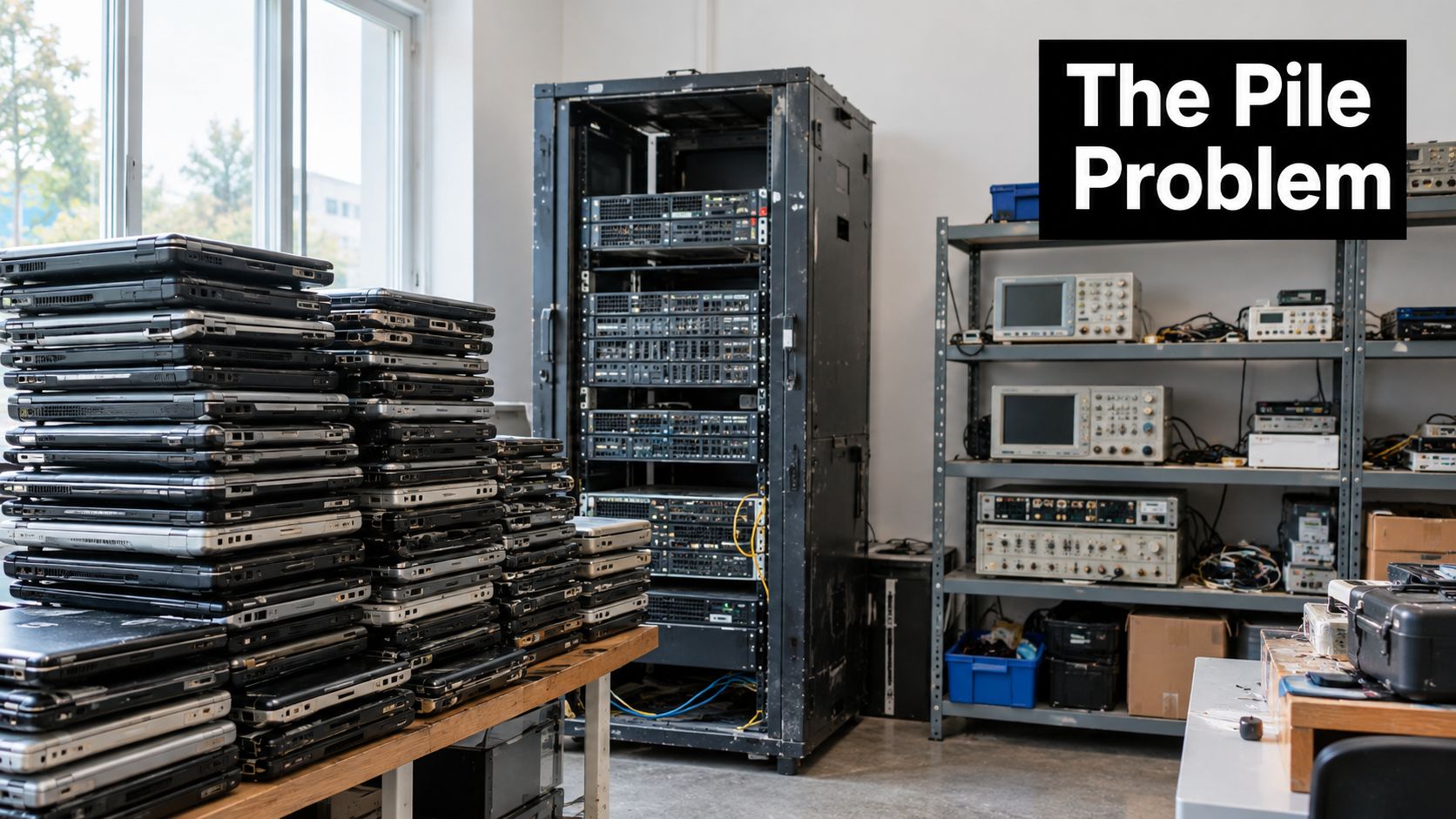
A generic e-waste drop-off doesn't resolve those decisions. IT asset disposition (ITAD) requires the organization to manage the device as an asset with a history, data risk, and possible second life, not just as scrap. A working laptop may be suitable for internal redeployment or donation after verified sanitization. A failed drive may need an approved destruction route. Equipment that can't be reused still needs responsible downstream processing.
Before devices move, the team should establish who owns the inventory, who approves sanitization methods, and what proof the vendor must provide. An asset audit can help identify equipment, storage media, and gaps before collection, as outlined in this guide to IT inventory audits before recycling.
Treat the pile as a controlled disposition project. Security, sustainability, facilities, and finance all have a stake in its outcome. A pickup is only the logistics step. The work is deciding, documenting, and verifying what happens to each asset.
What IT Asset Recycling Actually Means
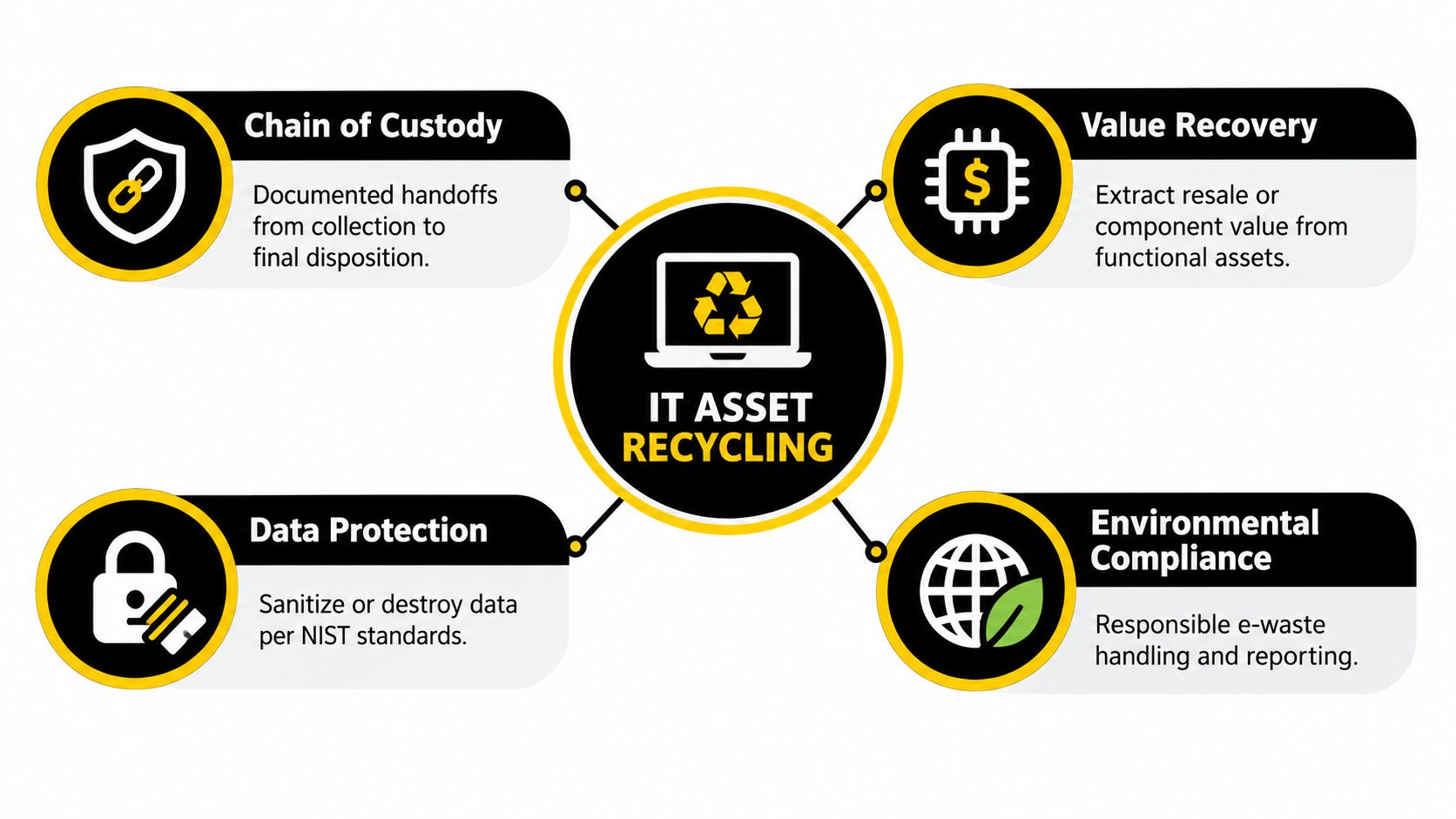
IT asset recycling is a documented process for retiring technology, not a synonym for dropping electronics at a collection point. It covers custody, inventory, data sanitization, condition assessment, reuse or parts recovery, and final recycling. The organization is buying a controlled route through those decisions, not just the removal of equipment.
Consider a mixed office cleanout containing working laptops, a server with failed drives, monitors, and networking equipment. The laptops may be tested and prepared for reuse after the data is securely sanitized. The server's storage media may need a different method from its reusable chassis or components. Monitors and other non-data-bearing items still need inventory and responsible downstream handling.
The process is more than a recycling certificate
A chain of custody records handoffs and keeps assets identifiable as they move from the organization to the processor and onward to their final outcomes. Inventory connects those handoffs to specific devices, ideally by serial number or another unique identifier. Sanitization addresses data before reuse or recycling; the method must fit the storage media and the information's sensitivity. A downstream processor is another organization that handles equipment or recovered materials after the initial service provider, so the customer needs visibility into that route as well.
These controls distinguish ITAD from a basic e-waste collection. A certificate that only lists a shipment or weight can't, on its own, show which drives were sanitized, which assets were reused, or where residual materials were processed. Ask for reporting that ties each device to its documented disposition.
Judge the service, not the label
A provider may describe itself as a recycler, refurbisher, or ITAD partner. Those labels aren't enough to establish whether it can handle your inventory securely and transparently. Ask what happens to a laptop that can be refurbished, to a drive that fails sanitization, and to parts that have no reuse value.
Businesses working through restructuring or asset sales may also find it useful to review broader liquidation resources for advisors when planning equipment disposition alongside other business assets. For recycling decisions, the practical question remains the same: can the provider account for each device from pickup to final outcome?
The End-to-End Disposition Workflow
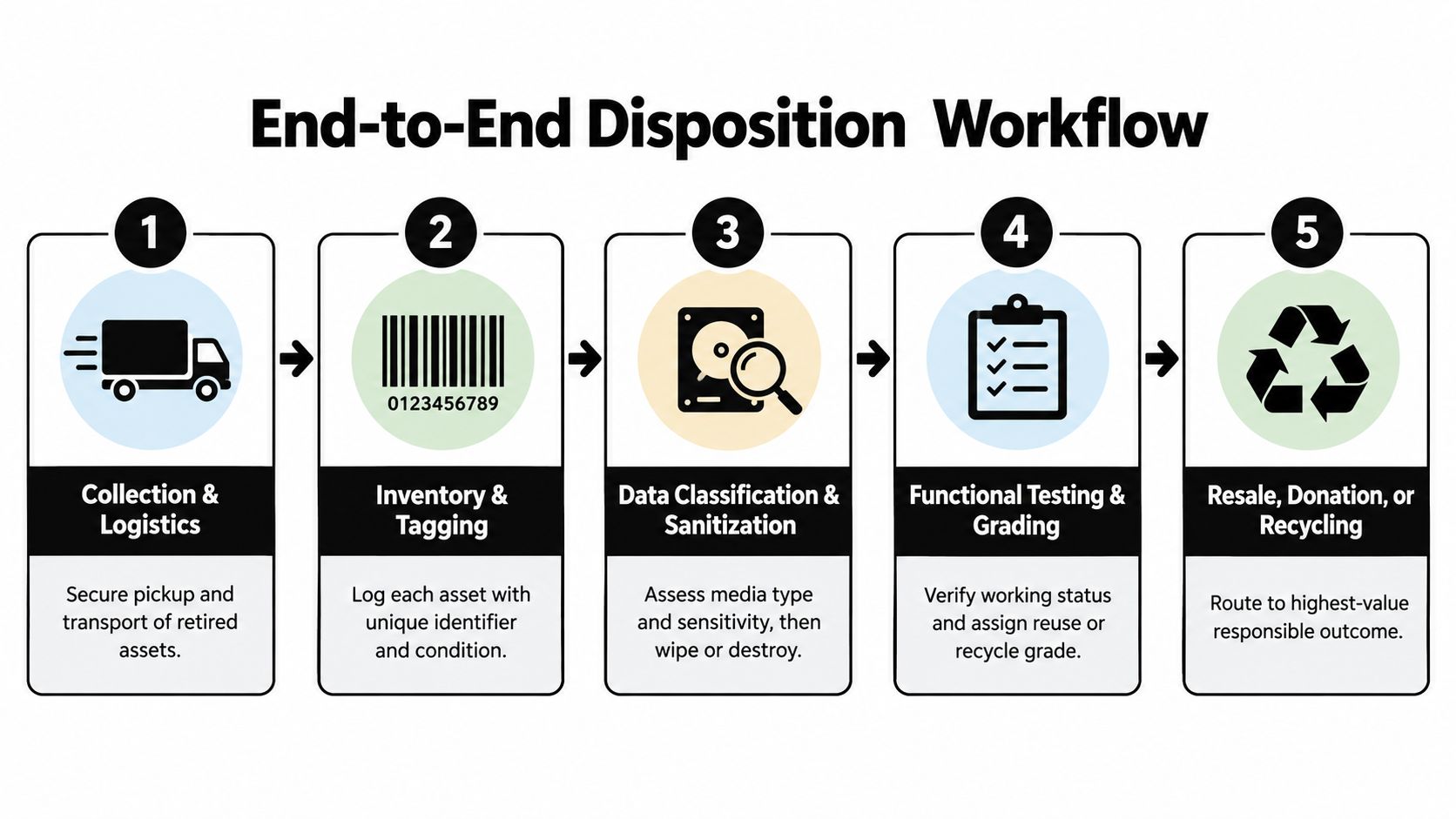
A responsible disposition workflow begins before the truck arrives. The organization identifies what it intends to retire, decides who can release equipment, and sets expectations for handling, tracking, and reporting. After that, each device takes a route determined by its data-bearing components, condition, and reuse potential.
Follow the handoffs, not just the pickup
Collection and logistics. The team agrees on what will leave, who can release it, and how the load will be handled. At handoff, record the pickup and transfer of custody. For multiple sites or a data center decommissioning, reconcile shipments to the location and project they came from.
Inventory and tagging. Capture device identity, type, and condition as the assets are received. Serial-number-level tracking helps match equipment to later wiping, testing, resale, donation, or recycling records. If a device label is unreadable or an asset is missing from the original list, record the exception rather than dropping it from the report.
Data classification and sanitization. Determine which equipment contains storage media and what level of data protection is required. The selected method should be appropriate for the device and information, and the verification result should be tied to the asset record. Failed or unsupported media needs a defined alternate route.
Functional testing and grading. Testing separates working equipment from repairable, parts-only, and end-of-life items. A functioning laptop may qualify for reuse; a failed server may still contain recoverable components, but its drives remain a separate data-control decision.
Resale, donation, or recycling. Route reusable equipment to internal redeployment, donation, or resale only after required sanitization and checks. Harvest useful parts where appropriate. Send non-reusable material for documented recycling, with records that identify the processing outcome and downstream handling.
Expect exceptions and document them
The workflow isn't identical for every asset. A tested laptop, a server with unsupported storage, and laboratory equipment with specialized components can't be assigned the same route by default. The handoff record should make clear what changed, who approved the exception, and what evidence supports the final disposition.
For organizations that need help planning collection and movement between sites, Reworx reverse logistics services are one option to evaluate. In any arrangement, require a final reconciliation that accounts for received devices, exceptions, and disposition records.
Matching Data Sanitization to Media and Sensitivity
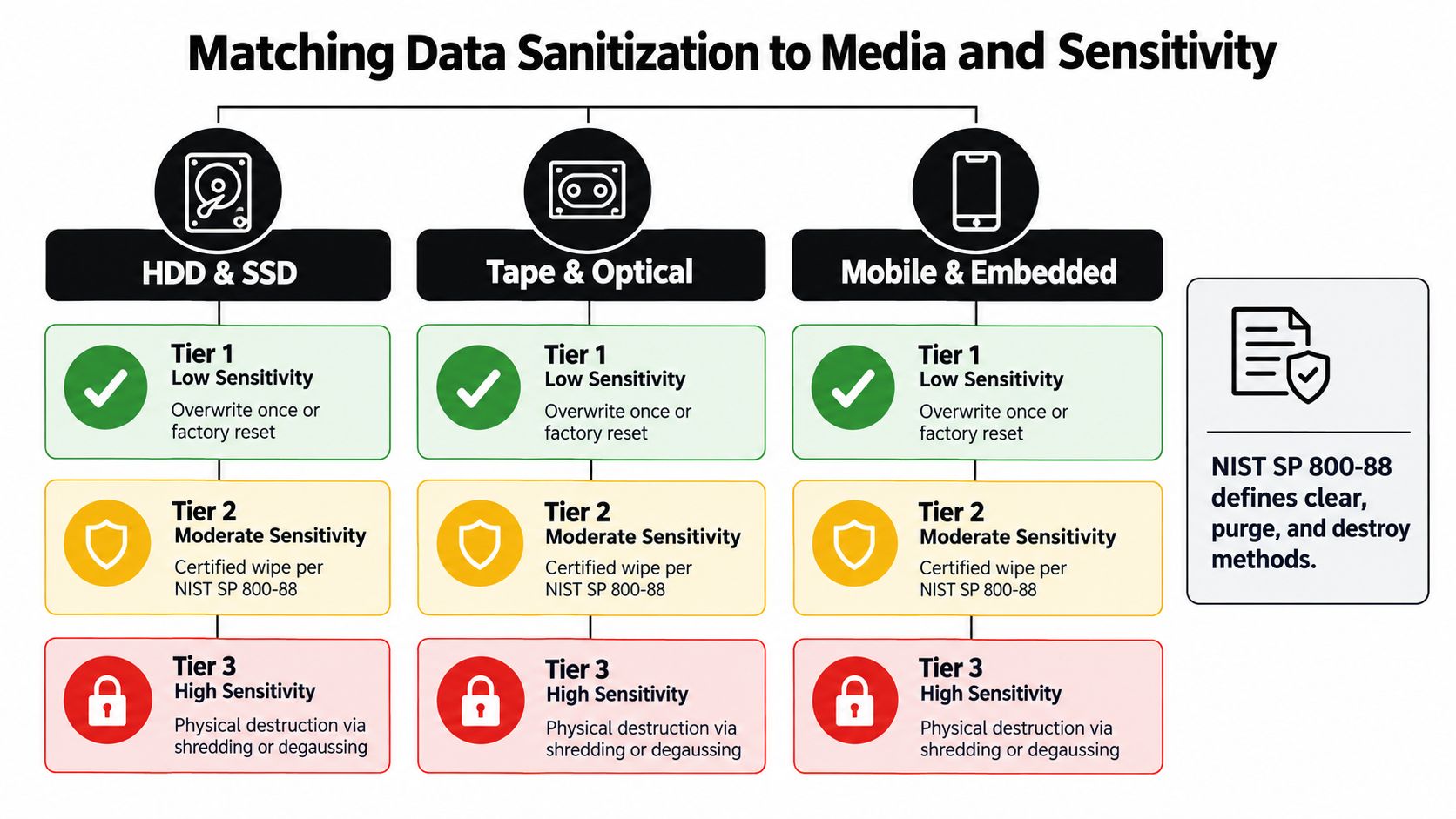
A factory reset isn't a universal data-destruction method. NIST SP 800-88 Rev. 2 defines sanitization as making access to data infeasible for a given level of effort, and its framework distinguishes Clear, Purge, and Destroy. Select the method for each device based on storage technology, data sensitivity, and whether you need to preserve the equipment for reuse. The NIST publication is identified as the current U.S. media-sanitization reference in the NIST SP 800-88 Rev. 2 publication.
Apply the NIST tiers to the device
- Clear uses logical techniques to sanitize accessible data while leaving the device potentially usable. It may suit lower-sensitivity data when the media supports a reliable method and verification confirms success.
- Purge applies a stronger method intended to make recovery infeasible while preserving the possibility of reuse. For qualifying encrypted media, cryptographic erase can work by eliminating the relevant encryption keys, but only if the encryption design and key handling meet the required conditions.
- Destroy physically renders the media unusable. Use it when the media has failed, the sanitization method can't be verified, or the organization's requirements call for destruction.
SSD handling deserves particular care. Wear leveling and over-provisioned areas can make ordinary logical overwriting incomplete. A successful process must account for the media's actual capabilities, not assume that a software wipe touched every relevant area. For encrypted SSDs, cryptographic erase may preserve resale potential, but only when the encryption architecture, key hierarchy, cryptographic strength, and permanent key zeroization can be verified. NIST's media-sanitization guidance addresses those conditions, including the need to handle relevant wrapping, master, and subordinate keys.
Require evidence at device level
Mechanical hard drives, mobile devices, tape, and embedded storage each need a method suited to the hardware and its intended disposition. Don't accept “wiped” as sufficient documentation. Ask for a record that identifies the device, method, date, operator or tool, and verification result. For drives that can't be supported or verified, specify the approved physical-destruction route.
The decision should account for information exposure if the method fails, as well as whether resale or donation remains possible. For teams that need to explain data-handling responsibilities to non-technical colleagues, a plain-language overview of data privacy for local app businesses can provide useful context. Reworx also describes available data sanitization methods, which organizations can compare against their own media and policy requirements.
Why Reuse Should Come Before Shredding
Shredding every retired device can feel like the safest shortcut, but it destroys the possibility of reuse and can discard recoverable asset value. A working laptop, server, or networking device may be suitable for internal redeployment, donation, or resale after it passes testing and its data has been properly sanitized. Shredding should be a decision based on risk or condition, not the default route for a mixed inventory.
The environmental case for separating reuse from recycling is substantial. In 2022, the world generated approximately 62 million tonnes of e-waste, or about 7.8 kilograms per person, while only 13.8 million tonnes, 22.3% of the total, were documented as formally collected and recycled in an environmentally sound manner. The remaining 48.2 million tonnes weren't recorded as properly recycled, and approximately US$62 billion in recoverable natural-resource value was left unaccounted for, according to the Global E-waste Monitor 2024 summary. Those figures underline why organizations should prioritize controlled recovery rather than treating all retired equipment as disposable scrap.
Measure circular outcomes, not just weight
A weight-diverted figure doesn't tell you whether devices were repaired, donated, resold, or dismantled. Ask providers for outcome metrics that show what happened to usable equipment and materials:
- Reuse by unit and value, so functioning devices aren't hidden inside a recycling total.
- Additional service life, where the provider can document it.
- Recovery revenue and material recycled, reported separately.
- Export destination and the documented basis for shipping.
- Data-sanitization coverage, linked to devices rather than a general statement.
For material recovery, the same monitor reports approximately 31 billion kilograms of metals in the 2022 e-waste stream, valued at about US$91 billion, including US$19 billion of copper, US$15 billion of gold, and US$16 billion of iron. That's a supply-chain reason to route non-reusable equipment through controlled recovery channels, while testing and refurbishing equipment that still works.
Treat cross-border reuse carefully
The Basel Convention's e-waste amendments became effective on January 1, 2025, expanding controls over covered international e-waste movements. Tested second-hand equipment and waste aren't interchangeable categories. Before approving cross-border movement, require clarity on the equipment's condition, destination, downstream processing, and applicable authorization. Reuse should come first when it's safe, documented, and lawful. For more on how reuse can fit a business model, review circular economy approaches for businesses.
Choosing a Recycling Partner Without Getting Burned
A provider's promise to recycle responsibly means little if it can't show where assets go, how data is handled, or what documentation comes back. Ask for a written process before signing. Get clear answers on downstream processors, media-specific sanitization, international shipments, and responsibility if a device goes missing or a control fails.
| Evaluation Area | Credible Provider | Red Flag |
|---|---|---|
| Chain of custody | Records asset handoffs and reconciles received devices | Offers only a pickup slip or general weight ticket |
| Data sanitization | Identifies methods, devices, and verification results | Treats every drive with the same vague “wipe” claim |
| Downstream processing | Discloses relevant processors and final routes | Won't identify where material goes |
| Cross-border movement | Explains authorization and destination documentation | Treats e-waste as ordinary freight |
| Liability and coverage | Provides clear insurance and contractual terms | Leaves data and environmental responsibility undefined |
Ask the questions that expose weak controls
Ask where each material stream is processed and whether the provider will disclose downstream vendors. For any international shipment, ask how it will be classified and authorized. Request sample certificates and check whether they identify the asset, method, date, responsible operator or tool, and verification result. Clarify what insurance and indemnification cover for data exposure and environmental liability.
A credible partner should also explain how it distinguishes reusable equipment from waste and how it handles exceptions, such as missing inventory details or failed media. If the proposal doesn't answer those questions in writing, don't assume the controls exist. Reworx Recycling is one provider to assess for electronics recycling, IT asset disposition, pickups, and secure data destruction; use the same evidence-based criteria when evaluating any provider. For a more detailed screening checklist, see vendor selection criteria for recycling partners.
Implementing Your Program and Putting It on Paper
Start with a written policy that makes ownership clear. SMBs upgrading technology can begin with a single intake log and a named approver. Enterprise IT and facilities teams should align site procedures, contracts, and project records. Schools and universities need a repeatable process for department refreshes and equipment donations. Public agencies should set approval, procurement, records-retention, and reporting responsibilities before a bulk disposal project begins.
Use a short, auditable checklist
- Inventory: Record devices and storage media before release; log exceptions rather than omitting them.
- Sanitization: Define acceptable Clear, Purge, or Destroy methods by device class and data sensitivity.
- Vendor control: Require documented custody, disclosed downstream processing, and an approved path for failed media.
- Evidence: Retain asset-level sanitization and disposition records, plus recycling documentation.
- Ownership: Name the people responsible for release approval, data decisions, vendor oversight, and final reconciliation.
- Reporting: Review reuse, resale, material recovery, and sanitization coverage as separate outcomes.
Sample policy language: “Retired IT assets must remain under documented chain of custody until their final disposition is verified. The organization will select and document a media-sanitization method aligned with applicable NIST sanitization tiers and information sensitivity, retain asset-level verification records, and require approved downstream processing and audit documentation.”
Before your next laptop disposal, office cleanout, laboratory equipment disposal, or facility cleanout, assign an owner and inventory the equipment. Then choose a provider whose documentation matches the policy, not merely the pickup schedule.
Reworx Recycling helps businesses arrange electronics recycling, equipment pickups, IT asset disposition, and secure hard drive shredding while supporting technology donations and community impact. Review Reworx Recycling and contact the team to discuss donating old equipment, scheduling a pickup, or building a documented recycling partnership.