A laptop refresh rarely ends when the replacement devices arrive. The old equipment is still in a storage room, a server rack, an employee's home office, or a school surplus area. Someone must decide whether each asset can be reused, how its data will be removed, who will transport it, and what evidence will prove its final disposition.
That's the work of an IT asset disposition company, usually called an ITAD company. The right partner treats retired technology as three connected responsibilities: a data-security risk, an environmental resource, and a business asset with possible reuse or resale value. The wrong partner treats it as a pile of scrap.
This distinction matters because global electronic-waste generation reached 62 billion kilograms in 2022, while only 22.3% was documented as formally collected and recycled in an environmentally sound manner, according to the International Telecommunication Union's Global E-waste Monitor. A governed ITAD program gives business owners, IT managers, facilities teams, and sustainability leaders a practical way to control that gap.
The Moment Old Equipment Becomes a Real Problem
The problem often appears during an ordinary technology refresh. An IT manager has a replacement fleet ready, but the retired laptops are stacked beside the loading dock. A school has surplus desktops in a classroom. A facilities lead finds networking equipment in a locked closet after an office move. The equipment still contains storage media, serial numbers, batteries, and potentially useful components.
Putting those devices in a dumpster creates several separate risks at once. Files may remain recoverable, the organization may lose track of who handled each asset, and valuable equipment may go straight to a waste stream before anyone assesses its condition. A generic recycling receipt won't answer which device was wiped, which drive failed verification, or where a downstream processor sent the material.
IT asset disposition, or ITAD, is the structured response. It covers the controlled retirement of computers, servers, networking equipment, mobile devices, storage media, and related hardware. The process can include inventory, logistics, secure data destruction, testing, refurbishment, resale, donation, material recovery, and final reporting.
Practical rule: If an asset has data, residual value, hazardous components, or a named owner, treat its retirement as a governed business process rather than a simple pickup.
The rest of the decision becomes easier when you separate three questions. Can the device be reused? Can its data be securely removed? Can the organization prove what happened afterward? Those questions apply whether you're planning laptop disposal for a small office, data center decommissioning for an enterprise, medical equipment disposal for a clinic, or a facility cleanout for a public agency.
The objective isn't to destroy everything. It's to protect information, preserve value where responsible, and document the outcome well enough for an auditor, customer, insurer, or sustainability review.
What an ITAD Company Does
An ITAD company governs the end-of-life journey of technology from collection through its final outcome. Its work connects three goals: protecting data, directing equipment to reuse or controlled recycling, and producing records that show what happened. Material recovery is one possible result, while resale, donation, refurbishment, or destruction may suit other assets.
A useful analogy is returning a rental car. The rental company identifies the vehicle, checks its condition, controls the handoff, handles required service, and closes the rental with a recorded status. An ITAD provider applies the same discipline to technology, with the added responsibility of protecting information stored on its devices.
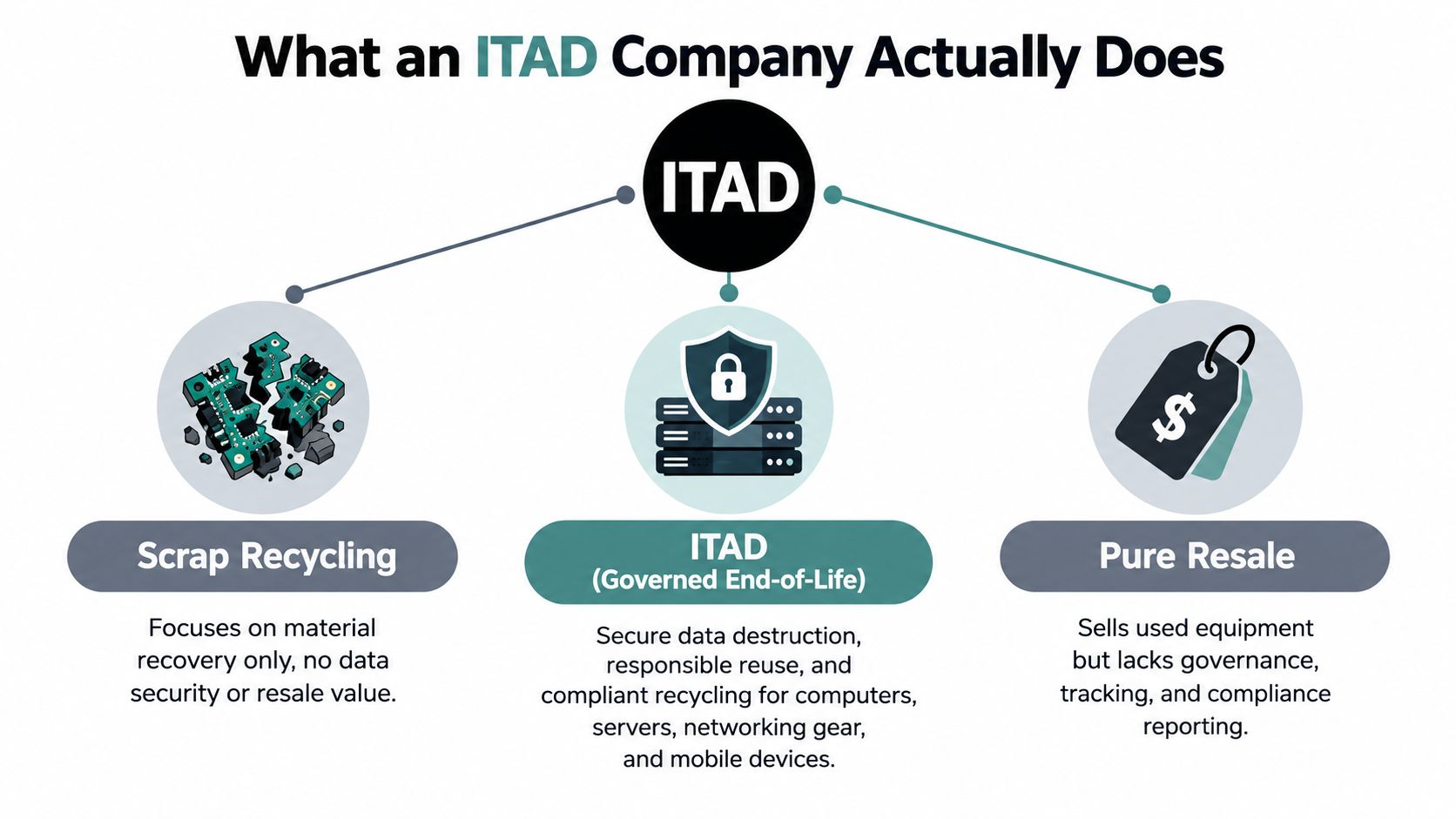
Four responsibilities sit inside the service
Logistics covers scheduling, packing, pickup, transport, receiving, and reconciliation. A credible provider should identify what was collected, where it came from, and when custody changed.
Decommissioning prepares equipment for its next outcome. This may involve removing accounts, separating components, identifying storage media, recording condition, and confirming whether a server, laptop, monitor, or networking device works.
Data security links each asset to a sanitization decision. The chosen method should match the media type, information sensitivity, and intended outcome. NIST describes sanitization as removing data with reasonable assurance that it cannot be easily retrieved or reconstructed in Special Publication 800-88.
Downstream stewardship controls what happens after intake. Functional equipment may be refurbished, donated, or resold. Nonfunctional equipment may enter controlled electronics recycling, while batteries and other hazardous components receive separate handling.
A donation-based model adds community impact without reducing security requirements. Reworx Recycling combines electronics recycling, equipment disposal, secure hard drive shredding, decommissioning, and potential buyback with technology donations, digital inclusion, and workforce development. Its IT asset disposition overview describes this governed end-of-life approach.
For buyers, the practical test is whether the provider can connect each handoff, sanitization result, recovery decision, and downstream outcome in a defensible record. Certifications may support that assessment, but operating controls and evidence show how the program works in practice.
Inside the ITAD Workflow from Pickup to Reporting
A credible workflow starts before pickup. Suppose an organization is retiring a fleet of office laptops while also removing equipment from a small server room. The provider should first receive an asset list, identify locations, flag storage media, and distinguish working equipment from damaged or incomplete units.
The operational sequence
Inventory and condition tagging. Record the manufacturer, model, serial number, storage type, location, and condition. Barcode labels or serial capture at intake reduce confusion when similar devices arrive together.
Scheduled pickup or drop-off. Set the collection window, loading responsibilities, packaging requirements, and site contacts. A business pickup may involve locked carts, palletized equipment, or special handling for medical and laboratory equipment.
Secure transport. Document the transfer from the site to the processing location. Use seals, custody records, and a defined exception process for missing or damaged items. The reverse logistics services offered by Reworx Recycling illustrate how transportation fits within a broader disposition process.
Decommissioning and sanitization. Separate storage devices from other components, select clear, purge, or destroy, and record the method, tool, version, and result. Failed verification should move the device into quarantine instead of allowing it into resale.
Testing and disposition. Functional equipment can be graded for reuse, refurbishment, donation, or resale. Equipment that cannot be responsibly reused should move into controlled recycling or product destruction.
Reporting and closure. Reconcile the original inventory against final outcomes. The evidence package may include serialized certificates, sanitization results, exception logs, recycling records, and value-recovery summaries.
Where weak programs lose control
Bottlenecks usually form at handoffs. A pickup crew may collect assets without recording serial numbers. A processor may issue one certificate for a mixed load. A downstream recycler may receive material without a documented link to the original owner.
A well-run program makes each handoff visible. It may use barcode scanning, photographs, secure staging, documented shredding procedures, and per-asset reporting. Video evidence can support physical destruction records, but it shouldn't replace the underlying inventory and custody trail.
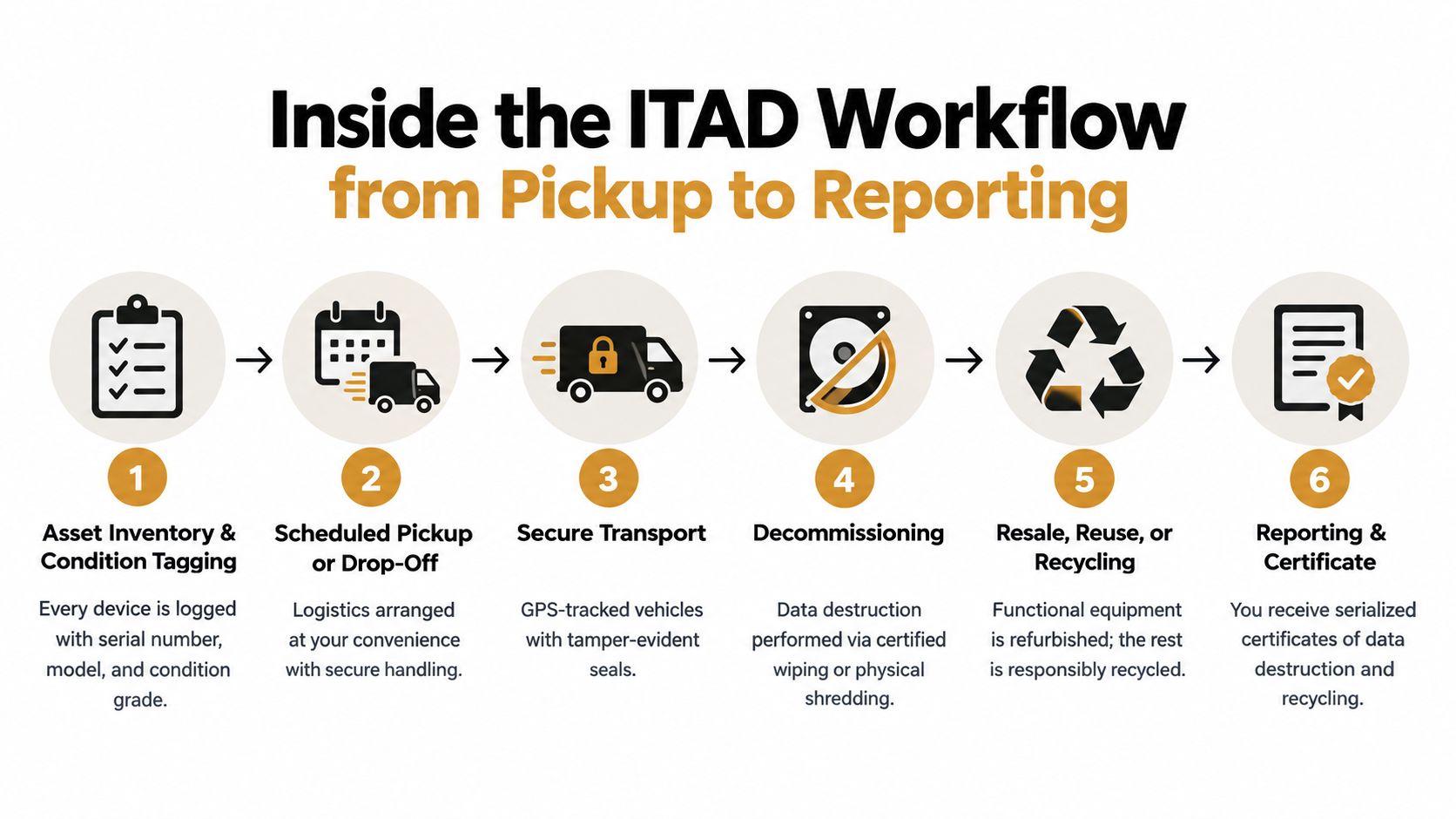
When comparing proposals, ask whether the provider can show the exact path from asset received to data outcome to final disposition. If the proposal describes only a truck, a shredder, and a recycling certificate, it doesn't yet describe a complete ITAD workflow.
Clear, Purge, and Destroy Explained Without Jargon
NIST's framework uses three outcomes: clear, purge, and destroy. The terms help a data owner match the treatment to the storage technology, information sensitivity, and intended future use.
Clear uses logical techniques to protect against basic, non-invasive recovery attempts. It may fit a low-risk device that will remain within a controlled environment, but ordinary file deletion isn't the same thing as clear.
Purge uses physical or logical methods intended to make recovery infeasible with state-of-the-art laboratory techniques while preserving the device for possible reuse. A verified purge can make sense for a laptop or server that still has operational value.
Destroy makes recovery infeasible and renders the storage media unusable for future storage. Shredding, pulverizing, and similar methods may be appropriate when the media is damaged, the risk is high, or the organization can't verify a logical method.
Encrypted storage adds another decision point. Cryptographic erase can be relevant when encryption and key controls are properly managed, but the organization still needs evidence that the correct keys were sanitized and that the result addresses the confidentiality risk. A failed SSD shouldn't automatically go to resale merely because a software tool reported success.
| Asset Type | Recommended Outcome | Why This Outcome Fits | Evidence to Require |
|---|---|---|---|
| Reissued office desktop with low-risk data | Clear or purge, based on policy | The device may remain useful when the selected method matches the media and risk | Asset identity, method, tool and version, verification result |
| Donated laptop with an SSD | Verified purge or approved cryptographic erase | Preserves reuse value while addressing recovery risk on solid-state storage | Serial number, storage technology, technique, verification and validation records |
| Failed or inaccessible drive | Destroy | Logical treatment may not provide sufficient assurance when the device can't be reliably processed | Quarantine record, destruction method, custody history, certificate |
| Highly sensitive storage media | Purge or destroy | Stronger treatment is appropriate when confidentiality risk outweighs resale value | Data classification, approval, method, independent review where applicable |
NIST distinguishes verification, which checks whether the method completed without technical errors, from validation, which decides whether the outcome adequately addresses the information risk. That distinction is why a generic “wiped” label isn't enough.
The choice should be documented through a data sanitization process that considers device type, encryption status, data classification, and intended disposition. Physical destruction is powerful, but it eliminates reuse and can reduce material value. Responsible ITAD doesn't promote shredding as the automatic answer. It selects the least destructive method that still provides defensible protection.
Compliance, Chain of Custody, and Defensible Records
An ITAD company proves compliance through connected records, not a logo on its website. Each record should tie an identified asset to a controlled action, a responsible party, and a final outcome. This evidence trail lets an organization examine security, environmental handling, and recovery decisions as one governed process.
A healthcare organization may need controls supporting HIPAA obligations. A financial institution may apply GLBA-related safeguards. Schools and universities may handle records subject to FERPA, while public agencies may face state privacy requirements, retention rules, and procurement oversight. These frameworks do not require one identical ITAD procedure, but they raise the same practical question: can the organization show who handled each device and what happened to its data?
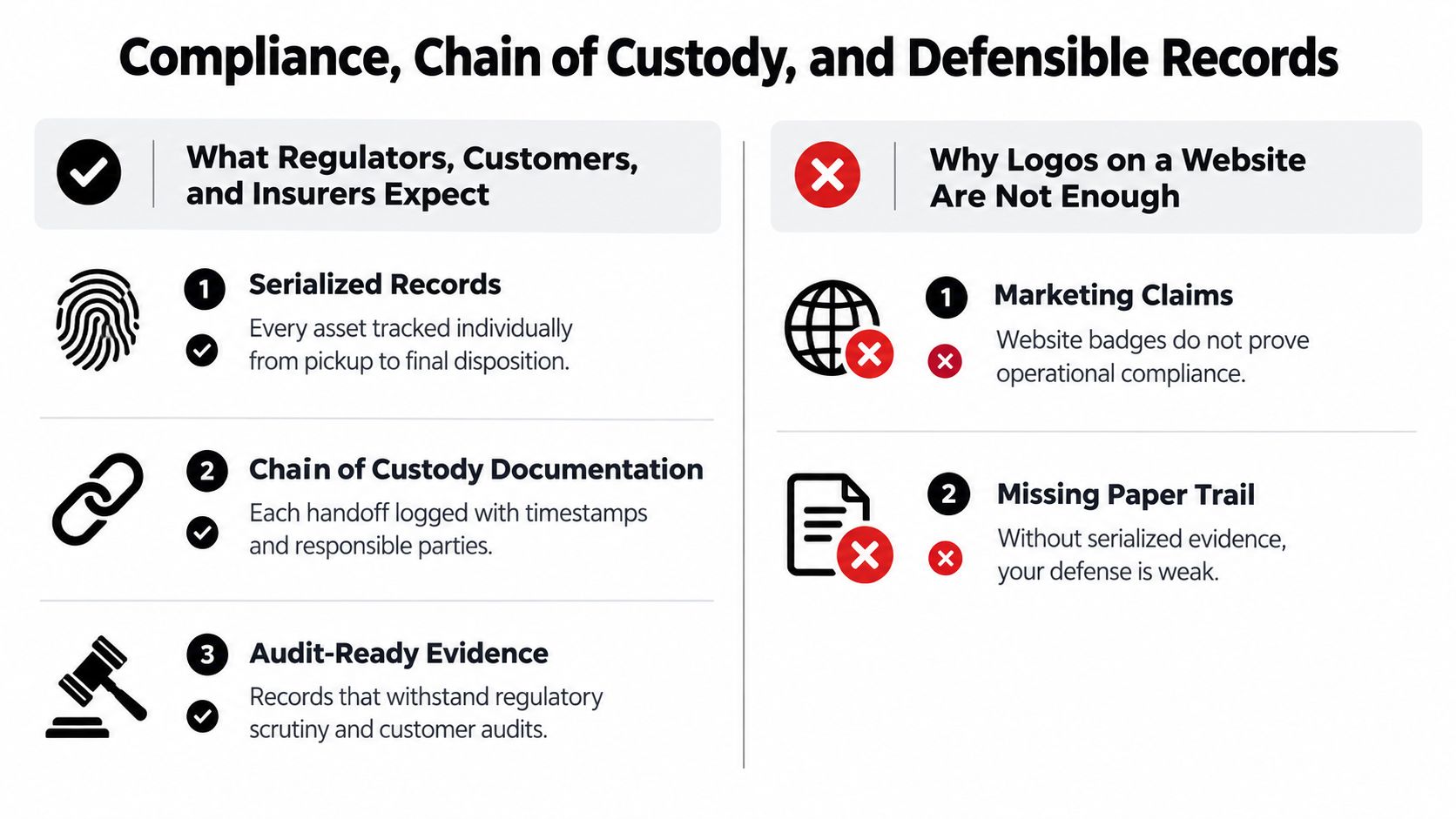
Build the evidence trail
A defensible record set usually includes:
- Serialized intake records: Match each device with its serial number, asset tag, location, and condition.
- Custody transfers: Record dates, times, responsible people, transport details, and exceptions through a documented chain of custody process.
- Sanitization evidence: Identify the media, selected outcome, technique, tool and version, verification, and validation.
- Disposition records: Show whether the asset was reused, donated, resold, recycled, or destroyed.
- Downstream documentation: Identify later processors and connect their work to the original asset or material stream.
Environmental compliance needs the same level of planning. EPA universal-waste rules allow small- and large-quantity handlers to accumulate universal waste for no longer than one year from the date it is generated or received. State programs may add different requirements or waste categories, so businesses planning an office, laboratory, or multi-site cleanout should confirm applicable rules through the EPA universal-waste guidance.
A recycling receipt proves that something was received. It does not necessarily prove which device was sanitized, which drive failed, or how downstream material was handled.
Sustainability reports need traceable inputs too. The EPA explains that recycling returns materials such as gold, copper, aluminum, glass, and plastics to supply chains. Its electronics guidance notes that recycling one million mobile phones can recover approximately 35,000 pounds of copper, 772 pounds of silver, 75 pounds of gold, and 33 pounds of palladium. Recycling one million laptops saves energy equivalent to the annual electricity use of more than 3,500 U.S. homes, as described in the EPA electronics research and initiatives. Those results become useful business evidence only when documented asset and material flows support them.
Questions to Ask Before You Sign With an ITAD Vendor
A vendor meeting should test the operating model, not just the price. Ask the same core questions whether you're a small business owner retiring a few laptops, an enterprise planning a data center decommissioning, a school clearing a technology lab, or a government agency managing public assets.
Start with security and exceptions
Ask which standard governs sanitization, how the provider chooses between clear, purge, and destroy, and whether the decision is approved by the data owner. Then ask what happens when a drive fails verification, can't be read, contains damaged sectors, or arrives without a matching asset record.
A strong answer includes quarantine, escalation, reprocessing or destruction, and an exception log. A weak answer is “our software handles it” without naming the media-specific method, verification process, or person responsible for validation.
Test accountability beyond the first vendor
Ask these questions directly:
- Serial reconciliation: Will every collected asset appear in the final report, including missing, damaged, or unprocessable units?
- Downstream control: Who performs recycling, resale, product destruction, or material processing after intake, and how are those parties evaluated?
- Evidence package: Will you receive certificates tied to individual serial numbers rather than one certificate for a mixed shipment?
- Environmental handling: How are batteries, lamps, medical components, and other regulated or hazardous materials separated?
- Value recovery: How are condition grades, resale decisions, deductions, and equipment buyback values documented?
- Logistics: Who seals the load, records custody, manages exceptions, and confirms delivery to the processing site?
- Reporting retention: How long will records remain available, and can your team export them for an audit or customer inquiry?
An enterprise procurement team may also request sample reports, insurance information, subcontractor terms, and a documented incident process. A school may prioritize classroom pickup coordination, student-data protection, and donation outcomes. A small business may need a simpler engagement, but it shouldn't accept weaker custody or sanitization evidence.
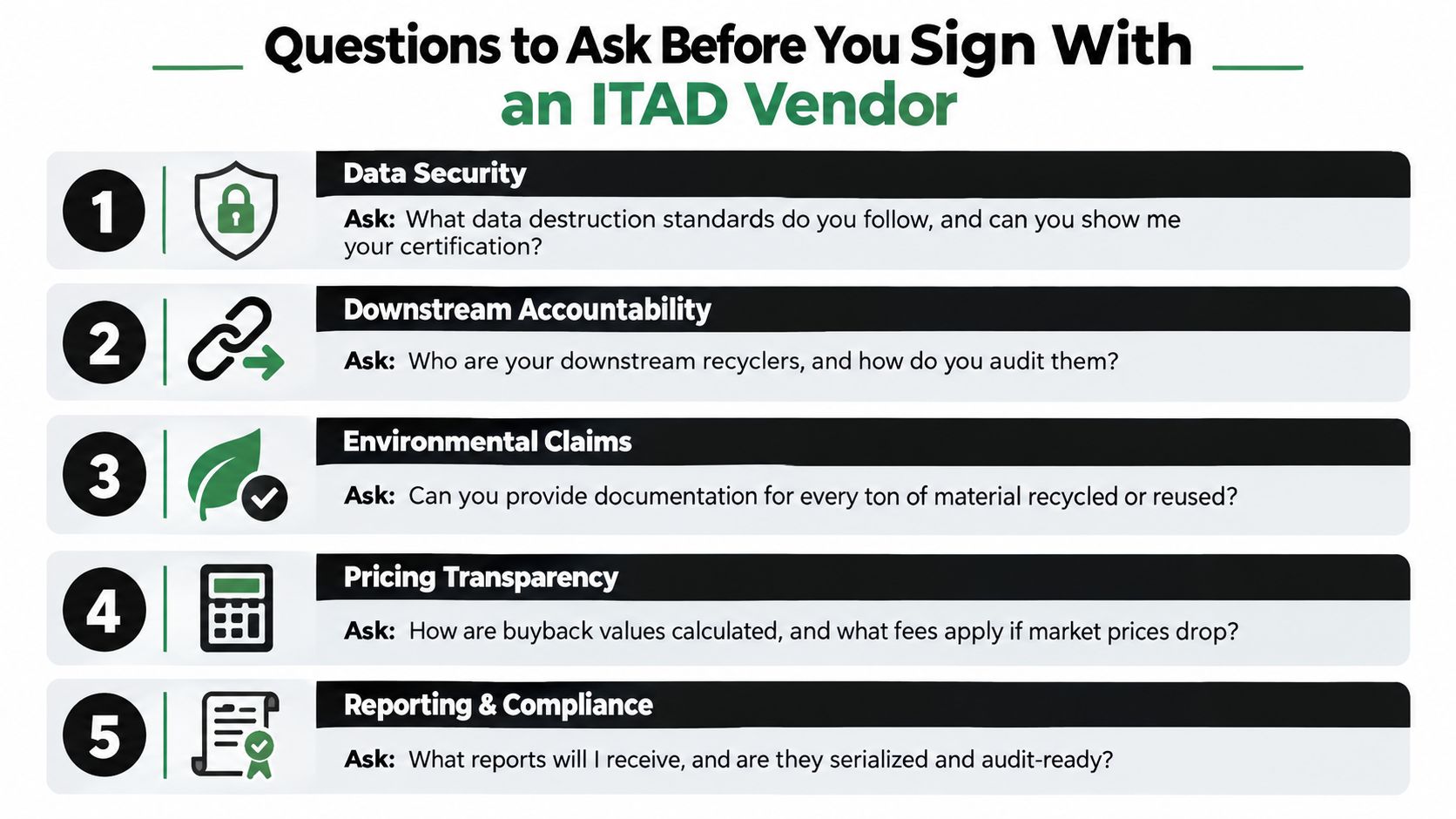
Compare proposals using equivalent line items. Separate pickup, sorting, sanitization, physical destruction, recycling, reporting, storage, and any value-recovery credit. The ITAD vendor selection criteria should be treated as a starting point for a buyer-side review, not a substitute for inspecting the provider's actual evidence.
Buyer test: Ask the vendor to show you a redacted certificate, an exception log, and a sample chain-of-custody record before you sign.
How Donation-Based ITAD Connects Security, Sustainability, and Community Impact
Donation-based ITAD works when donation is an outcome inside a governed process, not an excuse to skip data destruction. A functional laptop can support digital inclusion, but only after the organization has identified it, removed its data appropriately, confirmed its condition, and documented the transfer.
The hierarchy is straightforward. Reuse functional equipment first. Refurbish or donate devices that can serve another user. Route nonfunctional equipment into responsible electronics recycling, recover usable materials, and isolate batteries or other hazardous components from general processing. Destroy storage media when the risk or device condition requires it.
This approach also protects environmental value. The EPA report on electronics recycling recorded consumer-electronics recycling rising from 30.6% in 2012 to 40.4% in 2013. Even at the later rate, most consumer electronics in that reporting period were outside the measured recycling pathway, which shows why corporate donation programs and formal sustainable recycling processes need clear accountability.
Reworx Recycling offers a practical service mix for organizations that need one coordinated partner. Its services include free customer drop-off, business pickups, equipment decommissioning, IT asset management, recycling consultations, secure hard drive shredding, data destruction, and equipment buyback. Those options can support an SMB office cleanout, a school technology donation effort, a government facility cleanout, or an enterprise refresh that combines laptop disposal with hardware recycling.
The community outcome matters, but it should remain connected to operational evidence. Technology donations can support digital inclusion, while workforce development can create practical pathways around repair, preparation, logistics, and responsible recycling. The organization retiring the equipment should still receive a clear record of what was collected, sanitized, donated, reused, recycled, or destroyed.
A well-designed ITAD program therefore delivers more than disposal. It protects information, preserves resale and reuse opportunities, diverts materials from inappropriate waste streams, and gives communities access to useful technology. That is the difference between moving old equipment out of a building and managing its end of life responsibly.
Reworx Recycling helps businesses coordinate electronics recycling, secure data destruction, equipment donation, pickups, decommissioning, and IT asset disposition with community impact in mind. Visit Reworx Recycling to discuss donating old equipment, scheduling a business pickup, or building a responsible retirement program for your organization.