Chicago's summer festival ecosystem runs from May through October and features over 80 to 90+ major festivals, markets, and events each year. Planning around overlapping weekends, crowded corridors, and neighborhood spillover is more practical than treating each event as a separate outing.
You might start the morning with a lakefront program, head downtown for music, and hope to finish the night at a neighborhood street festival. In Chicago, that plan can unravel quickly. A closed street changes the walking route, a headline event fills nearby trains, and a festival several neighborhoods away can make parking and rideshare service harder to find.
This Illinois Chicago Summer Events and Festival Guide focuses on the structure behind the calendar, not just a long list of dates. It covers recurring anchors, crowd patterns, transit pressure, accessibility, and the decisions that help families, businesses, and nightlife seekers enjoy more while spending less time in lines or traffic.
Why Chicago Summers Feel Different
A visitor can build a seemingly simple Saturday in Chicago, perhaps starting with a market, moving to a lakefront concert, and ending at a neighborhood food festival. The problem isn't a lack of options. Chicago's warm-season calendar is so distributed that the best choice often depends on what else is happening nearby.
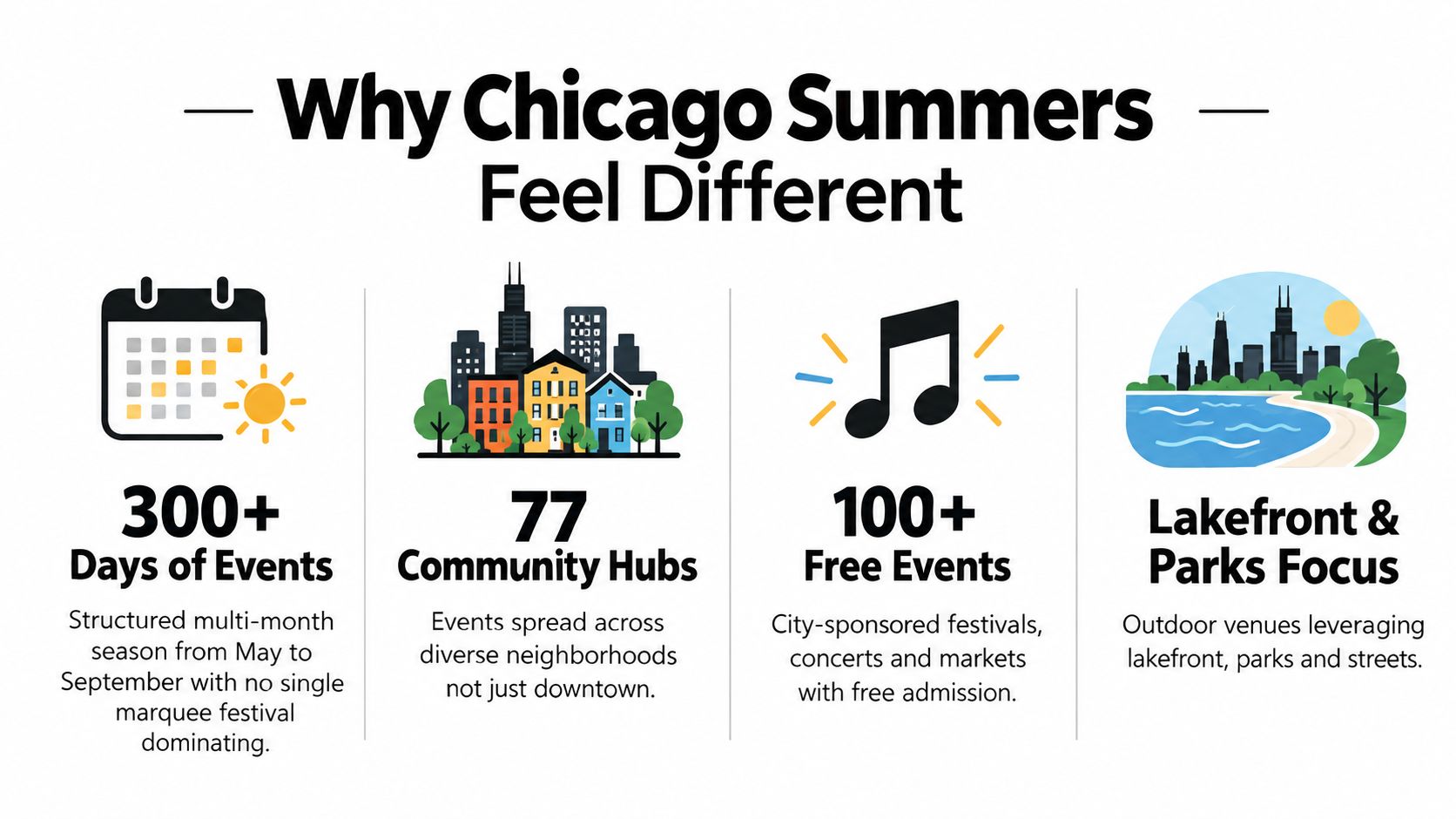
A widely used 2025 Chicago summer guide counted more than 90 festivals, parades, markets, and related events across the season, while a 2026 calendar tracked roughly 80 festivals and described programming from May through October. Those figures come from different guides and counting methods, so they shouldn't be treated as an exact master total. Together, they show the scale of a city that fills its calendar with recurring events rather than depending on one marquee weekend. (2025 Chicago summer guide)
A season built across the city
Chicago SummerDance, the Chicago Blues Festival, Taste of Chicago, and the Chicago Jazz Festival function as recurring anchors, but they sit within a much broader network of neighborhood festivals, parades, markets, park programs, and lakefront gatherings. Downtown may carry the largest headline events, while communities such as Lincoln Square, Hyde Park, Bronzeville, Lakeview, Humboldt Park, Chinatown, and Ravenswood create their own distinct event rhythms.
That geographic spread changes how you plan. A downtown itinerary can be convenient for visitors staying near the Loop, but it can also expose you to the most concentrated transit and pedestrian pressure. A neighborhood-focused plan may require more deliberate routing, yet it often gives you a more manageable pace and a clearer connection to local businesses and community programming.
Practical rule: Choose the neighborhood before choosing the second event. Chicago's summer map rewards proximity more than ambition.
The calendar's density also affects businesses operating near event routes. Deliveries, waste collection, street access, vendor staging, and employee commutes can all become more complicated when several gatherings overlap. Readers looking for entertainment experience that same operational pressure as longer walks, crowded stations, limited parking, and slower departures.
How Chicago Built Its Long-Running Summer Calendar
Chicago's summer calendar grew from civic programs, neighborhood traditions, and recurring lakefront events rather than a single festival strategy. The Grant Park Music Festival has continued for more than 90 years, and 2026 coverage identifies it as one of the longest-running free outdoor classical music series in the United States. That history helps explain why summer programming functions as part of Chicago's civic infrastructure, with familiar anchors that shape planning well beyond tourism. (NBC Chicago's 2026 summer events coverage)
Tradition creates dependable anchors
Established programs give residents, visitors, vendors, and nearby businesses a reliable seasonal framework. Chicago SummerDance, for example, combines one hour of professional instruction with two hours of live music and dancing in each session, according to the city's official guide. Repeatable free programming encourages return visits and lets organizers build operations around known spaces, staffing needs, and audience patterns. (Chicago Department of Cultural Affairs and Special Events)
The same structure appears in the city's major seasonal staples. The Chicago Blues Festival is associated with early June, Taste of Chicago with July, and the Air and Water Show with August. Lollapalooza brings a major Grant Park music weekend, while Navy Pier fireworks create recurring lakefront demand. Their familiar timing gives Chicago's season a recognizable framework, but it also places attendees, suppliers, transit riders, sanitation crews, and security teams in the same corridors at overlapping times.
That overlap affects attendance decisions. A visitor who chooses two events in separate parts of the city may spend more time crossing crowded routes than participating. An organizer may gain visibility from a busy weekend, yet face higher staffing, delivery, security, and cleanup demands because nearby events compete for the same movement corridors.
Cultural infrastructure has operational consequences
The city's festival information describes a high-density season from May through September, including 20+ street festivals and major events such as Lollapalooza, the Blues Festival, Taste of Chicago, and Navy Pier fireworks. For operators, that creates a predictable demand curve, with pressure generally building from late May through August.
Predictability reduces surprises, not operational risk. Chicago requires a special event permit for events expecting 1,000 or more people. A permitted event with 10,000+ attendees can also require a community engagement plan and public meeting, as shown in the Park District agreement connected with Riot Fest. (Chicago Municipal Code)
Attendance is therefore an operating assumption, not only a marketing forecast. It affects approval timing, crowd controls, staffing, stakeholder outreach, delivery windows, cleanup, emergency planning, and how an event's schedule fits around the rest of Chicago's summer program.
Navigating the Packed Festival Season and Overlapping Dates
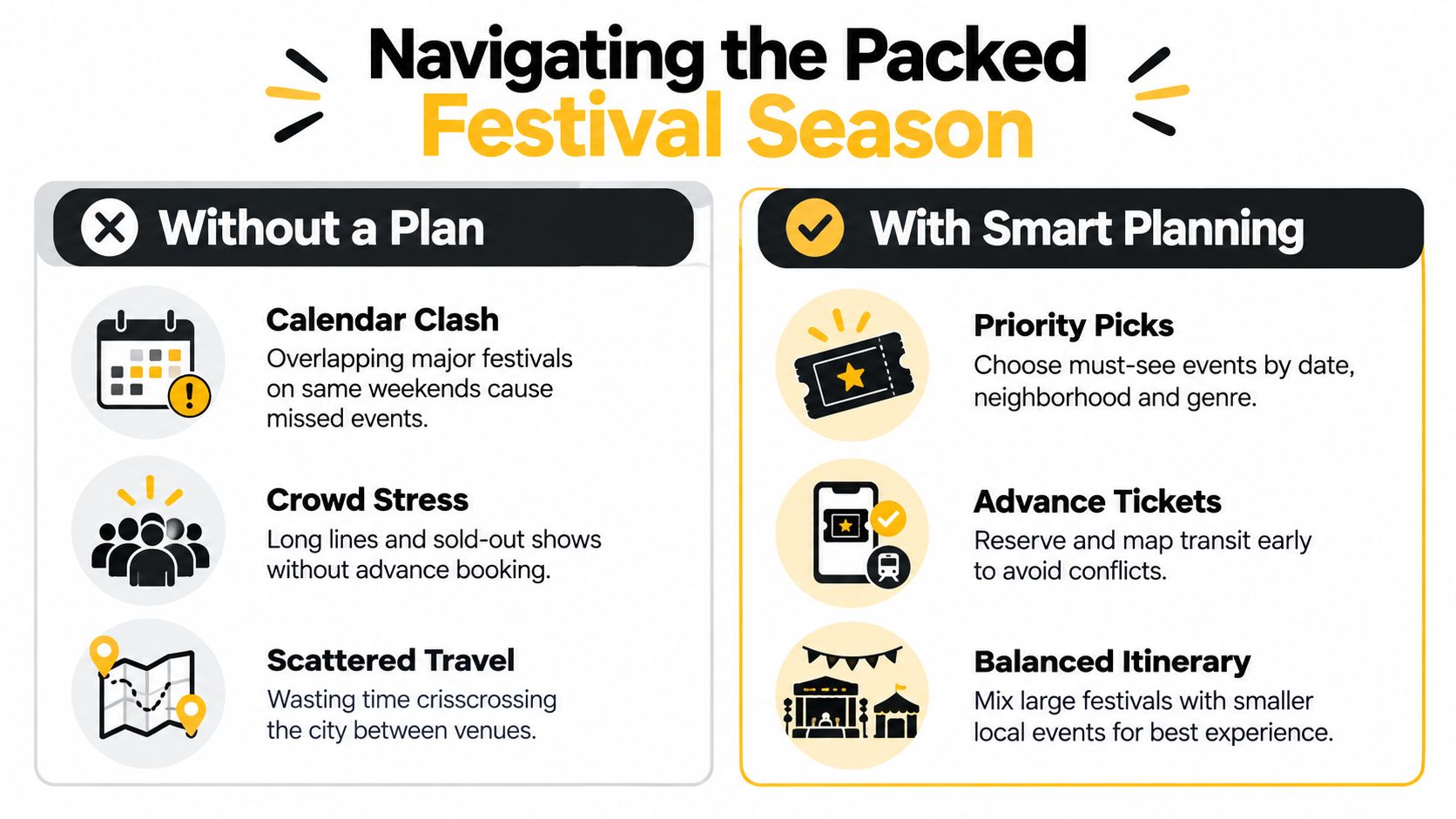
The most useful way to plan Chicago's summer calendar is to evaluate the weekend, not just the event. A single festival may be manageable on its own, but Pride celebrations, major concerts, Lollapalooza, lakefront programming, and neighborhood street festivals can create overlapping demand across several areas.
Start with these decisions:
- Select your priority event. Decide whether the weekend's main purpose is music, food, cultural programming, art, family activities, or nightlife. Don't build an itinerary around every appealing listing.
- Map the surrounding geography. Downtown anchors, lakefront venues, and neighborhood street festivals create different walking and transit conditions. Two events that look close on a map may be difficult to connect once crowds, barricades, and route closures are in place.
- Protect the transition. Leave room for entry lines, food stops, restroom breaks, and the trip between venues. A plan that depends on arriving exactly as one event ends usually fails during a crowded weekend.
- Use a pressure-release option. Keep a smaller neighborhood event, park program, or weekday activity available if the main venue becomes too congested.
Match the weekend to your crowd tolerance
Families often do better with daytime programming, open park layouts, and one primary destination. A downtown headliner can offer broad entertainment, but a neighborhood festival may provide easier exits and a less punishing schedule. If you're traveling with young children or mobility equipment, the most exciting weekend isn't automatically the most suitable one.
Businesses and professional groups should think about employee arrival, client hospitality, and return travel. A daytime conference or business meeting can pair well with a nearby evening event, but crossing the city during a major concert or parade creates unnecessary uncertainty. Build the social portion around one district, then give attendees a clear departure plan.
Nightlife seekers may accept heavier crowds in exchange for headline performances. Even then, arriving earlier, booking essential tickets in advance, and choosing a nearby late-night option can prevent the night from becoming a series of queues. For additional destination-planning ideas, compare your approach with this guide to top Atlanta events, while adapting the strategy to Chicago's more geographically layered calendar.
A crowded weekend isn't automatically a bad weekend. It becomes difficult when every part of the itinerary depends on perfect timing.
Planning Logistics for Neighborhoods, Transit, and Accessibility
A festival route can fail before anyone reaches the gate. A street closure may redirect pedestrians several blocks, a lakefront event may add a long exposed walk, and a busy station can turn a short trip into a slow transfer. From late May through August, overlapping deliveries, barricades, waste hauling, transit demand, and cleanup create operational pressure across several districts at once.
Build a route that works in real conditions
Use public transit when it provides a direct trip, then check the venue's access details rather than assuming the nearest station is the best entrance. Identify an alternate station and choose a meeting point away from the main gate. Parking may take longer than expected when a street festival occupies the road instead of a contained venue.
Accessibility planning belongs in the first route decision. Confirm accessible entrances, restrooms, seating areas, and drop-off procedures before departure. Groups that need regular rest, shade, or shorter walking distances should choose one primary venue rather than stack destinations across the city. On crowded weekends, a route that avoids one major transfer can protect the schedule for everyone.
Neighborhood conditions change the calculation. Lakefront areas offer open views but expose visitors to sun, wind, and long approaches. Dense commercial corridors usually have more food and indoor options, while closures can narrow sidewalks and limit crossings. Use this Chicago neighborhood guide to compare areas before selecting lodging or an event base.
Account for the event site, not just the audience
Organizers must schedule vendor access, sanitation, recycling stations, barricade placement, and cleanup around public programming. Temporary seating and weather protection also require practical equipment planning. Resources such as tent and chair rentals BC can offer planning concepts, although that supplier serves another market.
For attendees, timing and departure planning matter as much as the performance schedule. Arrive before the busiest period, carry only permitted items, and set a departure point before the final act or closing announcement. Check service changes on the day, keep the group's meeting plan visible, and leave room for slower movement. These choices reduce transit pressure and prevent accessibility needs from becoming an afterthought.
Choosing Events for Families, Businesses, and Nightlife Seekers
Chicago's calendar is broad enough to serve very different audiences, but each group should make different compromises. Trying to attend the same event mix with children, clients, or a nightlife-focused group usually creates friction.
Families need comfort more than volume
Families should favor free city programming, daytime cultural festivals, park events, and neighborhood routes with nearby restrooms and food. A smaller street festival can work better than a headline concert because adults can leave easily when children tire. Strollers also change the route calculation, especially on crowded sidewalks or streets narrowed by vendor booths.
Choose one main activity and one flexible add-on. A park-based program followed by an early meal is usually more manageable than moving between distant venues. Keep water, shade, and a meeting point in the plan, and verify age restrictions before committing to ticketed evening events.
Businesses should optimize for conversation
Corporate groups need environments where people can talk. Neighborhood food festivals, cultural markets, art events, and daytime outdoor programs can support informal networking without the noise and crowd compression of a major concert. A downtown anchor may impress clients, but it can be a poor setting for relationship-building if everyone spends the evening navigating entrances and exits.
For office teams, use a shared itinerary with the venue address, meeting location, transit option, and backup plan. Businesses hosting their own gathering should also confirm whether street closures, outdoor food preparation, liquor sales, merchandise, tents larger than 20 feet by 20 feet, or stages taller than 24 inches require a Special Event Permit. (Chicago Special Event Permit tutorial)
Nightlife seekers can trade scale for flow
Large concerts and late cultural programs deliver energy, but they also create the strongest entry and exit surges. A neighborhood festival can offer live music, food, and social atmosphere with fewer cross-city transfers. If the headline is nonnegotiable, make it the only major destination and keep the after-event plan nearby.
Families and visitors looking for additional low-stress ideas can also review this resource on family-friendly attractions, then apply the same principle locally, prioritize comfort, access, and age-appropriate timing over an overloaded schedule.
Safety, Health, and Sustainable Festival Practices
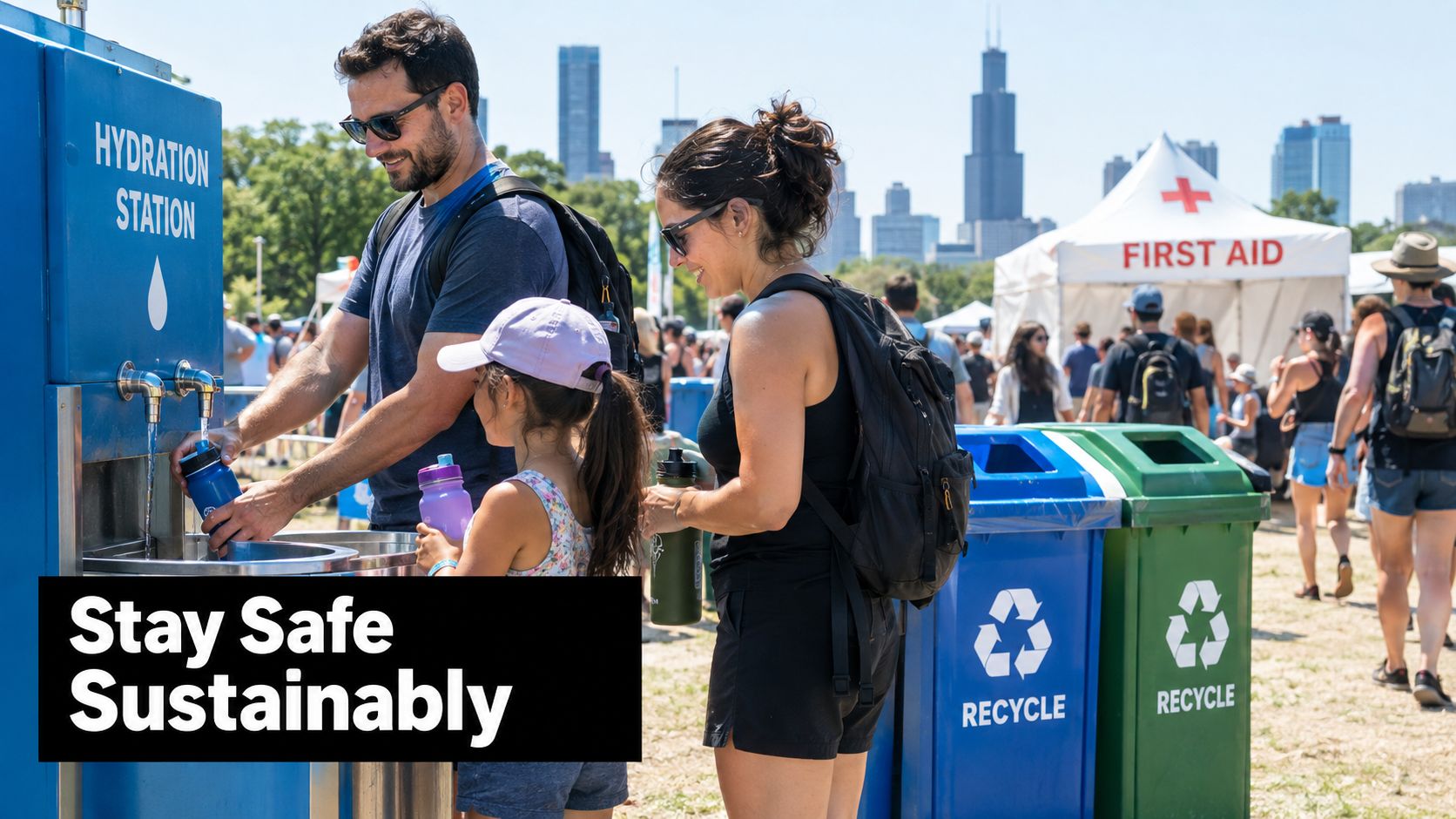
A long Chicago summer rewards people who plan for physical comfort as carefully as they plan for tickets. Outdoor events expose visitors to heat, sun, changing weather, dense crowds, and long periods on their feet. Carry water where permitted, identify shade and medical locations, wear suitable footwear, and set a meeting point before the crowd thickens.
Make responsible choices part of the itinerary
Use refillable bottles when the venue provides hydration stations, separate waste according to posted signs, and avoid bringing disposable items you don't need. Festival cleanliness affects safety, comfort, vendor operations, and the condition of public spaces. This practical discussion of why festival cleanliness matters offers useful context for organizers and venue teams.
Sustainability also extends beyond the event grounds. Businesses replacing laptops, monitors, networking hardware, or other equipment shouldn't place outdated electronics in ordinary waste streams. Reworx Recycling provides electronics recycling, business pickup, secure hard drive shredding with data destruction, equipment decommissioning, IT asset management, recycling consultations, and equipment buyback options for organizations managing retired technology. Its donation-based social enterprise model connects responsible disposition with community impact, including technology donations and workforce development. Businesses can review this Chicago electronics recycling guide for business leaders before planning an office cleanout or IT asset disposition project.
Health and sustainability work best as habits. A reusable bottle, a planned route, and proper electronics disposal each reduce avoidable pressure across a busy season.
If you're organizing a public gathering, design waste stations into the site plan rather than adding them after vendors arrive. Clear signage, accessible placement, regular servicing, and a defined post-event cleanup window make responsible behavior easier for attendees and crews alike.
Building a Realistic Chicago Summer Festival Plan
A workable plan starts with restraint. Choose two or three anchor events that reflect your interests, then add smaller neighborhood gatherings only when their locations and timing fit naturally. Chicago's calendar offers enough variety that you don't need to prove you've attended everything.
Start with anchors, then add texture
Your anchors might include a major music festival, a recurring cultural program, a lakefront event, or a food-focused gathering. Place each on a separate planning line, then examine the surrounding weekend for closures, parades, and competing demand. If two anchors overlap, decide which one matters more instead of pretending you can experience both fully.
Add neighborhood events by geography:
- Downtown and the lakefront: Strong for major cultural programming, free concerts, fireworks, and large public gatherings, but expect heavier pedestrian movement and more complex exits.
- North Side corridors: Useful for food, art, music, and community festivals, with a more local feel but frequent street-level access changes.
- South Side neighborhoods: Offer distinctive cultural programming and lakefront or park settings, though travel time deserves a place in the itinerary.
- Farther neighborhood destinations: These can provide a calmer experience, but you should confirm transit connections and return options before committing.
Keep a flexible operating plan
Check official event pages shortly before departure because schedules, entrances, weather procedures, and transportation information can change. Save the address, entry requirements, accessibility details, and a backup activity offline. For businesses, add employee contact procedures, equipment needs, waste responsibilities, and a clear pickup or departure window.
The same planning discipline helps organizations prepare a workplace recycling effort. A documented recycling program plan can define collection points, staff responsibilities, data-security steps, and the handoff process for retired devices.
Chicago's summer calendar rewards intentional choices, but leave room for discovery. A realistic day might include one major event, a nearby meal, and an optional neighborhood stop. If congestion becomes excessive, switch to the backup rather than exhausting the group. The best itinerary isn't the longest one. It's the plan that protects time, energy, access, and the chance to enjoy where you are.
Reworx Recycling helps businesses manage responsible electronics recycling, secure data destruction, equipment pickups, IT asset disposition, and technology donation programs for retired devices. Visit Reworx Recycling to explore practical guidance, then schedule a pickup or discuss a recycling partnership for your next office, facility, or technology cleanout.