Your recycling launch looked organized on paper. The bins arrived, the hauler confirmed the route, leadership announced the initiative, and employees received a polished email. A few weeks later, the recycling container is half empty, the trash bin beside it is overflowing, and someone has placed a food container, a disposable glove, and a laptop charger in the paper stream.
That pattern doesn't mean people oppose sustainability. It usually means the operating system is incomplete. A successful program connects waste data, convenient collection, clear behavior cues, contamination control, vendor accountability, and secure handling of electronics. This guide shows how to start a recycling program that can keep working after launch day, including the IT equipment disposal and data-security controls that many organizations leave until the end.
The Moment Most Recycling Programs Quietly Stall
The sustainability manager notices the problem during a routine floor walk. The reception area looks clean, but the mixed recycling station contains mostly empty space. The adjacent trash receptacle is full of paper, cardboard, drink containers, and packaging that the program was designed to recover. No one has complained. No one has asked for the bins to be removed. The program has stopped becoming part of the daily routine.
That quiet stall often follows a predictable launch. The organization introduces new containers, publishes accepted-item guidance, and assumes participation will follow. Employees understand the general idea, but they don't know whether a greasy container belongs in recycling, whether a coffee cup is accepted, or what to do with a damaged laptop. Facilities teams then see contamination, haulers report poor material quality, and leadership questions whether the program is worth maintaining.
The underlying issue is rarely awareness alone. A U.S. government review identified contamination, low collection, limited market demand, poor profitability, and weak decision data as cross-cutting recycling challenges, with national contamination of collected recyclables estimated at roughly 15% to 25% (Government Accountability Office review). Those problems reinforce each other. Confusing signage increases contamination, contamination reduces the value of collected material, weak reporting hides the cause, and leadership loses confidence.
The launch event isn't the program
A launch event creates attention. It doesn't create a habit. Daily behavior depends on whether the right receptacle sits beside the point of disposal, whether the accepted-item list matches local processing capability, and whether someone checks the results after the first collection.
The National Academies reports that 43% of households participate in recycling overall, while 59% of households with access use the service regularly, and that curbside contamination averages 15% to 20% (National Academies discussion of participation and contamination). These figures aren't a direct forecast for an office, school, or city department, but they illustrate the operational gap between access and consistent use.
Practical rule: Treat participation and contamination as design requirements from the first day, not as communications problems to solve later.
Start with a baseline, test the physical system, coach the people closest to the bins, and review the first hauler data before expanding the program. The organizations that skip those steps usually spend month six correcting a system that month one made difficult to use.
Build the Baseline Before You Buy a Single Bin
The first purchase shouldn't be a receptacle. It should be a clear picture of what your organization throws away, where that material appears, and who controls each decision.
The U.S. EPA's implementation framework places a waste audit and defined baseline at the beginning of a sequential recycling launch. Its broader framework includes 12 implementation steps, moving from assessment and goals through material characterization, market review, collection design, budget, legal review, training, and formal adjustment (EPA implementation framework).
Run an audit that leadership can use
Don't begin by asking employees what they think the organization wastes. Pull hauler records, inspect representative disposal points, and document the material streams that dominate volume. Include general waste, paper, cardboard, containers, organics, electronics, and any specialized materials generated by laboratories, clinics, workshops, or data centers.
For public-sector offices and businesses, track monthly hauler data for general waste, recycling, and food waste. Normalize the information in kilograms per employee per year, a practical office measure identified in public-sector guidance (EPA office measurement guidance). Keep the same measurement method each month so a change in collection volume means something.
A one-page baseline brief should answer:
- What is being discarded: Identify the highest-volume streams and the locations producing them.
- What can be recovered: Confirm accepted materials with local processors and haulers.
- Who owns the result: Name the executive sponsor, facilities lead, procurement contact, communications owner, and IT asset manager.
- What success means: Define a diversion, contamination, participation, or service target in language people can remember.
- What the program needs: Show collection equipment, training, vendor services, secure data destruction, and reporting requirements.
Paper deserves early attention in many office programs. EPA data show that paper and paperboard represented about 67% of recycled municipal solid waste by weight in 2018, while the United States generated 292.4 million tons of municipal solid waste and recycled or composted about 94 million tons, a 32.1% recycling and composting rate (EPA national materials data). The operational lesson is straightforward: start with dominant, recoverable streams such as office paper, shipping cartons, plastics, metals, and organics instead of promising to recycle everything.
Before approval, give leadership a concise sentence it can repeat: “We will recover the materials our facility generates most, place collection where disposal happens, and review contamination monthly.” That statement turns a sustainability aspiration into an operating commitment. For a deeper starting assessment, use Reworx Recycling's waste stream analysis service as one possible resource for characterizing material flows.
Designing Collection, Streams, and Signage That People Actually Use
Collection design is a behavior decision disguised as a facilities decision. Employees sort what they can identify quickly, where they can reach it, and when the alternative is obvious. A recycling station placed across the room from a full trash can creates a predictable result, even if the signage is technically accurate.
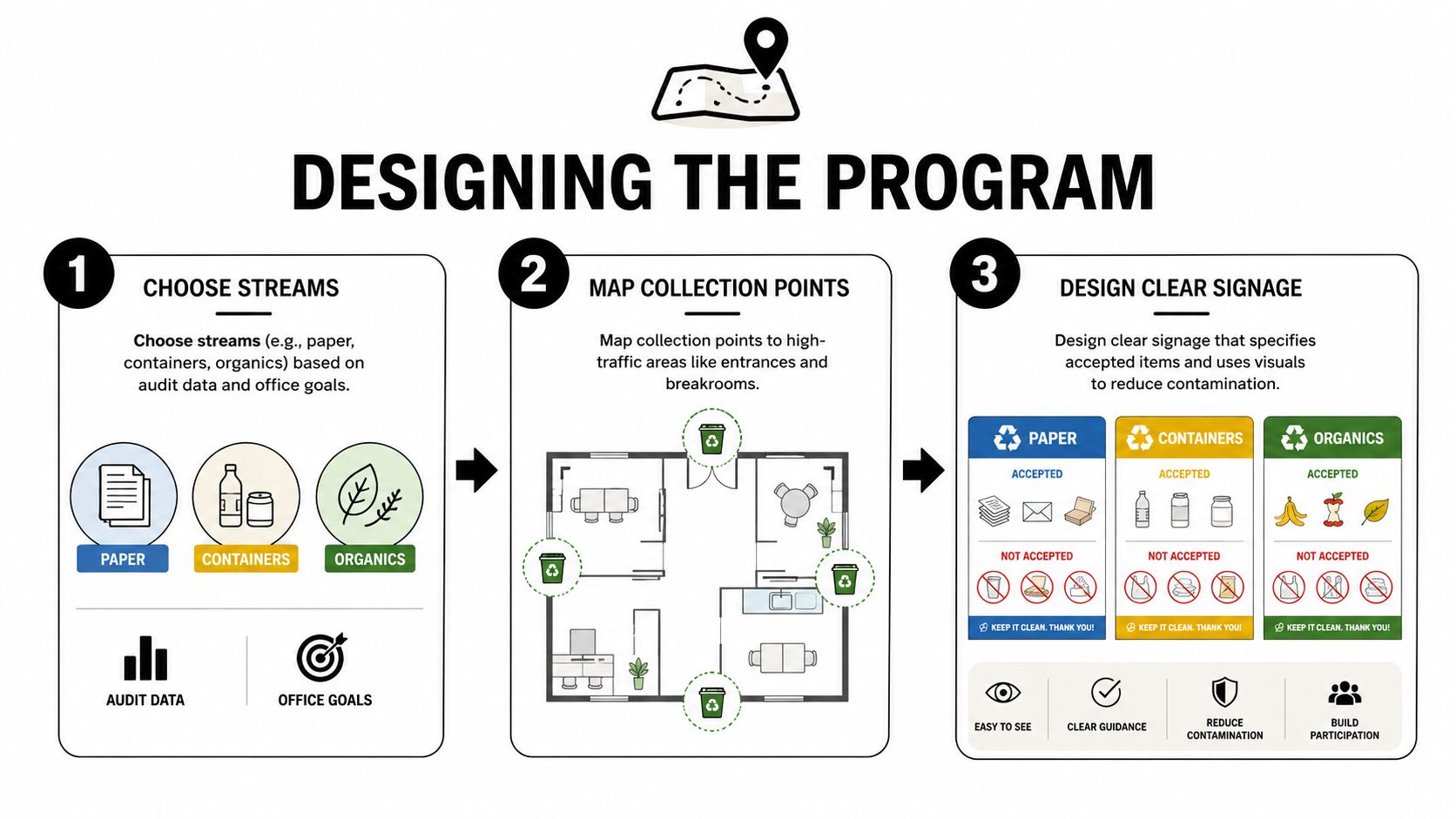
Choose streams from the audit, then map collection points against traffic and disposal patterns. Entrances, breakrooms, copy areas, cafeterias, loading zones, classrooms, and shared workspaces each create different risks. Pair recycling with trash wherever possible, and use a separate organics stream only where the material volume and local processing support justify it.
Match the collection model to the risk
A single-stream approach reduces sorting effort at the point of disposal, but it can make contamination harder to prevent when users treat the container as a general-purpose bin. A dual-stream station creates a clearer distinction between paper and containers, but it requires more space and more disciplined labeling. Source-separated collection works best for a material with a reliable volume, a clear owner, and a processor that wants it kept separate, such as confidential paper or certain electronics.
Don't give every area the same station. A breakroom may need prominent container and organics guidance, while a print center may need paper-only collection. A loading dock may require cardboard handling rules rather than a public-facing recycling bin.
Signage should answer one question immediately: What belongs here? Use pictures of common local items, short accepted-item lists, and a prominent “not accepted” list for the materials that cause recurring problems. Avoid signs that say only “recyclables.” That label transfers the sorting decision to a person who may be standing in front of the bin for a few seconds.
Put the instruction at the point of disposal, not in a policy folder employees rarely open.
Reviewing practical guidance on cutting failed collection rates can help facilities teams identify missed pickups, overflowing containers, access problems, and other service failures that undermine trust. A station that isn't serviced consistently teaches people that sorting doesn't matter.
The difference between commingled and separated recycling should also be clear to the people managing the contract. Your vendor's terminology, your signs, and your internal training need to describe the same material pathway.
Choosing Vendors and Partners You Can Actually Trust
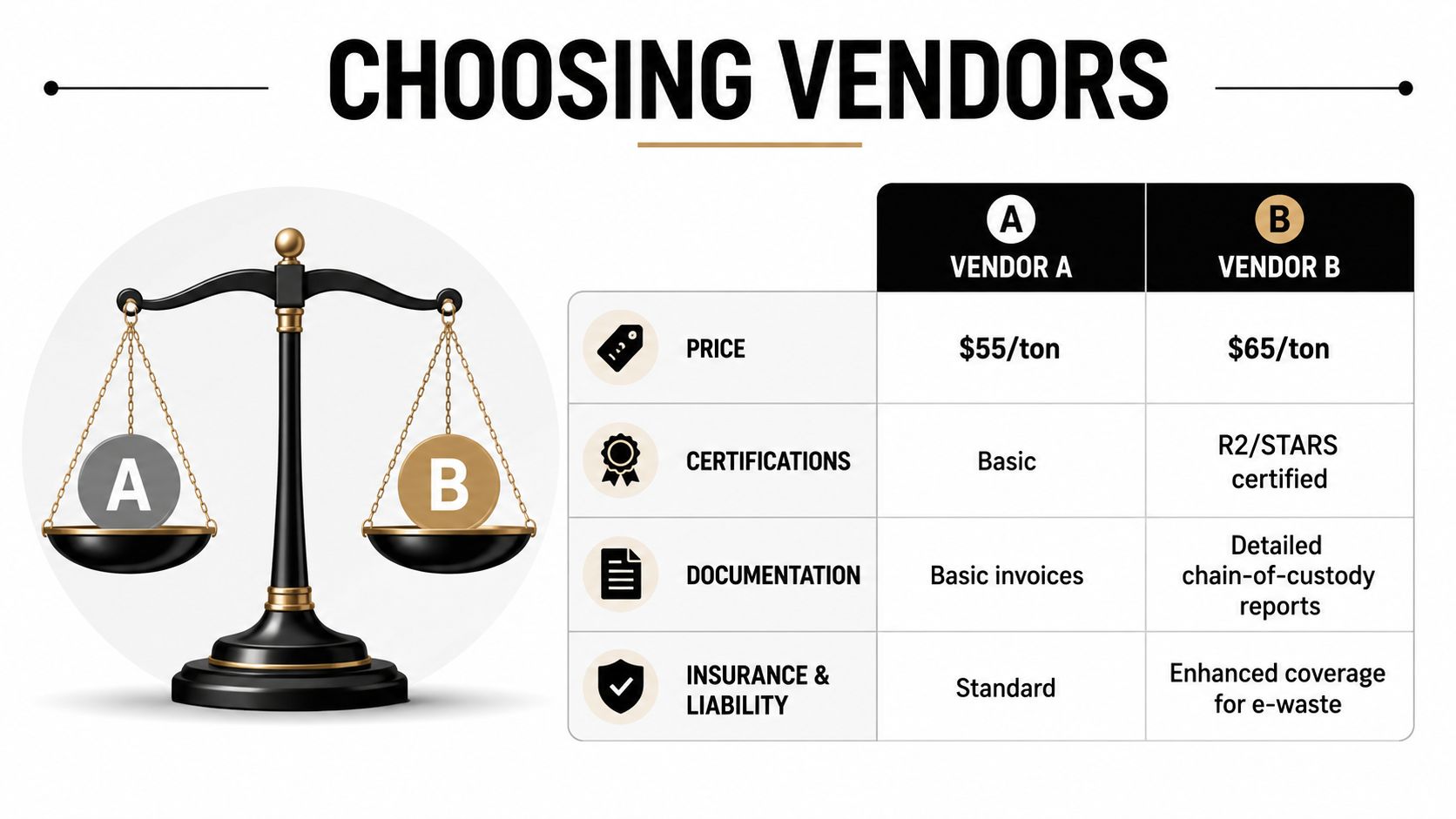
The cheapest collection quote often excludes the controls that protect the program. Price matters, but it shouldn't outrank material acceptance, downstream transparency, insurance, service reliability, or documentation.
Evaluate a prospective partner across four areas:
| Evaluation area | Questions to ask |
|---|---|
| Capability | Which materials do you accept, and which processor receives them? |
| Documentation | What weights, manifests, certificates, and service records will you provide? |
| Security | How are laptops, servers, drives, and storage media tracked and sanitized? |
| Accountability | What happens after a missed pickup, contamination event, or disputed weight? |
For electronics recycling and IT asset disposition, ask the vendor to explain the full chain of custody. The answer should identify who receives the equipment, how serial numbers are recorded, where data-bearing assets are held, which sanitization outcome applies, and what proof returns to your organization. A vague promise to “wipe everything” isn't a control.
NIST Special Publication 800-88 Rev. 1 defines three sanitization outcomes for storage media, Clear, Purge, and Destroy, covering logical methods, stronger sanitization, and physical destruction across media types (NIST sanitization outcomes explained). Select the outcome based on the asset, data sensitivity, reuse plan, and organizational policy. For devices that can't be sanitized, Samsung's 2025 e-waste policy requires data-containing devices to be fully erased or physically destroyed, aligned with NIST SP 800-88 or an equivalent standard, and prefers NAID AAA-certified destruction providers (Samsung e-waste disposition policy).
Test the operating relationship
Run a controlled pilot before committing every site. Give the vendor a defined asset list, require pickup documentation, inspect the returned report, and ask how exceptions are handled. Put the result into a Service Level Agreement covering collection windows, communication contacts, documentation, contamination handling, damaged equipment, and escalation.
For employee engagement, a simple recognition system can reinforce correct behavior without turning recycling into a gimmick. A customizable loyalty card tool may help teams structure participation prompts for recurring workplace campaigns, but it should supplement convenient design and feedback, not replace them.
Use Reworx Recycling's vendor selection criteria as a reference when comparing electronics and IT asset partners. Reworx Recycling provides electronics recycling, business pickups, equipment decommissioning, IT asset management, secure hard drive shredding, and data destruction services for organizations retiring technology. Ask every bidder the same questions, compare the evidence, and select the partner whose operating process you can audit.
Compliance, Data Security, and the Communication Layer That Holds It Together
A recycling station can be perfectly placed and still fail if employees do not know what belongs there or who fixes recurring mistakes. Compliance records and communication must make the process visible, assign responsibility, and preserve evidence when material or equipment goes off course.
For ordinary recyclables, retain the accepted-item list, hauler agreement, weight records, service tickets, contamination observations, and corrective actions. For electronics, maintain asset inventories, serial-number records, transfer documents, sanitization or destruction certificates, downstream processor details, and exception logs. Your chain-of-custody documentation for IT assets should let an auditor, security officer, or procurement lead trace what left the building and what happened afterward.
State requirements can add specific obligations. A Georgia compliance guide says each electronics recycling batch should include vendor documentation and that businesses should retain those records for at least three years (Georgia electronics disposal documentation guidance). Illinois law cited in an IT asset disposal compliance source requires state agencies to render disposed personal data “unreadable, unusable, and undecipherable,” while most computers, monitors, printers, and related IT assets are banned from landfill disposal (Illinois IT asset disposal requirements).
Make ownership visible
Assign one owner to each record. IT controls the asset inventory and data disposition decision. Facilities controls pickup access and collection conditions. Procurement verifies insurance and contract terms. Sustainability consolidates weights, contamination findings, and progress reports. Legal or compliance reviews retention and jurisdiction-specific requirements.
Give communication the same structure. Use onboarding, short team briefings, floor walks, refreshed signs, and targeted messages after contamination appears. Show examples from the actual workplace, including shipping cartons, disposable foodware, printer paper, cables, laptops, or laboratory equipment. Keep the instructions short enough to use during a busy shift.
A contamination alert should name the location, item, and correction:
Subject: Correction needed at the second-floor recycling station
A disposable food container was found in the paper stream. Please empty food containers and place them in the designated container before recycling the remaining paper. Facilities will check this station again today.
For e-waste collection and recycling operations in markets where it applies, SPCB or PCC authorization may be mandatory before collection, dismantling, or recycling begins, and EPR registration on the CPCB portal may be required for participation in Extended Producer Responsibility arrangements (e-waste authorization and EPR guidance). Confirm local rules before accepting material or selecting a downstream partner.
Measuring What Matters and Adjusting Before Drift Becomes Damage
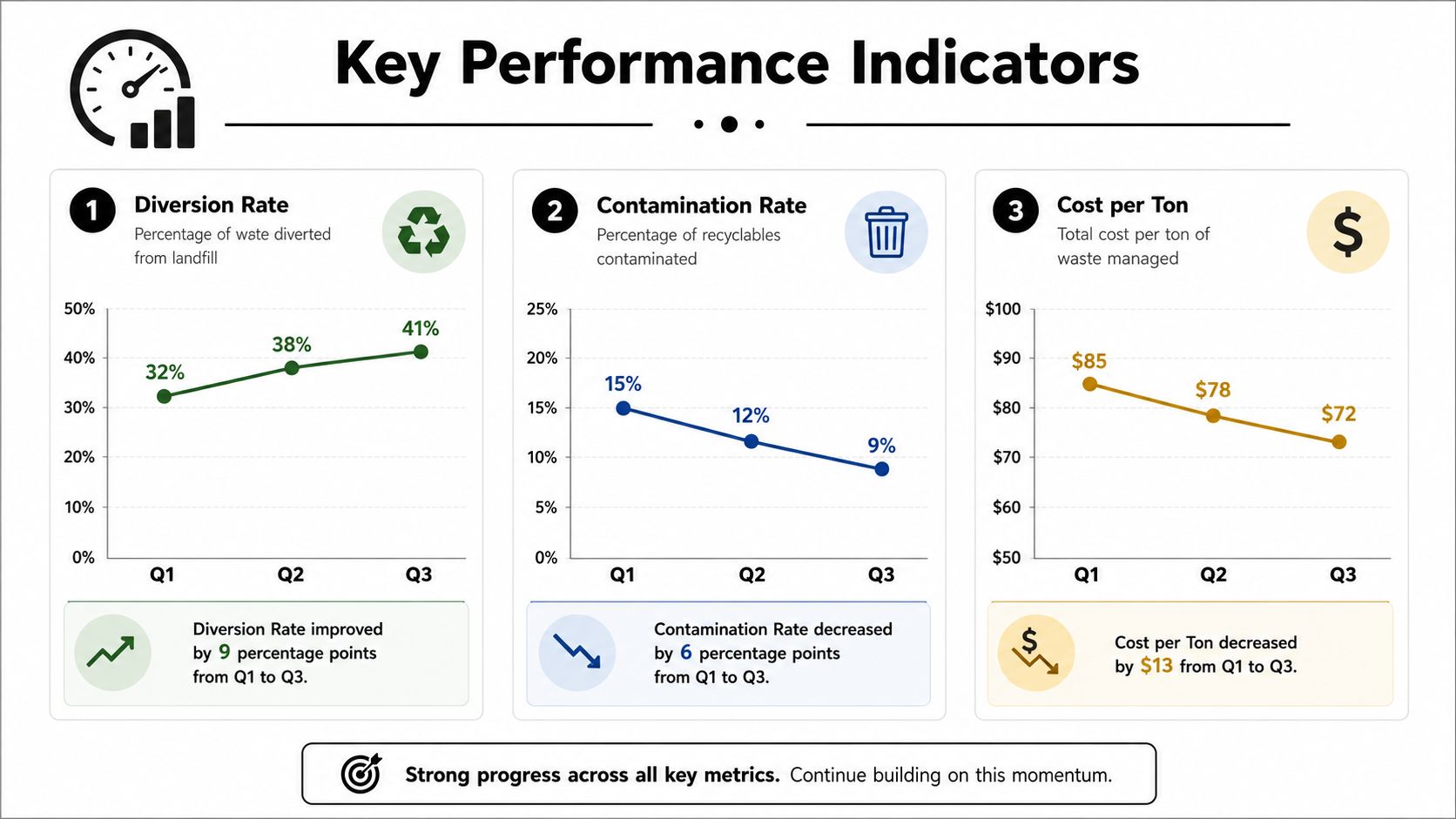
A program can look busy while recoverable material still goes to disposal. Counted bins and upbeat announcements do not prove performance. Set KPIs that connect collection, material quality, participation, cost, and service reliability, then review them on a fixed calendar.
Track these measures:
- Diversion: Compare the weight sent to recovery with the weight sent to disposal. Use the same scope and unit during each reporting period.
- Contamination: Record rejected material, observed sorting errors, and processor feedback by location and stream. Repeated contamination usually points to unclear instructions, poor station design, or a mismatch between accepted materials and the processor's requirements.
- Participation proxies: Monitor collection volume by occupied area, department, employee group, or service point. Investigate unusual changes instead of treating volume as proof of engagement.
- Cost per ton: Include collection, processing, hauling, education, equipment, and special handling. The vendor invoice alone hides the true operating cost.
- Service reliability: Log missed pickups, overflowing stations, delayed reports, and unresolved tickets.
Review operational data monthly. Hold a deliberate quarterly review with facilities, sustainability, procurement, communications, and IT. Use a formal review and adjustment loop, rather than treating launch as a finished project.
Ask questions that force action
At each review, ask:
- Which location produces the most contamination?
- Which accepted stream is consistently under-collected?
- Did the vendor provide complete weights and service records?
- Are signs accurate for the current processor?
- Did a staffing, layout, tenant, or operational change alter disposal behavior?
- Should the organization expand a stream, simplify it, or pause it?
Report results in operational language. Leadership needs to know what was recovered, which problem requires funding, and who owns the correction. If contamination rises, move the sign, change the container, retrain the affected group, or narrow the accepted list. Adding more streams usually makes sorting harder.
For electronics and IT assets, record donation, reuse, secure destruction, and recycling outcomes in the same program record. Reworx Recycling's impact measurement resources can support that reporting and help maintain a clear chain of custody for equipment and data-bearing devices.
Turning the Program Into a Continuous Improvement Loop
A recycling program isn't complete when the bins are installed. It becomes durable when every review produces a specific adjustment, someone owns that adjustment, and the next report shows whether it worked.
Expand only after the initial streams are stable. Then address specialized materials with the right partner. Electronics recycling, computer recycling, laptop disposal, data center decommissioning, medical equipment disposal, laboratory equipment disposal, product destruction, and secure data destruction each require different handling decisions. A general office station isn't an IT asset disposition system.
Reworx Recycling gives businesses an option for donation-based recycling, equipment pickups, IT asset disposition, secure hard drive shredding, and electronics recycling. Its social enterprise model connects responsible retirement with community impact through technology donations, digital inclusion, and workforce development.
Set a review date, assign owners, and bring your electronics inventory to the conversation. A focused partner discussion can turn an unreliable office cleanout or facility cleanout into a documented, sustainable recycling workflow.
Reworx Recycling helps businesses donate or responsibly recycle outdated electronics, coordinate pickups, manage IT equipment disposal, and document secure data destruction. Visit Reworx Recycling to schedule a pickup, donate equipment, or start a conversation about building a safer, more accountable recycling program.