The IT storage closet is usually where an organization's technology lifecycle becomes visible. Retired laptops sit beside monitors awaiting a decision, network equipment remains boxed after a refresh, and hard drives stay locked away because nobody wants to risk exposing company data. A planned office cleanout or data center decommissioning turns that quiet accumulation into an operational problem involving security, compliance, logistics, and sustainability.
The Growing Challenge of Corporate E-waste
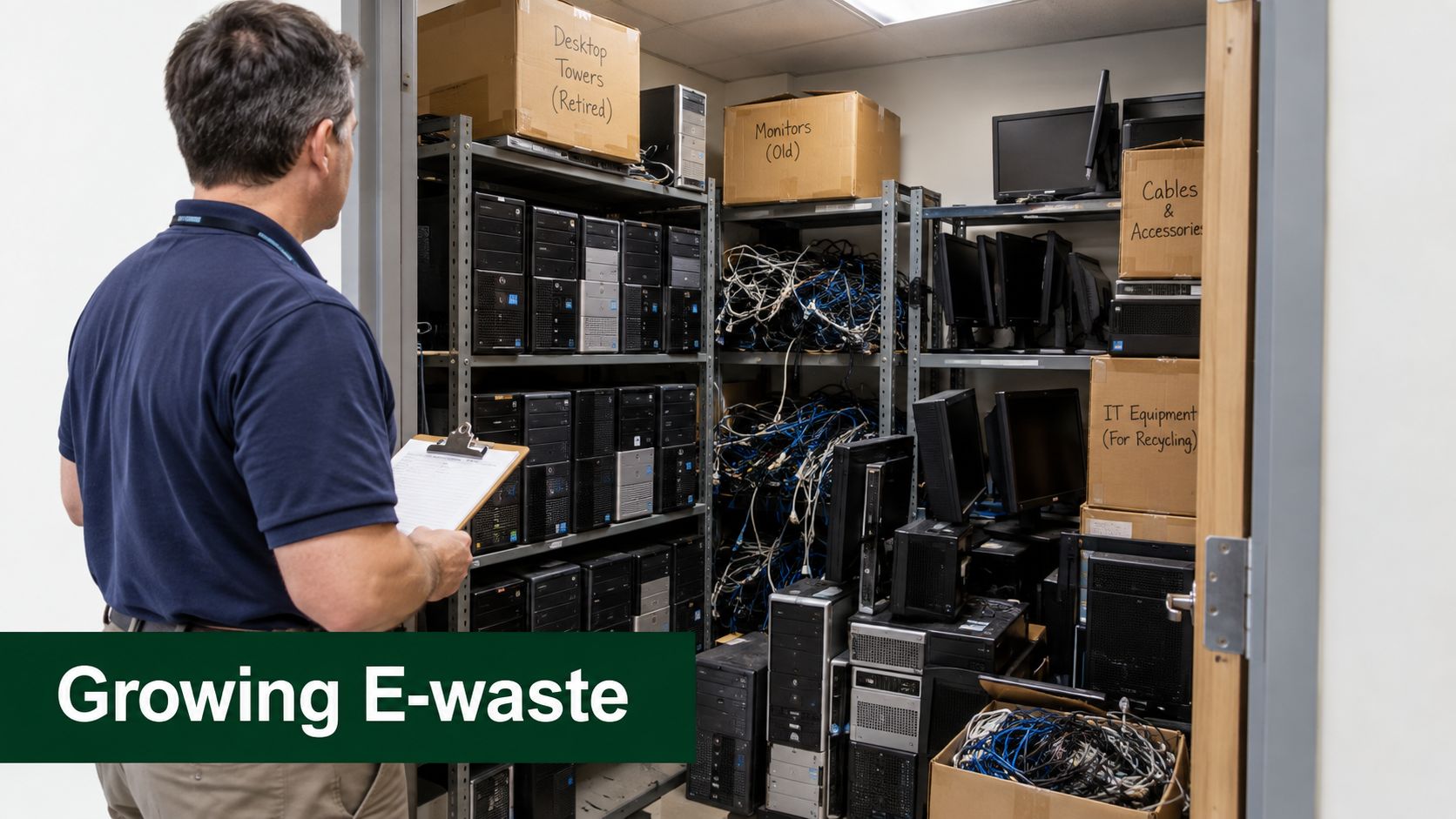
The equipment in that room isn't merely unwanted property. It may contain confidential files, recoverable resale value, batteries, and components that require controlled processing. A responsible program must distinguish between assets suitable for reuse, devices requiring secure data destruction, and materials that should enter a documented recycling stream.
The global context makes informal disposal harder to justify. The Global E-waste Monitor 2024 report states that the world generated 62 million tonnes of e-waste in 2022, while only 22.3% was formally collected and recycled. The same report projects that global e-waste will reach 82 million tonnes by 2030, with documented recycling potentially falling to about 20%.
For a business, that recovery gap translates into practical exposure. Devices left in storage can become difficult to track. Unprocessed equipment can occupy valuable space. A discarded drive can create a security incident, while poorly managed electronics can send recoverable metals and hazardous materials into channels that offer little accountability.
Practical rule: Treat retired electronics as controlled business assets until inventory, data handling, disposition, and documentation are complete.
Reworx Recycling fits this operational model by combining electronics recycling, IT equipment disposal, secure hard drive shredding, business pickups, and IT asset disposition support. Its donation-based approach also gives organizations a way to connect equipment retirement with community technology access, rather than treating disposal as the only outcome. Businesses evaluating the broader environmental consequences can review this guide to the impact of e-waste on the environment.
Key Drivers for Prioritizing E-waste Recycling
Three concerns should shape an e-waste policy: environmental responsibility, compliance, and data security. Treating any one of them as secondary weakens the entire program.
Environmental stewardship
Electronics contain both recoverable resources and materials that require careful handling. Printed circuit boards in e-waste can contain about 1,000 to 3,000 grams of gold per tonne, compared with roughly 5 to 10 grams per tonne in primary mined ore, according to research from Heriot-Watt University. Under controlled conditions, optimized hydrometallurgical or hybrid processes can reach up to 95% recovery of base and precious metals, although results depend on feedstock, process design, and operating controls.
That difference explains why sustainable recycling is more than a disposal preference. A professional processor can direct working equipment toward reuse, separate recyclable materials, and keep hazardous components out of unsuitable waste streams. Businesses considering purchasing decisions can also examine eco-friendly smartphone options to reduce future environmental pressure through longer use and more responsible sourcing choices.
Regulatory accountability
Legal obligations vary by jurisdiction, equipment type, and business activity. The EU WEEE Directive sets a minimum collection target of 65% of the average weight of electrical and electronic equipment placed on the market during the previous three years, or alternatively 85% of WEEE generated within the territory, with the higher target applying from 2019 onward. The European Commission's WEEE Directive provides the underlying requirements.
Collection performance shows why written policy and vendor oversight matter. The European Environment Agency reported EU27 WEEE collection rates of 45.9% in 2020 and 40.6% in 2022, both below the 65% target, as documented by the EEA collection-rate metrics. Requirements differ in the United States, but the management lesson is consistent: document who handled equipment, where it went, and how the final disposition occurred.
Data security
A recycler that accepts laptops, servers, phones, or storage arrays is also handling potential business information. Secure data destruction must therefore sit inside the ITAD workflow, not after it.
The WHO and ITU note that countries without e-waste laws have collection and recycling rates near zero, while countries with legislation reach about 25%, illustrating the importance of policy and enforcement, as summarized by the ITU e-waste backgrounder. For individual organizations, that same principle applies internally. A written procedure, trained staff, controlled transport, and verifiable destruction records are more dependable than asking employees to place devices in a general recycling bin.
The End-to-End IT Asset Disposition Process
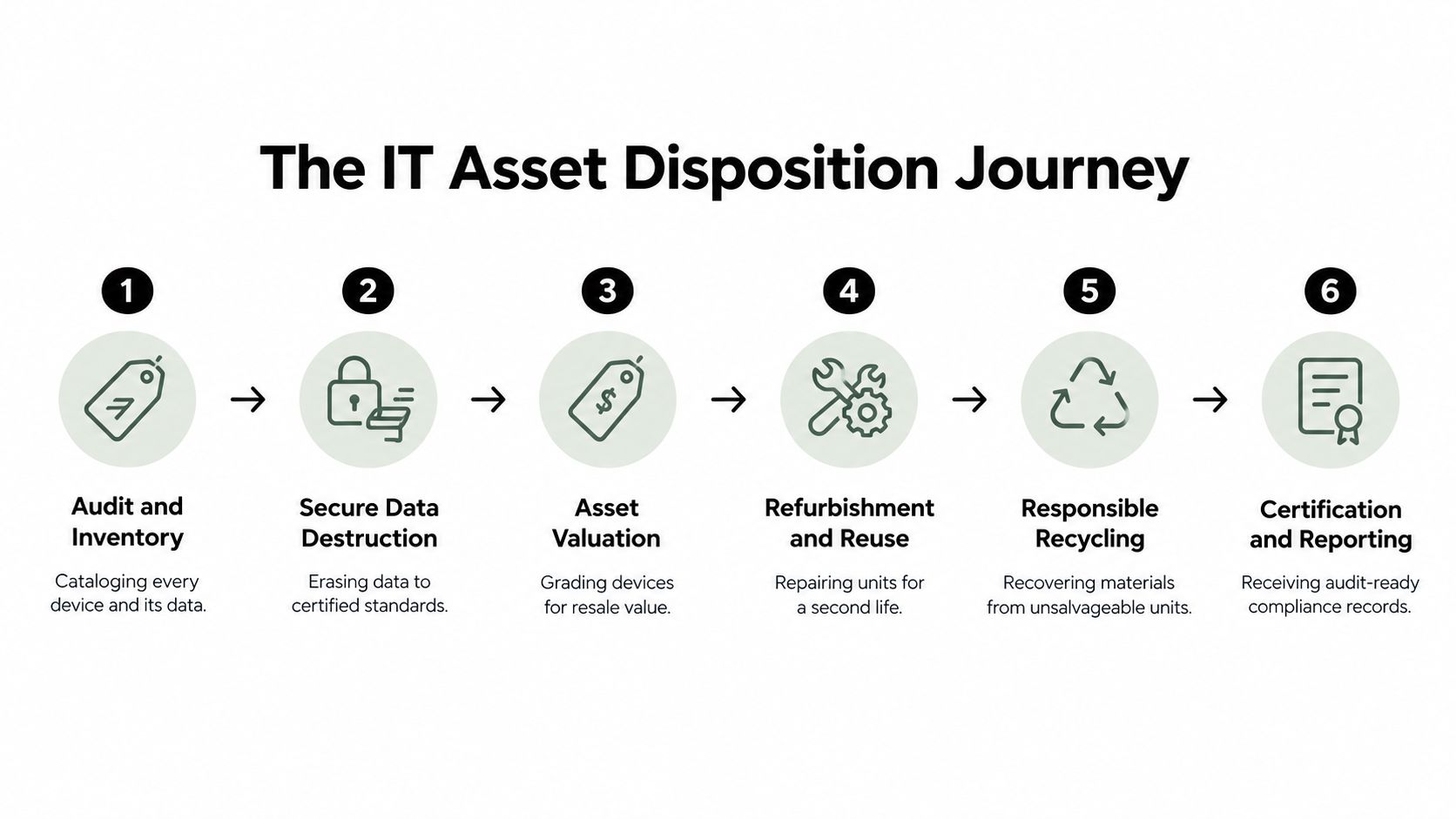
A credible IT asset disposition process creates an unbroken record from pickup to final reporting. The exact workflow can vary by asset type, but the controls should remain visible to the IT manager, facilities team, and compliance stakeholders.
Audit and collection
Start with an inventory that records device type, manufacturer, model, serial number, location, ownership status, condition, and storage media. Include laptops, desktops, monitors, printers, networking equipment, servers, mobile devices, cables, and specialized assets such as laboratory or medical equipment where the recycler is qualified to handle them.
The collection plan should identify loading areas, access requirements, packaging needs, and responsible contacts. For a multi-site business, scheduled pickups and consistent labels reduce confusion between active equipment and retired assets. A vendor should also explain how it handles office cleanout, facility cleanout, and large-scale data center decommissioning.
Data destruction
Data handling must match the device and its intended destination. NIST SP 800-88 defines three media sanitization methods, Clear, Purge, and Destroy. The guidance identifies Purge as appropriate when media will leave organizational control for resale, donation, or third-party recycling, as summarized in this NIST-aligned asset disposal reference.
Wiping can suit reusable equipment when the process is verified and documented. Physical destruction may be more appropriate for failed drives, damaged media, or assets that won't be reused. Ask for serial-level records, method details, certificates, and a clear chain of custody. Businesses that need a broader primer on how to dispose of an old computer should still apply the same principles to every corporate device.
Valuation and reuse
After data controls, the partner should grade assets for reuse, refurbishment, resale, donation, or material recovery. Working laptops may support a corporate donation program, while obsolete or damaged equipment may have value only through component or metal recovery. Clear grading prevents organizations from sending reusable technology directly to destruction.
Downstream processing
Recycling should occur through documented, qualified channels. The processor should identify downstream facilities, explain how batteries and hazardous components are managed, and provide final reports that reconcile collected assets with their outcomes.
A useful overview of the full lifecycle is available through Reworx Recycling's explanation of what IT asset disposition involves. The point isn't to choose a particular route for every device. It's to ensure every route is intentional, secure, and auditable.
Choosing the Right E-waste Recycling Partner
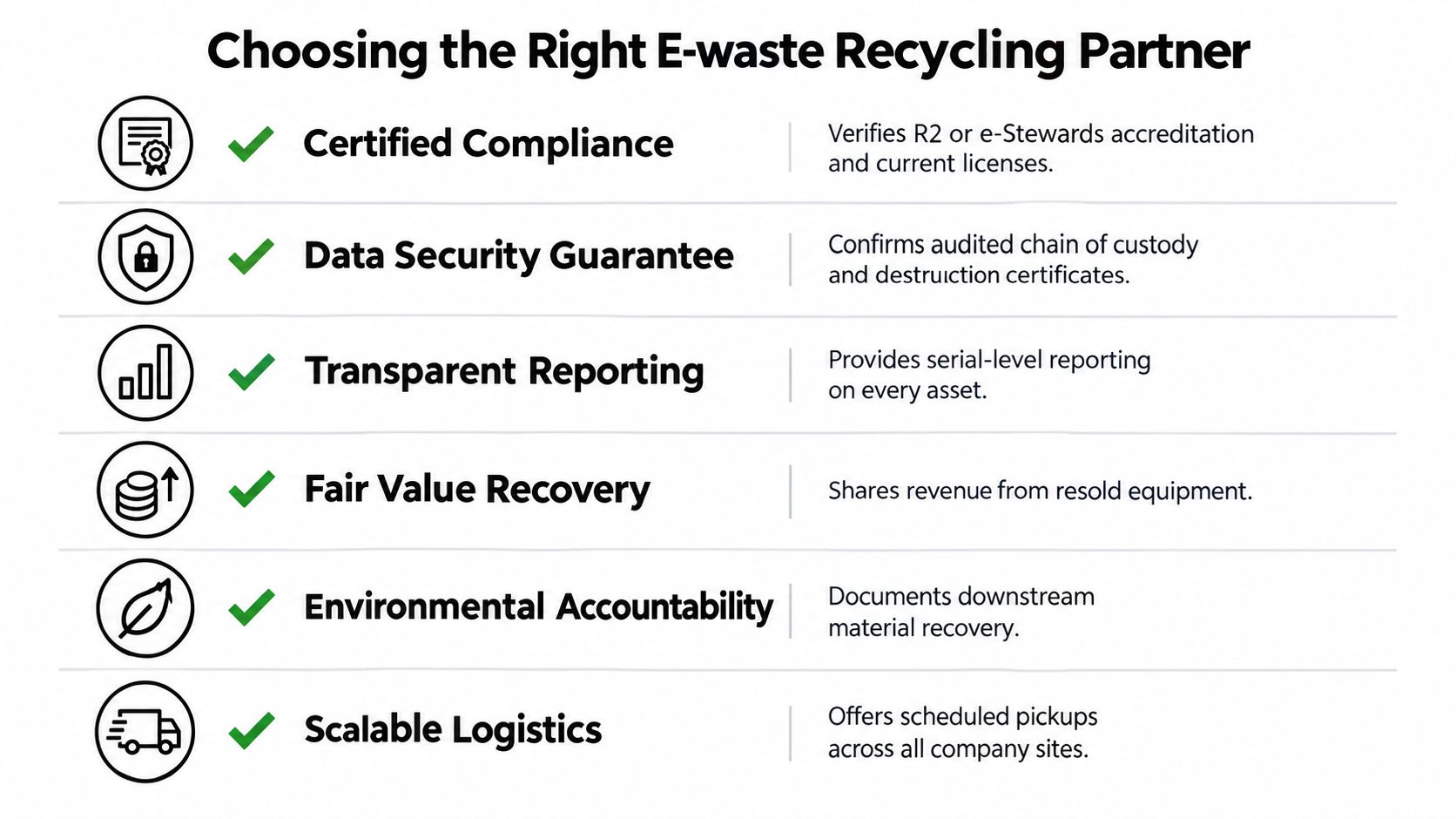
The cheapest pickup can become the most expensive option if it produces weak records, uncertain downstream handling, or unverified data destruction. Vendor selection should therefore evaluate risk control, operational fit, recovery value, and community impact together.
Start with evidence
Ask prospective partners for current certifications, licenses, insurance information, and written environmental procedures. R2 and e-Stewards are commonly used benchmarks to investigate, but the relevant question is how the partner's controls apply to your actual equipment and locations.
Data security deserves its own review. Confirm whether the vendor offers wiping, Purge-level sanitization where appropriate, physical destruction, or secure hard-drive shredding. Request sample certificates and chain-of-custody documentation before signing a service agreement, not after the first shipment leaves your building.
Test the reporting model
A strong report should help your organization reconcile what it released with what the partner received and processed. Useful fields may include asset identifiers, disposition category, data destruction method, downstream destination, and environmental outcome. If the report contains only a broad weight total, it may not support an internal audit or answer questions about individual drives.
Look at logistics, too. A national organization may need coordinated pickups across offices, schools, warehouses, and facilities. A smaller company may value flexible scheduling and help with an office cleanout more than a complex resale program.
Add mission alignment to the assessment
A social enterprise recycling partner can expand the value of the program when usable equipment is directed toward community needs. Reworx Recycling is a donation-based electronics recycling and ITAD organization that supports technology donations, digital inclusion, and workforce development while providing business recycling and data destruction services.
That doesn't replace technical diligence. It adds another decision criterion. Review the partner's donation process, recipient controls, impact reporting, and ability to distinguish genuine reuse from unsuitable redistribution. Organizations can use this vendor selection criteria guide to structure their questions around security, compliance, logistics, and impact.
Implementing Your Corporate Recycling Program
A policy works only when employees know what to do with a retired device and managers can arrange service without improvising. Build the program around ownership, repeatable collection points, and a defined disposition path.
Establish responsibility
Assign a program owner from IT, facilities, sustainability, or operations. Create a small working group that includes procurement, information security, finance, and any department managing regulated equipment.
Use an initial audit to identify what exists, where it sits, and which assets have sensitive storage. Then document the intake rules:
- Accepted equipment: List computers, monitors, phones, servers, peripherals, batteries, and specialized devices your partner can process.
- Data-bearing assets: Require staff to route laptops, drives, mobile devices, and servers through IT rather than placing them in an open collection container.
- Collection points: Use controlled, clearly labeled areas with access limited to authorized personnel.
- Approval records: Capture department, asset owner, serial number, and disposition approval before pickup.
- Pickup cadence: Schedule recurring service so equipment doesn't accumulate in closets or loading areas.
Adapt the workflow to the site
Schools may need separate procedures for student Chromebooks, loaner laptops, chargers, and devices returned at the end of a term. Healthcare organizations may require a specialized review before medical equipment disposal. Laboratories may need to separate laboratory equipment disposal from ordinary computer recycling because instruments can contain components, fluids, or compliance considerations outside a standard electronics stream.
Data center decommissioning requires earlier coordination with facilities and engineering teams. A recent report described a coming “tsunami” of discarded electronics from the data center boom and raised concerns about hardware containing lead, mercury, cadmium, PFAS, and recoverable metals, as reported by The Guardian's coverage of data center e-waste. End-of-life planning should therefore appear in refresh schedules, procurement decisions, rack removal plans, and facilities work orders.
Communicate and improve
Tell employees what belongs in the program, what must never be placed in ordinary waste, and how secure data destruction works. Provide a simple request path for laptop disposal, product destruction, and pickup scheduling. Review exceptions after each collection and update the procedure.
Reworx Recycling's guide to starting a recycling program can help teams turn these controls into an operating routine.
Measuring the ROI of Responsible Recycling
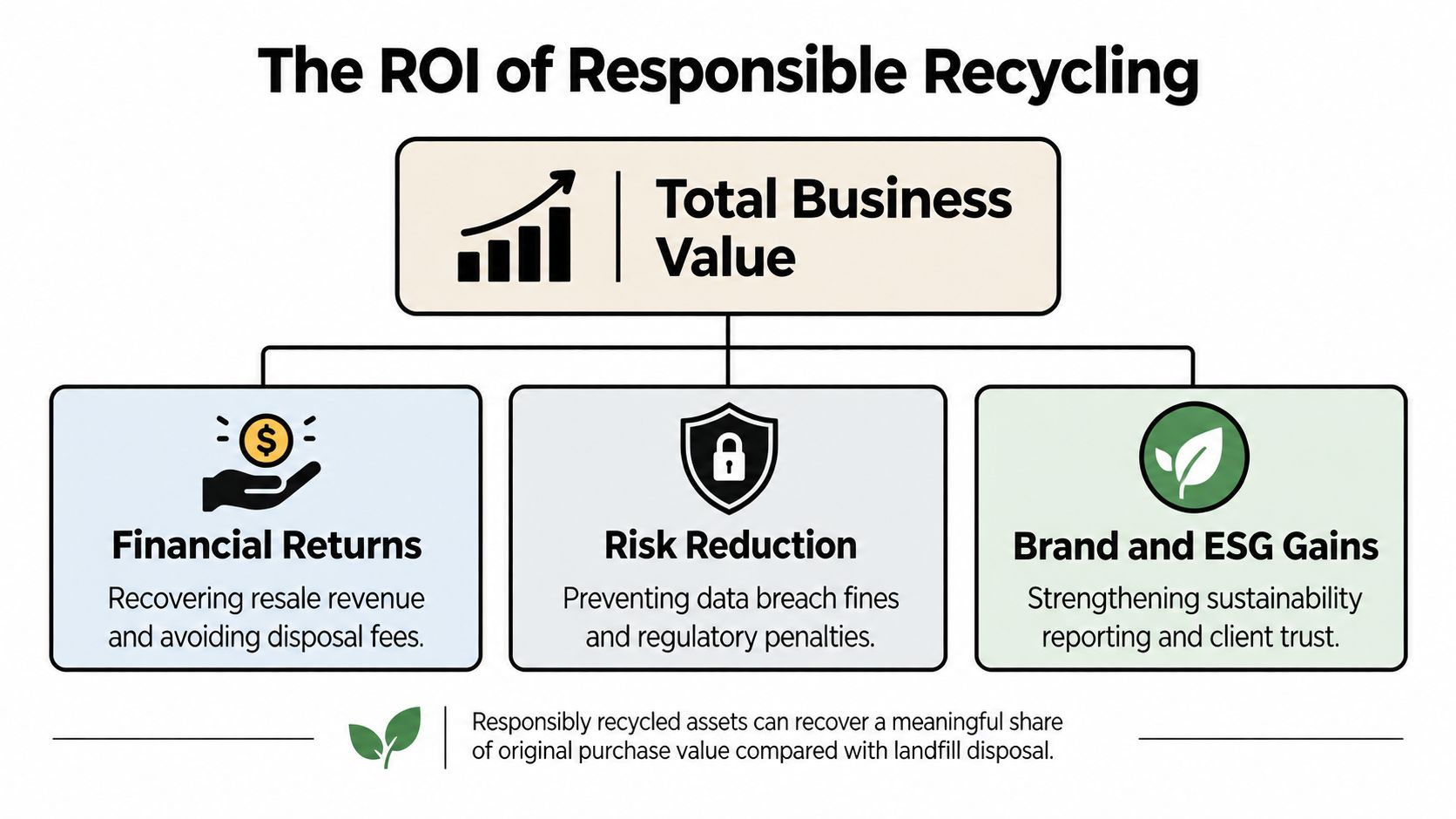
The business case for e-waste recycling isn't limited to a disposal invoice. A complete assessment considers recovered value, avoided risk, operational efficiency, and community outcomes.
Financial value
Reusable devices may generate recovery value through remarketing, buyback, refurbishment, or donation documentation where applicable. The result depends on condition, demand, configuration, age, and processing costs, so finance teams should require transparent valuation rather than assume every retired asset has resale value.
Material recovery also matters. Research on printed circuit boards shows why concentrated resources can make urban mining economically attractive, while controlled processing can recover valuable metals. The relevant measure for a business is not a headline estimate. It's the documented value and disposition outcome for its own equipment.
Risk and operations
Secure data destruction reduces exposure created by misplaced or improperly handled media. Compliance records help answer internal audit questions and demonstrate that the organization followed its own policy. Consolidated pickups can also reduce staff time spent moving equipment between departments.
An organized program reclaims space in storage rooms and makes technology refreshes easier to manage. It can support office cleanout and facility cleanout projects without mixing active assets, reusable equipment, hazardous components, and general waste.
Brand and social outcomes
Donation-based recycling can connect an equipment retirement project with digital inclusion and workforce development. That gives sustainability leaders a more meaningful story than reporting that devices left a facility. It also creates a practical channel for corporate donation programs when equipment remains suitable for use.
Track outcomes your organization can substantiate, such as assets donated, assets reused, data-bearing devices sanitized or destroyed, materials recycled, and facilities served. Reworx Recycling provides impact measurement support for organizations that want their environmental and community reporting to reflect actual disposition records.
Partner with Reworx for Community Impact
Responsible e-waste recycling protects more than the environment. It protects company data, supports compliance, releases occupied storage space, and gives IT and facilities teams a controlled way to retire equipment. The strongest programs combine inventory, secure data destruction, reuse decisions, documented recycling, and reporting in one workflow.
Reworx Recycling brings that workflow together for businesses through electronics recycling, IT equipment disposal, computer recycling, business pickups, equipment decommissioning, and secure hard-drive shredding. As a social enterprise, it also creates a path for suitable technology donations to support digital inclusion and workforce development.
If your organization is planning a refresh, office cleanout, facility cleanout, or data center decommissioning, start before equipment reaches the storage closet. Define the inventory, protect the data, and choose a partner that can document both environmental processing and community benefit.
Reworx Recycling can help your organization arrange responsible electronics recycling, secure data destruction, equipment pickups, and donation-based disposition for retired technology. Visit Reworx Recycling to learn how to plan your next ITAD project and turn old equipment into a safer, more accountable community investment.