If your company is spread across the country, what happens to all the old IT gear? It’s a logistical headache, right? Trying to manage electronics recycling from a dozen, or even hundreds, of different offices can quickly turn into chaos. For IT managers and corporate sustainability leaders, a patchwork of local vendors often leads to compliance gaps and missed opportunities.
A real nationwide recycling program is so much more than just getting rid of old equipment. It’s a smart, unified strategy that protects your data, recovers value from retired assets, and demonstrates your brand’s commitment to sustainability and community impact. It’s time to move away from a messy, site-by-site approach and build a cohesive plan that actually works for your business.
Building Your Nationwide Electronics Recycling Blueprint
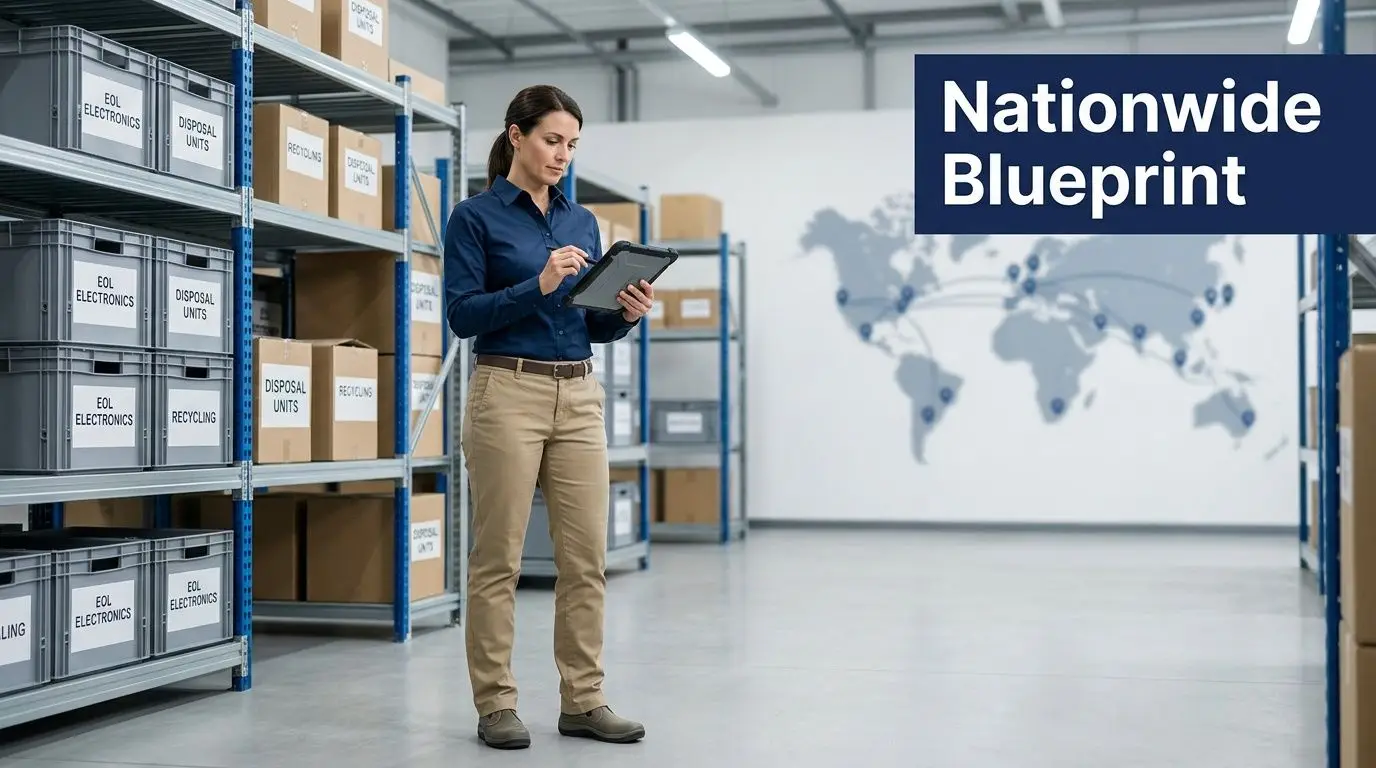
The secret to a successful national IT asset disposition (ITAD) program is to stop putting out fires at individual locations. Instead, you need a single, structured plan that every facility manager—from Miami to Seattle—can follow without a second thought. This blueprint is your key to ensuring every device is handled correctly, your data stays secure, and your company meets its compliance and environmental, social, and governance (ESG) goals.
Without this unified plan, you're stuck with a patchwork of local vendors, inconsistent data security, and lost opportunities to recover value from retired assets. A central strategy brings order to that chaos, streamlining everything from an office cleanout to a full facility cleanout.
Define Your Program's Core Objectives
Before you even think about moving a single laptop, you need to decide what success looks like. Your main goals will shape every decision you make, from choosing a partner to measuring results. What matters most? Is it minimizing risk, cutting costs, or boosting your corporate social responsibility profile?
Most programs focus on a mix of these common goals:
- 100% Data Security: Ensuring no device leaves any facility without certified data destruction. This is non-negotiable for protecting your business and your customers.
- Regulatory Compliance: Following all federal, state, and local e-waste rules, which can change dramatically from one state to another.
- Sustainability Targets: Hitting your corporate ESG goals for diverting waste from landfills, achieving sustainable recycling, and lowering your carbon footprint.
- Value Recovery: Getting the most money back from retired but still useful IT assets through transparent buyback or remarketing programs.
- Social Impact: Partnering with a social enterprise like Reworx Recycling, so your usable equipment can support community initiatives like digital inclusion and workforce development.
The best part? These goals aren't mutually exclusive. A great program can lock down your data security while generating revenue and making a positive community impact. Figure out your priorities first, and you’ll have a clear mission for your entire nationwide recycling effort.
A successful program is built on a clear chain of custody. You need a documented, unbroken trail from the moment an asset is retired in a branch office to its final recycling or reuse. This is how you prove compliance and mitigate risk.
Inventory Assets and Establish a Chain of Custody
You can’t manage what you don’t measure. The next step is to get a full inventory of all the IT assets you plan to retire, across every single one of your locations. This is more than just a device count; it's a detailed log for secure IT asset disposition (ITAD).
Your inventory needs to capture:
- Asset type (e.g., laptop, server, monitor, specialized medical equipment, or laboratory equipment)
- Serial number or your internal asset tag
- Location (city, state, and the specific office)
- Whether it contains sensitive data (a simple yes/no)
This detailed inventory is the bedrock of your chain of custody, which is non-negotiable for accountability. It tracks each asset from your front door to its final disposition—whether that’s secure data destruction, refurbishment, or recycling. This documentation is your proof of due diligence if an auditor or data breach investigator ever comes knocking. For companies operating on an even larger scale, understanding the best practices for handling global electronics recycling can offer even more valuable insights.
Partnering with a social enterprise like Reworx Recycling makes this whole process much simpler. We provide the tools and hands-on expertise to build and manage a national inventory. We ensure every single device is accounted for and handled according to your program's goals and compliance needs. By turning your retired tech into community resources through corporate donation programs, your nationwide recycling program becomes a powerful statement about your company's values.
Vetting and Selecting the Right National Partner
Your nationwide electronics recycling program is only as strong as the partner you bring on board. A common mistake is trying to stitch together a solution with a patchwork of local vendors, which quickly turns into a logistical nightmare with significant compliance gaps.
What you really need is a single, unified partner who can act as a true extension of your team, managing your entire program from coast to coast. This isn't just about laptop disposal. It's about finding an expert who can handle everything—from a standard office cleanout in one state to a complex data center decommissioning in another.
Vet for Nationwide Logistics and Service Scope
The first thing to look at is their reach. Can the vendor physically service all of your locations without creating logistical headaches? Relying on multiple regional recyclers introduces inconsistency, drives up administrative costs, and creates a mess of different data security standards.
A true national partner gives you one point of contact for scheduling, reporting, and support. That simplifies everything. Imagine orchestrating pickups for offices in San Francisco, Chicago, and Atlanta with a single phone call instead of juggling three different vendors, each with their own unique process.
When you're vetting a potential partner, get specific with your questions:
- Do they run their own logistics network or subcontract everything out to third parties?
- Can they handle mixed loads of assets? Think computers, servers, networking gear, and even specialized lab or medical equipment.
- What's their process for a full facility cleanout or product destruction project that requires more than just a simple dock pickup?
A partner like Reworx Recycling, a donation-based social enterprise, is built to handle these complexities for national businesses. We manage the reverse logistics so your facility managers and IT teams can stay focused on their core responsibilities.
Prioritize Certifications and Data Security
In the IT asset disposition world, certifications aren't just fancy badges. They are your non-negotiable proof that a vendor is committed to environmental responsibility and data security. They are your first line of defense against massive compliance fines and reputational damage.
There are two certifications that are absolutely essential for any electronics recycling partner:
- R2 (Responsible Recycling): This standard guarantees the vendor follows best practices for environmental safety, worker health, and data security through the entire recycling chain.
- e-Stewards: Often seen as the gold standard, e-Stewards certification ensures absolutely no hazardous e-waste gets exported to developing countries and that all data is completely destroyed.
A vendor without these certifications is a huge red flag. If your old equipment ends up in a landfill or is mishandled, the legal and reputational blowback can land squarely on your company, no matter who you hired to haul it away.
Beyond certifications, you must scrutinize their secure data destruction methods. A top-tier partner should offer several options, including on-site physical shredding of hard drives and other storage media. This is the ultimate way to eliminate risk because your sensitive data never leaves your facility intact.
Always, always demand a serialized Certificate of Data Destruction. This document provides a clear, auditable trail for every single asset that was processed. If you're looking to dive deeper, you can learn more about what sets the best IT asset disposition companies apart from the rest.
To help you with your evaluation, we've put together a simple checklist. Use these questions to compare potential vendors and see how they stack up.
Vendor Capability Assessment Checklist
| Capability | Essential Questions to Ask | Ideal Vendor Response (e.g., Reworx Recycling) |
|---|---|---|
| Nationwide Logistics | Do you have your own trucks and personnel for all our locations? How do you handle scheduling across different time zones? | Yes, we have a dedicated logistics network. All scheduling is managed through a single point of contact for a seamless experience. |
| Data Security | Can you perform on-site hard drive shredding? What kind of documentation do you provide? | We offer both on-site and off-site shredding, with a serialized Certificate of Data Destruction for every project to ensure a secure chain of custody. |
| Certifications | Are you R2 and e-Stewards certified? Can you provide copies of your current certifications? | Yes, we hold both R2v3 and e-Stewards certifications and provide documentation upon request to verify our commitment to compliance. |
| Value Recovery | Do you have a buyback program for functional equipment? How is the value calculated and shared? | We have a robust buyback and refurbishment program. Value is determined by market rates, with transparent revenue sharing. |
| Reporting | What kind of reporting can we expect? Is it serialized by asset tag? | We provide detailed, serialized reports tracking every asset from pickup to final disposition, available through a secure client portal. |
| Social Impact | Do you have a donation or community impact program for refurbished equipment? | As a social enterprise, our core mission is to donate refurbished tech to support digital inclusion and workforce development. |
A thorough vendor assessment using a checklist like this ensures you cover all your bases and find a partner that truly meets the demands of a nationwide program.
Look for Flexibility and Social Impact
Finally, the best partners go beyond just disposal and actually align with your company's broader ESG goals. Can they help you recover value from your old assets? A modern ITAD program should include a strong buyback program where functional equipment is tested, refurbished, and resold, returning a portion of that revenue back to your bottom line.
This is where a social enterprise model provides a really unique advantage. When you partner with an organization like Reworx Recycling, your nationwide recycling program becomes a powerful engine for community good. Viable equipment that might otherwise be scrapped is instead refurbished and donated to support digital inclusion and local workforce development initiatives.
This approach doesn’t just check a CSR box—it bakes social responsibility right into your operations. It completely reframes IT disposal from a simple cost center into a meaningful investment in the very communities where you do business.
Mastering Logistics and Secure Data Destruction
You’ve done the hard work of vetting and choosing a certified ITAD partner. Now comes the part where the rubber meets the road: execution. A successful nationwide recycling program truly comes down to getting two things right—flawless reverse logistics and ironclad data security.
Getting these right is what separates a smooth, compliant program from a logistical nightmare. This is about coordinating pickups across multiple states, tracking every single asset, and ensuring that sensitive information is wiped clean forever. It's not just disposal; it's about maintaining complete control from the moment an asset leaves your facility.
This flowchart maps out the key decisions when selecting a partner, highlighting the non-negotiables: certifications, national scope, and, of course, data security protocols.
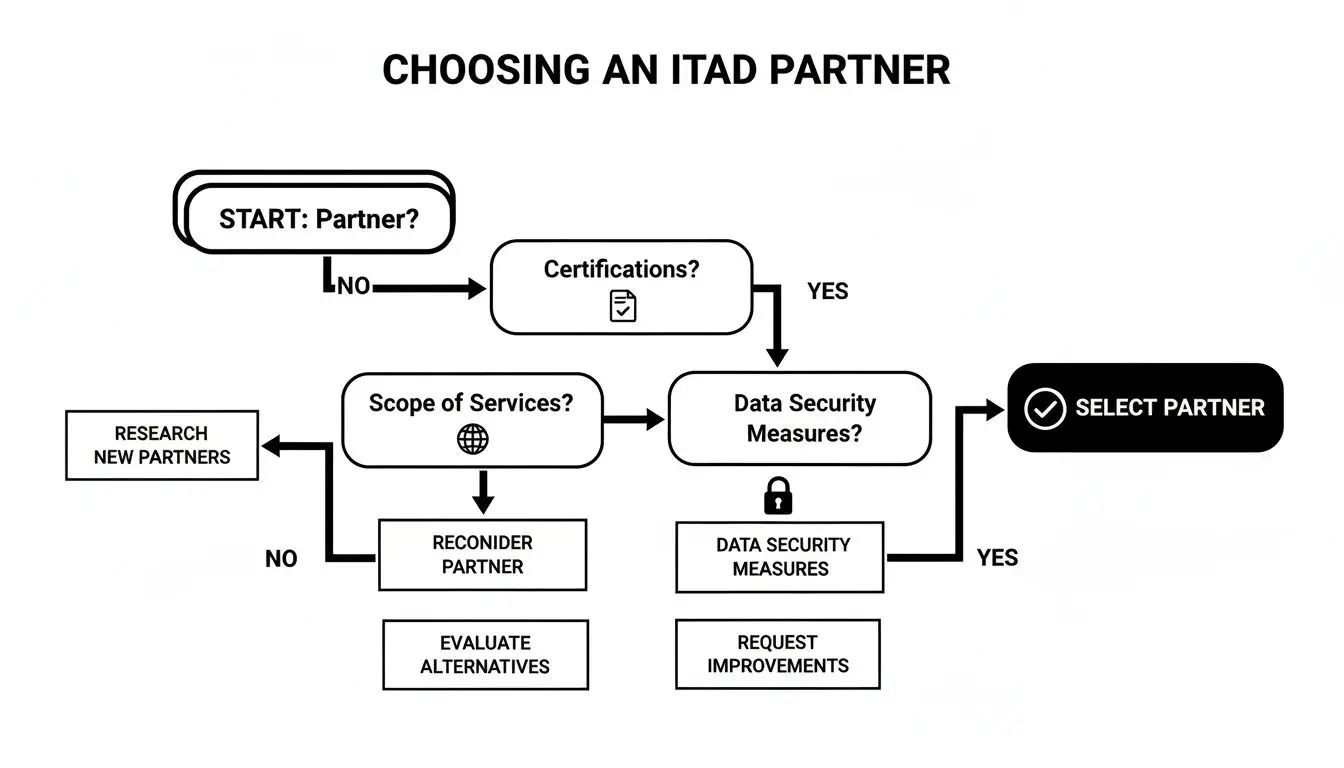
As you can see, a secure and compliant program starts with verifying a partner’s credentials and ensuring they have the national reach your business demands.
Streamlining Your Reverse Logistics
Reverse logistics—the process of getting retired equipment from your various locations back to the recycling partner—can get messy for a national company. The name of the game is efficiency. The best way to achieve this is to consolidate your shipments.
Instead of arranging dozens of small, one-off pickups from individual offices, work with your partner to schedule periodic, larger collections. This simple change has a massive impact:
- Slashes Costs: Fewer truck rolls mean lower transportation bills. Simple as that.
- Reduces Your Carbon Footprint: Consolidating freight is a quick win for your program's sustainability goals.
- Frees Up Your Team: Your facility managers and IT staff can stop playing logistics coordinator and focus on their core duties.
This is where having a single, dedicated partner like Reworx Recycling really pays off. We can build a custom pickup schedule that matches the retirement cadence of your different sites, whether it’s a quarterly cleanout in one city or a massive data center decommissioning in another. To learn more about this, check out how to maximize efficiency and sustainability with reverse logistics solutions from Reworx Recycling.
Secure Data Destruction Methods Explained
Data security isn't just an important part of your ITAD program; it's the most critical part. One data breach from a single mishandled laptop can cause devastating financial and reputational harm that takes years to repair.
Let's be honest, getting recycling right is a challenge even for households. Research shows only 21% of residential recyclable material in the U.S. is captured correctly. For businesses handling e-waste, the stakes are exponentially higher. Old devices packed with sensitive data can easily get lost in the shuffle or, worse, end up in a landfill. The good news? Getting it right has huge potential. Improving nationwide recycling to just 75% could create 1.5 million jobs.
Here are the three main ways to ensure data is gone for good:
- Data Wiping (Sanitization): This is a software-based approach that overwrites the entire hard drive with random data, making the original information impossible to recover. It's the perfect choice for newer, working devices you plan to resell or donate because it leaves the drive intact and ready for a new life.
- Degaussing: This method uses an incredibly powerful magnet to completely scramble the data on magnetic media like older hard drives and tapes. It’s highly effective, but it also permanently bricks the drive, so it's best for assets with zero resale value.
- Physical Shredding: This is the gold standard for security. The hard drive is fed into an industrial shredder that grinds it into tiny, confetti-like metal fragments. There is no coming back from this. It's the only choice for devices that held highly sensitive information like financial records, intellectual property, or protected health information (PHI).
For absolute certainty and peace of mind, many companies go with on-site physical shredding. Your ITAD partner brings a mobile shredding truck right to your office, and you can watch your drives get destroyed before they ever leave the property.
No matter which method you use, there's one document you must always demand: a Certificate of Data Destruction. This is your legal, auditable proof that every single serialized asset was sanitized according to strict industry and regulatory standards like HIPAA or GDPR. It's a non-negotiable for proving due diligence and protecting your organization.
Proving Your Program's Worth: Compliance and Measurement
A nationwide recycling program doesn't end when the trucks pull away. That’s actually just the beginning. The real test is whether your program can stand up to scrutiny from internal auditors, stakeholders, and, most importantly, external regulators.
Success here isn't about collecting a few certificates. It's about building an airtight system for compliance and having a clear framework for measuring what really matters. This means navigating a dizzying maze of environmental rules and data privacy laws that change from one state to another. Meticulous records and transparent reporting aren't just good habits—they're your best defense against risk.
Navigating the Regulatory Landscape
Compliance is the bedrock of any responsible nationwide electronics recycling program. The rules for e-waste and data privacy are anything but uniform across the country, creating a potential minefield for any company operating in multiple states. What's required in California is often worlds apart from the laws in Texas or New York.
This is where a certified ITAD partner becomes your most valuable player. They live and breathe this stuff, keeping up with every twist and turn in the regulations, including:
- State-specific e-waste laws that dictate exactly how electronics must be processed and recycled.
- Federal and industry-specific data privacy laws like HIPAA for healthcare, GLBA for finance, and even GDPR if you handle data from EU citizens.
- Environmental standards from the EPA and local authorities to prevent hazardous materials from being dumped improperly.
Working with a partner like Reworx Recycling means you're leaning on centralized expertise. It takes the burden off your team and dramatically lowers your compliance risk. To really get a feel for how deep this goes, you can check out our overview of electronics recycling certifications.
Tracking KPIs That Show Real Value
To prove your program is more than just a cost center, you need to look beyond the obvious metric of "waste diverted." While that's important, it doesn't paint the full picture. The best programs track a handful of Key Performance Indicators (KPIs) that directly connect what you're doing to business value and corporate responsibility.
Just look at the broader recycling picture in the U.S. for context. We recycle about 50.4% of aluminum cans but only 29.1% of PET plastic bottles, according to the latest EPA data on materials and waste. These gaps show that our national infrastructure struggles, and specialized materials like e-waste need a far more dedicated approach to protect both the environment and our data.
Your ITAD program’s success isn't just about what you get rid of. It’s about the value you create—for your bottom line, for the environment, and for the community.
Key Metrics for a Modern ITAD Program
Here are the essential KPIs that help you demonstrate a powerful return on investment and a real commitment to the circular economy.
Pounds of E-Waste Diverted from Landfills: This is the classic sustainability metric, and for good reason. It’s a direct, easy-to-understand measure of your environmental impact, showing stakeholders the exact volume of hazardous materials you've kept out of the ground.
Value Recovered from Asset Remarketing: This is where things get interesting. Track every dollar generated from your ITAD partner’s buyback program. This single KPI can flip your recycling initiative from a cost center into a revenue stream, proving a tangible financial ROI.
Number of Devices Refurbished and Donated: When you work with a social enterprise like Reworx Recycling, this metric becomes a cornerstone of your social impact story. It quantifies how many laptops, desktops, and other devices got a second life, supporting digital inclusion and helping people get back to work.
Carbon Footprint Reduction: A truly advanced ITAD partner can give you data on the estimated carbon emissions you've saved. They do this by comparing the impact of recycling and reusing your old gear versus manufacturing brand-new devices. This gives you a killer data point for your corporate sustainability reports.
By tracking these metrics together, you're not just reporting numbers—you're building a powerful narrative. You can walk into any leadership meeting and show not only that the program is compliant and cost-effective, but that it’s a strategic asset that makes your brand stronger.
Optimizing Costs and Maximizing Social Impact
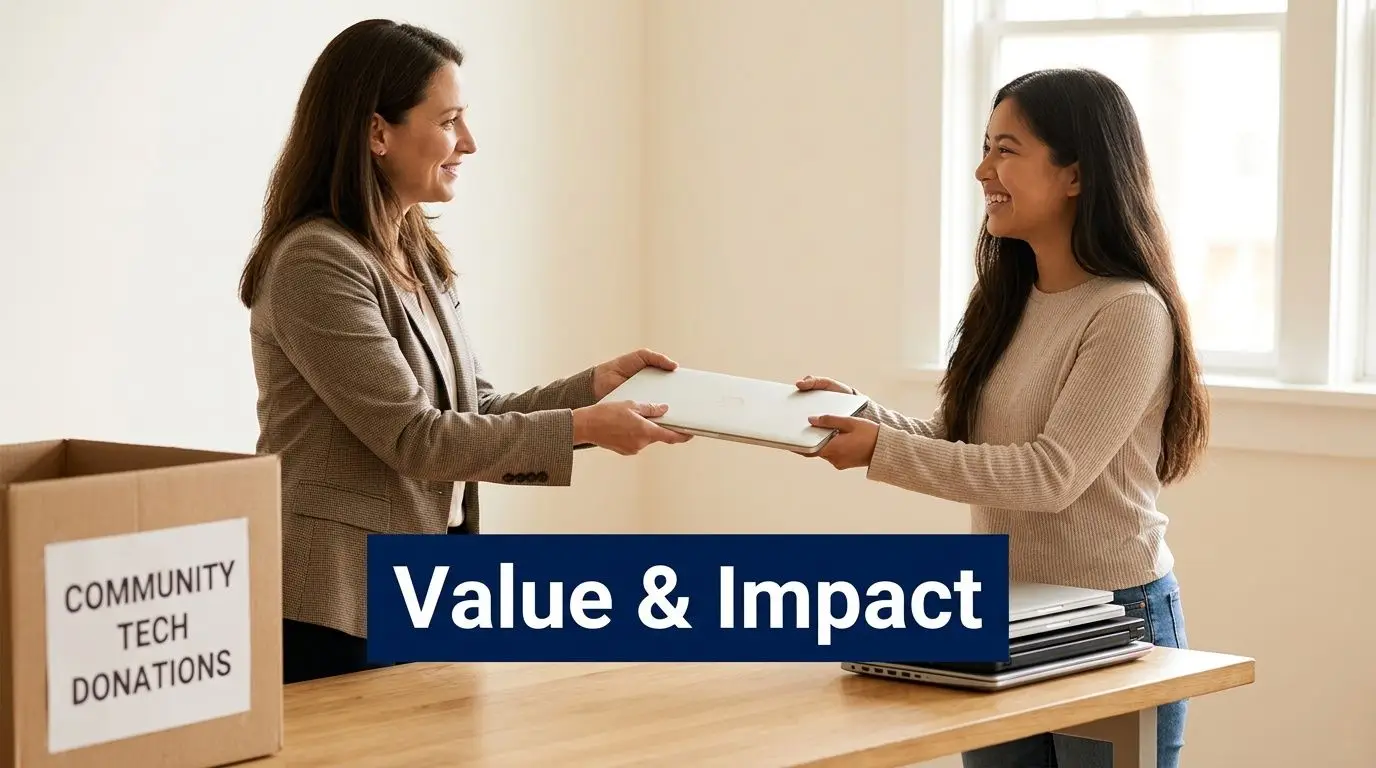
Let's be honest: a nationwide electronics recycling program can look like a major expense on paper. But what if it wasn't? When you approach it the right way, your program can shift from being a pure cost center to something that actually generates revenue and creates a powerful, positive story for your brand.
This is where everything comes together. It’s about seeing your old tech not as trash, but as a genuine resource. With a smart strategy, you can cut your disposal costs while giving back to communities, helping to close the digital divide, and showing the world what your company truly stands for.
From Cost Center to Value Creator
The most straightforward way to flip the script on costs is by getting money back for your retired assets. Not every device that's past its prime is worthless. Far from it. Many of your used laptops, servers, and networking gear still hold significant value.
An experienced ITAD partner will have a solid process for unlocking that value. It usually looks something like this:
- Testing and Auditing: Every single asset gets evaluated to figure out its condition and what it might be worth on the market.
- Data Sanitization: All data is securely and permanently wiped, following strict NIST 800-88 standards, to get the device ready for a new user.
- Remarketing: Functional equipment is then sold through well-established resale channels to generate revenue.
This process creates a buyback program where your company gets a cut of the sales. That revenue can be used to directly offset the costs of logistics and recycling for the devices that can't be resold. In many cases, it can make the entire program budget-neutral or even profitable. For any nationwide operation, understanding the real benefits of automation in business is a game-changer, as it can dramatically lower your operational costs and boost the efficiency of your whole recycling program.
The Social Enterprise Advantage
Now, this is where things get really interesting. Partnering with a social enterprise like Reworx Recycling adds a completely different—and powerful—layer to your program. While getting the best financial return is important, the social impact you can make is often immeasurable.
Instead of every single working device going to the highest bidder, a portion is intentionally directed back into the community. Your company's old laptops can become vital tools in workforce development programs. Desktops you no longer need can find a new life in under-resourced schools or local community centers, giving people digital access they wouldn't have otherwise.
This approach gives you a unique two-for-one benefit:
- Tangible Community Support: You are directly helping to bridge the digital divide.
- Powerful Brand Storytelling: Your recycling program suddenly becomes a compelling story about corporate responsibility that you can share.
By choosing a donation-based recycling partner, you’re making a conscious decision to invest in society. Your end-of-life assets don't just disappear—they become instruments of opportunity, helping to build skills and close the digital gap.
This model changes the entire conversation from just "getting rid of old stuff" to a strategic act of corporate citizenship. If you're curious about how this works in practice, you can get a deeper look by unlocking value after electronics recycling.
Aligning with National Goals
The need for companies to step up has never been clearer. Back in 2018, the United States generated 292.4 million tons of municipal solid waste, but only 32.1% of it was recycled or composted. There's a national goal to get that recycling rate up to 50% by 2030, and your organization can be a huge part of the solution.
When you partner with certified electronics recyclers, you're not just diverting your own e-waste from landfills—you're actively helping the country meet its sustainability targets.
Your nationwide recycling program becomes a tangible example of your commitment to a circular economy. It shows leadership and proves that your company is serious about building a more sustainable and equitable future, one device at a time.
Frequently Asked Questions About Nationwide Recycling
Thinking about a nationwide electronics recycling program brings up a lot of questions. We get it. Juggling logistics, security, and compliance across dozens of states can feel like a massive puzzle.
We hear these questions all the time from IT managers, sustainability leaders, and business owners. Here are the answers to some of the most common ones we encounter when building a national ITAD strategy.
How Do We Handle Recycling Regulations That Differ From State To State?
This is easily one of the biggest headaches for any national business. What’s legal and compliant for computer disposal in California is completely different from the rules in Texas or New York. Keeping track is a full-time job.
The simplest, most effective approach is to work with a certified ITAD partner like Reworx Recycling that lives and breathes nationwide compliance. A truly capable partner knows the ins and outs of the regulations in every state you operate in. They ensure your program meets even the most stringent local rules for e-waste, data destruction, and reporting, taking a huge administrative and legal weight off your shoulders.
Is One National Vendor More Cost-Effective Than Multiple Local Recyclers?
It might seem like patching together a network of local recyclers would be cheaper, but for a multi-state company, a single national vendor almost always wins on both cost and security. A national partner offers economies of scale, much simpler logistics for things like office cleanouts, and consistent reporting across every single location.
Think about the time saved on administration alone. Plus, you get the peace of mind that comes from knowing uniform data security protocols are being followed everywhere. The risk you avoid by standardizing secure data destruction and chain-of-custody tracking is often worth far more than any small savings you might see from a fragmented, local approach.
"Achieving the Widely Recyclable designation for polypropylene cups is a significant milestone. It reflects what’s possible when businesses, recyclers and communities work together to create solutions that can reduce waste and make recycling easier…" – Marika McCauley Sine, chief sustainability officer at Starbucks
This same idea of a unified partnership applies directly to electronics recycling. Working together with one expert partner just makes the entire process smoother and more effective for everyone.
What Is The Best Way To Ensure Data Is Securely Destroyed From All Devices?
There's no room for error here. The only truly reliable way is to enforce a strict, standardized data destruction policy through your national ITAD partner.
For companies with zero-tolerance for risk, we always recommend on-site hard drive shredding at your own facilities before any equipment leaves the building. This method is the gold standard—it guarantees sensitive data never leaves your control intact.
Your vendor must then provide a serialized Certificate of Data Destruction for every single asset. This document is your proof. It creates a clear, auditable trail confirming every laptop, server, and piece of equipment was handled according to NIST 800-88 standards, giving you the documentation you need to prove compliance.
Can We Recover Value From Our Old IT Equipment In A Nationwide Program?
Absolutely! This is a core component of a modern IT Asset Disposition (ITAD) program. A good partner isn't just a recycler; they're a remarketing expert. They'll assess all your retired assets to see what has a second life.
Functional equipment like laptops, servers, and networking gear can often be refurbished and sold. Through a transparent buyback program, your partner shares the revenue from those sales with you. This doesn’t just help offset recycling costs—it can actually turn your IT disposal process into a source of revenue, boosting the program's ROI.
How Does Donation-Based Recycling Work on a National Scale?
Donation programs add a powerful layer of social good to your ITAD strategy. Instead of selling all viable devices, some are designated for donation to help bridge the digital divide.
Even if your company is spread across the country, the process is managed centrally. Your ITAD partner will identify equipment that’s a good fit for donation, perform the same secure data destruction, and then work with their network of non-profits to get the tech into the hands of those who need it. It’s a fantastic way to turn your end-of-life assets into tools that empower communities nationwide.
Ready to build a nationwide recycling program that is secure, compliant, and impactful? The team at Reworx Recycling can help you create a custom ITAD strategy that meets your business goals and amplifies your commitment to corporate social responsibility. As a donation-based social enterprise, we specialize in helping businesses across the country manage their IT equipment disposal responsibly while making a real community impact. Partner with us to turn your old technology into a force for good. Schedule a pickup or learn more about our corporate donation programs today.