A warehouse filled with old laptops, stacked monitors, and retired servers needs a disposition plan, not more storage. Those assets already sit inside your reverse supply chain, even if no one has documented the flow.
That is why reverse logistics practices matter in IT asset disposition. They connect collection, triage, data destruction, refurbishment, recycling, and compliant disposal. Each decision affects recovered value, storage costs, environmental obligations, and the risk of sensitive information leaving with an untracked device. A trusted partner such as Reworx can help establish custody records, secure processing, and auditable outcomes, turning idle equipment into a controlled operational process rather than a growing liability.
Why Reverse Logistics Is More Than Just Returns
A retired laptop can become resale inventory, a parts source, or a compliance problem. The outcome depends on how the organization controls collection, custody, testing, data destruction, and final routing. Treating reverse logistics as a back-office cleanup task leaves those decisions to chance, especially during office closures, technology refreshes, and equipment consolidations.
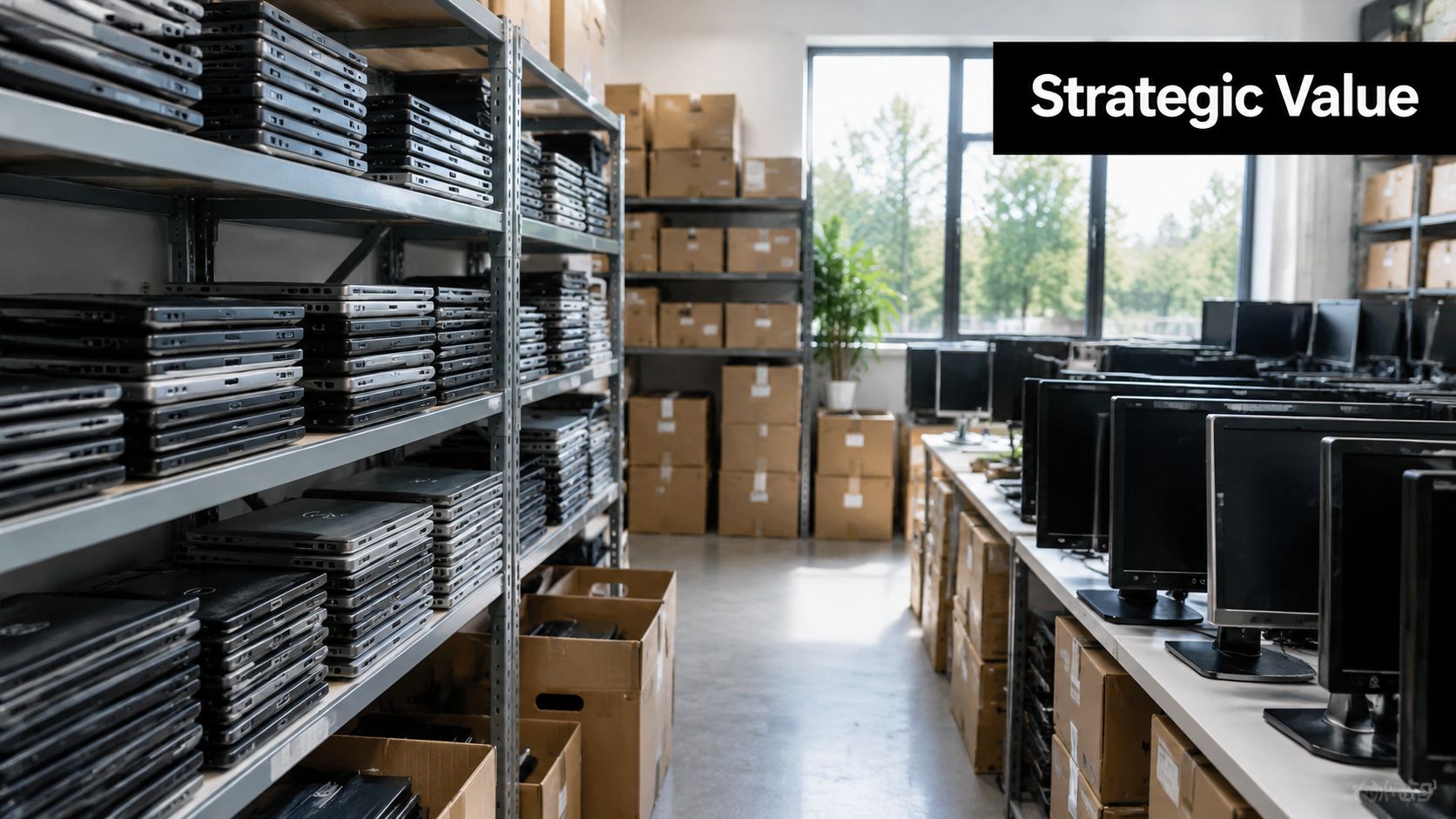
For businesses that refresh technology regularly, the return stream carries more value than disposal avoidance. Controlled handling can preserve usable hardware, reduce waste, and support sustainability reporting. It also reduces the chance that sensitive information leaves the building on an untracked drive. For a practical explanation of how this flow fits into supply chain design, this overview of reverse logistics in supply chain operations provides useful context.
What changes when you treat returns as an asset stream
Retired equipment becomes inventory with an assigned disposition path. Someone must own intake, sorting, cleaning, testing, data sanitization, and downstream routing. Without that ownership, departments improvise, storage expands, and valuable devices sit idle while their resale window narrows.
Practical rule: If an item has no assigned next step, it is already costing you space, labor, and delay.
IT assets rarely follow one route. A working laptop may be refurbished and remarketed. A desktop with limited resale demand may be stripped for parts, while a damaged storage drive may require destruction rather than reuse. Condition, age, completeness, security exposure, and recovery economics should determine the decision.
That distinction separates returns processing from IT asset disposition. Reverse logistics handles the physical movement, but an effective ITAD program also documents custody, verifies data destruction, and records the final outcome. A trusted partner such as Reworx can provide controlled processing and auditable records when internal teams lack the equipment or specialist capacity.
The market reflects the broader shift toward organized recovery. The worldwide reverse logistics market is valued at USD 823.21 billion in 2024 and is projected to reach USD 3,183.94 billion by 2033, covering returns, refurbishment, recycling, and related value-recovery activity (Grand View Research). For IT leaders, the practical priority is clear: every asset needs a documented path that protects data, controls cost, and recovers value where the economics support it.
The Critical First Step Triage and Sorting
The first mistake many organizations make is jumping straight to disposal. That's expensive, and it can be risky. If a device has resale value, recycling it too early leaves money on the table. If a device holds data and gets routed for reuse without proper sanitization, the downside is much worse.
Build a simple intake decision tree
Use four questions at intake. Is it functional, is it complete, is it worth refurbishing, and is the data risk low enough for reuse? Those questions work for laptops, desktops, monitors, docking stations, servers, and peripheral equipment alike.
A useful way to think about the decision is in four buckets:
- Condition. Power on, missing parts, cracked housing, liquid damage, battery swelling, or visible board failure.
- Age and usefulness. Newer assets often have a stronger reuse case, while older units may be better suited to parts harvesting or recycling.
- Recovery value. Devices with strong specifications or widely used form factors usually have a better secondary market.
- Security risk. Storage media, especially on systems that handled sensitive business data, needs controlled handling before any resale path is considered.
That triage step needs to happen quickly. One academic model notes that investment cost in a reverse-logistics scheme rises with the return rate and can increase at an accelerating rate as volume grows, which means slow sorting can turn a manageable reverse flow into a compounding cost problem (Econstor academic model).
Route the item before it sits
A clean triage room is better than a crowded warehouse. Once assets are received, they should move into labeled lanes for refurbishment, parts recovery, recycling, or destruction. That keeps people from making ad hoc calls later, when the chain of custody is already blurred.
Fast triage doesn't just reduce storage time. It keeps the highest-value items from decaying in place while teams argue about ownership.
For teams that want to formalize the intake stage, an IT equipment audit process helps identify what's reusable, what's repairable, and what should be retired under controlled conditions. That kind of audit is especially useful when multiple offices, campuses, or departments are turning in mixed hardware at the same time.
The main operational point is simple. Sorting isn't clerical work. It's the decision engine that determines whether reverse logistics creates value or leaks it.
Maximizing Value Through Refurbishment and Remarketing
Refurbishment is where reverse logistics starts paying you back. If triage identifies equipment that still has useful life, the next question isn't whether it can be thrown into a recycler's bin. It's whether it can be repaired, cleaned, tested, and put back into service in a way that protects margin and reduces waste.
What actually creates resale value
The work is usually straightforward, but it has to be disciplined. Technicians test the device, verify functionality, replace damaged components, wipe or replace accessories, and handle cosmetic cleanup when it matters to the buyer. In many cases, parts harvesting is the better choice than full-unit repair, especially when a device is partially functional but not economically worth restoring as a whole.
If your internal team doesn't have enough bench capacity, a repair workflow partner can help. For example, solutions for business equipment repair are worth reviewing when you need to compare in-house repair against outside depot services for higher-volume hardware.
The implementation challenge is real. Advanced reverse logistics for electronics often runs into infrastructure deficits and regulatory gaps, which makes it harder to balance value recovery with data security and compliance on every asset (JETIR research on electronics reverse logistics).
Choose the right exit path
Not every recoverable device should go to the same market. Employee buy-back can work for some organizations, secondary B2B channels make sense for other equipment classes, and donation-based redistribution is often the right answer when the social return matters as much as the financial one. The main thing is to match the asset to the channel instead of forcing every unit into the same sale process.
The best remarketing program is the one that can explain why a device went to reuse, repair, parts, or recycling, and prove it later.
That's where a structured partner helps. Reworx's asset recovery approach fits into the broader workflow by separating recoverable assets from end-of-life equipment instead of treating all retired hardware the same way. For busy IT teams, that distinction is more critical than often recognized.
If the business case is clear, refurbishment extends product life, keeps usable hardware in circulation, and supports circular economy goals without making every internal team learn the entire downstream market. The point isn't to keep everything. It's to keep the right things moving.
Ensuring Ironclad Data Security and Compliance
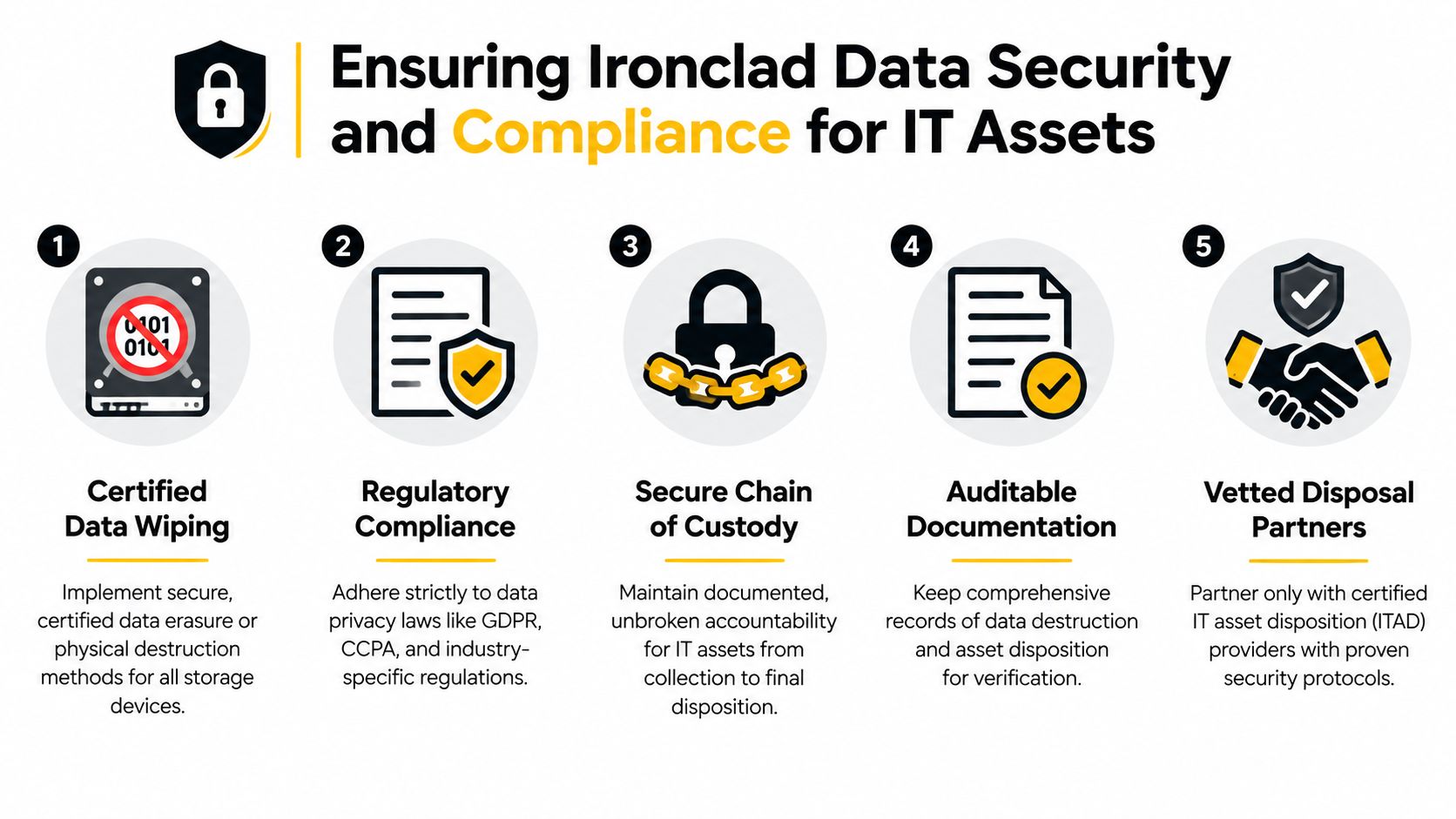
A device is never just a device once it has held business data. That's why secure data destruction has to be built into the reverse logistics process from the start, not added after transport or after a recycler has already touched the media. Deleting files isn't enough, and casual wiping creates a false sense of safety.
What secure disposal actually means
The federal benchmark is NIST Special Publication 800-88 Rev. 1, which defines three approved sanitization outcomes, Clear, Purge, and Destroy. The point is to make stored data unrecoverable by known techniques, not just invisible to the next user (NIST-compliant asset disposal reference).
For flash-based media, that bar is even higher. The UK Government's secure sanitisation standard says a minimum of NIST 800-88 Purge level must be used, which makes simple deletion or low-level wiping insufficient for higher-risk devices (UK secure sanitisation standard).
That matters because the destruction method has to match the media. Industry guidance on IT asset disposition lists shredding, disintegration, crushing, and degaussing, and also notes that degaussing is not effective for SSDs or optical media (ITAD secure destruction guidance). Media type drives the method, not the other way around.
Proof matters as much as destruction
If you can't prove custody, you can't prove compliance. The U.S. government and related ITAD guidance emphasize chain-of-custody documentation and a closure record for each batch, which means every pickup, transfer, and final disposition needs to be traceable (ITAD certifications and compliance guide).
A practical compliance file should include:
- Asset identifiers. Serial numbers or batch references tied to the pickup.
- Custody handoffs. Who had the equipment, and when.
- Sanitization outcome. Clear, Purge, or Destroy, matched to media type.
- Final disposition evidence. Recycling, resale, destruction, or redeployment.
For IT and compliance managers, that documentation is the difference between a clean audit trail and a costly explanation. If you're evaluating outside support, secure data destruction services should be part of the reverse logistics conversation, not a separate afterthought.
Optimizing Your Reverse Logistics Workflow
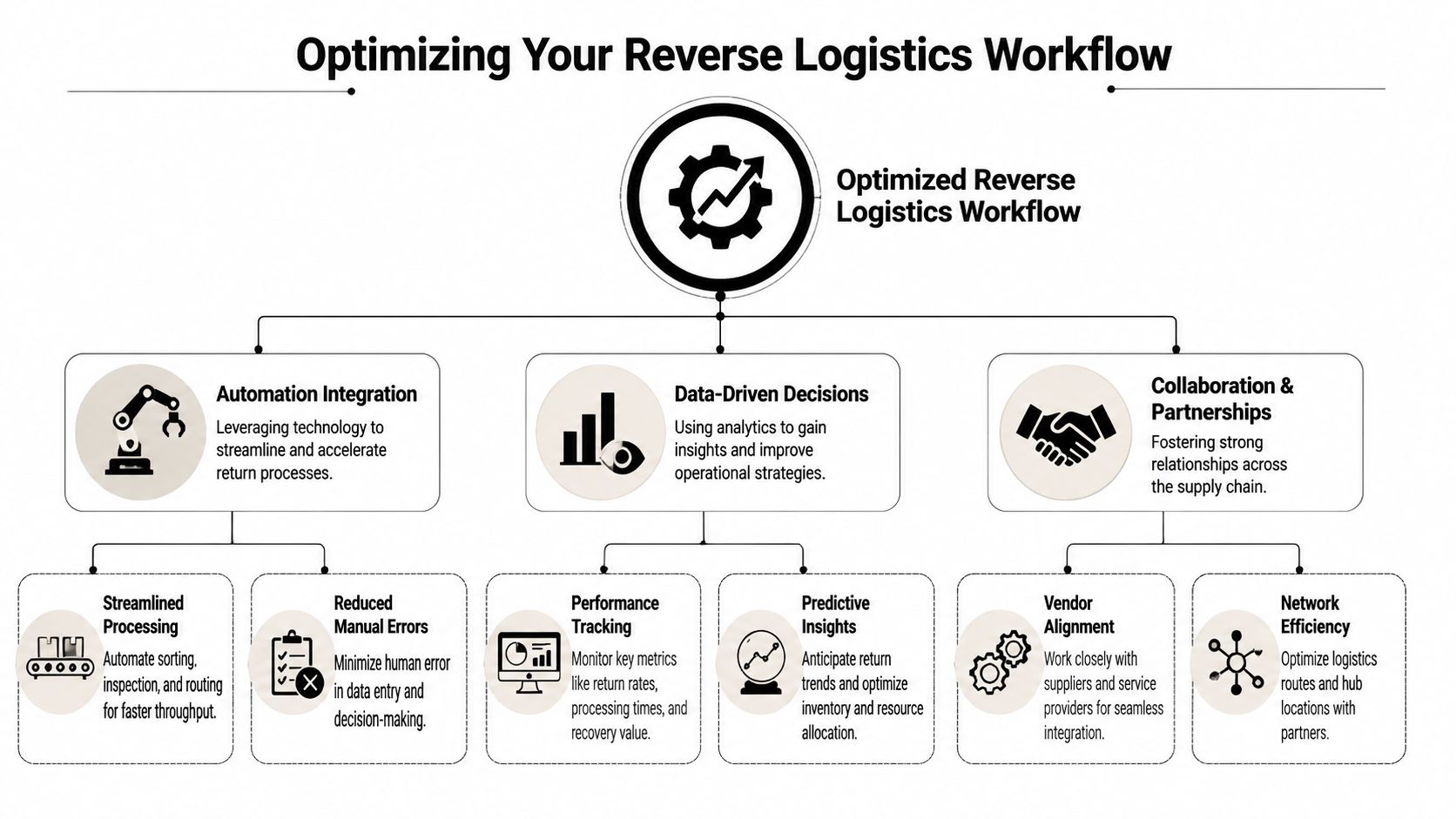
Most reverse programs don't fail because people don't care. They fail because the workflow is inconsistent. One site logs assets carefully, another site keeps spreadsheets on a local drive, and a third site makes disposition decisions by email. That's how visibility gaps, delays, and avoidable handling costs show up.
Standardize the boring parts first
The most important fix is often the least glamorous one. Common reverse logistics problems include visibility gaps between the customer, carrier, and warehouse, slow disposition decisions, and inconsistent workflows, which means standardized intake and clear rules are usually the first fix (OpenDock reverse logistics challenges).
That starts with simple SOPs. Define how an asset is received, who approves the next step, what gets quarantined, and what triggers destruction instead of reuse. Once that is stable, a basic tracking system can do a lot of work, even before you invest in more complex software.
Use automation where it removes friction
Automation helps when it cuts repeat work, not when it papers over bad process design. Automating logistics with AI can support routing, logging, and exception handling, but only after the intake rules are clean enough for the system to follow. Otherwise, you just scale confusion.
A simple operating rhythm can look like this:
- Log every arrival. Capture the asset as soon as it comes in.
- Assign a disposition owner. One person needs to own the next move.
- Set time limits for decisions. Assets shouldn't sit in limbo.
- Review bottlenecks weekly. Look for repeated delays by site, asset type, or channel.
Standardization beats sophistication when the team is still losing track of items between pickup and final disposition.
You don't need to build the perfect reverse logistics stack on day one. You need a repeatable process that keeps assets visible, decisions fast, and downstream movement controlled. That's the foundation for scale.
Partnering for Sustainable and Social Impact
Reverse logistics becomes more valuable when it does more than reduce waste. Done well, it supports reuse, keeps usable hardware in circulation, and creates a cleaner path for donation or recycling. For organizations trying to connect operations with CSR, that's where the social and environmental return starts to matter as much as the operational one.
A partner like Reworx's impact-focused program turns retired equipment into a managed flow instead of a storage problem. Reworx Recycling is a donation-based electronics recycling and IT asset disposition social enterprise, so businesses can route equipment toward responsible recycling and community benefit in the same process. That matters when the fundamental choice is not just “dispose or keep,” but “how do we recover value without creating risk.”
Why the partner model works
A good reverse logistics partner reduces the number of moving parts your team has to coordinate. That includes pickups, decommissioning, secure destruction, and downstream handling, all while keeping the paperwork in order. For schools, public agencies, and mid-sized businesses, that practical support is often the difference between a stalled cleanout and a completed one.
If your facilities or capital planning team is comparing broader sustainability strategies, sustainable modular buildings from Pacific Mobile Structures show how operational choices can be tied to lower waste and better resource use across different parts of the business. The same logic applies to retired IT equipment, where the best outcome is the one that preserves value, protects data, and avoids landfill.
Reworx also fits practical needs that most generic reverse logistics articles skip. Businesses need pickups, office cleanouts, secure data destruction, and a partner that can handle mixed hardware without turning every asset into a special case. That's where a social enterprise model has a practical edge, not just a branding one.
If your team is sitting on retired hardware, Reworx Recycling can help you sort, recover, and dispose of it with secure handling and clear documentation. Visit Reworx Recycling to plan a pickup, explore ITAD options, or start a responsible electronics recovery program that fits your business.