Reverse logistics can be a larger financial exposure than a sustainability opportunity. The global market was estimated at USD 839.88 billion in 2025, with a projection of USD 1.2608 trillion by 2034, according to Fortune Business Insights' reverse logistics market analysis. Yet many companies still treat retired laptops, servers, networking equipment, and storage media as a facilities problem.
That approach misses the point. The meaningful reverse logistics benefits appear when an organization controls the entire backward flow, protects data, recovers usable value, documents environmental outcomes, and makes disposal predictable. The benefits aren't universally positive, either. Low-value equipment, fragmented pickups, weak triage, and undocumented handling can turn a recovery program into a margin drag.
For CIOs, the right question isn't whether reverse logistics sounds sustainable. It's which benefits will improve financial control, reduce exposure, or strengthen operational performance in your specific asset stream.
Why Reverse Logistics Benefits Belong on the Operations Agenda
Reverse logistics belongs on the operations agenda because it controls margin, exposure, and accountability. Treating it as a sustainability project leaves money and risk outside the operating model. For CIOs, the useful test is direct: which outcomes improve financial recovery or reduce security and regulatory exposure, and which merely satisfy an ESG checklist?
In electronics and IT asset streams, the answer depends on execution. Resale, redeployment, component harvesting, and material recovery can offset processing costs when inventory is accurately tracked and routed to the right channel. Environmental reporting still matters, but it does not compensate for poor custody, weak data sanitization, or unprofitable handling. Those controls move the P&L and protect the organization.
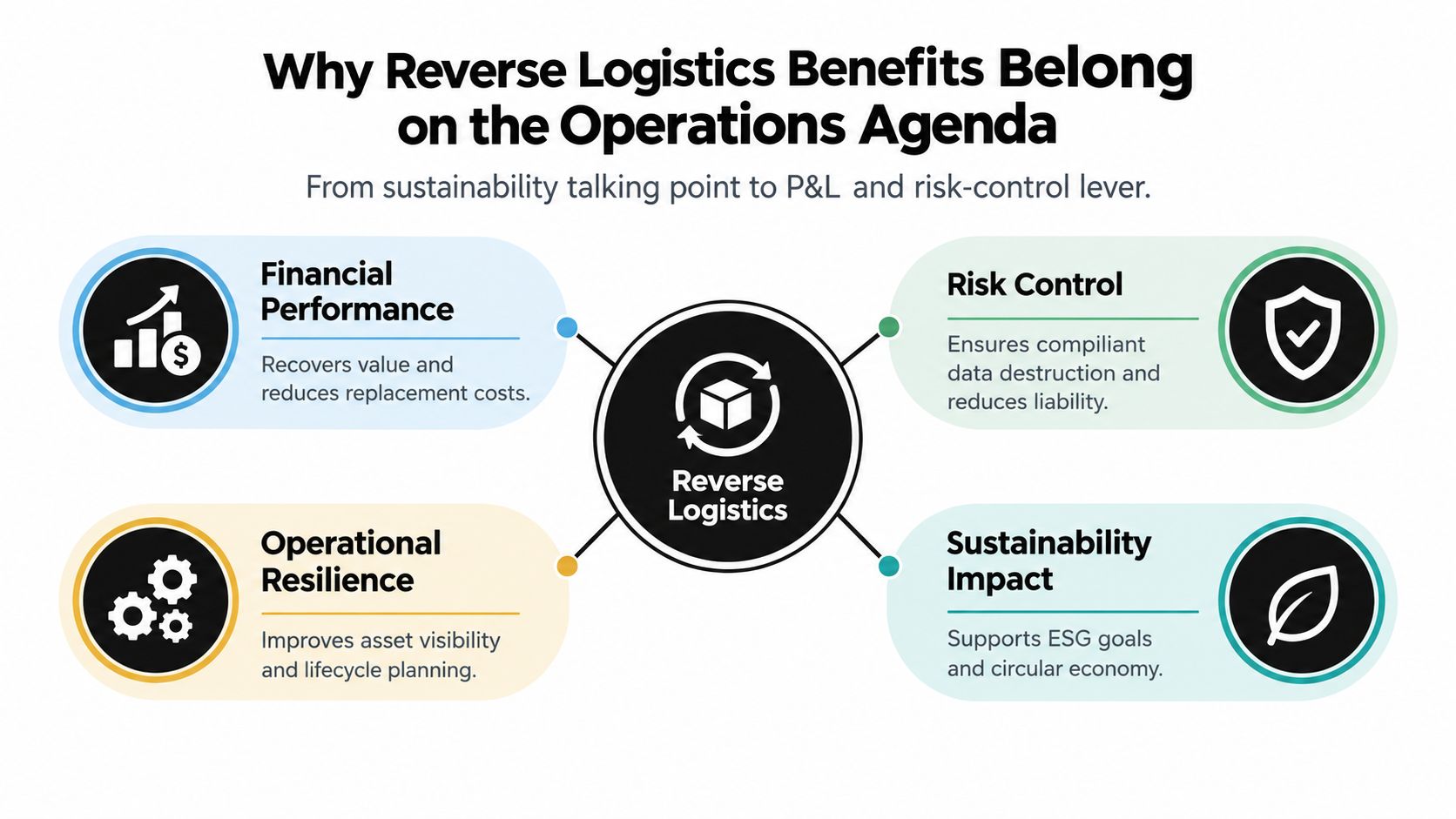
A four-part operating checklist
- Financial recovery: Measure whether resale, redeployment, component harvesting, or material recovery exceeds processing and transport costs.
- Risk control: Require documented custody, sanitization, destruction, and reporting that can withstand internal and external review.
- Environmental reclamation: Record reuse, recycling, material recovery, and disposal through auditable downstream documentation.
- Customer experience: Show employees, clients, donors, and business partners that equipment leaves the organization under responsible controls.
This framework keeps the benefits in proportion. Financial recovery and risk control usually deserve priority in enterprise ITAD. Environmental reclamation supports compliance and reporting, while customer confidence protects relationships. Neither should obscure a program that loses value or exposes sensitive data.
IT and electronics require tighter operating discipline because devices retire in waves, useful lifecycles vary, and storage media may retain sensitive information after removal from service. The reverse logistics services offered by Reworx Recycling demonstrate the practical scope, from collection and transportation to responsible disposition.
Physical infrastructure also affects results. Temporary inventory, staging areas, and sensitive shipments need controlled space when equipment cannot move directly from a facility to its final disposition channel. Guidance on secure business storage Derby can inform that planning.
Practical rule: If finance, IT security, facilities, and sustainability cannot access the same asset record, the program lacks operational control.
Reverse logistics crosses departments by design. Procurement may manage the vendor, finance measures recovery, security controls data exposure, facilities manages movement and space, and leadership owns the resulting risk and reputation. Assign those responsibilities before the first pickup, not after a failed audit or missing asset.
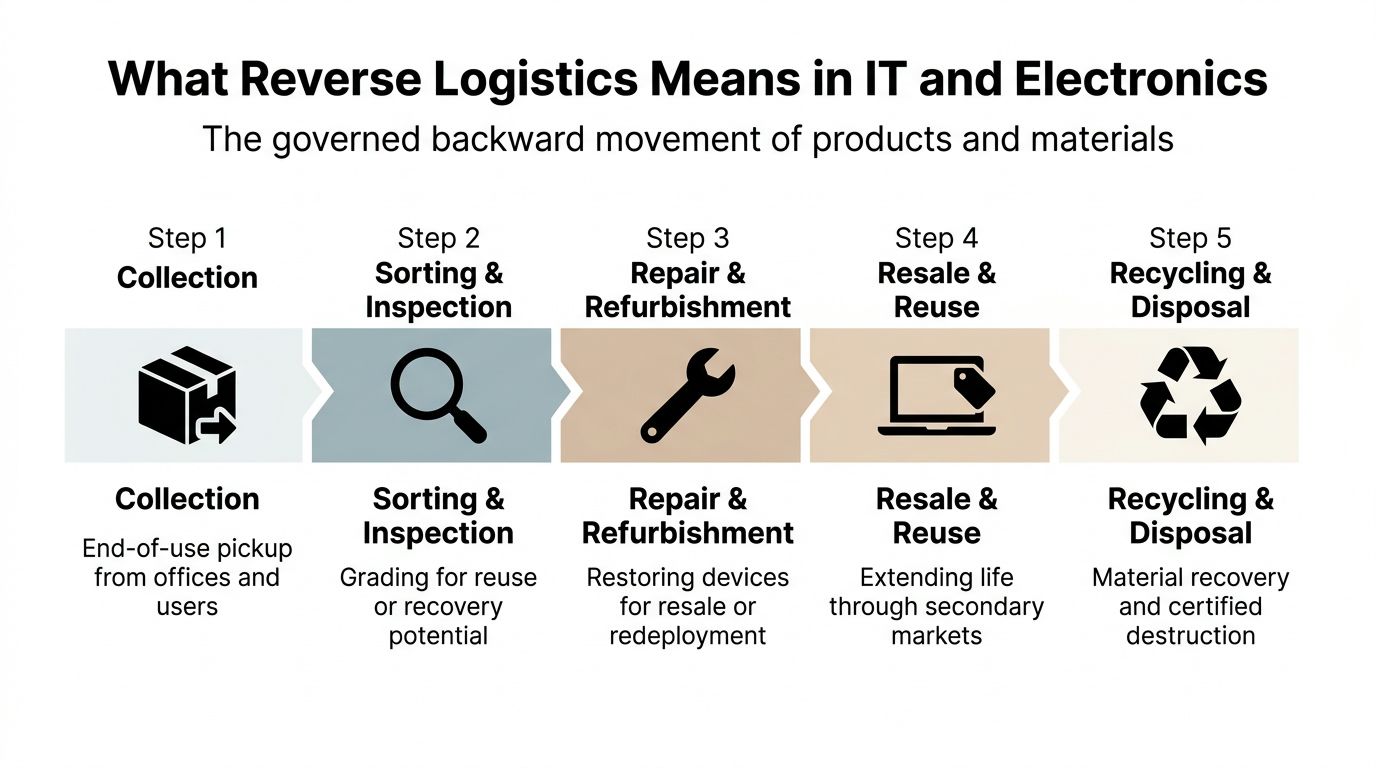
What Reverse Logistics Actually Means in an IT and Electronics Context
Reverse logistics is the planned movement of products, equipment, materials, and related information backward through a supply chain. For IT, that means moving decommissioned laptops, desktops, servers, network equipment, mobile devices, and storage media from their point of use to a controlled disposition partner.
Retail programs often handle consumer returns, exchanges, warranty claims, and unsold goods. IT asset disposition, or ITAD, has a stricter priority. A retired laptop may contain employee credentials, customer records, regulated information, or intellectual property. The reverse flow must preserve recoverable value while maintaining control of the data.
The ITAD flow
A defensible program connects five operating stages:
- Pickup and chain of custody: Equipment leaves an office, data center, school, laboratory, or public facility under documented control.
- Inventory and asset tagging: Serial numbers, make, model, condition, ownership, and destination are recorded.
- Data sanitization: Storage media is cleared, purged, or destroyed according to risk and intended disposition.
- Inspection and disposition: Devices are routed to redeployment, resale, refurbishment, component harvesting, recycling, or disposal.
- Reporting: Records connect every asset to its final outcome.
The IT asset reverse logistics process described by Reworx Recycling shows why these stages must operate as one system. A pickup without serialized intake creates uncertainty. A recycling certificate without data records can leave security gaps. A resale channel without testing and grading makes recovery values difficult to defend.
Why electronics require tighter control
Electronics create three distinct control problems. They contain recoverable materials, including copper and precious metals such as gold, silver, and palladium, as documented in the LACCEI proceedings on e-waste and material recovery. They can retain sensitive data. Their handling can also involve environmental, producer-responsibility, privacy, and sector-specific requirements.
Packaging belongs in the control plan. Servers, monitors, medical devices, and storage media can suffer damage during transport, reducing recovery value or creating safety concerns. For fragile or static-sensitive equipment, teams should review protective packaging for sensitive items before scheduling movement.
The benefits come from disciplined execution, not from arranging a truck. For IT and electronics, the highest-value outcome is a correct, documented disposition decision for every asset, with data security and regulatory exposure addressed before recovery value is counted.
The Financial Side of Reverse Logistics Benefits
The financial case begins with triage, not recycling. A current-generation business laptop may have a viable secondary-market path, while an older desktop may offer more value through component recovery or material processing. A server can contain processors, memory, storage, and networking components that deserve separate evaluation rather than a single bulk-disposal decision.
That doesn't mean every asset should be remarketed. Processing requires transportation, labor, testing, data sanitization, storage, administration, and vendor oversight. Small firms with scattered pickups or low-value equipment may spend more recovering an asset than the asset returns. Finance should judge the program on net recovery, not on gross resale proceeds.
What finance should measure
Use a simple asset-level model:
- Cost per asset recovered: Include transport, intake, testing, sanitization, storage, labor, and reporting.
- Net recovery rate: Compare proceeds with the complete cost of processing.
- Avoided procurement spend: Record equipment redeployed internally instead of purchased new.
- Disposition yield: Track how much equipment reaches reuse, refurbishment, component recovery, recycling, or destruction.
- Forecast accuracy: Compare expected recovery with actual proceeds by category and condition.
The category matters more than the average. Current devices with complete accessories, clean ownership records, and accessible resale channels usually have a stronger recovery case than obsolete or damaged equipment. Fully depreciated assets can still have operational value, but book value and market value aren't the same thing.
| Asset Category | Resale Channel Range | Component Harvest Range | Scrap Channel Range |
|---|---|---|---|
| Business laptops | Depends on age, condition, configuration, and channel access | Memory, storage, displays, batteries, and boards may be evaluated | Mixed metals, plastics, and circuit boards |
| Enterprise servers | Depends on processors, memory, storage, and supportability | CPUs, memory, drives, power supplies, and components may be separated | Steel, aluminum, copper, and printed circuit boards |
| Networking equipment | Depends on model, demand, and functional testing | Modules, power supplies, optics, and boards may retain value | Metals and circuit boards |
| End-of-life peripherals | Usually limited unless specialized or complete | Selected parts may be harvested | Plastics, metals, cables, and circuit boards |
The cost-recovery strategies provided by Reworx Recycling can help teams structure this analysis around disposition routes rather than a blanket recycling decision.
Finance test: A recovery program is working when it produces predictable net outcomes by asset category, not when it generates an occasional attractive rebate.
The strongest programs treat recovery as a forecast line item. Report results quarterly, separate resale from scrap, identify avoided purchases, and show where processing costs consumed the return. If the math fails for low-value devices, the program may still justify itself through security, compliance, environmental responsibility, or reduced internal handling. Just don't label risk reduction as profit.
Data Security and Regulatory Benefits You Cannot Ignore
For IT assets, secure data destruction is the first benefit to establish. Financial recovery and sustainability gains don't compensate for a data exposure caused by informal storage, undocumented transportation, or incomplete sanitization.
NIST Special Publication 800-88 provides the core framework for media sanitization. Its methods include Clear, Purge, and Destroy, with the objective of making data unreadable, unusable, and undecipherable. The correct method depends on the media, the information risk, and whether the asset will be reused or permanently removed from service. (NIST media sanitization guidance)
Match the method to the disposition
| Method | NIST 800-88 Level | Best For | Audit Trail |
|---|---|---|---|
| Logical clearing | Clear | Lower-risk reuse where the media remains operational | Sanitization record, asset identifier, method, operator, and date |
| Cryptographic or device-level purging | Purge | Reuse or redeployment when supported by the media and workflow | Verification record linked to the serialized asset |
| Physical destruction | Destroy | Failed, obsolete, high-risk, or permanently retired media | Chain of custody, destruction record, media identifier, and certificate |
Hard-drive shredding is a practical Destroy route for end-of-life magnetic drives and other media that shouldn't return to service. Industry guidance on NIST 800-88 hard-drive destruction describes particle-size considerations, including 2-to-5 millimeter fragments for shredding aligned with NSA/CSS EPL standards. That specific standard should be confirmed against the organization's policy and the media type rather than treated as a universal requirement.
A defensible reverse flow also records who collected the equipment, where it went, when it entered processing, how the media was sanitized, and what happened afterward. That documentation supports privacy and regulatory obligations involving frameworks such as HIPAA, FACTA, GDPR, and applicable state disposal rules. It also gives security teams evidence during audits and customer reviews.
Organizations developing broader information security governance should connect media sanitization to access controls, asset inventories, incident response, vendor management, and retention policies. The secure data destruction services available through Reworx Recycling are one example of how destruction can be integrated into an ITAD workflow rather than handled as an isolated task.
Security priority: Don't authorize resale until the organization can prove what happened to the data-bearing media.
The benefit here is mostly avoided exposure. That may not appear as revenue, but it directly affects legal risk, customer confidence, audit readiness, and executive accountability.
Environmental and Resource Reclamation Gains
Environmental claims matter only when they correspond to measurable material flows. A mature ITAD program directs equipment to reuse, refurbishment, component recovery, recycling, or controlled destruction. That can reduce landfill waste and demand for virgin inputs, but only when the downstream route is documented and verified.
The scale of e-waste makes collection discipline an operational issue. The global e-waste stream reached 53.6 million metric tons in 2019, an increase of 9.2 million metric tons from 2014, and is projected to reach 74.7 million metric tons by 2030. Only 22.3% of global e-waste was formally collected and recycled in 2022, according to the e-waste analysis published through GBMR Journal. A warehouse certificate does not prove meaningful recovery. CIOs should require controlled collection channels that capture equipment and materials for legitimate downstream processing.
Measure what leaves the disposal stream
Track each output separately:
- Reuse and refurbishment: Redeployment, donation, or resale keeps equipment in service.
- Material recovery: Steel, aluminum, copper, plastics, and printed circuit boards move into appropriate processing streams.
- Precious-metal recovery: Circuit boards and related components may contain gold, silver, and palladium. Use precious metals recovery services described by Reworx Recycling as an example of separating resource recovery from general disposal.
- Residual disposal: Record material that cannot be reused or recovered, along with its final treatment.
Remanufacturing can deliver significant environmental value when the component is technically suitable. A diesel particulate filter case study found a total unit cost 82% lower than new production, with carbon footprint emissions down 92% and virgin material demand down 99%. The Circular Economy Journal case study concerns a specific component stream, so CIOs should not apply those results directly to laptops or servers. It does support testing recovery potential before defaulting to destruction.
Formal collection can also reduce emissions. A 2026 systems analysis estimated that formal e-waste recycling in 2022 avoided 15 million tons of CO2 emissions. (Frontiers analysis)
Build sustainability reporting from weights, disposition records, certificates, and verified downstream partners. Circular-economy language earns credibility only when those records support it. For electronics and IT assets, resource reclamation can strengthen ESG reporting, but the financial return depends on recovery value, processing cost, and the quality of the disposition data.
Customer Experience and Brand Trust Benefits
Customer experience in reverse logistics isn't limited to consumer returns. For B2B organizations, it often appears in the experience of employees, clients, auditors, donors, and enterprise customers who need confidence that equipment has been handled properly.
Consider a law firm refreshing laptops across a 500-employee environment. The firm's partners don't want residual client data exposed, facilities staff don't want untracked equipment sitting in storage, and the CFO doesn't want a vague sustainability statement. A white-glove pickup, serialized asset tracking, documented chain of custody, and a destruction certificate delivered within 48 hours give each stakeholder something concrete to evaluate.
The CFO's approval may have little to do with an ESG slide. The stronger argument is audit-ready documentation that supports the firm's security obligations and reduces administrative uncertainty. The same records can help IT close assets in its inventory system and help facilities reclaim space without creating an unmanaged pile of retired devices.
Trust is built through repeatable execution
Enterprise customers increasingly ask suppliers to demonstrate responsible lifecycle practices and contribute information for sustainability and Scope 3 reporting. A documented ITAD program can influence renewal conversations because it gives account teams evidence of control. It also supports corporate donation programs, especially when organizations want to move usable laptops or monitors into community and education channels rather than sending everything to material recycling.
That experience advantage is cumulative. A single smooth pickup won't repair a pattern of missed appointments, missing serial records, or late certificates. Conversely, dependable reverse logistics becomes part of how employees and customers experience the company's operating discipline.
The trust signal isn't the recycling slogan. It's the record that shows who handled the device, how the data was protected, and where the material went.
Donation-based recycling and social enterprise recycling can add meaning, but only when the underlying controls remain strong. Community impact should complement secure processing, not substitute for it. Businesses evaluating partners should ask for service-level expectations, reporting samples, downstream controls, and a clear explanation of how equipment moves from collection to final disposition.
Prioritizing the Benefits That Matter Most for Your Operation
Operations leaders should rank reverse logistics benefits by the pain they solve, not by the order in which vendors present them. Start with the asset stream, then connect each problem to a measurable operational outcome.
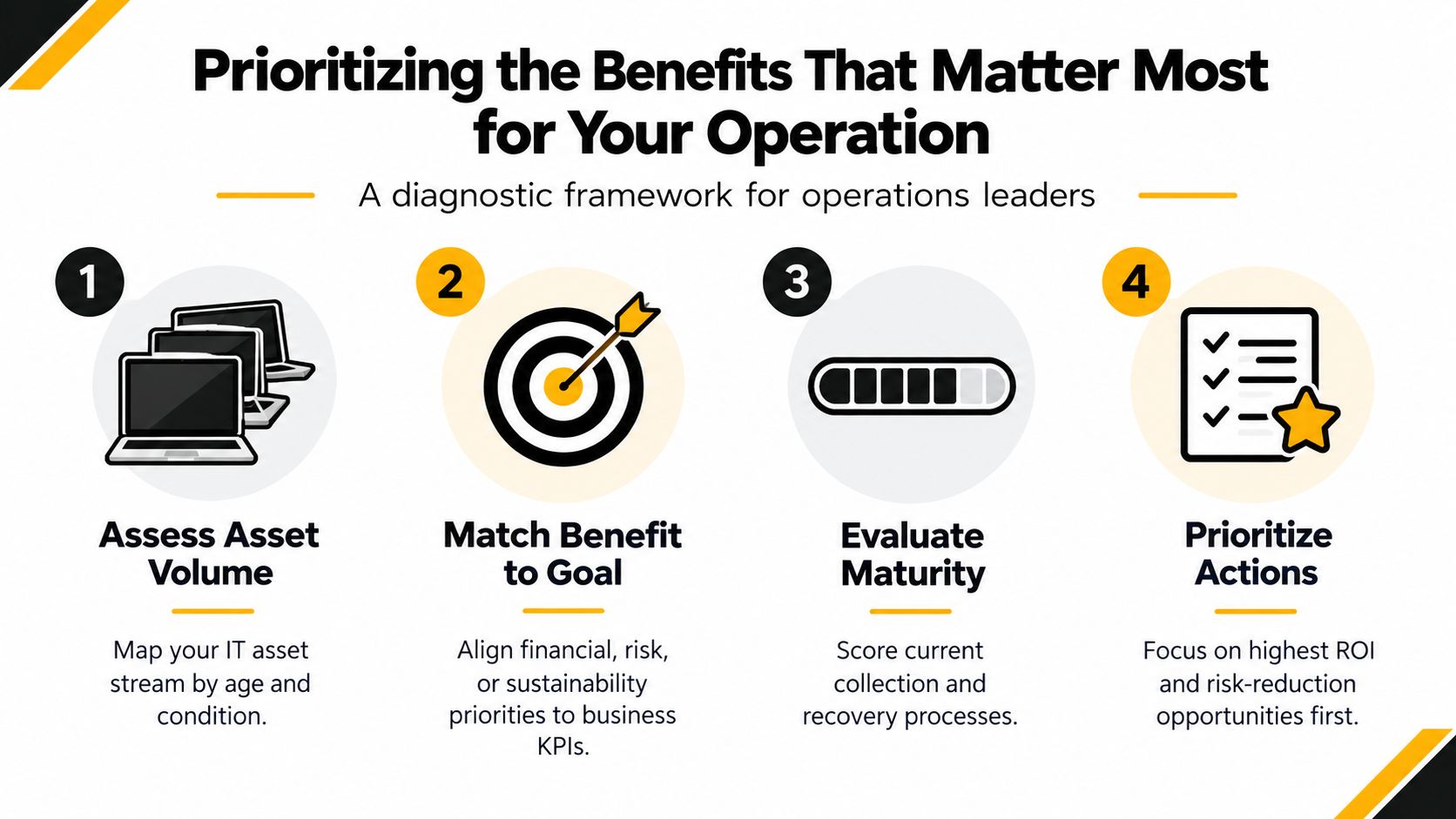
Use a practical diagnostic
- If data exposure is the concern, start with control. Inventory every retired device and storage medium, define the approved Clear, Purge, and Destroy paths, and require chain-of-custody records before pursuing resale.
- If the organization has an e-waste backlog, start with visibility. Separate equipment by location, age, condition, data risk, and likely disposition. A backlog often hides both recoverable value and avoidable handling costs.
- If sustainability reporting is the pressure point, start with evidence. Capture weights, reuse outcomes, recycling records, destruction documentation, and downstream information that can support internal reporting.
- If margin pressure dominates, start with economics. Compare processing costs and net recovery by category. Don't assume every laptop, server, monitor, or peripheral deserves the same treatment.
For most enterprises, data security is table stakes. Financial recovery and environmental gains compound only after the organization can move equipment through a governed process. A loose reverse flow may produce occasional resale revenue, but it won't provide reliable assurance.
The next step is a baseline audit of retired assets. Identify where equipment is stored, which systems contain the inventory, whether serial numbers are complete, how data destruction is authorized, and what reporting the current vendor provides. Then define a chain-of-custody protocol that facilities, IT, security, and finance can all use.
Prioritize the benefit that removes the most expensive uncertainty first. In many IT environments, that means proving data control before optimizing resale yield.
Reworx Recycling is one partner organizations can evaluate for electronics recycling, business pickups, equipment decommissioning, secure hard-drive shredding, IT asset management, recycling consultations, and donation-oriented disposition. Its social enterprise model connects responsible electronics handling with community impact, technology donations, digital inclusion, and workforce development. The right partner should fit the organization's volume, geography, security policy, reporting needs, and disposition economics.
Reworx Recycling helps businesses collect retired electronics, manage IT asset disposition, arrange secure data destruction, recover usable equipment, and route materials toward responsible recycling or community-focused donation. Review the Reworx Recycling recycling resources to plan a pickup, donate old equipment, or discuss a reverse logistics program built around your security and recovery requirements.