You're staring at a pallet of spent laptop packs, a few UPS batteries, and maybe some swollen cells pulled from old devices, and the question is the same one every IT manager asks sooner or later, is this a liability, or can it bring money back? The blunt answer is that it can do both, but only if you treat battery disposal like a recovery workflow instead of a junk haul. Money for recycled batteries comes from chemistry, condition, documentation, and the channel you choose, not from dropping off a mixed pile and hoping for the best.
Most companies leave value on the table because they mix everything together and call it recycling. That's sloppy, and it costs real money. A pallet of intact lithium-ion packs is a different animal from a stack of leaking cells, and a documented, segregated load is priced very differently from an unlabeled one. Reworx Recycling handles electronics recycling and IT equipment disposal with the same operational mindset I'd use on a warehouse floor, sort it correctly, document it cleanly, and route it to the right downstream buyer.
Turning a Pile of Spent Batteries Into Real Recovery Value
A mixed battery pile contains several different revenue streams, and the financial result depends on how fast you sort it and how cleanly you document it. If you've got old laptop batteries from a refresh cycle, decommissioned UPS cells, and a few loose packs from field returns, the difference between a payout and a bill usually comes down to whether a buyer sees recoverable metal or a hazard problem.
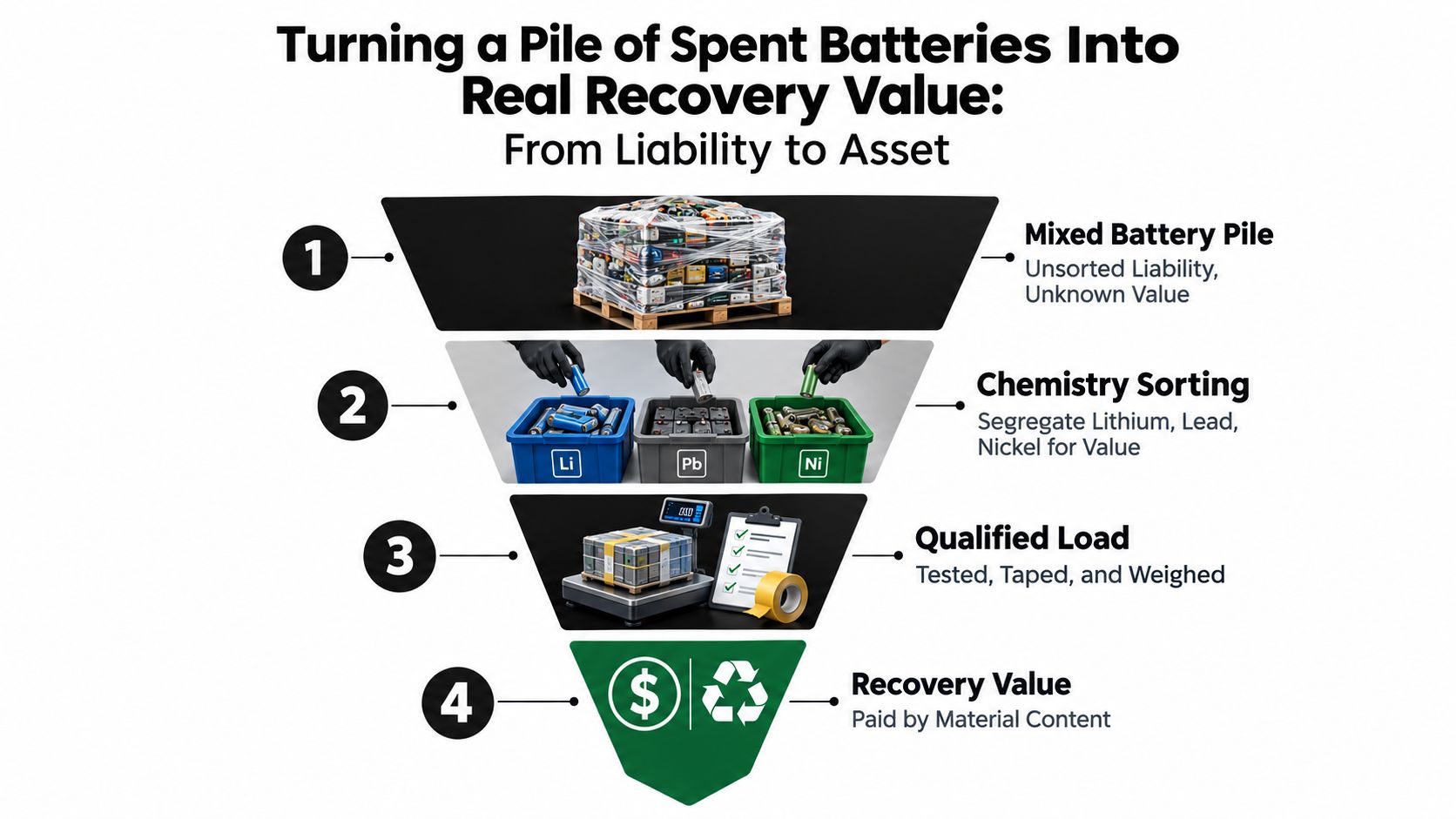
The four financial outcomes
A load of batteries usually lands in one of four buckets. It can produce a net payout, it can break even, it can require a paid recycling arrangement, or it can trigger a hazardous waste surcharge if the material is damaged, mixed, or poorly documented. The material itself doesn't decide that outcome alone. The winning variables are chemistry, condition, weight, documentation, and the downstream channel you choose.
That's why the smartest operators don't ask, “Can batteries be recycled?” They ask, “Which batteries can be monetized, and which ones are going to cost us?” In practice, recovered value comes from separating salvageable lithium-based packs from the material that only belongs in controlled handling. If you want real money for recycled batteries, you have to think like a buyer, not a hauler.
Practical rule: sort first, quote second. A mixed pallet almost always prices worse than a cleaned, labeled, weighed lot.
The chemistry spread is visible in current market pricing. The CSIRO notes that in 2022 nickel- and cobalt-rich NMC cathode materials were worth about US$50 to US$95 per kilogram, while lower-value LFP materials were about US$35 to US$50 per kilogram (CSIRO via Statista topic page). That spread is why experienced recyclers focus on chemistry before anything else. Commercial lithium-ion recycling has historically chased nickel and cobalt recovery because that's where the strongest revenue stream sits, including precious metals recovery from e-waste.
For a business, the operational takeaway is simple. Don't dump batteries into a catch-all container and expect market pricing. Build a load that a buyer can understand quickly, then push it through the right recycling or ITAD channel. Do that, and the battery stream stops being a disposal headache and starts acting like a small but real revenue line inside your broader electronics recycling program.
Which Battery Types Actually Pay and Which Cost You to Recycle
The chemistries that usually pay
Lithium-ion batteries are the closest thing this market has to a payday, especially when they're intact, identified, and not heat-damaged. Laptop packs, phone batteries, power-tool packs, and many higher-grade industrial modules tend to carry the strongest per-pound economics because buyers can recover value from cobalt, nickel, and lithium. A systematic review found that the economic value of these recovered metals has been estimated at roughly 8.75 to 34 USD/kg for Co, Ni, and Li in reviewed recycling programs (MDPI systematic review).
Nickel metal hydride can still have some value, but it usually sits below good lithium-ion material and above the cheap, mixed waste stream. Sealed lead-acid batteries are a different business case entirely. They're generally priced around lead recovery and handled with acid-management costs in mind, so they can move into break-even or fee territory depending on condition and local market structure. Alkaline batteries are usually the weak end of the value curve and are rarely the kind of load that makes a buyer excited.
The chemistries that usually cost you
The material I'd expect to cost the most is the stuff buyers don't trust. Swollen, leaking, or otherwise compromised cells tend to shift the economics toward surcharge territory fast. The same goes for damaged lithium metal, wet-cell nickel cadmium, and anything with an unclear origin or a thermal event history. If a buyer can't trust the load, the buyer prices in risk, labor, and disposal overhead.
Plain truth: if the cell is lithium-based, intact, and documented, it usually pays. If it's swollen, leaking, or unlabeled, expect a surcharge.
The value spread also explains why chemistry sorting matters. A buyer that can isolate a clean lithium-ion stream will quote differently from one facing a mixed tote of random packs. That's not greed, it's processing logic. The better the segregation, the more material ends up in the payable stream, and the less gets pushed into the cost side of the ledger.
| Chemistry | Typical Payout Direction | Primary Payable Material | Buyer Fee Likely? |
|---|---|---|---|
| Lithium-ion | Usually payout | Cobalt, nickel, lithium | Sometimes, if damaged or mixed |
| Lithium cobalt oxide | Usually higher payout | Cobalt, lithium | Sometimes, if degraded |
| NMC | Usually payout | Nickel, cobalt, lithium | Sometimes, if mixed or damaged |
| LFP | Lower payout, sometimes break-even | Lithium, iron value is limited | Often, if load is small |
| Nickel metal hydride | Mixed, often modest value | Nickel | Sometimes |
| Sealed lead-acid | Break-even to modest value | Lead | Sometimes |
| Alkaline | Usually cost | Limited recoverable value | Yes, often |
| Damaged lithium metal | Usually cost | Minimal payable recovery | Yes |
If you're building an ITAD program, start with the high-confidence, high-value stream. The better lithium packs belong in a controlled channel, and the weak or damaged batteries need a separate path. That's where a service like lithium battery recycling matters, because it keeps the value-bearing material from getting buried under the bad stuff.
Safely Preparing Batteries for Pickup or Drop-Off
Safe prep is not paperwork theater. It protects your staff, keeps the load eligible for better pricing, and prevents a carrier from rejecting the shipment at pickup. If you want the best shot at money for recycled batteries, you earn it here. Skipping prep is how good material gets downgraded into a problem load.
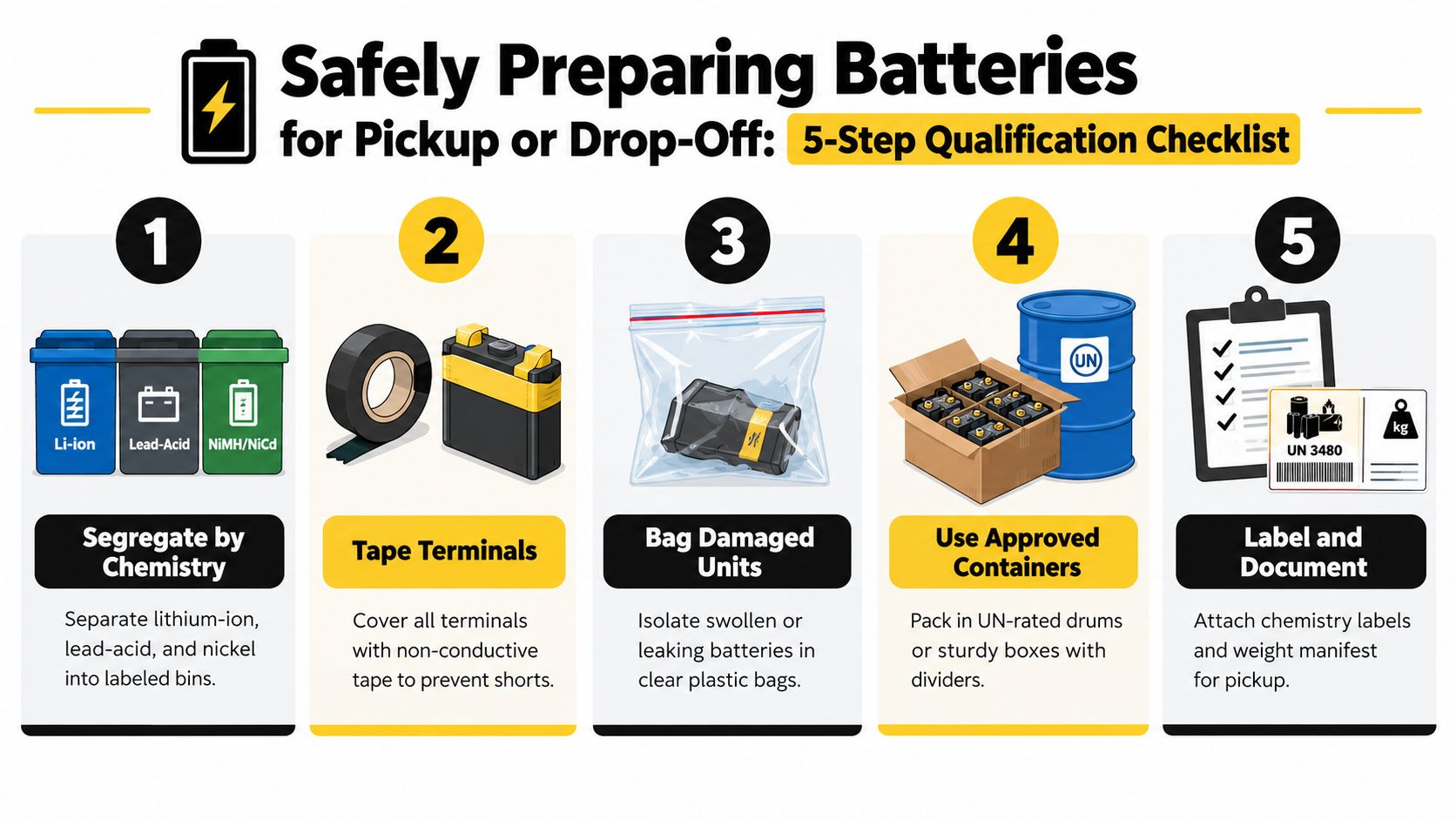
The physical prep that buyers expect
Start by segregating by chemistry into clearly labeled bins. Lithium-ion, lead-acid, and nickel chemistries should never sit together in the same loose container. Every lithium-ion cell needs its terminals insulated with non-conductive tape, because a stray short is how a manageable load turns into an incident.
Damaged units need special handling. Swollen, leaking, or dented cells should be isolated in individual sand or vermiculite containers and clearly flagged as damaged. Intact packs go into UN-rated fiber drums or lined Gaylord boxes with enough internal protection to stop movement. Damaged stock belongs in separate steel pails or equivalent protected containers, not mixed in with good material.
Keep damaged cells away from the rest of the pile. One bad pack can downgrade the whole lot.
The storage and transport controls that matter
Store batteries in a cool, controlled area, around 77°F is the practical target often used in warehouse handling. Keep them separated from combustible material, and don't stage battery pallets next to cardboard, wood waste, or shrink-wrap scrap. If the load crosses state lines, the outer packaging needs to be DOT-compliant and the shipment has to be documented correctly.
The paperwork should travel with the load, not show up later in someone's inbox. That means a chemistry inventory, weight by category, a bill of lading that identifies the right battery classification, and shipper certification where it applies. For lithium-ion shipments, the relevant references are often UN3480 or UN3481, and the UN 3481 label should be used where it fits the shipment profile.
If you're coordinating this inside a larger device refresh, fold the battery prep into your pickup workflow instead of treating it as a side job. The more disciplined the prep, the easier it is to route the load into a value-bearing channel instead of a fee-based one. That's exactly why UN 3481 labeling guidance belongs in your shipping checklist.
Where to Sell Recycled Batteries for the Best Return
Not every channel pays the same way, and not every channel is appropriate for a business. A homeowner wants convenience. A corporate buyer wants documentation, clean chain of custody, and a certificate that stands up in audit review. Those are different priorities, so the “best” channel depends on chemistry, volume, and compliance needs.
Comparing the realistic options
Retail and OEM buyback programs can work for small, clean loads, especially when the battery sits inside a branded device or a take-back path already exists. Scrap yards and metal recyclers may offer a faster cash path for certain chemistries, but they're usually less interested in chain-of-custody details. Certified e-waste recyclers with R2v3 or e-Stewards alignment are often the right answer when the batteries are part of a corporate IT refresh, because they can handle the operational and documentation side more cleanly. Municipal household hazardous waste programs are convenient, but convenience is not the same thing as monetization.
A business should ask three questions before choosing a channel. Who is willing to buy this chemistry, who can document the transfer properly, and who will support the downstream paperwork your finance or ESG team needs later? If the answer to any of those is weak, the highest quoted dollar amount may not be the smartest choice.
| Channel | Typical Payout | Min. Volume | Documentation | Best For |
|---|---|---|---|---|
| Retail and OEM buyback | Low to moderate, case-dependent | Small | Usually basic | Small lots, branded consumer gear |
| Local scrap yard | Moderate for the right chemistries | Varies | Limited | Clean metal-bearing loads |
| Certified e-waste recycler | Moderate, sometimes bundled with service | Business loads | Strong | Corporate ITAD and chain-of-custody needs |
| Municipal HHW program | Usually none | Small household volumes | Basic drop-off record | Convenience, not revenue |
The operational point is blunt. If your battery stream is tied to a data-bearing asset or an office refresh, the channel has to do more than pay. It has to document. That's why pricing transparency guidance matters, because opaque quotes are where sellers get squeezed on freight, contamination, or assay terms they didn't notice until after the load moved.
How Buyers Price a Load and How to Negotiate
A buyer doesn't invent a number out of thin air. The quote usually starts with a public index or material reference for cobalt, nickel, lithium, or lead, then gets reduced by processing yield loss, freight, handling, and contamination risk. The better your load quality, the less the buyer has to subtract. That's the whole game.
What drives the quote down
A sealed lithium-ion pack is easier to value than a swollen one because the buyer can trust the chemistry and expect cleaner processing. Individually sorted chemistries beat mixed loads for the same reason. Contamination, unknown state of charge, missing labels, and damaged cells all push the quote down because they create extra handling and higher rejection risk.
Buyers also care about how much of the input comes back as saleable output. That's where processing yield, freight, and treatment cost get deducted. If the quote is “subject to smelter settlement,” you do not have a firm net price yet. You have an estimate with escape hatches.
How to negotiate like a buyer, not a hopeful seller
Ask for the assay certificate or the basis used to calculate the quote. Get two written quotes if the load is large enough to justify the time, and ask whether tiered pricing improves at higher volume. Confirm whether the offer is firm net or open to post-acceptance adjustment. Then keep the quote, weight ticket, and transfer paperwork together so finance, sustainability, and audit teams can trace the transaction later.
If a buyer won't explain the pricing basis, they're asking you to carry the uncertainty for free.
For operations teams, the best defense against a bad deal is a clean comparison file. List the chemistry, pack condition, weight, pickup terms, and document requirements side by side before anyone signs. That way the conversation stays on net return, not on the noise surrounding the load.
Pairing Battery Recovery With Secure Data Destruction
Batteries rarely travel alone in a real IT refresh. They come out of laptops, phones, tablets, and UPS systems, which means they're tied to devices that also carry data, asset tags, and audit risk. If you separate the battery stream from the device stream too early, you create loose ends that waste staff time and invite storage problems.
A better model is to pair battery recovery with secure data destruction inside one chain of custody. A NIST 800-88 compliant sanitization or shred event lets the data-bearing asset and its battery move through the same controlled process, which reduces the chance of a lithium cell sitting forgotten in a drawer or warehouse. That single workflow also makes it easier to issue a unified certificate trail that covers both destruction and recycling.
Donation-driven ITAD programs fit here too. The right sequence is reuse first, then parts recovery, then battery value capture at end of processing. That keeps functional equipment in circulation longer and pushes the batteries into the correct end-of-life channel only when the host device is done. For businesses trying to support donation, compliance, and recovery at the same time, that's the cleanest structure.
One controlled intake beats three ad hoc handoffs every time.
There's a fire-safety angle, but there's also an accounting angle. A battery sitting in limbo is a risk item, not an asset. A battery that moves through a documented ITAD process is a managed material stream with a defined end point. That's the difference between operational clutter and an ESG record you can defend.
Building a Repeatable, Compliant Battery Revenue Program
A warehouse full of spent batteries is only useful if the same process runs every time. Companies that keep recovering value from batteries use a monthly routine, and the paperwork is tight enough that a staffing change does not break it.
The monthly workflow that holds up
Start with an intake log that records where each load came from and which chemistry it contains. Capture the weight ticket at receipt, then sort by chemistry and condition. Keep the chain-of-custody paperwork with the load, and file the certificate of recycling when the downstream handler closes it out. Review pricing and route performance on a set schedule so you can see which channel still pays and which one has turned into a cost center.
You should also keep vendor qualifications, manifests, and downstream recycler audits on file for as long as your internal policy or customer requirements call for it. That record trail is what holds up when someone asks how the load was handled under the EPA Universal Waste Rule, state e-waste requirements, or a customer ESG review. Recovered value is easy to talk about and hard to prove if the files are a mess.
For teams that need a compliance anchor, the Universal Waste workflow can sit at the center of battery handling inside a broader electronics program. See Reworx Recycling's universal waste guidance for a practical framework, and keep waste carrier rules for UK hauliers in view if regulated transport is part of your chain.
Standardize the containers, pickup cadence, and reporting format if you want this to survive personnel turnover. Reworx Recycling supports battery recycling inside a universal waste workflow, alongside electronics recycling, data destruction, and IT asset disposition, so batteries stay inside one controlled process instead of becoming a side task that gets ignored during a busy refresh cycle. Standardizing these steps turns battery recovery into a predictable line item rather than an occasional windfall.