For today's forward-thinking businesses in Atlanta, balancing IT budgets with performance demands and corporate responsibility goals is a constant challenge. A refurbished PC desktop offers a powerful solution—it's a pre-owned computer that a professional organization, like social enterprise Reworx Recycling, has thoroughly inspected, repaired, and certified to function like new. This process transforms used hardware into a reliable, secure, and sustainable technology asset for businesses, often at a significant discount.
Why Atlanta's Smartest Businesses Are Choosing Refurbished PCs

Staring down a massive IT budget can be daunting for any IT manager or business owner, especially in a competitive market like Atlanta's thriving tech and logistics sectors. There's constant pressure to equip your teams with dependable technology while keeping a close eye on the bottom line. What if you could slash your hardware spending without sacrificing performance or security?
This is precisely why refurbished PCs have evolved from a niche option to a core component of modern business strategy.
Let's clarify a critical distinction: 'refurbished' and 'used' are worlds apart. A professionally refurbished machine isn't just a secondhand computer pulled off a shelf. It undergoes a meticulous certification process, including multi-point hardware diagnostics, component upgrades, and guaranteed data destruction. Think of it less like buying a random used item and more like acquiring a certified pre-owned asset that comes with a warranty and a promise of enterprise-grade quality.
The Strategic Advantages for Your Business
Opting for refurbished desktops delivers benefits that extend far beyond the initial price tag. For growing startups in the Atlanta tech scene, it means deploying more workstations for the same budget, accelerating productivity from day one. For larger corporations, it's a strategic approach to managing the Total Cost of Ownership (TCO) across the entire IT infrastructure.
Here are the key advantages:
- Significant Cost Reduction: Businesses can realize savings of 30% to 70% compared to new equipment. That’s capital you can reinvest into innovation, talent, or other critical growth areas.
- Enterprise-Grade Quality: Many refurbished PCs began as high-end commercial models leased by large corporations. These machines were engineered for superior performance and durability from the outset.
- Enhanced Sustainability Profile: By extending the life of existing hardware, your company actively participates in the circular economy. This reduces e-waste, conserves the natural resources required for new manufacturing, and shrinks your corporate carbon footprint—aligning with Georgia's growing focus on green business practices.
By integrating refurbished hardware, a company not only makes a fiscally sound decision but also demonstrates a tangible commitment to environmental responsibility. It's a clear win for both the bottom line and corporate sustainability goals.
This approach aligns perfectly with corporate social responsibility (CSR) initiatives. When it’s time to retire your old IT assets, partnering with a donation-based social enterprise like Reworx Recycling for your IT equipment disposal ensures your legacy equipment is managed securely and ethically. You can read more about the environmental and social benefits of recycling computers in our detailed guide. This isn't about cutting corners; it's about making a smarter, more responsible, and financially savvy investment in your company's technological future.
Decoding Refurbishment Grades for Your Business
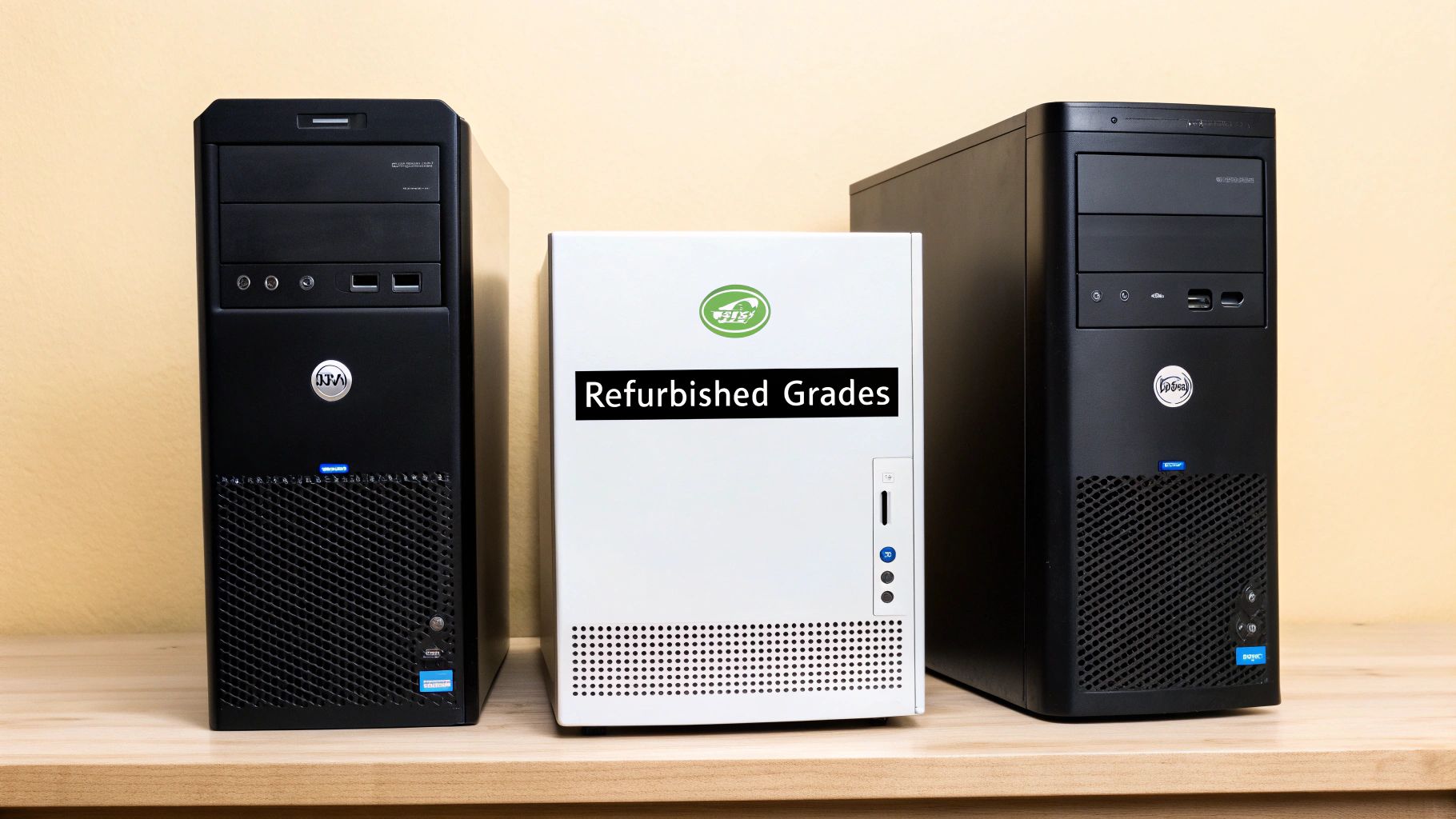
Not all refurbished desktops are created equal, and understanding the grading system is the key to making an informed procurement decision for your business. Think of it like acquiring a fleet vehicle: you could get a simple "used" car, or you could opt for a "certified pre-owned" model that includes a full inspection report and a guarantee. The grading system for PCs provides the same transparency, offering a clear, upfront assessment of the asset you're acquiring.
Understanding these grades removes the guesswork from procurement. It empowers your IT team to match the right machine to the right role, transforming what could feel like a gamble into a strategic, reliable investment in your company's infrastructure.
The Three Tiers of Refurbished Hardware
Most reputable suppliers, including social enterprises like Reworx Recycling, utilize a standard A, B, and C grading scale. It’s crucial to understand this scale is based purely on cosmetics—the physical appearance of the machine—because every grade is certified to be 100% functional.
- Grade A: This is the highest quality available. These devices are in "like-new" or near-mint condition, showing minimal to no signs of prior use. You can expect a pristine machine with no significant scratches, scuffs, or blemishes.
- Grade B: These desktops are fully functional but exhibit minor cosmetic imperfections. You might observe light scratches on the casing or small scuffs from normal office use.
- Grade C: These PCs will show more obvious signs of their previous operational life, such as more noticeable scratches or dents on the casing. However, like all other grades, they have been thoroughly tested and are fully operational.
Knowing this distinction enables you to optimize your budget. A Grade A machine is ideal for a client-facing reception area or an executive office, while a Grade B or C unit is a highly cost-effective solution for a back office, call center, or warehouse where cosmetic appearance is not a priority.
Why Functionality Is Always the Priority
Regardless of the cosmetic grade, the operational integrity of the PC is what truly matters. This is why partnering with a certified refurbisher is non-negotiable. These professionals conduct extensive diagnostic tests on every component, from the motherboard and CPU to the memory and storage drives.
A cosmetic grade describes a machine's appearance, but a certified refurbisher's guarantee validates its performance. Always prioritize vendors who provide comprehensive testing protocols and support their products with a robust warranty.
This process ensures that every PC meets or exceeds its original performance specifications. If a component is found to be suboptimal, it is replaced with a quality-tested part. The entire system is then cleaned, updated, and recertified. This is what distinguishes professional refurbishment from simply reselling used electronics. For more tips on selecting the right hardware, see our guide on what to consider when buying a refurbished laptop; many of the same principles apply to desktops.
Refurbished PC Desktop Grading System Explained
The table below provides a clear breakdown of what you can expect when procuring refurbished PCs from a trusted source.
| Grade | Cosmetic Condition | Functional Guarantee | Ideal Use Case |
|---|---|---|---|
| Grade A | Near-mint condition with minimal to no signs of wear. | 100% tested and fully functional. | Client-facing roles, executive offices, or any area where appearance is important. |
| Grade B | Minor scuffs, light scratches, or small blemishes on the casing. | 100% tested and fully functional. | General office use, call centers, and internal employee workstations. |
| Grade C | Obvious signs of wear, including noticeable scratches or dents. | 100% tested and fully functional. | Warehouse settings, industrial environments, or budget-critical deployments. |
Ultimately, a strong warranty is your best assurance. A refurbisher who is confident in their process will offer a minimum 90-day warranty, with many providing a full year of coverage. This protects your investment and provides peace of mind, ensuring your new fleet of desktops will deliver sustained value.
Your Essential Procurement Checklist
When you’re ready to integrate refurbished desktops into your organization, you need more than a purchase order—you need a strategic plan. A comprehensive checklist is the best tool for guiding your IT and procurement teams through the critical decision points, ensuring every machine meets your standards for performance, security, and reliability. This elevates a simple transaction into a strategic acquisition.
Arming yourself with the right questions is how you effectively vet suppliers. It’s the difference between buying budget-friendly hardware and acquiring high-performing, secure assets that align with your operational needs and protect your company’s data.
Evaluating Core Technical Specifications
The heart of any desktop is its hardware. While refurbished models offer fantastic value, you must ensure their specifications are robust enough for your business applications, both today and in the near future. Look beyond the price tag and scrutinize the components that drive performance.
Key components to evaluate include:
- CPU Generation: The processor is the engine of the computer. Aim for a relatively recent generation, such as an 8th-generation Intel Core i5 or newer, to ensure compatibility with modern software and operating systems like Windows 11.
- RAM (Random Access Memory): For standard office productivity, 8GB of RAM is a solid baseline. However, 16GB is strongly recommended for users who multitask heavily or run more demanding applications. Confirm it's a modern standard like DDR4 for optimal speed.
- Storage Type and Capacity: This is a critical factor. Insist on a Solid-State Drive (SSD) over a traditional Hard Disk Drive (HDD). SSDs are exponentially faster, resulting in near-instantaneous boot times and application loading. A 256GB capacity is an excellent starting point for most business users.
These three components form the foundation of a productive user experience. A machine with a modern CPU, ample RAM, and a fast SSD will feel responsive and capable, directly impacting employee efficiency. You can learn more about aligning technology with your business goals in our guide on IT asset management best practices.
Verifying Testing Protocols and Warranty
A reputable supplier demonstrates its value through its process. Simply wiping a hard drive and dusting off a case is not true refurbishment. It is incumbent upon you to ask direct questions about their quality assurance protocols and post-sale support.
A trustworthy refurbisher will be transparent about their testing methodology and stand behind their products with a clear, comprehensive warranty. This guarantee is your primary assurance of quality and reliability.
Before committing to a purchase, ask potential vendors these critical questions:
- What does your testing process involve? Do they run full diagnostic software on every component, including the motherboard, ports, and power supply?
- What is your policy on component replacement? Are failing parts repaired, or are they replaced with new or certified-working components?
- What are the specific terms of the warranty? A minimum 90-day warranty is standard, but a one-year warranty offers far greater peace of mind. Clarify what it covers (parts, labor) and what the claims process entails.
A vendor who provides detailed, confident answers to these questions is far more likely to deliver a dependable refurbished desktop.
Prioritizing Data Security and Compliance
This may be the most critical checkpoint of all: data security. Every refurbished desktop had a previous owner, and ensuring the complete, permanent erasure of all prior data is non-negotiable. A basic format is insufficient and exposes your organization to significant risk.
You must demand proof of certified data sanitization. The industry gold standard is NIST 800-88, "Guidelines for Media Sanitization." This protocol ensures data is forensically unrecoverable.
Ask your supplier for a Certificate of Data Destruction for every machine. This document is your auditable proof that the storage drives were properly sanitized, protecting your organization from potential data breaches and ensuring compliance with privacy regulations like GDPR and CCPA. This isn't just a best practice; it's an essential component of corporate due diligence.
Looking at the Financial and Environmental Payback
Deciding to incorporate refurbished desktop PCs into your IT ecosystem extends far beyond immediate invoice savings. For finance leaders and sustainability officers, the true value lies in the dual financial and environmental return on investment (ROI). This dual benefit creates a rock-solid business case, transforming a cost-saving measure into a strategic initiative that benefits the budget, the brand, and the planet.
A smart analysis begins with the Total Cost of Ownership (TCO). While a new desktop might cost $1,000, a comparable refurbished model could be just $500, yielding an immediate 50% capital saving. For a deployment of 100 machines, that $50,000 in savings is substantial, freeing up capital for other strategic projects. But TCO considers the entire lifecycle—deployment, maintenance, and eventual disposal—and refurbished assets continue to deliver value throughout.
Putting a Number on the Green Impact
Beyond the compelling financial case, the environmental benefits are equally tangible and measurable. When you choose a refurbished PC, you take direct action to support a circular economy and reduce your company's ecological footprint.
- Less E-Waste: Every refurbished device you procure is one less piece of equipment contributing to the global e-waste stream—the fastest-growing category of waste worldwide, an issue the U.S. EPA is actively working to address.
- Saving Resources: Manufacturing a new computer is an incredibly resource-intensive process, requiring hundreds of kilograms of fossil fuels, minerals, and water. Refurbishing bypasses this, preserving valuable virgin materials.
- Smaller Carbon Footprint: The majority of a PC's lifetime carbon emissions are generated during manufacturing. By extending a device's life, you effectively eliminate those manufacturing emissions from your company's environmental ledger.
This commitment to sustainability is not just for an internal report; it's a powerful narrative to share with stakeholders. You can learn more about how to maximize ROI and sustainability through global ITAD services in our specialized guide.
Tying It All to Corporate Social Responsibility
Integrating refurbished technology is a clear, tangible demonstration of your company's commitment to Corporate Social Responsibility (CSR). It's a decision that resonates with employees, clients, and investors who prioritize environmental stewardship, enhancing your brand's reputation as a responsible corporate citizen. It positions you as a leader in sustainability, actively participating in solutions rather than simply meeting minimum compliance.
Choosing refurbished isn't just a procurement decision; it's a public statement about your company's values. It proves that being smart with money and being a good steward of the environment can, and should, go hand-in-hand.
This strategic shift is occurring within a larger trend. The global market for refurbished PCs is no longer a niche; it's a booming industry reflecting widespread business adoption. The market was valued at around $12.47 billion in 2024 and is projected to reach $19.38 billion by 2031, with businesses like yours now accounting for nearly 40% of all purchases. This growth underscores the significant strategic upside companies are finding in refurbished hardware. You can check out more insights on the refurbished PC market growth on archivemarketresearch.com.
Finally, when these assets reach their end of life, partnering with a social enterprise like Reworx Recycling for your IT equipment disposal ensures the cycle of responsibility continues. This provides secure data destruction and environmentally sound electronics recycling, completing a truly sustainable IT lifecycle.
Managing Data Security and End-Of-Life Disposal
For any IT leader, data security is not just a priority—it is the bedrock of operational integrity and client trust. Integrating refurbished hardware into your IT ecosystem does not change this fundamental principle. A device's lifecycle extends from procurement through daily use and, critically, to its final disposal.
This entire lifecycle demands a robust strategy to protect sensitive corporate information at every stage. A single data breach can result in severe financial and reputational damage, making secure end-of-life management a non-negotiable component of any IT asset plan.
The Critical Difference in Data Destruction
Many people mistakenly believe that deleting files or reformatting a hard drive permanently erases data. In reality, these methods often only remove the pointers to the data, leaving the underlying information easily recoverable with basic software tools. For a business, this is an unacceptable risk.
Certified data destruction is the only acceptable method. It utilizes specialized software to overwrite the entire drive with random characters, often in multiple passes, rendering the original data forensically unrecoverable. This process adheres to strict industry standards, such as those defined by the National Institute of Standards and Technology (NIST).
When procuring a refurbished PC, you must insist on a Certificate of Data Destruction from the vendor. This document is your auditable proof that the device was professionally sanitized before it entered your network, protecting you from inheriting the previous owner's data liabilities.
The infographic below illustrates the clear return on investment generated by a well-managed, secure, and sustainable approach to refurbished hardware.
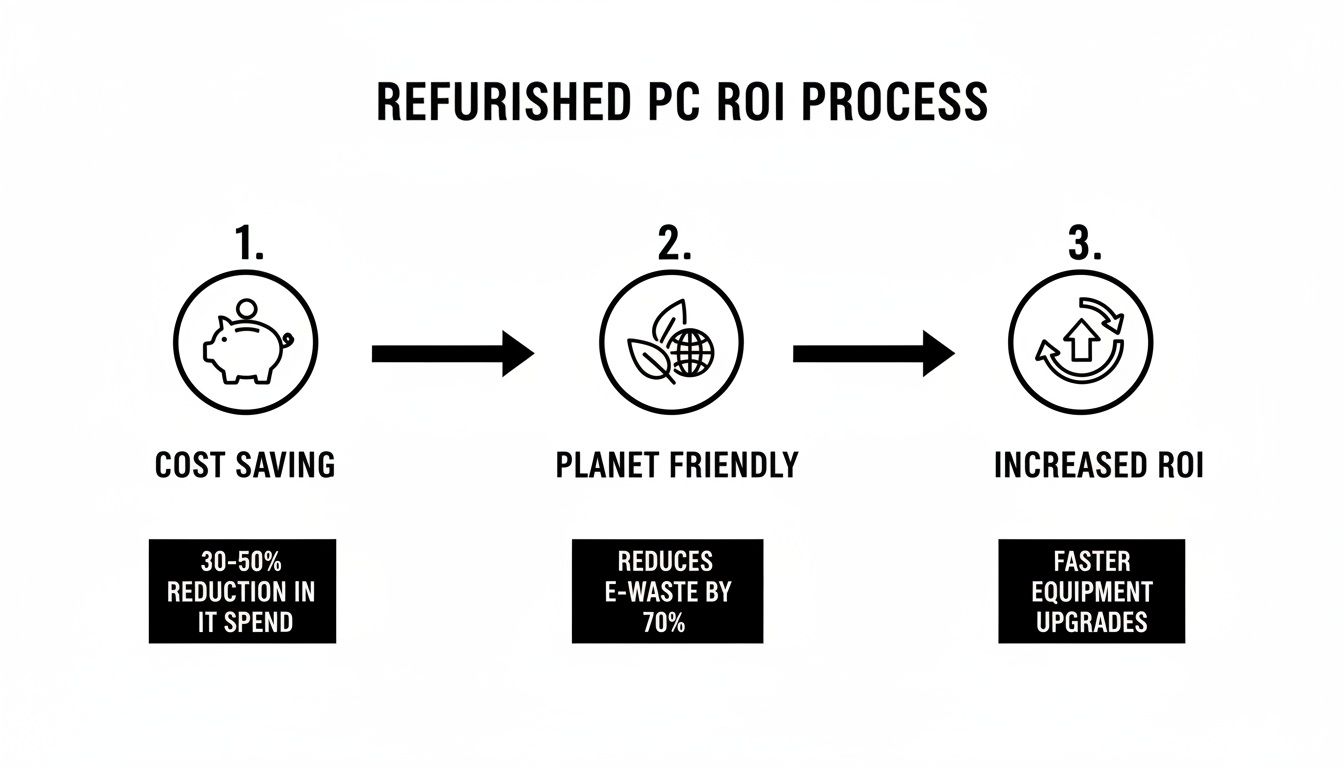
This process highlights how initial cost savings are amplified by strong environmental performance, delivering a powerful dual benefit for the business.
Closing the Loop with Responsible Disposal
Your responsibility for a device's data does not end when it leaves your facility. When your refurbished PCs reach their own end of life, their disposal is as critical as their acquisition. This is where a certified IT Asset Disposition (ITAD) partner is absolutely essential.
Partnering with a social enterprise like Reworx Recycling provides a secure, compliant, and environmentally responsible pathway for retiring obsolete technology. This closes the loop on the IT asset lifecycle, ensuring every stage is managed to the highest ethical and professional standards.
A certified ITAD process, such as that for an office cleanout or data center decommissioning, will always include:
- Secure Logistics: A documented chain of custody from the moment the assets leave your premises.
- Certified Data Destruction: The same rigorous data sanitization process, now applied to your retired equipment, with certificates issued for your compliance records.
- Responsible Recycling: Ensuring all components are recycled in an environmentally sound manner, preventing hazardous e-waste from entering landfills.
This structured approach is increasingly critical as regulatory oversight tightens. Market dynamics show that e-waste concerns and data security mandates are heavily shaping the industry. In fact, the U.S. refurbished computer market is projected to reach $6.50 billion by 2035, a growth driven by the demand for secure, compliant refurbishment and disposal practices. Managing these assets efficiently also includes knowing how to remotely restart a PC to resolve issues.
For a deeper dive into protecting your organization's most sensitive information, review our guide on secure data destruction services. It will help you ensure your IT lifecycle is secure from acquisition to final disposition.
Still Have Questions About Refurbished Desktops?
Navigating the complexities of IT procurement can be challenging, but transitioning to refurbished desktops doesn't have to be. To provide clarity, let's address some of the most common questions from business leaders and IT managers. Our goal is to provide clear, direct answers that build your confidence and demonstrate the immense value these machines can bring to your organization.
Are Refurbished Desktops As Reliable As New Ones?
Yes, they absolutely can be—particularly when sourced from a certified refurbisher. A professionally refurbished desktop is fundamentally different from a typical "used" computer. It has undergone a rigorous series of diagnostic tests where every component—from the motherboard and RAM to the power supply and ports—is individually verified for performance.
If any part fails to meet strict original manufacturer specifications, it is repaired or replaced with a quality component. This meticulous process ensures the machine functions as reliably as a new one for the vast majority of business applications. The proof is in the warranty; a certified vendor’s confidence in their product is always backed by a solid guarantee, providing an essential layer of assurance for your business.
What Kind of Warranty Should I Expect?
A warranty is your single best indicator of a supplier's quality and confidence. In the refurbished market, reputable vendors typically offer warranties ranging from 90 days to a full year. This guarantee serves as your safety net, protecting your investment against unexpected hardware failures.
Before finalizing a purchase, it is vital to review the specific terms of the warranty. Ask for details on what is covered (e.g., parts, labor, shipping) and understand the process for initiating a return or repair. A transparent and comprehensive warranty policy is a strong signal that the refurbisher stands firmly behind the quality and reliability of their products.
How Is Data from the Previous Owner Handled?
This is a non-negotiable security checkpoint and one of the most critical questions you can ask. Professional refurbishers and certified ITAD partners like Reworx Recycling perform secure data destruction on every device they process. They use methods that comply with rigorous industry standards, such as NIST 800-88, to ensure all previous data is forensically unrecoverable.
This is not a simple file deletion. It is a complete data sanitization process that overwrites the entire storage drive, leaving no trace of the former user's information. For your own compliance and peace of mind, you should always request a Certificate of Data Destruction for each asset. This document serves as the official record that your device is clean, secure, and ready for deployment.
Can I Get a Refurbished PC with Modern Specifications?
Absolutely. The misconception that "refurbished" equates to "outdated" is a common myth. In reality, the refurbished market is rich with recent, high-performance models, often only two or three years old. These typically come off corporate leases from large enterprises that maintain regular hardware refresh cycles.
This means you can easily acquire a refurbished desktop equipped with a modern processor (such as an Intel Core i5 or i7), ample RAM (16GB is common), and a fast Solid-State Drive (SSD). These specifications are more than sufficient to handle demanding business software, heavy multitasking, and daily productivity with ease. It is enterprise-grade performance at a fraction of the cost of new equipment.
At Reworx Recycling, our mission is to create a more sustainable and equitable world by giving technology a second life. As a donation-based social enterprise, we partner with businesses in Atlanta and across Georgia to manage their IT equipment disposal responsibly. By donating your used computers, laptops, and other electronics, you not only ensure secure data destruction and environmentally sound recycling but also support our community programs that provide technology access and job training.
Ready to make your IT operations more sustainable and impactful? Schedule a pickup for your old equipment, learn about our corporate donation programs, or contact us today to see how we can help your business achieve its financial and CSR goals.