You've got retired laptops on the dock, a server refresh that's already behind schedule, and a recycling partner saying the pickup is “in process.” That's usually the moment IT managers realize the core problem isn't hauling boxes, it's losing visibility the second assets leave the building. In ITAD, real time tracking is the difference between assuming a device made it to destruction and proving it.
What Is Real Time Tracking and Why IT Managers Should Care
A company can do everything right on the front end, label the assets, wipe the drives, hand off the pallets, and still lose control of the disposition chain once the truck pulls away. That's the weak point real time tracking is meant to close. Instead of reconstructing movement later from emails, spreadsheets, and pickup logs, teams get continuous updates on location, status, and condition as assets move through IT asset disposition.
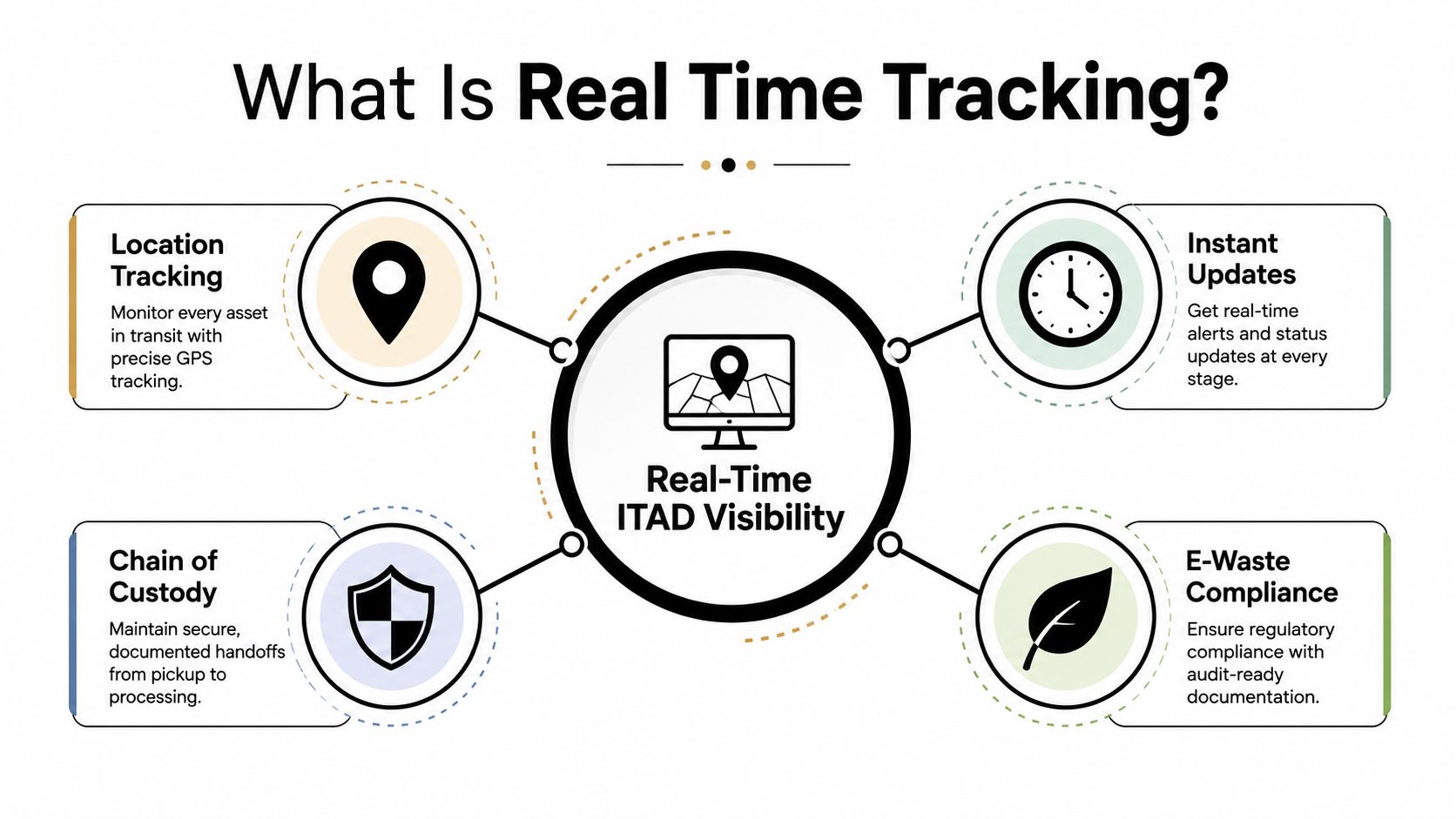
For an IT manager, that matters because disposition is full of handoffs. A retired laptop might leave a conference room, sit in a staging cage, get loaded onto a truck, arrive at a refurbisher, and then disappear from your view unless every step is captured. Without that visibility, compliance records go incomplete, chain of custody gets harder to prove, and data destruction confirmation can turn into a scramble.
Practical rule: if you can't answer where the asset is, who touched it last, and what happened next, you don't have control of the workflow yet.
The market context explains why this has become mainstream. One industry roundup puts the time-tracking software market at $6.1 billion in 2025 and projects $11.43 billion by 2030, a 13.38% CAGR, while also estimating that ineffective time management costs U.S. companies $588 billion annually and that time theft can consume 1% to 7% of total payroll depending on misuse, all of which points to a broader business demand for live visibility and accountability Breeze time tracking statistics. A separate employee-monitoring roundup reports 78% of employers now use some form of monitoring, up from 60% before the pandemic, and about 86% of employee monitoring tools include real-time activity monitoring, which shows how far live oversight has moved from niche to normal WorkTime employee monitoring statistics.
In ITAD, the value isn't surveillance for its own sake. It's that a retired asset doesn't behave like a static spreadsheet line item anymore, it moves, gets sorted, gets wiped, gets destroyed, or gets diverted to donation. The link below is worth reviewing if you're mapping that visibility back into your own disposition process: asset tracking systems. Real time tracking gives you the operational proof that your recycled hardware followed the path you intended.
Core Technologies Behind Real Time Tracking Systems
Real time tracking is often sold as one idea, but the hardware choices are very different in practice. For ITAD work, the question isn't “what technology is best,” it's which layer of visibility you need. A truck route, a warehouse bay, and a sealed destruction room each call for a different approach.
GPS works for movement, not detail
GPS is the clearest fit for fleet and transport legs. If your goal is to know whether a pickup truck left the client site, reached the consolidation center, or got delayed en route, GPS is the sensible tool. It's a long-range logistics layer, not a fine-grain indoor system, so it won't tell you which pallet a device ended up on or whether a tagged box was moved from one secure area to another.
That limitation matters in ITAD because the highest-risk moments often happen indoors, not on the highway. The truck ride is easy to explain. The warehouse handoff is where chain of custody usually gets muddy.
RFID and UWB solve different warehouse problems
RFID is the workhorse for high-volume inventory control. It's useful when you need fast scanning, zone-level presence, and a lower-friction way to confirm that assets entered or exited a space. What it usually doesn't give you is precise location inside a building, which is why teams that rely only on RFID still end up asking staff to interpret where an item probably went.
UWB is the precision option. NASA's testing notes sub-1% range resolution and 100 to 1,000 times finer granularity than conventional narrowband RF RTLS, using time-difference-of-arrival and angle-of-arrival methods on ultra-wideband pulses, with picosecond-level temporal resolution as the technical enabler NASA UWB RTLS patent. That level of accuracy is the difference between “somewhere in the facility” and “this asset is in that room.”
For a practical comparison of adjacent logistics visibility, real-time supply chain visibility from Peak Transport is a useful external reference, especially if your team already thinks in terms of inbound and outbound shipment telemetry.
A separate internal reference point for tag design and asset-level identification is here: asset tagging system.
Real time tracking fails fastest when teams choose a precision tool for a low-value task, or a cheap tool for a compliance-critical one.
The other issue is latency. A technical reference for live location systems cites a practical 2 to 5 second end-to-end latency budget from GPS capture to display, and notes that pushing updates to 1-second intervals can drain batteries in 4 to 6 hours and raise cost about 10 times versus 10-second reporting location tracking latency tradeoffs. In ITAD, that tradeoff is real. Faster isn't automatically better if the power burden, device replacement cycle, or operating expense starts working against the program.
Benefits and Risks of Real Time Tracking in ITAD Operations
The biggest benefit of real time tracking in ITAD is simple. It gives your team fewer blind spots. When a pallet of decommissioned servers leaves a client site, continuous visibility reduces the chance that hardware gets misplaced, misrouted, or left sitting without a documented next step. It also makes audit response faster because you're not digging through old pickup slips to answer basic custody questions.
What visibility actually improves
The operational gains show up in three places.
- Chain of custody clarity: every handoff can be time-stamped and tied to a physical movement.
- Faster exception handling: if a load drifts off route or stalls, the issue is visible while it's still fixable.
- Cleaner billing and reconciliation: when item counts, status updates, and destination records line up, disputes shrink.
There's also a sustainability angle. If your disposition stream includes reuse, donation, or parts harvesting, the same visibility that protects compliance can prove where assets were diverted and why. That matters when leadership wants evidence, not just claims, about responsible recycling.
The broader business case for visibility is supported by labor data, too. As noted earlier, ineffective time management costs U.S. companies an estimated $588 billion annually Breeze time tracking statistics. ITAD isn't workforce analytics, but the same principle applies, hidden time and hidden movement both create waste.
The risks are real
The tradeoff is that tracking introduces its own exposure. The more movement, condition, and custody data you collect, the more there is to protect. A program that tracks retired laptops and drives still has to protect the metadata around those assets, because that metadata can reveal security posture, disposal timing, client locations, and operational routines.
Privacy concerns also matter. The monitoring roundup cited earlier reports that 74% of U.S. employers use online tracking tools and 60% use real-time screen monitoring WorkTime employee monitoring statistics. That environment has made people wary of anything that feels like surveillance overreach, so the implementation has to be scoped to assets and compliance, not employee micromanagement.
Operator insight: the most common failure isn't a missing sensor, it's a system that shows movement but not meaning.
That gap comes up all the time in the field. Some platforms show a dot on a map, but don't tell you whether a compliance step was missed, whether a unit is in quarantine, or whether a destruction queue has started. Independent industry commentary on real-time asset tracking makes the same point, location alone isn't enough, teams need context, condition signals, and workflow meaning why location data isn't enough. If your system can't answer “what should happen next,” it's only halfway useful.
For a practical risk-management lens, this internal guide is worth a look: best practices for risk management.
Implementing Real Time Tracking for Your ITAD Program
The cleanest rollouts start with scope, not hardware. If you try to track every asset the same way, you'll overbuild for low-risk items and underbuild for the ones that matter most. The first question is which assets need live visibility, laptops, servers, storage arrays, medical devices, or mixed office cleanout loads.
Start with the compliance requirement, not the gadget
Different disposal streams create different tracking needs. A standard office refresh might only need chain-of-custody confirmation and final reconciliation, while regulated environments may need tighter logging because the disposition record has to support internal audit, legal review, or a specific compliance program. The important part is to define the custody point where loss, tampering, or misrouting becomes unacceptable.
Then choose the tracking layer that fits that risk. GPS can be enough for transport legs. RFID often works for warehouse intake and staged inventory. UWB is stronger when you need exact indoor location in a secure environment. If you need live movement but also care about response time and power draw, the latency tradeoff mentioned earlier should influence the pilot design.
Build around workflow, not a separate dashboard
Tracking that lives off to the side gets ignored. The data has to feed your existing ITAM or disposition workflow so it's usable by the people who approve, receive, wipe, sort, and certify the assets. If the system doesn't create an action, a flag, a handoff, or a report, it becomes another screen to check.
That's why integration matters as much as the sensor itself. The practical reference point here is the internal implementation guide: implementation timelines. Even a good system needs a staged rollout, because staff have to learn the new scan points, exception codes, and approval steps before the process can be trusted.
A workable rollout usually includes:
- Asset scope definition: what gets tracked, what doesn't, and why.
- Process mapping: where custody changes, where data destruction starts, and where final disposition closes.
- Pilot testing: one site, one asset class, one reporting workflow.
- Change management: make sure operations teams know what data is collected and how it's used.
Keep the first deployment boring. The goal isn't clever technology, it's fewer disputes, cleaner records, and less manual reconciliation.
If you buy tracking without training, people work around it. If you buy tracking without integration, the data sits unused. If you buy tracking without a defined exception process, every problem becomes a manual hunt.
Integrating Real Time Tracking with ITAM Systems
Tracking data on its own is just movement history. The value shows up when that data lands inside IT asset management, where you can connect it to purchase dates, depreciation, warranty status, owner records, and disposition requirements. Without that context, a location update tells you where something is. It doesn't tell you what it means to the lifecycle.
A mature setup treats location as one field in a larger record. When an asset arrives at a recycling facility, the ITAM system should know whether that unit is eligible for resale, needs secure destruction, or belongs in a donation stream. If a unit detours from its expected route, the workflow should flag it for review instead of forcing someone to discover the problem manually.
Integration paths that actually work
API connectors are the most flexible option when your ITAM platform exposes them cleanly. Middleware helps when you need to normalize data from multiple sites, carriers, or tracking devices. Platform-native integrations are easiest to maintain if your core system already supports the events you care about. The right choice depends less on branding and more on how many systems need to talk without breaking custody records.
Data ownership matters too. Someone has to own the event logic, who closes the ticket, who confirms destruction, who approves a route exception, and who resolves a mismatch between the physical count and the digital record. If that ownership is vague, the data becomes someone else's problem.
The best use case is workflow intelligence, not passive visibility. A mature ITAM integration can trigger actions when an asset reaches a certain stage, alert on route deviation, or hand off a device for secure erasure when the receiving site scans it in. That is far more useful than a map pin.
The internal best-practice reference below is helpful if your team is formalizing the operating model: IT asset management best practices.
If the tracking event doesn't change the next step in the process, it's data exhaust, not operational intelligence.
That's the line to hold teams to. Real time tracking pays off when it shortens the path from physical movement to digital action. Everything else is just more telemetry.
Real Time Tracking for E Waste Logistics and Secure Data Destruction
ITAD teams don't just move assets, they prove what happened to them. That's why real time tracking matters so much for e-waste logistics and secure data destruction. The core question is not whether a device was picked up, it's whether you can document every custody change until the asset is wiped, destroyed, reused, donated, or recycled.
Chain of custody versus batch tracking
Batch tracking usually works like this. A team counts what left the site, the recycler confirms what arrived, and someone later reconciles the difference. That can be enough for low-risk material, but it leaves gaps if an audit asks who had the asset at a specific point in time.
Real time tracking gives you a live custody trail instead of a retroactive summary. That matters when loads move through pickup, storage, processing, quarantine, and final disposition. It also helps when clients need documentation for their own internal controls, because the record isn't built after the fact.
| Tracking approach | Operational value | Compliance strength | Weak point |
|---|---|---|---|
| Batch tracking | Good for simple counts | Moderate | Gaps between handoffs |
| Real time tracking | Continuous custody visibility | Stronger | Requires better process discipline |
| Manual sign-off only | Easy to start | Weak | Hard to verify later |
Secure destruction needs linked confirmation
Data destruction is where the record has to be tight. If a drive is scheduled for erasure or physical destruction, the tracking system should link the destruction event to the specific asset record. That link is what keeps certificates, serial numbers, and processing steps aligned.
This is also a security issue in its own right. The system that tracks sensitive hardware has to be secured like the hardware it describes. If someone can tamper with the records, the paper trail becomes less trustworthy than the asset itself.
A useful distinction from the earlier section still applies here, location visibility alone is not enough. Recent industry analysis argues that organizations also need condition signals and usage patterns to reduce reactive maintenance and improve operational decisions real-time condition tracking analysis. In ITAD, the same logic extends to status, not just movement. A device that's “in transit” and a device that's “cleared for destruction” are very different things.
Real time tracking makes the logistics record stronger, but only if the destruction workflow, exception handling, and final certificate generation all use the same asset identifiers. If they don't, the custody chain fractures.
Real World Examples and Next Steps for Your Organization
A mid-sized healthcare provider has one obvious reason to care about real time tracking, medical equipment disposal touches sensitive records and often has to satisfy strict audit expectations. In that environment, the practical value is not flashy analytics. It's being able to match each retired device to a custody trail and a destruction record without chasing down three different departments.
A university system faces a different problem. Laptops come off campus in waves, departments close out at different times, and equipment may be routed from several locations to a single consolidation point. Real time tracking helps the team reconcile delivered counts against the pickup list, which reduces the chance that a drive, docking station, or specialty device gets lost in the shuffle.
A corporate real estate team sees another use case entirely. During a facility cleanout, desks, monitors, phones, and network gear can move through several hands in a single day. Continuous visibility keeps the team from leaving stranded hardware behind and makes it easier to prove the inventory was handled correctly.
A short readiness check
Before you start a pilot, ask four questions.
- Which assets are highest risk? Focus first on devices where loss, tampering, or missing paperwork hurts most.
- What compliance obligations apply? HIPAA, GDPR, R2, and e-Stewards can all affect how detailed the record needs to be.
- What can your ITAM system ingest? If the platform can't consume tracking events, integration work comes first.
- What do you need to prove at the end? Chain of custody, destruction, diversion, or all three.
If you can answer those four clearly, you're ready to design a usable pilot. If you can't, the tracking stack will probably get overbuilt or misapplied.
The best programs treat real time tracking as part of the disposition operating model, not a gadget add-on. That's where secure data destruction, equipment decommissioning, and responsible recycling fit together cleanly.
If you're planning an office cleanout, a laptop disposal project, or a full data center decommissioning, Reworx Recycling can help you structure the pickup, tracking, and secure data destruction process around your compliance needs. Visit Reworx Recycling to discuss donation-based recycling, IT asset disposition, and a workflow that keeps your retired equipment accounted for from pickup to final processing.