An IT manager signs off on 300 retired laptops leaving a data center. The carrier hands over a paper manifest, the pallet disappears into reverse logistics, and three weeks later nobody can prove whether every drive was wiped, which devices were resold, or which units were suitable for donation. The spreadsheet says the assets moved. It doesn't prove what happened to them.
That gap is where real-time inventory management becomes an IT asset disposition, or ITAD, control layer. In electronics recycling and IT equipment disposal, inventory accuracy affects more than warehouse efficiency. It influences data-breach exposure, regulatory evidence, chain of custody, recovery value, and whether usable technology reaches a community program instead of being destroyed. The same principle applies to a small office cleanout, a multi-site laptop disposal project, or a complex data center decommissioning program.
When a Pallet of Laptops Walks Out the Door
The manager in that opening scenario probably has a manifest, a pickup confirmation, and a vendor contact. What's missing is a live record connecting each serial number to a physical location, custody event, sanitization status, disposition decision, and final certificate. If one laptop is placed on the wrong pallet or one drive is processed under the wrong asset record, the system can remain tidy while the physical truth drifts away.
That creates several risks at once. A missing device may contain sensitive information. A device marked as sanitized may still be waiting in quarantine. A laptop intended for a corporate donation program may be classified as scrap because nobody can locate its testing record. In a medical equipment disposal or laboratory equipment disposal project, the same visibility problem can affect equipment status, components, and documentation.
The handoff is the control point
Traditional inventory thinking asks, “How many units do we have?” ITAD operations need better questions:
- Which device is where? Is it at the client site, in a vehicle, at a receiving dock, in quarantine, at a technician workstation, or ready for reuse?
- Who handled it? Can the record show the handoff from the client to the driver, from the driver to the recycler, and from receiving to the sanitization technician?
- What happened to the data? Is the drive awaiting secure data destruction, successfully erased, physically shredded, or blocked because the wipe failed?
- What value remains? Can the unit be reused, donated, recovered for parts, recycled, or sent for product destruction?
A paper manifest can document intent. A connected event record documents action. That distinction matters during an audit, a client dispute, a data-security review, or a sustainability report.
Practical rule: If a device changes location, custody, condition, or data status, the inventory record should change with it.
Real-time inventory management doesn't mean every ERP screen refreshes instantly. It means the operational event is captured at the point of movement and made available to the systems and people who need it. That approach gives an IT manager a defensible chain of custody instead of a delayed reconciliation exercise.
What Real-Time Inventory Management Actually Means
Start with an everyday comparison. Traditional inventory is like balancing a checkbook once a month. You might eventually discover what happened, but you won't know your available balance immediately after every purchase. Real-time inventory is closer to a banking app, where each transaction updates the account as it occurs.
In an ITAD environment, the transactions aren't purchases. They're receipts, transfers, scans, sanitization events, inspection results, shipments, donations, and recycling decisions. A laptop received at a loading dock should become “received” at that moment. When it enters a quarantine cage, its location and status should change. When a technician completes secure data destruction, the record should connect that action to the device's serial number.
The architecture behind the screen
Most modern implementations use an event-driven model. Each event is captured, written to a distributed log, and passed into dashboards, APIs, workflow tools, and analytics layers. The result is continuous visibility across warehouses, offices, vehicles, and channels within seconds rather than hours, as described in the research on real-time inventory visibility frameworks.
That architecture supports a single-pane view of total inventory. It can show what's physically present, what's allocated to a processing queue, what's available for donation, and what has left the facility. The same data can feed available-to-promise logic for recovery commitments and support reverse-logistics planning.
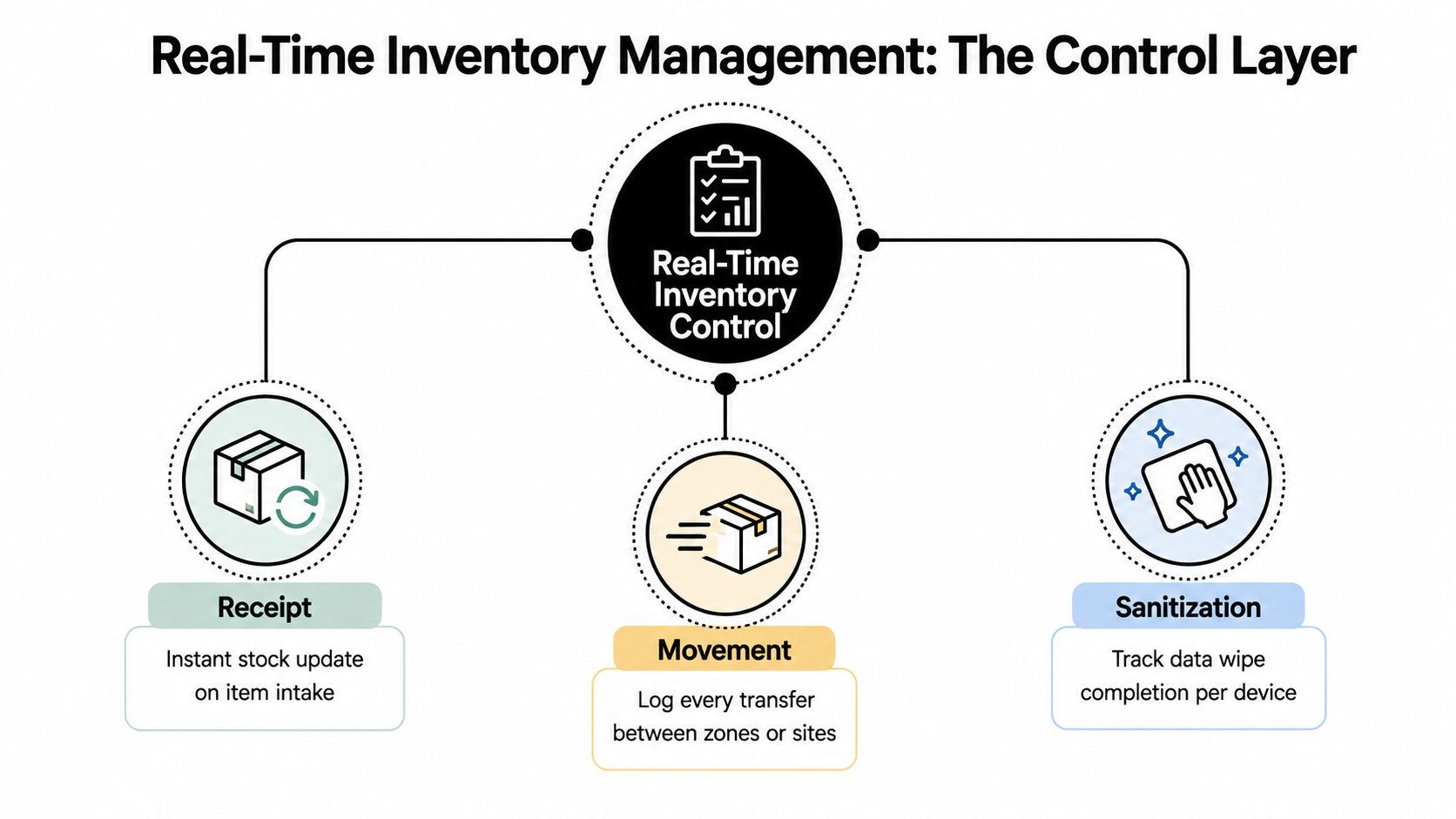
The point isn't to create a more attractive dashboard. Stock accuracy becomes a live operational signal. It tells an operations lead whether assets are ready to process, tells a security manager whether drives remain exposed, and tells a sustainability director whether recoverable equipment is moving toward reuse.
The same event-driven logic applies outside ITAD. For example, businesses evaluating ways to improve break room vending services can use similar principles to connect physical consumption with current stock records. The operational lesson is the same: capture the event where it happens, then distribute trustworthy status information to the workflows that depend on it.
The Capture Layer, Barcodes, RFID, and IoT Sensors
Real-time inventory data has to enter the system somehow. In ITAD, the capture layer usually combines barcodes, RFID, IoT sensors, and asset-tracking software, with each tool suited to a different operating condition.
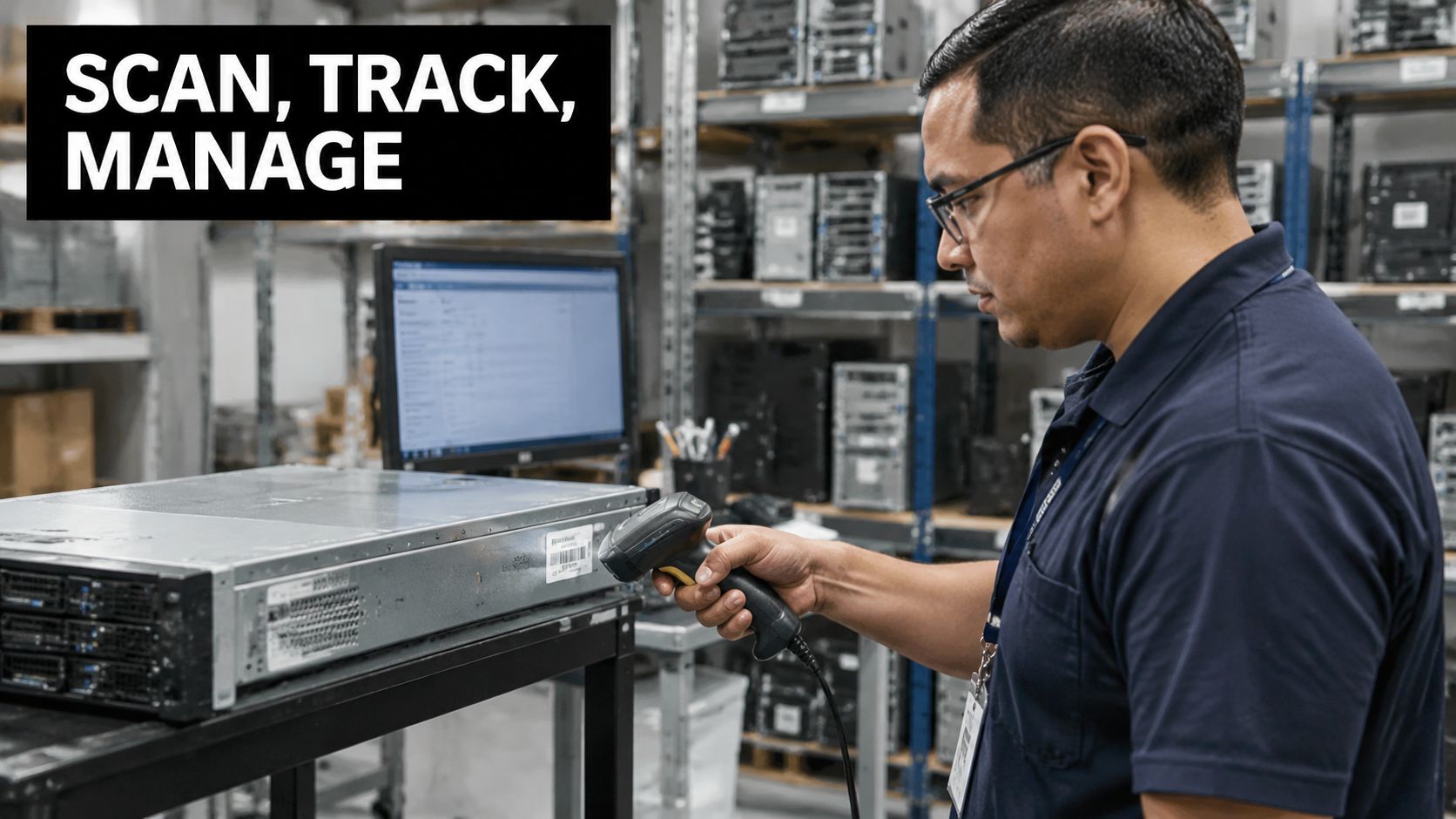
Barcodes are familiar, inexpensive, and practical for small batches. A technician can scan a laptop during an office cleanout, verify the serial number, photograph damage, and assign a status from a mobile device. Barcode workflows work well when items arrive in manageable groups and the operator can see and handle each asset. They depend on line-of-sight, correct label placement, charged equipment, and disciplined scanning.
RFID helps when the team needs to read many tagged items quickly. Tagged cases and cartons can pass through a portal without line-of-sight scanning, which reduces manual intervention and supports bulk intake. Field research in a major global retailer found that RFID reduced inventory record inaccuracy by about 26% overall, with category-level effects ranging from no statistically significant change to an 81% improvement in the categories most prone to manual error, as reported in the RFID inventory accuracy study.
Match the technology to the risk
RFID tags cost more than printed labels, and portals require thoughtful placement. Metal racks, dense pallets, mixed equipment, and poorly tuned readers can create missed reads or duplicate reads. A handheld RFID reader gives flexibility, while a fixed portal can automate a controlled doorway. Neither removes the need for exception handling.
IoT sensors add another layer. GPS-enabled trackers, door sensors, temperature monitors, and shock sensors can provide location or environmental telemetry for high-value assets in transit, quarantine, or at customer sites. They're useful when knowing that a device exists isn't enough. You may also need to know whether a shipment left a defined route or whether sensitive equipment experienced damaging conditions.
A practical design often looks like this:
- Barcode at the workstation: Use it for serial-level verification, testing, sanitization, and exception notes.
- RFID at controlled transitions: Use it for pallets, cartons, and high-volume receiving or shipping.
- IoT for special exposure: Use sensors where transit, location, or environmental conditions create material risk.
- Software for reconciliation: Use the platform to compare expected movement with captured movement and route exceptions to a person.
Organizations building a labeling foundation can review Reworx Recycling's inventory labeling system. For broader RFID context, the discussion of RFID for South Wales businesses also illustrates how automated identification supports movement visibility across operating environments.
How the Data Flows From Scan to Certificate
A useful ITAD workflow begins before the asset reaches the recycler. The client exports an asset list, the project team validates identifiers, and each device receives a unique record or label. That preparation prevents a common failure: receiving equipment into a system without enough information to connect the physical item to its owner, location, or required disposition.
Five events that close the chain
First, intake creates the event. A barcode or RFID read records the asset at the receiving workstation. The system should capture the serial number, asset tag, condition, source location, custody handoff, and time of receipt. If the item arrives damaged or doesn't match the manifest, the operator should record an exception immediately.
Second, the asset enters a controlled status. Equipment awaiting inspection or secure data destruction moves into a defined quarantine location. That status matters because “received” doesn't mean “safe for reuse.” The dashboard should distinguish physical presence from processing readiness.
Third, the workflow triggers sanitization. The asset-tracking platform or warehouse management system sends the device into the appropriate secure data destruction process. A technician records the method, result, operator, and serial number. Failed wipes should create a hold, not return the device to available stock.
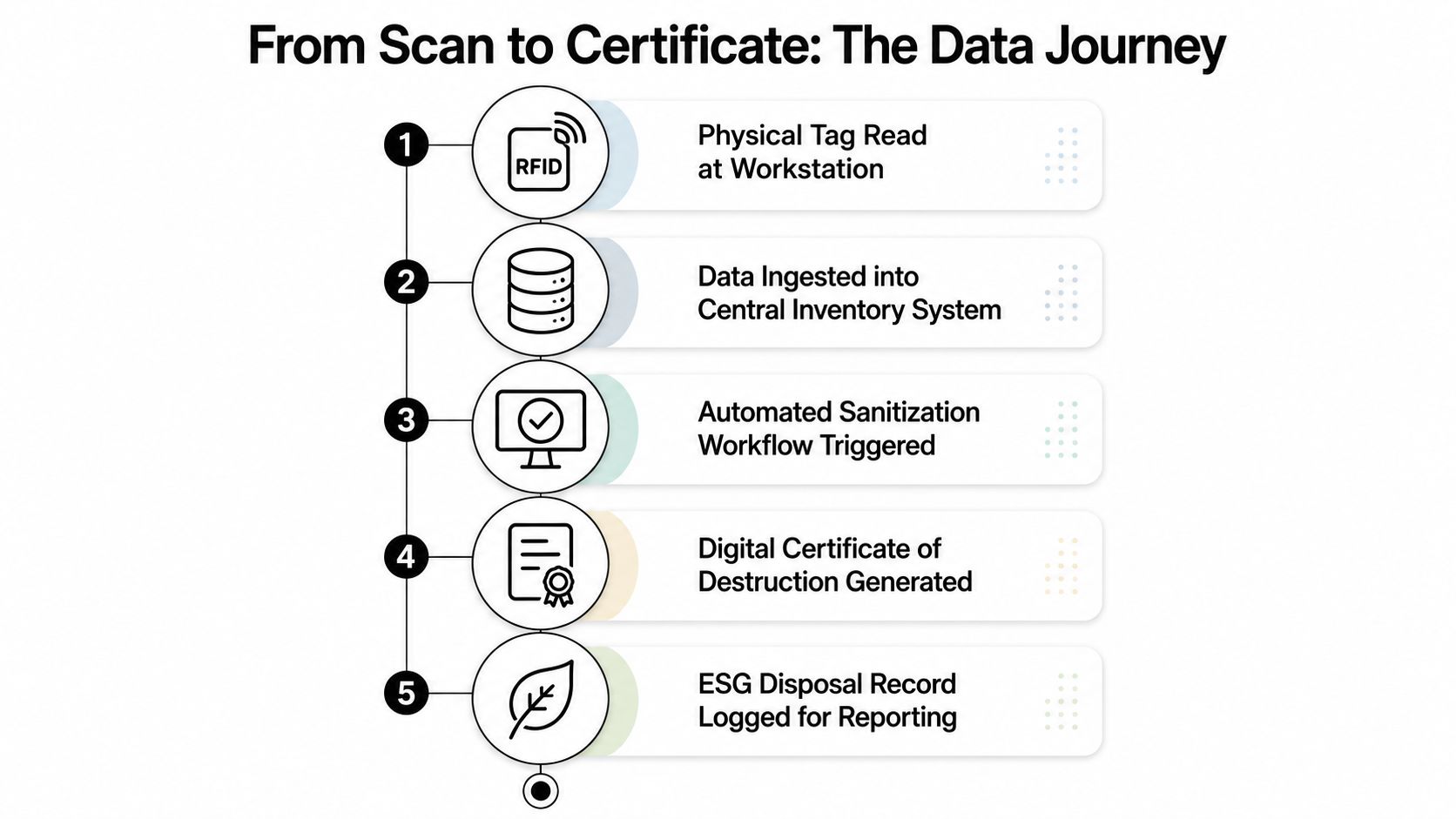
Fourth, evidence becomes a certificate. The certificate of destruction should identify the asset or drive, not merely the shipment. Reworx Recycling provides a certificate of destruction for hard drives as part of the evidence trail organizations may need for internal review and client reporting.
Fifth, disposition closes the record. Reusable equipment can move to resale, refurbishment, or a donation handoff. Non-reusable material moves to electronics recycling or product destruction. The record should preserve the final outcome, recipient or downstream route where applicable, and associated documentation.
The strongest workflow treats every handoff as a data event. A driver scans the load when custody changes. A technician scans the device before processing. A supervisor reviews exceptions before shipment. That sequence exposes the moments where visibility breaks, including unlabeled items, shared pallets, unrecorded vehicle inventory, and certificates detached from serial numbers.
What Real-Time Visibility Is Worth for ITAD and Recycling
A recovered laptop is promised to a community program, but the pallet location is stale and the device cannot be found. At the same time, equipment sits in a cage because its ownership, condition, or data status is unclear. In ITAD, these visibility gaps affect more than throughput. They can increase data-breach risk, regulatory exposure, and lost donation or recovery value.
A 2025 inventory management research study reported stock-out rates falling from 12% to about 7% and overstock rates declining from 18% to 12% after real-time inventory improvements. The reported reductions were roughly 25% and 18% in those problem areas. ITAD teams can apply the pattern by analogy. A stock-out may mean a promised asset is missing, while overstock may mean usable equipment is stranded because its status is unknown.
Better visibility helps staff identify reusable units sooner, avoid duplicate purchases for replacement programs, and keep decommissioning work moving. It also gives security and compliance teams a clearer record of where an asset was held before destruction, reuse, donation, or recycling.
Translate the gain into operational value
Some 2026 market estimates associate real-time inventory tracking with about a 35% improvement in stock accuracy, around a 25% reduction in storage costs, and fulfillment speed improvements of up to 30%. These figures originate from retail and general logistics research, not ITAD-specific studies. Operators should map them to equivalent cost categories in their own operations rather than treat them as promised results.
Those categories include reconciliation hours, cage space occupied by unidentified equipment, delayed pickup-to-certificate work, and recovery value that cannot be billed or donated because records are incomplete.
A mature retail operation often targets at least 98% inventory record accuracy, while average retail accuracy can be closer to 63%, according to the cited research. For an ITAD manager, the comparison frames a control problem. If the business cannot identify what it owns, where it is, or what happened to it, recycling totals, donation claims, recovery forecasts, and security evidence become harder to defend.
The same source estimates that poor inventory management costs businesses globally about USD 1.1 trillion annually, while retailers lose about USD 1.75 trillion each year from stock-outs and overstocks combined. ITAD leaders should not copy those figures into a business case. Measure local equivalents, including replacement purchases, storage labor, unbilled recovery value, delayed facility closures, and preventable investigations.
For transport, Haulier.AI real time tracking shows why movement data matters beyond the warehouse. In an ITAD program, IT asset recovery depends on keeping recoverable equipment visible through final disposition.
KPIs and Dashboard Ideas That Matter
A pallet can be present in the warehouse while its individual records are wrong. That distinction should shape the dashboard. An ITAD operations lead needs one view of where assets are, what risks remain, and which records require action. A sustainability director needs reliable totals for recovery, donation, recycling, and supporting evidence. Together, these views connect physical control with data-security and environmental reporting.
Start by separating location-level accuracy from unit-level accuracy. Location accuracy asks whether the cage, vehicle, quarantine area, and processing zone contain what the system lists. Unit accuracy checks each serial number, asset tag, and disposition status. Review both measures. A correct pallet location does not prove that every laptop inside it has the right identity or destruction status.
Build the daily operating view
A practical dashboard should show:
- Quarantine dwell time: How long drives and devices remain blocked before inspection or sanitization.
- Chain-of-custody completeness: The share of assets with every required handoff recorded.
- Certificate coverage: Whether each asset requiring secure data destruction has a linked certificate.
- Disposition mix: Units donated, reused, recovered for value, recycled, or sent for product destruction.
- Pickup-to-certificate time: The elapsed time between collection and completed evidence.
- Exception queue: Missing labels, duplicate identifiers, failed wipes, manifest variances, and unverified locations.
These measures reveal different control failures. Rising quarantine dwell time can point to a processing bottleneck. Missing certificates create a security-evidence gap. A large exception queue may indicate weak scanning discipline, unclear ownership, or a capture system that does not fit the work.
Operations that combine guided mobile workflows with RFID or vision can reach 98.5% to 99.5% location-level accuracy, according to industry reporting on inventory accuracy. Treat that range as an aspiration, not a promise. A smaller organization may first need consistent scanning, labeling, and handoffs before setting a higher threshold.
| KPI | Target Range | What It Tells You |
|---|---|---|
| Location-level inventory accuracy | 98.5% to 99.5% aspiration | Whether physical zones match system records |
| Unit-level serial accuracy | Set from baseline, then improve | Whether each asset is correctly identified |
| Complete chain of custody | 100% required for controlled assets | Whether every custody transfer is defensible |
| Certificate linked to asset | 100% for sanitized drives | Whether destruction evidence matches the device |
| Quarantine dwell time | Trend downward from baseline | Whether processing bottlenecks are growing |
| Donated versus destroyed units | Track by project and condition | Whether usable value is preserved |
| Pickup to certificate time | Establish a project baseline | Whether clients receive evidence promptly |
Review exceptions daily with the warehouse or ITAD lead. Give the board or sustainability director a monthly view of recovered value, donation outcomes, diversion, unresolved records, and security evidence. Reworx Recycling's impact measurement resources can help organize the environmental and community dimensions of those reports.
A dashboard is only as reliable as its capture process. Skipped scans, reused labels, and convenient status selections can produce precise-looking records while leaving data-bearing devices, regulatory evidence, and donation value unaccounted for.
The Catch, Why Real-Time Does Not Automatically Mean Accurate
Fast data can still be wrong. A system may record a movement in seconds, but if the technician scans the wrong laptop, selects the wrong sanitization status, or leaves an asset untagged, the platform becomes confidently inaccurate.
Industry reporting describes an availability-reality gap in which system inventory doesn't match physical stock. One 2026 industry summary cites average inventory accuracy around 65% and says up to 60% of records may contain errors, while another report says only 26% of retailers update inventory every 30 minutes or less, as detailed in the retail inventory accuracy analysis.
Visibility has an off-site boundary
The blind spot becomes larger when assets leave the facility. Recent reporting says only 6% of organizations report full end-to-end supply chain visibility, and 23% of supply chain leaders say they can't access inventory that physically exists somewhere in their network, according to the supply chain visibility research.
For ITAD, “somewhere in the network” includes a technician's van, a customer site, a consignment location, a quarantine room, or a shipment in transit. An ERP may show an asset as shipped, even though the device remains physically present and still carries data. That gap can cause unnecessary purchases, missed service commitments, hidden shrinkage, and unbilled consumption.
The contrarian point: Workers need sub-second feedback at the point of movement. The ERP doesn't necessarily need to post every accounting update at the same speed if operational capture is reliable.
That distinction keeps implementation practical. Let a handheld or portal capture the event immediately, then allow downstream systems to synchronize according to their own processing needs. The priority is not a permanently refreshing screen. It's a trustworthy record of who moved what, where it went, and what changed.
Controls should include scan validation, restricted status changes, exception review, cycle counts, label checks, and reconciliation between expected and actual loads. Real-time inventory management improves accuracy only when the organization designs the human workflow to support it.
Implementation Roadmap, Pitfalls, and Next Steps
A small or mid-sized business doesn't need to automate every location at once. Start by defining the control problem, then add technology where it removes a known failure.
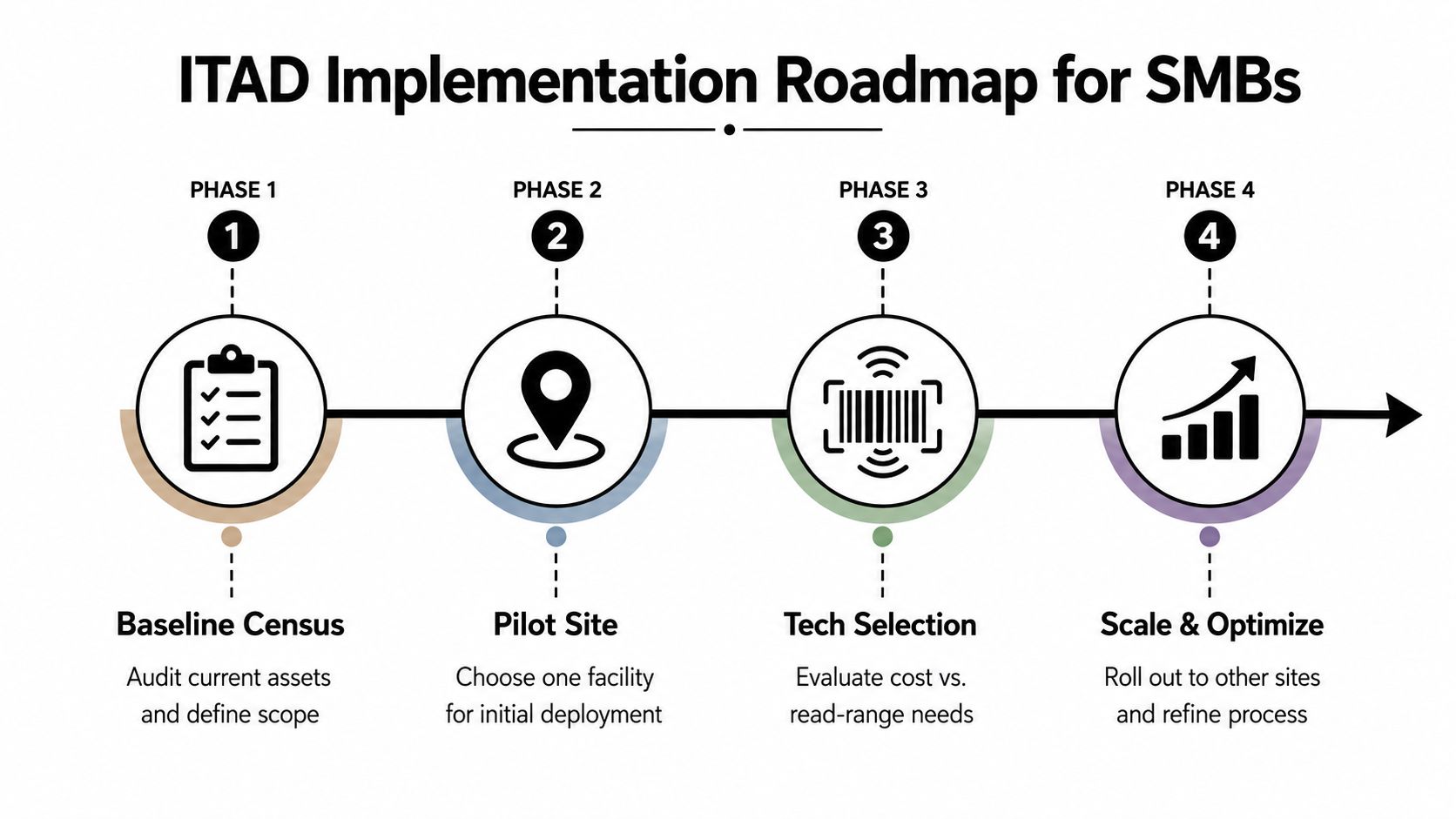
Begin with a measured pilot
Baseline census: Export the current asset list, count physical equipment, identify duplicate or missing identifiers, and document off-site inventory. Include laptops, servers, networking equipment, medical equipment, laboratory equipment, accessories, drives, and items awaiting donation or recycling.
Pilot site: Choose one office, warehouse, or facility with a clear project boundary. A contained office cleanout may suit mobile barcode capture. A high-volume data center decommissioning project may justify RFID at receiving and shipping transitions.
Technology selection: Compare read-range needs, item density, label conditions, portal requirements, operator behavior, and data sensitivity. Use barcodes where a technician handles each unit. Add RFID where bulk movement creates excessive manual work. Add IoT sensors only where location or environmental telemetry solves a specific risk.
System integration: Connect the capture tools to an asset-tracking platform and define the status model. The workflow should support receipt, quarantine, inspection, secure data destruction, certificate generation, donation handoff, product destruction, recycling, and final reporting.
Avoid the failures that undermine the system
Under-tagging creates invisible assets. A missing chain-of-custody event leaves a gap between driver and technician. A certificate disconnected from a serial number proves that destruction occurred somewhere, but not that it applied to the right drive. Ignoring equipment in vans, at customer sites, on consignment, or in transit creates the off-site blind spot that dashboards often hide.
Security and compliance decisions should follow the data, not the convenience of the workflow. Define who can change sanitization status, preserve audit logs, restrict certificate access, and establish escalation rules for failed wipes or unidentified devices. For organizations evaluating electronics recycling partners, the EPA's guidance on sustainable management of electronics provides broader environmental context for responsible end-of-life planning.
A partner can help close the operational loop, but the client still needs clear ownership of asset lists, approvals, data policies, and reporting requirements. Reworx Recycling is one option for organizations combining electronics recycling, secure data destruction, IT equipment disposal, business pickups, equipment decommissioning, and donation-based recycling within a broader social enterprise recycling program.
Set the first pilot around a real upcoming event, such as a laptop refresh, facility cleanout, or server retirement. Establish the baseline, capture every movement, review exceptions daily, and compare the final recovery and evidence record with the original manifest. Reworx Recycling's implementation timelines can help teams organize that work into practical project stages.
Reworx Recycling helps businesses manage electronics recycling, IT asset disposition, secure data destruction, equipment pickups, and technology donations with an emphasis on environmental responsibility and community impact. Visit Reworx Recycling to donate old equipment, schedule a pickup, or discuss a real-time ITAD control layer for your next office cleanout or facility decommissioning project.