Is your IT storage room starting to resemble a museum of outdated laptops, servers, and monitors? That growing collection isn't just occupying valuable real estate—it's a critical business liability waiting for a proactive strategy. A forward-thinking approach to your IT assets moves beyond simple disposal and prioritizes the hierarchy of reuse, repair, and responsible recycling. This isn't just about shrinking your environmental footprint; it's an essential move to fortify data security, meet sustainability goals, and showcase tangible corporate social responsibility.
For businesses across the state, particularly in dynamic hubs driven by technology, finance, and healthcare, managing the lifecycle of IT equipment is a pressing concern. A comprehensive strategy is no longer optional—it's a cornerstone of modern corporate governance.
Why Your Business Needs a Proactive E-Waste Strategy Now
The relentless cycle of corporate technology upgrades is fueling a global e-waste crisis, presenting significant financial, security, and environmental risks for companies of all sizes. That closet packed with old hardware is a strategic challenge that demands a forward-thinking solution, not a problem to be dealt with "later."
Implementing a formal IT Asset Disposition (ITAD) program is no longer a "nice-to-have." It is absolutely essential for regulatory compliance, safeguarding sensitive data, and protecting your brand's reputation. The scale of the global e-waste problem is staggering and growing exponentially.
The world generated a record 62 million tonnes of e-waste in 2022, an 82% increase from 2010. Even more concerning, this mountain of discarded electronics is accumulating five times faster than it can be formally recycled, with a mere 22.3% being properly collected and repurposed. This statistic isn't just an environmental footnote; for corporate leaders, it's a clear business imperative.
The Hidden Costs of Inaction
Delaying a formal e-waste strategy is a high-stakes gamble. Storing obsolete equipment indefinitely creates significant vulnerabilities, including data breaches if a device containing sensitive corporate or client information is lost, stolen, or improperly discarded during an office cleanout.
Furthermore, non-compliance with local, state, and federal disposal regulations can result in substantial fines and legal challenges. The reputational damage from an environmental incident or a data leak can be far more costly and enduring than the investment in a responsible ITAD program.
By failing to plan for end-of-life IT assets, companies inadvertently accept risks related to data security, regulatory compliance, and environmental liability. A proactive strategy transforms this liability into an asset.
A Tale of Two ITAD Strategies
This table contrasts the common, reactive approach to e-waste with a strategic, sustainable path, highlighting the different outcomes for your business.
| Lifecycle Stage | The Typical Reactive Approach | The Strategic Sustainable Path |
|---|---|---|
| Procurement | Buy new with no end-of-life plan. | Purchase with longevity and repairability in mind. |
| Asset Use | Run-to-failure model; minimal maintenance. | Proactive maintenance; extend useful life. |
| Retirement | Store in a closet indefinitely; "we'll deal with it later." | Timely decommissioning; immediate, secure processing. |
| Data Security | Inconsistent data wiping, if any. | Certified, audited data destruction for every device. |
| Disposition | Pay a hauler for pickup, destination unknown. | Partner with a certified recycler for reuse and ethical recycling. |
| Outcome | Data risks, clutter, compliance fines, environmental harm. | Data security, positive brand image, community impact, sustainability goals met. |
The difference is clear. A strategic approach doesn't just manage risk—it creates value.
Turning a Corporate Challenge into a Community Opportunity
This is where your business can truly differentiate itself. By shifting your perspective, you can see outdated technology not as waste, but as a valuable resource. Partnering with a donation-based social enterprise like Reworx Recycling completely redefines your approach to IT equipment disposal.
Instead of defaulting to shredding and raw material recovery, a strategic partnership establishes a clear value hierarchy for your retired assets:
- Secure Data Destruction: The absolute first step is ensuring all sensitive corporate and customer information is professionally and permanently destroyed using certified methods. This protects your business from liability.
- Refurbishment for Reuse: Devices that still have operational life are professionally refurbished. This is the most sustainable option, as it preserves the energy and resources embedded in the original manufacturing process.
- Donation and Community Impact: Refurbished computers and other devices are then donated to schools, nonprofits, and families in underserved communities. Your business directly helps bridge the digital divide and generates tangible social good.
- Responsible Recycling: Only when a device is truly at its end-of-life are its components ethically dismantled. Valuable materials are recovered and returned to the supply chain, supporting a circular economy and keeping hazardous materials out of landfills.
This model enables your business to move beyond basic compliance. It’s an opportunity to achieve your sustainability targets, secure your data, and make a powerful, positive impact on the community—all while efficiently managing your end-of-life technology. To understand the full scope of what's at stake, you can learn more about the environmental impact of electronic waste. This knowledge is key to building a compelling case for a better strategy inside your organization.
Rethink Your IT Procurement From the Start
The most effective way to address electronic waste is to prevent its creation in the first place. This process begins long before your team unboxes a single new device—it starts with a sustainable procurement policy. This is your first and most impactful line of defense.
Shifting your corporate mindset from short-term cost savings to long-term value and sustainability can drastically reduce your future e-waste generation. It means looking beyond the initial purchase price to ask critical questions: How was this device manufactured? How easily can it be repaired or upgraded? What is the vendor's end-of-life plan for this product?
A smart procurement strategy is the bedrock of any successful IT Asset Disposition (ITAD) program. It weaves sustainable decision-making into the fabric of your organization, preventing waste from the outset.
Evaluate Vendors on Sustainability Metrics
When sourcing new equipment, a vendor's commitment to environmental stewardship should carry as much weight as technical specifications. A partner genuinely invested in sustainability will offer transparent, well-defined programs that support the entire product lifecycle.
Before signing a new procurement contract, conduct due diligence. Scrutinize their corporate responsibility reports and ask direct questions about their circular economy initiatives. A vendor solely focused on the initial sale is contributing to the e-waste problem. You need a partner who understands the bigger picture.
Here are a few key indicators of a sustainable supplier:
- Take-Back Programs: Do they provide a straightforward process for returning equipment at its end-of-life? The best programs prioritize refurbishment and reuse over simple recycling.
- Use of Recycled Materials: Inquire about the percentage of post-consumer recycled content in their new products. This demonstrates a commitment to closing the material loop.
- Repairability Scores: Investigate how easily their devices can be repaired. Products with modular, user-replaceable components—like batteries, RAM, and storage—are far more sustainable than sealed units designed for obsolescence.
A proactive procurement policy is the ultimate upstream solution to the e-waste dilemma. By choosing devices built for longevity and repairability, you are designing waste out of your operations from day one.
The Strategic Advantage of Leasing
For certain hardware categories, leasing can be a powerful tool for reducing e-waste. This model shifts the responsibility for end-of-life management from your organization back to the manufacturer or leasing company.
Instead of owning a fleet of devices that will eventually become a disposal burden, you are essentially renting the technology. At the end of the lease term, the equipment is returned. The provider then manages its next phase, whether that involves refurbishment for another client, resale on the secondary market, or responsible recycling.
This approach offers several key business benefits:
- Reduced Disposal Burden: Your team is freed from the complex logistics of managing and disposing of outdated assets.
- Predictable Costs: Leasing transforms a significant capital expenditure into a manageable, fixed operational cost, simplifying budgeting.
- Access to Modern Tech: It ensures your employees are equipped with up-to-date technology without the high cost of frequent purchasing cycles.
Leasing is not a universal solution, and careful review of the terms is essential. Verify the provider's data security protocols for returned devices and confirm they partner with a certified, transparent recycler for final disposition. Building out a comprehensive plan is key, and you can get more ideas by exploring our guide to a green IT strategy, which dives deeper into sustainable IT management.
This calculated approach to technology acquisition delivers the performance your business needs while upholding your commitment to environmental responsibility. It transforms a simple purchase into a strategic decision that benefits both your operational efficiency and the planet. By embedding these principles into your procurement, you position your company as a forward-thinking leader in the fight against e-waste.
Give Your Old Tech a Second Life
Before your business defaults to recycling, consider a more powerful and sustainable strategy: reuse. Extending the operational life of the IT assets you already own is the single most effective way to reduce electronic waste. This often starts with simple adjustments to your internal workflows.
The first step is establishing a clear internal redeployment program. Not every employee requires the latest, most powerful machine. A high-performance laptop from a few years ago, previously used by a software developer, is often more than sufficient for a marketing coordinator or an administrative role for several more years.
This simple process keeps perfectly good equipment in circulation, delaying new purchases and immediately reducing potential waste. It’s a win-win for your budget and the environment, requiring only a modest investment in internal logistics.
Building Your Reuse Playbook
Creating a formal system for redeployment doesn't have to be a monumental task. The primary goal is to track devices as they move between employees, ensuring they are securely wiped and properly configured for their new role.
- Asset Audit: Maintain a running inventory of devices being taken offline. Note their age, key specifications (RAM, CPU, storage), and overall condition.
- User Needs Assessment: Identify employees or departments with less intensive computing needs. These are prime candidates for redeployed equipment.
- Secure Transition: This is non-negotiable. Your IT team must perform a secure data wipe on every device before it is assigned to a new user, following a strict data sanitization protocol.
- Upgrade Potential: For devices that are slightly underperforming, consider minor upgrades.
Sometimes, a small enhancement can make a significant difference. Swapping an old mechanical hard drive for a solid-state drive (SSD) or adding more RAM can make a five-year-old machine feel surprisingly responsive at a fraction of the cost of a new one. When your tech encounters issues, exploring professional computer repair services can further extend its life and keep it out of the recycling stream.
The most sustainable device is the one you already own. By prioritizing repair, upgrades, and internal redeployment, a business can drastically reduce its e-waste footprint and maximize the return on every technology investment.
Harvesting Parts for In-House Repairs
What about devices that are genuinely broken? Even then, they hold potential value. Establishing a parts-harvesting system can be a game-changer for your IT support team. A laptop with a failed motherboard may still have a perfectly good screen, keyboard, RAM, and SSD.
These components can be cataloged and stored for in-house repairs on other machines of the same model. This practice saves time and money on sourcing spare parts. It transforms what would have been e-waste into a valuable inventory, reducing the need to purchase new components or entire devices.
Partnering for Community Impact
What should you do with equipment that no longer meets any internal needs but is still perfectly functional? This is where your e-waste strategy can evolve from a logistical task into a source of profound community impact. This issue is larger than many realize; the UK, for instance, generates about 23.9 kilograms of e-waste per person annually, with millions of usable devices being discarded.
Instead of sending these assets to a standard recycler, partnering with a social enterprise like Reworx Recycling ensures they get a meaningful second chance. We specialize in professionally refurbishing business-grade equipment—laptops, desktops, and monitors—and distributing them to schools, nonprofits, and community centers that desperately need them.
This donation-based recycling model transforms your surplus tech from a disposal problem into a community solution. It directly supports digital inclusion and provides essential tools to organizations doing vital work. We manage the entire process for you, from secure data destruction to refurbishment and delivery, giving your business a powerful CSR story backed by real, measurable results. Thinking about the recycling of surplus tech for businesses can show you just how beneficial it is to turn old assets into community assets.
Master Secure Decommissioning and Data Destruction
For many organizations, the primary barrier to responsible electronics disposal isn't logistics—it's the fear of a data breach. A single improperly wiped hard drive can become a massive liability. However, this concern shouldn't paralyze your e-waste strategy. The solution is to address it head-on with a transparent, secure, and certified process for decommissioning your IT assets.
First, let's clarify the terminology. In IT disposal, data destruction is primarily achieved through two methods: software wiping and physical shredding. Each plays a distinct role in a comprehensive data security plan.
This decision tree provides a clear starting point for processing your retired technology.
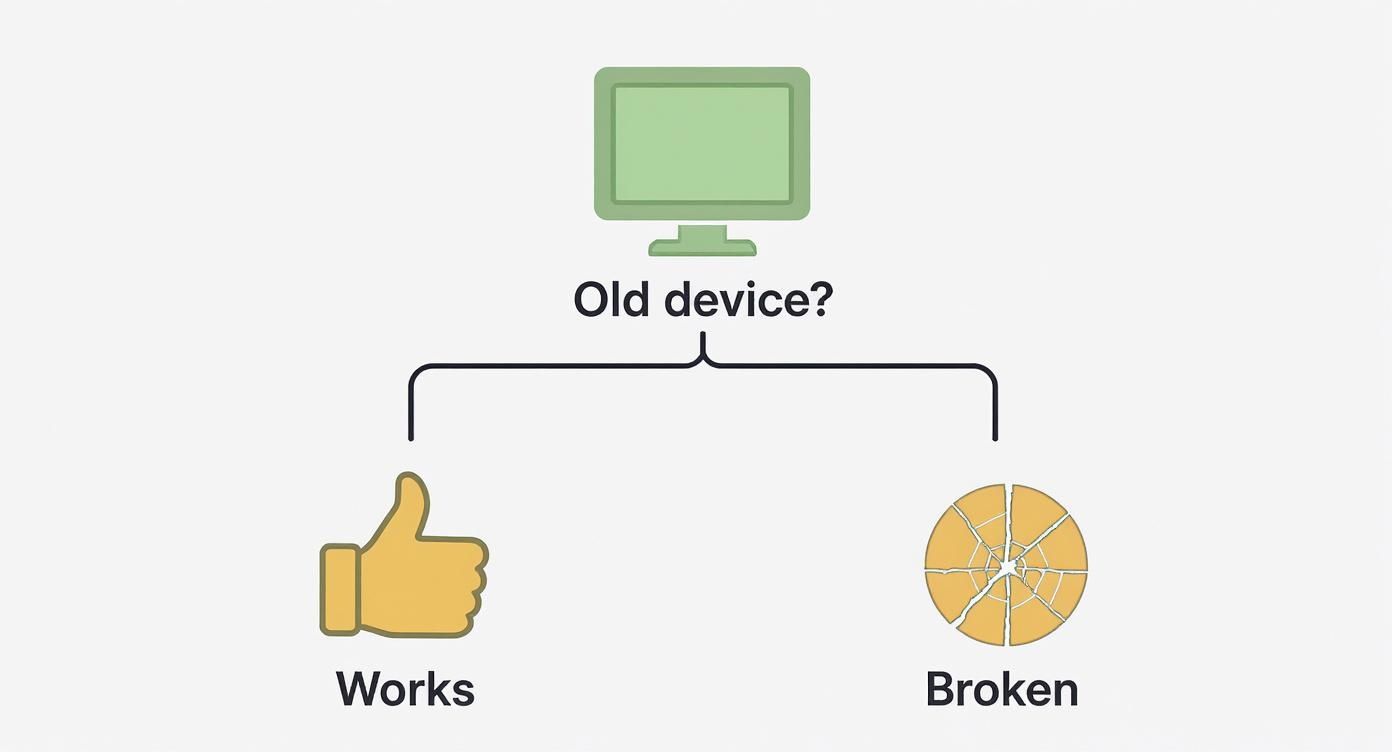
As illustrated, the initial assessment of a device's functionality is crucial. This simple check determines whether an asset can be given a second life through reuse or must be sent directly for secure recycling.
Choosing the Right Data Destruction Method
Software-based wiping utilizes specialized programs to overwrite every sector of a hard drive with random data, rendering the original information completely unrecoverable. This process often adheres to rigorous standards like DoD 5220.22-M, which involves multiple overwriting passes. This is the ideal method for devices intended for refurbishment and donation, as it leaves the drive intact and ready for a new user.
Physical shredding is precisely as it sounds. The hard drive is fed into an industrial shredder that mechanically grinds it into small metal fragments. This is the required method for drives that are non-functional, obsolete, or contained highly sensitive data where zero risk is acceptable. The process renders the drive and its data permanently destroyed.
A certified partner like Reworx Recycling strategically employs both methods. We use certified software to sanitize all viable devices destined for our community donation programs and utilize our industrial shredders for all other media. This dual approach is how we guarantee 100% data security.
The real goal of secure decommissioning isn’t just to erase data. It’s to create a clear, auditable trail that proves you’ve done your due diligence. That paperwork is your best defense against compliance fines and data breach headaches.
A Checklist for Your Next Office Cleanout
A successful decommissioning project, whether for a small office cleanout or a full data center decommissioning, hinges on a clear, documented process. Maintaining control over every asset from start to finish is paramount.
- Inventory and Tag Every Asset: Before any equipment is moved, create a detailed inventory of every device designated for disposal. Record serial numbers, asset tags, and device types. This establishes the first link in your chain of custody.
- Segregate and Secure Assets: Relocate all tagged equipment to a secure, locked area. This prevents devices from being accidentally put back into service before data has been sanitized.
- Verify Data Sanitization On-Site or Off-Site: Decide whether you require data to be destroyed at your facility or at your vendor's secure location. For maximum peace of mind, many companies opt for on-site shredding to witness the destruction firsthand. A certified partner should offer both options.
- Maintain a Clear Chain of Custody: Ensure a documented paper trail tracks who handled your assets and when. This log should follow the equipment from your facility all the way to final disposition.
- Receive Your Certificate of Data Destruction: This is your most critical compliance document. A certified ITAD partner like Reworx Recycling will provide a formal Certificate of Data Destruction that lists every serialized asset that was sanitized or destroyed.
This certificate is your official proof of compliance, verifying that you have met legal and industry data protection standards like HIPAA, FACTA, and GDPR.
For a deeper dive into the specifics, check out our comprehensive guide to secure data destruction. Working with a certified vendor isn't just a good idea—it's the only way to guarantee compliance and fully shield your business from the fallout of a data breach.
Find the Right E-Waste Recycling Partner
Once you have maximized the value of your IT assets through redeployment and repair, the final step is managing the equipment that has truly reached its end-of-life. This stage may seem straightforward, but it's where many businesses make critical errors.
Choosing an e-waste partner is not like selecting a standard vendor. Not all recyclers operate with the same standards, and opting for the cheapest provider can lead to disastrous consequences. This decision is about finding a partner that reflects your company’s commitment to security, compliance, and corporate social responsibility.
The wrong choice could expose your business to significant risks. An uncertified vendor might mishandle your data, illegally dump toxic materials in a landfill, or export your old equipment to developing countries—creating environmental and legal liabilities that can damage your brand. The right partnership, conversely, protects your organization and transforms a disposal task into a strategic advantage.
Look Beyond the Price Tag
The first and most important criterion is certification. This is non-negotiable. Industry certifications are not just logos for a website; they are hard-earned credentials proving that a recycler has passed rigorous, third-party audits covering data security, environmental standards, and worker safety.
Two of the most respected certifications in the industry are:
- R2 (Responsible Recycling): This standard ensures environmental protection, worker health and safety, and robust data security throughout the entire recycling process, from collection to final disposition.
- e-Stewards: Another globally recognized standard, e-Stewards places a strong emphasis on preventing the illegal export of hazardous e-waste and upholding the highest possible data security protocols.
Partnering with a certified recycler provides a transparent, auditable trail for your assets. You gain full visibility into the disposition process and can be confident that your equipment is being handled ethically. It’s about protecting the planet and, crucially, protecting your corporate reputation.
Choosing a certified partner like Reworx Recycling isn’t just about checking a compliance box; it's about mitigating risk. It gives you documented proof that you’ve handed your assets to a vendor who lives and breathes the industry’s highest standards for data security and environmental stewardship.
The Social Enterprise Advantage
While certification provides a baseline for responsible recycling, you can elevate your impact by partnering with a donation-based social enterprise. Choosing a partner like Reworx Recycling transforms your IT Asset Disposition (ITAD) process from a cost center into a powerful Corporate Social Responsibility (CSR) initiative.
Instead of immediately shredding functional equipment, we prioritize refurbishment and reuse. This model delivers unique benefits that traditional recyclers cannot offer:
- Measurable Community Impact: Your working laptops, desktops, and monitors are professionally refurbished and given a second life at local schools, nonprofits, and in underserved communities, helping to close the digital divide right in your own backyard.
- A Better Brand Story: We provide detailed impact reports that you can plug directly into your ESG reporting and marketing materials, showing the world your tangible commitment to social good.
- Support for a Circular Economy: By keeping good equipment in use longer, you help keep valuable resources in circulation and contribute to a much more sustainable system.
This approach is about more than just solving your e-waste problem—it’s about creating a positive ripple effect. The value locked in discarded electronics is immense. In 2022 alone, global e-waste contained recoverable resources worth over $62 billion, yet the vast majority was not recovered. A reuse-first model helps reclaim that value for the community.
Key Questions to Ask Any Potential Vendor
To ensure you are making a prudent choice, you must ask the right questions. Any transparent, reputable partner will provide clear and confident answers. Our complete guide on selecting a reliable e-waste recycling partner includes a full checklist, but here are the critical questions to start with:
- Are you R2 or e-Stewards certified? (And can you provide documentation?)
- Can you provide a Certificate of Data Destruction for every single serialized asset?
- What is your process for determining if an asset can be refurbished and donated?
- Can you provide reporting that quantifies our environmental and social impact?
- Do you maintain a zero-landfill policy for all processed electronics?
Asking these questions allows you to quickly vet potential partners and ensures you find one who not only manages the logistics but also strengthens your company’s commitment to building a more sustainable and equitable community.
Answering Your Top E-Waste Questions
As you delve into IT asset disposition, many questions naturally arise. This is understandable—getting the details right is crucial as you formulate a strategy for your organization's electronic waste. Let's provide clear answers to the most common questions we hear from businesses like yours.
This is about more than just compliance; it's about understanding the strategic value of a secure, sustainable, and socially conscious plan for your retired technology.
What's the Real Difference Between ITAD and Basic Recycling?
Think of basic electronics recycling as just one component of a much larger strategy. Its primary function is to break down end-of-life devices to recover raw materials like metals and plastics. It is the final step for equipment that can no longer be used.
IT Asset Disposition (ITAD), in contrast, is the comprehensive, strategic process that governs the entire lifecycle of a retired asset. This includes secure data destruction, a detailed audit of every device, professional refurbishment for reuse, and, lastly, responsible recycling.
A strategic ITAD partner like Reworx Recycling will always look for ways to reuse equipment first. The goal is to get the most social and functional value out of an asset before breaking it down for materials. It’s a far more secure, sustainable, and impactful way to handle things.
How Can We Be Sure Our Sensitive Data Was Actually Destroyed?
Proof is paramount. When it comes to data security and regulatory compliance, a verbal promise that your data has been wiped is insufficient and will not protect you from liability.
Any reputable partner must provide certified data destruction services that meet or exceed government and industry standards, such as those from the National Institute of Standards and Technology (NIST).
Upon completion, they must issue a formal Certificate of Data Destruction for every device they process. This document is your auditable proof, listing each asset by serial number and demonstrating that you have fulfilled your legal and ethical obligations to protect company and customer data. Always insist on this certificate from any partner you consider.
We Have a Mix of Office, Lab, and Medical Equipment. Can One Vendor Handle It All?
This is an excellent question to ask upfront. Many standard e-waste recyclers are only equipped to handle common office technology like laptops, monitors, and printers. Juggling multiple vendors for different types of equipment can quickly become a logistical nightmare.
A full-service ITAD partner and social enterprise like Reworx Recycling is equipped to manage diverse and specialized equipment streams. This includes:
- Standard office IT gear (desktops, monitors, phones)
- Specialized lab and scientific instruments
- Medical devices and healthcare technology
- Data center hardware (servers, networking racks)
Working with a single, qualified partner simplifies the entire process. You have one point of contact for a complete office cleanout or a facility decommissioning, ensuring every piece of equipment is handled securely and responsibly under a unified, streamlined process.
What Are the Actual, Tangible Benefits of a Donation-Based Model?
A donation-focused recycling model transforms a necessary operational expense into a measurable victory for your Corporate Social Responsibility (CSR) goals. Instead of your functional equipment being immediately scrapped for parts, it is professionally refurbished and given a second life at schools, nonprofits, or community organizations that desperately need it.
This approach directly helps bridge the digital divide in your local community by placing essential technology into the hands of those who would otherwise go without. For your business, this creates an authentic, positive story that can be shared in your Environmental, Social, and Governance (ESG) reports, marketing materials, and internal communications.
Partners like Reworx Recycling even provide detailed impact reports showing the exact community benefits your donation created. It’s a powerful way to demonstrate a genuine commitment to social good while sustainably managing your e-waste—a mission your employees, customers, and stakeholders can be proud of.
Ready to transform your company's electronic waste from a liability into a community asset? Reworx Recycling provides secure, certified ITAD services with a focus on donation-based recycling and reuse. Partner with us to handle your computer recycling, office cleanout, or data center decommissioning with a social enterprise that prioritizes environmental responsibility and community impact. Schedule a pickup today and discover how simple it is to make a meaningful difference. Learn more at https://www.reworxrecycling.org/category/recycling-blog.