Atlanta hotels, restaurants, and event venues are making technology decisions under pressure right now. A front desk that used to handle a steady business mix now has to absorb sudden arrival waves, mobile-first guest expectations, and tighter labor coverage without letting service quality slip. In practice, that means IT is no longer sitting in the background. It's shaping check-in flow, room readiness, staffing response, pricing discipline, and how quickly a property recovers when something breaks.
That's why Atlanta hospitality industry IT trends matter beyond software fashion. The primary question isn't which tool sounds modern. It's which systems help operators handle demand swings, reduce friction for guests, protect sensitive data, and avoid creating a bigger mess when older hardware gets pushed aside. The strongest hospitality teams in Atlanta are treating technology as a full lifecycle issue, from selection and rollout through retirement, secure data destruction, and electronics recycling.
Setting the Scene for Atlanta's Hospitality Tech Boom
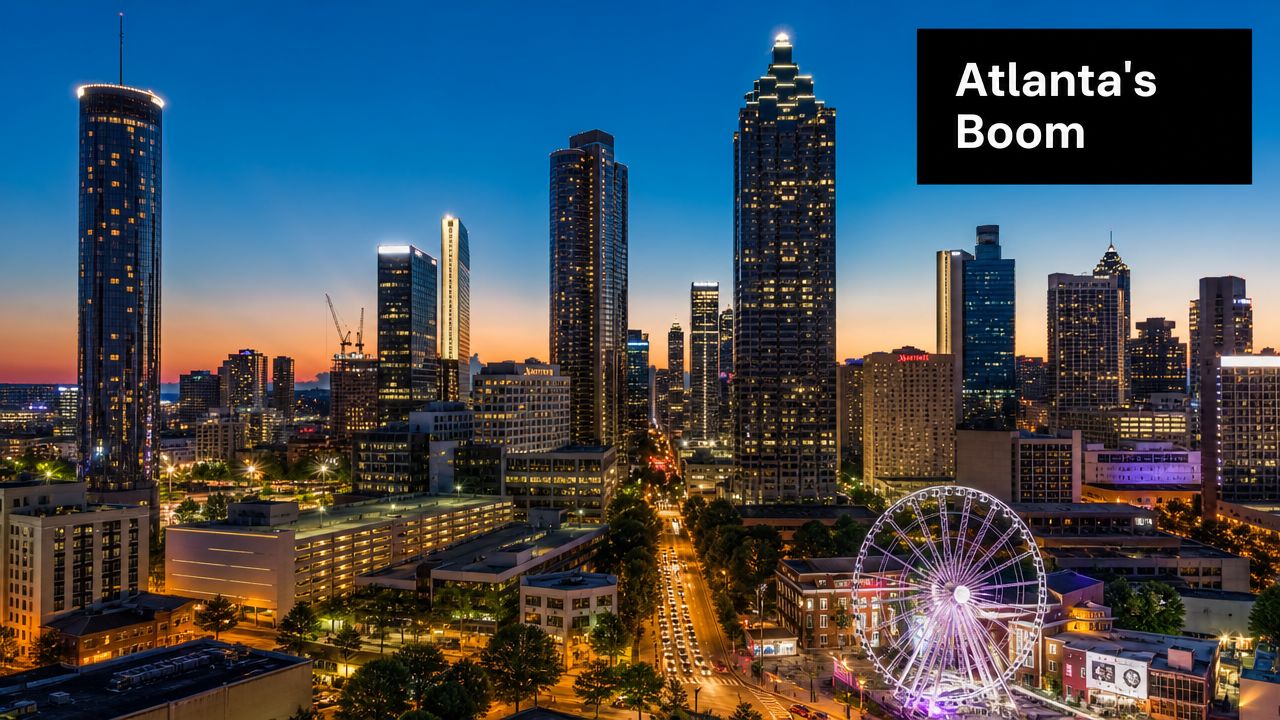
A summer arrival rush in Atlanta doesn't just test front desk staff. It tests property management systems, guest messaging workflows, network capacity, payment systems, housekeeping coordination, and every device behind them. That pressure will be sharper as projected event demand builds. Marcus & Millichap notes that Atlanta hospitality planning for 2026 is being shaped by event-driven spikes, with summer visitation expected to increase as the FIFA World Cup draws visitors, and more than 500 million tickets were requested across the 16 host cities, while corporate travel in hubs such as Alpharetta is also expected to support demand growth according to the Atlanta 2026 hospitality market report.
Where the strain actually shows up
When occupancy patterns turn volatile, weak infrastructure gets exposed fast. Legacy on-prem servers slow down. Old Wi-Fi gear creates support tickets. Standalone systems force staff to re-enter information across front desk, housekeeping, food service, and finance. None of that is visible in the booking funnel, but guests feel it at check-in and during service recovery.
A lot of operators are also discovering that their modernization plans collide with an older problem. The new tablet, kiosk, phone system, access controller, switch, workstation, or back-office server usually replaces something. That outgoing equipment still contains credentials, payment workflows, or guest-related data traces. If there's no retirement plan, the upgrade isn't finished.
Atlanta hospitality leaders need technology that scales up cleanly during peak demand and scales down without leaving security and disposal gaps behind.
Atlanta's hospitality market has enough volume and complexity that this issue now looks more like enterprise IT than simple property support. Convention hotels, restaurant groups, mixed-use venues, and multi-property operators need flexible systems at the edge. For teams thinking through local infrastructure capacity, this broader look at edge computing trends in Atlanta businesses is useful because it highlights the same pattern hospitality teams face: more local devices, more connected systems, and more hardware turnover.
The Core IT Trends Shaping Guest Experiences
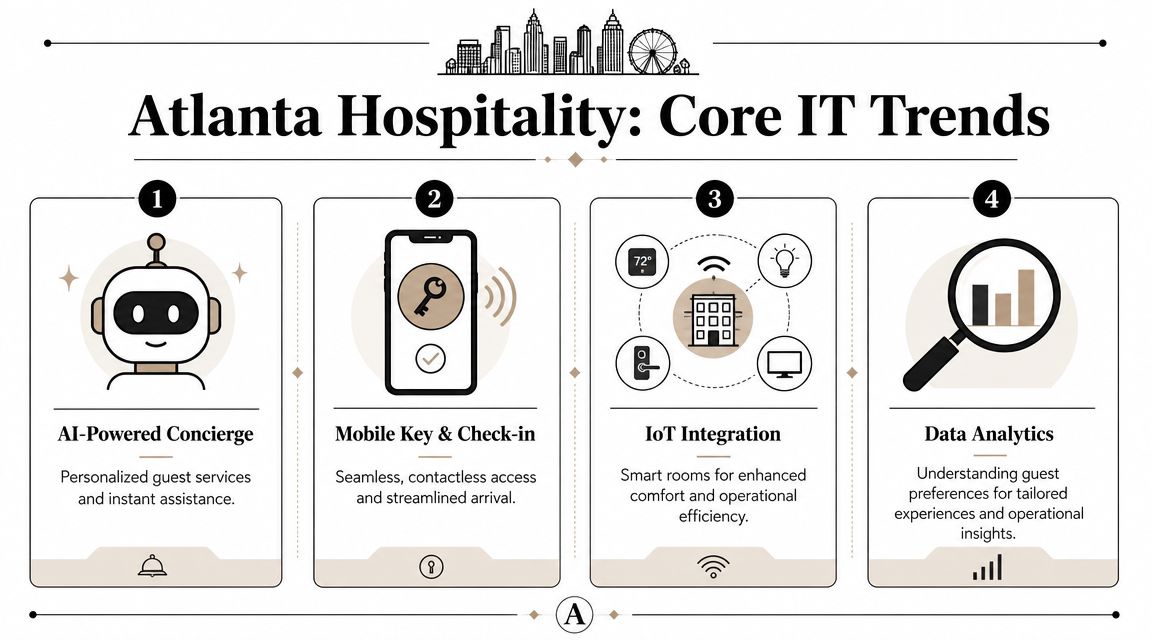
A guest lands at Hartsfield-Jackson after a delayed flight, skips the front desk line, opens a room with a phone, orders a late meal from the room, and messages the property for an extra checkout hour. That entire experience depends on connected systems working together in real time. In Atlanta hospitality, guest-facing tech now sits at the center of service delivery, not at the edge of it.
Contactless tools have become standard guest expectations
A 2025 hospitality trends summary reports strong industry investment in contactless tools, broad guest preference for automated messaging, and continued movement toward more fully contactless hotel stays. For Atlanta operators, that shows up in very practical ways: late arrivals expect mobile check-in to work, group guests want to avoid front desk backups, and restaurant or venue customers expect fast digital confirmations and payment options.
The trade-off is straightforward. Contactless service reduces friction only when the workflow behind it is clean.
What usually works well:
- Mobile check-in with a staffed backup path for ID exceptions, billing issues, and app failures
- Digital keys connected to reliable lock hardware and a tested PMS or access-control integration
- Pre-arrival messaging that handles routine tasks before the guest reaches the property
What usually creates more work:
- Kiosks dropped into old workflows without changing staffing, escalation rules, or back-office steps
- Contactless add-ons that do not sync cleanly with the PMS, POS, or housekeeping system
- App-dependent service models in buildings with weak cellular coverage or inconsistent Wi-Fi
AI helps most in repeatable service tasks
AI is getting attention for a reason, but hospitality teams get the best results when they use it in narrow, controlled cases. Guest message triage, common FAQ handling, housekeeping dispatch, and timed upsell prompts are all reasonable fits. These are high-volume tasks with clear decision paths.
AI is less dependable during service recovery, billing disputes, accessibility requests, or any interaction where tone and judgment matter. Keep a person in the loop for those cases.
A good rule is simple. If staff members answer the same question dozens of times each day with only minor variation, automation can save time. If the answer depends on context, guest history, or discretion, route it to a trained employee. For teams reviewing guest communication tools, Nimbio's Guestview platform is one example of how messaging, feedback collection, and digital guest interaction can be consolidated instead of split across separate products.
Connected devices only improve the stay if the network can carry them
Smart thermostats, mobile keys, IPTV, VoIP phones, occupancy sensors, kitchen display systems, staff tablets, and guest Wi-Fi all compete for the same underlying network capacity. Hotels often approve the software purchase first and address switching, cabling, coverage, or VLAN design later. That order creates avoidable outages.
Older Atlanta properties feel this first. Thick walls, patched-over renovations, and mixed vendor environments can turn a simple rollout into a long support problem. Before adding more endpoints, properties should review network readiness, voice requirements, and carrier dependencies. Teams planning upgrades should also assess local options for telecom services in Atlanta if dead zones, aging cabling, or fragmented support are already affecting operations.
The guest experience trend that gets missed most often
Every new tablet, lock controller, handset, access point, kiosk, or back-office device usually replaces something older. That matters because retired hospitality hardware can still hold credentials, network settings, user accounts, and traces of payment or guest data. A better guest experience at the front end can create a security and disposal problem at the back end if the replacement plan stops at installation.
The stronger approach is full-lifecycle planning. Choose guest technology that fits the property, confirm the infrastructure can support it, and build retirement steps for the outgoing equipment before the rollout starts. That is how operators improve service without creating hidden risk.
How New Tech Impacts Operations and Revenue
The business case for hospitality IT is stronger when margins are tight. PwC/STR data cited in 2025 show year-to-date RevPAR growth of just 0.2%, driven by a 1.0% rise in ADR and offset by a 0.8% occupancy decline, which is why operators are leaning on analytics and revenue-management software to protect margins, as described in PwC's hospitality property outlook.
Why flat growth changes the IT conversation
In a stronger growth environment, operators can sometimes absorb inefficiency. In a slower one, they can't. If rate growth is harder to push and occupancy is under pressure, a property needs better forecasting, better labor alignment, cleaner rate execution, and fewer operational misses.
That's why modern systems are getting funded from multiple angles:
- Revenue teams want more accurate pricing and channel control.
- Operations teams want fewer manual handoffs.
- Ownership groups want visibility across properties.
- Finance teams want fewer leaks in labor and service recovery costs.
A smart revenue-management tool helps when a hotel needs to react to demand changes by segment, date, and booking window. A better housekeeping workflow matters when arrivals cluster. A cloud POS or integrated PMS stack matters when restaurant, room, and event spend need to be visible in one operating picture.
What usually delivers real value
Not every upgrade earns its keep. In my experience, the most useful projects are the ones that remove repeat manual work or reduce decision lag.
| Area | Strong use case | Weak use case |
|---|---|---|
| Pricing | Revenue management tied to real occupancy patterns | Static rules that no one updates |
| Labor | Automated scheduling with manager review | Full automation with no property oversight |
| Guest service | Messaging for routine requests | Bots handling escalations poorly |
| Reporting | Shared dashboards across departments | Separate spreadsheets by team |
A hotel doesn't need more dashboards. It needs fewer blind spots between reservations, front desk, housekeeping, food service, and finance.
The operators getting the most from Atlanta hospitality industry IT trends are using technology to tighten execution, not just to appear modern.
Navigating Cybersecurity and Data Privacy Risks
Hospitality teams often talk about convenience as if it's automatically good. It isn't. Every mobile key rollout, self-service payment process, guest messaging system, connected room device, and cloud integration expands the number of places a failure can happen.
A key question for Atlanta operators is how to justify IT upgrades that reduce labor pressure without increasing cyber risk. The market's dependence on corporate travel and large events makes automation more valuable, but it also expands the attack surface for identity, payment, and guest-data systems, as noted in this hospitality technology trends analysis.
The hidden risk in fast rollouts
The common mistake is approving a guest-facing tool based on speed and ease of deployment while treating security review as a later step. In hospitality, that “later” can become a production environment full of shared credentials, unmanaged tablets, exposed admin consoles, and forgotten integrations.
High-risk areas usually include:
- Digital access systems because they touch identity and physical security.
- Payment workflows because they cross multiple vendors and devices.
- Guest messaging platforms because they often pull in personal data and booking information.
- Back-office endpoints because old admin machines often remain in service long after the software around them has changed.
Better automation means better boundaries
The answer isn't to reject automation. It's to classify use cases by risk and govern them differently.
Low-friction, lower-risk projects often include routine chatbot triage, internal scheduling assistance, and non-sensitive workflow automation. Higher-risk projects include anything tied to payments, door access, identity verification, loyalty records, or broad integrations across multiple systems.
A practical review should ask:
- What data does this tool store or touch?
- Who administers it at the property level?
- Can access be limited by role?
- What happens when the device or platform is retired?
Security failures often start with old hardware that stayed in service too long, then continue when that hardware leaves service without proper controls.
For teams managing compliance exposure across states, this guide to state data breach laws is a helpful reminder that disposal and documentation matter just as much as prevention. A retired front desk PC, kiosk drive, or access-control server can become a breach problem if nobody owns the final step.
A Rollout Checklist for Technology Modernization
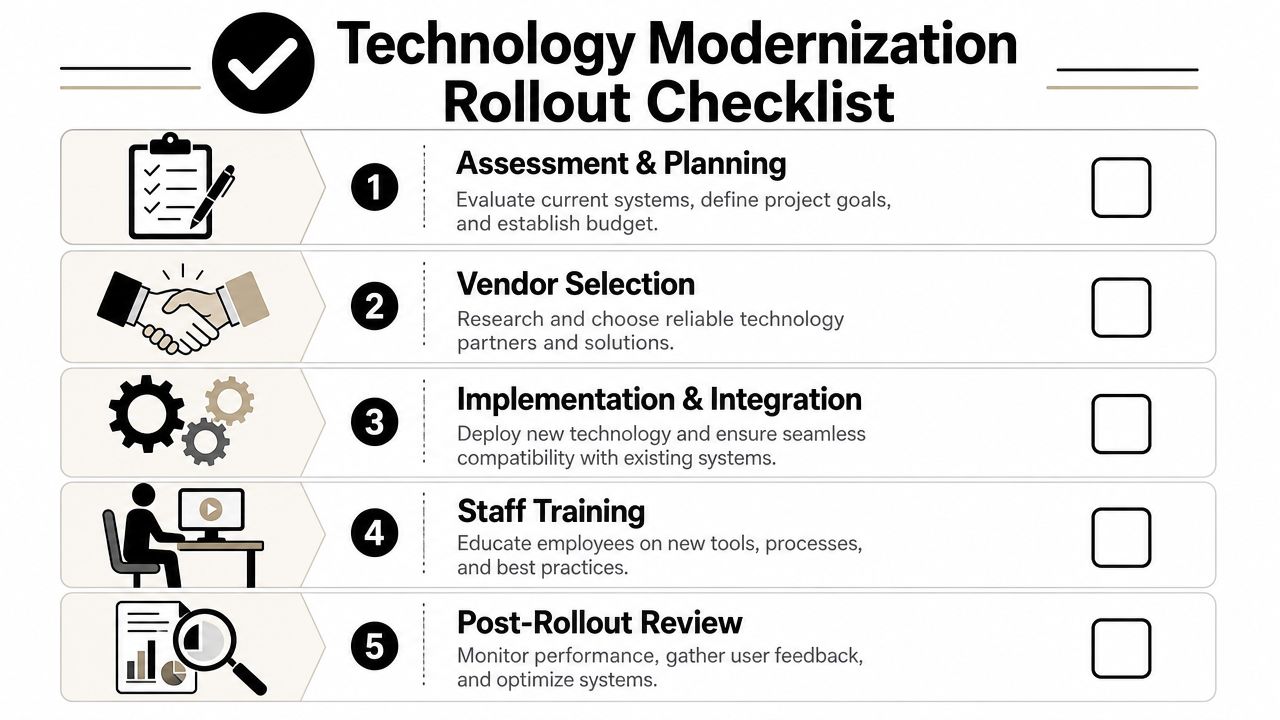
A successful rollout starts before vendor demos. Most hospitality technology problems aren't caused by bad software alone. They come from unclear goals, weak integration planning, rushed training, and no retirement plan for replaced equipment.
Start with the operational bottleneck
Don't buy a platform because competitors mention it. Buy it because a specific problem is costing time, service quality, or control.
A practical sequence looks like this:
Define the use case clearly
“We need to reduce front desk queue pressure during peak arrival windows” is concrete. “We want a better digital experience” is too vague.Map current dependencies
List every system the new tool must connect to. PMS, POS, locks, payment devices, Wi-Fi, CRM, accounting, and housekeeping platforms all affect rollout risk.Vet the vendor beyond the demo
Ask who handles support after hours, what hardware is required on-site, how updates are managed, and how data is removed at contract end.
Build the project around people
Training usually gets treated as a short handoff. In hotels and restaurants, that's not enough. Shift-based work, seasonal staffing, and mixed technical comfort levels mean the property needs role-specific training and quick-reference playbooks.
Use this simple review structure:
Front desk readiness
Can staff override, recover, or escalate when a mobile process fails?Housekeeping and operations fit
Does the workflow save steps for the people using it?Manager controls
Can supervisors audit activity, correct errors, and control access without calling support every time?Guest fallback path
If the tool goes down, is there a manual service method that staff can execute calmly?
Buy fewer tools. Integrate them better. Train the team harder.
Don't ignore the hardware coming out
Every modernization project should include an exit path for old endpoints, network gear, kiosks, storage devices, and back-office servers. If that part is missing, the project is incomplete. A practical server decommissioning checklist helps by forcing teams to document shutdown, data handling, chain of custody, and final disposition before equipment starts piling up in closets or storage rooms.
Sustainable Disposal for End-of-Life IT Equipment
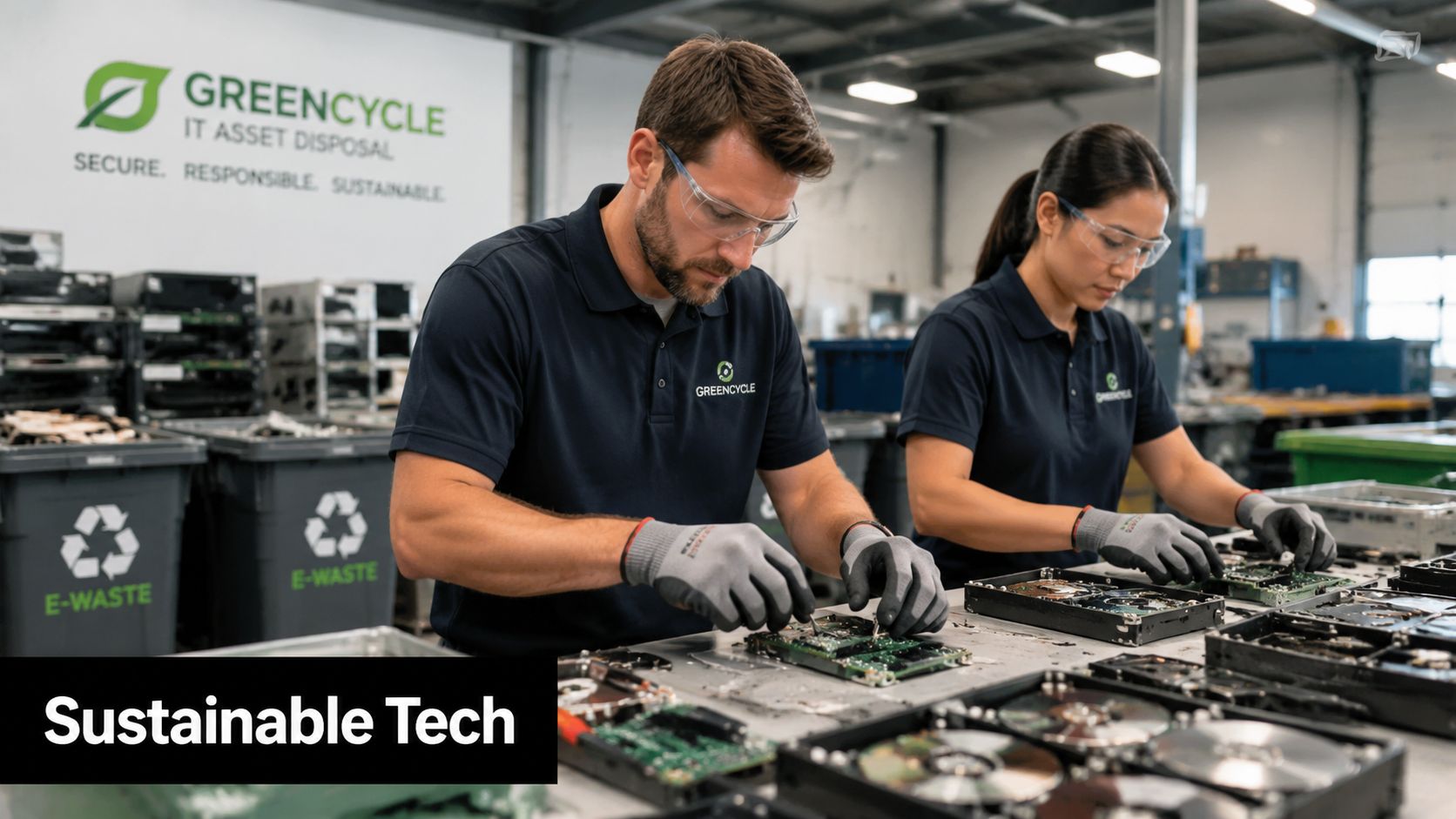
Most hospitality modernization plans are too focused on procurement and not focused enough on retirement. The result is familiar. Old POS terminals sit in a back office. Decommissioned access-control gear gets stacked in maintenance space. Front desk workstations and kitchen printers move from active use to “temporary storage,” where they stay indefinitely.
Why disposal belongs inside the IT strategy
That equipment isn't harmless just because it's unplugged. Hospitality devices often contain guest records, staff information, saved credentials, transaction histories, configuration files, and network details. If a drive, terminal, or server leaves control without secure data destruction, the business keeps the risk even after the upgrade is finished.
There's also the environmental side. Hotels, restaurants, and event venues cycle through a lot of electronics: laptops, tablets, telecom equipment, displays, office PCs, handheld devices, printers, networking hardware, and storage systems. Sending that material into irregular disposal channels creates governance problems for IT, facilities, finance, and sustainability teams at the same time.
What a mature end-of-life program includes
A responsible program should cover more than pickup. It should include:
- Asset collection and tracking so properties know what was removed and from where.
- Secure data destruction for drives and data-bearing devices.
- Reuse decisions when equipment still has practical life.
- Electronics recycling for material that can't be redeployed.
- Disposition records that support internal controls and sustainability reporting.
This is also where donation-based recycling can make sense. Some retired business equipment still has value for reuse after proper evaluation and data handling. In that model, IT asset disposition supports both risk reduction and community benefit instead of ending with landfill exposure or informal disposal.
For Atlanta operators that want a local option, Reworx Recycling provides electronics recycling, secure data destruction, IT equipment disposal, and IT asset disposition support for organizations retiring business hardware. That matters for hospitality groups doing office cleanouts, back-office refreshes, laptop disposal, network equipment replacement, or larger decommissioning work tied to renovations and system changes.
Old tech shouldn't become shadow inventory
The biggest disposal mistake isn't dramatic. It's passive. Teams leave old equipment in drawers, closets, storage cages, and former IT rooms because nobody owns the process. Once that happens, chain of custody weakens, records disappear, and the hardware often gets harder to identify, wipe, reuse, donate, or recycle properly.
A modern hospitality tech strategy needs a clear end date for old equipment, not just a go-live date for new equipment.
Build a Responsible Tech Strategy with Reworx Recycling
Atlanta hospitality industry IT trends are pushing operators toward faster, more connected, and more automated environments. That's the right direction when the systems are chosen well. Mobile access can reduce friction. Better scheduling can reduce operational drag. Smarter forecasting can protect margins when growth is hard to find.
But good strategy doesn't stop at rollout. It includes security review, fallback planning, staff adoption, hardware retirement, and sustainable disposal. The properties that manage all of those pieces together usually avoid the most expensive mistakes. They don't just modernize the guest journey. They control the full technology lifecycle.
What responsible leadership looks like now
A practical leadership approach for Atlanta hotels, venues, and restaurant groups usually comes down to three habits:
- Prioritize systems that solve a defined operational problem instead of chasing broad digital transformation language.
- Separate low-risk automation from high-risk automation so convenience doesn't inadvertently increase exposure.
- Retire replaced equipment with the same discipline used to buy and deploy it so old hardware doesn't become a data, compliance, or sustainability liability.
For corporate IT teams, facilities managers, and sustainability leaders, that last point often gets missed until a renovation, audit, relocation, or office cleanout forces action. A structured partner can help manage pickup, secure data destruction, equipment tracking, and final disposition across multiple sites. Atlanta organizations looking at that piece of the lifecycle can review IT asset disposition services in Atlanta for corporate IT teams as part of planning.
The strongest hospitality operations in Atlanta won't be the ones with the most gadgets. They'll be the ones that implement carefully, secure what they deploy, and retire legacy equipment responsibly.
Atlanta businesses upgrading hotel, restaurant, venue, or back-office technology can explore practical next steps with Reworx Recycling. If you need electronics recycling, donation-based recycling, secure data destruction, IT equipment disposal, laptop disposal, product destruction, or support for a larger office cleanout or facility cleanout, Reworx Recycling can help you donate old equipment, schedule a pickup, and build a more sustainable end-of-life process for retired IT assets.