You're clearing out a file room before an office move. Someone finds old employee forms in banker boxes, a stack of client files in a credenza, and a shelf of retired laptops that “probably got wiped already.” That's the moment many St. Louis businesses realize they don't have a cleanup problem. They have an information disposal problem.
Paper is the obvious risk because you can see it. Digital risk is easier to miss. A closed laptop, a pulled hard drive, a copier with internal storage, or a backup device can still hold sensitive data long after the office has moved on. If your disposal process only covers paper shredding, your policy has a gap.
That's why secure document destruction in St. Louis needs to be viewed as part of a broader end-of-life information security program. The question isn't just, “How do we shred these files?” It's, “How do we make sure no sensitive information leaves our control in recoverable form, whether it lives on paper or inside retired equipment?”
If documents or records have already escaped your control, cleanup shifts from destruction to response. In that situation, business owners may also need expert advice on internet content removal to deal with leaked files, cached copies, and downstream exposure.
A complete policy usually includes records retention rules, secure collection points, approved destruction methods for each asset type, and proof that the work was done. For electronic media, the process often falls under data destruction or IT asset disposition rather than paper shredding. Businesses that want a practical overview of that side of the issue can review how data destruction protects businesses.
Protecting Your Business Beyond the Paper Trail
A lot of disposal mistakes happen during ordinary business activity. Office cleanouts. Department moves. Storage room purges. Device refreshes. None of those feel dramatic, but each one creates a moment when sensitive information is handled in bulk, often by busy staff under time pressure.
Where businesses usually get exposed
The most common misunderstanding is thinking that disposal starts at the shredder. It starts earlier.
A risk appears the moment a document or device is set aside for disposal without control over who can access it, where it sits, or how it will be tracked. If staff leave records in open boxes near a loading dock or pile old laptops in an unsecured room, the weakness isn't the final destruction step. The weakness is the uncontrolled period before it.
Secure disposal is a custody issue first, and a destruction issue second.
That matters in industries common across the St. Louis area, including healthcare, finance, legal services, education, logistics, and professional services. These organizations often handle employee data, customer records, internal financial information, contracts, and regulated information in both paper and digital formats.
The modern disposal policy is hybrid
A workable policy should treat information by asset class, not by convenience.
For example:
- Paper records need secure collection, controlled handling, and verified destruction.
- Hard drives and other digital media may require physical destruction or a media-specific sanitization method.
- Multifunction devices and office electronics need review because they may store scanned documents, print history, or internal data.
That's the practical shift many businesses need to make. Secure document destruction in St. Louis still matters. It just can't stand alone anymore.
What Secure Document Destruction Really Means
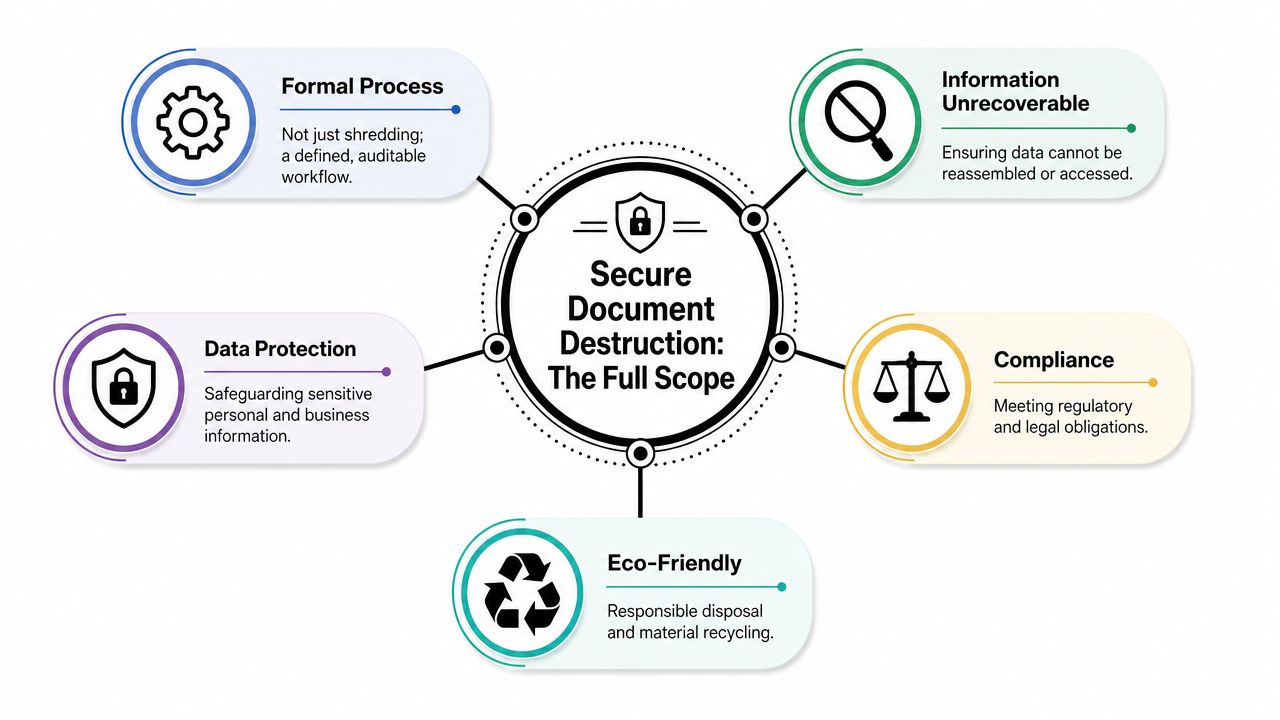
Secure destruction isn't the same as “we shredded it.” It means the information has been made unrecoverable through a controlled process that your business can defend if a regulator, client, auditor, or attorney asks what happened to the records.
More than an office shredder
A desk-side shredder can reduce paper volume. It usually can't provide a formal workflow, documented handling, or proof of destruction. It also doesn't tell you whether the output is suitable for the sensitivity of the material.
For high-assurance government use, the NSA/CSS paper shredder requirement sets a maximum particle size of 1 mm × 5 mm for paper and certain optical media, a benchmark associated with making forensic reassembly practically infeasible compared with strip-cut output, as described in the NSA/CSS paper shredder requirements.
That doesn't mean every business needs an NSA-level outcome. It does mean “secure” has a real technical meaning. The smaller and more controlled the destruction output, the harder reconstruction becomes.
What a professional process includes
When businesses buy secure destruction, they should expect a process with several elements working together:
- Defined intake procedures so records don't sit in unsecured piles
- Controlled handling by authorized personnel
- A destruction method matched to the material
- Documentation that proves what happened and when
- Environmental handling for the residual material after destruction
That's also why paper security and digital security increasingly overlap. The same business that needs document destruction often needs media destruction for retired drives, storage devices, and IT equipment. Companies comparing options on that side of the process can review secure data destruction services.
Practical rule: If your process can't show who handled the material, how it was destroyed, and what evidence you kept, it isn't a strong security process.
Security is the outcome, not the tool
Businesses sometimes focus too much on the machine and not enough on the workflow. A powerful shredder doesn't fix weak intake, poor supervision, or missing records. Secure destruction is a chain of controls. If any link is weak, the final result is weaker than it looks.
Key Compliance Rules for St. Louis Businesses
Most organizations don't pursue secure destruction because they enjoy record cleanup. They do it because sensitive information creates legal, contractual, and reputational obligations. Disposal has to match those obligations.
What the major rules mean in plain English
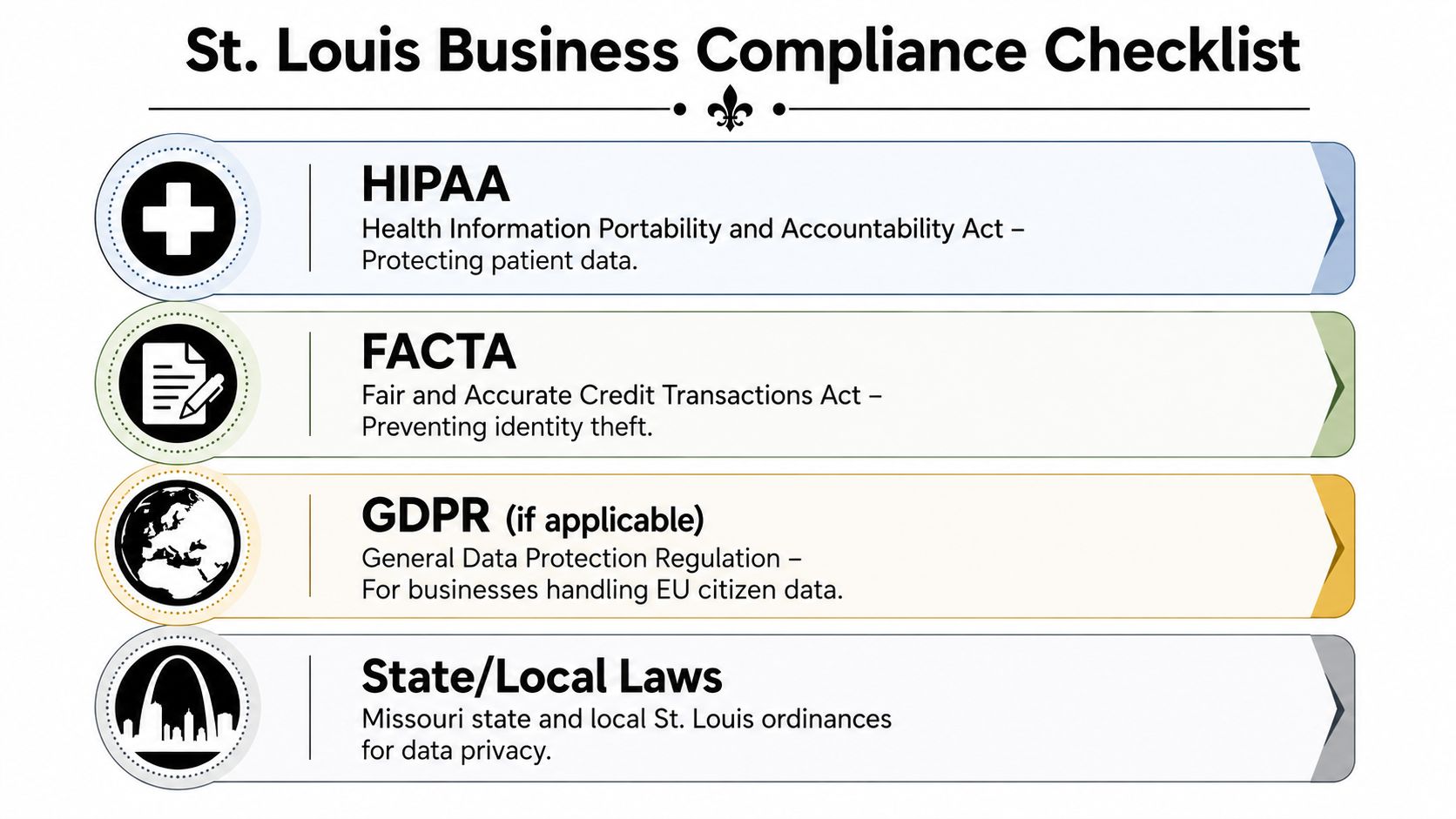
For many St. Louis employers, three federal frameworks show up often in disposal decisions:
- HIPAA matters when an organization handles protected health information. Healthcare providers, insurers, and business associates are the obvious examples, but other organizations may touch health-related records too.
- FACTA is closely tied to proper disposal of consumer information in ways that help reduce identity theft risk.
- GLBA matters for financial institutions and others handling certain consumer financial information.
The main point is simple. These rules don't care whether the information was stored in a file cabinet or on a hard drive. If the information is sensitive, disposal has to prevent unauthorized access.
Why format matters less than recoverability
Many businesses split responsibility in the wrong place. They assign paper files to office administration and old devices to IT, with no single policy connecting the two. That division feels efficient, but it can produce inconsistent disposal controls.
A medical office in St. Louis, for example, may shred patient intake forms but overlook data stored on retired workstations or imaging-adjacent devices. A finance firm may lock down archived paper statements but fail to verify what happened to decommissioned drives from employee laptops.
The compliance question isn't “Was it paper or electronic?” The question is “Could someone still recover the information?”
For organizations that also handle international data subjects or cross-border operations, documenting disposal controls can become part of a broader privacy evidence trail. Teams working through that issue may find operational evidence for GDPR useful as a process reference.
Auditability matters
A defensible disposal program should leave evidence. Certification, service records, destruction documentation, and custody controls matter because they show your business used a repeatable process rather than informal cleanup.
Businesses evaluating secure handling standards often start by reviewing NAID AAA certification requirements and context. That kind of review is useful because disposal vendors shouldn't be judged only by convenience or price. They should be judged by whether their process can hold up under scrutiny.
Comparing On-Site and Off-Site Destruction Methods
The choice between on-site and off-site destruction isn't just operational. It's a risk decision. Both can have a place, but they solve slightly different problems.
Why businesses choose on-site destruction
Professional providers in St. Louis often present on-site destruction as the most secure option because documents are destroyed before leaving the customer's control, as described by a local provider's explanation of why on-site shredding is framed as the most secure method.
That model appeals to businesses that want direct visibility. If records are destroyed at your location, there's less exposure tied to transporting intact documents elsewhere. It also makes sense when leadership, compliance staff, or clients want to witness or monitor the event.
Where off-site can still fit
Off-site destruction can work when the provider's intake, transport, facility controls, and documentation are strong. Some organizations prefer it for routine service, recurring pickups, or situations where plant-based processing fits their workflow better.
The tradeoff is straightforward. Off-site service introduces another custody phase because intact records leave the premises before destruction occurs. That doesn't automatically make it wrong. It does mean the transport and facility controls deserve more scrutiny.
On-Site vs. Off-Site Document Destruction
| Feature | On-Site (Mobile Shredding) | Off-Site (Plant-Based Shredding) |
|---|---|---|
| Primary security advantage | Documents are destroyed before leaving your premises | Can centralize destruction in a controlled facility |
| Visibility | Staff can often witness or monitor destruction | Verification depends more on provider documentation |
| Transport risk | Lower exposure because records aren't moved intact after collection | Higher exposure window because intact records travel to another location |
| Best fit | High-sensitivity files, compliance-focused purges, leadership oversight | Recurring service, larger operational workflows, centralized processing |
| Key question to ask | How is witnessing or monitoring handled on-site? | What controls govern transport, storage, and plant intake? |
Mixed assets change the decision
The comparison gets more interesting when your “document destruction” event includes more than paper. A lot of office cleanouts produce boxes of records plus hard drives, desktop towers, backup media, and retired laptops.
Paper can be shredded on-site. Some digital assets may also need physical destruction at the location, particularly if your policy requires that storage media never leave the premises intact. Companies reviewing that option for electronics can look at on-site hard drive destruction.
If your cleanout includes both records and retired devices, don't let convenience force one method across every asset type. Match the method to the risk.
A simple decision test
Use on-site destruction when immediate destruction and direct control matter most. Use off-site only when you're comfortable that custody, transport, facility security, and documentation are strong enough to close the gap created by moving intact materials.
That's the right framing for secure document destruction in St. Louis. Not “which service sounds easier,” but “which service creates the fewest opportunities for exposure.”
Understanding the Secure Chain of Custody
Chain of custody sounds legalistic, but the idea is practical. It means your business can show where sensitive material was, who handled it, and what happened to it from collection through final destruction.
What the chain should include
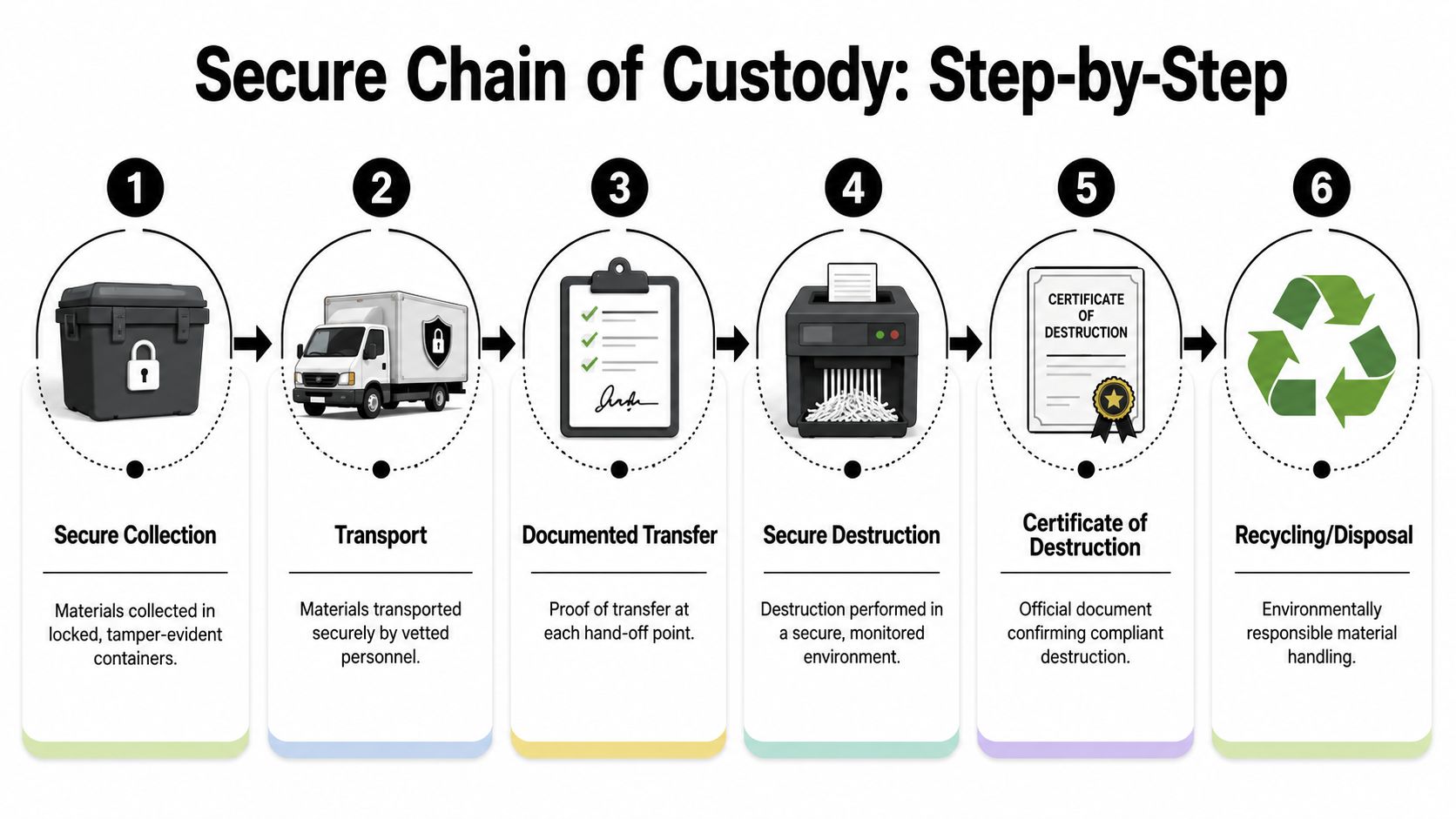
A compliant destruction program requires a documented chain of custody with locked collection containers, secure transport, witnessed or monitored destruction, and a Certificate of Destruction, creating an auditable trail for HIPAA, FACTA, and GLBA, as outlined in this description of business document shredding controls.
That sequence matters because risk doesn't disappear just because a service was scheduled. Exposure often happens in the handoff points.
Follow the material from start to finish
Think of the chain in steps:
Secure collection
Staff place records into locked containers instead of open recycling bins or boxes in a hallway.Controlled pickup
Authorized personnel remove the contents using documented procedures.Documented transfer
Each handoff is recorded so there's no ambiguity about possession.Secure destruction
The provider destroys the material under the conditions promised in the service agreement.Proof after completion
The Certificate of Destruction serves as evidence, not just a receipt.
A certificate matters most when no one remembers the event six months later and an auditor asks for proof.
The same logic applies to electronics
This is also where paper and digital workflows meet. If your business retires drives, laptops, phones, or storage equipment, the same custody principles should carry over: tracked collection, controlled handling, documented destruction or sanitization, and records retained for audit purposes.
Organizations that want a template for that evidence trail can review chain of custody documentation practices. The important idea is consistency. Your paper process and your IT disposal process shouldn't operate at two different security levels.
How to Choose a Destruction Partner in St. Louis
Most vendors can remove material. Fewer can support a defensible disposal program. The difference shows up in the questions they can answer clearly.
Start with process, not promises
Ask a provider to describe the full workflow in plain language. How are materials collected? What containers are used? Who handles them? Is destruction on-site or off-site? What documentation do you receive? How are exceptions handled if the load includes mixed media?
If the answers are vague, the process is probably weak.

What to ask before you sign
Use a short vendor checklist:
Certification and standards
Ask what certifications apply to their destruction process and whether they can explain them clearly.Employee controls
Ask how staff are screened, trained, and supervised when handling sensitive material.Mixed-media capability
Ask whether they can distinguish paper destruction from media-specific destruction for drives and devices.Documentation
Ask exactly what proof you'll receive after destruction.Service model
Ask whether they recommend on-site or off-site service for your specific risk profile, and why.
Understand how pricing is commonly structured
In the St. Louis market, one provider publicly lists a drop-off rate of $75 per 96-gallon tote, described as holding about 10 to 12 standard letter-size boxes, which is a useful example of a standardized service model in the metro area, according to the provider's St. Louis service location page.
That detail is helpful because it shows how mature destruction services are often packaged. You're not usually paying for “some shredding.” You're buying a controlled intake model tied to standard containers, scheduled hours, and predictable handling.
Look for a partner that understands paper and devices
This is the point where disposal policy often needs two lanes. One vendor may handle paper destruction. Another may handle retired electronics and storage media under an IT asset disposition workflow.
For example, Reworx Recycling provides electronics recycling, IT equipment disposal, and secure data destruction services for retired technology assets, which makes it relevant when a St. Louis business is clearing both records and hardware as part of the same office cleanout or refresh cycle.
The right question isn't “Who can take this stuff away?” It's “Who can handle each asset in a way that matches its data risk?”
A strong vendor decision protects your business twice. First, by reducing the chance of exposure during disposal. Second, by giving you records that support the decisions you made if anyone asks later.
St. Louis Secure Destruction FAQ
Is my office shredder enough for business records
Usually not. An office shredder may help with occasional low-volume paperwork, but it doesn't create a documented custody process or an audit trail. It also won't solve the operational problem of bulk cleanouts, retention purges, or mixed-media disposal.
What about personal papers versus business files
Professional destruction services can work for both. In the St. Louis market, secure drop-off service is available through at least one provider with a listed Hazelwood location and weekday hours, which shows that smaller-scale destruction needs can be handled through a formal process rather than informal disposal. Business files, though, usually need more documentation and policy control than household papers.
What should I do with old hard drives, laptops, and phones
Treat them as data-bearing assets, not scrap. Deleting files or setting a device aside for recycling doesn't answer the security question, which is whether the stored information can still be recovered.
Some media require destruction methods beyond ordinary paper shredding. That's why a modern secure document destruction St. Louis policy should connect paper disposal with IT asset disposition, secure data destruction, and electronics recycling. If your office cleanout includes retired technology, handle it under a documented process built for digital media rather than folding it into a paper purge.
If your business is retiring laptops, hard drives, office electronics, or other data-bearing equipment alongside paper records, Reworx Recycling offers educational resources and service information on secure data destruction, electronics recycling, donation-based recycling, and IT equipment disposal. For organizations planning an office cleanout, facility cleanout, device refresh, or broader ITAD workflow, that's a practical next step for building a more complete disposal policy.