440.4 million medical-device units were affected by recalls in 2024, up 55.4% from 283.4 million in 2023, according to Sedgwick's index reported by 24×7 Magazine. For a facilities or biomedical manager, that scale reframes the job: arranging a truck isn't enough. Recalled medical device disposal services must produce evidence that affected equipment left service, reached an authorized destination, and received the correct final disposition.
For Atlanta, Georgia, organizations planning medical equipment disposal alongside an office cleanout or technology upgrade, the most important deliverable isn't an empty storage room. It's a reconciled inventory with no unexplained devices.
Why Recall Volume Turns Disposal Into a Compliance Task
The Government Accountability Office reported 3,934 FDA-overseen medical-device recalls during fiscal years 2020–2024, including 1,017 in fiscal year 2024. Moderate-risk Class II devices accounted for 3,468 recalls, or 88%; highest-risk Class I devices accounted for 350, approximately 9%; and Class III devices accounted for 116, approximately 3%.
That moderate-risk majority still creates substantial handling work. Affected accessories, batteries, and connected subassemblies may sit in supply cabinets, maintenance stores, unopened cartons, or loaner kits rather than on the main equipment register.
Recall events measure corrective actions. Affected units determine physical workload. Storage space, packaging, transport, and destruction capacity must match the inventory, not the number of notices received.
Test the inventory before arranging collection
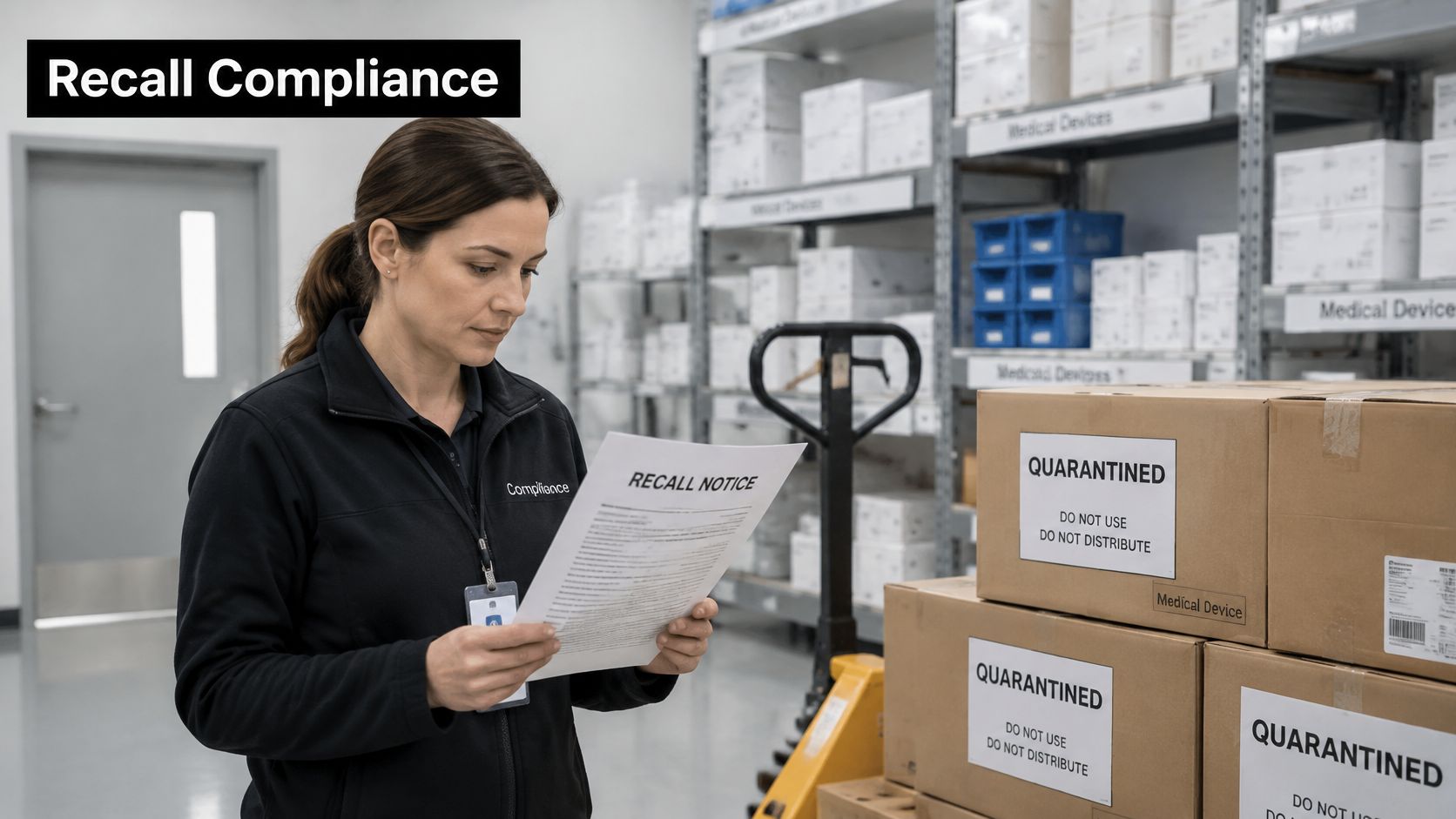
Ask whether your team can identify the model, lot number, location, and serial number, where assigned, of every affected unit. An unidentified carton or missing loaner remains an open reconciliation issue, even after the disposal truck leaves.
For Atlanta wellness operators maintaining specialized equipment, Atlanta Hyperbaric Center's chamber protection guidance for wellness centers offers useful preventive-care context. Maintenance guidance complements equipment oversight, but it doesn't replace manufacturer-specific recall instructions.
Closure test: Can someone outside your department trace each affected unit from its original location to its authorized outcome?
If not, keep the internal recall file open and assign the missing evidence to a named owner.
Disposal Routes for Each Recalled Device Type
| Device category | Main disposal risk | Required route | Proof to keep |
|---|---|---|---|
| Implanted or blood-contacting devices | Biohazard contamination | Decontaminate under an approved process, then route as regulated medical waste | Waste manifest and destruction certificate |
| Battery-powered or lithium-containing units | Fire and chemical hazard | Have qualified personnel remove batteries when safe and authorized, then send them to a licensed battery recycler | Battery handling record and receipt |
| Monitors, workstations and imaging consoles with storage | ePHI exposure | Sanitize or destroy storage before any recycling | Sanitization or destruction record for each drive serial number |
| Lamps and components with mercury or lead | Metal release to soil and water | Applicable universal or hazardous waste stream | Hazardous waste manifest where required |
| Single-use consumables | Infectious residue or pharmaceutical content | Medical or pharmaceutical waste stream, according to contents and condition | Waste manifest and quantity log |
| Non-data electronic accessories with no memory | Low hazard, recall tracking still required | Certified electronics recycling after authorized release | Serial reconciliation and certificate of recycling |
Read each row left to right: identify the risk, establish the route, and retain the proof. These are planning routes, not blanket disposal permissions. The manufacturer's disposition instructions, the affected product's unique device identifier, or UDI, and applicable law control the actual decision.
Before selecting a route, establish separate holding groups for regulated waste, data-bearing electronics, and clearly non-hazardous accessories. These categories can overlap. A contaminated diagnostic workstation belongs in controlled hazardous handling, not beside clean computers because it contains a hard drive.
Complete the hazard check in order
Start with contamination and device contents, not resale value. Use the following handling sequence:
- Identify exposure: Flag implanted, blood-contacting, pharmaceutical-containing, battery-powered, and chemically hazardous devices.
- Contain infectious material: Use appropriate labeled, leak-resistant packaging. Don't open sealed contaminated units merely to improve the inventory description.
- Identify regulated components: Record batteries, lamps, mercury, lead, solvents, and other constituents before arranging transport.
- Confirm release restrictions: Block resale, donation, or redeployment until the responsible recall authority permits correction and release.
The EPA's medical-waste guidance explains that healthcare facilities must manage pharmaceutical waste under applicable local, state, and federal requirements, while hazardous-waste obligations depend on generator category. Review the relevant RCRA requirements and check state medical-waste and electronics-recycling rules before approving the destination.
Keep hazardous handling separate from ordinary e-waste
A generic e-waste pickup isn't an appropriate default for mixed medical devices. Combining clean accessories with contaminated items can create cross-contamination, while concealed batteries and hazardous components require their own acceptance review.
For Atlanta-area planning, our medical e-waste management guidance for Fulton County hospitals and clinics provides additional operational context. Build the collection specification around device-level acceptance criteria, decontamination status, and downstream treatment qualifications, rather than requesting a price for an unidentified load.
Hold, Separate or Dispose Before You Destroy
Immediate disposal can be the wrong instruction. Use these factors to establish whether a unit needs authorized disposition, controlled holding, or correction in place.
| Decision factor | Points toward destruction | Points toward hold |
|---|---|---|
| Recall action | Manufacturer requires removal and disposition | Correction-in-place recall where removal may add risk |
| Device function | Device isn't needed for patient care and disposal is authorized | Device supports active care with no replacement on hand |
| Contamination status | Contaminated or infectious, route to regulated waste | Clean and intact, preserve evidence before any wipe |
| Replacement availability | Equivalent replacement already in stock | No replacement, keep in use only per instructions or quarantine |
| Manufacturer instruction | Explicit disposal or return directive, following the specified route | Instruction says hold until replacement or correction |
A return directive authorizes return, not independent destruction. Likewise, contamination determines handling controls but doesn't automatically authorize disposal before the manufacturer completes an investigation.
The FDA's guidance on device recalls, corrections, and removals places notification obligations on recalling firms and ties recall termination to reasonable efforts to remove or correct devices and achieve proper disposition. It also recognizes that removing equipment can create greater health risk unless an equivalent replacement is immediately available.
Separate a recalled component from a usable system
The FDA's Abbott glucose-sensor recall communication illustrates this distinction: affected sensors required serial-number confirmation and instructions to stop use, dispose of them, and obtain replacements, while unaffected readers, apps, and other product families remained in service.
Apply that discipline to a kit. List the sensor, reader, charger, removable storage, and other accessories separately; don't discard the entire assembly because one component matches a notice. Obtain written confirmation when an accessory's status isn't clear.
Before wiping or dismantling anything, preserve label photographs, serial logs, and relevant fault information. Record the replacement device, expected handover, and person responsible for maintaining care continuity.
Battery-related recalls need additional segregation and transport planning. Our recalled lithium battery disposal guidance addresses that separate workstream.
Hold rule: Out-of-service units awaiting a decision belong in locked quarantine, never beside usable stock. Every hold needs an owner and a review date.
An actively used device retained under explicit clinical and manufacturer instructions needs a documented exception and monitoring plan. It cannot simultaneously be treated as quarantined inventory.
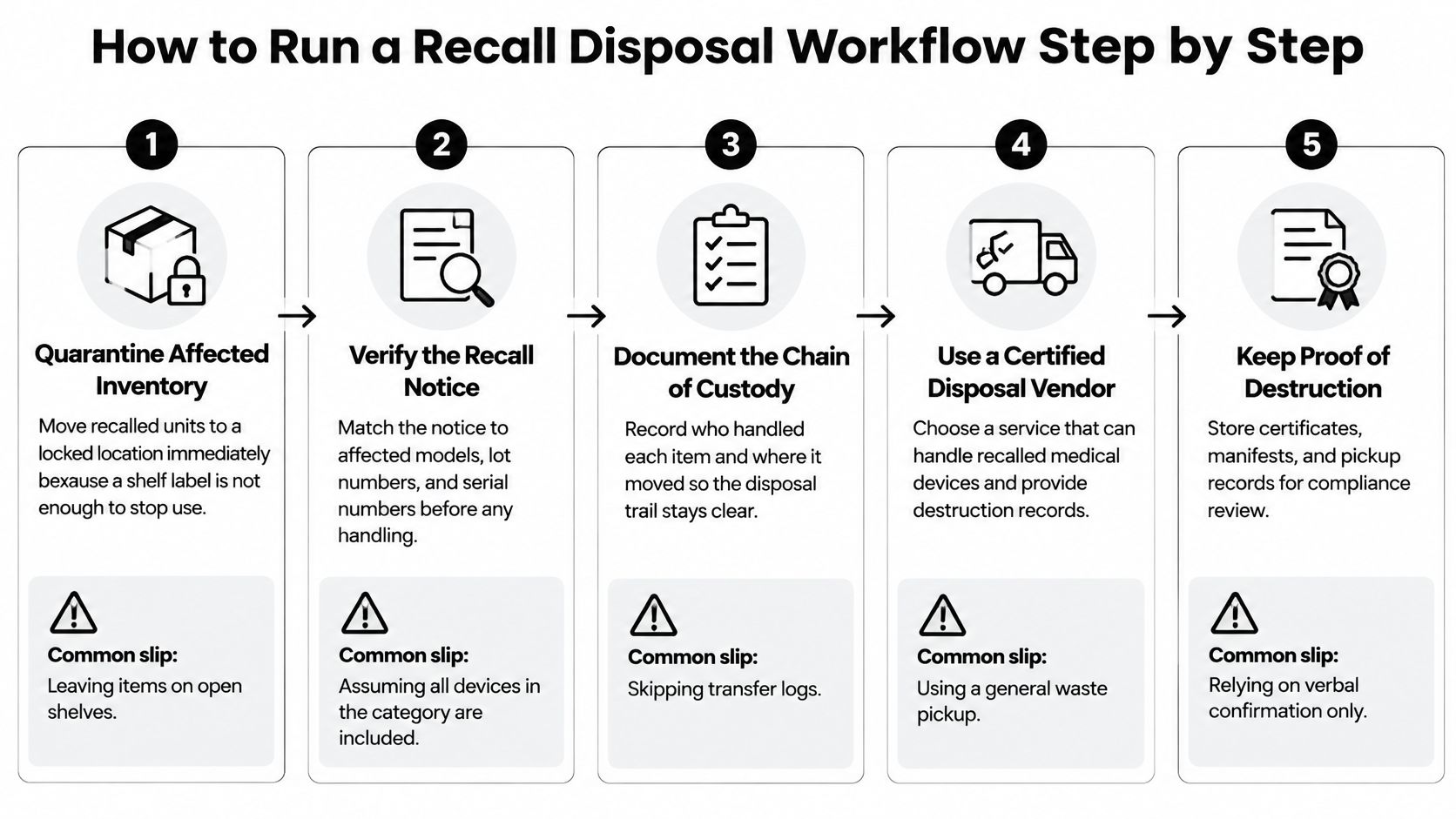
How to Run a Recall Disposal Workflow Step by Step
A disposal program fails when collection records become a substitute for product reconciliation. In a GAO review of FDA recalls, only 20 of 43 completed or terminated recalls, 47%, had corrected or removed all products; firms couldn't correct or remove every product in 21 of 53 Class I recalls examined.
Use a controlled workflow that connects each handling action to an inventory record. The physical process should remain simple enough for receiving staff, biomedical technicians, and facilities teams to follow without inventing their own status labels.
Execute the controlled handling sequence
Quarantine affected inventory immediately. Attach a recall tag, record the holding location, and restrict access to out-of-service units so staff can't accidentally select them for use. The common slip is relying on a shelf label while leaving equipment accessible, with any authorized continued-use exception undocumented.
Reconcile against the manufacturer's notice. Match model, serial number, lot number, UDI data, location, and quantity, and preserve the notice version used for the decision. A spreadsheet containing only descriptions and carton counts can't distinguish affected units from similar, unaffected products.
Classify each unit by its authorized outcome. Assign return, correction, destruction, or regulated-waste treatment and record the approval supporting that choice. Don't let a collection crew make disposition decisions from appearance, condition, or potential resale value.
Document transfer to the authorized provider. Use a signed manifest or handoff record identifying the units, receiving organization, destination, date, and responsible personnel. The usual break is recording departure from the building without obtaining evidence of receipt at the approved facility.
Collect and verify completion records. Match certificates of destruction or other disposition evidence to the transferred inventory, then retain photographs, manifests, and reconciliation records together. A certificate that describes miscellaneous electronics but cannot be connected to your units leaves the outcome unproven.
Run an effectiveness check. Search clinical areas, storage, repair benches, loaner pools, satellite locations, and outbound shipments, then investigate any unresolved identifiers. Don't close the file because the originally scheduled pickup is complete.
Build a record that can survive a staff handover
Use one row per serial number, rather than one row per batch. For products without individual serials, use the manufacturer's applicable lot identifier and controlled quantity reconciliation; never invent serial numbers to make the worksheet look complete.
| Record group | Fields to capture |
|---|---|
| Recall identity | Recall reference, notice version, affected manufacturer and models |
| Product identifiers | UDI, lot number, device serial number, linked component serial numbers |
| Inventory location | Department, room or storage location, assigned custodian |
| Authorized decision | Return, correction, destruction, or regulated waste; chosen route and approval reference |
| Transfer evidence | Transfer date, signed manifest number, sender and recipient |
| Provider details | Provider name, receiving facility, approved final destination |
| Completion evidence | Certificate number and date, method, photograph references |
| Effectiveness review | Search locations, discrepancy resolutions, final status |
| Accountability | Named owner, signature, closure date |
Keep identifiers in a consistent format. Preserve leading zeros, distinguish device serials from drive serials, and use controlled status values such as quarantined, transferred, corrected, and closed.
Our chain-of-custody documentation guidance can support the transfer-record portion of this file. Keep the clinical decision, waste classification, and final acceptance approvals attached to the same recall reference.
Measure the share of affected distributed units reconciled, not just the quantity shipped. If equipment moved between departments, reconcile the receiving department's record rather than counting the internal transfer as removal.
A closed internal file contains a reconciliation sheet with zero open serials, the applicable completion certificates, and a signed effectiveness memo. That memo should identify what was searched, who performed the check, how discrepancies were resolved, and who authorized closure; it doesn't replace the FDA's separate recall-termination process.
Protecting Patient Data Before Any Device Leaves
Under HHS guidance on disposing of protected health information, covered entities must remove electronic protected health information, or ePHI, or destroy the media before reuse or disposal. HHS identifies clearing through overwriting and purging, including appropriate degaussing, as possible removal methods; destruction options include disintegration, pulverization, melting, incineration, and shredding.
Select the method for the actual medium. A technique suitable for a magnetic hard drive isn't automatically effective for embedded flash storage.
| Media or device type | Acceptable method | Evidence to keep |
|---|---|---|
| Hard drives in monitors or workstations | Verified overwriting, suitable degaussing, or shredding | Sanitization record for each drive serial number |
| Solid-state or flash storage | Physical destruction where overwriting cannot be verified | Destruction certificate with photographs |
| Removable media such as USB drives and SD cards | Physical shredding suitable for the media | Count log and destruction certificate |
| Non-functional drives | Physical destruction by shredding or pulverization | Destruction certificate listing serial numbers |
These are method-selection examples, not a universal HIPAA prescription. The HHS guidance on reusing computers and media explains the risk-based approach and the requirement for policies governing final disposition and removal of ePHI before reuse.
Find the storage that equipment inventories miss
Check embedded drives in imaging systems, diagnostic workstations, network devices, and removable media. Review service documentation and ask biomedical engineering or the manufacturer to identify storage that isn't accessible through the normal user interface.
Don't confuse cleaning a device with sanitizing its data. Surface disinfection addresses contamination; deleting patient files or resetting a menu setting doesn't establish verified media sanitization.
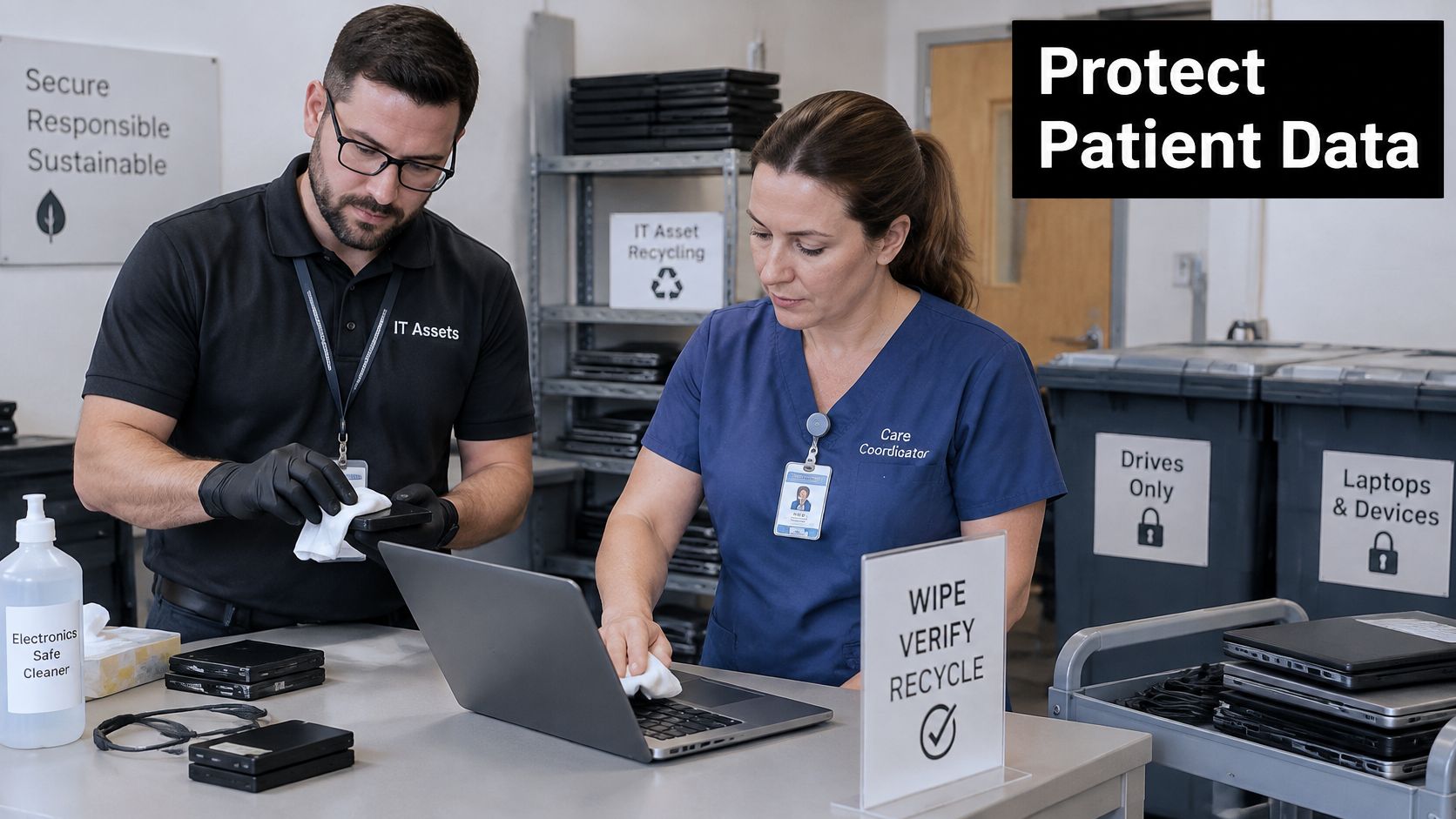
Reworx Recycling offers secure data destruction and uses hard drive shredding and degaussing during IT equipment decommissioning to eliminate retrieval risk. We securely wipe or shred data-bearing devices before responsible recycling, selecting the applicable treatment for the equipment.
Our data sanitization guide helps distinguish information removal from ordinary deletion. Preserve any manufacturer-required diagnostic evidence before authorizing irreversible treatment.
Connect the media record to the parent asset
Record both the equipment identifier and the drive identifier when storage is removed. Otherwise, the facilities inventory may show a completed device pickup while IT holds a destruction certificate that nobody can connect to that equipment.
Require a completion record for each drive serial number as a contractual evidence standard. A generic batch note may document an activity, but it doesn't establish which particular media received treatment.
Choosing a Certified Disposal Partner
| Evaluation criterion | What to require | Red flag |
|---|---|---|
| Serial-level reconciliation | Unit-by-unit intake log matched to the recall notice | Totals by weight or box count only |
| Downstream facility qualification | Named destruction and recycling sites with audit evidence | Subcontractors not disclosed |
| Data sanitization | Method per media type with completion record per serial number | Generic claim that everything is wiped |
| Certificate of destruction | Certificate per task, with serials and method listed or attached | Summary letter with no unit detail |
| Chain of custody | Signed transport and handoff records through final disposition | No tracking between pickup and destruction |
| Licensing and insurance | Current applicable environmental and transport credentials, plus insurance evidence | Reluctance to share documents |
Scope caveat: Reworx Recycling's documented services center on electronics and IT assets. Confirm in writing that your specific medical-device category, contamination status, and manufacturer's recall instructions are within the accepted scope before booking.
A weight ticket can support billing or material reporting. It doesn't prove that a particular recalled device was destroyed, corrected, or prevented from returning to circulation.
Ask questions that expose gaps before contracting
Use the vendor call to establish deliverables, not just collection availability:
- Acceptance: Which recalled device categories will you accept, and what preparation or exclusions apply?
- Downstream control: Who operates the destruction and recycling facilities, and what audit evidence is available?
- Reconciliation: Can intake records match individual units against our recall notice?
- Certificate detail: Will the certificate identify the method, date, facility, and covered serial numbers?
- Transport tracking: How will signed handoffs connect pickup to final disposition?
Review the actual certificate template and an example intake format before approving the statement of work. If either document lacks the fields your recall owner needs, resolve the gap before loading equipment.
Match documented services to the assignment
We're an electronics recycling and IT asset disposition (ITAD) partner based in Smyrna, Georgia. We provide a certificate of destruction for every task fulfilled, supporting audits and legal documentation, and offer free e-waste pickups nationwide.
Our process has four steps: schedule a drop-off or pickup, prepare the electronics, securely wipe or shred data-bearing devices, and recycle responsibly. Medical-device acceptance still requires the scope review described above; an electronics service offering isn't blanket authorization to handle infectious or pharmaceutical waste.
Use our electronics recycling certification guidance when evaluating what credentials mean for the proposed work. Procurement should name the required outcome and evidence, rather than treating the word certified as a complete specification.
Confirm the Recall Scope and Book a Disposal Pickup
A pickup is only one part of recall closeout. The inventory must show which units are recalled, which are cleared, and what happened to each affected device. Confirm the recall notice, affected models, and the person responsible for signing the effectiveness check before arranging collection.
Reworx Recycling offers business pickups and free e-waste pickups nationwide. Before scheduling, provide the recall reference, inventory, device condition, and proposed disposition requirements so acceptance questions can be addressed in advance.
Prepare distinct collection groups
Gather the unwanted electronics and identify devices containing sensitive data. Keep separate, labeled groups with an accompanying inventory:
- Recalled equipment: Segregate restricted units and include their authorized handling instructions.
- Data-bearing assets: Flag devices with sensitive storage for secure handling.
- Cleared surplus: Separate non-recalled equipment approved for ordinary IT equipment disposal.
An Atlanta facility cleanout may combine laboratory equipment disposal with computer recycling, laptop disposal, or data center decommissioning. Keep each category's acceptance requirements and records distinct, even if the equipment leaves in one collection.

Cleared, non-recalled technology can be considered for Reworx's equipment buyback program, which offers businesses a way to recover value from surplus hardware. Keep recalled equipment out of that route unless it has been released for disposition.
Choose the next action based on the inventory: arrange an accepted pickup, consider equipment buyback for cleared surplus, or discuss an ongoing IT asset disposition partnership.
Reworx Recycling offers business electronics pickups, secure data destruction, and responsible recycling for the electronics portion of a documented recall response. Visit Reworx Recycling to discuss the recall scope, schedule a pickup, or arrange an ongoing IT asset disposition partnership.