62 billion kilograms of electronic waste were generated worldwide in 2022, while only 22.3% was documented as formally collected and recycled in an environmentally sound manner, according to the Global E-waste Monitor 2024 from the International Telecommunication Union and UNITAR. That's the context your recalled stock enters if you treat it like ordinary surplus. A recalled laptop, appliance, or battery device isn't just unwanted inventory. It's inventory a regulator, a brand, or a safety notice has marked as unfit for normal sale, donation, or use.
That's why retail product recall disposal services exist. They don't start with a truck. They start with identification, quarantine, an approved remedy, and records that connect every unit you pulled to its final treatment. If you can't reconcile those units at the end, you haven't closed the recall. You've only moved the problem.
Why Recalled Stock Needs a Disposal Service
Say a regional retailer gets a notice on a Tuesday morning for a battery powered appliance sold in forty stores. The distribution center has full pallets. Return desks have open boxes. A repair bench has two units waiting for parts, and a liquidation partner has already scanned a mixed lot for resale. Pulling the shelf tag solves only the most visible part of that problem.
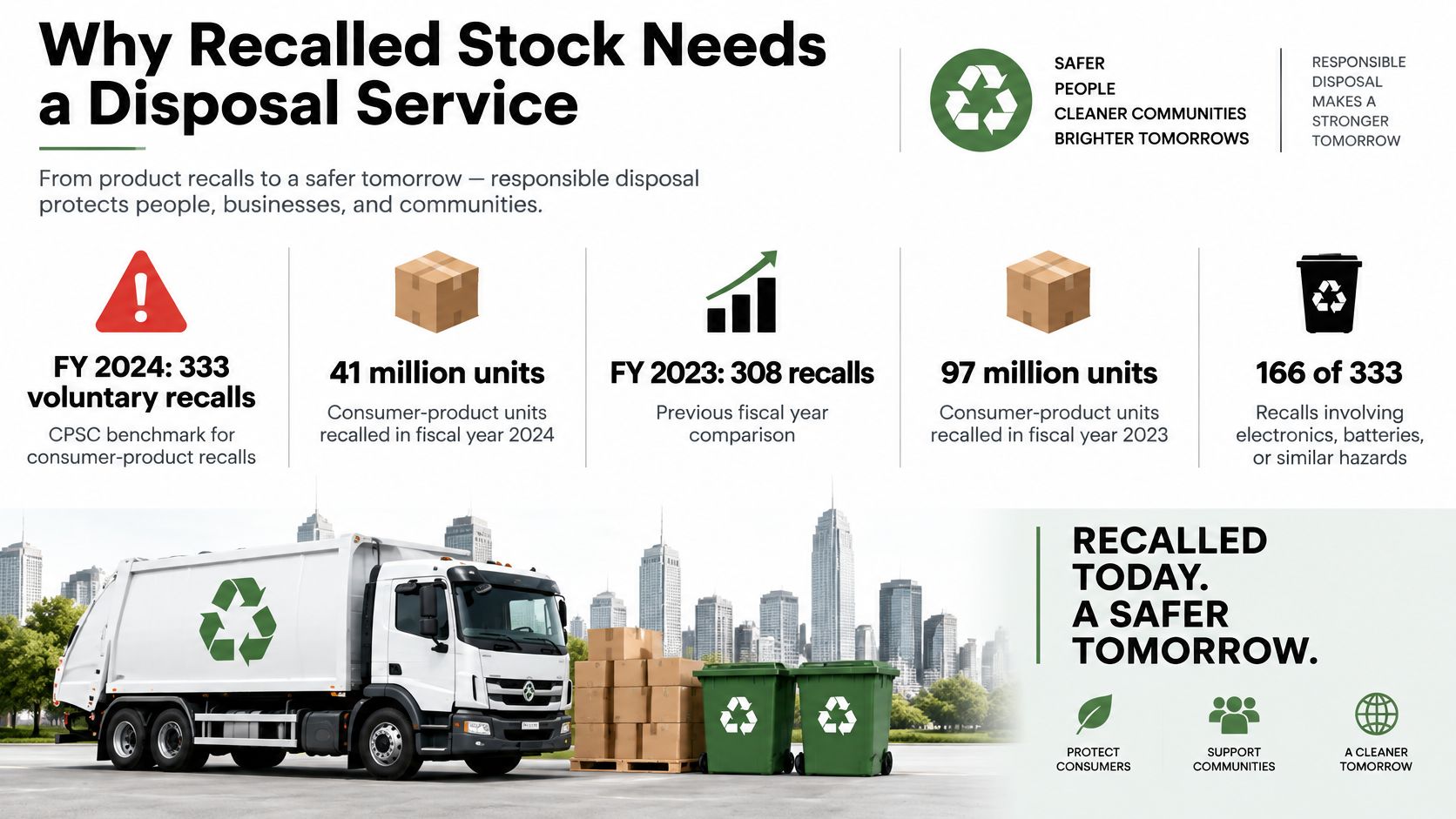
Scale is the first reason ad hoc routines fail. In fiscal year 2024, the U.S. Consumer Product Safety Commission FY 2024 annual performance report recorded 333 voluntary recalls covering 41 million consumer-product units, compared with 308 recalls involving 97 million units in fiscal year 2023. The same report recorded that 166 of the 333 completed recalls in FY2024 used its Fast-Track program. Notice what changed and what didn't. The number of recall events moved moderately. The unit count swung by tens of millions. Your team can't staff for that swing with a dumpster, a donation bin, and good intentions.
Scope the lot before you move it
Retail product recall disposal services mean a controlled sequence. You identify affected stock, segregate it so nobody can sell, donate, liquidate, or return it to a shelf, and send it down an approved return, repair, destruction, or recycling path with records at each handoff. That definition matters for retail operations teams and brand quality teams. It matters just as much for school facilities staff holding recalled Chromebooks or lab equipment and government property managers holding recalled appliances or battery products.
Start with a scope assessment, not a pickup request:
- Confirm the notice: Record the recall classification, affected SKUs, lot codes, serial ranges, and the remedy the notice requires.
- Search every location: Check stores, return desks, distribution centers, repair benches, school storerooms, and agency warehouses, not just the sales floor.
- Size the lot: Compare units found against units shipped or purchased, so you know whether you're looking at full recovery or a shortfall you'll need to explain.
- Record the remedy: Write down whether the notice requires return, repair, destruction, or another remedy before any stock moves.
Removing product from the shelf is not the same as proving it is unavailable.
That distinction drives the whole playbook order. Scope the lot, choose the remedy, collect under chain of custody, meet waste and witness rules, then close the file. Skipping ahead is how recalled units end up in a landfill diversion gaylord or, worse, back on a marketplace listing. Read the disposition table in the next section before you book any truck.
Choose a Remedy Before Anything Leaves
Every disposition decision starts from the recall notice, not from what's convenient. Capture SKU, lot or serial number, quantity, location, classification, and condition for each group of units, then quarantine them so they can't be commingled with good stock. Only then do you pick a path.
Recall disposition paths and the proof each one needs
| Path | Use it when | Do not use when | Proof that closes it |
|---|---|---|---|
| Return to recalling firm | Notice requires return and the unit is safe to transport | Packaging is leaking, burning, or barred from shipment | RMA, bill of lading, and quantity match |
| Rework or repair | Recalling firm and regulator authorize a fix that removes the hazard | The hazard cannot be engineered out | Authorization letter, serial list, and post-repair check |
| Safe diversion | A written non-consumer use is approved | Any route back to sale, donation, or a marketplace | Approval letter and destination record |
| Destruction | Notice says dispose, or no safe repair exists | A repair or return remedy was ordered instead | Photos, weight ticket, and certificate of destruction |
| Authorized recycling | Recovery is allowed and the product is stable | Lithium battery fire risk or regulated hazardous waste | Facility name, weights, and recycling certificate |
| Wipe or shred, then recycle | Device holds customer, student, or employee data | The drive cannot be sanitized | Wipe or shred log plus certificate of destruction |
Walk the rows in order
Return is your default when the notice requires it and the product is safe to ship. The recalling firm owns the remedy, and your job is intact packaging, an RMA number, and a quantity match on arrival. Don't improvise a local destruction because shipping feels slow.
Rework or repair needs written authorization from both the recalling firm and the regulator. A verbal okay from a sales rep doesn't count. If the fix doesn't remove the hazard itself, the unit doesn't go back into service, no matter how expensive it was.
Safe diversion is the row people stretch. It means an approved non-consumer use, in writing, with no route back to retail shelves, donation programs, or third-party marketplaces. If you can't name the destination and the control that keeps units there, you don't have diversion. You have leakage.
Destruction fits when the notice says dispose or the hazard can't be removed. Authorized recycling fits only after the remedy allows material recovery and the item is stable. For data-bearing devices, neither path starts until you've wiped or physically destroyed storage. A recycled laptop with a readable drive is a data incident with a recycling certificate attached.
The battery exception
Lithium-ion products break the generic recycle instruction. CPSC recall guidance for a lithium-ion battery product states that recalled lithium-ion batteries and devices must not enter household trash, curbside recycling, or general recycling streams because they present a higher fire risk, and consumers should first confirm that a household hazardous waste facility accepts them. It also requires recalled products to be quarantined and controlled so they cannot reenter commerce. For a commercial lot, that means triage before transport:
- Intact units: Isolate, label, and package under your battery procedure.
- Damaged or leaking units: Segregate from intact stock and confirm the destination accepts them before booking.
- Swollen, hot, or venting units: Stop handling them. Containment and fire prevention come before material recovery.
A reverse logistics and returns process built for controlled product earns its keep, because the return path for a swollen battery pack is not the return path for a boxed toaster. If repair or diversion isn't authorized in writing, the product stays quarantined until destruction evidence exists. That rule has no exceptions for storage pressure.
Sort Waste Streams Before Treatment
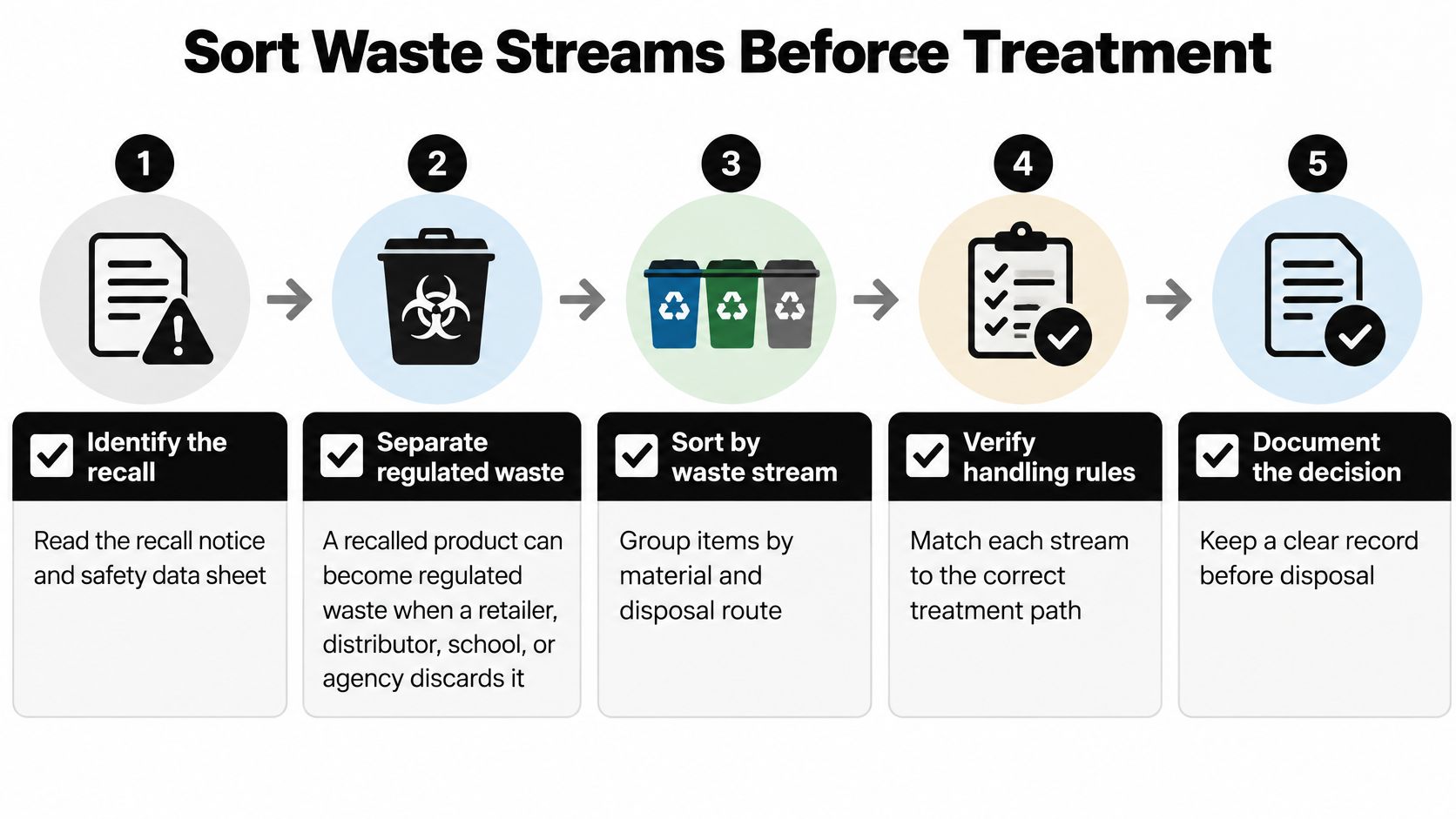
A recalled item changes category when a business decides to discard it. What was inventory may now be regulated waste, and the organization that generates it must determine the applicable requirements. That decision governs the container, label, carrier, and destination. If the classification is wrong, each later control can be wrong too.
The EPA guidance on recalled product disposal says non-household parties discarding recalled children's products must determine whether the material is hazardous waste and, if so, follow applicable storage, treatment, transportation, and disposal requirements. For recalled pesticides, universal-waste rules may apply after the responsible party agrees to participate in the recall and decides to discard the stock. Other hazardous pesticides remain subject to hazardous-waste requirements. State and local rules may be stricter than federal minimums, so check the requirements where the waste originates and where it will be treated.
The separation sequence
Sort at the point of generation rather than waiting until the dock. This keeps incompatible materials apart and makes each stream easier to label and route. Follow a consistent sequence:
- Read the paperwork: Review the recall notice and safety data sheet for each product family.
- Separate by stream: Keep liquids, aerosols, batteries, electronics, contaminated goods, and ordinary solid products in distinct, labeled groups.
- Inspect packaging: Place leaking or damaged items in separate containment before they contact other units.
- Assign classifications: Apply the relevant waste codes or state classification for the location.
- Package and label: Match each container and label to its contents. Use authorized transport and treatment facilities, and retain manifests or equivalent final-disposition records.
For battery streams, determine the waste classification, container, and destination approval before shipment. The earlier remedy decision must address safe handling and containment of intact, damaged, or heat-affected units. Recycling is not the first objective when a battery product requires containment.
Failures that create violations
The common failures are procedural. A shortcut that saves space or time can mix streams and compromise the records needed to show proper handling.
- Draining chemicals into sinks without first characterizing the liquid.
- Mixing incompatible materials in one drum to fill it faster.
- Placing damaged lithium-battery products in general bins, where compaction may trigger a fire.
- Applying household exemptions to retail inventory. Those exemptions do not cover a business's back room.
The same point-of-generation sorting principle applies in facilities and venues. A guide to reduce venue waste with Simply Hospitality concerns a different setting, but sorting streams where they arise is a practical way to prevent confusion before materials reach a collection area. Sorting late can increase handling and weaken the record of what was separated.
File three records at close of day: the waste determination, the labels as applied, and the destination approval for each stream. Check the applicable rules for each origin and destination, keep a written emergency procedure with the containers, and record the basis for choosing return to the manufacturer or destruction. If electronics will cross a border, resolve consent and destination requirements before arranging shipment with a provider of recalled lithium battery and electronics disposal services. A pickup receipt transfers custody; it does not close the recall. Reconcile each unit against the approved remedy and retain the final-disposition record.
How to Collect and Keep Chain of Custody
Chain of custody is the difference between a recall you can prove and a recall you can only describe. The CPSC Regulated Products Handbook requires a recall reverse-distribution plan to explain how affected products will be removed from store shelves, quarantined, returned, repaired, replaced, or disposed of, and requires recalled products to remain quarantined and segregated from other products throughout the distribution chain. Before destruction, disposal, or recycling, the recalling firm must notify CPSC staff, and the agency may witness the process or require an affidavit and photographic evidence. Any outside disposal provider must be monitored by the recalling firm to ensure recalled inventory stays separated and follows the approved plan.
Number every handoff
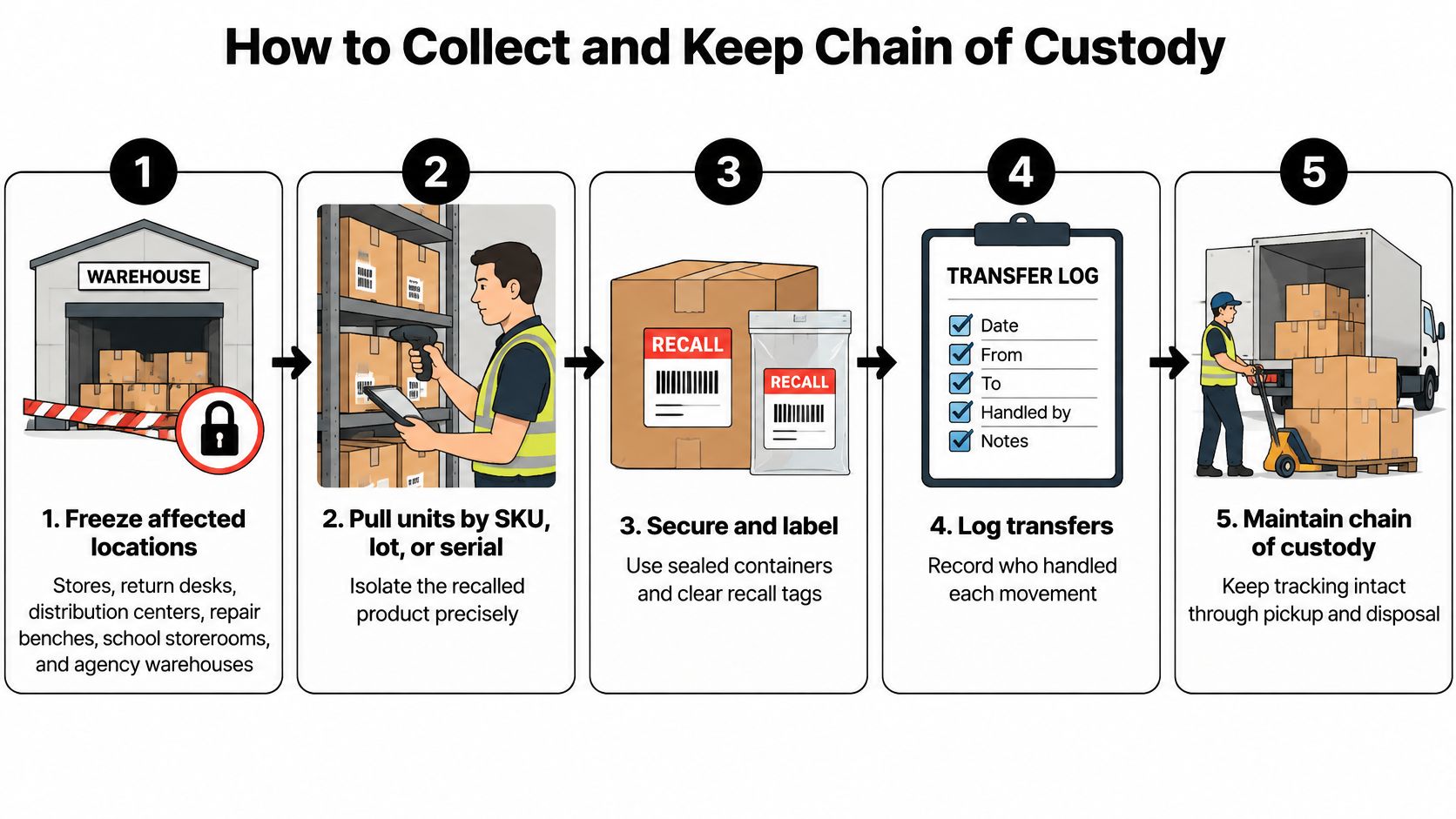
Run collection as a numbered sequence so a new team member can't skip the controls:
- Freeze affected locations. Lock down stores, return desks, distribution centers, repair benches, school storerooms, and agency warehouses so units stop moving.
- Pull by identifier. Collect units by SKU, lot, or serial and count them against the notice.
- Mark and stage. Label each carton recalled and illegal to sell, distribute, or donate, and stage it away from good inventory.
- Write the plan. Document removal, quarantine, return, repair, replacement, or disposal, and keep product segregated for the whole trip.
- Notify before treatment. CPSC staff hear about destruction, disposal, or recycling before it happens, not in a summary afterward.
- Check condition, then book transport. Leaks, aerosols, and battery condition get verified before authorized transport is scheduled.
- Log every handoff. Date, custodian, seal number, count, and photo at each transfer.
- Reconcile and open exceptions. Match units received against units destroyed or repaired, and open an exception record for every missing piece.
- Monitor the provider. Confirm recalled inventory stays separated and follows the approved plan at the vendor's site, not just at your dock.
Custody rule: A signed pickup receipt proves a transfer of custody. It does not prove destruction.
For serialized or high-risk goods, reconcile 100 percent of units even if a contact-check sample would be smaller. A sample tells you about notification reach. It tells you nothing about the three serialized units that never arrived. Cross-border movement needs the same discipline. Since January 1, 2025, Basel Convention amendments require prior written consent for covered e-waste shipments, including non-hazardous e-waste, to importing and transit countries, a requirement summarized in the CPSC Recall Handbook. That makes international recycling a planned, consented step, not a casual last resort.
Chain-of-custody log template
| Field | Example entry |
|---|---|
| Date and time | 2026-03-04, 09:15 |
| Custodian name and company | J. Ortiz, retail operations |
| Seal number | SL-00482 |
| Unit count against notice | 240 of 240 units, lot 7B |
| Photo reference | IMG-2214, sealed pallet at dock |
| Destination and certificate | Approved facility, certificate number pending |
Standardize this log through your chain of custody documentation process so every site fills the same fields the same way. Then refuse to close any file with no count match, no photos, or no approved destination. Those gaps don't get smaller with time.
Select a Vendor, Close the File, and Book a Pickup
Vendor selection should follow the records your organization must close. A retailer may need to reconcile returned units against a recall notice, while a school may also need to account for tagged equipment and stored data. Decide what proof is required before requesting a pickup.
Closeout expectations by organization
| Organization | Typical recalled stock | Extra control | Closeout document |
|---|---|---|---|
| Retailer or brand | Shelf, warehouse, returns, and marketplace units | Block resale, donation, and liquidation | Unit reconciliation against the recall notice |
| School or university | Lab devices, appliances, and laptops | Protect student data and tagged property | Asset list plus certificate of destruction |
| Government agency | Surplus electronics and safety recalls | Public-record chain of custody | Affidavit, photographs, and manifest |
Apply the vendor checklist
The FDA recall regulations in 21 CFR Part 7 describe four effectiveness-check levels: Level A covers 100% of consignees, Level B more than 10% but less than 100%, Level C 10%, and Level D 2%. FDA guidance recommends considering effectiveness checks for every recall and using failed checks to trigger corrective follow-up. These checks assess notification effectiveness; they do not replace a count of the physical units sent for disposal.
Use a consistent inventory record from identification through final treatment. Capture SKU, lot or serial number, quantity, location, recall classification, and condition, then compare the units received with the units destroyed. Apply the same controls when assessing a vendor against vendor selection criteria for controlled disposal work:
- Segregation monitoring: Can the vendor explain how recalled inventory remains separated at its facility?
- Stream separation: How are battery products and other hazardous streams kept apart from ordinary electronics?
- Evidence, not receipts: Will the closeout include photographs, weight tickets, transporter and facility names, and a certificate of destruction?
- Exception handling: Will the vendor reconcile serialized units and document every variance?
A sample of consignee contacts can support a recall effectiveness check, but it cannot account for each serialized item. For high-risk or serialized merchandise, 100% unit reconciliation with destruction evidence provides a clear record of what arrived and what was treated. Record why the chosen check level matches the recall strategy.
Do not ship recalled battery products in the same gaylord as ordinary office e-waste.
Data destruction, timing, and cost
For data-bearing devices, deleting files does not by itself show that stored information has been destroyed. Specify the approved treatment, such as an overwrite wipe, physical shredding, or degaussing, and require a log for the file. Reworx Recycling offers hard drive shredding and degaussing for IT equipment decommissioning, free data destruction, and a certificate of destruction for each completed task. The certificate supports audit and legal records.
Plan the sequence, too. Quarantine can happen the same day, but CPSC notice comes before destruction; manifests and certificates follow treatment. Cost depends on the hazard class, damaged batteries, distance, witness time, and serial reconciliation. A quote issued before the vendor understands the waste streams may not account for the work required.
Assemble the closeout file, then book
Keep the recall notice, quarantine count, RMA or work order, chain-of-custody log, manifest, photographs, and certificate together. Set a retention period when creating the file, using the recordkeeping guidance from Class A Media as a starting point for deciding how long records should remain retrievable. A pickup receipt records a transfer of custody. It does not close the recall: the remedy is complete only when units reconcile against the approved disposition, with batteries contained before recycling is treated as the goal. Electronics should not go into ordinary trash because batteries, circuit boards, and stored data each require appropriate handling.
Book pickup after counts, battery triage, and data-destruction instructions are documented. Reworx Recycling, based in Smyrna and serving organizations nationwide, handles single devices and bulk loads of commercial electronics, with free business pickups and no-cost facility drop-off. Keep recalled stock out of donation or resale channels; route it through the documented remedy.
If your business has recalled electronics, battery devices, or data-bearing equipment that cannot return to a shelf, Reworx Recycling offers commercial pickup and secure data destruction. To arrange a documented business pickup, contact Reworx Recycling through its vendor selection and service information.