Your technology refresh is finished, but the old equipment is still waiting by the loading door. Facilities wants the space back, IT wants the collection approved, and finance wants to know whether those laptops still have resale value. Before anything leaves, someone needs to answer the question that matters most: what evidence proves the business data is no longer accessible?
Secure data destruction isn't a choice between blindly wiping everything and shredding every device. It's a verified disposition decision that connects data location, sensitivity, treatment, and the equipment's next destination.
Why Retired Technology Still Creates Risk
Consider a representative Smyrna, Georgia, office preparing for an equipment pickup. A facilities manager has boxed former employees' laptops, phones, and server drives together. Someone has deleted visible folders, but nobody has reconciled the contents against the asset register.
That isn't a completed IT equipment disposal project. It's an unresolved security handoff.
Retired equipment can retain credentials, cached business records, intellectual property, regulated information, and configuration details. The broader threat environment makes careless handling difficult to justify: Verizon's 2025 Data Breach Investigations Report reviewed 22,052 security incidents and 12,195 confirmed breaches. Those figures don't measure disposal failures, but they establish the context in which businesses must protect their information.

Treat the handoff as a business decision
For a local office cleanout or a broader Atlanta-area facility cleanout, assign ownership before arranging transport. Your team needs answers to practical questions:
- Location: Which devices, accounts, and repositories contain business information?
- Sensitivity: What would unauthorized access expose?
- Destination: Will each asset be reused, donated, recycled, or destroyed?
- Proof: What records must remain after the equipment leaves?
Ownership changes deserve particular attention. During an acquisition, asset lists and responsibilities may change together; Bizbe, Inc.’s resource on data security in mergers and acquisitions provides a related planning reference without replacing asset-level retirement controls.
Don't let a collection deadline determine the security outcome. Keeping usable equipment available for community technology donations is worthwhile, but only after the organization has established a defensible release decision. Security, recoverable value, and environmental responsibility belong in the same approval process.
Understanding Secure Data Destruction
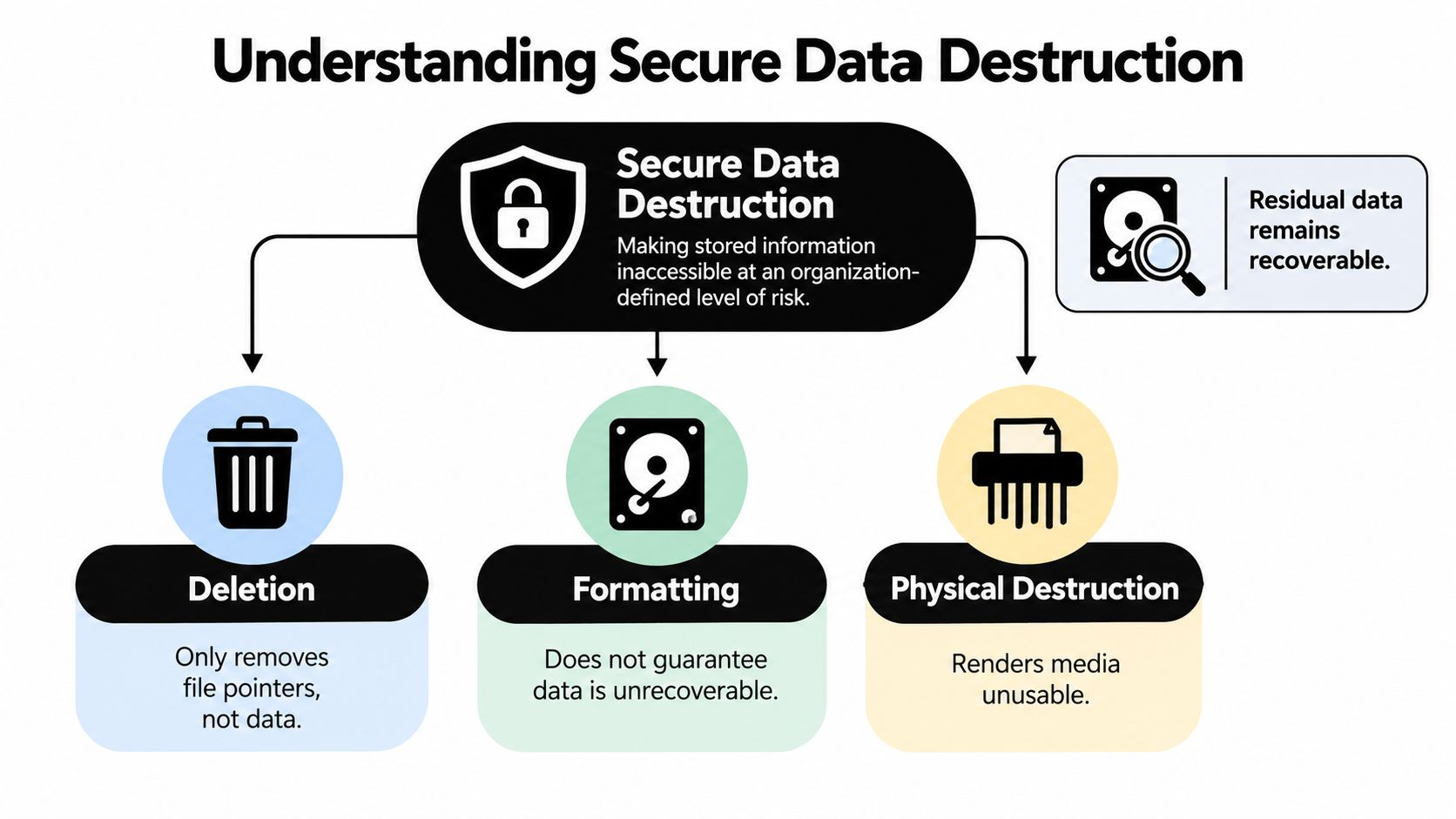
Secure data destruction means making stored information inaccessible at an organization-defined level of risk. The operational question isn't whether a technician ran a command. It's whether the chosen treatment achieved an acceptable result for the information and media involved.
Think of retiring a file cabinet. Closing the drawer doesn't establish what happened to its contents, and sealing the cabinet doesn't account for copies elsewhere. Likewise, deletion or formatting alone isn't evidence that a complete sanitization process succeeded.
Understand the sanitization outcome
NIST's media sanitization guidance distinguishes clear, purge, and destroy. These categories describe different security outcomes, not interchangeable marketing labels.
- Clear applies logical techniques intended to protect against ordinary recovery tools.
- Purge uses physical or logical methods designed to make recovery infeasible with more advanced techniques.
- Destroy prevents recovery while rendering the storage media unusable.
Choose the required outcome before choosing a tool. A software report labeled “successful” isn't useful if the underlying operation doesn't satisfy your approved treatment.
Separate the device from the data estate
A laptop is an asset. Its storage drive is media. Its user files are information, and related backups or cloud accounts may be separate retirement responsibilities. Treating those as one object creates gaps.
NIST's September 2025 revision announcement emphasizes an enterprise sanitization program, including logical sanitization for modern environments such as cloud storage. It also emphasizes validation and trust in implementation rather than accepting a wipe or certificate at face value.
That shift matters to smaller organizations as much as large enterprises. The office manager arranging computer recycling may control the physical collection, while an administrator controls account closure and another team controls backup retention.
Practical rule: Approve the information outcome, validate the treatment, and then authorize the equipment's destination.
A destruction method can't compensate for an incomplete inventory. Nor can perfect paperwork make an unsuitable method effective. Secure disposition requires both competent execution and evidence that the right information was addressed.
Comparing Secure Data Destruction Methods
Choose the method for the media, not the method your contractor happens to prefer. Overwriting, cryptographic erase, degaussing, and shredding solve different problems. None deserves a universal recommendation.
For procurement discussions, use this Secure Data Destruction Method Comparison as a decision aid. The questions and evidence requirements below are recommended purchasing criteria, not a promise that every implementation achieves the same result.
| Method | Best-Fit Media | Main Security Mechanism | Reuse Potential | Key Limitation | Evidence to Retain |
|---|---|---|---|---|---|
| Overwriting | Writable media supported by the selected tool and procedure | Replaces accessible stored information with non-sensitive data | Possible after successful validation | Must match storage technology and accessible storage areas | Asset identifier, tool report, errors, verification result |
| Cryptographic erase | Appropriately encrypted media with controlled keys | Makes encrypted information inaccessible by sanitizing required keys | Possible when implementation is validated | Depends on encryption coverage and reliable key handling | Encryption assessment, key-sanitization record, validation decision |
| Degaussing | Suitable magnetic media | Disrupts recorded magnetic domains | Don't assume media remains reusable | Not an SSD treatment; equipment must suit the media | Media identification, equipment suitability, processing record |
| Physical shredding | Media requiring destruction under an approved specification | Breaks storage components into fragments | Storage media cannot be reused | Visible damage alone doesn't establish adequate destruction | Serial numbers, processing record, output inspection |
Make the technology boundaries explicit
For healthcare media, HHS describes overwriting, magnetic purging, and physical destruction as available treatment categories. That doesn't make each category appropriate for every storage technology.
A magnetic hard drive and a solid-state drive shouldn't receive the same treatment merely because both fit inside a laptop. Require the provider to explain which media its equipment and software support. For an encrypted device, ask how the organization establishes that all relevant information was encrypted and that required keys are no longer accessible.
For failed equipment, don't build the disposition plan around a software operation the device can't complete. An unreadable drive needs an exception decision, not a fictional success entry.
Specify destruction output, not just activity
Shredding must address the components that retain information. A damaged enclosure or broken circuit board isn't an adequate acceptance criterion by itself.
NIST's physical destruction guidance discusses output as small as 3/32 inch, approximately 2.4 mm, in the relevant destruction context. Don't turn that figure into a universal specification for every device and sensitivity level. Require a media-specific output requirement and an inspection procedure.
Use the data sanitization methods resource to organize questions before accepting a quote. Ask separately about treatment, validation, reuse eligibility, and downstream material handling.
My recommendation: retain functional hardware where validated sanitization supports release. Destroy storage when sensitivity, equipment failure, or unresolved uncertainty makes reuse indefensible. Then manage the remaining material through responsible electronics recycling.
Build a Data Destruction Decision Framework
Start with the release decision you need to defend. “Collected by the recycler” is a logistics status, not a security conclusion.
A workable IT asset disposition (ITAD) process should let an approver trace each asset from its information risk to its authorized destination. Keep that decision understandable enough for IT, facilities, procurement, and sustainability staff to use together.
Establish the scope before selecting treatment
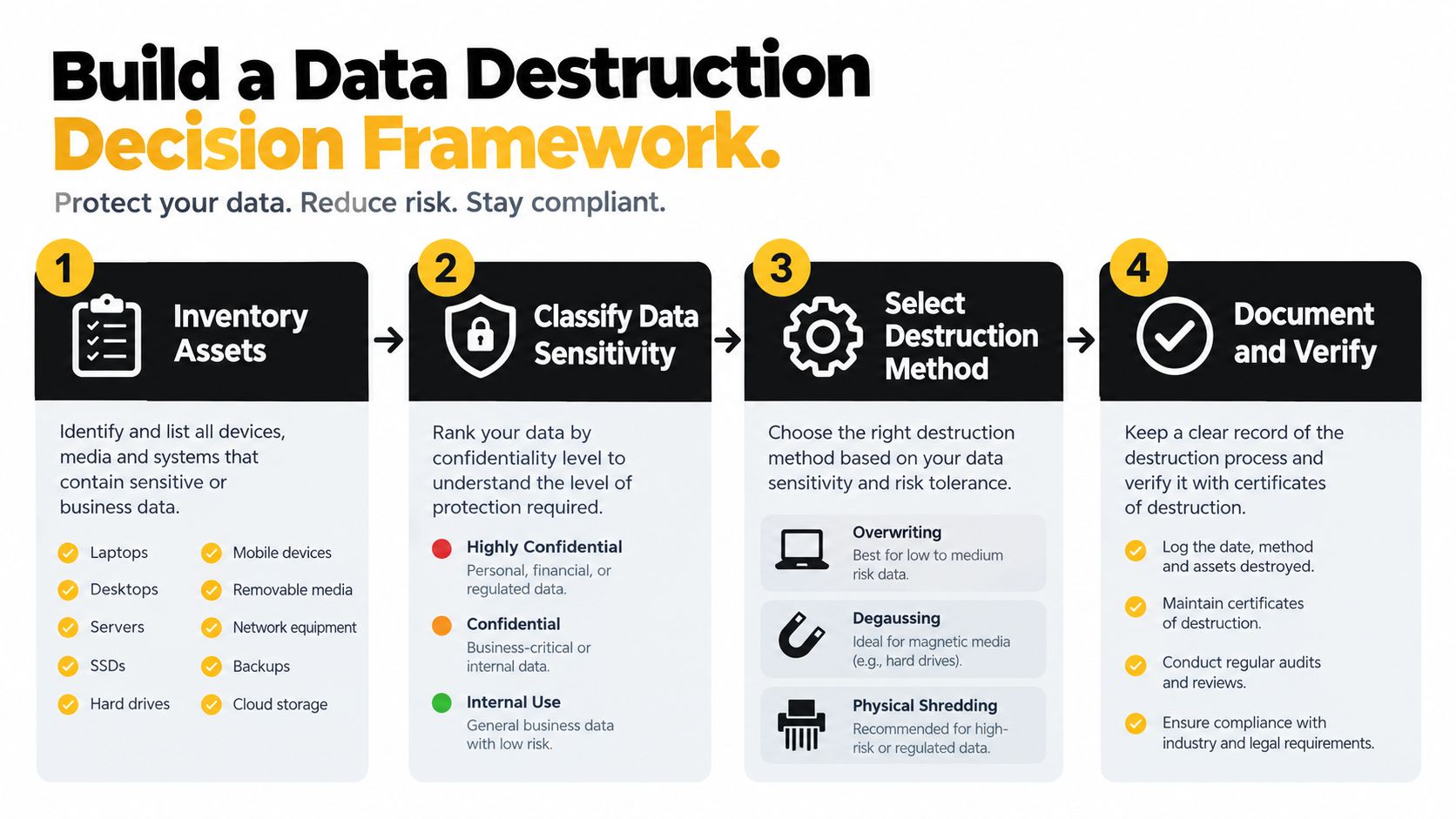
Inventory laptops, desktops, servers, SSDs, hard drives, phones, removable media, and network equipment. Add backups, shared storage, and cloud resources under organizational control to the same retirement workstream, even when different people manage them.
For each entry, record the information owner and what the retirement covers. A hardware collection may not include account administration, retained backups, or a shared repository.
- Classify the information: Identify confidentiality, contractual restrictions, applicable obligations, and the consequences of unauthorized recovery.
- Define the recipient: Distinguish internal redeployment from employee transfer, donation, resale, or material recycling.
- Set acceptance conditions: Decide what constitutes successful treatment and who can approve an exception.
- Assign unresolved copies: Give cloud repositories, backups, and retained records named owners and separate completion criteria.
The data risk assessment resource can support these planning discussions. Use it to structure decisions, not to substitute a generic checklist for knowledge of your own systems.
Approve the outcome before releasing equipment
For controlled internal reuse, your policy may permit validated sanitization that preserves the device. For externally transferred equipment, require evidence sufficient for that release boundary. If a high-risk drive fails treatment or can't be validated, route it to an approved destruction process.
Cryptographic erase belongs in the decision set only when the organization can support its assumptions about encryption and keys. Do not approve it because the laptop displays an encryption icon.
Environmental considerations belong at this stage, too. Evaluate whether the storage alone needs destruction while the remaining equipment remains eligible for recovery. For corporate donation programs, make sanitization approval a prerequisite to allocation rather than an administrative task after delivery.
Greater sensitivity or uncertainty calls for a more conservative treatment decision and stronger evidence.
The framework should also define who can stop a shipment. If nobody has authority to hold an unresolved asset, your written policy won't control the handoff.
Navigate Compliance and Audit Requirements
A technical framework, a healthcare requirement, and a privacy law do different jobs. Don't ask a recycling certificate to stand in for all of them.
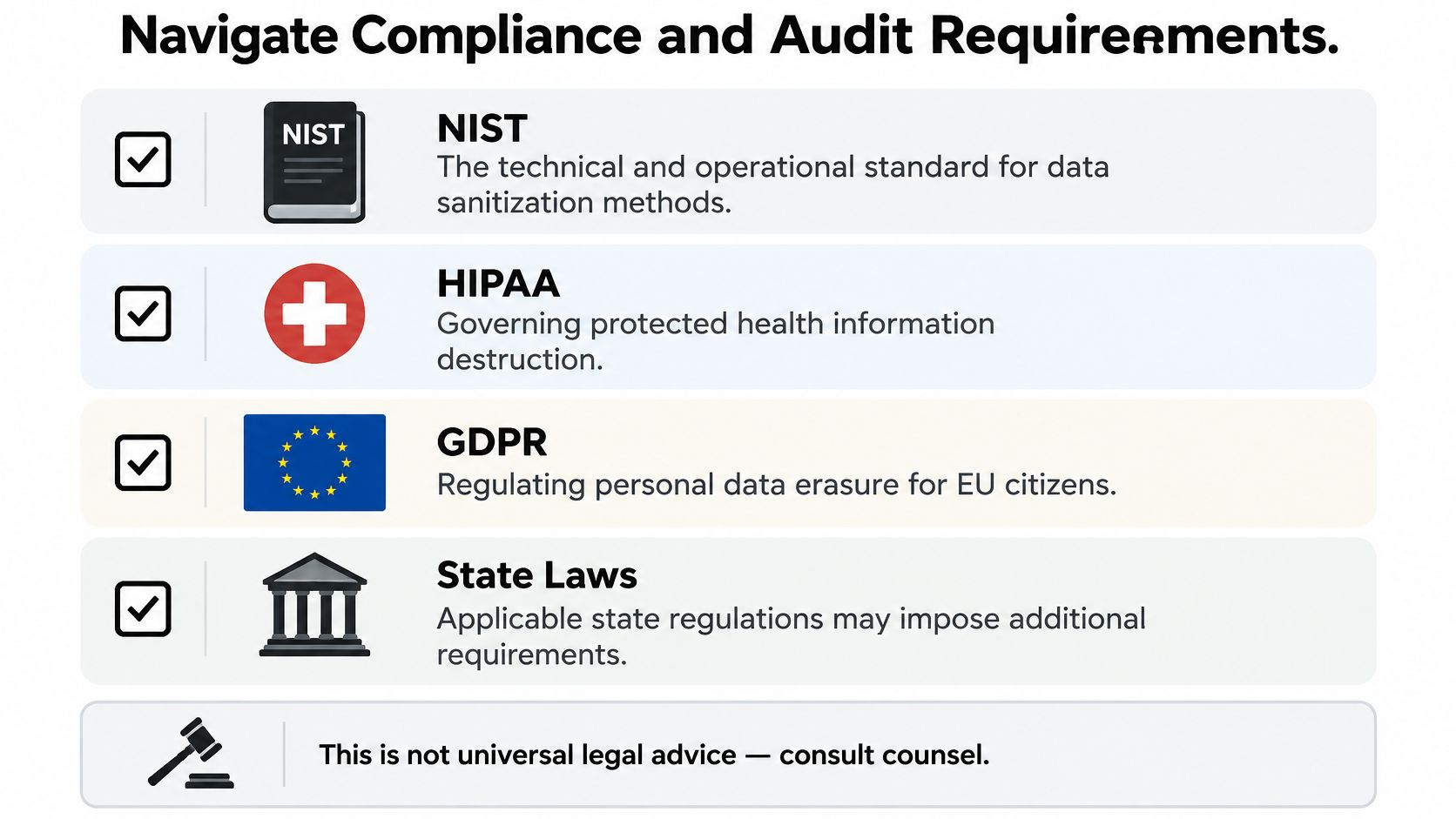
NIST supplies a technical and risk-management foundation for selecting and documenting sanitization. HIPAA creates specific responsibilities for covered entities handling electronic protected health information. Treat GDPR and applicable state laws as separate applicability reviews with counsel, based on your organization, processing circumstances, jurisdiction, and affected records.
Translate obligations into operating controls
HHS guidance on reusing or disposing of computers containing protected information states that covered entities must remove the information or destroy the media before reuse or disposal. It also identifies policies and procedures for final disposition and removal of ePHI before media become available for reuse.
For medical equipment disposal, that means the equipment release process needs a documented information-handling decision. Don't assume that moving an asset from clinical service into storage completes the obligation.
For GDPR or state-law questions, ask counsel to identify applicable duties, retention constraints, and any restrictions on erasure. An equipment-retirement deadline shouldn't override an unresolved legal hold or records-retention decision.
Retain an audit-ready evidence set
Your internal record should explain not just what happened, but why the organization accepted the result:
- Identity and scope: Asset identifiers, media identifiers where available, information classification, and the original inventory reference.
- Authorization: Approved treatment, intended destination, and the person responsible for release.
- Execution: Completion date, responsible personnel or partner, method used, and exceptions.
- Validation: Verification results, reviewer acceptance, final outcome, and reconciliation status.
For clinical teams organizing related documentation, PatientNotes' audit log policy template for clinicians is a supplementary planning reference. It isn't a substitute for evidence that a particular storage asset was sanitized.
The data security compliance resource can help frame questions for your disposal partner. Ask counsel to approve legal interpretations and ask security staff to approve technical acceptance criteria.
Compliance isn't demonstrated by a logo on a certificate. Demonstrate it through an applicable policy, an appropriate method, competent execution, and records that connect the result to the asset.
Apply the Framework to Real IT Assets
A usable office laptop shouldn't automatically meet the same fate as an unreadable healthcare drive. These representative scenarios show how an adviser should translate policy into a practical release decision.
Working equipment with a viable next use
A laptop designated for donation-based recycling needs an approved sanitization result before anyone promises it to a recipient. Its dominant risk is premature release. Retain the asset-specific treatment result and release approval, then record the donation destination.
A server holding customer records and intended for certified reuse needs a storage-level inventory, not just a chassis entry. Define what “certified” means in the purchase agreement and require records for the media included in the server. If a drive fails, hold that component rather than treating the entire batch as successful.
An encrypted laptop assigned to cryptographic erase needs an administrator who can establish the relevant encryption and key conditions. A remote command submission isn't the same as an accepted completion result. If those conditions can't be demonstrated, select another approved path.
Preserve reuse value when the evidence supports it. Don't preserve value by accepting an unexplained security exception.
Failed media and distributed information
A failed drive containing regulated healthcare information should remain controlled while the organization selects an executable treatment. Software wiping isn't a credible plan if the media can't complete the operation. An approved physical destruction path can resolve that failure, with the record tied to the original asset.
A data-center drive governed by strict internal records requirements needs the approved disposition authorization before processing. During data center decommissioning, don't let a bulk pallet description replace the identifiers your policy requires. Escalate missing or mismatched identifiers before release.
A departing employee's laptop with associated cloud records requires separate decisions for the device and the remotely retained information. Assign the account and repository work to the responsible administrator. Don't infer that destroying the laptop resolves a cloud-retention question.
The same discipline applies to laboratory equipment disposal, school computer recycling, and public-agency laptop disposal. Identify what stores information and establish the release conditions before choosing the equipment's destination.
For a Smyrna office coordinating IT and facilities teams, the useful distinction is simple: hardware availability doesn't equal release authorization. A boxed device can be ready for transport while still being prohibited from leaving organizational custody.
Create a Chain of Custody and Verification System
Chain of custody should let your team explain who controlled each asset, what happened to it, and how the final record connects to the original inventory. Build the process around identifiers, handoffs, and exception handling.
A vendor statement can describe an activity. Verifiable evidence must connect that activity to your assets and your acceptance conditions.
Follow the media through every handoff
Use this operating checklist for internal teams and outsourced processors:
- Tag and reconcile: Match equipment and removable storage to the approved retirement inventory before staging.
- Remove active access: Assign network removal and account actions where applicable without confusing those actions with media sanitization.
- Segregate by status: Keep untreated, completed, failed, and disputed assets physically distinguishable.
- Document collection: Record the releasing and receiving parties, identifiers, collection date, and custody transfer.
- Control transport: Agree on security arrangements and what happens if a shipment is delayed, damaged, or incomplete.
- Record treatment: Associate the approved operation and its result with each relevant asset or media identifier.
- Inspect and reconcile: Review destruction output where applicable and compare received, processed, failed, and released items.
- Retain proof: Store final records where authorized staff can retrieve them after equipment has left the organization.
The chain-of-custody documentation resource provides a useful starting point for specifying your partner's reporting obligations.
Investigate gaps before closing the job
A certificate should identify serial numbers or agreed alternative identifiers, method, date, responsible personnel or partner, outcome, and relevant verification details. Require an exception record when an identifier is unreadable or treatment doesn't complete.
Don't let procurement close the purchase order while security still has an unresolved asset discrepancy. An unmatched drive isn't merely an untidy spreadsheet row; it represents an unproven disposition.
Acceptance test: Can a reviewer select an asset from the original inventory and trace it to an authorized, validated final outcome?
Independent review doesn't always mean witnessing every operation. It means someone with appropriate authority evaluates whether the evidence satisfies the agreed criteria instead of accepting the provider's conclusion without examination.
Choose a Destruction and Recycling Partner
Outsourcing treatment doesn't eliminate your release decision. Choose a provider that can explain its process, show representative reporting, and accept written requirements before collection.
Start with operational questions rather than broad assurances. Ask how the provider identifies storage technology, handles failed drives, validates results, manages subcontractors, and reconciles discrepancies. Require clear boundaries for encryption keys, cloud copies, and backups so nobody mistakes physical collection for a service that wasn't purchased.
Evaluate the evidence and the destination
Use the vendor selection criteria resource to prepare a purchasing discussion. Your agreement should address:
- Scope and exceptions: Included assets, excluded services, failed treatments, and escalation authority.
- Reporting quality: Asset-level identifiers, verification results, custody records, and final outcomes.
- Reuse controls: Release approval before refurbishment, resale, employee transfer, or donation.
- Material handling: Downstream processing arrangements and the disposition of destroyed storage and recoverable equipment.
Reworx Recycling is a Smyrna, Georgia-based option for organizations comparing business pickups, equipment decommissioning, IT asset management, equipment buyback, secure hard drive shredding, and electronics recycling. Its donation-based social-enterprise model connects responsible equipment retirement with technology donations, digital inclusion, and workforce development. Confirm the scope and evidence requirements for your particular engagement rather than assuming every asset needs the same service.
Keep security and sustainability in the same contract
For sustainability leaders, the strongest proposal isn't necessarily the one that destroys the most equipment. It's the one that distinguishes reusable hardware from media requiring destruction and documents both destinations.
The word reuse also needs context across departments. Marketing staff reviewing how AdManage.ai streamlines ad reuse are addressing a different workflow from IT staff authorizing hardware transfer. Don't let familiar terminology substitute for explicit ownership, approval, and records.
Evaluate product destruction separately when commercial restrictions prohibit reuse. Otherwise, specify where validated recovery is acceptable and where destruction is mandatory.
Buy a defensible outcome, not just a collection service. A useful partner should support your security requirements while helping you plan sustainable recycling, recover available equipment value, and identify appropriate donation opportunities.
Reworx Recycling offers business equipment pickups, secure data destruction, electronics recycling, and donation-based equipment recovery that supports community technology access. Before your next refresh or office cleanout, prepare an asset list and visit Reworx Recycling to discuss donating usable equipment, scheduling a pickup, or building a secure ITAD and sustainable recycling program.