A lot of Los Angeles telecom recycling projects start the same way. A network refresh is done, the new gear is live, and the old equipment ends up in a locked room, cage, or corner of a warehouse waiting for someone to decide what to do with it.
That backlog usually includes more than a few routers and switches. It's VoIP phones from a floor-by-floor migration, wireless access points, firewalls, racks, patch panels, cable, batteries, failed spares, and servers that were supporting voice or edge workloads. The problem isn't just space. The problem is that every one of those assets can create a compliance issue, a data security issue, or a value-recovery miss if the disposition process is sloppy.
For Los Angeles businesses, sustainable telecom recycling Los Angeles planning has to do more than remove equipment quickly. It has to stand up to internal audit, satisfy security teams, support sustainability reporting, and make sense operationally across dense sites, loading docks, and distributed offices. That's why a structured IT asset disposition process matters. It turns a messy cleanup into a controlled project.
The Challenge of Retiring Telecom Assets in Los Angeles
An LA-based IT manager usually knows the feeling. The migration off legacy gear is complete, but the retired hardware hasn't left the building. Facilities wants the room back. Security wants assurance that no device with stored credentials or configs slips out untracked. Sustainability wants to know what can be reused instead of dumped.
The local waste picture makes that harder to ignore. Los Angeles County generates roughly 700,000 tons of plastic waste annually, yet only a minority of plastic types are effectively recycled, which is one reason complex devices with mixed plastics and metals need a dedicated end-of-life process rather than a generic cleanup haul, according to this recycling capture overview.
Telecom gear is a perfect example of why the simple answer often fails. A pallet of switches may contain recoverable metals, reusable components, data-bearing storage, lithium batteries, and plastic housings that don't all belong in the same downstream path. When teams treat the whole lot as scrap, they usually lose documentation, lose residual value, and create unnecessary risk.
Practical rule: If your inventory includes anything that ever touched the network, assume chain-of-custody and data handling matter until proven otherwise.
That's also where a social enterprise model can matter. A donation-based recycling partner isn't only handling removal. It can help route suitable assets toward reuse, support community benefit through technology access, and still keep the process disciplined enough for business requirements. For companies under pressure to show both environmental responsibility and local impact, that combination is stronger than a one-time junk-out.
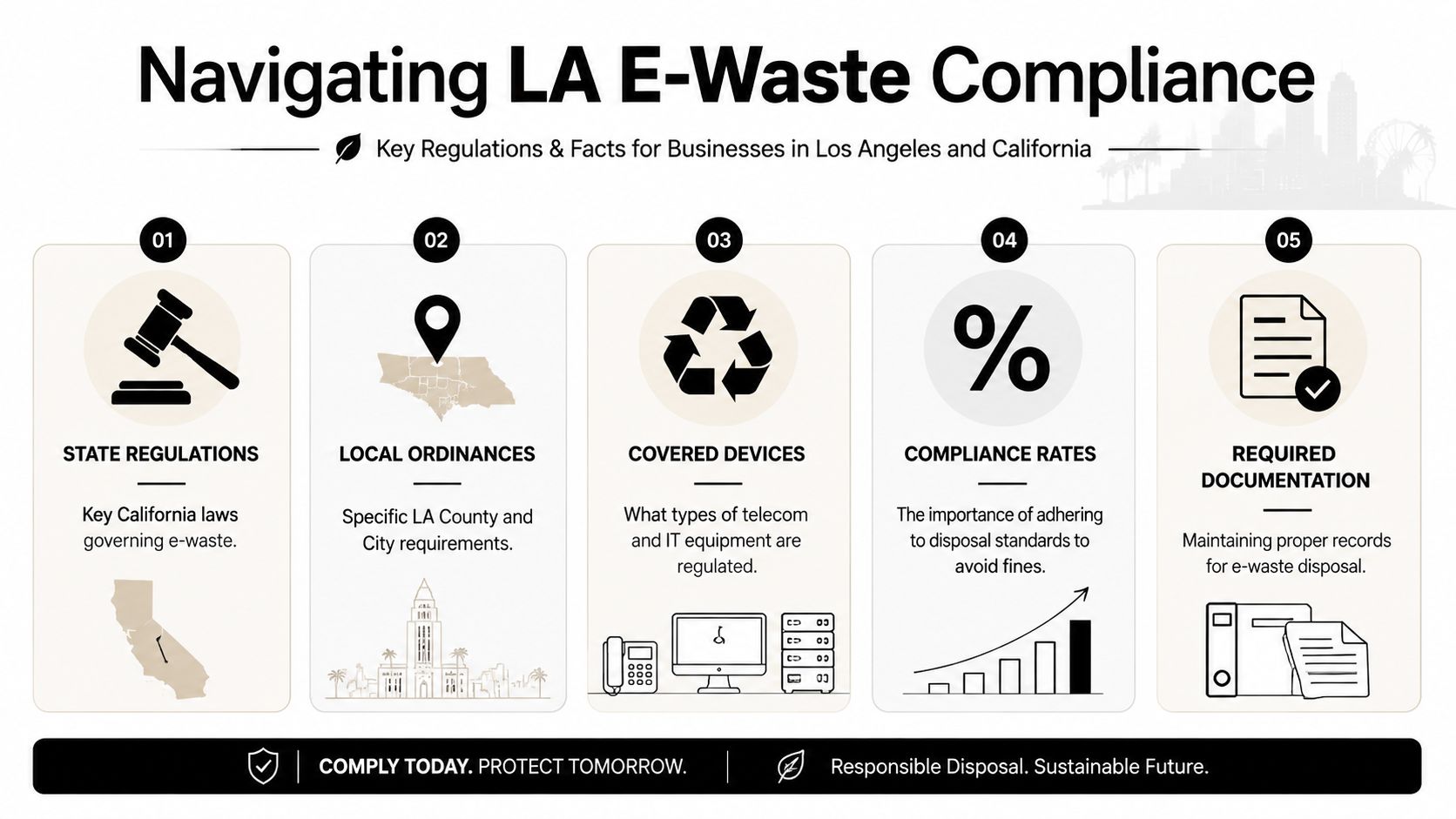
Navigating the Legal Landscape of LA E-Waste Disposal
Compliance starts before the truck arrives. If your team waits until pickup day to ask what the rules are, you're already behind.
Los Angeles businesses retiring telecom infrastructure sit at the intersection of environmental handling obligations, internal records requirements, and data privacy exposure. Even when a specific device looks harmless, the safer working assumption is that it belongs inside a documented disposal process.
Start with the local waste mandate
The strongest local signal is policy direction. Los Angeles County's Zero Waste Plan sets an aggressive 80% landfill diversion target by 2030, which means businesses are under growing pressure to use responsible outlets for waste streams like electronics, as outlined by the Los Angeles County Zero Waste Plan.
For an enterprise, that changes the conversation. Telecom retirement is no longer just an operations task. It's part of how the company responds to local sustainability expectations. If your decommissioning program sends mixed gear into an opaque downstream chain, it works against that direction.
Know what regulators and auditors will care about
A practical compliance review usually comes down to a handful of questions:
- What equipment left the site: You need an inventory that identifies what was removed. For telecom projects, that often means routers, switches, firewalls, handsets, access points, server appliances, cabling, UPS components, and batteries.
- Who handled it: If custody changes hands without documentation, your audit trail weakens immediately.
- What happened to data-bearing devices: Network gear can retain saved configurations, logs, credentials, and management data.
- Where did the material go next: Reuse, remarketing, parts harvesting, and commodity recycling each carry different risk and reporting implications.
A lot of e-waste pages focus on accepted items and pickup convenience. That's useful, but it doesn't answer what legal teams usually ask after a project is complete.
Data privacy risk is part of disposal risk
Often, telecom assets are underestimated. People think about laptops and file servers first. They forget about appliances, SSDs in network gear, call-management systems, and retired security hardware.
If those devices contain customer information, employee information, stored credentials, or infrastructure details, disposal errors can quickly become privacy incidents. California privacy obligations make that a governance issue, not just a recycling detail. Even when your legal team doesn't require a formal destruction event for every asset class, they'll still want defensible records showing that the company followed a documented sanitization standard and controlled custody from pickup through final disposition.
The vendor's promise matters less than the paperwork. If they can't show custody, sanitization method, and final outcome, you don't have a defensible process.
Build your file before the project begins
For telecom decommissioning in Los Angeles, the easiest way to stay out of trouble is to prepare your documentation stack in advance. At minimum, many enterprises want:
| Record | Why it matters |
|---|---|
| Asset inventory | Confirms what entered the project scope |
| Pickup log | Shows date, site, handler, and transfer details |
| Serial-level tracking where available | Helps reconcile what was processed |
| Data destruction record | Supports security and legal review |
| Final recycling or disposition summary | Supports internal sustainability and audit needs |
This is also the point where a certified ITAD workflow earns its keep. A recycler that only offers hauling may remove equipment. A true business process has to preserve records and route assets correctly. For LA organizations looking for a business-focused framework, responsible e-waste recycling in Los Angeles is the kind of service model worth comparing against your internal requirements.
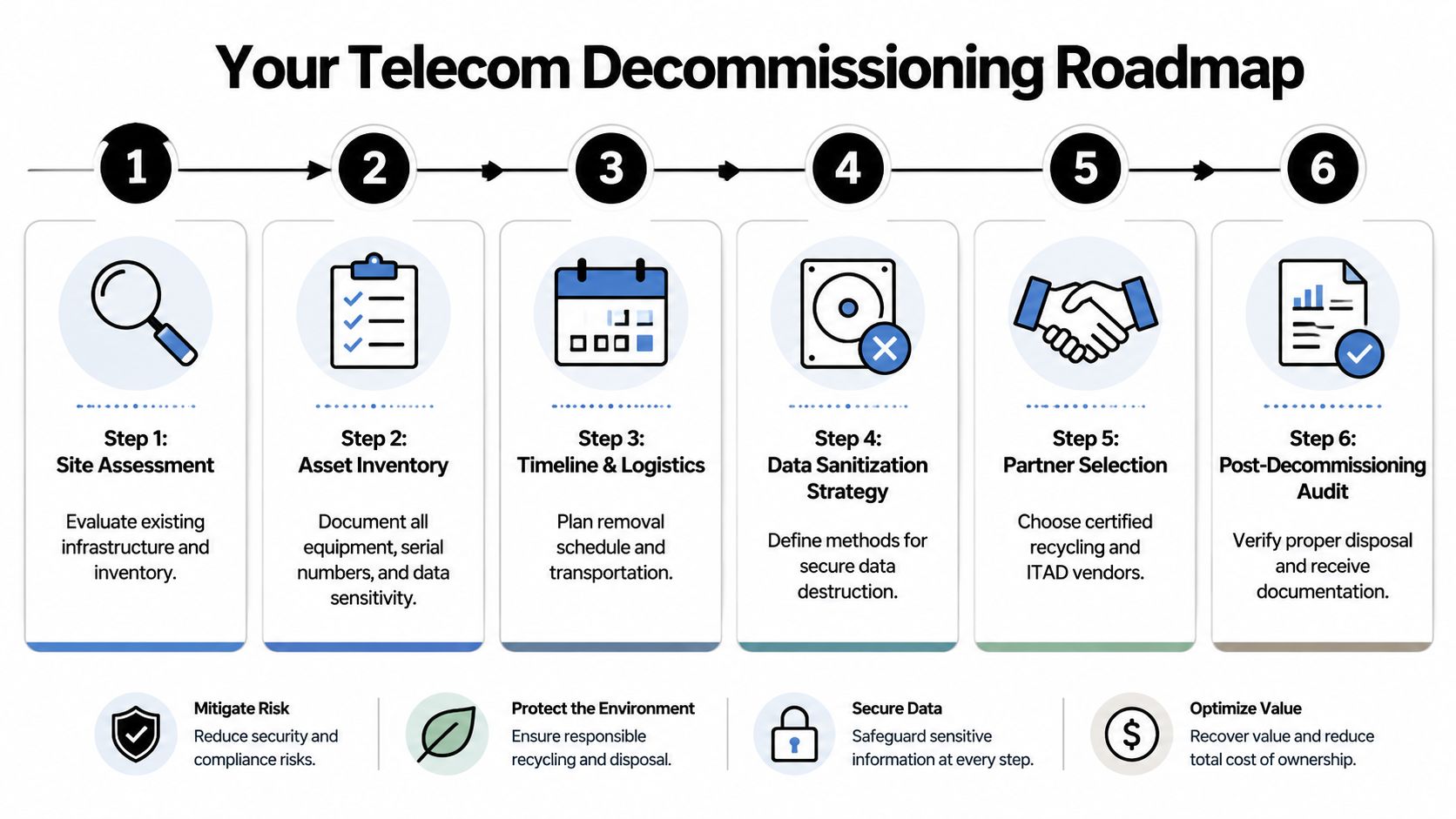
How to Plan Your Telecom Decommissioning Project
Most telecom disposal problems are planning problems in disguise. The truck arrived too early. The inventory was incomplete. Batteries were packed with general hardware. A business unit expected buyback value on equipment that was already physically damaged. None of that gets fixed at the dock.
The cleaner approach is a staged reverse-logistics plan. An effective reverse-logistics workflow involves segregating telecom assets at the point of decommissioning, triaging devices for resale versus recycling, and only shredding non-recoverable fractions, which helps preserve value from functional hardware before it's destroyed, according to this reverse-logistics and end-of-life management research.
Audit the environment before you count the gear
Start with the site, not the spreadsheet. Walk the MDFs, IDFs, storage rooms, server spaces, repair benches, and any offsite storage your telecom team uses. In Los Angeles, large organizations often have more gear spread across satellite offices and mixed-use facilities than they realize.
Look for the equipment that gets missed in a quick inventory:
- Installed but inactive devices: Old switches left in racks, disconnected firewalls, and edge appliances still mounted after cutover.
- Shelf spares and RMAs: These often hold resale value or require separate documentation.
- Peripheral infrastructure: Rack PDUs, transceivers, patch panels, batteries, handsets, and cabling can materially affect labor and sorting.
Build an inventory that operations can use
A useful inventory is more than make and model. It should help security, facilities, finance, and your ITAD vendor make decisions without guessing.
Include details such as:
Asset type and function
Distinguish between core network, voice, wireless, security, and supporting hardware.Location and access notes
A rooftop cabinet, hospital wing closet, and downtown high-rise loading dock each create different removal constraints.Data sensitivity
Flag anything with storage, management logs, saved credentials, call records, or removable media.Physical condition
Working, untested, damaged, incomplete, or harvested. That affects whether an asset is a reuse candidate or material recovery item.Power and battery status
Devices with embedded or attached batteries should be separated early.
Field note: Teams recover more value when they identify functional assets before teardown starts. Once good gear gets mixed into scrap gaylords with cable and broken plastics, the economics usually collapse.
Set project rules before anyone touches the racks
Enterprises do better when they decide a few things up front. Don't leave these to ad hoc judgment on removal day.
A workable pre-decommissioning checklist often includes:
- Who signs off on scope: IT, security, and facilities should agree on what is being removed.
- What gets wiped, what gets shredded: Not every asset class follows the same path.
- What can be remarketed or redeployed: This matters for branch equipment, handsets, and newer network hardware.
- What must stay segregated: Batteries, drives, and high-value devices should not get packed loose with mixed materials.
If you need a planning reference for internal teams, a server decommissioning checklist is useful because the same discipline applies to telecom environments that include storage or compute elements.
Separate for outcome, not convenience
Too many projects sort by who happened to remove the item. That creates mixed loads and weak reporting. Sort by disposition path instead.
| Category | Typical examples | Best next step |
|---|---|---|
| Reuse or redeploy candidates | Newer switches, handsets, tested spares | Triage, test, evaluate for remarketing or internal redeployment |
| Data-bearing assets | Firewalls, routers with storage, call systems, servers | Controlled sanitization and chain-of-custody |
| Commodity recovery items | Damaged chassis, mixed cable, broken peripherals | Material recovery through certified recycling |
| Special handling items | Batteries, media, damaged power units | Separate containment and specialized processing |
That structure keeps your telecom decommissioning project from becoming a generic office cleanout. It also gives procurement and sustainability teams something concrete to measure after the work is done.
The Critical Importance of Secure Data Destruction
Telecom hardware gets retired for technical reasons long before its security risk disappears. Disconnecting a firewall doesn't remove stored settings. Powering down a call system doesn't erase logs. Pulling a switch from a rack doesn't guarantee there's no saved configuration or credential material left behind.
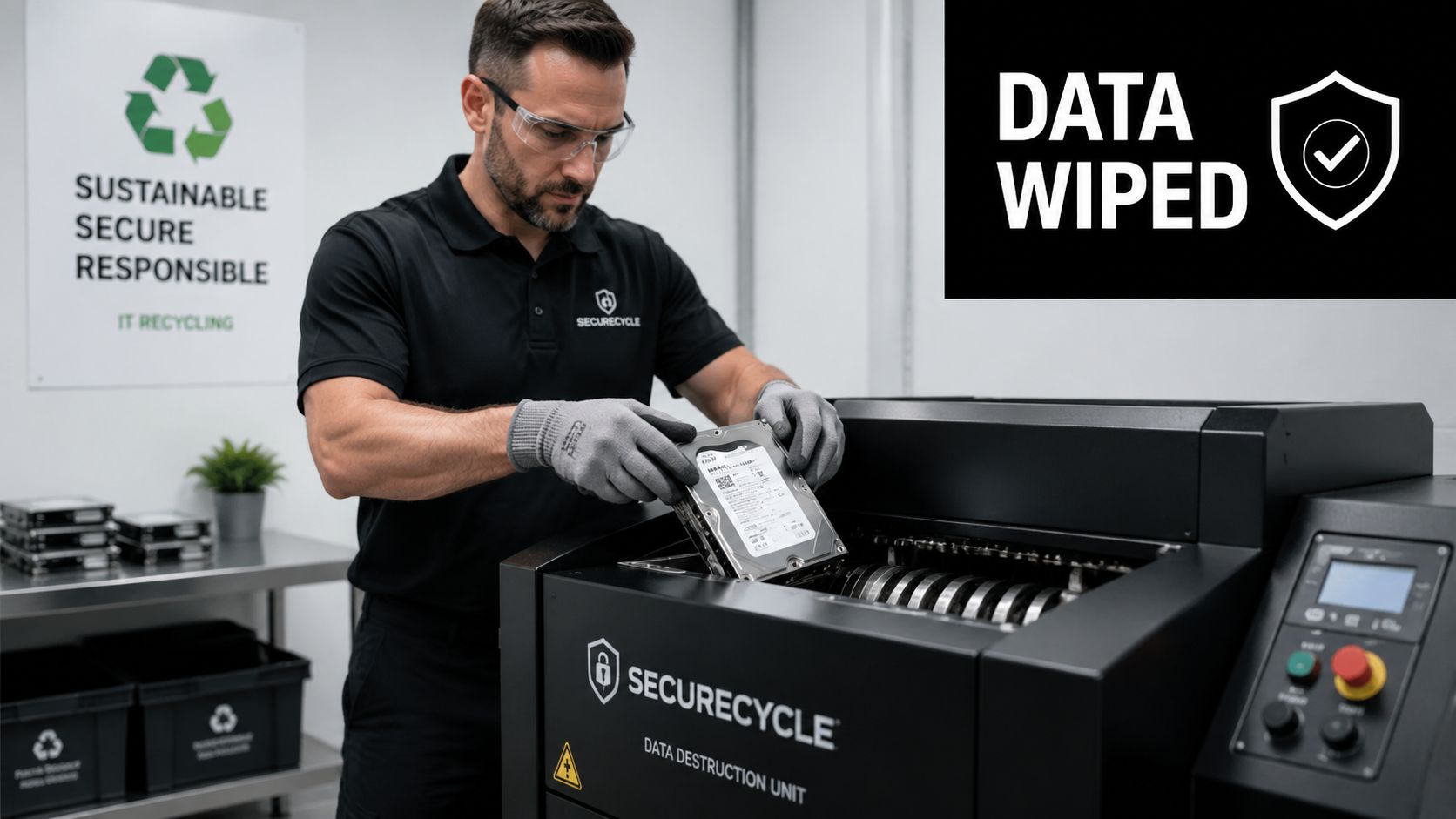
That's why sustainable telecom recycling Los Angeles programs fail when they treat data destruction as an optional add-on. Secure recycling only counts as secure if the sanitization method matches the device and the vendor can prove what was done.
Why telecom devices get overlooked
Most IT teams have formal procedures for laptops and primary servers. Telecom assets often sit outside that habit. They may be managed by a network group, a voice team, a facilities technology unit, or an outside integrator. The result is inconsistency.
Commonly overlooked devices include:
- Routers and firewalls that retain configuration files, VPN settings, or management credentials
- Unified communications platforms that may store call detail, user data, or administrative records
- Network appliances with SSDs, flash modules, or removable media
- VoIP phones and mobile endpoints that may hold user settings or cached account information
The same logic that applies when you factory reset an iPhone applies here in principle, but enterprise telecom gear usually requires more than consumer-grade reset habits. A menu reset may change usability status without meeting your company's evidentiary standard for data sanitization.
The three methods that matter
Not every destruction method fits every device. That's where companies get into trouble. They choose one approach and apply it indiscriminately.
Wiping
Software-based wiping works when the media supports it and the device can be processed under a controlled standard. This is often the preferred route for assets with reuse potential because it preserves the hardware for redeployment or remarketing. But it only works if the device is reachable, the media is functional, and the process is logged.
Degaussing
Degaussing is relevant for certain magnetic media. It disrupts stored data but also affects whether the media remains usable. It's not a universal answer for all telecom hardware, especially where newer storage types are involved.
Physical destruction
Shredding or other physical destruction methods are the fallback when media is damaged, inaccessible, failed, or designated for destruction based on policy. It's also the right option when the organization has no appetite for any residual uncertainty.
If you can still debate whether the media was fully sanitized after it leaves your building, the method probably wasn't strong enough for that asset class.
What a defensible process looks like
A secure process should answer five questions cleanly:
- Which assets required sanitization
- Which method was used on each applicable asset
- Who handled the equipment from release to completion
- Whether exceptions occurred
- What documentation was issued afterward
This is why a Certificate of Data Destruction matters. It isn't just ceremonial paperwork. It's what your internal audit, legal, or security team can rely on later if a device record is questioned.
For organizations evaluating vendors, secure data destruction services in Los Angeles is the kind of capability set that should be on the checklist. You want auditable records, a defined sanitization process, and clarity about when destruction is performed versus when wiping is permitted to preserve asset value.
Security and sustainability are not competing goals
A lot of companies assume they must choose between maximum security and maximum reuse. In practice, the better process is selective. Reuse-eligible assets get validated, sanitized, and documented. Non-recoverable or policy-restricted media gets destroyed. That split protects the organization without forcing every device into the shredder.
Premature shredding is one of the biggest value leaks I see in telecom retirement work. It feels decisive, but it often destroys equipment that could have been safely sanitized and put back into service or secondary markets. Security should drive the method, not panic.
Choosing the Right Sustainable Recycling Partner in Los Angeles
Vendor selection is where strategy becomes real. If you choose a hauler, you'll get hauling. If you choose a disciplined ITAD partner, you'll get process, security controls, and usable reporting.
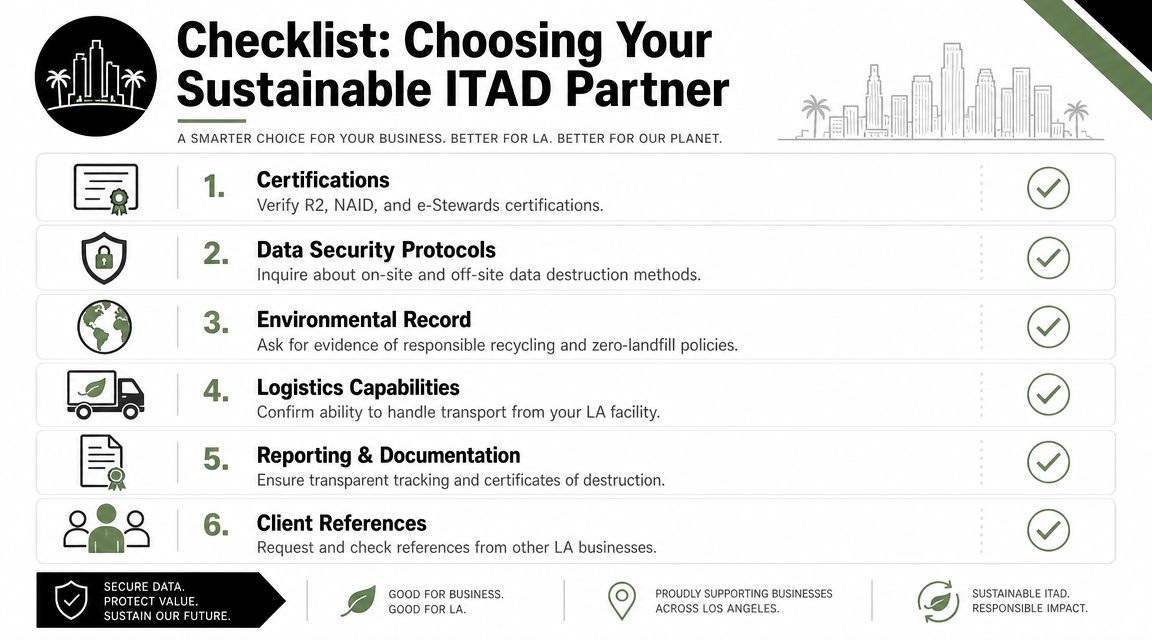
That distinction matters because the global system still loses too much material to poor execution. The world generated 62 million metric tons of e-waste in 2022, but only 22.3% was formally recycled, which highlights how much the outcome depends on logistics and process transparency rather than good intentions alone, as summarized by California Recycles. The same source notes that a key differentiator is whether a vendor can show how much hardware is reused versus shredded.
Separate scrap handling from ITAD capability
A scrap vendor may be acceptable for low-risk commodity material. That's not the same thing as enterprise telecom disposition.
Use this quick comparison during procurement:
| Question | Scrap-focused vendor | ITAD-focused vendor |
|---|---|---|
| Can they track serialized assets? | Sometimes limited | Usually part of the workflow |
| Can they document data destruction? | Not always | Should be standard |
| Do they triage for reuse before recycling? | Often no | Should be central to the model |
| Can they support audit requests later? | Often weak | Should be prepared for it |
If a vendor answers every question with broad assurances but can't show sample documentation, keep looking.
What to ask in the first call
Good vetting questions are specific. Generic questions invite generic sales answers.
Ask things like:
- How do you maintain chain-of-custody from pickup through final processing?
- What happens to tested reusable telecom gear before any shredding decision is made?
- How do you handle batteries, mixed loads, and partially decommissioned racks?
- What reporting do you provide after pickup?
- Can you separate data-bearing equipment from commodity recycling streams at intake?
Due diligence check: A credible partner can explain its decision tree in plain English. If the workflow sounds vague, the downstream handling probably is too.
Reuse transparency matters more than slogans
A lot of vendors market sustainability but say little about actual disposition hierarchy. For telecom and networking hardware, that's a red flag. The more mature model prioritizes repair, remarketing, parts harvesting, and redeployment before final material recovery, when those paths are appropriate and secure.
That's one reason social enterprise recycling deserves a look in Los Angeles. The model can align disposal with community benefit rather than treating every retired asset as raw scrap. Within that category, IT asset disposal solutions for businesses in Los Angeles is one example of a provider approach that combines business pickup, decommissioning support, data handling, and donation-based recycling pathways. For organizations with ESG and local impact goals, that structure can fit better than a pure commodity buyer.
The checklist I'd use for a telecom project
Not every criterion carries equal weight. For telecom environments, I'd rank them like this:
Chain-of-custody discipline
If custody breaks, everything else gets harder to defend.Data destruction controls
Especially important for routers, firewalls, appliances, communications systems, and anything with removable media.Reuse-first triage
This protects value and supports lower-carbon disposition paths.Reporting quality
You need post-project records your security, procurement, and sustainability teams can all use.Operational fit in Los Angeles
Dense sites, building rules, timing windows, and traffic all affect execution.Community benefit model
Useful when corporate donation programs or digital inclusion goals are part of the broader mandate.
A good sustainable telecom recycling Los Angeles partner should be able to operate at all six levels. If they only excel at pickup speed, they're incomplete.
Executing the Pickup and Tracking Your Impact
Pickup day should be boring. That's a compliment. The project is in good shape when the team on site already knows what's leaving, how it's labeled, which assets require special handling, and who signs the transfer.
The best execution plans are disciplined but simple. Label by disposition category, keep data-bearing gear separate, isolate batteries, and make dock access instructions explicit. In Los Angeles, small logistical misses become expensive fast because loading windows, parking constraints, freight elevator access, and multi-site coordination can all slow the job.
What to have ready before the carrier arrives
You don't need a complicated war room. You need clarity.
A practical pre-pickup setup includes:
- A release list: The internal list of what is approved to leave site
- Staging by type: Reuse candidates, data-bearing equipment, cable and commodity material, and special handling items shouldn't be mixed
- Site instructions: Dock hours, contact names, badging rules, elevator access, and pallet or cart requirements
- Exception handling: A plan for found assets, mislabeled gear, or devices discovered to contain media during removal
Effective internal coordination demonstrates its value. IT identifies the hardware. Security approves data handling. Facilities manages building flow. Procurement or sustainability may want copies of the final records.
Use labeling and feedback loops to improve future loads
The overlooked part of telecom recycling is what happens after the first project. Most organizations repeat the same mistakes because no one closes the loop.
That's avoidable. Studies on recycling behavior show that simple feedback mechanisms, such as post-pickup reports and clear labeling, can significantly improve collection purity and reduce contamination, which improves recovery value and processing efficiency, according to this research on recycling feedback mechanisms.
That finding translates well to enterprise telecom operations. If your vendor tells you which pallets were clean, which assets were reusable, which loads had contamination issues, and what was rejected, your next decommissioning project gets easier.
Post-pickup reporting shouldn't just confirm removal. It should teach your team how to sort better next time.
What the final report should help you answer
A solid post-project package should let you answer three internal questions.
First, was the work compliant and secure?
That means you can reconcile what left the site, confirm custody, and match applicable assets to destruction or sanitization records.
Second, did the organization preserve value where possible?
You want visibility into what was suitable for reuse, what went to material recovery, and where sorting quality affected the outcome.
Third, what does this contribute to internal sustainability reporting?
Even when you don't publish a formal ESG report, many companies still need internal evidence of responsible electronics handling.
A useful review meeting after the pickup is often short but revealing. Which buildings generated the cleanest loads? Which teams mislabeled gear? Which asset classes should be separated differently next time? Those questions turn one-time cleanup into a repeatable program.
Turn Your Outdated Tech into a Community Asset with Reworx
Retiring telecom infrastructure in Los Angeles doesn't have to be a scramble. When the process is handled correctly, the company gets a cleaner site, stronger documentation, lower security risk, and a more credible sustainability story.
The sequence is straightforward. Understand the disposal rules that affect your business. Inventory and segregate assets before removal begins. Match the data destruction method to the device. Choose a partner that can prove chain-of-custody and show what was reused versus recycled. Then use the final reporting to improve the next project.
There's also an opportunity to make the outcome more useful than simple disposal. A donation-based social enterprise model can support responsible IT asset disposition while extending community benefit through digital inclusion and equipment reuse programs. If your organization wants to connect technology retirement with corporate donation efforts, donate a laptop through Reworx Recycling is a practical next step to explore.
If your business is planning a network refresh, office cleanout, data center decommissioning, or broader IT equipment disposal project, Reworx Recycling offers a place to start. Schedule a pickup, review donation-based recycling options, or explore a partnership that supports secure data destruction, sustainable recycling, and community impact at the same time.