
Your team is probably in the middle of it right now. Circuits are overloaded, Wi-Fi complaints keep surfacing, cloud apps feel slower than they should, and someone has finally said the obvious: the network can't stay the way it is.
In Los Angeles, that decision carries more weight than it does in most markets. A network upgrade here isn't just a facilities project or an IT refresh. It affects tenant experience, production continuity, remote access, data movement, security, procurement, and what happens to every retired switch, router, server, access point, and cable run after cutover. Businesses that treat deployment and disposal as separate projects usually create unnecessary cost and risk. The smarter move is to plan the entire lifecycle at the start.
The Los Angeles Connectivity Imperative
Los Angeles rewards companies that can move data fast, keep systems available, and adapt without ripping out their network every few years. That's true for media firms moving large files between production teams, logistics operators coordinating warehouses and ports, healthcare groups connecting distributed sites, and multi-location businesses trying to keep voice, cloud, and security systems stable.
The local stakes are higher because LA isn't just a large metro. It's a major digital crossroads. Los Angeles serves as a critical gateway for trans-Pacific internet traffic, which matters directly for companies with Asia-Pacific customers, suppliers, teams, or cloud dependencies. CoreSite's LA3 data center connects to over 100 networks and offers direct on-ramps to major cloud providers, reinforcing LA's role as one of the West Coast's top three tech talent pools, according to TechBehemoths on Los Angeles telecom companies.

That changes how businesses should think about telecom infrastructure services Los Angeles providers offer. You're not only buying bandwidth. You're buying resilience, interconnection options, room for growth, and the ability to support a business model that may already depend on real-time systems and cloud traffic flowing across regions.
Why legacy networks fail in LA first
Older networks usually break under modern usage patterns long before the hardware is technically dead. The symptoms show up in predictable ways:
- Cloud congestion: SaaS platforms, video meetings, file sync, and security tools all compete for the same links.
- Coverage gaps inside buildings: Steel, concrete, low-e glass, and dense tenant buildouts can weaken indoor wireless performance.
- Patchwork upgrades: New apps get layered onto old cabling and aging edge hardware until troubleshooting becomes guesswork.
- Unplanned retirements: Teams replace equipment under pressure and leave the old gear sitting in closets, MDFs, storage rooms, or loading docks.
Businesses in Los Angeles rarely lose ground because they lack tools. They lose ground because their underlying connectivity wasn't designed for how the business actually operates today.
That's why serious planning starts with a full lifecycle view. New fiber paths, structured cabling, small cells, and data center interconnects matter. So does what happens when the old stack comes out.
Infrastructure strategy has to include end-of-life planning
A mature upgrade plan accounts for three moments, not one: design, cutover, and retirement. Most vendors focus heavily on the first two. Fewer are disciplined about the third.
If your team is evaluating telecommunications support options for business environments, the useful question isn't just who can install fastest. Ask who can coordinate around occupancy constraints, staged migrations, documentation, and decommissioning without creating cleanup problems for IT, facilities, or compliance teams later.
In Los Angeles, speed matters. So does control. The best telecom projects improve service without leaving a pile of obsolete hardware and cabling behind.
Decoding Core Telecom Infrastructure Services
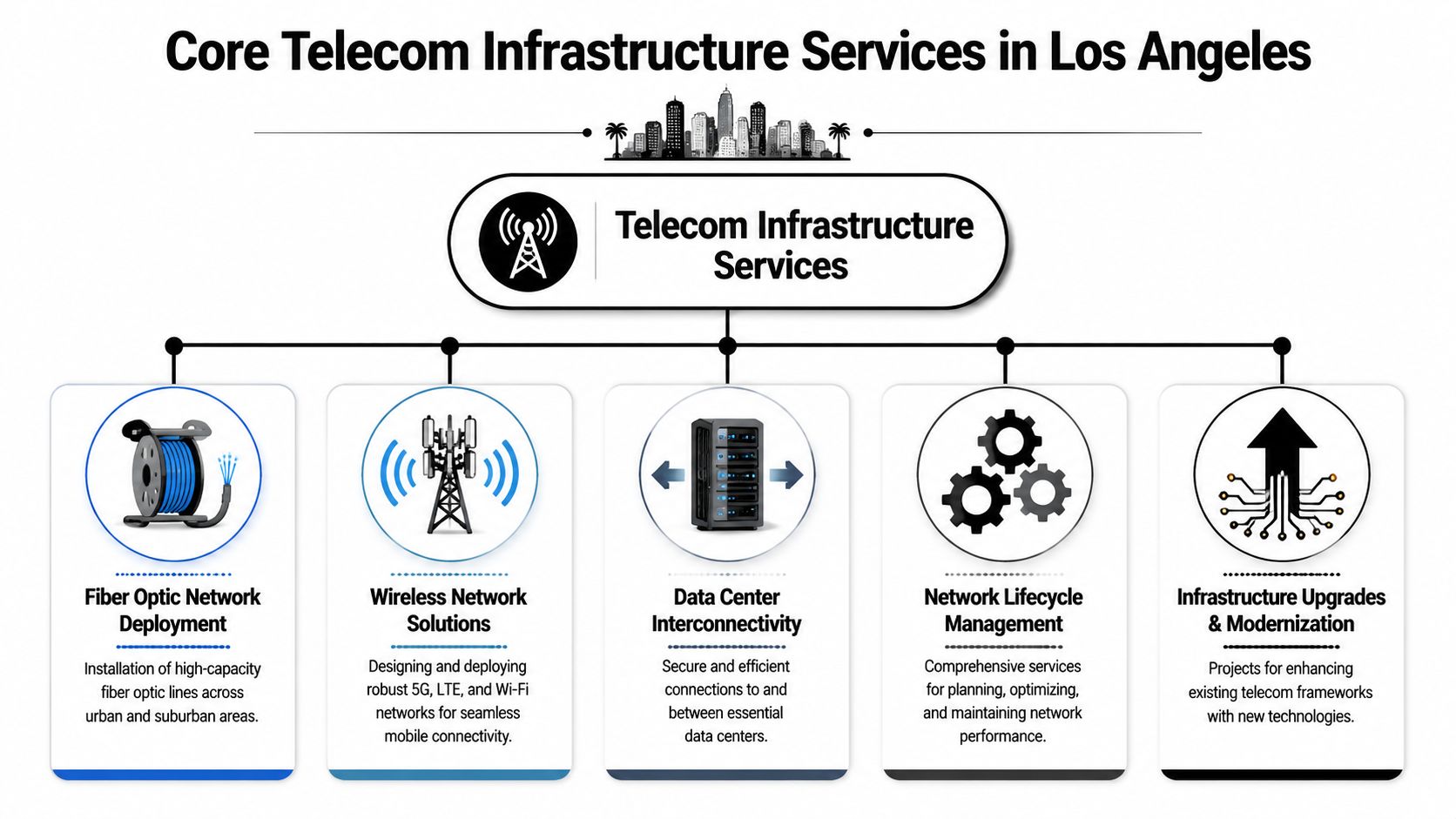
Most buyers don't need a theory lesson. They need a clear map of what each service does and when it solves a real business problem. In practice, telecom infrastructure services Los Angeles companies provide usually fall into a few core buckets: fiber deployment, wireless coverage systems, structured cabling, data center connectivity, and modernization work tied to new applications.
Fiber and structured cabling
Fiber is the long-haul backbone. Structured cabling is the internal road system that lets users, devices, and applications reach it. A lot of failed projects happen because decision-makers fund the carrier handoff but under-scope the internal distribution layer.
In high-performance LA data center environments, structured cabling often uses OM4 multimode or OS2 single-mode fiber that supports speeds up to 400Gbps, with designs aligned to TIA-942 Tier III standards targeting 99.982% uptime, as described by Telecom Wiring's data center cabling guidance.
For a business buyer, the practical takeaway is simple:
| Service type | What it solves | Where it matters most |
|---|---|---|
| Fiber backbone | High-capacity transport between buildings, carriers, and data centers | Campuses, multi-site businesses, cloud-heavy operations |
| Structured cabling | Clean, documented connections for users, APs, cameras, phones, and switches | Offices, healthcare, industrial, mixed-use buildings |
| Fiber distribution inside facilities | Support for dense traffic and future growth | Data rooms, IDFs, production spaces |
DAS, small cells, and wireless coverage
A lot of businesses assume poor mobile performance indoors is just a carrier issue. It often isn't. Buildings themselves can block signal, and tenant density can overload nearby outdoor infrastructure.
That's where distributed antenna systems (DAS) and small cells come in, but they solve different problems.
- DAS works like an internal signal distribution system. It's useful when a building needs broad, managed in-building cellular coverage.
- Small cells act more like localized wireless nodes that add capacity in targeted areas, especially where user density is high.
- Enterprise Wi-Fi remains separate from public carrier coverage. It still needs careful RF design, switching, power, and backhaul planning.
A warehouse operator, hospital, studio lot, or high-rise owner shouldn't buy these interchangeably. The right choice depends on who needs coverage, what applications are in use, and whether you're solving for public cellular, private wireless workflows, or internal Wi-Fi performance.
Field reality: If the site survey is weak, the installation will look better on paper than it performs in production.
Data center interconnectivity and lifecycle management
A modern telecom project also includes the less visible work: carrier cross-connects, cloud access, failover design, hardware refresh sequencing, and maintenance planning after installation. Experienced providers separate themselves from contractors who are only strong at physical installation through these critical technical components.
Teams pursuing public sector or large enterprise work often need procurement discipline as much as technical skill. If your business is bidding, partnering, or trying to understand how telecom vendors position themselves, it's useful to review resources on winning telecom contracts on SamSearch, especially for organizations that need to align technical capability with government or institutional buying processes.
For day-to-day operations, ask whether the provider can handle all of the following in one coordinated scope:
- Design validation: Not just diagrams, but field-verified routing, rack layouts, and pathway checks.
- Cutover planning: A sequence for moving services without leaving partial failures behind.
- Documentation: Labeling, as-builts, patching maps, and test results your internal team can use.
- Retirement planning: A defined process for removing replaced hardware and obsolete cabling from the environment.
If you're comparing telecom solution partners for commercial upgrades, keep the conversation grounded in operational outcomes. Better service comes from better design discipline, not from the longest equipment list.
Navigating LA's Regulatory and Permitting Maze
Many telecom projects in Los Angeles stall for the same reason. The technical scope is sound, but the local approval path wasn't respected early enough.
That's especially true for rooftop deployments, street-level work, and projects that cross jurisdictional lines between building owners, municipalities, utilities, and carriers. LA's scale is one challenge. Its fragmented operating environment is another. A plan that works in one submarket can hit friction quickly in another.

Rooftops, rights-of-way, and real-world delay points
For 5G and related wireless expansion, Los Angeles projects can involve rooftop permits under FCC regulations and specialized mounting systems able to withstand 120mph winds, according to Future Market Insights on U.S. telecom network infrastructure. That fact alone tells you something important. These projects aren't just about hanging hardware. They involve structural review, landlord approvals, installation methods, and reliability requirements that need to hold up in dense urban conditions.
Common delay points include:
- Landlord sign-off: Especially when roof access affects warranties, visual impact, or shared tenant rights.
- Municipal coordination: Street work, conduit access, and utility interaction can trigger multiple review layers.
- Power availability: Telecom hardware is useless without realistic plans for electrical tie-in and backup support.
- Site access rules: Downtown towers, campuses, medical properties, and production facilities often limit work windows.
The vendors who move fastest usually know the paperwork best
The strongest local firms don't just know equipment. They know how projects move through property management, inspectors, utility coordination, and field constraints.
That matters even more when your upgrade intersects with public-facing infrastructure or larger digital access initiatives. Los Angeles has been advancing fiber expansion through public channels, and that broader environment affects private work too. Businesses planning a cutover should build time for permit review, site revisions, and owner comments before procurement deadlines get tight.
A telecom schedule in Los Angeles should always include an approval buffer. If a vendor promises a frictionless path without mentioning permits, ask harder questions.
Don't ignore the cleanup obligations tied to physical work
Permitting rarely gets discussed alongside decommissioning, but the two are connected in practice. Once technicians remove old antenna components, cabinets, routers, copper, batteries, or legacy cabling, someone is responsible for secure handling and lawful disposal.
That's especially relevant for organizations trying to align infrastructure work with local sustainability expectations. Companies reviewing responsible e-waste recycling support in Los Angeles should think of disposal planning as part of site closeout, not as a separate afterthought. A clean turnover matters to landlords, auditors, and internal stakeholders alike.
Budgeting and Timelines for Your Telecom Project
Budget discussions usually start in the wrong place. Buyers focus on switch costs, cabling materials, antennas, or monthly carrier charges. Those line items matter, but they don't tell you what the project will really consume in labor, coordination, downtime avoidance, testing, staging, change control, and disposal.
The market backdrop matters too. The U.S. telecom services market generated USD 522.8 million in 2025 and is projected to grow at a 7.3% CAGR through 2033, driven by 5G launches and high capital expenditures, according to Wireless Infrastructure Association market statistics. For LA businesses, that kind of investment cycle typically means tighter scheduling, longer lead coordination, and more pressure on experienced labor.
What actually drives cost
Think in cost layers rather than line items.
First, there's the site condition layer. An occupied high-rise, medical property, production studio, or campus with restricted work windows will cost more to execute than a straightforward office suite. Access rules, after-hours labor, pathway limitations, and staging constraints all add complexity.
Second, there's the integration layer. The project gets more expensive when the new network has to coexist with the old one during migration. That includes temporary circuits, phased cutovers, extra labeling, overlap testing, and rollback planning.
Third, there's the retirement layer, which buyers often ignore until the final week. Removed hardware, rack gear, UPS components, copper, legacy wireless equipment, and storage devices all need handling. If no one priced that work, facilities and IT inherit it.
A better way to estimate timeline risk
Telecom timelines fail less often because of bad installation and more often because of bad sequencing. A realistic schedule accounts for procurement, access approvals, pre-staging, implementation windows, testing, remediation, and asset removal.
A useful planning habit is to separate the project into these phases:
Discovery and design
Audit the current environment, document dependencies, and confirm what must remain live during cutover.Approvals and procurement Projects either gain momentum or start slipping during this phase.
Installation and migration
Hardware can go in quickly. Clean migration still takes coordination.Post-cutover stabilization
Expect punch lists, signal tuning, user validation, and cleanup.Decommissioning and disposition
Old assets shouldn't stay in place because the “main project” is over.
Teams that need better internal coordination around staffing and project handoffs can borrow ideas from TekRecruiter project management insights, especially when multiple departments share responsibility for execution.
Use total cost of ownership, not install cost
A network that looks cheaper on bid day can become expensive fast if it creates maintenance burden, documentation gaps, or a messy retirement process.
Here's a practical comparison:
| Budget lens | What it includes | What buyers often miss |
|---|---|---|
| Install cost | Hardware, cabling, field labor | Testing depth, cleanup, rollback support |
| Operating cost | Maintenance, support, service changes | Time spent troubleshooting poor documentation |
| Lifecycle cost | Refresh planning and decommissioning | Secure disposition and removal of retired assets |
If your team is benchmarking telecom network installation support for business rollouts, apply that same lifecycle thinking locally. The right budget isn't the smallest initial quote. It's the one that closes the project properly and leaves your environment easier to operate.
How to Choose the Right Telecom Vendor in Los Angeles
Vendor selection in LA should be less about presentations and more about proof. Plenty of firms can describe fiber, cabling, wireless coverage, and cutover support. Fewer can show they've handled occupied buildings, difficult ownership groups, strict access windows, and multi-team coordination without leaving rework behind.
Start with the vendor's local operating maturity. Ask where they've worked, what kinds of sites they know, and how they deal with tenant-sensitive or mission-critical environments. A provider that's strong in greenfield construction may struggle in a live office tower, hospital, studio campus, or logistics facility.
Questions worth asking before you sign
Who runs the field work?
You want to know whether the senior team that sells the project is the same team that will supervise routing, testing, and closeout.How do you document the finished environment?
“We label everything” isn't enough. Ask for sample as-builts, test reports, and turnover packages.What happens during cutover if something fails?
Good vendors can describe rollback logic clearly and calmly.How do you handle removed equipment and old cabling?
If the answer is vague, the project closeout will probably be vague too.
The best telecom vendor usually isn't the one with the broadest slide deck. It's the one that can explain exactly how your site will function on the day after cutover.
Review fit, not just capability
A capable provider can still be the wrong fit if their service model doesn't match your business. Some firms are built for carrier-scale jobs and treat mid-market clients as side work. Others are responsive but don't have enough depth for large, multi-site upgrades.
One practical way to calibrate options is to compare top business internet options first, then work backward from your connectivity strategy. Once you know whether your environment needs carrier diversity, stronger SLA terms, in-building wireless improvement, or a major cabling overhaul, vendor evaluation gets sharper.
Red flags that usually show up later
Watch for these warning signs during procurement:
- Overconfident schedules: If the timeline ignores approvals, access constraints, or testing windows, it's probably fantasy.
- Thin discovery: A provider that skips detailed surveys often prices low and changes scope later.
- No closeout process: If there's no documented handoff, your internal team will spend weeks fixing what wasn't finished.
- Disposal blind spots: Old hardware, patch panels, and storage media cannot be left for someone else.
Choose the vendor that makes operations easier after install, not just one that gets hardware on site quickly.
The Critical Final Step Sustainable IT Asset Disposition
Every major telecom upgrade creates a second project whether you plan for it or not. It's the end-of-life stream: retired switches, routers, firewalls, access points, servers, optics, copper cabling, batteries, racks, handsets, and storage media that no longer belong in production.
Most organizations still treat that stream as cleanup. That's a mistake. It's a security issue, a compliance issue, a facilities issue, and a sustainability issue.

Los Angeles has a visible planning gap here. Despite major broadband expansion efforts such as The Angeleno Project, there is still a significant gap in planning for e-waste from retired legacy telecom equipment, which creates risk for companies and public agencies upgrading systems, as noted by Esri's coverage of broadband equity gaps in Los Angeles.
Why telecom upgrades create disposal risk fast
Telecom hardware is different from ordinary office electronics because it often sits in spaces people forget to audit. MDFs, IDFs, rooftop enclosures, branch closets, data rooms, and edge locations accumulate gear over multiple refresh cycles. By the time the next project starts, no one is fully sure what's active, what contains configuration data, and what can be removed.
That creates four common risks:
- Data exposure: Network appliances, edge systems, and attached storage may still contain sensitive information.
- Operational confusion: Unlabeled gear gets left behind because no one wants to remove something that might still matter.
- Environmental mishandling: Mixed loads of telecom scrap, batteries, and electronics can't be treated like ordinary waste.
- Lost value: Usable assets with residual value often sit idle until they become obsolete.
What good ITAD looks like in a telecom project
IT asset disposition (ITAD) should be written into the project scope from the beginning. Not after cutover. Not once closets are full. At the beginning.
A disciplined process usually includes:
| ITAD step | Why it matters in telecom environments |
|---|---|
| Asset inventory | Identifies what's active, retired, reusable, or data-bearing |
| Segregation by device type | Prevents cable, metal, batteries, and electronics from getting mixed improperly |
| Secure data destruction | Protects stored credentials, configs, logs, and customer or employee data |
| Chain of custody | Gives IT, compliance, and facilities a documented handoff |
| Recycling and remarketing | Supports environmental goals and possible value recovery |
Practical rule: If your decommissioning vendor can't explain chain of custody and secure data destruction in plain language, they shouldn't touch retired telecom hardware.
For organizations managing Los Angeles upgrades, this work is especially important when projects involve branch consolidation, office cleanouts, data center decommissioning, or replacement of edge equipment tied to distributed sites.
Why responsible recycling belongs in the original budget
When telecom teams leave ITAD out of the plan, three things happen. The site stays cluttered, sensitive hardware remains accessible longer than it should, and internal teams scramble to solve the problem with limited time and poor documentation.
Responsible handling is more than hauling away scrap. It should support:
- Secure data destruction for retired storage and network-adjacent devices
- Electronics recycling that keeps equipment out of landfill streams
- IT equipment disposal aligned with internal controls and environmental expectations
- Value recovery where eligible surplus assets still have useful market life
- Donation-based recycling when equipment can still support community use through the right channels
For local businesses, schools, healthcare groups, and public agencies, that makes end-of-life planning part of risk management. It also supports sustainability reporting and keeps the final stage of the telecom project from becoming the least controlled one.
If your team is preparing for a refresh, office move, facility cleanout, or network replacement, review IT asset disposal solutions for businesses in Los Angeles before installation begins. The strongest projects treat deployment and disposition as one continuous workflow.
Your Action Plan for a Future-Ready Network
The cleanest telecom projects start with discipline, not urgency. If you're preparing for a major upgrade, keep the process simple and sequence the work properly.
Start with the operating reality
Audit what users and systems are experiencing today. Look for congestion points, recurring outages, weak indoor coverage, aging cabling, undocumented circuits, and any closets or rooms full of equipment that no one has formally retired.
Then define what the business needs the network to support over the next several years. That usually means cloud access, collaboration traffic, site-to-site performance, wireless reliability, physical security systems, and room for future application growth.
Build the project around execution, not just design
Before you buy hardware, shortlist vendors based on field discipline. Ask how they survey, document, stage, cut over, test, and close out projects in occupied Los Angeles environments.
Use this checklist:
- Confirm business requirements: Tie bandwidth, coverage, and resiliency decisions to actual operations.
- Validate site constraints: Access rules, roof conditions, risers, pathways, and power availability can change scope quickly.
- Demand realistic scheduling: Approval time, migration windows, and post-cutover stabilization all need room in the plan.
- Require documentation: As-builts, labels, inventories, and test records should be part of deliverables.
- Plan retirement on day one: Every removed device, cable, and storage component needs a secure end-of-life path.
A future-ready network isn't finished when the new gear comes online. It's finished when the old environment has been removed, documented, and handled responsibly.
That final point is where many projects still fall short. Don't let your upgrade create a second unmanaged problem in the form of obsolete electronics, exposed data, and forgotten telecom hardware.
If your Los Angeles business is planning a network refresh, office cleanout, data center decommissioning, secure data destruction project, or broader electronics recycling initiative, Reworx Recycling can help you handle the retirement side responsibly. Their team supports donation-based recycling, IT equipment disposal, computer recycling, product destruction, and corporate donation programs that keep usable technology in circulation while protecting sensitive data and reducing landfill waste. If you're ready to donate old equipment, schedule a pickup, or build a sustainable recycling workflow into your next telecom project, connect with Reworx Recycling.