
Which internet provider in Houston fits the way your business works day to day. That's the gap most comparison pages miss. They rank providers by headline download speed, but a Houston accounting firm pushing cloud backups, a logistics office running VoIP, and a hybrid engineering team sharing large design files don't stress a connection in the same way.
Houston gives you strong options. The city's broadband market is fast, competitive, and mature enough that you can often choose between fiber, cable, and fixed wireless depending on your address and tolerance for outages, upload bottlenecks, and promo pricing. According to Houston broadband performance data from Speedtest Intelligence, the city's fixed broadband median in the second half of 2025 reached 325.84 Mbps download, 116.44 Mbps upload, and 9 ms latency. That's a solid baseline for businesses that rely on cloud apps, remote collaboration, and large file movement.
Still, “fast” on paper doesn't settle the buying decision. You need to know which providers work best for home offices, which ones hold up for business operations, and where the trade-offs show up after install day. If you also handle end-of-life hardware, secure data destruction, or office refreshes, stable broadband matters beyond email and Zoom. It affects how quickly teams can upload chain-of-custody records, reconcile asset inventories, and coordinate pickups for electronics recycling and IT equipment disposal.
This guide gets to the practical comparison quickly. It focuses on the broadband providers Houston businesses and heavy users consider, from large incumbents to local fiber specialists, with residential and business-grade implications side by side. For readers comparing connectivity strategies across markets, this look at top business internet options in Australia offers a useful contrast in how operators package speed, continuity, and business support.
1. AT&T Fiber
AT&T Fiber is the cleanest fit for Houston buyers who care about upload performance as much as downloads. That matters more than many businesses realize until they move phone systems to the cloud, centralize backups, or ask staff to work from home three days a week and keep everything synced.
The strongest argument for AT&T in Houston is measurable network performance. In SpeedGEO's Houston data for April 2024 through March 2025, AT&T led upload speeds at 191.8 Mb/s and posted the lowest ping at 17 ms, making it especially well-suited for cloud syncing, video conferencing, and real-time collaboration workloads that depend on responsiveness rather than headline download numbers alone, according to Houston provider performance from SpeedGEO.
Where AT&T works best
If your operation spends the day sending data, not just receiving it, AT&T Fiber usually rises to the top of the shortlist. Marketing teams uploading media, legal offices backing up case files, clinics sharing records within approved systems, and distributed teams living inside Microsoft 365 or Google Workspace all benefit from symmetrical fiber behavior.
For Houston businesses managing technology refreshes, that also shows up in back-office workflows. Teams handling decommissioning records, serialized asset logs, and secure transfer documentation need steady upstream performance. That's one reason companies pairing connectivity planning with secure IT asset disposition services in Houston for businesses often prefer fiber over cable when the address supports it.
Practical rule: If your staff complains about slow uploads, choppy calls, or lag during screen sharing, stop comparing plans by download speed alone.
The trade-offs
AT&T isn't automatically available on every street, even in neighborhoods where nearby blocks have fiber. That address-level inconsistency is the main friction point. You have to verify serviceability for the exact suite, office, or home office location.
The other practical issue is promotional structure. Intro pricing can look attractive, but businesses should confirm what happens after the promo period, whether autopay or paperless billing is required for the best rate, and whether the quoted package includes the hardware and support level they require.
A few buying notes matter more than the marketing page:
- Best fit for upload-heavy work: Cloud backups, shared drives, VoIP, and frequent video meetings benefit more from symmetrical fiber than from cable plans with weaker upstream capacity.
- Strong choice for hybrid teams: If executives, remote staff, and branch users all touch the same cloud stack, lower latency helps make the experience feel more consistent.
- Less forgiving on availability: AT&T can be the best option at one address and unavailable a few blocks away. Always check the exact location before planning a cutover.
For most Houston firms that can get it, AT&T Fiber is the benchmark connection. Not because it wins every marketing comparison, but because it solves the problems businesses experience.
2. Xfinity
Xfinity is usually the practical answer when fiber isn't available yet, when you need a serviceable connection fast, or when you want a broad-coverage provider that can work as either your primary circuit or your fallback line. In Houston, that broad footprint matters.
The provider's local scale is hard to ignore. HighSpeedInternet.com's Houston trends report says the city has 27 providers available, with Xfinity holding 40% market share and AT&T 31%, while Houston ranks 11th nationally for download speed and 3rd for upload speed in that report's local view, according to Houston internet trends from HighSpeedInternet.com. That doesn't make Xfinity the automatic best performer for every workload, but it does explain why so many Houston addresses can get connected quickly through Comcast's cable network.
Why Xfinity stays on the shortlist
For many businesses, the biggest Xfinity advantage isn't elegance. It's reach. Cable remains the broadest wireline fallback in a lot of commercial corridors and residential pockets where full fiber options still vary by block.
Xfinity also tends to be easier to deploy quickly than some business fiber builds. If you're opening a temporary project office, moving a small team, or need internet in place while waiting for a dedicated circuit, Comcast often fills that gap better than providers that require longer construction timelines.
That flexibility also matters in operational cleanouts. During an office move, laptop refresh, or staged secure laptop disposal in Houston, Texas, teams often need a “good enough now” connection to keep inventory systems, shipping labels, and internal communications working until the permanent network is finalized.
Where Xfinity falls short
Cable's classic weakness still applies. Upload performance usually lags fiber. If your business mostly downloads files, streams content, uses web apps, and handles normal office traffic, that may not matter much. If your team routinely sends large media files, mirrors data offsite, or depends on constant upstream traffic, it matters a lot.
Everyday pricing is the second catch. Promotional deals can be attractive, but managers should model the non-promo rate before signing. The cheapest first-year plan doesn't always stay cheapest once the discount expires.
Xfinity is often the right operational choice when availability and speed of install matter more than having the cleanest network architecture.
A few situations where Xfinity makes sense:
- Fast turn-up needs: Small offices and home offices often choose Xfinity when they can't wait for fiber construction or extended scheduling.
- Backup connectivity: Many businesses pair cable with a fiber primary connection to avoid single-provider dependency.
- Budget-sensitive deployments: Promo pricing can work well if you calendar the expiration date and renegotiate before the bill changes.
Xfinity isn't the first pick for upload-heavy teams. It is, however, one of the most realistic broadband providers Houston buyers can deploy quickly at scale.
3. Ezee Fiber
Ezee Fiber appeals to a specific kind of buyer. Someone who wants fiber performance, dislikes promotional pricing games, and is willing to check whether their neighborhood is inside an expansion zone. In Houston, that can be a very good bet or a dead end, depending on the address.
What makes Ezee Fiber notable is the combination of symmetrical multi-gig tiers, no-contract positioning, included Wi-Fi hardware, and local relevance. It looks attractive on paper for creative teams, tech-heavy households, and small businesses that want modern fiber service without a long, bundled sales process.
Why buyers like it
The product pitch is straightforward. Symmetrical tiers appeal to users who move data in both directions, and included equipment removes some of the nickel-and-diming that frustrates buyers comparing total monthly cost across providers.
That transparency matters in small business environments where one connection may support accounting, cloud files, conferencing, surveillance access, and guest Wi-Fi all at once. If you're running lean, simple billing and predictable support can be worth almost as much as raw speed.
Houston organizations also run into telecom overlap during relocations, cleanouts, and refresh cycles. In those moments, a provider with a simpler install and support model can ease the transition, especially when the move also involves phones, cabling, and telecom services in Houston.
The real limitation
Coverage is the story. Houston's broadband infrastructure has clear disparity across service tiers, and newer fiber entrants don't serve the same footprint as the incumbents. BroadbandMap's Houston provider view notes that AT&T reaches 95% with fiber up to 5,000 Mbps, while EzeeFiber offers up to 8,000 Mbps but serves only 5% of the market, according to Houston broadband availability analysis from BroadbandMap.
That means Ezee Fiber can be the most appealing option on your list and still be unavailable at your location.
If Ezee Fiber serves your address, compare it seriously. If it doesn't, don't build your migration plan around future rollout assumptions.
A practical way to consider your options:
- Excellent for early adopters: Buyers who want multi-gig fiber and straightforward pricing usually like what Ezee Fiber offers.
- Less useful for multi-site standardization: If you manage several Houston locations, patchy availability can make it hard to use one provider consistently.
- Good fit for high-demand users: Design teams, content producers, and heavy cloud users can benefit from the symmetrical performance if service is available.
Ezee Fiber is one of the more interesting local challengers among broadband providers Houston businesses discuss. Just verify the address before you get attached to the plan lineup.
4. Astound Broadband formerly enTouch
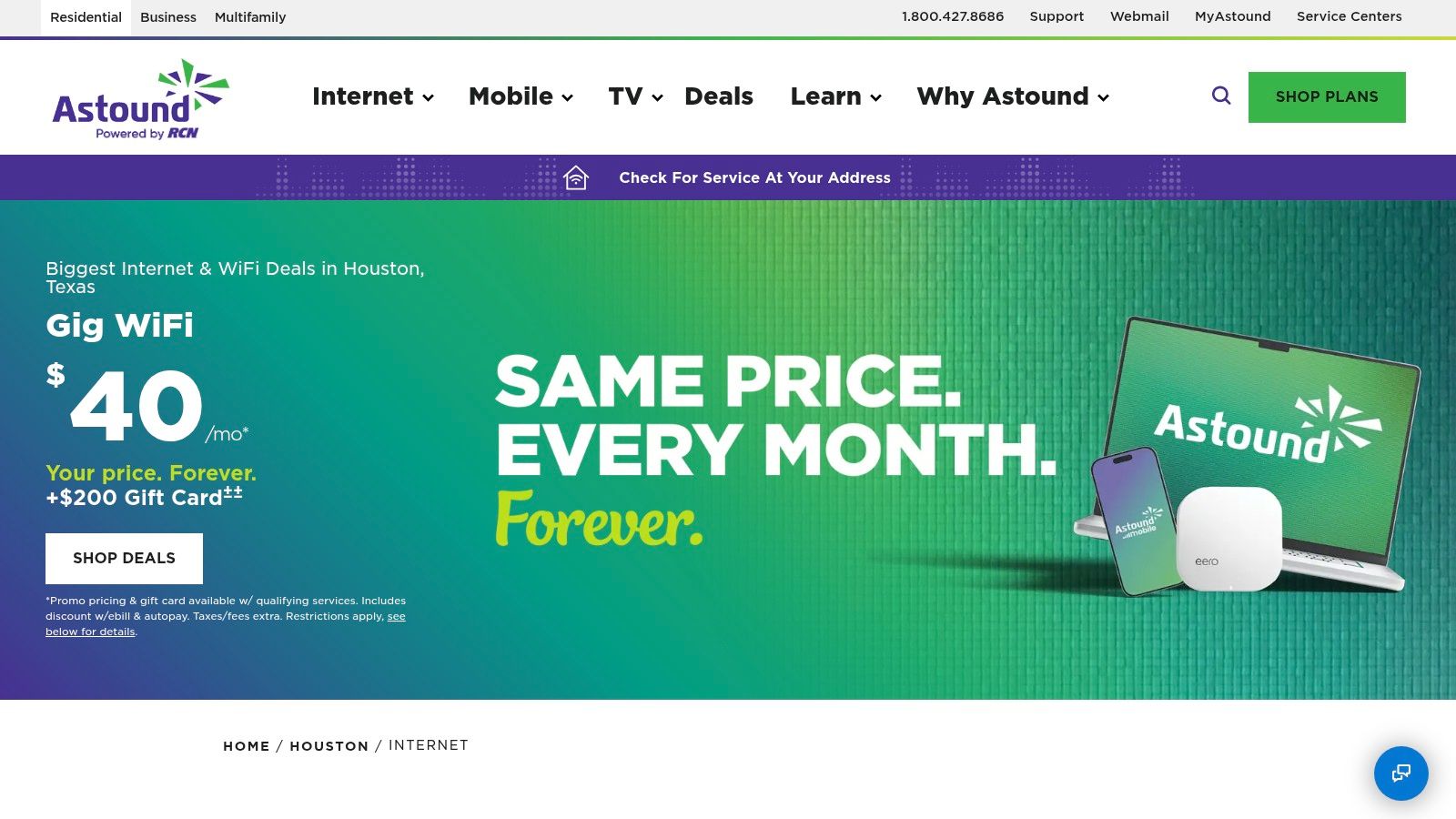
Astound sits in the middle ground between the giant incumbents and the niche enterprise-only providers. In practice, that means it can be a smart value play for some Houston addresses, especially if you find a good online offer and your requirements are more mainstream office traffic than mission-critical low-latency performance.
Its legacy enTouch footprint still matters in parts of the Houston area, and Astound's shopping experience tends to emphasize address-based offers, bundle availability, and pricing hooks like long-term rate positioning on select tiers. For small offices, branch sites, and cost-conscious teams, that's often enough to earn a quote request.
Where Astound can make sense
Astound is worth considering if you want a provider outside the AT&T and Xfinity duopoly but don't need a fully bespoke enterprise circuit. It often fits organizations that want better economics than premium dedicated fiber, while still preferring a fixed wireline connection over wireless home internet.
It can also work in mixed-use situations, such as a founder-led business operating from a home office, or a nonprofit with modest bandwidth demands but a strong need to control monthly expenses. For these buyers, price stability and bundled equipment can matter more than top-tier upload metrics.
The same buyers often juggle provider decisions with broader operating costs, including phones, network gear, and disposal planning. If that sounds familiar, comparing Astound against local small business telecom providers in Houston can help clarify whether a value-oriented broadband plan is enough or whether you need a more business-specific service model.
What to watch
Astound's trade-offs are familiar. Actual speed and pricing vary by address and offer window, so what one business gets may not resemble what another sees a few miles away. Upload behavior can also trail true fiber, particularly during busy periods on shared infrastructure.
Buyer discipline matters here. Don't stop at the splash page. Ask what hardware is included, whether the quoted rate depends on autopay, how long any special pricing lasts, and what support path exists if your service goes down during business hours.
A short decision filter helps:
- Strong fit for budget-led decisions: If controlling recurring cost is the first priority, Astound can be worth a hard look.
- Weaker fit for heavy upstream traffic: Frequent large uploads, backup replication, and media transfer tend to favor fiber-first providers.
- Useful alternative in selective neighborhoods: In the right pocket of Houston, Astound can be a reasonable blend of speed, price, and convenience.
Astound isn't the top recommendation for every serious business workload. But for the right address and budget, it can be the most sensible compromise.
5. LOGIX Fiber Networks
LOGIX is different from the providers above because it doesn't try to win the mass-market internet conversation. It's built for business connectivity. If you're comparing residential-style plans for a small office, LOGIX may feel like overkill. If uptime, routing control, and building connectivity matter, it deserves serious attention.
Houston businesses with multiple offices, campus environments, private data traffic, or latency-sensitive workloads often outgrow consumer broadband faster than they expect. At that point, a dedicated fiber provider becomes less of a luxury and more of an operations tool.
When LOGIX earns the extra cost
LOGIX is strongest when internet is part of a wider network design, not just a utility bill. Dedicated Internet Access, Ethernet, wavelengths, and dark fiber are the kinds of services buyers choose when they need consistency, support, and a network that fits how the business is wired together.
That can apply to legal firms with multiple floors, manufacturers moving data between facilities, or healthcare-adjacent organizations that need predictable performance and support. It also applies to companies coordinating decommissioning projects across several sites where secure inventory movement and reporting matter as much as internet access itself.
For firms trying to align operations, telecom, and sustainability planning, local partner evaluation often overlaps with vendor consolidation. In that context, comparing LOGIX with other local telecom companies can reveal whether you need business-grade fiber architecture or just a faster shared connection.
The buyer mindset you need
You don't buy LOGIX the same way you buy home internet. Pricing is typically quote-based. Deployment can involve more sales engineering. The conversation tends to focus on SLA expectations, building access, and technical fit rather than quick promotional signup.
That's not a flaw. It's the point.
Operational takeaway: If an outage costs your team real money, compare dedicated fiber against the cost of downtime, not against the cheapest advertised broadband rate.
LOGIX is usually a better fit when:
- Your internet supports revenue operations: Contact centers, transaction-heavy environments, and multi-site businesses need stronger assurances than shared broadband usually provides.
- You need local business support: A provider built around business accounts tends to handle escalation differently than a residential-first ISP.
- You care about network design: Firms that need more than plain internet access often benefit from a carrier that can support broader connectivity architecture.
For a solo office, LOGIX may be more service than you need. For a Houston company with serious operational dependence on connectivity, it can be the right kind of service.
6. Phonoscope Fiber
Phonoscope has long had a different reputation in Houston than the national brands. It feels local, relationship-driven, and more willing to handle specialized commercial situations. That can be valuable if your site doesn't fit a standard broadband order form.
This is the kind of provider buyers consider when they want to talk to people who understand local buildings, local routes, and the difference between a simple office install and a custom business requirement. For some teams, that high-touch approach is more useful than another promo code.
Best use cases
Phonoscope makes the most sense for businesses that need flexibility. Private networks, dark fiber, Ethernet, and custom commercial internet setups are part of the appeal. Some organizations also like having a local operator for residential service in select areas, especially if they value support responsiveness over brand scale.
That local focus can help in odd deployment environments. Older buildings, unusual layouts, and businesses with mixed office and warehouse operations don't always fit neatly into national ISP processes. A provider that's used to custom builds can be easier to work with.
Houston's business base is broad enough that this matters. Energy services firms, professional offices, industrial support companies, and growing tech teams often need a provider that can adapt rather than force everything into a one-size-fits-all package.
Why it won't fit everyone
Availability is narrower than the big incumbents, and pricing is often specific to the location rather than posted in a clean consumer grid. That works well if you need a custom solution and less well if you just want to click, buy, and install this week.
Phonoscope also isn't the first recommendation for a buyer who values standardized national coverage over local support. If you need one vendor across many cities, the local advantage can become a procurement complication.
A simple lens helps:
- Choose Phonoscope for flexibility: It's a strong option when your building, network, or support needs are unusual.
- Skip it for mass-market simplicity: If your goal is fast self-service ordering, national providers may be easier.
- Consider it for Houston-specific relationships: Some local businesses prefer a provider with regional roots and a commercial mindset.
Phonoscope is not the broadest option among broadband providers Houston buyers evaluate. It is one of the more interesting ones when the requirement is custom fit, not commodity internet.
7. T-Mobile 5G Home Internet
T-Mobile 5G Home Internet is the wildcard on this list. It isn't a replacement for enterprise fiber in demanding environments, but it solves a different problem very well. It gets you online quickly, without trenching, construction, or waiting on a traditional wired install.
That makes it useful for pop-up sites, temporary offices, short lease spaces, and backup connectivity. In Houston, fixed wireless can also be a practical bridge when a new location is waiting on fiber activation or when a small business wants a second path for continuity without paying for another full wired circuit.
Where wireless earns its keep
Houston's mobile performance is strong enough that 5G home internet is more than a gimmick. Speedtest Intelligence reports a median mobile download speed of 258.70 Mbps in Houston, with 5G from T-Mobile Home Internet and Verizon in the 245 to 300 Mbps range, according to the same Houston performance report from Speedtest Intelligence. For many basic office needs, that's workable.
The bigger advantage is deployment speed and flexibility. If you need internet for a temporary field office, a staging space, or a fast failover option, fixed wireless can be much easier to stand up than waiting for a cable or fiber technician.
A secondary wireless circuit often does more for continuity than upgrading a single primary line to a faster plan.
Limits you should respect
Wireless performance depends on local signal strength and congestion. That means it can feel great at one address and inconsistent at another. Upload behavior and latency consistency also tend to be weaker than business-grade fiber, which matters for VPN-heavy users, large uploads, and time-sensitive cloud applications.
It's also not the best fit for offices with many simultaneous users hammering the same link. A small team may be fine. A dense office with constant video calls, large data transfers, and cloud telephony may not be.
Houston buyers should also keep underserved edges in mind. Statewide Texas data shows 777,115 unserved Broadband Serviceable Locations and 364,991 underserved locations relative to 100/20 Mbps service thresholds, according to Texas unserved and underserved broadband data summarized by Benton Institute. That doesn't describe urban Houston as a whole, but it does explain why fixed wireless and satellite remain relevant bridge options in outskirts and harder-to-serve pockets.
T-Mobile 5G Home Internet is best treated as one of three things: a fast temporary connection, a budget-conscious primary line for light-duty use, or a smart backup for business continuity.
Houston Broadband: Top 7 Provider Comparison
| Provider | 🔄 Implementation complexity | ⚡ Resource requirements | ⭐ Expected outcomes | 💡 Ideal use cases | 📊 Key advantages |
|---|---|---|---|---|---|
| AT&T Fiber | Medium, scheduled fiber install; optional 5G failover setup for business | Fiber ONT + router; address-dependent availability; promos often require autopay | ⭐ High reliability and symmetrical multi‑gig performance | Hybrid work, cloud backups, VoIP, continuity‑sensitive sites | Wide metro coverage; multi‑gig tiers; 5G backup on business plans |
| Xfinity (Comcast) | Low–Medium, self‑install or tech install; fast provisioning | Cable modem/xFi gateway; broadly available across metro area | ⭐ Moderate to high download performance; lower uploads vs fiber; congestion possible | Primary home broadband where fiber isn't available; quick installs | Broadest serviceability; many speed/price tiers; bundle options |
| Ezee Fiber | Medium, professional underground installation included | ONT + eero Wi‑Fi hardware; no contracts; 24/7 US support | ⭐ High, competitive multi‑gig symmetrical speeds and low latency | Multi‑gig homes; latency‑sensitive residential or small business users | Transparent lifetime pricing; included Wi‑Fi; 24/7 US support |
| Astound Broadband (enTouch) | Low–Medium, cable/fiber varies by address; online deals common | Equipment often included in bundles; address-based offers | ⭐ Moderate, competitive promos on gig tiers; variable by node | Budget households; bundled streaming/mobile; eligible low‑income programs | "Price‑for‑life" gig offers; competitive promotional pricing; affordability programs |
| LOGIX Fiber Networks | High, quote‑based dedicated builds with enterprise provisioning | Dedicated fiber gear, SLA management, higher cost; NOC support | ⭐ Very high, carrier‑grade DIA, low latency, strong uptime SLAs | Enterprises, campuses, data centers, mission‑critical operations | Dedicated DIA to 100 Gbps; strong SLAs; local business focus and data‑center connectivity |
| Phonoscope Fiber | High, bespoke commercial builds; selective residential installs | Custom quotes, enterprise equipment, 24/7 NOC | ⭐ Very high for enterprise; residential performance varies by area | Businesses requiring private networks, dark fiber, fast commercial turn‑ups | Local operator with flexible bespoke solutions and high‑touch support |
| T‑Mobile 5G Home Internet | Low, plug‑and‑play customer premise equipment; quick activation | Wireless CPE (Wi‑Fi6/7); depends on local 5G signal and tower congestion | ⭐ Variable, good download speeds for many; upload/latency less consistent than fiber | Rapid backup/failover, temporary sites, non‑fiber homes | Fast deployment, portability, unlimited data, multi‑year price guarantee |
Making the Right Choice for Your Houston HQ
The best broadband providers Houston businesses consider aren't interchangeable. The right choice depends less on marketing and more on your traffic pattern, uptime tolerance, and location. A design studio uploading assets all day should evaluate providers differently than a law office that mostly uses web apps, and both should evaluate differently than a warehouse office that needs resilient point-of-sale and VoIP.
Start with address verification. Not ZIP code. Not neighborhood. The exact suite and service address. Houston has strong overall connectivity, but real availability still varies block by block, building by building, and sometimes floor by floor. Fiber can be present on one side of a street and absent on the other. Don't sign contracts, schedule moves, or promise a cutover date until serviceability is confirmed.
Then compare total cost, not teaser pricing. Promotional rates can be useful, but businesses get in trouble when they budget from a first-month offer instead of the long-term monthly reality. Ask what happens after the intro period, whether autopay is required, whether equipment is included, and what support level comes with the plan. A slightly higher monthly rate with stable terms can be the better decision.
Upload speed deserves more attention than most buyers give it. Download speed is easy to market, but upstream capacity determines how smoothly your team can back up files, send media, run video meetings, use cloud phones, and support remote workers. If your business sends data constantly, fiber usually delivers a better day-to-day experience than cable. If your team mainly browses web apps and handles lighter office traffic, cable may be perfectly adequate.
Support model matters too. Shared residential-style broadband can work well for many small offices, especially if budget and speed of deployment matter most. But if downtime creates operational risk, dedicated business fiber and clear SLA terms become much more valuable. This is particularly true for multi-site companies, healthcare-adjacent operations, firms with customer-facing call flows, and organizations that rely on continuous cloud access.
A second connection is often the smartest resilience upgrade. Many Houston businesses overspend on a single primary circuit and underinvest in failover. A secondary cable or 5G fixed wireless line can protect phones, payment systems, remote access, and cloud tools during an outage. It doesn't need to match the primary line feature for feature. It just needs to keep critical functions alive.
For office moves and provider changes, overlap your services rather than trying to switch in one step. Keep the old circuit active until the new one is installed, tested, and carrying real production traffic. Test VoIP, VPN, cloud file access, and guest Wi-Fi before canceling anything. This avoids the common mistake of discovering firewall issues, wiring problems, or weak wireless coverage after the old line is already gone.
Houston's broadband market is strong enough that most businesses can build a good setup if they buy carefully. Fiber is usually the best answer for upload-heavy and latency-sensitive work. Cable is often the practical answer for broad coverage and quick deployment. Fixed wireless is valuable for backup, temporary space, and edge cases. The key is matching the connection to the work, not to the ad.
If your connectivity project is part of a larger technology transition, don't treat internet as a separate decision from hardware retirement, office cleanout planning, and secure data handling. The same businesses upgrading circuits are often also replacing endpoints, retiring network gear, or clearing storage rooms full of obsolete equipment. When that happens, responsible electronics recycling, secure data destruction, and structured IT asset disposition should move in parallel with the network upgrade. For broader compliance and environmental guidance, the EPA's information on electronics donation and recycling is a useful reference point.
If your Houston business is upgrading networks, replacing devices, or preparing for an office cleanout, Reworx Recycling can help you handle the other half of the transition responsibly. Reworx supports organizations with donation-based recycling, electronics recycling, computer recycling, secure data destruction, IT equipment disposal, product destruction, and broader IT asset disposition planning, all with a social enterprise mission focused on digital inclusion and community impact. If you're retiring laptops, network gear, medical equipment, or surplus office hardware, connect with Reworx to plan a pickup, coordinate sustainable recycling, or build a corporate donation program that keeps usable technology out of landfills and working for people who need it.