A pallet of 30 laptops lands on your dock, one battery is swollen, two monitors are cracked, and the client wants the equipment gone before the next refresh cycle starts. That's the kind of morning that turns a tidy ITAD plan into a live safety problem. In electronics recycling, worker protection standards are the difference between a controlled intake process and a floor full of avoidable exposure, confusion, and downtime.
For a new IT asset disposition manager, the hard part isn't believing safety matters. It's knowing where the line is between office-style handling and regulated hazardous work, especially when a broken CRT, a lithium battery, or a dusty shred line changes the risk profile in minutes. Small recyclers cut corners here all the time, usually by treating every device like the last one they handled instead of asking what changed in the load.
The enforcement backdrop is real. Federal OSHA and state partners have about 1,850 inspectors protecting 130 million workers at more than 8 million worksites, which comes out to roughly one compliance officer for every 70,000 workers. OSHA completed 34,696 federal inspections in FY 2024, and workplace fatalities still totaled 5,283 in 2023, equal to 3.5 deaths per 100,000 full-time equivalent workers. OSHA also reports that worker deaths have fallen from about 38 per day in 1970 to about 15 per day in 2023, while injury and illness rates dropped from 10.9 incidents per 100 workers in 1972 to 2.4 per 100 in 2023. Those numbers, from OSHA's own data, show why safety standards are operational infrastructure, not paperwork. OSHA common statistics
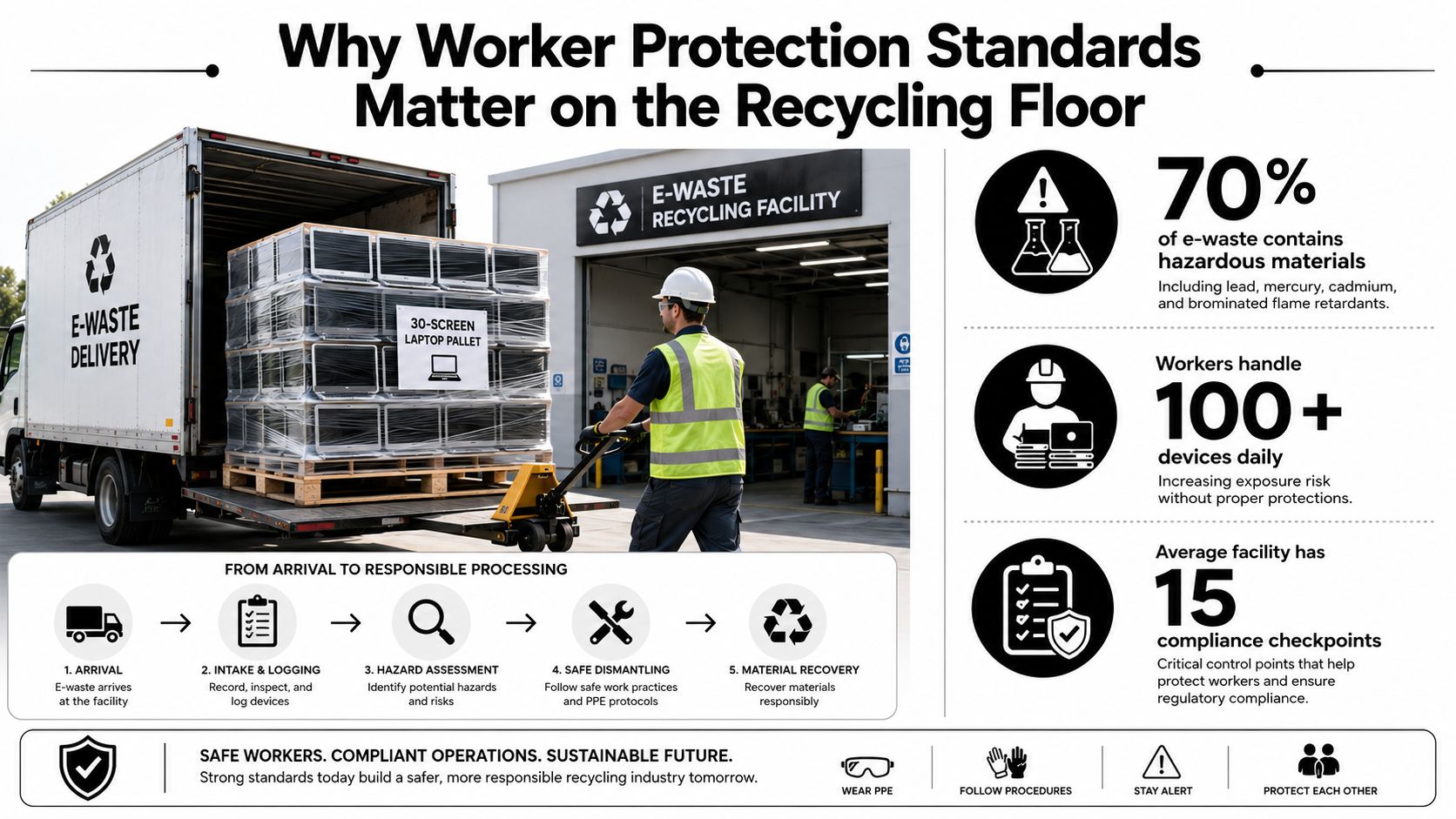
Why Worker Protection Standards Matter on the Recycling Floor
A small electronics recycler can look calm right up until the intake dock fills with mixed assets. A 30-screen laptop pallet might hide cracked casings, loose cords, swollen batteries, and accessories that no one inventoried properly. At that point, the floor stops behaving like a storage room and starts behaving like a controlled industrial space.
That shift matters because worker protection standards are built for real exposure, not job titles. The same logic that protects agricultural crews from pesticide contact also applies when a technician handles damaged devices, opens obsolete equipment, or clears dust from a shredder hopper. The hazard is different, but the management problem is the same, identify the exposure, control the task, and keep the worker out of the danger zone.
What the reader should notice first
If a load includes even one broken display or compromised battery pack, the handling plan changes. The intake station needs eyes on the load, not blind stacking. The worker needs a decision tree, not a shrug.
Practical rule: if a shipment forces you to ask, “What exactly is inside this unit?” you've already crossed into higher-risk handling.
The reason small recyclers get burned is simple, they often treat every device as routine. A clean office desktop is not the same thing as a monitor with damaged glass or a pallet of unknown return merchandise. Reusing yesterday's process for today's hazard is how a minor intake issue becomes a shutdown, a citation, or an injury that spreads through the crew's confidence.
Reworx Recycling's own focus on electronics recycling and IT asset disposition fits this reality because the work lives at the intersection of logistics, data security, and physical protection. That means every load has to be screened for risk before it moves deeper into the line. Once you see the floor through that lens, worker protection stops looking abstract and starts looking like the operating system of the facility.
What Worker Protection Standards Actually Cover
The phrase worker protection standards gets used loosely, but the concept is straightforward. A standard usually starts by naming the hazard, then it tells you how to control it, what gear to use, and what training to document. If you can remember those four pieces, you can read almost any safety rule without getting lost.
The four parts that show up again and again
First comes hazard identification. You cannot control a risk you haven't named, so the floor needs a way to spot damaged batteries, exposed glass, dust generation, solder fumes, and other task-specific problems before work starts.
Next come engineering and administrative controls. In practice, that means local exhaust ventilation at soldering benches, barriers around grinding or shredding points, job rotation when a task creates repetitive strain, and clear limits on who can enter a processing zone.
Then comes PPE. Gloves, eye protection, respirators, hearing protection, and protective clothing only work when they match the task, fit the worker, and are worn. A box of mixed gloves on a table isn't a program.
Finally, there's training and recordkeeping. Workers need to know what they're facing, supervisors need proof that training happened, and the facility needs records that can survive an audit.
A standard without training records is a suggestion. An auditor will treat it that way.
That framework helps explain why generic office policies fall apart on a recycling floor. A solder-fume hazard, for example, doesn't get solved by a casual reminder. It calls for ventilation, a respirator program where needed, written instruction, and a supervisor who can tell whether the worker is following the procedure.
The U.S. Environmental Protection Agency's Agricultural Worker Protection Standard is a good example of how a broad safety concept becomes a sector-specific rule set. EPA says it is designed to protect more than 2 million agricultural workers and pesticide handlers at over 600,000 agricultural establishments, and its impact analysis estimated about 1.5 million hired workers and handlers were occupationally exposed to pesticides on agricultural-plant establishments. EPA Agricultural Worker Protection Standard

The U.S. Regulatory Overview You Need to Know
An ITAD manager usually hears about safety through OSHA, but electronics recycling sits under several rule sets at once. OSHA covers worker exposure and conditions inside the facility, EPA governs environmental handling of certain wastes, DOT controls transport of damaged hazardous items, and state rules can add another layer. A recycler that only thinks in one lane usually misses something important.
The agencies that matter on a recycling floor
OSHA is the one most operators meet first, because it focuses on the live worksite. In a federal inspection, the agency can look at hazard communication, lockout/tagout, respiratory protection, machine guarding, and the way the crew performs the job. That matters in electronics recycling because the floor often mixes hand disassembly, powered equipment, and material handling in one workflow.
EPA becomes central when the waste stream includes regulated materials or handling practices that trigger environmental obligations. Many operators keep a separate eye on universal waste and related disposal expectations, because batteries, lamps, and similar items can move through a facility differently from ordinary scrap. For a quick rule reference on that side of the business, the Reworx Recycling universal waste guidance is a useful starting point for sorting what stays on-site, what moves, and what needs special handling.
DOT is the agency to respect when damaged batteries or other hazardous components leave the building. A recycler that ships compromised lithium cells like ordinary freight is taking an avoidable risk. State right-to-know laws can also require more specific chemical communication than a federal minimum would.
The enforcement reality is not theoretical. OSHA's common statistics show that inspections are part of normal enforcement, so a small recycler should assume that a visit can happen and that documentation matters as much as floor conditions. The point isn't to panic, it's to build a file that shows your process is intentional and repeatable.
If a facility operates in Florida, workers' compensation and risk planning also sit alongside safety compliance, so it helps to get a policy in florida before a claim exposes gaps in coverage. That does not replace safety work, but it does keep one bad incident from becoming a financial crisis.
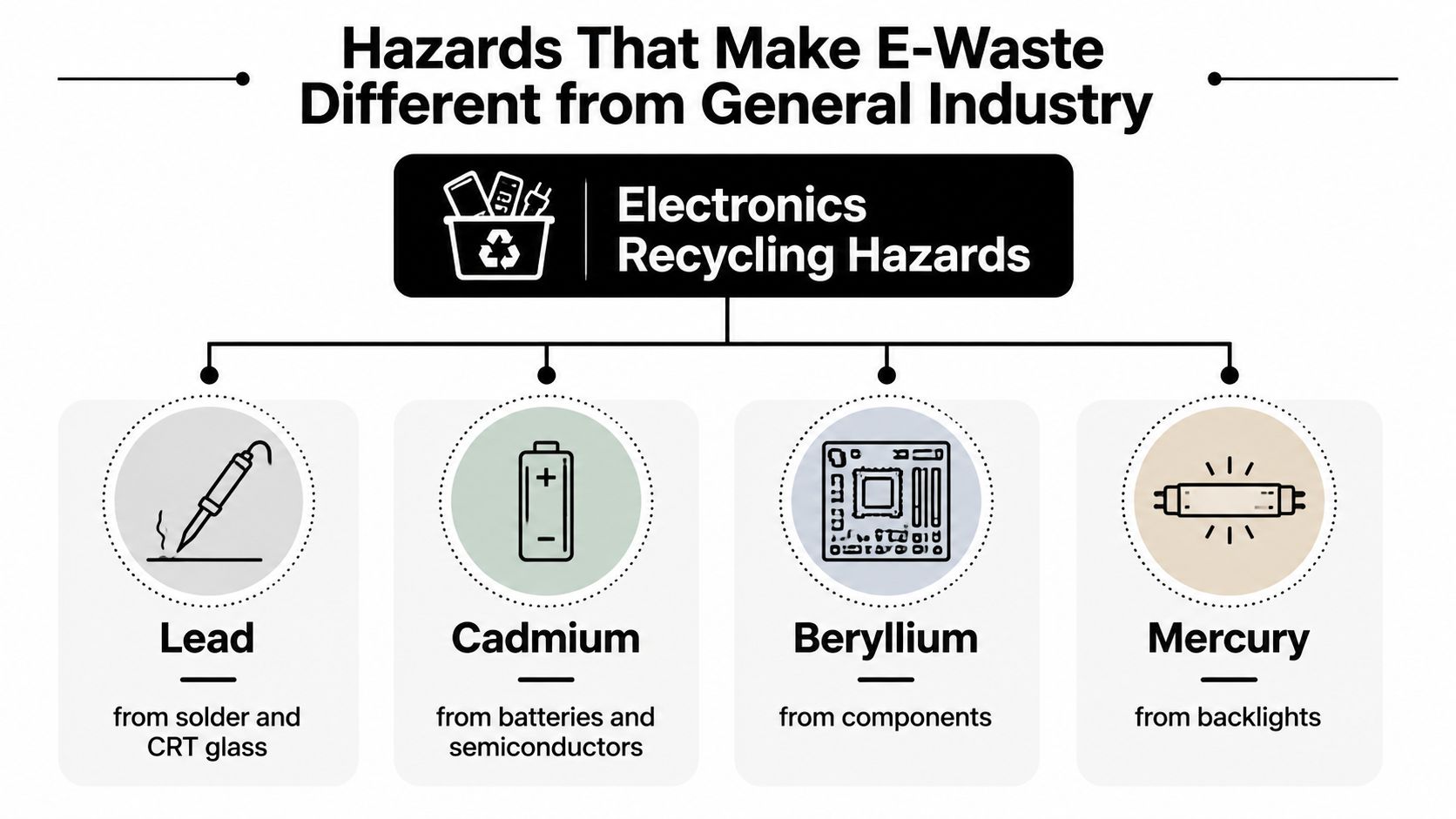
Hazards That Make E-Waste Different from General Industry
Electronics recycling isn't just another warehouse environment. The materials themselves can change the hazard profile, and the mix of tasks changes it again. A worker might start the shift unloading office computers, then move to monitor breakup, then end the day near a shred line.
The materials that change the job
Lead shows up in solder and in some CRT glass, which is why lead-specific controls matter when a crew opens older devices or breaks display units. Cadmium can appear in batteries and older semiconductors, so battery sorting isn't just a housekeeping task. Beryllium may be present in certain components and boards, which is one reason dust control and exposure awareness matter during disassembly. Mercury can be found in backlights and some switches, so broken lamp assemblies need a different response than a plastic housing.
The hazard list doesn't stop at chemicals. Lithium cells are a separate concern because damaged or poorly managed batteries can create heat, fire, and transport problems. Reworx Recycling's lithium battery disposal guidance fits naturally here because battery handling belongs in the same hazard inventory as glass breakage and metal dust.
How the standards map to the work
A basic hazard inventory should ask where dust is created, where fumes are released, and where the worker's hands are closest to the source. That's where standards like 29 CFR 1910.1025 for lead, 29 CFR 1910.1000 for air contaminants, and 29 CFR 1910.132 for PPE assessment become practical instead of abstract.
Mixed-exposure floors are especially tricky. A worker who handles batteries in the morning and monitors in the afternoon may need a different glove set, a different respirator decision, or a different cleanup protocol by lunch. That's why one-size-fits-all PPE rules usually fail in recycling operations.
Engineering Controls and PPE for Recycling Operations
The safest recycling floor is the one that keeps the hazard away from the person before PPE ever matters. That's the hierarchy of controls in plain terms. If you can ventilate, isolate, enclose, or automate the task, you should do that before leaning on gloves and masks to carry the whole program.
Controls that belong on the floor
Engineering controls do the heavy lifting. Local exhaust ventilation belongs at soldering stations, negative-pressure containment makes sense for CRT processing, and dust collection should sit close to shredders or grinding equipment. If the process creates a plume, the plume needs a capture point.
Administrative controls are the next layer. Rotate jobs when repetitive disassembly starts to strain hands and shoulders. Keep visitors out of active processing zones. Build cleaning and housekeeping into the shift, not after it.
PPE is still essential, but it works best when it matches the hazard. Cut-resistant gloves help on glass and sheet metal, nitrile gloves fit chemical contact tasks, eye protection belongs anywhere fragments can fly, and hearing protection should be considered when the equipment gets loud. For respirators, the cartridge has to match the contaminant, and the user has to be fit-tested and medically cleared where the rule requires it.
Practical rule: if the task creates dust, fumes, or fragments, the control plan needs to be written before the worker reaches for the tool.
The WPS decontamination benchmark is a useful way to think about concrete thresholds. It requires 1 gallon of water for each worker and 3 gallons for each handler and each early-entry worker, measured at the start of the work period, with eye-flush water immediately available at each mix/load site when the label requires eye protection. That kind of specificity is what makes compliance auditable, and recyclers should think the same way about wash stations and contamination control. MS State extension on WPS decontamination supplies
For hearing protection, a specialist resource like Z Audiology hearing protection can help a team think beyond foam plugs and consider fit, comfort, and real-world use on loud processing lines. Reworx Recycling's mercury-containing equipment guidance also belongs in the control conversation because broken components need a response that's more deliberate than “clean it up later.”
Training, Documentation, and the Worker Eligibility Rules
A safety program only works if the crew can repeat it under pressure. That means training has to be role-specific, documented, and refreshed often enough that people remember it when the busy season hits. A good folder of paper doesn't protect anyone, but a missing folder will absolutely hurt you during an audit.
The document set that should exist on day one
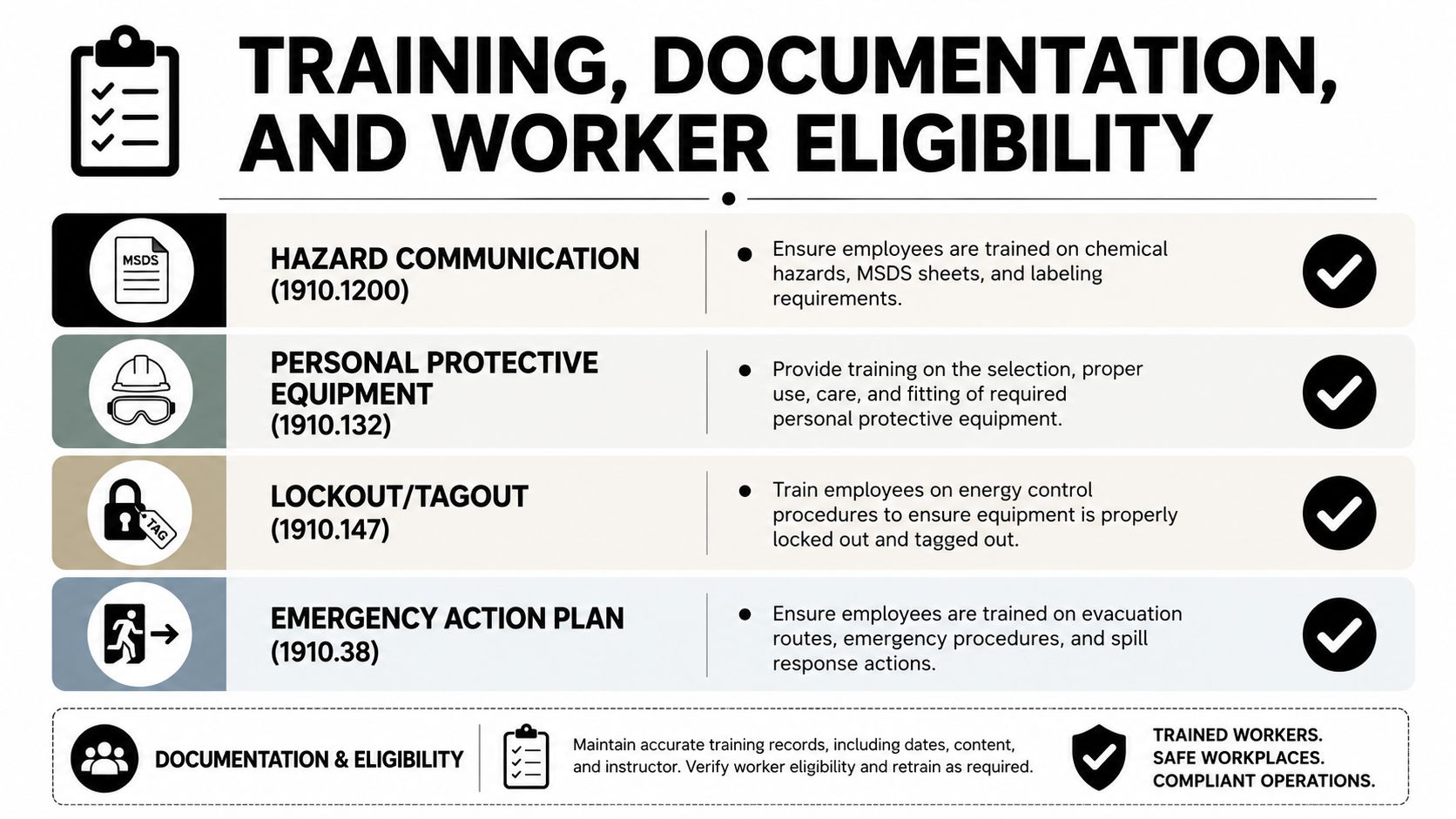
Start with hazard communication training under 29 CFR 1910.1200, because workers need to know what labels, SDSs, and warning signs mean before they touch the load. Add PPE training under 29 CFR 1910.132, then layer in lockout/tagout for powered equipment and emergency response procedures for spills, battery events, and evacuation.
If bloodborne pathogen exposure is possible through sharps or contaminated material, that training belongs too. A battery handling module should sit beside it, not inside a generic orientation deck. That's how you keep training tied to actual tasks instead of abstract policy language.
The recordkeeping that proves the program exists
Training rosters, signed acknowledgments, medical surveillance records where required for lead, cadmium, or beryllium, and the OSHA 300 log all belong in the same controlled system. If a supervisor can't pull a record quickly, the facility will look disorganized even if the workers are doing the right thing. Reworx Recycling's training and education materials fit naturally into this kind of rollout because the content has to be understandable on the floor, not just in a binder.
The revised WPS also uses age as a hard line. Workers performing early-entry tasks and pesticide handlers must be at least 18 years old. That rule comes from agriculture, but the principle transfers cleanly to recycling, if a job needs maturity, judgment, and task-specific competence, age and authorization should be checked before assignment.
R2 and e-Stewards as the Practical Audit Path
Certifications matter because they force a recycler to turn safety into evidence. If a facility wants enterprise ITAD, public sector work, or healthcare accounts, it helps to show that worker protection isn't just a verbal promise. R2v3 and e-Stewards both give auditors a structure to review, and both create pressure to close gaps before a customer finds them.
How they differ in practice
| Dimension | R2v3 | e-Stewards |
|---|---|---|
| Worker protection focus | Requires documented health and safety programs and operational controls | Places strong emphasis on worker protections and downstream accountability |
| Audit posture | Built for structured management systems and corrective action tracking | Known for strict requirements and rigorous review |
| Downstream handling | Requires responsible downstream management of materials | Strongly controls export and downstream movement of hazardous materials |
| Best fit | Broad ITAD and electronics recycling operations | Buyers who want a tighter sustainability and labor-protection posture |
The practical question isn't which label sounds better. It's which audit path matches the customer base you want to serve and the controls you can maintain. R2 tends to fit operations that want a management-system approach, while e-Stewards is often attractive when downstream scrutiny and worker protection expectations need to be especially visible.
That choice should be made with the full compliance picture in mind, not as a branding exercise. Reworx Recycling's electronic recycling certification resource is relevant here because the audit path only works if the floor procedures match the paperwork. If they don't, certification becomes a gap-finding exercise instead of a risk reducer.
A 90-Day Plan to Bring Your Operation Up to Standard
The fastest path is a quarter-long rollout, not a vague safety memo. Days 1 to 30 should focus on a written hazard inventory, a PPE matrix, a hazard communication program, and the OSHA 300 log. That gives you the basic file an auditor or investigator will ask for first.
Days 31 to 60 should add role-based training, medical surveillance where it's triggered, and the first engineering fixes, especially at soldering, battery, and shredding stations. Days 61 to 90 should test the program against an R2 or e-Stewards audit checklist, then lock in a recurring review cycle for near misses, incidents, and retraining.
For an ITAD leader who wants to outsource part of the operational burden, Reworx Recycling can support donation-based electronics recycling, secure data destruction, business pickups, and IT asset disposition workflows that keep retirement projects moving without turning every load into a safety project. That's the cleaner path when your team needs the equipment gone, the data protected, and the floor kept under control.
If you're ready to tighten your electronics recycling program, Reworx Recycling can help you retire equipment through donation-based recycling, secure data destruction, and business pickup services that fit real ITAD workflows. Visit Reworx Recycling to plan your next equipment retirement and start building a safer, cleaner process for your team.