You see the stack of outdated routers, switches, and VoIP phones in the server room. It's a familiar sight for any IT manager or business owner. This isn't just clutter. It's a mix of potential value, data security risk, and environmental obligation.
Before you even search for where to recycle telecom equipment near me, set a disposition strategy. First, secure your data. Deleting files isn't enough. Devices with storage, including routers, firewalls, and UC appliances, need professional sanitization or physical destruction so credentials, configuration files, and customer data don't walk out the door with the hardware. Second, build an inventory. A basic list of makes, models, and serial numbers helps you get realistic quotes, prove custody, and keep the project from turning into a loose pile of gear with no paper trail.
That early discipline matters because electronics recycling isn't one-size-fits-all. The U.S. EPA's guidance, referenced in broad consumer recycling discussions, aligns with a practical reality many teams discover too late. Device handling can depend on battery content, device type, and whether the equipment stores data. Consumer pages often focus on general electronics instead of telecom-specific assets, which is why mixed loads of modems, handsets, switches, and accessories can create confusion at drop-off time. If you're also handling mobile devices, it helps to securely recycle your mobile phone through a process that treats data destruction as part of disposal, not an afterthought.
These first steps turn a cleanout into an IT asset disposition project. That's the difference between “getting rid of old equipment” and actually reducing risk.
1. Reworx Recycling
Reworx Recycling is the option I'd put in front of a business first when the job isn't just a few consumer gadgets but a real telecom and IT retirement project. It combines electronics recycling, IT equipment disposal, pickup support, data destruction, and asset recovery in a way that fits how businesses decommission equipment. The company is based in Smyrna, Georgia, but its service model is broader than a single walk-in location, which matters if you're coordinating office cleanouts, branch refreshes, or mixed loads of network and end-user gear.
For telecom assets specifically, Reworx has a dedicated page for telecom equipment recycling in Atlanta, which is useful because many recyclers speak generally about electronics but say very little about switches, routers, firewalls, PBX hardware, or VoIP phones.
Why it works for B2B teams
Reworx is strongest when you need one partner to handle more than the final drop-off. That includes decommissioning support, secure hard-drive shredding and data destruction workflows, equipment buyback, consultations, and pickup options for organizations that don't have time to self-manage every pallet and serial number.
A few practical strengths stand out:
- End-to-end handling: It supports projects from single-item recycling to larger office, facility, and ITAD initiatives.
- Data security focus: Secure destruction services are built into the offering, which is critical for data-bearing network appliances.
- Flexible logistics: Free customer drop-off, business pickups, and recycle-by-mail options reduce friction.
- Mission alignment: The donation-based social enterprise model adds community benefit instead of treating equipment retirement as a pure waste transaction.
Practical rule: If your project includes both value recovery and secure destruction, use one provider that can document both. Splitting those steps across vendors usually creates audit gaps.
The main trade-off is procurement visibility. Public pricing isn't posted, and I don't see clearly displayed certification badges on the site, so enterprise buyers should request a quote and verify any certification requirements directly before approval. Still, for small and midsize businesses, schools, agencies, and sustainability teams that want secure handling plus social impact, Reworx is a strong fit.
2. ERI
ERI belongs on the shortlist when the phrase “near me” really means “across multiple offices and with real documentation.” It's built for scale, and that matters when your telecom recycling project includes staged pickups, central processing, and reporting that has to survive legal, procurement, or internal audit review.
If you're comparing enterprise vendors to regional specialists, ERI is the type of provider that competes on process control more than convenience. For businesses that need a local option with a more hands-on regional service model, telecom equipment disposal near you through Reworx may feel simpler. For national rollouts, ERI is often the cleaner fit.
Best use case
ERI makes sense for larger commercial jobs, especially when telecom gear is mixed into a broader IT equipment disposal stream. That can include network hardware, endpoint devices, peripherals, and data-center support equipment moving through one chain of custody.
What I'd ask before signing:
- Pickup thresholds: Confirm whether minimum volume applies for on-site collection.
- Data handling: Ask what serialized destruction and downstream reporting looks like for network appliances.
- Project scoping: Clarify whether your job is treated as a standard pickup or a managed decommissioning engagement.
The limitation is obvious. ERI isn't the easiest path for a handful of low-value devices or ad hoc office leftovers. It's better when you have enough material, enough compliance pressure, or enough locations to justify enterprise-grade handling.
You can review its business services at ERI.
3. Sims Lifecycle Services

Sims Lifecycle Services is the kind of provider IT directors bring in when retiring telecom equipment is tied to a larger infrastructure event. Think data-center consolidation, network modernization, M&A integration, or a multi-state hardware refresh. The service model is structured, standardized, and geared toward enterprise lifecycle management instead of neighborhood drop-off convenience.
It's also useful if your priority is reuse before recycling. That sequencing matters. Higher-value equipment should be evaluated for remarketing first, with true end-of-life material sent into recycling streams only after that determination.
Where SLS stands out
Telecom and network teams often underestimate the logistics side of retirement. The problem isn't finding a recycler. It's managing de-racking, site coordination, packaging, shipping, custody, and disposition records across locations. That's where SLS is stronger than a local scrap option.
For organizations that want a more regionally focused partner, Reworx ITAD telecom services may be more approachable. For complex enterprise programs, SLS is built for the heavier lift.
The wrong recycler creates work for your IT team. The right one removes work from your IT team.
Trade-offs are straightforward. This usually isn't the best answer for small businesses with a few shelves of retired phones and routers. It's typically scoped as a project, and pricing requires direct engagement.
You can evaluate its lifecycle and decommissioning approach at Sims Lifecycle Services.
4. Iron Mountain Asset Lifecycle Management
Iron Mountain's Asset Lifecycle Management service is a high-trust option for regulated industries, public sector projects, and businesses that already use Iron Mountain for records or information governance. When telecom hardware retirement needs to align with formal chain-of-custody expectations, the familiarity of that brand can help move internal approvals faster.
This is less about convenience and more about defensibility. If legal, compliance, or procurement teams want documented handling from pickup through data sanitization and recycling, Iron Mountain is built for that conversation.
When to choose it
Iron Mountain fits projects with strict internal controls. That includes on-site or off-site sanitization, decommissioning, secure transport, and serialized reporting for data-bearing equipment. Those are good matches for firewalls, gateways, unified communications systems, and other hardware that may retain credentials or configuration history.
If your organization also wants to recover value from hardware before final recycling, compare that structure against selling telecom equipment through Reworx. In some environments, asset recovery and social-impact disposition need to sit alongside security, not behind it.
A few practical cautions:
- Premium positioning: Expect project-based pricing rather than low-cost drop-off economics.
- Less SMB-friendly: It's not built for walk-ins or very small jobs.
- Best for audits: The value shows up when documentation requirements are serious.
For reviewed details on its service portfolio, visit Iron Mountain Asset Lifecycle Management.
5. Best Buy Electronics Recycling
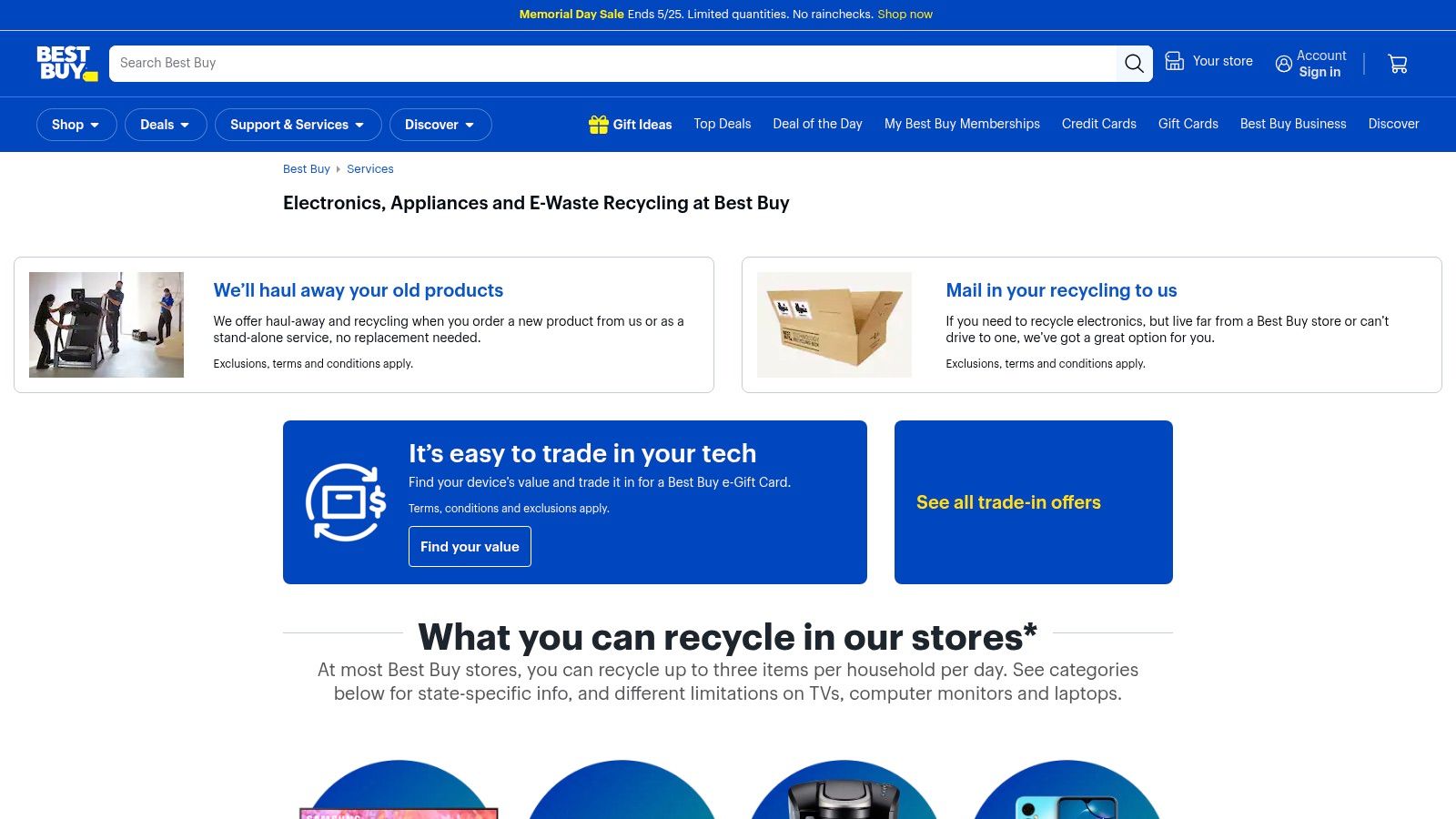
Best Buy is one of the most practical answers to where to recycle telecom equipment near me when the equipment is small, low-volume, and consumer-adjacent. If your branch office has a couple of modems, routers, gateways, or accessories, the retail network is hard to beat for convenience.
That said, convenience isn't the same thing as ITAD. Best Buy's public guidance is consumer-focused, and that's exactly the friction many business users run into. As noted in Best Buy's recycling guidance, the framing is broad electronics recycling, not telecom-specific lifecycle handling. That can leave open questions about mixed office network gear, accessories, batteries, and business documentation.
Good for small loads, not for decommissioning
Use Best Buy when speed matters more than reporting. It works well for remote staff returns, a handful of office devices, or cleanup of consumer-grade networking hardware.
It's less suitable when you need:
- Serialized asset tracking: Retail drop-off isn't a substitute for formal chain of custody.
- Bulk commercial pickups: The model is built around store acceptance, not site-level decommissioning.
- Telecom-specific guidance: You may still need to confirm whether your exact hardware type is accepted.
The practical lesson is simple. Retail programs solve the “I need this gone today” problem. They usually don't solve the “I need secure, documented, enterprise-ready disposition” problem.
You can check accepted categories and local limitations at Best Buy Electronics Recycling.
6. Staples Recycling
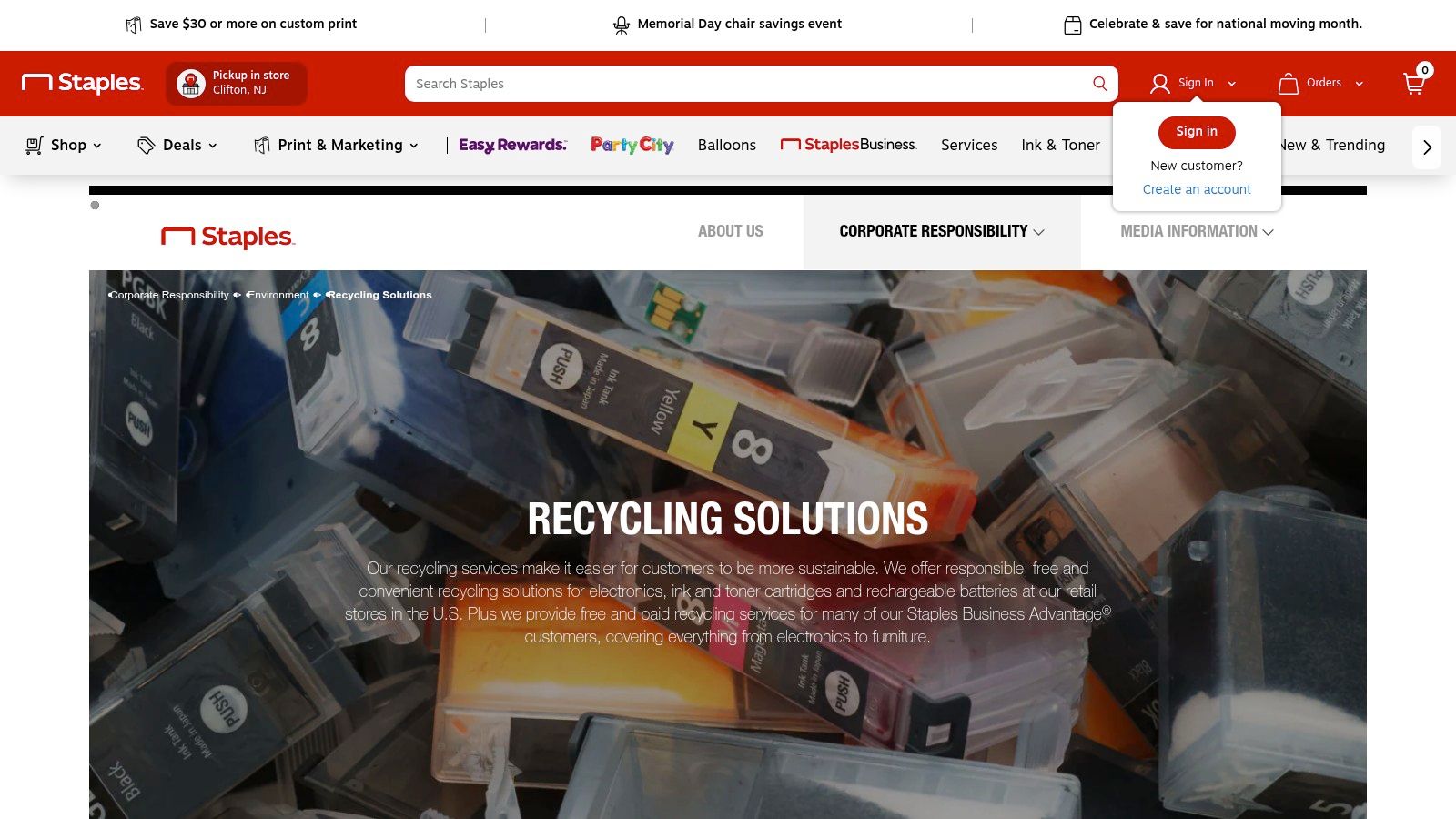
Staples sits in the middle ground between consumer convenience and business recycling support. For smaller offices, satellite branches, and administrative teams cleaning out closets full of modems, desk phones, and assorted IT accessories, it can be a practical local option. The national store footprint helps when your challenge is distribution rather than volume.
Where Staples becomes more useful for B2B buyers is its business recycling orientation. It isn't just a store counter story. There's also a broader recycling-solutions posture that can fit office-level e-waste handling.
The trade-off to watch
Staples is a good option when the telecom load is small enough to behave like office electronics. It's less compelling when your equipment retirement starts to look like a formal IT asset disposition or data center decommissioning effort.
Ask these questions up front:
- Accepted telecom categories: Don't assume every store interprets networking hardware the same way.
- State-specific rules: Store policies and fees can vary by location and item type.
- Business documentation: Confirm what records you'll receive if the equipment belongs to the company, not an employee.
For SMBs, I often see Staples used as a cleanup valve. It helps teams move light office gear without launching a full vendor engagement. For larger telecom retirements, it usually becomes a secondary option rather than the primary one.
Review current program details at Staples Recycling Solutions.
7. Cisco Customer Recycling Solutions
Cisco's takeback and reuse program is one of the easiest answers when your retired estate is mostly Cisco-branded gear. If your closets and racks are filled with Cisco routers, switches, firewalls, IP phones, or optics, going back to the OEM can simplify internal decision-making.
The appeal is obvious. You're sending equipment into a brand-aligned channel instead of trying to explain model compatibility and handling requirements to a generic recycler.
Best for single-vendor Cisco environments
This is especially effective for network teams decommissioning standard Cisco fleets. Return guidance is clear, and the takeback structure is designed around Cisco customers and partners rather than general mixed-brand electronics disposal.
If the load is all one manufacturer, check the OEM takeback program before you schedule a mixed-vendor recycler.
The downside is equally clear. Mixed loads break this model fast. The moment your shipment includes non-Cisco phones, third-party firewalls, racks, or unrelated office electronics, you need another channel. Cisco is a strong lane, not a complete answer for every office cleanout or facility cleanout.
That makes this a smart specialist option, not a universal one. If your business runs a heavy Cisco environment, it can reduce disposal friction. If your gear is mixed, use it selectively.
You can start with Cisco Customer Recycling Solutions.
8. Dynamic Lifecycle Innovations
Dynamic Lifecycle Innovations is a solid choice for organizations that want sustainability reporting, enterprise-grade logistics, and a reuse-first mindset in the same program. It fits larger refresh cycles, OEM takeback support, and multi-site commercial projects more than neighborhood disposal needs.
I'd look at Dynamic when the business wants the recycling story to stand up in ESG conversations as well as in IT operations. That makes it relevant to sustainability leaders, procurement teams, and corporate donation program stakeholders, not just infrastructure managers.
Why it appeals to enterprise buyers
Dynamic's value is less about “where's the nearest place” and more about “who can run this responsibly across the full disposition workflow.” That includes decommissioning, logistics, resale, and certified recycling. If your retired hardware still has market demand, pairing recycling with value recovery is important, and Reworx asset recovery services are worth comparing for organizations that want a mission-driven alternative.
The wider backdrop matters here. The world generated 62 million metric tons of e-waste in 2022, and only 22.3% was formally collected and recycled, according to the Global E-waste Monitor as cited by Rebooter Recycling. That's why mature ITAD programs now emphasize documented channels, secure handling, and proper downstream processing rather than generic disposal.
Dynamic's limitation is that smaller companies may find it oversized for occasional office recycling. It's a stronger fit when the project already has scale, reporting needs, or executive visibility.
You can review its services at Dynamic Lifecycle Innovations.
9. Wisetek USA
Wisetek USA is a practical middle path for businesses that care about resale recovery as much as they care about compliant disposal. That balance matters in telecom recycling because not everything in a retired network closet is waste. Some gear still has secondary-market value, while other devices belong in certified recycling streams.
Many teams lose money by sending everything to one “recycler” without separating reusable assets from true scrap. A provider with pickup, data destruction, and remarketing can reduce that waste.
Strong when asset value is still in play
For IT managers, Wisetek is attractive when the project includes network hardware that may still be marketable. The company's model aligns with a common buyback workflow used in the used telecom and data-center space: submit an asset list, receive a line-item offer, arrange pickup or shipment, then wipe or erase retained data before resale or recycling, as described by Big Data Supply's equipment resale process.
That workflow is useful because it forces discipline:
- Inventory first: You can't price or track what you haven't listed.
- Disposition by condition: Reuse and resale should be considered before recycling.
- Sanitize before transfer: Network gear can retain settings, credentials, and other sensitive information.
Wisetek is less ideal if you need a simple consumer-style drop-off. It's built more for managed business service than for quick retail convenience.
You can evaluate its U.S. services at Wisetek USA.
10. STS Electronic Recycling
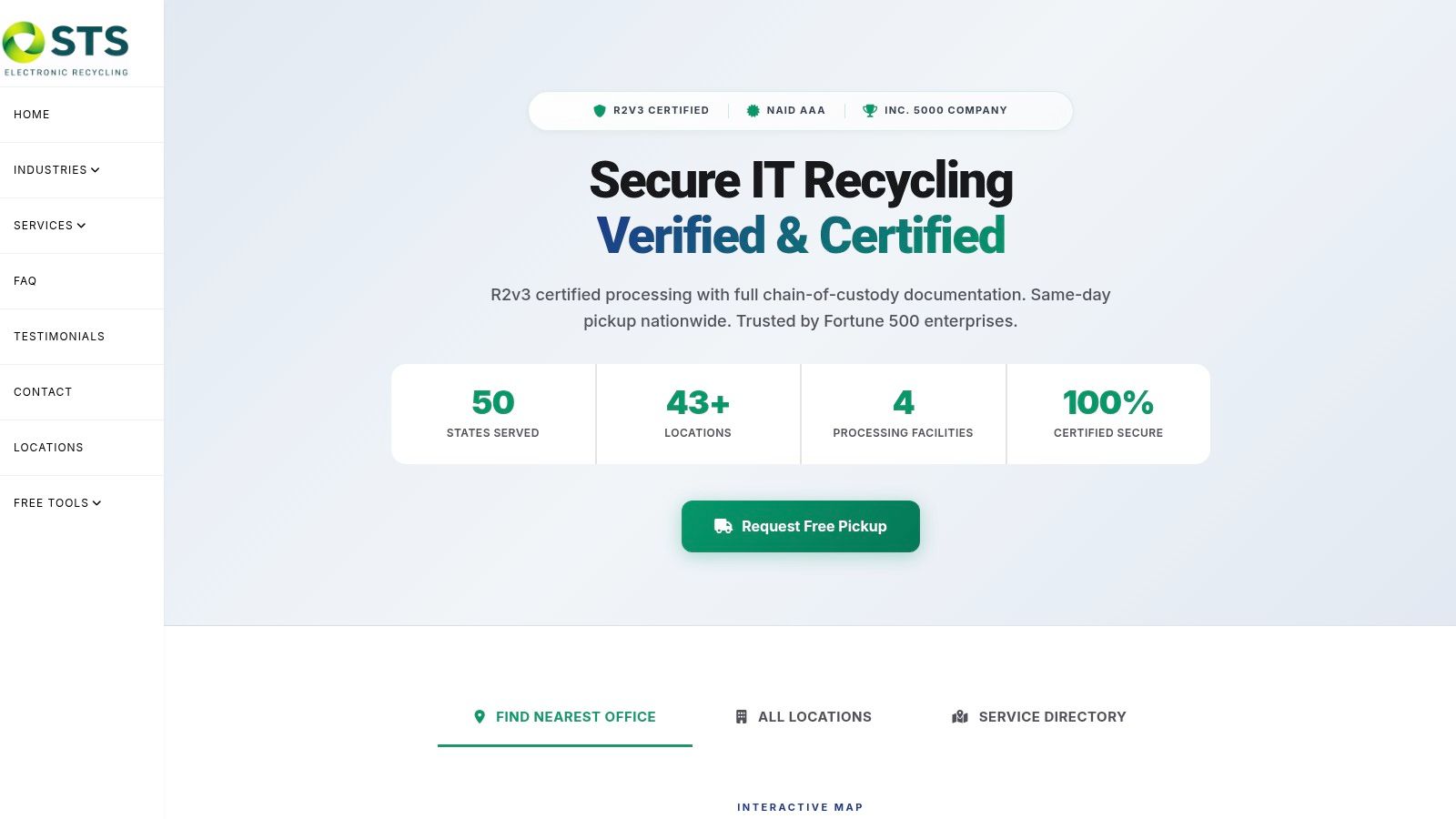
STS Electronic Recycling is a good fit for companies that want a national recycler with local-market reach but don't necessarily need the largest enterprise brand. It covers a broad range of IT and telecom assets and offers enough service depth to work for both SMB and enterprise projects, depending on the region and job scope.
One thing I like about STS in this context is flexibility. Some businesses need on-site destruction. Others need pickup and remarketing. Others just need a competent recycler that understands business equipment isn't the same as household e-waste.
Where STS makes sense
It's a sensible option for companies with multiple locations that still want regional responsiveness. If your sites are spread out and you're trying to avoid piecing together county facilities, store counters, and local haulers, a provider like STS can be easier to manage.
That point becomes clearer when you look at how public e-waste infrastructure works. County programs can be useful, but they're often designed around resident drop-off. For example, Monmouth County, New Jersey says residents, small businesses, and institutions can use its free electronic recycling program, and it explicitly directs that computers, televisions, and electronic devices should not go into regular garbage because proper recycling protects the environment. Nearby Morris County's MCMUA accepts consumer electronics at household hazardous waste sites with set drop-off hours, illustrating that “near me” often means a county-run facility rather than a retail store or ITAD provider, as outlined in Monmouth County's electronics recycling information.
That's useful for basic access. It's usually not enough for a business telecom project with asset tracking, pickups, and secure data destruction. STS fills that gap better than public drop-off programs do.
You can review service locations at STS Electronic Recycling.
Top 10 Telecom Equipment Recycling Options Near You
| Provider | Core Services ✨ | Quality ★ | Pricing & Value 💰 | Target 👥 | USP / Notes 🏆 |
|---|---|---|---|---|---|
| Reworx Recycling 🏆 | ITAD, secure HDD shredding, free drop‑off, business pickups, buyback | ★★★★, strong data‑security workflows (certs not listed) | Quote‑based; buyback recovers value 💰 | SMBs, schools, gov't, sustainability teams 👥 | Local free drop‑off + hands‑on consults 🏆 |
| ERI | Nationwide ITAD, high‑capacity processing, enterprise pickups ✨ | ★★★★★, R2, e‑Stewards, NAID, SOC2 | Enterprise pricing; quotes & min. volumes 💰 | Large enterprises, multi‑site projects 👥 | Enterprise chain‑of‑custody & scale ✨ |
| Sims Lifecycle Services (SLS) | Global ITAD, decommissioning, remarketing first ✨ | ★★★★, audited partner network | Custom quotes; reuse reduces net cost 💰 | Data centers, enterprises, multi‑state projects 👥 | Reuse/remarketing emphasis ✨ |
| Iron Mountain – ALM | Onsite/offsite sanitization, de‑rack, secure transport ✨ | ★★★★★, audit‑ready reporting & GSA experience | Premium, project‑based pricing 💰 | Regulated industries, public sector, auditors 👥 | High‑trust brand + serialized reporting ✨ |
| Best Buy Recycling | Retail drop‑offs for modems/routers; recycle FAQs ✨ | ★★★, consumer program, store limits | Low‑cost for small items; state fees may apply 💰 | Consumers, remote staff, small returns 👥 | Ubiquitous stores & fast drop‑offs ✨ |
| Staples Recycling | In‑store electronics drop‑off; B2B pickup program ✨ | ★★★, varies by location | Local fees vary; B2B options available 💰 | Small offices, branch cleanouts 👥 | Retail B2B option with local compliance support ✨ |
| Cisco Takeback | No‑cost return for eligible Cisco gear; reuse/recycle ✨ | ★★★★, OEM reporting & reuse metrics | No‑cost for Cisco equipment (eligible items) 💰 | Cisco customers & partners 👥 | Brand‑aligned, free returns for Cisco hardware ✨ |
| Dynamic Lifecycle Innovations | R2v3/RIOS certified ITAD, remarketing, logistics ✨ | ★★★★, certified with ESG reporting tools | Quote‑based; asset recovery offsets costs 💰 | Enterprises, OEMs, municipal programs 👥 | Strong sustainability reporting & remarketing ✨ |
| Wisetek USA | Pickup, certified data destruction, resale/remarketing ✨ | ★★★★, R2‑aligned processes | Quotes required; resale can offset fees 💰 | IT managers seeking resale value 👥 | Resale focus with multi‑state hubs ✨ |
| STS Electronic Recycling | R2v3 certified, 40+ locations, onsite shredding (where offered) ✨ | ★★★★, documented chain‑of‑custody | Flexible SMB→enterprise pricing; fees possible for low‑value loads 💰 | SMBs to enterprises; regional offices 👥 | Broad US presence + onsite shredding options ✨ |
Making Your Choice Security, Sustainability, and Social Impact
The right answer depends on what problem you're solving. If you have three old routers and a modem, a retail drop-off program may be enough. If you're decommissioning telecom closets across offices, retiring VoIP handsets in bulk, or handling firewalls and gateways with stored credentials, you need more than a nearby counter. You need secure data destruction, documented chain of custody, and a recycler that can explain what happens downstream.
That distinction matters because the broader e-waste problem is getting bigger, not smaller. The Global E-waste Monitor 2024 reports that the world generated 62 million tonnes of e-waste in 2022 and is projected to reach 82 million tonnes by 2030, while only about 22.3% was formally collected and recycled in 2022. In the U.S., the EPA estimates only about 40% of electronics are recycled, as cited by Detroit's Recycle Here information page. For business leaders, that isn't just an environmental headline. It's a sign that generic disposal habits still leave too much equipment outside responsible channels.
When you evaluate vendors, ask direct questions. Can they document data destruction for network hardware? Can they support pickup and reverse logistics for multi-site projects? Can they distinguish resale candidates from true end-of-life waste? And if certifications matter in your procurement process, ask them to provide proof rather than assuming.
A practical benchmark is to prioritize certified ITAD and e-waste channels over general scrap recyclers. Telecom hardware often contains configuration data, credentials, and storage media, so documented data destruction and chain-of-custody handling should be part of the selection process. That's consistent with the industry guidance discussed by Telecom Recycle on used network hardware disposition.
Reworx Recycling stands out because it combines those practical business needs with a donation-based social enterprise mission. That matters if your organization wants sustainable recycling without reducing the project to a pure waste-hauling transaction. Responsible IT asset disposition can protect data, keep e-waste out of landfills, support digital inclusion, and create community value at the same time. For many businesses, that's the better long-term model.
If your team is rethinking old hardware, it's also worth embracing sustainable technology as part of a broader lifecycle strategy, not just at the moment of disposal. The best telecom recycling program is the one that treats security, reuse, recycling, and community impact as connected decisions.
If you're ready to retire routers, switches, VoIP phones, or mixed IT equipment responsibly, Reworx Recycling can help you plan the next step. Businesses can donate old equipment, schedule a pickup, request secure data destruction, or build a repeatable ITAD process that supports both compliance and community impact.