
You're staring at a familiar problem. The lease is ending on one floor, the help desk has a stack of retired laptops, facilities wants old monitors gone before the renovation crew arrives, and someone in compliance is asking how hard drives will be handled.
At that moment, disposal can look like a pure expense. It isn't. When the load is large enough, volume discount pricing turns a messy office cleanout into something more manageable, more predictable, and often more strategic.
That matters because volume pricing isn't just about a lower unit cost. In broader commercial use, properly designed volume discount structures mathematically drive an average order value increase of 15–25% and translate to total revenue growth of 10–18%, while strengthening profitability through economies of scale, according to Chargebee's glossary on volume discounting. In plain terms, larger, better-structured transactions can work for both sides.
For IT teams, facilities managers, and sustainability leaders, that same logic applies to electronics recycling, IT equipment disposal, secure data destruction, and corporate donation programs. If you understand how the pricing works, you can line up pickup timing, asset counts, packaging, and reporting in a way that cuts friction instead of adding to it.
Your Next Big Office Cleanout Can Be a Big Win
A common scenario looks like this. An IT manager approves a refresh cycle. Suddenly there are rows of aging laptops, docking stations, monitors, printers, and a few forgotten network appliances sitting in storage. Facilities wants the space back. Finance wants cost control. Sustainability wants diversion from landfill and a clean record for reporting.
The first instinct is often to treat every item as a separate disposal task. That's where costs creep in. Multiple pickups, fragmented handling, and unclear sorting rules usually create more work than the equipment is worth.
A smarter approach is to treat the cleanout as one coordinated volume event. Instead of asking, “What will this box of laptops cost?” ask, “What does the total project look like if we consolidate pickups, standardize handling, and move everything under one pricing structure?” That shift changes the conversation from reactive disposal to planned procurement.
Why larger loads change the economics
When a recycling or ITAD partner handles a larger batch at once, the work becomes easier to plan. Trucks can be routed more efficiently. Warehousing is simpler. Device intake, sorting, and downstream processing can be scheduled in a tighter workflow.
For the business handing off the assets, that usually means:
- Fewer moving parts: one project instead of a string of small disposal requests
- Cleaner budgeting: fewer surprise charges tied to ad hoc pickups
- Better internal coordination: IT, facilities, and sustainability can work from one scope
- Stronger donation potential: reusable devices are easier to channel into corporate donation programs when they arrive in organized batches
Bulk disposal works best when you manage it like a planned transition, not a last-minute cleanup.
What managers often miss
The confusion usually isn't about whether volume discounts exist. It's about how they're applied. Some providers discount all units once you hit a threshold. Others discount only the units inside a higher band. If you don't know which model you're being quoted, it's hard to compare vendors fairly.
That's why office cleanouts, facility cleanouts, and data center decommissioning projects deserve the same attention you'd give any other sourcing decision. The pricing model matters just as much as the service scope.
Understanding Volume Discount Pricing Fundamentals
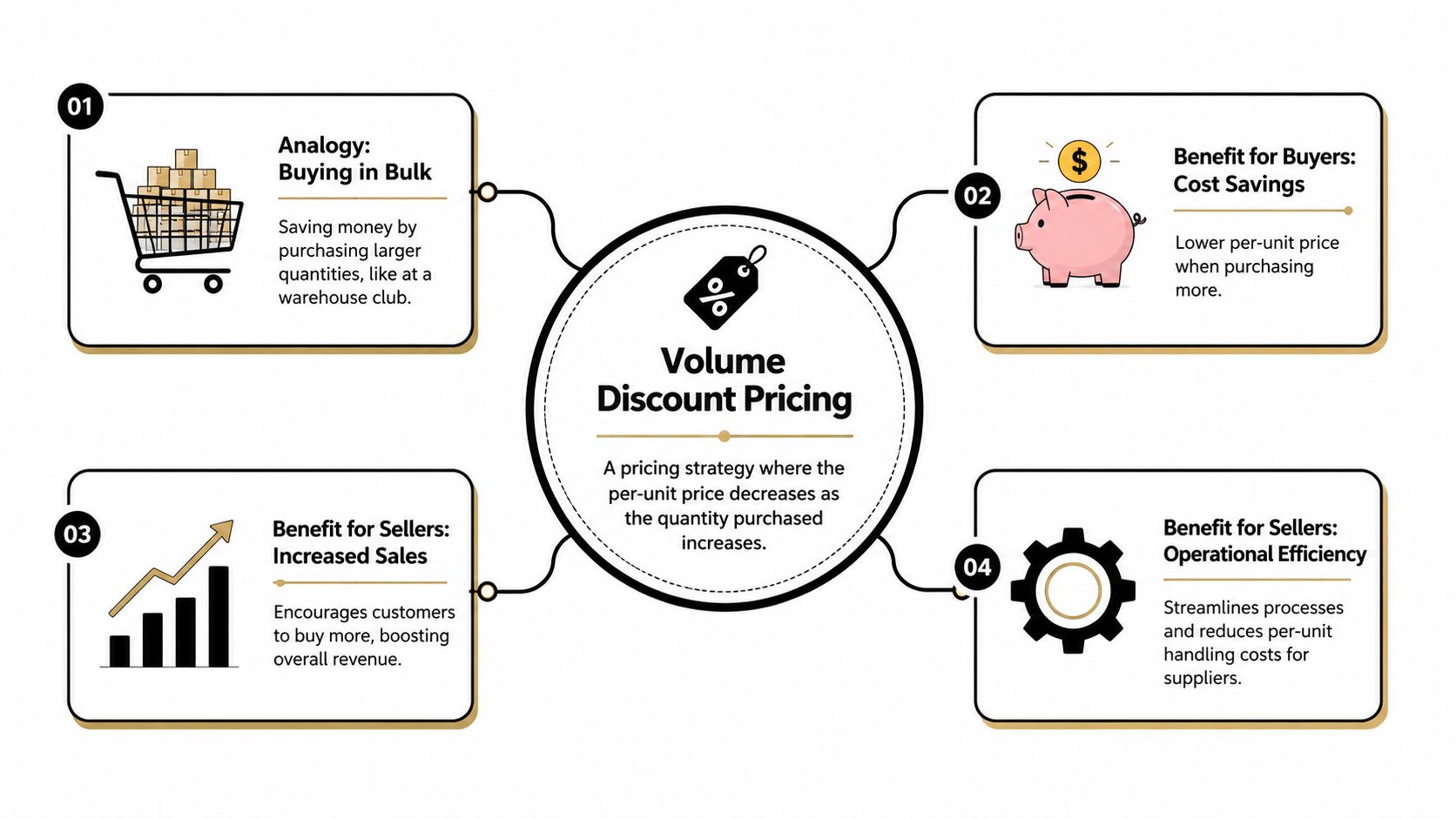
Think of volume discount pricing the same way you think about a warehouse club. Buy one case and you pay the standard rate. Buy several cases on one pallet and the seller can move more inventory with less handling per unit, so the price improves.
In B2B recycling and IT asset disposition, the principle is the same. Volume discount pricing rewards larger commitments with better economics because the work becomes more efficient to execute.
What the term actually means
Volume discount pricing means the buyer receives a lower effective rate when order size crosses a defined threshold. In retail that might be cartons. In ITAD, it might be a truckload of mixed electronics, a palletized laptop refresh, or a recurring stream of decommissioned equipment.
The model is widely used in modern B2B commerce, where suppliers define clear discount tiers, set minimum order quantities, and map pricing through structured matrices, as explained in this overview of volume-based pricing in B2B commerce. That same article also notes that small commitment jumps of 10–20% can justify 2–4% additional discount, medium jumps of 30–50% can justify 5–8%, and large jumps of 75%+ may support 10%+ additional discount when the economics are there.
Why buyers and sellers both like it
This isn't a one-sided pricing trick. Both parties can benefit when the terms match real operating conditions.
| Perspective | Practical benefit |
|---|---|
| Buyer | Lower per-unit or per-load cost, simpler project planning |
| Seller | Larger transaction size, steadier workflow |
| Operations team | Fewer handoffs, better route and labor planning |
| Sustainability lead | Easier tracking for electronics recycling and donation-based recycling efforts |
Where readers usually get mixed up
The phrase “volume pricing” sounds simple, but three questions matter:
What counts as volume?
In one contract it may mean unit count. In another it may mean total shipment weight.When does the discount trigger?
Some providers apply the better rate the moment you cross the threshold. Others only discount part of the order.Is the structure permanent or project-based?
For an office cleanout or laptop disposal event, a time-bound project rate may make more sense than a standing blanket tier.
Practical rule: If the quote doesn't state the threshold, the pricing method, and what's included in the load, it isn't detailed enough yet.
For business owners and IT managers, this matters most when a project includes several service lines at once. A single cleanout may involve computer recycling, secure data destruction, product destruction for branded materials, and laboratory equipment disposal. Clear pricing logic keeps those categories from getting blurred together.
The Strategic Value for Recycling Partners and Businesses
A good volume discount program does more than reduce a line item. It aligns the operational goals of the service provider with the internal goals of the client.
For the provider, larger consolidated loads are easier to forecast and process. For the client, one structured project is easier to approve, schedule, document, and explain to stakeholders.
What businesses gain from scale
When an organization bundles retired equipment into one coordinated event, several things improve at once. Procurement gets a cleaner scope. Facilities sees less disruption. IT can standardize chain-of-custody steps. Sustainability teams get more consistent reporting for internal reviews.
That's especially important in corporate donation programs. According to DTP Group's 2025 e-waste statistics page, volume-based donation programs can produce administrative cost savings of $0.75–$1.25 per device when donating 1,000+ laptops or desktops in a single cleanout, and this model is incentivized by e-waste policies in 37 countries.
That's a useful reminder. Donation-based recycling isn't only about goodwill. When devices are collected, sorted, documented, and directed in bulk, the administrative side can become easier too.
What recycling partners gain from the same arrangement
A recycling partner also benefits from organized volume. Intake teams can prep for the right mix of assets. Transportation can match truck capacity to the job. Reusable equipment can be separated from scrap more efficiently. Secure data destruction can be scheduled in a predictable chain instead of a stop-start pattern.
Here's where that matters most in practice:
- Office cleanout projects: mixed loads are easier to process when they arrive as one planned pickup
- Facility cleanout work: large batches reduce repeated dispatch and handling friction
- Data center decommissioning: coordinated removal helps with sequencing and documentation
- Medical equipment disposal and laboratory equipment disposal: specialized items can be isolated early instead of discovered late in the stream
The strongest pricing arrangements come from real handling efficiencies, not from arbitrary discounts.
Why sustainability teams should care about the pricing model
Sustainability programs often lose momentum when end-of-life equipment is handled piecemeal. Small, scattered pickups make it harder to track what was recycled, what was donated, what required product destruction, and what entered secure downstream processing.
A consolidated volume strategy creates a cleaner paper trail. That supports internal governance and helps leadership connect cost control with environmental responsibility. In a well-run project, electronics recycling and social impact aren't competing priorities. They reinforce each other.
Exploring Common Volume Discount Models
Most confusion around volume discount pricing comes from one issue: two quotes can look similar but calculate very differently. If you're comparing IT equipment disposal vendors, that difference can change the final project value in a meaningful way.
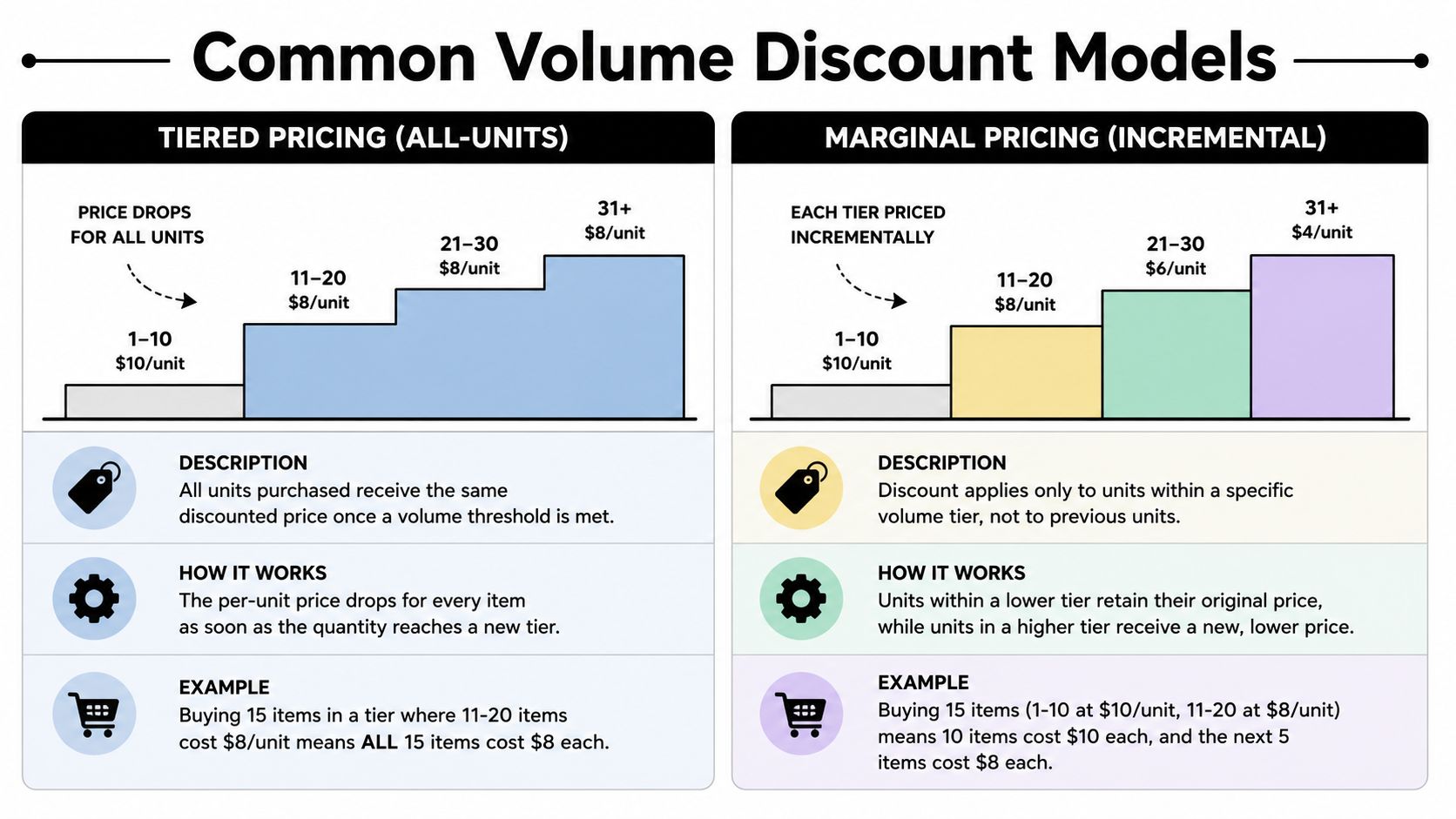
The two models procurement teams should know are all-units pricing and incremental pricing.
All-units pricing
With all-units pricing, once you cross the threshold, the discounted rate applies to every unit in the order.
That's easy to explain and easy for buyers to understand. It also gives a strong incentive to consolidate assets and hit the next bracket.
A simple way to think about it is this:
- Reach the threshold
- Qualify for the lower rate
- Apply it across the full quantity
If you're retiring a large batch of laptops after a fleet refresh, this model can feel more rewarding because one extra pallet may reduce the rate on the entire load.
Incremental pricing
With incremental pricing, each block of units is priced within its own tier. Earlier units keep their original rate. Only the units in the higher tier receive the lower rate.
That protects the seller's margin more carefully. It also makes the quote harder to read if the provider doesn't break it out clearly.
In plain language, the order is “layered”:
- First block at one rate
- Next block at another
- Final block at the deepest discount
A real math example
The difference becomes clear in a published example from IWANTEK's explanation of volume discount formulas. For 500 decommissioned laptops at a $100/unit list price, an all-units discount of 15% yields a total of $42,500, while an incremental model may yield $46,250. That is a $3,750 difference.
| Model | How the discount works | Total in the example |
|---|---|---|
| All-units | Reduced rate applies to all 500 laptops | $42,500 |
| Incremental | Different quantity blocks priced separately | $46,250 |
That single example explains why buyers shouldn't stop at “15% off at 500 units.” The same percentage can produce a very different total depending on the underlying method.
If a quote shows a threshold and a discount but not the calculation method, ask for the math in writing.
Which model fits which type of project
There isn't a universal winner. The right model depends on the job.
All-units pricing often suits:
- Big laptop disposal events
- Standardized monitor and desktop refreshes
- Projects where consolidation is the main goal
Incremental pricing often suits:
- Mixed-value IT asset disposition portfolios
- Loads with stronger margin sensitivity
- Programs where the seller needs tighter control across tiers
One more practical point matters in recycling and reverse logistics. Breakpoints often line up with real handling efficiencies, such as pallet counts, standard pack sizes, or container loads. That's why a good pricing schedule should feel operational, not arbitrary.
For procurement teams, the takeaway is simple. Don't just compare rates. Compare the structure that produces those rates.
Volume Pricing in Action for IT Asset Disposition
A regional company is clearing one office, a warehouse admin area, and a small lab space during the same quarter. IT has retired laptops and monitors. Facilities has old break-room electronics and printers. The lab manager has a few specialized devices that can't be mixed casually into the general stream.
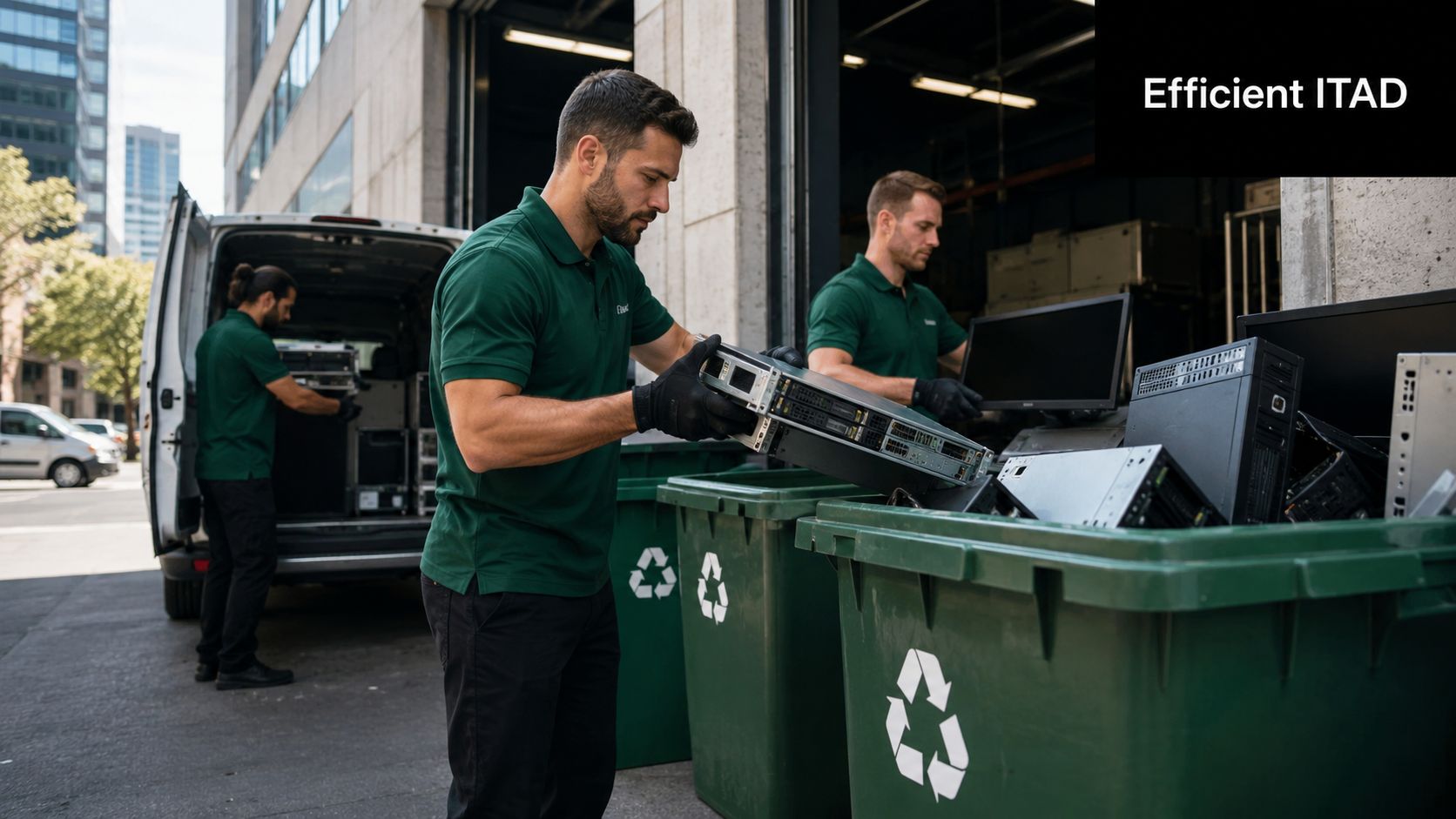
Handled separately, this becomes three projects. Handled together, it becomes one coordinated IT asset disposition event.
What a realistic cleanout looks like
The retired equipment usually falls into categories like these:
- End-user devices: laptops, desktops, tablets, docking stations
- Display equipment: monitors and conference room screens
- Peripheral gear: keyboards, cables, printers, scanners
- Special handling items: lab hardware, select medical equipment, branded items requiring product destruction
- Storage media: hard drives and backup devices that need secure data destruction
The company's first question isn't “What's the list price per item?” It's whether the total load is large enough to qualify for a stronger volume structure.
According to EMEW's e-waste industry pricing overview, volume discounts in electronics recycling often begin at 500–1,000 lbs of e-waste, with rates dropping 15–25% for bulk loads over 5,000 lbs. Medical equipment disposal can qualify for discounts over 2,000 lbs per shipment.
That gives IT and facilities managers a practical planning lens. If the project is approaching the lower threshold already, it may be worth holding a second small batch for the same pickup instead of scheduling two separate events.
Why consolidation often beats urgency
Suppose the company has a few hundred pounds of general electronics ready now, plus another set of retired devices coming out of a conference room upgrade next week. A rushed pickup solves the immediate space problem. A consolidated pickup may create better pricing and cleaner logistics.
That doesn't mean delaying every project. It means asking a more useful operational question: “Are we just removing equipment fast, or are we structuring the cleanout to capture the benefits of scale?”
Mixed loads need clear rules
ITAD projects rarely involve only laptops. Once medical equipment disposal or laboratory equipment disposal enters the picture, handling protocols become more important. The same goes for any devices carrying storage media or sensitive labels that trigger product destruction requirements.
A practical intake checklist usually includes:
- Asset grouping: keep reusable IT equipment separate from scrap-heavy electronics
- Data path: identify which items need secure data destruction before transport or at intake
- Load classification: isolate specialized equipment so the quote reflects actual handling needs
- Pickup timing: combine streams where possible without creating storage risk on-site
Large cleanouts work best when teams sort by handling need first, not by department ownership.
For sustainability leaders, there's another advantage. A coordinated load makes it easier to route reusable hardware into donation-based recycling and reserve recycling-only processing for equipment that has no second life left.
Smart Strategies for Implementation and Negotiation
The best volume pricing programs are grounded in actual efficiencies. If a higher quantity doesn't reduce handling cost, transport friction, or processing complexity, the discount may look attractive while damaging margin or service quality.
That's why the strongest agreements start with operations, not with sales targets.

Use the break-even logic before setting tiers
A useful formula for profitable tiers is published by Invoice Quickly's guide to volume discount pricing: Minimum quantity = 1 / (1 – (discount % / margin %)).
You don't need to turn that into a finance seminar. The practical meaning is straightforward. Before offering or accepting a discount tier, confirm that the larger load creates enough real efficiency to justify the lower rate.
If you're the buyer, that means asking questions such as:
What changes operationally at this threshold?
Is the provider saving time, freight cost, packaging effort, or labor?Is the threshold tied to pallets, truck space, or intake workflow?
If yes, the pricing is probably based on something real.Does the same logic hold across all categories?
Standard laptops may fit one model, while medical equipment disposal may need another.
Questions procurement teams should ask
Some negotiation wins come from precision, not pressure. Ask for specifics.
| Question | Why it matters |
|---|---|
| Is this all-units or incremental pricing? | It changes the total project cost |
| What exactly counts toward the threshold? | Prevents surprise exclusions |
| Are hard drive shredding and secure data destruction included? | Clarifies scope early |
| Is this a standing rate or a project-specific rate? | Helps compare long-term and one-time offers |
| Can timing affect pricing? | Useful for year-end office cleanout or refresh cycles |
Time-bound offers can make sense
Not every volume discount should become a permanent baseline. In sectors with uneven disposal cycles, a limited project window can protect normal pricing while still rewarding consolidation.
The broader point is simple. For a year-end ITAD push, a relocation, or a large facility cleanout, a temporary project rate may fit the work better than a static rate card. It encourages action without training everyone to expect the deepest discount at all times.
A good negotiation doesn't chase the lowest visible percentage. It matches the pricing model to the actual workload.
What to avoid
Three mistakes show up often:
- Combining unlike items without classification: standard computer recycling and specialized equipment handling shouldn't be priced as if they're identical
- Ignoring the service bundle: pickup, sorting, decommissioning, and reporting all affect value
- Negotiating on discount alone: if the chain of custody or sustainability documentation weakens, the cheap quote may not be the better one
For IT managers and facilities leaders, the strongest position is a well-prepared asset list, a realistic pickup window, and a clear understanding of which parts of the project create true scale.
Partner with Reworx for Sustainable Value
Volume discount pricing is most useful when you treat it as a planning tool, not just a bargaining chip. It helps businesses bundle office cleanouts, laptop disposal, secure data destruction, and broader IT asset disposition into a cleaner, more efficient project.
The biggest payoff comes from understanding the structure behind the quote. If you know the threshold, the discount model, and the operational reason the tier exists, you can make better decisions about timing, batching, and asset preparation. That leads to smoother pickups, clearer budgets, and stronger sustainability outcomes.
For organizations that care about both cost control and responsible end-of-life management, that balance matters. A well-run electronics recycling program doesn't just clear space. It supports data security, keeps reusable equipment in circulation where appropriate, and strengthens internal reporting around sustainable recycling and corporate donation programs.
That's where a specialized partner makes the process easier. Reworx Recycling supports businesses with donation-based recycling, IT equipment disposal, computer recycling, office cleanout support, facility cleanout coordination, secure hard drive shredding, and broader social enterprise recycling programs that connect responsible disposal with community benefit.
If your business is planning an office cleanout, laptop refresh, medical equipment disposal project, or large-scale IT asset disposition effort, Reworx Recycling can help you organize the load, schedule a pickup, and build a responsible path for recycling and donation. If you're ready to donate old equipment, arrange secure handling, or explore a long-term partnership, contact Reworx Recycling to start the conversation.